REVIEW 4 major objections 4 minor 1 cited by
Oversight Structures for Agentic AI in Public-Sector Organizations
T0 review · 4 major / 4 minor · reviewed 2026-08-07 · deepseek-v4-flash
Pith's one-line read Agentic AI forces public agencies to abandon episodic oversight
desk verdict A useful, honest qualitative study of German public-sector AI oversight, but 'strong evidence' overstates what six hypothetical interviews can support; deserves peer review with major revisions. read the letter →
The pith
A machine-rendered reading of the paper's core claim, the machinery that carries it, and where it could break.
The reading
What carries the argument
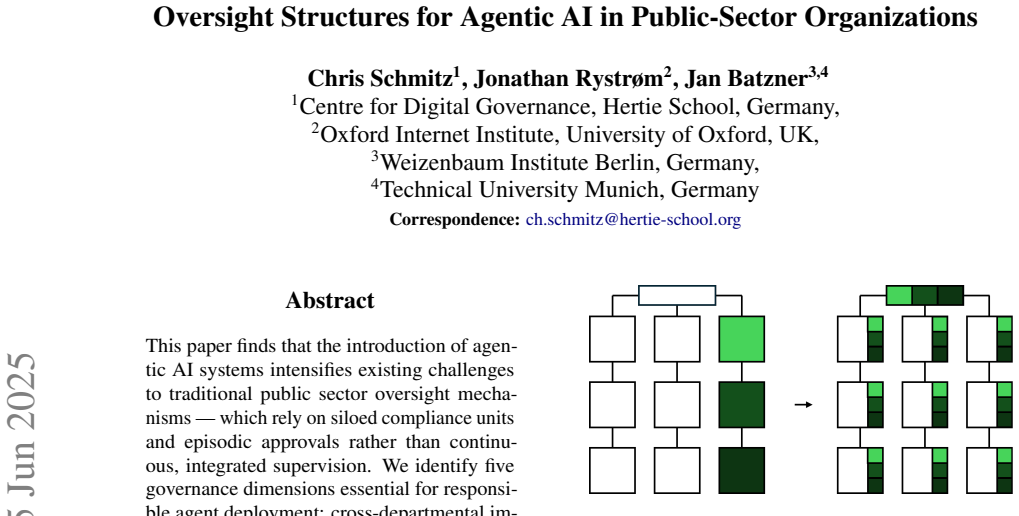
The analytical machinery is a governance-readiness framework built from five interdependent dimensions: cross-departmental implementation, comprehensive evaluation, enhanced security protocols, operational visibility, and systematic auditing. The pivotal contrast is between event-triggered, siloed compliance—where governance units are consulted at discrete approval points—and centrally coordinated, distributed governance, where oversight is diffused to operational staff while central units retain coordination. The three intensified challenges (continuous oversight, deeper integration, interdepartmental coordination) are the mechanism that drives the proposed shift, visualized as a move from standalone digital governance functions toward a matrix-like organizational form.
What would settle it
Observe an agency that deploys an LLM agent under the existing event-triggered, siloed governance model and count governance-relevant events per week as agent autonomy increases; if event frequency does not rise, or if existing approval gates catch incidents at the same rate as a comparison site using distributed oversight, the claim of intensified continuous-oversight pressure is refuted.
Extended reading notes
Core claim
The paper's central finding is that current public-sector oversight structures—characterized by dedicated compliance units, legal mandates, and event-triggered involvement—are only partially compatible with the governance requirements of LLM-based agents. It identifies five interdependent governance areas required for responsible agent deployment: cross-departmental implementation, comprehensive evaluation, enhanced security protocols, operational visibility, and systematic auditing. Through a literature review and six qualitative interviews, the paper finds strong evidence that agent oversight poses intensified versions of three existing governance challenges: continuous oversight, deeper integration of governance and operational capabilities, and interdepartmental coordination. The authors propose that successful agent governance must be centrally coordinated but diffused throughout the organization, and they recommend design principles for observability tooling, collaboration with non-technical public servants, and interoperability with legacy systems.
Load-bearing premise
The central claim rests on six interviews with German civil servants—recruited through a course run by the first author, with no hands-on agent deployment—accurately representing organizational practice and foreseeing agent-specific challenges from hypothetical scenarios.
Editorial extensions
If this is right
- Public-sector organizations that retain event-triggered, siloed governance will face prohibitive communication costs as the frequency of agent-generated events grows.
- Operational staff will need to take on dual roles as overseers, making upskilling and role-appropriate oversight interfaces a prerequisite for agent deployment.
- Agents that span departmental boundaries will require formal cross-departmental coordination mechanisms and sufficient in-department governance competency to avoid dependence on external mediation.
- Observability tooling must be designed for delegation to distinct technical and subject-matter groups, rather than assuming a combined oversight interface.
- Agent oversight systems must anticipate fragmented legacy processes and include human-in-the-loop fallbacks for scenarios where automated oversight is insufficient.
Reading between the lines
- The same intensification logic likely applies to public-sector organizations outside Germany, especially those with similar Weberian bureaucratic structures, though the paper restricts its empirical claims to the German context.
- If oversight is diffused to operational workers, new risks of automation bias and shifted discretion may emerge; the paper notes this tension but leaves the design of safeguards largely open.
- A testable extension would compare agencies with matrix or network-style governance against classic siloed structures on agent deployment outcomes such as incident rates, approval latency, and accountability clarity.
- The five governance dimensions could be developed into concrete readiness criteria for procurement and audit standards, giving agencies a measurable way to assess agent-governance preparedness.
Editorial analysis
A structured set of objections, weighed in public.
Referee Report
Summary. The manuscript examines whether existing public-sector AI governance structures are prepared for the deployment of LLM-based agents. It develops a five-dimensional governance framework from the literature, tests it against six semi-structured interviews with German civil servants, and concludes in Section 7 that agentic AI intensifies three existing challenges: continuous oversight, deeper integration of governance and operations, and interdepartmental coordination. The paper then proposes three design principles for agent-oversight tooling. The contribution is framed as an evaluation of the feasibility of agent oversight in current public-sector contexts.
Significance. If the central claim were supported, the paper would make a useful contribution to the emerging literature on AI governance in public administration, connecting technical agent-governance requirements to Weberian and neo-Weberian organizational theory. The manuscript has notable strengths: it includes a COREQ checklist, a Limitations section, a transparent interview guide, and a clear analytical framework. The proposed design principles (Section 7) are practical and grounded in the reported organizational constraints. The main weakness is that the empirical basis is too thin to support the strength of the claims made in Section 7.
major comments (4)
- [§7 and Appendix A, Q8–Q9] The opening sentence of Section 7 states that the authors find 'strong evidence' for the hypothesis that current governance structures face severe challenges in adapting to agent governance. This wording is not supported by the data: none of the six interviewees had deployed an LLM-based agent, and the agent-specific questions in Appendix A (Q8–Q9) ask participants to anticipate changes and challenges rather than report observed ones. The Limitations section acknowledges the small sample, but the main text does not carry that qualification into the strength of the conclusions. The claims about intensification should be reframed as exploratory, prospective findings or as hypotheses for further testing, and the phrase 'strong evidence' should be removed or substantially qualified.
- [§6–§7] The three intensified challenges identified in Section 7 (continuous oversight, deeper integration of governance and operations, and interdepartmental coordination) are not clearly tied to distinct interview evidence that isolates agentic properties such as autonomy, tool use, or multi-step execution as the causal drivers. Section 6 describes attributes of current governance for digital and non-agentic AI projects, but the argument that agents specifically intensify these challenges is made by inference rather than by data that compares agent and non-agent deployments. The paper should provide an explicit analytic mapping from the characteristics of LLM-based agents to the observed governance attributes, or present additional evidence that rules out the alternative explanation that any complex, interconnected digital system would produce the same intensification.
- [§3, §5, Appendix A, COREQ items 25–26] There is a risk of circularity in the study design. The literature review in Section 3 defines the five governance dimensions, and the same framework is used to construct the interview guide (Appendix A) and to code the responses (COREQ items 25–26 state that open coding is based on the literature review in Section 3). This means the interview findings are filtered through the very framework the paper is evaluating, which may inflate apparent confirmation. The authors should discuss this risk explicitly and, ideally, show that the coding also allowed for themes outside the five dimensions. At minimum, the paper should acknowledge that the study is not a neutral test of the framework.
- [§5, COREQ item 6] The sample was recruited through a certificate course coordinated by the first author, and all participants volunteered. As COREQ items 6 and 10 acknowledge, this introduces both a prior relationship and self-selection effects. Because the interviewees are likely interested and possibly invested in AI adoption, their accounts may overstate both the promise and the governance challenges of agentic AI. The paper reports this disclosure in the COREQ checklist, but the main text should address how the recruitment relationship and self-selection might have shaped the findings, and what that implies for the generalizability of the 'severe challenges' conclusion.
minor comments (4)
- [§1, §7] Typographical errors should be corrected: 'exasperate' in Section 1 should be 'exacerbate', and 'Continous' in Section 7 should be 'Continuous'.
- [References and Appendix A] There are several formatting issues: the Ilves et al. reference contains 'Tex.howpublished', the Chan et al. 2023 reference contains a spacing artifact in 'V ouderis', and Appendix A, Question 4 contains 'F achabteilungen'. These should be cleaned up.
- [COREQ item 22] The COREQ checklist states that data saturation was not discussed due to the low N and institutional diversity. This is an important caveat and should also be mentioned in the main text Limitations section, not only in the appendix.
- [§6] The finding 'Success of Breaking Hierarchy' is attributed only to 'interviewees partaking in models of collaboration' without indicating how many of the six participants that represents. Reporting the number or range of participants per finding would help readers calibrate the strength of each theme.
Circularity Check
Mild circularity: the §3 literature-derived governance framework is used to build the interview guide and coding scheme, so §7's 'intensification' findings partly restate the framework's own requirements; independent interview content remains.
-
self definitional
[Appendix A.1; Section 3; Section 7.1]
"This guide is grounded in a literature review of LLM agent governance best practices. ... Analysis will utilize coding based on our Agent governance readiness framework to identify gaps and potential. ... Such monitoring enables human-in-the-loop safeguards for continuous oversight (§3). ... Continous oversight is required to translate mechanical visibility into accountability at the operational level (§7)."
The §7 'finding' that continuous oversight is required restates the §3 framework requirement ('human-in-the-loop safeguards for continuous oversight') that was used to construct the interview guide and the coding scheme (Appendix A.1, COREQ 25–26). The interview data show that existing governance is event-triggered and siloed, but the normative requirement of continuous oversight is an input to, not an output of, those interviews. Presenting the combination as 'our interviews reveal agent governance requirements' (Section 7) thus labels a framework premise as an empirical result. The intensification claim is therefore partially built from the same literature-derived dimensions used to collect and code the data.
full rationale
The paper does not derive quantitative predictions, fit parameters, or rely on self-citations; its reference list contains no works by the authors, and there is no imported uniqueness theorem or ansatz. The descriptions of existing PSO governance as legally motivated, siloed, event-triggered, adversarial, and capacity-constrained (§6) come from six semi-structured interviews and are genuinely independent empirical content. However, one step has a mild self-definitional cast: the five governance dimensions in §3 are identified by the authors from the literature, the same framework is used to build the interview guide and the coding scheme (Appendix A.1, COREQ 25–26), and §7 then presents 'continuous oversight is required' as a finding that 'our interviews reveal.' That requirement already appears in §3 as part of the framework, so part of the intensification claim is the framework's premise re-labeled as an empirical result. The independent interview content prevents the whole derivation from collapsing into its inputs, but the 'strong evidence' phrasing (§7) overstates the support from six purposively sampled, hypothetical-scenario interviews. Overall, the circularity is partial but not forced; the central claim retains independent content.
Assumptions & free parameters
assumptions (3)
- domain assumption The studied German public sector organizations are Weberian bureaucracies with siloed, hierarchical structures.
- domain assumption The five governance dimensions (implementation, evaluation, security, visibility, auditing) are necessary and sufficient for responsible agent deployment.
- domain assumption The six interviewees' self-reports accurately reflect organizational governance practices and their anticipated agent challenges.
Cite this review
Pith. "Pith review of Oversight Structures for Agentic AI in Public-Sector Organizations." pith.science (2026). https://pith.science/paper/LZTYJDWN
@misc{pith2026250604836,
  author       = {Pith},
  title        = {Pith review of: Oversight Structures for Agentic AI in Public-Sector Organizations},
  year         = {2026},
  howpublished = {\url{https://pith.science/paper/LZTYJDWN}},
  note         = {Machine review of arXiv:2506.04836}
}
read the original abstract
This paper finds that the introduction of agentic AI systems intensifies existing challenges to traditional public sector oversight mechanisms -- which rely on siloed compliance units and episodic approvals rather than continuous, integrated supervision. We identify five governance dimensions essential for responsible agent deployment: cross-departmental implementation, comprehensive evaluation, enhanced security protocols, operational visibility, and systematic auditing. We evaluate the capacity of existing oversight structures to meet these challenges, via a mixed-methods approach consisting of a literature review and interviews with civil servants in AI-related roles. We find that agent oversight poses intensified versions of three existing governance challenges: continuous oversight, deeper integration of governance and operational capabilities, and interdepartmental coordination. We propose approaches that both adapt institutional structures and design agent oversight compatible with public sector constraints.
Figures
Forward citations
Cited by 1 Pith paper
-
AI Deployment and Cyber Governance Failures in Public-Sector Organizations: A Typological Analysis
A seven-domain typology of ten AI-driven public-sector cyber-governance failures, with a five-framework coverage matrix showing Shadow AI, speed asymmetry, and governance vacuum are not addressed at operational specificity.
Reference graph
Works this paper leans on
-
[1]
To start, we’d like to gather some basic background information about your role and experience. • What is your position/role in the organization? • Seniority level (years in current role/public sector)? • Do you have experience with digital transformation and/or AI projects in your organization? If yes, what role do you generally take in them?
-
[2]
Could you describe how NEW digital projects are currently managed in your organization? • How are decisions about implementing new digital sys- tems made? • Are there dedicated teams or individuals focused on digital project governance? • In what ways, if any, do AI-related projects differ from traditional digital projects in your organization?
-
[3]
When implementing a new digital system or tool, what approval processes or oversight mechanisms are typ- ically involved? • Where in the organization are these specialized depart- ments located, and how do they interact with other units? • What are the processes for bringing them into a digital project? • At what stage of implementation do they typically ...
-
[4]
How does coordination work across departments when implementing digital systems that affect multiple units? Consider, for example, projects involving multiple F achabteilungen, or projects implemented by internal third parties, such as centres of excellence. • What challenges have you experienced with cross- departmental digital initiatives? • How are res...
-
[5]
Exploring artificial intelligence adoption in public organizations: A comparative case study. Pub- lic Management Review, 26(1):114–141. Joshua Newman, Michael Mintrom, and Deirdre O’Neill. 2022. Digital technologies, artificial intel- ligence, and bureaucratic transformation. Futures, 136:102886. William A. Niskanen. 1971. Bureaucracy and Represen- tativ...
arXiv 2022
-
[6]
How does your organization approach ongoing moni- toring and security for AI systems after they’ve been de- ployed? • What mechanisms exist for detecting and responding to potential misuse or system failures? • How are incident response procedures structured? • How often are deployed AI systems reviewed or re- assessed?
-
[7]
What procedures exist for documenting and main- taining visibility into how AI systems function and make decisions? • How is information about AI systems communicated to relevant stakeholders? • Are there requirements for explainability or trans- parency? • How do you ensure citizens understand when they’re interacting with AI systems?
-
[8]
Breaking agents: Compromising autonomous LLM agents through malfunction amplification. Preprint, arXiv:2407.20859. Zhendong Zhao, Xiaotian Yue, Jiexin Xie, Chuanhong Fang, Zhenzhou Shao, and Shijie Guo. 2025. A dual-agent collaboration framework based on llms for nursing robots to perform bimanual coordina- tion tasks. IEEE Robotics and Automation Letters...
arXiv 2025
Show all 57 references
-
[9]
How would you assess your organization’s current ca- pacity in terms of staff expertise and resources for govern- ing more autonomous AI systems like LLM-based agents? • Can you provide examples of any existing governance structures or processes that might already be applicabl...
-
[10]
Your responses will help us better understand how public sector organizations can adapt governance structures for emerging AI agent technolo- gies
Is there anything else you’d like to share about AI governance in your organization that we haven’t covered? Thank you for your time and insights. Your responses will help us better understand how public sector organizations can adapt governance structures for emerging AI agen...
-
[11]
face-to-face, telephone, mail, email)? Answer: We invited for interviews both in a face- to-face class as well as in a follow-up email
Method of approach: How were participants approached? (e.g. face-to-face, telephone, mail, email)? Answer: We invited for interviews both in a face- to-face class as well as in a follow-up email
-
[12]
Sample size: How many participants were in the study? Answer: 6 participants
-
[13]
What capabilities does your organization have for evaluating the technical performance and safety of AI sys- tems before deployment? • Who conducts these evaluations? • What metrics or standards are typically used? • Do you have the technical expertise internally, or do you re...
-
[14]
home, clinic, workplace Answer: The data was collected in auto- transcribed online meetings
Setting of data collection: Where was the data collected? e.g. home, clinic, workplace Answer: The data was collected in auto- transcribed online meetings
-
[15]
Presence of non-participants: Was anyone else present besides the participants and researchers? Answer: No
-
[16]
Considering LLM-based agents that can perform tasks with some autonomy, what aspects of your current governance approach do you think would need to change? • What new challenges do you anticipate? • What resources or capabilities would need to be devel- oped? • How would you a...
-
[17]
We piloted the questions internally be- tween the authors
Interview guide: Were questions, prompts, guides provided by the authors? Was it pilot tested? Answer: We use the interview guide from Ap- pendix A. We piloted the questions internally be- tween the authors
-
[18]
Repeat interviews: Were repeat interviews car- ried out? If yes, how many? Answer: No
-
[19]
Transfer recording to secure University server
-
[20]
Complete interviewer reflection form
-
[21]
Initiate transcription process
-
[22]
Pseudonymize all identifying information
-
[23]
Begin preliminary coding using the governance readi- ness framework
-
[24]
Document any emerging themes or patterns to explore in subsequent interviews B COREQ checklist Domain 1: Research team and reflexivity Personal Characteristics
-
[25]
Interviewer/facilitator: Which author/s con- ducted the interview or focus group? Answer: All interviews were conducted by the first author
-
[26]
PhD, MD) Answer: MSc
Credentials: What were the researcher’s creden- tials? (e.g. PhD, MD) Answer: MSc
-
[27]
Occupation: What was their occupation at the time of the study? Answer: Doctoral Researcher / PhD Student
-
[28]
Gender: Was the researcher male or female? Answer: Male
-
[29]
Relationship with participants
Experience and training: What experience or training did the researcher have? Answer: Completed course in qualitative field- work and effective interviewing. Relationship with participants
-
[30]
Relationship established: Was a relationship es- tablished prior to study commencement? Answer: Yes, participants were recruited via a certificate program organized (but not lectured) by the first author
-
[31]
personal goals, reasons for doing the research) Answer: Outline of research area and interests
Participant knowledge of the interviewer: What did the participants know about the re- searcher? (e.g. personal goals, reasons for doing the research) Answer: Outline of research area and interests
-
[32]
Interviewer characteristics: What char- acteristics were reported about the inter- viewer/facilitator? (e.g. bias, assumptions, reasons and interests in the research topic) Answer: Assumptions, reasons, and interests were all presented in both the invitation and be- ginning of...
-
[33]
Methodological orientation and Theory: What methodological orientation was stated to under- pin the study? (e.g. grounded theory, discourse analysis, ethnography, phenomenology, content analysis) Answer: We use content analysis and open-coding grounded in theory of public mana...
-
[34]
purposive, convenience, consecutive, snowball) Answer: We use purposive sampling to select highly relevant interviewees (Palinkas et al., 2015)
Sampling: How were participants selected? (e.g. purposive, convenience, consecutive, snowball) Answer: We use purposive sampling to select highly relevant interviewees (Palinkas et al., 2015). Still, there was a degree of convenience sampling as the participants volunteered fo...
2015
-
[37]
Most participants of the certificate course did not volunteer, often due to informa- tion security and privacy reasons
Non-participation: How many people refused to participate or dropped out? Reasons? Answer: None of the volunteers dropped out of the study. Most participants of the certificate course did not volunteer, often due to informa- tion security and privacy reasons. Setting
-
[40]
demographic data, date Answer: All participants sampled worked in bu- reaucratic institutions for more than a year and were interviewed between February and March
Description of sample: What are the important characteristics of the sample? e.g. demographic data, date Answer: All participants sampled worked in bu- reaucratic institutions for more than a year and were interviewed between February and March
-
[41]
Data collection
Further characteristics listed in §5. Data collection
-
[44]
Audio/visual recording: Did the research use audio or visual recording to collect the data? Answer: We only collected automatic transcripts from the interviews
-
[45]
Field notes: Were field notes made during and/or after the interview or focus group? Answer: The interviewer wrote informal field notes during and after each interview
-
[46]
Duration: What was the duration of the inter- views or focus group? Answer: Each interview was approximately 30 minutes
-
[47]
Data saturation: Was data saturation discussed? Answer: Due to the diversity in institutions sur- veyed and low N, data saturation was not dis- cussed
-
[48]
No correction was requested
Transcripts returned: Were transcripts returned to participants for comment and/or correction? Answer: Each participant was presented with the transcript immediately after the call, and offered the opportunity to comment, redact, or correct. No correction was requested. Domain...
-
[49]
Number of data coders: How many data coders coded the data? Answer: The data were read and analyzed by all authors
-
[50]
Description of the coding tree: Did authors pro- vide a description of the coding tree? Answer: We use open coding based on the litera- ture review in §3
-
[51]
Derivation of themes: Were themes identified in advance or derived from the data? Answer: Themes were derived from the data in- formed by our literature review
-
[52]
Software: What software, if applicable, was used to manage the data? Answer: No special software on the data
-
[53]
Reporting
Participant checking: Did participants provide feedback on the findings? Answer: The findings will be shared in future seminars with the participants. Reporting
-
[54]
participant number Answer: No, we perform only aggregate analysis to maintain confidentiality
Quotations presented: Were participant quota- tions presented to illustrate the themes/findings? Was each quotation identified? e.g. participant number Answer: No, we perform only aggregate analysis to maintain confidentiality
-
[55]
Data and findings consistent: Was there con- sistency between the data presented and the find- ings? Answer: Yes, all presented findings originate from both the literature review and the interviews
-
[56]
Clarity of major themes: Were major themes clearly presented in the findings? Answer: Yes, see §6
-
[57]
Clarity of minor themes: Is there a description of diverse cases or discussion of minor themes? Answer: Yes, though elaborate discussion is con- strained by the page limit
-
[1033]
Lei Wang, Chen Ma, Xueyang Feng, Zeyu Zhang, Hao Yang, Jingsen Zhang, Zhiyuan Chen, Jiakai Tang, Xu Chen, Yankai Lin, Wayne Xin Zhao, Zhewei Wei, and Jirong Wen
Palgrave Macmillan UK, London. Lei Wang, Chen Ma, Xueyang Feng, Zeyu Zhang, Hao Yang, Jingsen Zhang, Zhiyuan Chen, Jiakai Tang, Xu Chen, Yankai Lin, Wayne Xin Zhao, Zhewei Wei, and Jirong Wen. 2024. A survey on large language model based autonomous agents. Frontiers of Com- pu...
2024
-
[2007]
International Journal for Quality in Health Care, 19(6):349–357
Consolidated criteria for reporting qualitative research (COREQ): A 32-item checklist for inter- views and focus groups. International Journal for Quality in Health Care, 19(6):349–357. Thomas A. Turk. 2018. Matrix Organization. In Mie Augier and David J. Teece, editors, The P...
2018
-
[2020]
Information Polity , 25(4):491–506
Artificial intelligence, bureaucratic form, and discretion in public service. Information Polity , 25(4):491–506. Rodrigo Cetina Presuel and Jose M. Martinez Sierra
-
[2021]
Jaccp: Journal of the Ameri- can College of Clinical Pharmacy, 4(10):1358–1367
Research and scholarly methods: Semi- structured interviews. Jaccp: Journal of the Ameri- can College of Clinical Pharmacy, 4(10):1358–1367. Mike Ananny and Kate Crawford. 2018. Seeing without knowing: Limitations of the transparency ideal and its application to algorithmic ac...
2018
-
[2024]
Digital Government: Research and Practice, 5(1):1– 20
The adoption of artificial intelligence in bu- reaucratic decision-making: A weberian perspective. Digital Government: Research and Practice, 5(1):1– 20. Alan Chan, Carson Ezell, Max Kaufmann, Kevin Wei, Lewis Hammond, Herbie Bradley, Emma Bluemke, Nitarshan Rajkumar, David Kr...
2024
-
[2025]
ACM Comput- ing Surveys, 57(7):1–36
AI agents under threat: A survey of key secu- rity challenges and future pathways. ACM Comput- ing Surveys, 57(7):1–36. Leon Derczynski, Hannah Rose Kirk, Vidhisha Bal- achandran, Sachin Kumar, Yulia Tsvetkov, M. R. Leiser, and Saif Mohammad. 2023. Assessing lan- guage model d...
2023 arXiv
Reviewed August 7, 2026 · model on record in the stance chip above.
Discussion (0). Sign in to comment.