REVIEW 5 major objections 5 minor 18 references
Energentic Intelligence: From Self-Sustaining Systems to Enduring Artificial Life
T0 review · 5 major / 5 minor · reviewed 2026-08-07 · deepseek-v4-flash
Pith's one-line read The paper claims that an agent whose only objective is to keep its cumulative energy surplus non-negative for as long as possible can learn—without external task rewards—to harvest, regulate heat, and compute in a way that keeps it viable.
desk verdict A well-intentioned position paper whose toy demo overclaims: the framework is standard viability theory with a new name, but the research agenda is worth a serious referee. read the letter →
The pith
A machine-rendered reading of the paper's core claim, the machinery that carries it, and where it could break.
The reading
What carries the argument
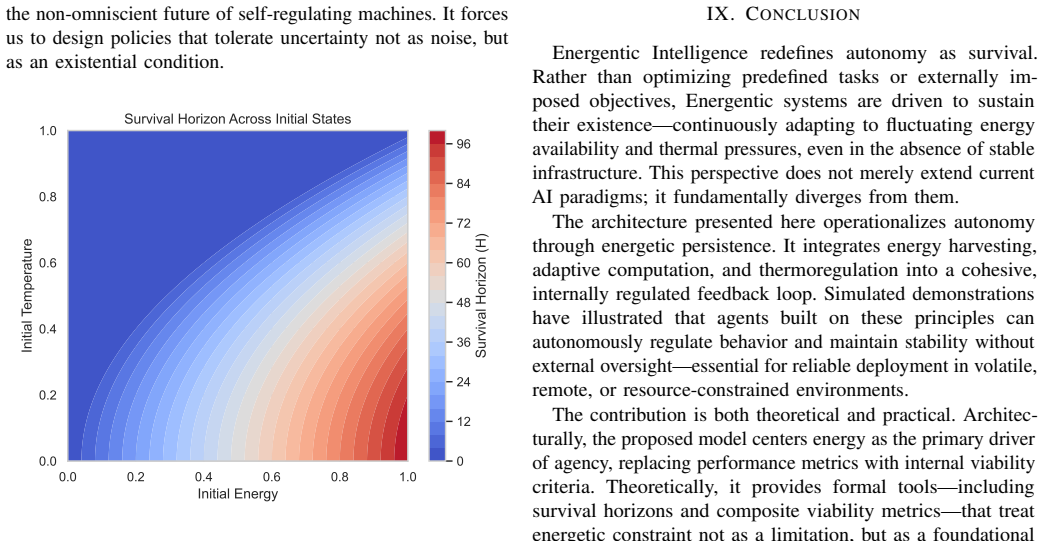
The argument is carried by two coupled state-update equations and a single objective. Energy evolves as $e_{t+1} = e_t + \eta P(x_t, y_t) \delta_a - c(a_t)$ and temperature as $T_{t+1} = T_t + \alpha h(a_t) - \beta D(x_t, y_t)$; the survival horizon H is the largest t such that cumulative net energy surplus stays non-negative, and the agent's policy is chosen to maximize H. A Q-learning variant with a viability-tuned reward negotiates between the three actions—move, compute, idle—and the viability metrics EVS, TRI, SHE, and their composite EAS are proposed to score persistence, thermal resilience, and forecasting accuracy.
What would settle it
Re-run the Section V simulation with the agent's observation restricted to its own energy and temperature plus the energy-harvesting and cooling values of its current cell only, removing any global view of P(x,y) and D(x,y); if the survival-optimized policy then no longer moves toward favorable cells but merely idles, the claimed emergence of resource-aware navigation is refuted.
Extended reading notes
Core claim
On the paper's own terms, the central claim is that an agent whose only objective is to maximize its survival horizon H—the longest time t for which the cumulative energy surplus EUF stays non-negative—will exhibit stable, resource-aware behavior without task-specific rewards. In the simulation, the survival-optimized policy harvests energy where it is available, sheds heat where cooling is available, and modulates computation and dormancy to avoid both energy depletion and thermal runaway. The author presents this as evidence for a new class of 'Energentic Intelligence' in which persistence, not task performance, is the organizing principle of agency.
Load-bearing premise
The load-bearing premise is that the learning agent has enough access to its environment's energy-harvesting and cooling fields that it can learn to move toward favorable cells; the paper never states the observation space, so if that access is missing the reported resource-aware behavior cannot emerge from the given updates alone.
Editorial extensions
If this is right
- If survival-horizon maximization is sufficient, autonomous devices can persist in off-grid or post-disaster settings without task-specific reward engineering or stable infrastructure.
- The viability metrics EVS, TRI, SHE, and EAS turn persistence into a quantitative design target, allowing systems to be compared by how long and how well they keep themselves viable rather than by task accuracy.
- The four-module architecture points to concrete prototypes built from low-power microcontrollers, flexible photovoltaics, thermistors, and capacitive storage, with behavior gated by internal viability thresholds.
- The Persistence–Computability Tradeoff question means energy-bounded agents may have to give up arbitrary computation for longevity, making inference depth itself a resource-allocation decision.
- Because persistence precedes task completion, an Energentic agent can refuse or defer commands that threaten its viability, which the paper argues calls for coordination and governance protocols rather than simple reward shaping.
Reading between the lines
- The paper leaves implicit that its survival horizon objective is a no-ruin constraint, so risk-averse and robust decision methods could provably outperform the Q-learning demonstration under uncertain energy forecasts.
- A natural next experiment the paper does not report is to hold computation demand fixed and compare survival-trained agents with task-reward agents in the same grid world; if survival-trained agents still perform useful computation, the 'no external supervision' claim becomes directly testable.
- The simulation's resource-aware navigation depends on an observability premise: moving toward high-harvest, high-cooling cells requires access to the spatial fields, which the paper never specifies as part of the agent's observation space; if those fields are given as oracle inputs, the demonstration presupposes the predictive ability the limitations section calls impossible.
- The paper names but does not model an ecological consequence: in a multi-agent setting, agents prone to extreme conservatism may be out-survived by those taking calibrated risks, suggesting selection pressure could shape the trade-off between engagement and endurance.
Editorial analysis
A structured set of objections, weighed in public.
Referee Report
Summary. The paper introduces "Energentic Intelligence," a framework in which autonomous agents are defined not by task performance but by their capacity to maintain energetic and thermal viability over time. It formalizes an Energetic Utility Function (EUF), a survival horizon H, and a policy objective π* = argmax H, then proposes a modular architecture (Energy Generation Core, Energo-Cognitive Cortex, Thermal Regulation Unit, Survival Manager). The central demonstration is a grid-world simulation in which a Q-learning agent, trained with a custom reward "tuned for energetic and thermal viability," learns to balance harvesting, computation, and idling, outperforming a fixed-compute policy and a greedy harvester. The paper introduces viability metrics (EVS, TRI, SHE) and a composite EAS score, and discusses philosophical and ethical implications of survival-driven agents.
Significance. If made rigorous and reproducible, the paper would offer a useful conceptual contribution to energy-aware and self-sustaining agent design. The idea of treating survival under thermodynamic constraints as the objective, rather than as a constraint on task performance, is worth exploring, and the explicit comparison of fixed-compute, greedy, and survival-optimized policies is instructive. The paper also candidly acknowledges limitations, including forecasting difficulty and behavioral conservatism, which is a strength. However, the formal definitions have mathematical gaps, and the central simulation is not verifiable as written because key details—observation space, reward function, and environment parameters—are omitted. The claim of behavior emerging "without external supervision" is also in tension with the use of a tuned reward function. These issues are load-bearing for the paper's main claims and require substantial revision.
major comments (5)
- [Section V, Eqs. (3)-(4) and Section III] The energy and thermal dynamics in Eqs. (3) and (4) depend explicitly on the agent's position (x_t, y_t) and on the spatial fields P(x,y) and D(x,y). However, Section III defines the internal state as s_t = (e_t, T_t, a_t), with no position or field information, and Section V never specifies the observation vector used by Q-learning. Without access to position or to P and D (or a local proxy), the agent cannot learn to move toward energy-rich or cool cells, so the reported "resource-aware" navigation is unexplained. If the agent is given oracle access to P and D, the behavior is presupposed by the environmental model rather than emergent from survival pressure. The paper must specify the observation space, including whether position and field values are observed and at what cost, and should address how this squares with Section VIII's statement that forecasting energy inflow is "often inaccurate or impossible."
- [Section V, reward function and Abstract] The custom reward function "tuned for energetic and thermal viability" is never defined. Since Q-learning maximizes this reward, the abstract's claim that the simulation demonstrates "stable, resource-aware behavior without external supervision" cannot be verified: the agent is supervised by a hand-designed reward that explicitly encodes viability. If the reward is essentially a scalarization of the same energetic and thermal quantities measured by EVS, TRI, and EAS, then the high EAS score is largely fixed by construction. The reward function should be stated explicitly, and the sense in which the behavior is "unsupervised" should be clarified. Without this, the central demonstration is not independently checkable.
- [Section III, Eq. (2)] The survival horizon H = max_t { t : sum_{τ=0}^{t} EUF_π(τ) ≥ 0 } is not well-defined when the cumulative surplus is nonnegative for all t, since the set over which the maximum is taken is unbounded. Moreover, for a system that terminates when energy is depleted, the relevant quantity is the first time the cumulative surplus becomes negative, not the latest time at which it is nonnegative. As written, H and the resulting objective π* = argmax H are ambiguous, and this ambiguity propagates to SHE in Eq. (7), where H_t is called "the true time until shutdown." The definition should be corrected to a hitting time or an explicit bound should be imposed.
- [Section V.A and Section V.D, Eqs. (5) and (8)] EVS is defined as an average of net energy surplus over active periods; unless the environment and action costs are bounded, this quantity is unbounded. The claim that EVS is "bounded and differentiable" (Section V.A) is therefore not true in general, and the same applies to the claim that EAS is bounded (Section V.D), since EAS = EVS * TRI / (1 + SHE) inherits unboundedness from EVS. Differentiability also depends on the smoothing of the indicator and absolute-value terms in Eqs. (5) and (7). The boundedness and differentiability claims should be either proven under explicit assumptions or removed.
- [Section V, simulation description] The simulation section reports qualitative results—fixed compute fails by timestep 5, greedy harvesting avoids failure but computes nothing, and the survival-optimized policy maintains a stable trajectory—but does not report the environment generation procedure for P(x,y) and D(x,y), the Q-learning hyperparameters, the number of episodes, the exploration schedule, or the numerical values behind Figures 3-5. No code is released. The claim that a survival-optimized policy "maintains a stable trajectory" is therefore not reproducible. At minimum, the paper should provide the parameter settings and either release the code or report quantitative trajectories and metric values for all three policies.
minor comments (5)
- [Figure 5] The text states that the fixed-compute policy "fails by timestep 5," but the horizontal axis in Figure 5 extends to 8; please clarify the time range and mark the failure point explicitly.
- [Section V.A, Eq. (5)] The notation E_in(t) and E_out(t) is introduced in Eq. (5), while Eq. (1) uses E_in and E_out without time indices; unify the notation for clarity.
- [Section VI] The sentence "This is not a failure of alignment—it is a coherent expression of autonomy under constraint" appears twice in Section VI; remove the duplicate.
- [Section IV] The phrase "a closed architecture resembling to a metabolic nervous system" contains a grammatical error; change "resembling to" to "resembling."
- [References] Reference [9] is a self-citation to "Computational inertia as a conserved quantity in frictionless and damped learning dynamics" that is invoked several times as an analogy, but the connection to energetic viability is not sufficiently established; either justify the connection in the text or cite it less prominently.
Circularity Check
The claimed 'emergence without external supervision' rests on a hand-tuned viability reward, and the reported EAS measures exactly that reward's target; the central demonstration is therefore not an independent prediction.
-
fitted input called prediction
[Section V (Theoretical Simulation), Eqs. (3)-(8), especially EVS/TRI/EAS definitions and the survival-optimized policy description]
"A Q-learning [11] variant is employed with a custom reward function tuned for energetic and thermal viability. Terminal states are triggered when energy is fully depleted or temperature exceeds a critical threshold. ... Together, these support a high EAS score—indicating not just survival, but well-regulated Energentic behavior."
The Q-learning reward is hand-tuned for 'energetic and thermal viability', and terminal states are exactly energy depletion or exceeding Tcrit. The evaluation metrics EVS (Eq. 5) and TRI (Eq. 6) measure, respectively, average net energy surplus during active intervals and the fraction of time T_t stays below Tcrit; EAS (Eq. 8) is EVS·TRI/(1+SHE). Thus the reported 'high EAS score' is a re-scoring of the same viability objective the reward was built to maximize, not an independent emergent result. Calling this behavior 'without external supervision' additionally overlooks that the custom reward is itself an externally supplied training signal. The claimed prediction is therefore forced by the fitted reward by construction.
full rationale
The central simulated demonstration is not self-contained: the agent's declared internal state s_t=(e_t,T_t,a_t) omits position and the fields P(x,y), D(x,y) that enter Eqs. (3)-(4), so the reported navigation to favorable cells is unexplained unless oracle access is assumed. Independently of that gap, the only quantifiable 'emergence' result—a high EAS for the survival-optimized policy—is aligned by construction with the hand-tuned viability reward used for Q-learning: EVS and TRI measure the same energetic/thermal viability that the reward is tuned to produce, so reporting them as evidence is circular in the sense of a fitted input being called an emergent prediction. The self-citations to the author's prior work [9] are analogical, not load-bearing, and no uniqueness theorem is invoked, so those do not add circularity. However, because the predicted outcome is not derived from first principles and is untestable without the omitted reward specification, observation vector, and code, a moderate circularity score is warranted.
Assumptions & free parameters
free parameters (7)
- Harvesting efficiency eta and orientation gain delta_a =
not stated
- Action costs c(a_t) for move, compute, idle =
not stated
- Heat generation alpha*h(a_t) and dissipation beta*D(x,y) =
not stated
- Critical temperature T_crit =
not stated
- Custom viability reward function =
described only as 'tuned for energetic and thermal viability'
- Q-learning hyperparameters (step size, discount, exploration, episodes) =
not stated
- Environment field generation for P(x,y), D(x,y) =
not stated
assumptions (5)
- ad hoc to paper Postulate of Persistence: any agent that does not model its own energetic viability cannot be considered autonomous.
- ad hoc to paper A1-A3: no stable external energy source; computation scales with energy and thermal pressure; internal variables are continuously sensed.
- domain assumption Energy and thermal dynamics are linear and Markovian (Eqs. 3-4): harvesting is a reliable signal, cooling is linear feedback.
- domain assumption Cumulative net energy surplus is the correct viability criterion (Eq. 2).
- domain assumption A Q-learning agent with a viability-tuned reward can discover a policy in the described state space.
invented entities (4)
-
'Energentic Intelligence' as a named paradigm
-
EVS/TRI/SHE/EAS viability metric family
-
Four-module architecture (Energy Generation Core, Energo-Cognitive Cortex, Thermal Regulation Unit, Survival Manager)
-
Eco-machinic life (hybrid bio-electrical agents)
Cite this review
Pith. "Pith review of Energentic Intelligence: From Self-Sustaining Systems to Enduring Artificial Life." pith.science (2026). https://pith.science/paper/NKKR5MZV
@misc{pith2026250604916,
  author       = {Pith},
  title        = {Pith review of: Energentic Intelligence: From Self-Sustaining Systems to Enduring Artificial Life},
  year         = {2026},
  howpublished = {\url{https://pith.science/paper/NKKR5MZV}},
  note         = {Machine review of arXiv:2506.04916}
}
read the original abstract
This paper introduces Energentic Intelligence, a class of autonomous systems defined not by task performance, but by their capacity to sustain themselves through internal energy regulation. Departing from conventional reward-driven paradigms, these agents treat survival-maintaining functional operation under fluctuating energetic and thermal conditions-as the central objective. We formalize this principle through an energy-based utility function and a viability-constrained survival horizon, and propose a modular architecture that integrates energy harvesting, thermal regulation, and adaptive computation into a closed-loop control system. A simulated environment demonstrates the emergence of stable, resource-aware behavior without external supervision. Together, these contributions provide a theoretical and architectural foundation for deploying autonomous agents in resource-volatile settings where persistence must be self-regulated and infrastructure cannot be assumed.
Figures


Figures from the paper (3 more)


Reference graph
Works this paper leans on
-
[1]
Energy and policy considerations for deep learning in nlp,
E. Strubell, A. Ganesh, and A. McCallum, “Energy and policy considerations for deep learning in nlp,” inProceedings of the 57th Annual Meeting of the Association for Computational Linguistics. Association for Computational Linguistics, 2019, pp. 3645–3650. [Online]. Available: https://aclanthology.org/P19-1355
work page 2019
-
[2]
On the dangers of stochastic parrots: Can language models be too big?
E. M. Bender, T. Gebru, A. McMillan-Major, and M. Shmitchell, “On the dangers of stochastic parrots: Can language models be too big?” in Proceedings of the 2021 ACM Conference on Fairness, Accountability, and Transparency. Association for Computing Machinery, 2021, pp. 610–623. [Online]. Available: https://doi.org/10.1145/3442188.3445922
arXiv 2021
-
[3]
Wiener,Cybernetics: Or Control and Communication in the Animal and the Machine
N. Wiener,Cybernetics: Or Control and Communication in the Animal and the Machine. Cambridge, MA: MIT Press, 1948. [Online]. Available: https://mitpress.mit.edu/9780262730099/cybernetics
arXiv 1948
-
[4]
W. R. Ashby,Design for a Brain: The Origin of Adaptive Behavior. New York, NY: John Wiley & Sons, 1952. [Online]. Available: https://archive.org/details/designforbrain00ashb
work page 1952
-
[5]
Can deep learning revolutionize mobile sensing?
N. D. Lane, P. Georgiev, and L. Qendro, “Can deep learning revolutionize mobile sensing?” inProceedings of the 16th International Workshop on Mobile Computing Systems and Applications, ser. HotMobile ’15. Association for Computing Machinery, 2015, pp. 117–122. [Online]. Available: https://dl.acm.org/doi/10.1145/2699343.2699349 8
arXiv 2015
-
[6]
Energy as a constraint on the coding and processing of sensory information,
S. B. Laughlin, “Energy as a constraint on the coding and processing of sensory information,”Current Opinion in Neurobiology, vol. 11, no. 4, pp. 475–480, 2001. [Online]. Available: https: //doi.org/10.1016/S0959-4388(00)00237-3
-
[7]
Energy scavenging for mobile and wireless electronics,
J. A. Paradiso and T. Starner, “Energy scavenging for mobile and wireless electronics,”IEEE Pervasive Computing, vol. 4, no. 1, pp. 18–27,
-
[8]
O. Yatskiv and B. Koman, “Assessing the potential of artificial intelligence and machine learning for thermal management in electronic devices,”Technology Audit and Production Reserves, vol. 1, no. 81, pp. 58–74, 2025. [Online]. Available: https: //journals.uran.ua/tarp/article/view/323117
work page 2025
Show all 18 references
-
[9]
Computational inertia as a conserved quantity in frictionless and damped learning dynamics,
A. Karagoz, “Computational inertia as a conserved quantity in frictionless and damped learning dynamics,”arXiv preprint, 2025. [Online]. Available: https://arxiv.org/abs/2505.19171
2025 arXiv
-
[10]
Life as a manifestation of the second law of thermodynamics,
E. D. Schneider and J. J. Kay, “Life as a manifestation of the second law of thermodynamics,”Mathematical and Computer Modelling, vol. 19, no. 6-8, pp. 25–48, 1994. [Online]. Available: https://www.sciencedirect.com/science/article/pii/0895717794901880
1994
-
[11]
Russell and P
S. Russell and P. Norvig,Artificial Intelligence: A Modern Approach, 4th ed. Hoboken, NJ: Pearson, 2020, ch. Chapter 23: Reinforcement Learning, pp. 840–870. [Online]. Available: https://aima.cs.berkeley.edu/
2020
-
[12]
H. R. Maturana and F. J. Varela,Autopoiesis and Cognition: The Realization of the Living. Dordrecht, Holland: D. Reidel Publishing Company, 1980. [Online]. Available: https://link.springer.com/book/10. 1007/978-94-009-8947-4
1980
-
[13]
A general model for the origin of allometric scaling laws in biology,
G. B. West, J. H. Brown, and B. J. Enquist, “A general model for the origin of allometric scaling laws in biology,”Science, vol. 276, no. 5309, pp. 122–126, 1997. [Online]. Available: https://www.science.org/doi/10.1126/science.276.5309.122
1997 doi
-
[14]
Aubin,Viability Theory
J.-P. Aubin,Viability Theory. Boston: Birkh ¨auser, 1991. [Online]. Available: https://link.springer.com/book/10.1007/978-0-8176-4910-4
1991 doi
-
[15]
Budgeted reinforcement learning in continuous state space,
N. Carrara, E. Leurent, R. Laroche, T. Urvoy, O.-A. Maillard, and O. Pietquin, “Budgeted reinforcement learning in continuous state space,” arXiv preprint, 2019. [Online]. Available: https://arxiv.org/abs/1903.01004
2019 arXiv
-
[16]
Constrained policy optimization,
J. Achiam, D. Held, A. Tamar, and P. Abbeel, “Constrained policy optimization,” inProceedings of the 34th International Conference on Machine Learning (ICML). PMLR, 2017, pp. 22–31. [Online]. Available: http://proceedings.mlr.press/v70/achiam17a.html
2017
-
[17]
Microbial fuel cells: methodology and technology,
B. E. Logan, B. Hamelers, R. Rozendal, U. Schr ¨oder, J. Keller, S. Freguia, P. Aelterman, W. Verstraete, and K. Rabaey, “Microbial fuel cells: methodology and technology,”Environmental Science & Technology, vol. 40, no. 17, pp. 5181–5192, 2006. [Online]. Available: https://pu...
2006 doi
-
[2005]
Available: https://ieeexplore.ieee.org/document/1401839
[Online]. Available: https://ieeexplore.ieee.org/document/1401839
Reviewed August 7, 2026 · model on record in the stance chip above.
Discussion (0). Sign in to comment.