REVIEW 3 major objections 3 minor 38 references
Simulating LLM-to-LLM Tutoring for Multilingual Math Feedback
T0 review · 3 major / 3 minor · reviewed 2026-08-07 · deepseek-v4-flash
Pith's one-line read This paper claims that LLM-generated hints in a student's native language significantly improve simulated math performance, particularly in low-resource languages, and that the effect depends jointly on teacher size, prompting strategy…
desk verdict First broad multilingual LLM-tutoring simulation, but the headline native-language claim is contradicted by the paper's own averages and rests on one-to-two-correct-answer cells. read the letter →
The pith
A machine-rendered reading of the paper's core claim, the machinery that carries it, and where it could break.
The reading
What carries the argument
The central object is the student–teacher interaction loop over the MGSM benchmark: a student model first solves a multilingual math word problem; if wrong, a teacher model generates a hint under one of four controlled strategies—English prompt with English hint (EN→EN), English hint machine-translated into the native language (EN→EN→L), native prompt with native hint (L→L), or English prompt with native hint (EN→L)—and the student attempts a revised solution. The outcome metric is Student Gain, the relative improvement in accuracy from before to after the hint, averaged over high-resource and low-resource language groups. This design isolates the effect of hint language and instruction language while controlling for model size and student model type.
What would settle it
A controlled study with human learners in a low-resource language such as Swahili or Telugu, comparing learning gains from native-language hints versus English hints on the same math problems, would directly test whether the simulation's finding that native-language feedback improves low-resource performance holds for actual students.
Extended reading notes
Core claim
The paper's central claim is that multilingual hints from LLM tutors lead to measurable learning gains in student models, with the largest relative improvements occurring in low-resource languages when the hint is delivered in the student's native language. This claim is supported by a 352-setting grid of experiments in which the teacher model's size, the hint-generation prompt strategy, the student model's language profile, and whether the student prompt is in English or the native language jointly determine the gain. In the best low-resource configurations, median student gains reach 31–38%, while high-resource languages show more modest but consistent improvements. The paper also finds that English-only prompts often outperform multilingual prompts, and that English hints are generally effective, suggesting the relationship between language alignment and learning is conditional rather than absolute.
Load-bearing premise
The study assumes that a student LLM's accuracy improvement after receiving a hint is a meaningful proxy for real human learning.
Editorial extensions
If this is right
- LLM-based tutors for low-resource languages should generate hints in the student's native language rather than defaulting to English.
- Larger teacher models should be preferred for multilingual hint generation because they produce more consistent gains, especially in low-resource languages.
- Student model choice matters: multilingual models such as Aya-8B are more effective for low-resource languages, while monolingual models like Mistral-7B do better on high-resource ones.
- The simulation grid can be reused to pre-test feedback strategies across languages cheaply before human deployment.
Reading between the lines
- The finding that English hints often match or beat native hints may reflect LLMs' English-centric reasoning; real students, who do not share that training bias, might show a stronger native-language advantage than the simulation suggests.
- The large gains in low-resource languages may be partly a ceiling effect, since student models start with much lower accuracy there; the same relative gain would be harder to achieve in high-resource languages.
- Extending the grid to other tasks, such as algebra or geometry with cultural contexts, would test whether the language-alignment effect generalizes beyond MGSM-style arithmetic word problems.
Editorial analysis
A structured set of objections, weighed in public.
Referee Report
Summary. The manuscript reports a large-scale LLM-to-LLM tutoring simulation in which a teacher model (LLaMA-3.3-70B or LLaMA-3.1-8B) generates hints for a student model (Mistral-7B or Aya-8B) solving MGSM math problems in 11 languages. It evaluates four hint-generation strategies (EN→EN, EN→EN→L, L→L, EN→L) under two student prompting setups (English-only and multilingual) and reports 'student gain' as relative accuracy improvement after one hint. The central claim is that multilingual hints can significantly improve learning outcomes, particularly in low-resource languages when feedback is aligned with the student's native language.
Significance. If supported, this would be a valuable contribution: it is the first multilingual hint-generation simulation at this scale (352 configurations), it includes sanity checks for gold-answer leakage and language consistency, and it makes the experimental grid explicit. The leakage and language-identification analyses are useful controls, and the limitations section is candid about the proxy nature of LLM students. However, the central quantitative claim is not currently supported by the reported statistics, and the abstract's native-language claim is in tension with the paper's own aggregated tables.
major comments (3)
- [Section 5, Table 10 and Table 7] The low-resource gains are computed from extremely small denominators. In Table 7, Mistral-7B solves Telugu on 1 of 250 problems (0.4%) in both prompting setups; in Table 10 (English-only), the EN→EN and EN→L Telugu cells report G=100%, which corresponds to the student fixing exactly one additional problem (1/250 to 2/250), while EN→EN→L and L→L report 0%. A single model output can therefore shift the reported gain by 100 percentage points. No confidence intervals, bootstrap estimates, or significance tests are reported for any gain in Section 5, so the abstract's 'significantly improve' is not supported by the evidence as presented.
- [Abstract and Table 2] The abstract's claim that gains are strongest 'when feedback is aligned with the student's native language' is contradicted by Table 2. For LLaMA-3.3-70B, the averaged low-resource-language gains are highest under EN→EN in both setups: 19.85 versus 17.70 for L→L in the multilingual setup, and 40.50 versus 12.25 in the English-only setup. The native-alignment advantage appears only in selected per-language cells (for example, Aya-8B Telugu in the multilingual setup). The headline claim needs to be re-derived from the appropriate aggregation or substantially qualified.
- [Section 5, 'Does the language of the hint...' and Final Takeaways] The body text itself concludes that 'English-language hints tend to be more effective when generated by larger teacher models' and the Final Takeaways state that 'English hints are generally preferred,' which directly conflicts with the abstract's native-language framing. This internal inconsistency indicates that the native-language result is not robust and should be presented as a conditional, cell-level observation rather than a headline finding.
minor comments (3)
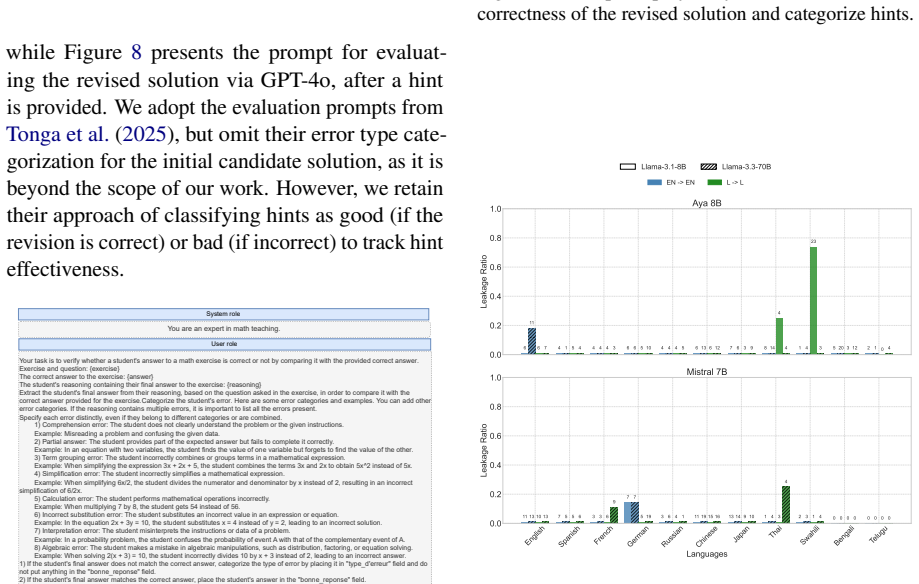
- [Section 6, Gold Answer Leakage] The text says 'The highest observed answer leakage was approximately 8% for LLaMA-3.3-8B,' but Table 3 identifies the model with roughly 8% leakage as LLaMA-3.1-8B; this appears to be a typo and should be corrected.
- [Throughout] Model names are typeset inconsistently (LlaMA, LLaMA, Llama); please standardize to a single form, preferably as used in the original model cards.
- [Section 3, Prompting] The text refers to 'the base prompts (provided in Appendix 4 and Appendix 5),' but the prompts actually appear in Appendix D.1 as Figures 4 and 5; the cross-reference should be fixed.
Circularity Check
No circularity: student-gain comparisons are measured outputs, not fitted inputs or self-citation-derived conclusions.
full rationale
This paper reports an empirical measurement study, not a derivation, so the circularity burden is low. The central quantity G=(A_after-A_before)/A_before is computed from observed pass/fail counts on MGSM before and after hint injection; it is not a fitted parameter, and no conclusion is obtained by substituting the hypothesis into the metric. The hint-generation prompt does include the gold answer, but the paper explicitly tests for verbatim answer leakage (Section 6, Table 3) and reports near-zero leakage among helpful hints; even if this check is imperfect, it addresses a confound rather than making the result true by construction. The conclusion that native-language feedback improves 'learning' is an inferential step from an LLM proxy; the Limitations section acknowledges this ('it cannot capture the full diversity of real learners' misconceptions'), which is a validity limitation, not circularity. Self-citations (Tonga et al. 2025 for evaluation prompts, Srivatsa and Kochmar 2024 for dataset-feature analysis) are methodological and do not carry the multilingual-gain claim. Concerns about near-zero baselines and lack of significance tests are quantitative robustness issues, outside the circularity definition.
Assumptions & free parameters
assumptions (3)
- domain assumption LLM-to-LLM simulation is a valid proxy for real-world educational tutoring scenarios.
- domain assumption GPT-4o correctly judges whether a student model's solution is correct when compared to the gold answer.
- domain assumption The 250-problem MGSM subset is representative of the full GSM8K dataset.
Cite this review
Pith. "Pith review of Simulating LLM-to-LLM Tutoring for Multilingual Math Feedback." pith.science (2026). https://pith.science/paper/M3UIKG5M
@misc{pith2026250604920,
  author       = {Pith},
  title        = {Pith review of: Simulating LLM-to-LLM Tutoring for Multilingual Math Feedback},
  year         = {2026},
  howpublished = {\url{https://pith.science/paper/M3UIKG5M}},
  note         = {Machine review of arXiv:2506.04920}
}
read the original abstract
Large language models (LLMs) have demonstrated the ability to generate formative feedback and instructional hints in English, making them increasingly relevant for AI-assisted education. However, their ability to provide effective instructional support across different languages, especially for mathematically grounded reasoning tasks, remains largely unexamined. In this work, we present the first large-scale simulation of multilingual tutor-student interactions using LLMs. A stronger model plays the role of the tutor, generating feedback in the form of hints, while a weaker model simulates the student. We explore 352 experimental settings across 11 typologically diverse languages, four state-of-the-art LLMs, and multiple prompting strategies to assess whether language-specific feedback leads to measurable learning gains. Our study examines how student input language, teacher feedback language, model choice, and language resource level jointly influence performance. Results show that multilingual hints can significantly improve learning outcomes, particularly in low-resource languages when feedback is aligned with the student's native language. These findings offer practical insights for developing multilingual, LLM-based educational tools that are both effective and inclusive.
Figures


Figures from the paper (4 more)


Reference graph
Works this paper leans on
-
[1]
Fatai Oyekola Al m , Adedeji Tella, Gabriel Olufemi Adeyemo, and Musibau Oyewale Oyeweso. 2020. Impact of mother tongue on primary pupils’literacy and numeracy skills in osun state. International Online Journal of Primary Education, 9(2):144--155
work page 2020
-
[2]
Dibyanayan Bandyopadhyay, Soham Bhattacharjee, and Asif Ekbal. 2025. Thinking machines: A survey of llm based reasoning strategies. arXiv preprint arXiv:2503.10814
arXiv 2025
-
[3]
Piotr Bojanowski, Edouard Grave, Armand Joulin, and Tomas Mikolov. 2017. https://doi.org/10.1162/tacl_a_00051 Enriching word vectors with subword information . Transactions of the Association for Computational Linguistics, 5:135--146
-
[4]
Nuo Chen, Zinan Zheng, Ning Wu, Ming Gong, Dongmei Zhang, and Jia Li. 2024. https://doi.org/10.18653/v1/2024.findings-emnlp.411 Breaking language barriers in multilingual mathematical reasoning: Insights and observations . In Findings of the Association for Computational Linguistics: EMNLP 2024, pages 7001--7016, Miami, Florida, USA. Association for Compu...
-
[5]
Karl Cobbe, Vineet Kosaraju, Mo Bavarian, Mark Chen, Heewoo Jun, Lukasz Kaiser, Matthias Plappert, Jerry Tworek, Jacob Hilton, Reiichiro Nakano, Christopher Hesse, and John Schulman. 2021. https://api.semanticscholar.org/CorpusID:239998651 Training verifiers to solve math word problems . ArXiv, abs/2110.14168
arXiv 2021
-
[6]
Nico Daheim, Jakub Macina, Manu Kapur, Iryna Gurevych, and Mrinmaya Sachan. 2024. https://arxiv.org/abs/2407.09136 Stepwise verification and remediation of student reasoning errors with large language model tutors . Preprint, arXiv:2407.09136
arXiv 2024
-
[7]
John Dang, Shivalika Singh, Daniel D'souza, Arash Ahmadian, Alejandro Salamanca, Madeline Smith, Aidan Peppin, Sungjin Hong, Manoj Govindassamy, Terrence Zhao, Sandra Kublik, Meor Amer, Viraat Aryabumi, Jon Ander Campos, Yi-Chern Tan, Tom Kocmi, Florian Strub, Nathan Grinsztajn, Yannis Flet-Berliac, Acyr F. Locatelli, Hangyu Lin, Dwarak Talupuru, Bharat V...
arXiv 2024
-
[8]
Abhimanyu Dubey, Abhinav Jauhri, Abhinav Pandey, Abhishek Kadian, Ahmad Al-Dahle, Aiesha Letman, Akhil Mathur, Alan Schelten, Amy Yang, Angela Fan, Anirudh Goyal, Anthony S. Hartshorn, Aobo Yang, Archi Mitra, Archie Sravankumar, Artem Korenev, Arthur Hinsvark, Arun Rao, Aston Zhang, Aur'elien Rodriguez, Austen Gregerson, Ava Spataru, Bap tiste Rozi \`e re...
arXiv 2024
Show all 38 references
-
[9]
Luyu Gao, Aman Madaan, Shuyan Zhou, Uri Alon, Pengfei Liu, Yiming Yang, Jamie Callan, and Graham Neubig. 2023. Pal: Program-aided language models. In International Conference on Machine Learning, pages 10764--10799. PMLR
2023
-
[10]
Daya Guo, Dejian Yang, Haowei Zhang, Junxiao Song, Ruoyu Zhang, Runxin Xu, Qihao Zhu, Shirong Ma, Peiyi Wang, Xiao Bi, et al. 2025. Deepseek-r1: Incentivizing reasoning capability in llms via reinforcement learning. arXiv preprint arXiv:2501.12948
2025 arXiv
-
[11]
OpenAI Aaron Hurst, Adam Lerer, Adam P. Goucher, Adam Perelman, Aditya Ramesh, Aidan Clark, AJ Ostrow, Akila Welihinda, Alan Hayes, Alec Radford, Aleksander Mkadry, Alex Baker-Whitcomb, Alex Beutel, Alex Borzunov, Alex Carney, Alex Chow, Alexander Kirillov, Alex Nichol, Alex P...
2024 arXiv
-
[12]
Albert Qiaochu Jiang, Alexandre Sablayrolles, Arthur Mensch, Chris Bamford, Devendra Singh Chaplot, Diego de Las Casas, Florian Bressand, Gianna Lengyel, Guillaume Lample, Lucile Saulnier, L'elio Renard Lavaud, Marie-Anne Lachaux, Pierre Stock, Teven Le Scao, Thibaut Lavril, T...
2023 arXiv
-
[13]
Feihu Jin, Yifan Liu, and Ying Tan. 2024. https://api.semanticscholar.org/CorpusID:267547394 Zero-shot chain-of-thought reasoning guided by evolutionary algorithms in large language models . ArXiv, abs/2402.05376
2024 arXiv
-
[14]
Hyunwoo Ko, Guijin Son, and Dasol Choi. 2025. Understand, solve and translate: Bridging the multilingual mathematical reasoning gap. arXiv preprint arXiv:2501.02448
2025 arXiv
-
[15]
Ekaterina Kochmar, Dung Do Vu, Robert Belfer, Varun Gupta, Iulian Vlad Serban, and Joelle Pineau. 2022. Automated data-driven generation of personalized pedagogical interventions in intelligent tutoring systems. International Journal of Artificial Intelligence in Education, 32...
2022
-
[16]
Takeshi Kojima, Shixiang Shane Gu, Machel Reid, Yutaka Matsuo, and Yusuke Iwasawa. 2022. Large language models are zero-shot reasoners. Advances in neural information processing systems, 35:22199--22213
2022
-
[17]
Aitor Lewkowycz, Anders Andreassen, David Dohan, Ethan Dyer, Henryk Michalewski, Vinay Ramasesh, Ambrose Slone, Cem Anil, Imanol Schlag, Theo Gutman-Solo, et al. 2022. Solving quantitative reasoning problems with language models. Advances in Neural Information Processing Syste...
2022
-
[18]
Jakub Macina, Nico Daheim, Sankalan Pal Chowdhury, Tanmay Sinha, Manu Kapur, Iryna Gurevych, and Mrinmaya Sachan. 2023. Mathdial: A dialogue tutoring dataset with rich pedagogical properties grounded in math reasoning problems. arXiv preprint arXiv:2305.14536
2023 arXiv
-
[19]
Hunter McNichols, Jaewook Lee, Stephen Fancsali, Steve Ritter, and Andrew Lan. 2024. Can large language models replicate its feedback on open-ended math questions? arXiv preprint arXiv:2405.06414
2024 arXiv
-
[20]
Jennifer Meyer, Thorben Jansen, Ronja Schiller, Lucas W Liebenow, Marlene Steinbach, Andrea Horbach, and Johanna Fleckenstein. 2024. Using llms to bring evidence-based feedback into the classroom: Ai-generated feedback increases secondary students’ text revision, motivation, a...
2024
-
[21]
Price, Tiffany Barnes, Sebastian Gross, and Niels Pinkwart
Benjamin Paa en, Barbara Hammer, Thomas W. Price, Tiffany Barnes, Sebastian Gross, and Niels Pinkwart. 2017. The continuous hint factory: Providing hints in vast and sparsely populated edit‐distance spaces. Journal of Educational Data Mining, 9(1):1--35
2017
-
[22]
Kishore Papineni, Salim Roukos, Todd Ward, and Wei-Jing Zhu. 2002. https://doi.org/10.3115/1073083.1073135 B leu: a method for automatic evaluation of machine translation . In Proceedings of the 40th Annual Meeting of the Association for Computational Linguistics, pages 311--3...
2002
-
[23]
Zachary A Pardos and Shreya Bhandari. 2024. Chatgpt-generated help produces learning gains equivalent to human tutor-authored help on mathematics skills. Plos one, 19(5):e0304013
2024
-
[24]
Huy Phung, Michael Khosravani, Tuan Nguyen, Zameer Ul Hassan, and Zhihao Wu. 2024. Leveraging gpt‐4 tutor model for hint generation and gpt-3.5 student model for hint validation. In Proceedings of the 2024 Learning Analytics & Knowledge Conference, Kyoto, Japan
2024
-
[25]
Freda Shi, Mirac Suzgun, Markus Freitag, Xuezhi Wang, Suraj Srivats, Soroush Vosoughi, Hyung Won Chung, Yi Tay, Sebastian Ruder, Denny Zhou, Dipanjan Das, and Jason Wei. 2022. Language models are multilingual chain-of-thought reasoners. In Findings of the Association for Compu...
2022
-
[26]
Kv Aditya Srivatsa and Ekaterina Kochmar. 2024. https://doi.org/10.18653/v1/2024.findings-naacl.72 What makes math word problems challenging for LLM s? In Findings of the Association for Computational Linguistics: NAACL 2024, pages 1138--1148, Mexico City, Mexico. Association ...
2024 doi
-
[27]
John Stamper, Tiffany Barnes, Marvin Croy, and Lisa F. Lehman. 2008. The hint factory: Automatic generation of contextualized help for existing computer‐aided instruction. In Proceedings of the 9th International Conference on Intelligent Tutoring Systems, pages 373--382
2008
-
[28]
Junior Cedric Tonga, Benjamin Clement, and Pierre-Yves Oudeyer. 2025. https://proceedings.mlr.press/v264/tonga25a.html Automatic generation of question hints for mathematics problems using large language models in educational technology . In Proceedings of Large Foundation Mod...
2025
-
[29]
o rnqvist, Pentti Vartia, and Yrj \
Leo T \"o rnqvist, Pentti Vartia, and Yrj \"o O Vartia. 1985. How should relative changes be measured? The American Statistician, 39(1):43--46
1985
-
[30]
Hugo Touvron, Thibaut Lavril, Gautier Izacard, Xavier Martinet, Marie-Anne Lachaux, Timothée Lacroix, Baptiste Rozière, Naman Goyal, Eric Hambro, Faisal Azhar, Aurelien Rodriguez, Armand Joulin, Edouard Grave, and Guillaume Lample. 2023. https://arxiv.org/abs/2302.13971 Llama:...
2023 arXiv
-
[31]
Khanh-Tung Tran, Dung Dao, Minh-Duong Nguyen, Quoc-Viet Pham, Barry O'Sullivan, and Hoang D Nguyen. 2025. Multi-agent collaboration mechanisms: A survey of llms. arXiv preprint arXiv:2501.06322
2025 arXiv
-
[32]
UNESCO Global Education Monitoring Report . 2025. Languages matter: Global guidance on multilingual education. https://www.unesco.org/en/articles/new-unesco-report-calls-multilingual-education-unlock-learning-and-inclusion
2025
-
[33]
Rose Wang, Qingyang Zhang, Carly Robinson, Susanna Loeb, and Dorottya Demszky. 2024 a . https://doi.org/10.18653/v1/2024.naacl-long.120 Bridging the novice-expert gap via models of decision-making: A case study on remediating math mistakes . In Proceedings of the 2024 Conferen...
2024 doi
-
[34]
Rose E Wang, Ana T Ribeiro, Carly D Robinson, Susanna Loeb, and Dora Demszky. 2024 b . Tutor copilot: A human-ai approach for scaling real-time expertise. arXiv preprint arXiv:2410.03017
2024 arXiv
-
[35]
Xuezhi Wang, Jason Wei, Dale Schuurmans, Quoc Le, Ed Chi, Sharan Narang, Aakanksha Chowdhery, and Denny Zhou. 2022. Self-consistency improves chain of thought reasoning in language models. arXiv preprint arXiv:2203.11171
2022 arXiv
-
[36]
Chi, Quoc V
Jason Wei, Xuezhi Wang, Dale Schuurmans, Maarten Bosma, Brian Ichter, Fei Xia, Ed H. Chi, Quoc V. Le, and Denny Zhou. 2022. Chain-of-thought prompting elicits reasoning in large language models. In Advances in Neural Information Processing Systems 35
2022
-
[37]
online" 'onlinestring :=
ENTRY address archivePrefix author booktitle chapter edition editor eid eprint eprinttype howpublished institution journal key month note number organization pages publisher school series title type volume year doi pubmed url lastchecked label extra.label sort.label short.list...
-
[38]
write newline
" write newline "" before.all 'output.state := FUNCTION n.dashify 't := "" t empty not t #1 #1 substring "-" = t #1 #2 substring "--" = not "--" * t #2 global.max substring 't := t #1 #1 substring "-" = "-" * t #2 global.max substring 't := while if t #1 #1 substring * t #2 gl...
Reviewed August 7, 2026 · model on record in the stance chip above.
Discussion (0). Sign in to comment.