REVIEW 4 major objections 6 minor 2 cited by
ComfyUI-Copilot: An Intelligent Assistant for Automated Workflow Development
T0 review · 4 major / 6 minor · reviewed 2026-08-07 · deepseek-v4-flash
Pith's one-line read ComfyUI-Copilot, an LLM-powered multi-agent plugin, claims to automate ComfyUI workflow construction, achieving over 88.5% recall for node and workflow recommendations and online acceptance rates of 65.4% for nodes and 85.9% for workflows.
desk verdict A useful open-source ComfyUI assistant with a plausible architecture and real deployment, but the headline recall numbers come from a test set built from the system's own knowledge base. read the letter →
The pith
A machine-rendered reading of the paper's core claim, the machinery that carries it, and where it could break.
The reading
What carries the argument
The load-bearing mechanism is the hierarchical multi-agent framework: an LLM-based assistant agent that either answers directly or delegates to worker agents, supported by three knowledge bases covering nodes, models, and workflows. All recommendations pass through a three-stage coarse-to-fine pipeline: intent expansion by an LLM or large multimodal model, hybrid scoring that combines a semantic embedding score (weight 0.7) with a lexical overlap score (weight 0.3) to shortlist 30 candidates, and a reranker plus popularity weighting to select the top 3. For workflow generation, ComfyUI graphs are converted between JSON and Python-like code, so the LLM can write a workflow as code with retrieved exemplars. The knowledge bases are themselves produced by an automated pipeline that runs node repositories in a sandbox, extracts metadata, embeds code with BGE-M3, and generates documentation with an LLM.
What would settle it
Run the plugin on a set of user requests collected from ComfyUI community forums and GitHub issues that were written before the system existed, where the correct workflow is not in the system's knowledge base, and check whether node and workflow acceptance remains near the reported 65.4% and 85.9%.
Extended reading notes
Core claim
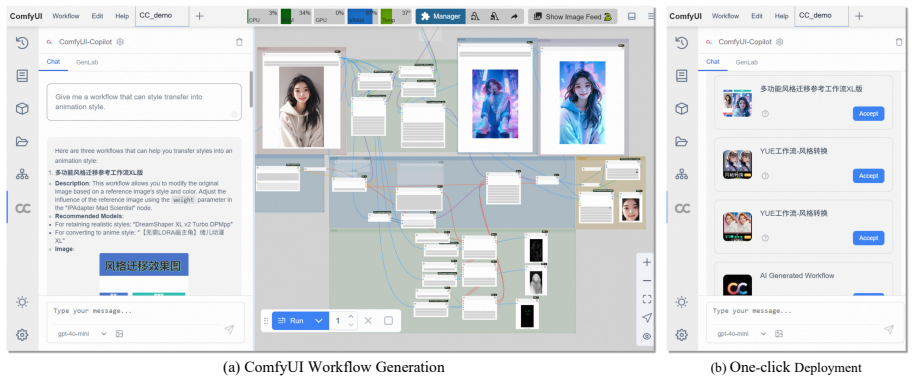
The discovery is a system design: a central assistant agent that plans and delegates, three specialized worker agents (workflow generation, node recommendation, model recommendation), and knowledge bases refreshed from community sources. When a user gives an instruction, the system expands the intent with an LLM, scores candidates by a weighted hybrid of semantic and lexical similarity, reranks the top candidates, and presents the top three workflows or nodes for one-click acceptance. In offline tests on instructions rewritten from the system's own knowledge-base usage descriptions, recall of the top three exceeds 88.5% for both workflows and nodes with GPT-4o and DeepSeek-V3. Online, users accepted 85.9% of proposed workflows and 65.4% of recommended nodes. The paper also reports that a fine-tuned 7B open-source code model reaches a 0.95 node-selection F1, comparable to Claude-3.7-Sonnet, although generated workflow pass rates remain improvable.
Load-bearing premise
The offline evaluation assumes that instructions formed by rewriting usage descriptions from the system's own knowledge base, with the original workflow as the ground truth, are representative of real user requests, so the 88.5% recall may not hold for unseen or ambiguously phrased prompts.
Editorial extensions
If this is right
- A user could state an image or video task in natural language and load a working workflow onto the canvas in one click, without manually wiring nodes or installing dependencies.
- The system's coverage of conditional image and video generation tasks means automated workflow construction extends beyond the text-to-image setting of prior work.
- Because a fine-tuned 7B open-source model matches a much larger closed-source model on node-selection F1, the workflow-generation backend could be run locally or at lower cost.
- The 85.9% online acceptance of proposed workflows suggests that retrieval from a large curated knowledge base is a reliable default, with generative construction as a supplement.
Reading between the lines
- Editorially, an ablation that removes the reranker stage would isolate how much of the reported 88.5% recall comes from the hybrid scoring alone, a comparison the paper does not report.
- The dependency-aware recommendation logic, such as pairing LoRA models with compatible diffusion checkpoints, suggests a general principle for node-based toolkits: recommending compatible subgraphs may matter more than recommending individual components, a pattern other modular creative tools could adopt.
- If given access to the system telemetry, one could test whether the 65.4% node acceptance rate is driven mainly by unfamiliar users accepting default suggestions; sorting acceptances by user experience level would show whether the assistant helps novices more than experts.
Editorial analysis
A structured set of objections, weighed in public.
Referee Report
Summary. The paper introduces ComfyUI-Copilot, an LLM-powered plugin for ComfyUI that provides automated workflow construction, node and model recommendation, and ComfyUI-related question answering. The system uses a hierarchical multi-agent framework with a central assistant agent and specialized worker agents, backed by curated knowledge bases of 7K nodes, 62K models, and 9K workflows. The authors report offline top-3 recall rates above 88.5% for nodes and workflows, online user acceptance rates of 65.4% for recommended nodes and 85.9% for proposed workflows, and a fine-tuned Qwen2.5-Coder-7B that achieves node-selection F1 of 0.95. The paper claims this is the first open-source ComfyUI assistant plugin and that it lowers entry barriers for beginners while enhancing efficiency for experienced users.
Significance. If the reported results hold, ComfyUI-Copilot is a practically valuable open-source tool: it addresses a real user pain point, ships with a large and continuously updated knowledge base, and demonstrates a workable multi-agent retrieval and generation pipeline. The paper's strengths include the detailed system description, the automatic documentation generation pipeline, the release of code and a demo, and the deployment evidence of 85K queries from 19K users across 22 countries. However, the central quantitative claims rest on a self-constructed offline test set whose instructions are rewritten from the system's own KB descriptions, and on online acceptance numbers without stated methodology. For a system paper, this is a meaningful gap but one that can be addressed with additional evaluation, so the contribution is potentially acceptable after substantial revision.
major comments (4)
- [Sec. 4, Table 1] The offline test set is built from 130 workflow and 104 node instructions created by rewriting the usage descriptions of the system's own KB entries. Because the retrieval pipeline searches exactly those KB descriptions, the reported recall rates (88.5-90.0%) largely measure the system's ability to match a paraphrase of its own data. This does not establish the claimed 'accurate recommendation' for out-of-distribution or ambiguous real-world prompts, so the central conclusion is only weakly supported.
- [Sec. 4, online user feedback] The manuscript reports acceptance rates of 65.4% for recommended nodes and 85.9% for workflows, but it does not define the acceptance event (e.g., clicking 'Accept' vs. manually using the suggestion), the denominator, the collection period, the treatment of queries for which no recommendation was made, or the effect of user self-selection. Without this methodology, these numbers cannot be interpreted or reproduced, and they should not be presented as independent validation.
- [Sec. 3.2, Eq. (1); Sec. 4] The retrieval pipeline has several free parameters—the 0.7/0.3 fusion weights, the top-30 candidate pool, the top-3 re-ranking, and the popularity factors—but no sensitivity analysis is provided. The reported recall rates have no confidence intervals or variance across the test instructions. The paper should report error bars and vary these parameters to show the result is not brittle.
- [Appendix B, Table 2] The node-selection F1 metric is computed against a single golden workflow, yet many valid workflows can satisfy the same user instruction. This conflates semantic equivalence with exact node overlap, and the F1=0.95 for the fine-tuned model is reported on only 100 examples without confidence intervals. The authors should either use multiple references, provide human equivalence judgments, or explicitly acknowledge the limitation and show that the metric is stable.
minor comments (6)
- [Sec. 1 vs. Sec. 3.1] The introduction states that the knowledge bases are 'continuously expanded and updated daily,' while Section 3.1 says they are 'continuously expanded weekly.' These timelines should be reconciled.
- [Sec. 3.2, footnote 1] The URL for the GTE-Rerank model appears broken or malformed in the manuscript ('https://huggingface.co/Alibaba-NLP/ gte-multilingual-reranker-base'); it should be a single, clickable link.
- [Sec. 2 and Sec. 4] ComfyBench (Xue et al., 2024) is cited in the related work but is not used for comparison. Given that it is a public benchmark for LLM-based ComfyUI agents, the authors should at least explain why it is not applicable to their evaluation.
- [Sec. 4] The error analysis of unsuccessful workflow cases is described as showing that suggested workflows 'often still fulfill the user's intended functions,' but no numbers are given; quantifying this would strengthen the qualitative claim.
- [Sec. 1 and Sec. 5] The phrase 'the first open-source project for a ComfyUI assistant plugin' is a strong novelty claim; it would be safer to state the novelty relative to the specific capabilities or to cite a more systematic survey of existing plugins.
- [Sec. 3.3 and Figure 1] The caption of Figure 1 describes 'one-click deployment,' but the mechanism by which a suggested workflow is loaded and any missing nodes installed should be stated more precisely in the text to avoid ambiguity about user effort.
Circularity Check
Offline recall is measured on instructions rewritten from the system's own knowledge base, so the 88.5% headline is partly self-referential; online acceptance and use cases provide partial independent support.
-
other
[Section 4 (Usage and Evaluation), in conjunction with Section 3.2 (retrieval pipeline, Eq. 1) and Table 1]
"To evaluate the performance of ComfyUI-Copilot, we designed 130 user instructions for workflow recall based on our workflow KB. These instructions are created by rewriting the usage descriptions of specific workflows, using the target workflow as the correct answer... Similarly, We create 104 node recommendation instructions based on our node KB... In the second stage, we represent the user intent as an embedding and calculate its cosine distance with modules in the KB, obtaining a semantic score simS... The overall retrieval score simO is calculated as: simO = 0.7×simS + 0.3×simL"
The KB is simultaneously the retrieval corpus and the source of the test instructions. Each test query is a paraphrase of one KB usage description, and the labelled correct answer is that same KB entry. The scorer in Eq. (1) computes semantic and lexical similarity between the query and those KB descriptions, so the offline recall measures how well the system maps a paraphrase back to its source description. It does not measure functional recommendation against novel, out-of-distribution, or ambiguous user requests. The 88.5% recall is therefore partly a consistency check on the system's own data rather than an independent validation. This is a self-referential evaluation design, not fitted-equation circularity; the online acceptance rates provide independent but under-specified evidence.
full rationale
Table 1's recall rates are the paper's central quantitative claim, but Section 4 shows the 130 workflow and 104 node test instructions were created by rewriting usage descriptions from the system's own KB, with the original KB entry as the correct answer. Section 3.2's retrieval pipeline scores queries against exactly those KB descriptions. Hence the offline metric is largely an in-distribution paraphrase-retrieval test, not an external benchmark of node/workflow recommendation on realistic user requests. The claimed numbers therefore do not by themselves establish out-of-distribution accuracy. The online acceptance rates (65.4% nodes, 85.9% workflows) are an independent signal, although their collection methodology and denominator are unspecified. Because the central claim still has some external grounding but the headline offline evidence is partly circular, a score of 4 is appropriate. No load-bearing self-citation, no uniqueness theorem imported from the authors, and no fitted-equation circularity were found.
Assumptions & free parameters
free parameters (4)
- Retrieval fusion weight for semantic score =
0.7
- Retrieval fusion weight for lexical score =
0.3
- Candidate pool size and final top-k =
30 candidates, top 3 after reranking
- Popularity ranking factors =
unspecified weights over upvotes, downloads, stars
assumptions (4)
- domain assumption Test instructions generated by rewriting KB usage descriptions are representative of real user requests.
- domain assumption Retrieval performance on the self-constructed test set transfers to in-the-wild usage.
- domain assumption Recalled workflows are executable and useful once loaded.
- domain assumption LLM expansion of user intent improves retrieval over direct query matching.
Cite this review
Pith. "Pith review of ComfyUI-Copilot: An Intelligent Assistant for Automated Workflow Development." pith.science (2026). https://pith.science/paper/OJ5OFP3F
@misc{pith2026250605010,
  author       = {Pith},
  title        = {Pith review of: ComfyUI-Copilot: An Intelligent Assistant for Automated Workflow Development},
  year         = {2026},
  howpublished = {\url{https://pith.science/paper/OJ5OFP3F}},
  note         = {Machine review of arXiv:2506.05010}
}
read the original abstract
We introduce ComfyUI-Copilot, a large language model-powered plugin designed to enhance the usability and efficiency of ComfyUI, an open-source platform for AI-driven art creation. Despite its flexibility and user-friendly interface, ComfyUI can present challenges to newcomers, including limited documentation, model misconfigurations, and the complexity of workflow design. ComfyUI-Copilot addresses these challenges by offering intelligent node and model recommendations, along with automated one-click workflow construction. At its core, the system employs a hierarchical multi-agent framework comprising a central assistant agent for task delegation and specialized worker agents for different usages, supported by our curated ComfyUI knowledge bases to streamline debugging and deployment. We validate the effectiveness of ComfyUI-Copilot through both offline quantitative evaluations and online user feedback, showing that it accurately recommends nodes and accelerates workflow development. Additionally, use cases illustrate that ComfyUI-Copilot lowers entry barriers for beginners and enhances workflow efficiency for experienced users. The ComfyUI-Copilot installation package and a demo video are available at https://github.com/AIDC-AI/ComfyUI-Copilot.
Figures


Figures from the paper (5 more)


Forward citations
Cited by 2 Pith papers
-
Knowledge-Centric Agents for Workflow Generation in ComfyUI
A knowledge-centric pipeline distills strategies and pseudo-codes from real workflows, fine-tunes a language model on those levels, and reconstructs executable ComfyUI graphs from task descriptions.
-
Magentic-UI: Towards Human-in-the-loop Agentic Systems
Magentic-UI, an open-source human-in-the-loop agent interface, reports that lightweight simulated-user input raises GAIA task completion from 30.3% to 51.9%.
Reference graph
Works this paper leans on
-
[1]
Saaket Agashe, Jiuzhou Han, Shuyu Gan, Jiachen Yang, Ang Li, and Xin Eric Wang. 2025. https://openreview.net/forum?id=lIVRgt4nLv Agent s: An open agentic framework that uses computers like a human . In The Thirteenth International Conference on Learning Representations
work page 2025
-
[2]
Akari Asai, Zeqiu Wu, Yizhong Wang, Avirup Sil, and Hannaneh Hajishirzi. 2024. https://openreview.net/forum?id=hSyW5go0v8 Self- RAG : Learning to retrieve, generate, and critique through self-reflection . In The Twelfth International Conference on Learning Representations
2024
-
[3]
Tariq Berrada, Pietro Astolfi, Melissa Hall, Marton Havasi, Yohann Benchetrit, Adriana Romero-Soriano, Karteek Alahari, Michal Drozdzal, and Jakob Verbeek. 2025. https://openreview.net/forum?id=y4DtzADzd1 Boosting latent diffusion with perceptual objectives . In The Thirteenth International Conference on Learning Representations
work page 2025
-
[4]
Jianlv Chen, Shitao Xiao, Peitian Zhang, Kun Luo, Defu Lian, and Zheng Liu. 2024 a . https://arxiv.org/abs/2402.03216 Bge m3-embedding: Multi-lingual, multi-functionality, multi-granularity text embeddings through self-knowledge distillation . Preprint, arXiv:2402.03216
arXiv 2024
-
[5]
Zehui Chen, Kuikun Liu, Qiuchen Wang, Wenwei Zhang, Jiangning Liu, Dahua Lin, Kai Chen, and Feng Zhao. 2024 b . https://doi.org/10.18653/v1/2024.findings-acl.557 Agent- FLAN : Designing data and methods of effective agent tuning for large language models . In Findings of the Association for Computational Linguistics: ACL 2024, pages 9354--9366, Bangkok, T...
-
[6]
Chuanqi Cheng, Jian Guan, Wei Wu, and Rui Yan. 2024 a . https://doi.org/10.18653/v1/2024.emnlp-main.284 From the least to the most: Building a plug-and-play visual reasoner via data synthesis . In Proceedings of the 2024 Conference on Empirical Methods in Natural Language Processing, pages 4941--4957, Miami, Florida, USA. Association for Computational Linguistics
-
[7]
Xiaoxue Cheng, Junyi Li, Xin Zhao, Hongzhi Zhang, Fuzheng Zhang, Di Zhang, Kun Gai, and Ji-Rong Wen. 2024 b . https://doi.org/10.18653/v1/2024.emnlp-main.809 Small agent can also rock! empowering small language models as hallucination detector . In Proceedings of the 2024 Conference on Empirical Methods in Natural Language Processing, pages 14600--14615, ...
-
[8]
comfyanonymous. 2023. Comfyui. https://github.com/comfyanonymous/ComfyUI
work page 2023
Show all 39 references
-
[9]
Prafulla Dhariwal and Alexander Nichol. 2021. https://proceedings.neurips.cc/paper_files/paper/2021/file/49ad23d1ec9fa4bd8d77d02681df5cfa-Paper.pdf Diffusion models beat gans on image synthesis . In Advances in Neural Information Processing Systems, volume 34, pages 8780--8794...
2021
-
[10]
Bermano, Daniel Cohen-Or, and Gal Chechik
Rinon Gal, Adi Haviv, Yuval Alaluf, Amit H. Bermano, Daniel Cohen-Or, and Gal Chechik. 2024. https://arxiv.org/abs/2410.01731 Comfygen: Prompt-adaptive workflows for text-to-image generation . Preprint, arXiv:2410.01731
2024 arXiv
-
[11]
Zinan Guo, Yanze Wu, Zhuowei Chen, Lang chen, Peng Zhang, and Qian HE. 2024. https://openreview.net/forum?id=E6ZodZu0HQ Pu LID : Pure and lightning ID customization via contrastive alignment . In The Thirty-eighth Annual Conference on Neural Information Processing Systems
2024
-
[12]
Jonathan Ho, Ajay Jain, and Pieter Abbeel. 2020. https://proceedings.neurips.cc/paper_files/paper/2020/file/4c5bcfec8584af0d967f1ab10179ca4b-Paper.pdf Denoising diffusion probabilistic models . In Advances in Neural Information Processing Systems, volume 33, pages 6840--6851. ...
2020
-
[13]
Edward J Hu, Phillip Wallis, Zeyuan Allen-Zhu, Yuanzhi Li, Shean Wang, Lu Wang, Weizhu Chen, et al. 2021. Lora: Low-rank adaptation of large language models. In International Conference on Learning Representations
2021
-
[14]
Binyuan Hui, Jian Yang, Zeyu Cui, Jiaxi Yang, Dayiheng Liu, Lei Zhang, Tianyu Liu, Jiajun Zhang, Bowen Yu, Keming Lu, Kai Dang, Yang Fan, Yichang Zhang, An Yang, Rui Men, Fei Huang, Bo Zheng, Yibo Miao, Shanghaoran Quan, Yunlong Feng, Xingzhang Ren, Xuancheng Ren, Jingren Zhou...
2024 arXiv
-
[15]
Minsoo Kim, Victor Bursztyn, Eunyee Koh, Shunan Guo, and Seung-won Hwang. 2024. https://doi.org/10.18653/v1/2024.findings-acl.802 R a DA : Retrieval-augmented web agent planning with LLM s . In Findings of the Association for Computational Linguistics: ACL 2024, pages 13511--1...
2024 doi
-
[16]
Nupur Kumari, Bingliang Zhang, Richard Zhang, Eli Shechtman, and Jun-Yan Zhu. 2023. Multi-concept customization of text-to-image diffusion. In Proceedings of the IEEE/CVF Conference on Computer Vision and Pattern Recognition, pages 1931--1941
2023
-
[17]
Tianle Li, Max Ku, Cong Wei, and Wenhu Chen. 2023. Dreamedit: Subject-driven image editing. arXiv preprint arXiv:2306.12624
2023 arXiv
-
[18]
Yunxin Li, Zhenyu Liu, Zitao Li, Xuanyu Zhang, Zhenran Xu, Xinyu Chen, Haoyuan Shi, Shenyuan Jiang, Xintong Wang, Jifang Wang, Shouzheng Huang, Xinping Zhao, Borui Jiang, Lanqing Hong, Longyue Wang, Zhuotao Tian, Baoxing Huai, Wenhan Luo, Weihua Luo, Zheng Zhang, Baotian Hu, a...
2025 arXiv
-
[19]
Oscar Mañas, Pietro Astolfi, Melissa Hall, Candace Ross, Jack Urbanek, Adina Williams, Aishwarya Agrawal, Adriana Romero-Soriano, and Michal Drozdzal. 2024. https://arxiv.org/abs/2403.17804 Improving text-to-image consistency via automatic prompt optimization . Preprint, arXiv...
2024 arXiv
-
[20]
Qian Ning, Weisheng Dong, Guangming Shi, Leida Li, and Xin Li. 2021. https://doi.org/10.1109/JSTSP.2020.3037516 Accurate and lightweight image super-resolution with model-guided deep unfolding network . IEEE Journal of Selected Topics in Signal Processing, 15(2):240--252
2021
-
[21]
Dustin Podell, Zion English, Kyle Lacey, Andreas Blattmann, Tim Dockhorn, Jonas Müller, Joe Penna, and Robin Rombach. 2023. https://arxiv.org/abs/2307.01952 Sdxl: Improving latent diffusion models for high-resolution image synthesis . Preprint, arXiv:2307.01952
2023 arXiv
-
[22]
Nataniel Ruiz, Yuanzhen Li, Varun Jampani, Yael Pritch, Michael Rubinstein, and Kfir Aberman. 2023. Dreambooth: Fine tuning text-to-image diffusion models for subject-driven generation. In Proceedings of the IEEE/CVF Conference on Computer Vision and Pattern Recognition, pages...
2023
-
[23]
Noah Shinn, Federico Cassano, Ashwin Gopinath, Karthik R Narasimhan, and Shunyu Yao. 2023. https://openreview.net/forum?id=vAElhFcKW6 Reflexion: language agents with verbal reinforcement learning . In Thirty-seventh Conference on Neural Information Processing Systems
2023
-
[24]
Dominik Sobania, Martin Briesch, and Franz Rothlauf. 2024. https://arxiv.org/abs/2411.14193 Comfygi: Automatic improvement of image generation workflows . Preprint, arXiv:2411.14193
2024 arXiv
-
[25]
Jifang Wang, Xue Yang, Longyue Wang, Zhenran Xu, Yiyu Wang, Yaowei Wang, Weihua Luo, Kaifu Zhang, Baotian Hu, and Min Zhang. 2025. https://arxiv.org/abs/2504.07046 A unified agentic framework for evaluating conditional image generation . Preprint, arXiv:2504.07046
2025 arXiv
-
[26]
Zora Zhiruo Wang, Jiayuan Mao, Daniel Fried, and Graham Neubig. 2024. https://arxiv.org/abs/2409.07429 Agent workflow memory . Preprint, arXiv:2409.07429
2024 arXiv
-
[27]
Chi, Tatsunori Hashimoto, Oriol Vinyals, Percy Liang, Jeff Dean, and William Fedus
Jason Wei, Yi Tay, Rishi Bommasani, Colin Raffel, Barret Zoph, Sebastian Borgeaud, Dani Yogatama, Maarten Bosma, Denny Zhou, Donald Metzler, Ed H. Chi, Tatsunori Hashimoto, Oriol Vinyals, Percy Liang, Jeff Dean, and William Fedus. 2022. https://openreview.net/forum?id=yzkSU5zd...
2022
-
[28]
Zhenran Xu, Senbao Shi, Baotian Hu, Jindi Yu, Dongfang Li, Min Zhang, and Yuxiang Wu. 2023. https://arxiv.org/abs/2311.08152 Towards reasoning in large language models via multi-agent peer review collaboration . Preprint, arXiv:2311.08152
2023 arXiv
-
[29]
Zhenran Xu, Jifang Wang, Baotian Hu, Longyue Wang, and Min Zhang. 2025. https://aclanthology.org/2025.naacl-demo.33/ M e KB -sim: Personal knowledge base-powered multi-agent simulation . In Proceedings of the 2025 Conference of the Nations of the Americas Chapter of the Associ...
2025
-
[30]
Xiangyuan Xue, Zeyu Lu, Di Huang, Zidong Wang, Wanli Ouyang, and Lei Bai. 2024. https://arxiv.org/abs/2409.01392 Comfybench: Benchmarking llm-based agents in comfyui for autonomously designing collaborative ai systems . Preprint, arXiv:2409.01392
2024
-
[31]
Ke Yang, Yao Liu, Sapana Chaudhary, Rasool Fakoor, Pratik Chaudhari, George Karypis, and Huzefa Rangwala. 2025. https://openreview.net/forum?id=oWdzUpOlkX Agentoccam: A simple yet strong baseline for LLM -based web agents . In The Thirteenth International Conference on Learnin...
2025
-
[32]
Hu Ye, Jun Zhang, Sibo Liu, Xiao Han, and Wei Yang. 2023. Ip-adapter: Text compatible image prompt adapter for text-to-image diffusion models. arXiv preprint arXiv:2308.06721
2023 arXiv
-
[33]
Da Yin, Faeze Brahman, Abhilasha Ravichander, Khyathi Chandu, Kai-Wei Chang, Yejin Choi, and Bill Yuchen Lin. 2024. https://doi.org/10.18653/v1/2024.acl-long.670 Agent lumos: Unified and modular training for open-source language agents . In Proceedings of the 62nd Annual Meeti...
2024 doi
-
[34]
Fanghua Yu, Jinjin Gu, Zheyuan Li, Jinfan Hu, Xiangtao Kong, Xintao Wang, Jingwen He, Yu Qiao, and Chao Dong. 2024. https://arxiv.org/abs/2401.13627 Scaling up to excellence: Practicing model scaling for photo-realistic image restoration in the wild . Preprint, arXiv:2401.13627
2024 arXiv
-
[35]
Aohan Zeng, Mingdao Liu, Rui Lu, Bowen Wang, Xiao Liu, Yuxiao Dong, and Jie Tang. 2024. https://doi.org/10.18653/v1/2024.findings-acl.181 A gent T uning: Enabling generalized agent abilities for LLM s . In Findings of the Association for Computational Linguistics: ACL 2024, pa...
2024 doi
-
[36]
Lvmin Zhang, Anyi Rao, and Maneesh Agrawala. 2023. Adding conditional control to text-to-image diffusion models. In CVPR
2023
-
[37]
Yaowei Zheng, Richong Zhang, Junhao Zhang, Yanhan Ye, and Zheyan Luo. 2024. https://doi.org/10.18653/v1/2024.acl-demos.38 L lama F actory: Unified efficient fine-tuning of 100+ language models . In Proceedings of the 62nd Annual Meeting of the Association for Computational Lin...
2024 doi
-
[38]
online" 'onlinestring :=
ENTRY address archivePrefix author booktitle chapter edition editor eid eprint eprinttype howpublished institution journal key month note number organization pages publisher school series title type volume year doi pubmed url lastchecked label extra.label sort.label short.list...
-
[39]
write newline
" write newline "" before.all 'output.state := FUNCTION n.dashify 't := "" t empty not t #1 #1 substring "-" = t #1 #2 substring "--" = not "--" * t #2 global.max substring 't := t #1 #1 substring "-" = "-" * t #2 global.max substring 't := while if t #1 #1 substring * t #2 gl...
Reviewed August 7, 2026 · model on record in the stance chip above.
Discussion (0). Sign in to comment.