REVIEW 4 major objections 6 minor 2 cited by
TIMING: Temporality-Aware Integrated Gradients for Time Series Explanation
T0 review · 4 major / 6 minor · reviewed 2026-08-07 · deepseek-v4-flash
Pith's one-line read The paper claims that time-series explanations should carry a sign for each point, that standard evaluation metrics hide the value of signed attributions by removing points simultaneously and letting positive and negative contributions…
desk verdict A real problem with a plausible fix, but the empirical claim stands on an unvalidated metric and a statistically marginal gain over IG. read the letter →
The pith
A machine-rendered reading of the paper's core claim, the machinery that carries it, and where it could break.
The reading
What carries the argument
The load-bearing object is the masked integrated-gradients path. For a binary mask $M\in\{0,1\}^{T\times D}$, TIMING's building block is $\mathrm{MaskingIG}_{t,d}(x,M)=x_{t,d}M_{t,d}\int_0^1 \partial F_{\hat y}(\alpha(M\odot x)+(1-M)\odot x)/\partial x_{t,d}\,d\alpha$, where $F_{\hat y}$ is the predicted-class probability. The intermediate point $\alpha(M\odot x)+(1-M)\odot x$ keeps some original values (where $M_{t,d}=0$) and scales others toward zero, so temporal relations can break while the input stays closer to the data distribution. The mask generator $G(n,s_{\min},s_{\max})$ samples $n$ contiguous segments of length between $s_{\min}$ and $s_{\max}$; the final attribution is the expectation over masks conditional on each point being scaled, i.e. masked. Proposition 4.1 lets this expectation be evaluated as a single path with one random mask per $\alpha$ step, which is what makes TIMING cost about the same as IG.
What would settle it
Take TIMING's MIMIC-III attributions, keep all magnitudes, shuffle or flip the signs, and recompute CPD at K=50; if the perturbed version scores close to 0.366, the metric rewards sign alternation rather than point localization, and the paper's central comparison collapses.
Extended reading notes
Core claim
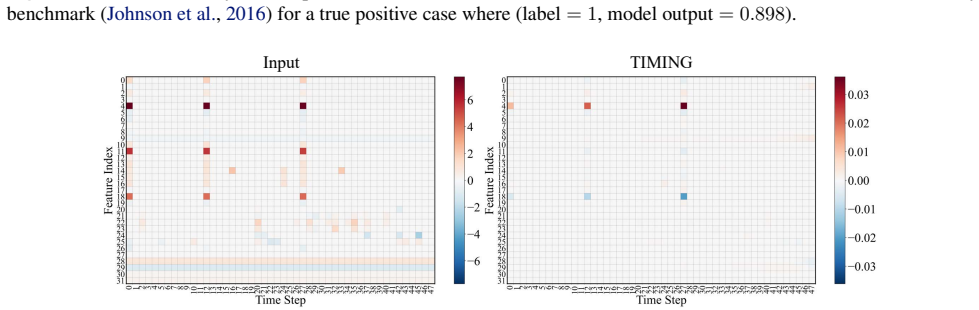
The central claim is that signed, cumulative evaluation changes the ranking of time-series explainers: when you remove the highest-attribution points one at a time and sum the changes to the full predicted-class distribution (CPD), and likewise remove the lowest-attribution points (CPP), Integrated Gradients outperforms recent masking-based methods such as Extrmask and ContraLSP, because points with positive and negative influence no longer cancel. The paper then argues that plain IG is suboptimal for time series because its zero baseline scales all points together, keeping temporal relations intact and sending interpolated inputs out of distribution. TIMING replaces that baseline with randomly retained segments: a mask M keeps some whole segments at their original values while scaling the rest, and the attribution is the expected gradient path conditional on the point being masked, computed with one random mask per integration step. This keeps IG's sensitivity and implementation-invariance axioms, drops completeness, and yields the best CPD scores on MIMIC-III (0.366 at K=50, 0.505 at K=100), PAM, Boiler, Epilepsy, Wafer, and Freezer, while matching IG on synthetic saliency benchmarks.
Load-bearing premise
The entire ranking depends on CPD and CPP actually measuring explanation faithfulness, and the paper itself warns that signed attribution methods can inflate CPD by alternating positive and negative points in the removal order.
Editorial extensions
If this is right
- Under CPD and CPP, recent results that rank unsigned masking methods such as Extrmask, ContraLSP, and TimeX++ ahead of gradient methods need to be re-examined, because their advantage was measured with simultaneous removal that lets opposing contributions cancel.
- Practitioners can apply TIMING to any differentiable time-series classifier at roughly the cost of Integrated Gradients (about 0.04 seconds per sample in the paper's measurements) and obtain explanations that retain directional information.
- Because TIMING deliberately gives up IG's completeness axiom, the sum of its attributions is not guaranteed to equal the prediction difference; users who rely on summed attributions for feature budgets should prefer plain IG.
- TIMING's largest gains appear under zero substitution, where masked points become zero, indicating that it captures points whose removal genuinely changes the model, while remaining competitive under average substitution.
Reading between the lines
- The paper's own warning about signed methods inflating CPD by alternating positive and negative removal order implies a control experiment it does not run: report CPD for TIMING, IG, and GradSHAP with signs randomly flipped or with removal order shuffled; without that control, the CPD leaderboard may partly reflect metric artifacts.
- Segment-based masking is a generic structural prior, so the same recipe could improve Integrated Gradients for images (object-region masks) or graphs (node-community masks), where the zero baseline suffers from the same out-of-distribution and relation-preservation problems.
- A direct clinical follow-up would test whether TIMING's lactate attributions on MIMIC-III change a clinician's trust or decision time compared with unsigned baselines; the paper shows qualitative agreement with clinical knowledge but does not include a human-subject study.
- If CPD and CPP are accepted as faithfulness metrics, many existing time-series XAI comparisons are confounded, and re-benchmarking published methods with cumulative removal would be a low-cost, high-value re-analysis.
Editorial analysis
A structured set of objections, weighed in public.
Referee Report
Summary. The paper makes three contributions. First, it proposes two evaluation metrics, CPD (Cumulative Prediction Difference) and CPP (Cumulative Prediction Preservation), which sequentially remove the highest- and lowest-ranked attribution points and sum the ℓ1 distances between consecutive model output probability vectors. The motivation is that conventional metrics, which remove top-K points simultaneously, cancel out opposing positive and negative attributions and thus bias rankings toward methods whose attributions are aligned in sign. Second, the paper observes that standard Integrated Gradients (IG) performs well under CPD/CPP, and third, it introduces TIMING, a variant of IG that replaces the uniform zero baseline with segment-based stochastic masks, drawing attribution from an expectation over random segment masks. The paper proves that TIMING retains sensitivity and implementation invariance, notes that it drops completeness, and reports experiments on synthetic and real-world benchmarks, claiming that TIMING outperforms existing time-series XAI baselines.
Significance. If the central claims hold, the CPD/CPP metrics provide a new and arguably more faithful way to evaluate directional time-series attributions, and TIMING offers a lightweight, gradient-based alternative to recent learned perturbation methods. The paper is commendably transparent in places: it acknowledges that signed methods can inflate CPD through alternating signs, and it explicitly states that TIMING does not satisfy the completeness axiom. However, the manuscript's central empirical assertion—that TIMING outperforms existing baselines—rests on a metric that the paper itself identifies as gameable, and the quantitative differences over IG on the main benchmark are within one standard error. The theoretical claim that TIMING preserves IG's sensitivity is supported by a proof that appears to contain an error. Because the method's practical value depends on the validity of CPD/CPP and the correctness of the axiomatic argument, the result is plausible but not yet established at the standard required for acceptance.
major comments (4)
- [Section 3.2, Table 2] The headline claim that TIMING outperforms existing time-series XAI baselines rests on CPD/CPP, but Section 3.2 warns that for signed methods, 'alternating positive and negative points by absolute value order can inflate the metric.' TIMING is a signed gradient-based method, while the main competitors (Extrmask, ContraLSP, TimeX++, Dynamask) produce unsigned attributions. The comparison therefore falls exactly in the regime the paper flags as vulnerable. The paper does not test whether TIMING's top-K attributions alternate in sign, does not provide a control (e.g., using absolute values for the removal order), and does not otherwise correct for this potential bias. In addition, the TIMING-versus-IG differences (CPD 0.366±0.021 vs 0.342±0.021 for K=50; 0.505±0.029 vs 0.469±0.030 for K=100) are within about one standard error, and no significance testing is reported. These issues together undermine the central empirical claim.
- [Section 4.2, Proposition 4.2] The proof of Sensitivity is incorrect as written. The proof states that when x and x' differ only at coordinate (t,d), TIMING reduces to IG with baseline x' for every mask with Mt,d=1, and therefore inherits IG's sensitivity property. However, the definition of MaskingIG in Section 4.2 uses baseline (1−M)⊙x, not (1−M)⊙x + M⊙x'. For a generic alternative input x' (not equal to 0), the equality (1−M)⊙x = x' does not hold, and the subsequent identification of TIMING with IG is unjustified. The proposition may be true with a different argument, but the provided proof does not establish it.
- [Section 5.2, Tables 2 and 4] The claim that TIMING 'outperforms existing time series XAI baselines' is broader than the evidence. In Table 2, on the standard metrics (Acc, CE, Suff, Comp), TIMING is not the best: Extrmask and ContraLSP score substantially better on Acc and Comp, and several baselines have better CE. On the synthetic datasets with known ground truth (Table 4), TIMING's AUP/AUR are approximately equal to IG and below ContraLSP and Extrmask. The paper responds that CPD is the more meaningful criterion, but CPD is introduced in the same paper, and no evidence is provided that CPD correlates with actual faithfulness (e.g., recovery of ground-truth salient points). Without an independent justification of the metric, using CPD as the sole arbiter for the central comparison is circular.
- [Section 5.2, Tables 2 and 3] Even within CPD, the paper's claim of consistent state-of-the-art performance is overstated. On MIMIC-III the TIMING gain over IG is within one standard error, and on Freezer (Table 3) TIMING's CPD (0.409±0.109) is statistically indistinguishable from IG (0.405±0.111). The large relative gains reported (e.g., 109.8% for Boiler) are driven by low baseline values rather than large absolute differences, and no confidence intervals or significance tests are provided. The text should either qualify the claim to specific datasets and metrics or supply the missing statistical analysis.
minor comments (6)
- [Figure 1] The plots in Figure 1 lack axis labels and a legend that clearly maps colors to methods; as presented, the reader cannot verify the claimed ordering between panels (c) and (d).
- [Table 1] The rows 'IG (Unsigned)' and 'IG (Signed)' are not defined in the text; presumably the former is the absolute value of IG attributions, but this should be stated explicitly because the distinction is crucial to the argument.
- [Algorithm 1] Line 13 reads 'grad s:c,d ← 0'; the subscripts appear to be a typo (likely 's:e,d' or the intended segment range). Line 17's division by 'n_samples − unmaskcount' should be explained, as the relationship to the expectation in Proposition 4.1 is not immediate.
- [Sections 4.1–4.3] The notation for x' is inconsistent: in Section 4.1 and Proposition 4.1, x' is the baseline (later specialized to 0), while in Proposition 4.2, x' denotes an alternative input. This makes the proof of Proposition 4.2 difficult to follow and should be clarified.
- [Section 5.2] The sentence 'TIMING consistently achieves state-of-the-art performance across all datasets' is contradicted by the Freezer row in Table 3, where TIMING and IG are within one standard error; the claim should be softened accordingly.
- [Tables 5 and 6] The ablation and hyperparameter tables show that all conditions produce CPD values within one standard error of each other; the text interprets the small differences as substantive, but it should acknowledge that the differences are not statistically distinguishable.
Circularity Check
No significant circularity: TIMING's derivation is self-contained, and the CPD metric concerns are evaluation-validity issues rather than definitional loops.
full rationale
TIMING is explicitly constructed from Integrated Gradients: TIMING_{t,d}(x;n,s_min,s_max) = E_{M~G}[MaskingIG_{t,d}(x,M) | M_{t,d}=1]. Proposition 4.1 is a Fubini-Tonelli interchange of an integral and a conditional expectation applied to that definition, so it does not assume the conclusion. Propositions 4.2-4.3 are proved by reducing TIMING to IG under the stated one-point masking condition, and Proposition 4.4 openly disclaims completeness, so the 'maintaining theoretical properties' claim is not hiding a circular assumption. CPD and CPP are defined for arbitrary attribution matrices and are not functions of TIMING's parameters; therefore, reporting TIMING's CPD score is not a definitional equivalence. The paper itself flags a real confound in Section 3.2: 'for signed methods, alternating positive and negative points by absolute value order can inflate the metric; they should avoid using attribution signs to manipulate point ordering.' TIMING is signed, so this is a genuine threat to the head-to-head CPD comparison against unsigned baselines. Additionally, Table 6 shows the default hyperparameters were selected on the same MIMIC-III benchmark with CPD as the criterion, which is a selection/leakage concern that could inflate the small TIMING-vs-IG margin (0.366 vs 0.342 at K=50). These concerns weaken the empirical claim, but they are evaluation-validity and data-selection issues rather than circular derivation: the paper also reports independent metrics (AUP/AUR on synthetic data; Acc, CE, Suff, Comp on real data) where TIMING is not uniformly best, and no load-bearing self-citation or imported uniqueness theorem is used. Hence the derivation chain is not circular.
Assumptions & free parameters
free parameters (5)
- n (number of segments) =
50 (default)
- s_min (minimum segment length) =
10
- s_max (maximum segment length) =
48
- n_samples (number of alpha steps) =
not stated in paper
- K (cumulative masking depth) =
50 and 100
assumptions (3)
- domain assumption Partial derivatives of the model output along the masked IG paths are bounded and integrable (Prop 4.1 premise)
- domain assumption Cumulative prediction difference/preservation measure faithfulness
- domain assumption Setting removed points to zero (or the feature mean) is a valid removal operator
Cite this review
Pith. "Pith review of TIMING: Temporality-Aware Integrated Gradients for Time Series Explanation." pith.science (2026). https://pith.science/paper/ZSTGOBZW
@misc{pith2026250605035,
  author       = {Pith},
  title        = {Pith review of: TIMING: Temporality-Aware Integrated Gradients for Time Series Explanation},
  year         = {2026},
  howpublished = {\url{https://pith.science/paper/ZSTGOBZW}},
  note         = {Machine review of arXiv:2506.05035}
}
read the original abstract
Recent explainable artificial intelligence (XAI) methods for time series primarily estimate point-wise attribution magnitudes, while overlooking the directional impact on predictions, leading to suboptimal identification of significant points. Our analysis shows that conventional Integrated Gradients (IG) effectively capture critical points with both positive and negative impacts on predictions. However, current evaluation metrics fail to assess this capability, as they inadvertently cancel out opposing feature contributions. To address this limitation, we propose novel evaluation metrics-Cumulative Prediction Difference (CPD) and Cumulative Prediction Preservation (CPP)-to systematically assess whether attribution methods accurately identify significant positive and negative points in time series XAI. Under these metrics, conventional IG outperforms recent counterparts. However, directly applying IG to time series data may lead to suboptimal outcomes, as generated paths ignore temporal relationships and introduce out-of-distribution samples. To overcome these challenges, we introduce TIMING, which enhances IG by incorporating temporal awareness while maintaining its theoretical properties. Extensive experiments on synthetic and real-world time series benchmarks demonstrate that TIMING outperforms existing time series XAI baselines. Our code is available at https://github.com/drumpt/TIMING.
Figures


Figures from the paper (7 more)




Forward citations
Cited by 2 Pith papers
-
TimeSAE: Causal Sparse Decoding for Faithful Explanations of Black-Box Time Series Models
TimeSAE trains a sparse autoencoder with counterfactual and consistency losses to explain black-box time series predictions, claiming better faithfulness and out-of-distribution robustness than eight baselines.
-
Attribution and Uncertainty Behavior of Learned Residual Gyro Correction for Gyro-Stellar Estimation
In learned residual gyro correction, ensemble epistemic uncertainty separates nominal from structured sensor perturbations more clearly than heteroscedastic aleatoric uncertainty, while attributions stay gyro-dominate...
Reference graph
Works this paper leans on
-
[1]
write newline
" write newline "" before.all 'output.state := FUNCTION n.dashify 't := "" t empty not t #1 #1 substring "-" = t #1 #2 substring "--" = not "--" * t #2 global.max substring 't := t #1 #1 substring "-" = "-" * t #2 global.max substring 't := while if t #1 #1 substring * t #2 global.max substring 't := if while FUNCTION format.date year duplicate empty "emp...
-
[2]
G., Lehnertz, K., Mormann, F., Rieke, C., David, P., and Elger, C
Andrzejak, R. G., Lehnertz, K., Mormann, F., Rieke, C., David, P., and Elger, C. E. Indications of nonlinear deterministic and finite-dimensional structures in time series of brain electrical activity: Dependence on recording region and brain state. Physical Review E, 2001
work page 2001
-
[3]
Benidis, K., Rangapuram, S. S., Flunkert, V., Wang, Y., Maddix, D., Turkmen, C., Gasthaus, J., Bohlke-Schneider, M., Salinas, D., Stella, L., et al. Deep learning for time series forecasting: Tutorial and literature survey. ACM Computing Surveys, 2022
work page 2022
-
[4]
Bernhard, M., D \"o ll, S., Kramer, A., Weidhase, L., Hartwig, T., Petros, S., and Gries, A. Elevated admission lactate levels in the emergency department are associated with increased 30-day mortality in non-trauma critically ill patients. Scandinavian Journal of Trauma, Resuscitation and Emergency Medicine, 2020
work page 2020
-
[5]
Bica, I., Alaa, A., and Van Der Schaar, M. Time series deconfounder: Estimating treatment effects over time in the presence of hidden confounders. In International Conference on Machine Learning, 2020
work page 2020
-
[6]
Brunstr \"o m, M. and Carlberg, B. Association of blood pressure lowering with mortality and cardiovascular disease across blood pressure levels: A systematic review and meta-analysis. JAMA Internal Medicine, 2018
work page 2018
-
[7]
Chattopadhay, A., Sarkar, A., Howlader, P., and Balasubramanian, V. N. Grad-cam++: Generalized gradient-based visual explanations for deep convolutional networks. In IEEE/CVF Winter Conference on Applications of Computer Vision, 2018
work page 2018
-
[8]
Chen, X., Qiu, P., Zhu, W., Li, H., Wang, H., Sotiras, A., Wang, Y., and Razi, A. Timemil: Advancing multivariate time series classification via a time-aware multiple instance learning. In International Conference on Machine Learning, 2024
work page 2024
Show all 47 references
-
[9]
Interpretable machine learning: A guide for making black box models explainable
Christoph, M. Interpretable machine learning: A guide for making black box models explainable. Leanpub, 2020
2020
-
[10]
Empirical evaluation of gated recurrent neural networks on sequence modeling
Chung, J., Gulcehre, C., Cho, K., and Bengio, Y. Empirical evaluation of gated recurrent neural networks on sequence modeling. NIPS Workshop on Deep Learning and Representation Learning, 2014
2014
-
[11]
and Van Der Schaar, M
Crabb \'e , J. and Van Der Schaar, M. Explaining time series predictions with dynamic masks. In International Conference on Machine Learning, 2021
2021
-
[12]
A survey of the state of explainable ai for natural language processing
Danilevsky, M., Qian, K., Aharonov, R., Katsis, Y., Kawas, B., and Sen, P. A survey of the state of explainable ai for natural language processing. In Proceedings of the 1st Conference of the Asia-Pacific Chapter of the Association for Computational Linguistics and the 10th In...
2020
-
[13]
A., Bagnall, A., Kamgar, K., Yeh, C.-C
Dau, H. A., Bagnall, A., Kamgar, K., Yeh, C.-C. M., Zhu, Y., Gharghabi, S., Ratanamahatana, C. A., and Keogh, E. The ucr time series archive. IEEE/CAA Journal of Automatica Sinica, 2019
2019
-
[14]
Dick, K., Russell, L., Souley Dosso, Y., Kwamena, F., and Green, J. R. Deep learning for critical infrastructure resilience. Journal of Infrastructure Systems, 2019
2019
-
[15]
Inherently interpretable time series classification via multiple instance learning
Early, J., Cheung, G., Cutajar, K., Xie, H., Kandola, J., and Twomey, N. Inherently interpretable time series classification via multiple instance learning. In International Conference on Learning Representations, 2024
2024
-
[16]
Learning perturbations to explain time series predictions
Enguehard, J. Learning perturbations to explain time series predictions. In International Conference on Machine Learning, 2023
2023
-
[17]
Group, S. R. A randomized trial of intensive versus standard blood-pressure control. New England Journal of Medicine, 2015
2015
-
[18]
A., Gunady, M., Corrada Bravo, H., and Feizi, S
Ismail, A. A., Gunady, M., Corrada Bravo, H., and Feizi, S. Benchmarking deep learning interpretability in time series predictions. Conference on Neural Information Processing Systems, 2020
2020
-
[19]
E., Pollard, T
Johnson, A. E., Pollard, T. J., Shen, L., Lehman, L.-w. H., Feng, M., Ghassemi, M., Moody, B., Szolovits, P., Anthony Celi, L., and Mark, R. G. Mimic-iii, a freely accessible critical care database. Scientific data, 2016
2016
-
[20]
Krizhevsky, A., Sutskever, I., and Hinton, G. E. Imagenet classification with deep convolutional neural networks. Conference on Neural Information Processing Systems, 2012
2012
-
[21]
K., Rooke, C., Smith, J., Zuberi, S., and Volkovs, M
Leung, K. K., Rooke, C., Smith, J., Zuberi, S., and Volkovs, M. Temporal dependencies in feature importance for time series prediction. In International Conference on Learning Representations, 2023
2023
-
[22]
Timex++: Learning time-series explanations with information bottleneck
Liu, Z., Wang, T., Shi, J., Zheng, X., Chen, Z., Song, L., Dong, W., Obeysekera, J., Shirani, F., and Luo, D. Timex++: Learning time-series explanations with information bottleneck. In International Conference on Machine Learning, 2024 a
2024
-
[23]
Explaining time series via contrastive and locally sparse perturbations
Liu, Z., ZHANG, Y., Wang, T., Wang, Z., Luo, D., Du, M., Wu, M., Wang, Y., Chen, C., Fan, L., et al. Explaining time series via contrastive and locally sparse perturbations. In International Conference on Learning Representations, 2024 b
2024
-
[24]
Lundberg, S. M. and Lee, S.-I. A unified approach to interpreting model predictions. Conference on Neural Information Processing Systems, 30, 2017
2017
-
[25]
Ma, H., Lin, S., Xie, Y., Mo, S., Huang, Q., Ge, H., Shi, Z., Li, S., and Zhou, D. Association between bun/creatinine ratio and the risk of in-hospital mortality in patients with trauma-related acute respiratory distress syndrome: a single-centre retrospective cohort from the ...
2023
-
[26]
Deep learning methods in transportation domain: a review
Nguyen, H., Kieu, L.-M., Wen, T., and Cai, C. Deep learning methods in transportation domain: a review. IET Intelligent Transport Systems, 2018
2018
-
[27]
Encoding time-series explanations through self-supervised model behavior consistency
Queen, O., Hartvigsen, T., Koker, T., He, H., Tsiligkaridis, T., and Zitnik, M. Encoding time-series explanations through self-supervised model behavior consistency. Conference on Neural Information Processing Systems, 2024
2024
-
[28]
S., Seeger, M
Rangapuram, S. S., Seeger, M. W., Gasthaus, J., Stella, L., Wang, Y., and Januschowski, T. Deep state space models for time series forecasting. Conference on Neural Information Processing Systems, 2018
2018
-
[29]
S., Werner, L
Rangapuram, S. S., Werner, L. D., Benidis, K., Mercado, P., Gasthaus, J., and Januschowski, T. End-to-end learning of coherent probabilistic forecasts for hierarchical time series. In International Conference on Machine Learning, 2021
2021
-
[30]
and Stricker, D
Reiss, A. and Stricker, D. Introducing a new benchmarked dataset for activity monitoring. In International Symposium on Wearable Computers, 2012
2012
-
[31]
T., Singh, S., and Guestrin, C
Ribeiro, M. T., Singh, S., and Guestrin, C. ``why should i trust you?'' explaining the predictions of any classifier. In ACM SIGKDD international conference on knowledge discovery and data mining, 2016
2016
-
[32]
S., Hughes, M
Ross, A. S., Hughes, M. C., and Doshi-Velez, F. Right for the right reasons: Training differentiable models by constraining their explanations. In International Joint Conference on Artificial Intelligence, 2017
2017
-
[33]
Stop explaining black box machine learning models for high stakes decisions and use interpretable models instead
Rudin, C. Stop explaining black box machine learning models for high stakes decisions and use interpretable models instead. Nature Machine Intelligence, 2019
2019
-
[34]
R., Cogswell, M., Das, A., Vedantam, R., Parikh, D., and Batra, D
Selvaraju, R. R., Cogswell, M., Das, A., Vedantam, R., Parikh, D., and Batra, D. Grad-cam: Visual explanations from deep networks via gradient-based localization. In IEEE/CVF International Conference on Computer Vision, 2017
2017
-
[35]
Simulated boiler data for fault detection and classification, 2019
Shohet, R., Kandil, M., and McArthur, J. Simulated boiler data for fault detection and classification, 2019
2019
-
[36]
Learning important features through propagating activation differences
Shrikumar, A., Greenside, P., and Kundaje, A. Learning important features through propagating activation differences. In International Conference on Machine Learning, 2017
2017
-
[37]
Spatial-temporal synchronous graph convolutional networks: A new framework for spatial-temporal network data forecasting
Song, C., Lin, Y., Guo, S., and Wan, H. Spatial-temporal synchronous graph convolutional networks: A new framework for spatial-temporal network data forecasting. In AAAI conference on artificial intelligence, 2020
2020
-
[38]
Sukkar, R., Katz, E., Zhang, Y., Raunig, D., and Wyman, B. T. Disease progression modeling using hidden markov models. In International Conference of the IEEE Engineering in Medicine and Biology Society, 2012
2012
-
[39]
Axiomatic attribution for deep networks
Sundararajan, M., Taly, A., and Yan, Q. Axiomatic attribution for deep networks. In International Conference on Machine Learning, 2017
2017
-
[40]
A., Szolovits, P., and Ghassemi, M
Suresh, H., Hunt, N., Johnson, A., Celi, L. A., Szolovits, P., and Ghassemi, M. Clinical intervention prediction and understanding using deep networks. In Machine Learning for Healthcare, 2017
2017
-
[41]
Impact of blood urea nitrogen to creatinine ratio on mortality and morbidity in hemodialysis patients: The q-cohort study
Tanaka, S., Ninomiya, T., Taniguchi, M., Tokumoto, M., Masutani, K., Ooboshi, H., Kitazono, T., and Tsuruya, K. Impact of blood urea nitrogen to creatinine ratio on mortality and morbidity in hemodialysis patients: The q-cohort study. Scientific reports, 2017
2017
-
[42]
K., and Goldenberg, A
Tonekaboni, S., Joshi, S., Campbell, K., Duvenaud, D. K., and Goldenberg, A. What went wrong and when? instance-wise feature importance for time-series black-box models. Conference on Neural Information Processing Systems, 2020
2020
-
[43]
F., Hadjout, D., Sebaa, A., Mart \' nez- \'A lvarez, F., and Troncoso, A
Torres, J. F., Hadjout, D., Sebaa, A., Mart \' nez- \'A lvarez, F., and Troncoso, A. Deep learning for time series forecasting: a survey. Big Data, 2021
2021
-
[44]
N., Kaiser, ., and Polosukhin, I
Vaswani, A., Shazeer, N., Parmar, N., Uszkoreit, J., Jones, L., Gomez, A. N., Kaiser, ., and Polosukhin, I. Attention is all you need. Conference on Neural Information Processing Systems, 2017
2017
-
[45]
H., and Lighthall, G
Villar, J., Short, J. H., and Lighthall, G. Lactate predicts both short-and long-term mortality in patients with and without sepsis. Infectious Diseases: Research and Treatment, 2019
2019
-
[46]
Interpretation of time-series deep models: A survey
Zhao, Z., Shi, Y., Wu, S., Yang, F., Song, W., and Liu, N. Interpretation of time-series deep models: A survey. arXiv preprint arXiv:2305.14582, 2023
2023 arXiv
-
[47]
Learning deep features for discriminative localization
Zhou, B., Khosla, A., Lapedriza, A., Oliva, A., and Torralba, A. Learning deep features for discriminative localization. In IEEE/CVF Conference on Computer Vision and Pattern Recognition, 2016
2016
Reviewed August 7, 2026 · model on record in the stance chip above.
Discussion (0). Sign in to comment.