REVIEW 4 major objections 5 minor 66 references
PulseRide: A Robotic Wheelchair for Personalized Exertion Control with Human-in-the-Loop Reinforcement Learning
T0 review · 4 major / 5 minor · reviewed 2026-08-07 · deepseek-v4-flash
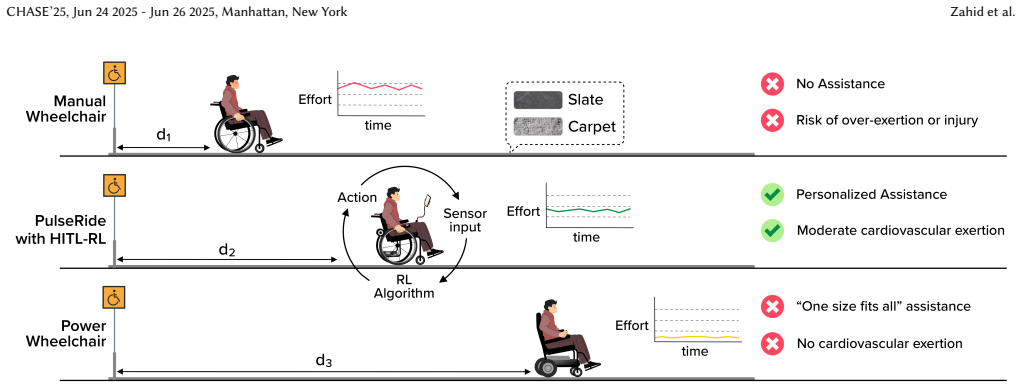
Pith's one-line read A motorized manual wheelchair that watches heart rate and ECG learns when to help push, and for ten participants it kept users in a personalized moderate-activity zone up to 71.7 percent longer than manual propulsion.
desk verdict A plausible new integration of HR/ECG with RL assist that deserves a referee, but its headline numbers rest on an undescribed manual baseline and circular reward/evaluation thresholds. read the letter →
The pith
A machine-rendered reading of the paper's core claim, the machinery that carries it, and where it could break.
The reading
What carries the argument
The load-bearing mechanism is a three-part control loop. The first part is a frozen convolutional ECG encoder, trained on four people to classify heart signals into low, medium, or high activity and then stripped of its classification head so it outputs eight features per three-second interval. The second part is a Deep Q-Network, a deep network that estimates the future reward value of each action, whose observation stacks two seconds of heart rate, velocity, previous motor action, and those eight ECG features; its only actions are motor on or motor off. The third part is a hand-shaped reward function that uses each user's personalized heart-rate and velocity thresholds, gathered in a 135-second pre-training session, to reward time spent in the moderate zone and penalize extreme heart rate, excessive velocity, or applying assistance at already-high speed. Together these parts let the system adapt assistance to an individual without explicit environment programming.
What would settle it
Train the ECG feature extractor on four people, then run the full PulseRide protocol on a fresh group of participants and measure how well the frozen feature extractor classifies their heart signals into low, medium, and high activity; if held-out accuracy is near chance, or if the per-user time in the moderate zone is no better than manual wheeling in a replication, the central claim fails.
Extended reading notes
Core claim
The discovery this paper seeks to establish is that a live physiological signal can act as the control input for adaptive wheelchair assistance. During a short pre-training phase, the system measures each user's own heart-rate and velocity ranges at self-chosen low, medium, and high effort, producing personalized thresholds. A Deep Q-Network then receives, every two seconds, heart rate, wheelchair velocity, the previous motor action, and an eight-dimensional encoding of the last three seconds of ECG produced by a convolutional network that was first trained to classify physical activity level. The network chooses only whether to turn the motors on or off, and the reward function rewards staying inside the moderate zone while penalizing over-exertion and excessive speed. The reported result is that this policy kept users' heart rates in the moderate zone longer than manual wheeling, with an individual best of 71.7 percent more time, while reducing muscle contractions and shifting electromyographic (EMG) mean frequency in the direction of less fatigue; the policy also generalized from training on slate to testing on carpet.
Load-bearing premise
The entire assistance decision depends on eight features that a machine-learning model extracts from the heart signal, and that model was trained on only four people who were not part of the ten-person study; if those features do not remain meaningful for a new user, the learned policy is acting on uninformative inputs.
Editorial extensions
If this is right
- If the central claim holds, wheelchair users can accumulate moderate cardiovascular exercise during ordinary trips instead of choosing between full manual effort and a fully powered chair.
- Because the policy trained only on slate still kept heart rates in the moderate zone on carpet, a single training session may transfer to other indoor surfaces with different rolling resistance.
- Personalized thresholds derived from each user's own propulsion effort mean the same hardware can serve users with very different fitness levels without manual tuning.
- Lower push frequency and reduced muscle contractions address the repetitive-strain injuries that make manual wheelchair use unsustainable for many people.
- The retrofit attaches to a stock manual wheelchair and costs under $500, so the approach is potentially accessible outside specialized clinical hardware.
Reading between the lines
- These are editorial extensions beyond the paper's own claims.
- Because PulseRide can only turn the motors on or off and has no braking, it cannot actively lower heart rate on downhill or coasting stretches; real-world gains may be smaller wherever gravity does the work.
- Both the encoder training pool, four people, and the main study, ten people, were people without disabilities, so the ECG features and the learned policy still need to be revalidated in wheelchair users, especially those with altered cardiovascular responses.
- A natural next experiment would keep the same reward structure but allow continuous motor thrust or several assist levels, since the binary action likely under-uses the physiological information; the 71.7 percent figure should also be reported as a distribution, since it is the best individual user's gain rather than a group average.
Editorial analysis
A structured set of objections, weighed in public.
Referee Report
Summary. The paper introduces PulseRide, an add-on motorized wheelchair system that uses human-in-the-loop deep Q-learning to provide individualized push assistance based on heart rate, ECG, and velocity. The authors formalize the control problem as an MDP, train a CNN encoder on ECG data from four separate participants, and evaluate the system with ten non-disabled participants on slate and carpet surfaces. The headline results are that PulseRide keeps users in their personalized moderate heart-rate zone up to 71.7% longer than a manual wheelchair, reduces muscle contractions by 41.86% on slate and 24.94% on carpet, and appears to delay fatigue based on EMG mean-frequency trends. The paper also claims that PulseRide is the first wheelchair system to offer personalized, adaptive assistance balancing physical effort with mobility needs.
Significance. If the causal claims were established, PulseRide would be a meaningful contribution: a low-cost (~$500) retrofitted wheelchair with real-time physiological feedback and personalized assistance, addressing a real gap between manual and powered wheelchairs. The MDP formulation, the two-phase personalization, and the use of a frozen ECG encoder are sensible system components, and the authors are transparent about the pilot nature of the study and the decision to test with participants without disabilities. However, the current evidence is preliminary: the manual-wheelchair comparison is not described in the methods, no inferential statistics are reported, and the fatigue evidence rests on a single participant's slope plus an undefined aggregate measure. The contribution is therefore an interesting system description and pilot evaluation, rather than a validated effectiveness claim.
major comments (4)
- [Section 4.2] The Procedure section describes only a PulseRide sequence (introduction, rest, pre-training, 20-minute training, 5-minute test on slate and carpet) and never specifies a manual-wheelchair condition. Yet Section 5 repeatedly compares PulseRide against 'manual wheelchair' (Figures 5-11), and the abstract quantifies gains of 71.7% and 41.86%. Without a description of the manual condition—its order relative to PulseRide training, randomization, instructions, duration, and whether the same personalized zones were used—these differences cannot be attributed to the assistive policy rather than to fatigue, practice, or instruction effects. This omission is load-bearing for the central claim.
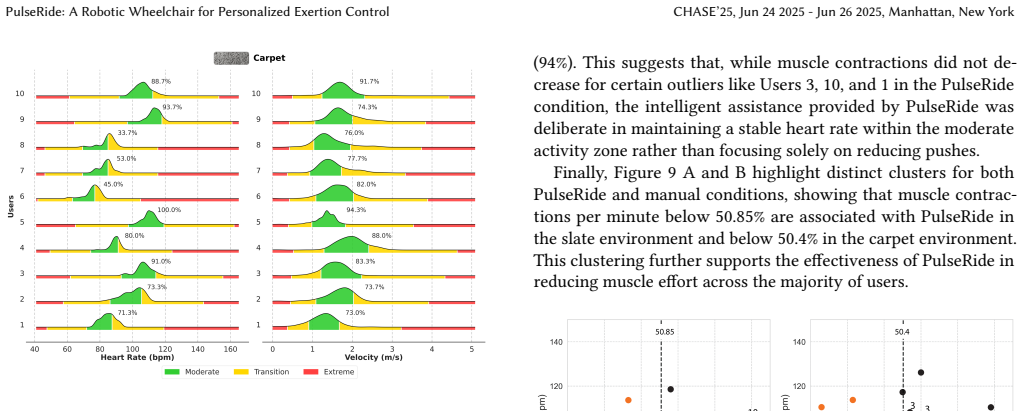
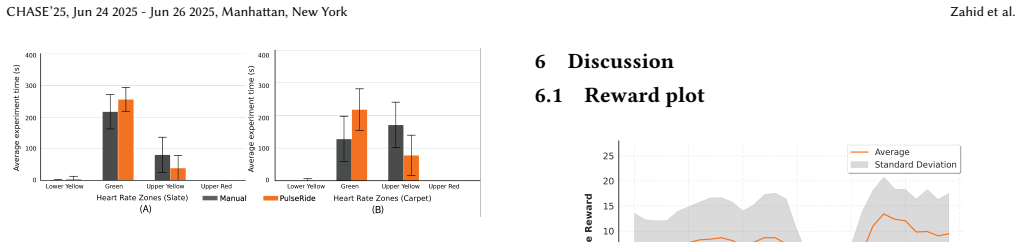
- [Section 5.1-5.3, Figures 8-10] No inferential statistics are reported for any comparison. Figure 10 shows only average percentages with standard-deviation error bars; Figures 8 and 9 show per-user counts without paired tests or effect sizes. With n=10, individual outliers (e.g., Users 3, 7, and 8 in Figures 5-6) can dominate averages. The paper should report paired statistical tests or explicit effect sizes with confidence intervals for time-in-zone, contraction counts, and MNF slopes, or alternatively downgrade the causal claims to descriptive pilot observations.
- [Section 5.4, Figure 11] The fatigue-delay claim is insufficiently supported. Figure 11B shows MNF slopes for one participant only; Figure 11C, described as 'MNF variability across all participants,' does not present per-participant slopes or a group-level slope analysis. The text states that PulseRide 'consistently demonstrated more positive MNF variability' but does not define how this variability is computed or whether it corresponds to a fatigue-relevant slope. Without group-level MNF slope statistics, the conclusion that PulseRide delays fatigue is not established.
- [Algorithm 1 and Section 4.3.2] The primary outcome, proportion of time in the moderate heart-rate zone, is computed with the same personalized λ thresholds that define the reward function in Algorithm 1. The evaluation metric is therefore aligned with the training objective by construction. This does not invalidate the system goal, but the manuscript should acknowledge this circularity and validate the zone boundaries against an independent standard (e.g., heart-rate reserve, ACSM moderate-intensity ranges, or participant-rated RPE) before claiming that PulseRide maintains 'moderate activity' as a health-relevant construct.
minor comments (5)
- [Algorithm 1] Algorithm 1 contains the condition 'velocity = vel_cv' but vel_cv is never defined in the text or tables; this appears to be a typographical or omitted definition.
- [Section 3.3] The ECG encoder is trained on only 4 participants (303 samples), yet it is used as a core observation for the 10 study participants. Since the policy also uses heart rate and velocity, the central zone-maintenance result may be robust, but the generalization of the encoder to new users should be demonstrated or explicitly acknowledged as a limitation.
- [Section 4.2.1] The pre-training description says participants push at 'moderate and transition' levels, while Section 3.1 says three perceived exertion levels (low, medium, and high); please reconcile these descriptions.
- [Figure 11C] The caption states that error bars represent standard error of the mean, but no sample size or definition of 'MNF variability' is given; please specify the statistic and the number of participants.
- [Section 5.2] The phrase 'distinct clusters ... below 50.85%' is not the result of a cluster analysis; please rephrase to avoid implying a formal clustering method.
Circularity Check
No significant circularity: the headline outcomes are empirical measurements, not algebraic consequences of fitted thresholds.
full rationale
The claimed derivation chain is an empirical HITL-RL experiment, not a closed-form prediction. The personalized lambda thresholds from pre-training do enter both Algorithm 1's reward and the 'moderate zone' evaluation, but the reported quantities (71.7% zone time, 41.86% contraction reduction, MNF slope) are observed outcomes of the trained policy and manual trials; the paper's own Figures 8-11 show substantial inter-user variability and outlier users (User 3, User 10), so the outcomes are not forced by the reward definition. The ECG encoder is an auxiliary representation learned on separate participants and is a transfer assumption, not a circular reuse. The only self-citation ([47], 'Similar reward functions are commonly used in DC motor control problems') is peripheral and not load-bearing. The absence of a described manual-wheelchair condition in Section 4.2 and the lack of inferential statistics are serious methodological and correctness risks, but they are confounds, not circular derivations. Therefore no significant circularity is established.
Assumptions & free parameters
free parameters (5)
- User-specific heart rate thresholds (lambda1h, lambda2h, lambda3h) =
Per user, not reported numerically
- User-specific velocity thresholds (lambda1v, lambda2v, lambda3v) =
Per user, not reported
- Reward function coefficients (0.5, 0.5, 3, 2, 1.2, 1.4, 0.6) =
Hand-chosen constants
- DQN and encoder hyperparameters =
Table 1 values
- vel_cv =
Undefined
assumptions (4)
- domain assumption The 135-second pre-training yields stable, meaningful personalized thresholds for each user.
- ad hoc to paper The ECG encoder trained on 4 separate participants generalizes to new users.
- domain assumption Able-bodied participants are a valid proxy for wheelchair users in this system evaluation.
- domain assumption DQN with 600 training interactions learns a useful policy.
Cite this review
Pith. "Pith review of PulseRide: A Robotic Wheelchair for Personalized Exertion Control with Human-in-the-Loop Reinforcement Learning." pith.science (2026). https://pith.science/paper/SZF7EVOC
@misc{pith2026250605056,
  author       = {Pith},
  title        = {Pith review of: PulseRide: A Robotic Wheelchair for Personalized Exertion Control with Human-in-the-Loop Reinforcement Learning},
  year         = {2026},
  howpublished = {\url{https://pith.science/paper/SZF7EVOC}},
  note         = {Machine review of arXiv:2506.05056}
}
read the original abstract
Maintaining an active lifestyle is vital for quality of life, yet challenging for wheelchair users. For instance, powered wheelchairs face increasing risks of obesity and deconditioning due to inactivity. Conversely, manual wheelchair users, who propel the wheelchair by pushing the wheelchair's handrims, often face upper extremity injuries from repetitive motions. These challenges underscore the need for a mobility system that promotes activity while minimizing injury risk. Maintaining optimal exertion during wheelchair use enhances health benefits and engagement, yet the variations in individual physiological responses complicate exertion optimization. To address this, we introduce PulseRide, a novel wheelchair system that provides personalized assistance based on each user's physiological responses, helping them maintain their physical exertion goals. Unlike conventional assistive systems focused on obstacle avoidance and navigation, PulseRide integrates real-time physiological data-such as heart rate and ECG-with wheelchair speed to deliver adaptive assistance. Using a human-in-the-loop reinforcement learning approach with Deep Q-Network algorithm (DQN), the system adjusts push assistance to keep users within a moderate activity range without under- or over-exertion. We conducted preliminary tests with 10 users on various terrains, including carpet and slate, to assess PulseRide's effectiveness. Our findings show that, for individual users, PulseRide maintains heart rates within the moderate activity zone as much as 71.7 percent longer than manual wheelchairs. Among all users, we observed an average reduction in muscle contractions of 41.86 percent, delaying fatigue onset and enhancing overall comfort and engagement. These results indicate that PulseRide offers a healthier, adaptive mobility solution, bridging the gap between passive and physically taxing mobility options.
Figures


Figures from the paper (7 more)





Reference graph
Works this paper leans on
-
[1]
Acekare. 2023. Yomper+ and Enjo: Power add-on for manual wheelchairs. https: //www.acekare.com/power-add-on-manual-wheelchair-yomper-enjo/ Accessed: 2024-11-02
work page 2023
-
[2]
Seyler, Thomas Bruckner, Judith Munzinger, Thomas Grieser, Hans J
Michael Akbar, Gabriel Balean, Manuela Brunner, Thorsten M. Seyler, Thomas Bruckner, Judith Munzinger, Thomas Grieser, Hans J. Gerner, and Markus Loew
-
[3]
Alber USA. 2023. e-motion: Active drive wheels for manual wheelchairs. https: //www.alber-usa.com/us/products/active-drives/e-motion/ Accessed: 2024-11- 02
work page 2023
-
[4]
Mudasir Saleem Andrabi, Mercy Mumba, Betty Key, and Robert Motl. 2022. Physical activity programs for cardiovascular outcomes in community wheelchair users: A systematic review. Frontiers in Rehabilitation Sciences 3 (2022), 1007778
work page 2022
-
[5]
Mahsa Asheghan, Mohammad Taghi Hollisaz, Taher Taheri, Hadi Kazemi, and Amidoddin Khatibi Aghda. 2016. The prevalence of carpal tunnel syndrome among long-term manual wheelchair users with spinal cord injury: A cross- sectional study. J. Spinal Cord Med. 39, 3 (May 2016), 265. https://doi.org/10. 1179/2045772315Y.0000000033
work page 2016
-
[6]
Michael L. Boninger, Alicia M. Koontz, Sue Ann Sisto, Trevor A. Dyson-Hudson, Michael Chang, Robert Price, and Rory A. Cooper. 2005. Pushrim biomechanics and injury prevention in spinal cord injury: recommendations based on CULP- SCI investigations. J. Rehabil. Res. Dev. 42, 3 (May 2005), Suppl. https://doi.org/ 10.1682/jrrd.2004.08.0103 arXiv:16195959
-
[7]
Frank W Booth, Scott E Gordon, Christian J Carlson, and Marc T Hamilton. 2000. Waging war on modern chronic diseases: primary prevention through exercise biology. Journal of applied physiology 88, 2 (2000), 774–787
work page 2000
-
[8]
Johannes BJ Bussmann, Ulrich W Ebner-Priemer, and Jochen Fahrenberg. 2009. Ambulatory activity monitoring: Progress in measurement of activity, posture, and specific motion patterns in daily life. European Psychologist 14, 2 (2009), 142–152
work page 2009
Show all 66 references
-
[9]
Sotirios Chatzidimitriadis and Konstantinos Sirlantzis. 2022. Deep Reinforcement Learning for Autonomous Navigation in Robotic Wheelchairs. In International Conference on Pattern Recognition and Artificial Intelligence . Springer, 271–282
2022
-
[10]
R. A. Cooper, L. A. Quatrano, P. W. Axelson, W. Harlan, M. Stineman, B. Franklin, J. S. Krause, J. Bach, H. Chambers, E. Y. Chao, M. Alexander, and P. Painter. 1999. Research on physical activity and health among people with disabilities: a con- sensus statement. J. Rehabil. R...
1999
-
[11]
Elaine H Coulter, Philippa M Dall, Lynn Rochester, Jon P Hasler, and Malcolm H Granat. 2011. Development and validation of a physical activity monitor for use on a wheelchair. Spinal cord 49, 3 (2011), 445–450
2011
-
[12]
Rachel E Cowan, Stephanie L Silveira, Tina Helle, Uffe Læssøe, Kirstine Rosenbeck Gøeg, Jette Bangshaab, and Robert W Motl. 2022. Lifestyle physical activity in manual wheelchair users–an overlooked public health opportunity. Spinal Cord 60, 2 (2022), 190–192
2022
-
[13]
Dalyan, D
M. Dalyan, D. D. Cardenas, and B. Gerard. 1999. Upper extremity pain after spinal cord injury. Spinal Cord 37, 3 (March 1999), 191–195. https://doi.org/10.1038/sj. sc.3100802 arXiv:10213328
1999 doi
-
[14]
Andrea L Dunn, Ross E Andersen, and John M Jakicic. 1998. Lifestyle physical ac- tivity interventions: History, short-and long-term effects, and recommendations. American journal of preventive medicine 15, 4 (1998), 398–412
1998
-
[15]
Kara Edwards and Annie McCluskey. 2010. A survey of adult power wheelchair and scooter users. Disability and Rehabilitation: Assistive Technology 5, 6 (2010), 411–419
2010
-
[16]
Arturo Escobedo, Anne Spalanzani, and Christian Laugier. 2013. Multimodal control of a robotic wheelchair: Using contextual information for usability im- provement. In 2013 IEEE/RSJ International Conference on Intelligent Robots and Systems. IEEE, 4262–4267
2013
-
[17]
Guoxi Feng, Lucian Buşoniu, Thierry-Marie Guerra, and Sami Mohammad. 2019. Data-efficient reinforcement learning for energy optimization of power-assisted wheelchairs. IEEE Transactions on Industrial Electronics 66, 12 (2019), 9734–9744
2019
-
[18]
Patrick Fougeyrollas and Luc Noreau. 2000. Long-term consequences of spinal cord injury on social participation: the occurrence of handicap situations. Dis- ability and rehabilitation 22, 4 (2000), 170–180
2000
-
[19]
Fullerton, Jeffrey J
Heather D. Fullerton, Jeffrey J. Borckardt, and Alan P. Alfano. 2003. Shoulder pain: a comparison of wheelchair athletes and nonathletic wheelchair users.Med. Sci. Sports Exerc. 35, 12 (Dec. 2003), 1958–1961. https://doi.org/10.1249/01.MSS. 0000099082.54522.55 arXiv:14652488
2003
-
[20]
Shawn C Gendle, Mark Richardson, James Leeper, L Brent Hardin, J Matt Green, and Phillip A Bishop. 2012. Wheelchair-mounted accelerometers for measurement of physical activity. Disability and Rehabilitation: Assistive Technology 7, 2 (2012), 139–148
2012
-
[21]
Giesbrecht, Jacqueline D
Edward M. Giesbrecht, Jacqueline D. Ripat, Arthur O. Quanbury, and Juli- ette E. Cooper. 2009. Participation in community-based activities of daily living: comparison of a pushrim-activated, power-assisted wheelchair and a CHASE’25, Jun 24 2025 - Jun 26 2025, Manhattan, New Yo...
2009 doi
-
[22]
Aditya Goil, Matthew Derry, and Brenna D. Argall. 2013. Using machine learning to blend human and robot controls for assisted wheelchair navigation. In 2013 IEEE 13th International Conference on Rehabilitation Robotics (ICORR) . 1–6. https: //doi.org/10.1109/ICORR.2013.6650454
2013
-
[23]
JA Haisma, LHV Van Der Woude, HJ Stam, MP Bergen, TAR Sluis, and JBJ Bussmann. 2006. Physical capacity in wheelchair-dependent persons with a spinal cord injury: a critical review of the literature. Spinal cord 44, 11 (2006), 642–652
2006
-
[24]
William L Haskell, I-Min Lee, Russell R Pate, Kenneth E Powell, Steven N Blair, Barry A Franklin, Caroline A Macera, Gregory W Heath, Paul D Thompson, and Adrian Bauman. 2007. Physical activity and public health: updated recommenda- tion for adults from the American College of...
2007
-
[25]
Kaiming He, Xiangyu Zhang, Shaoqing Ren, and Jian Sun. 2016. Deep residual learning for image recognition. In Proceedings of the IEEE conference on computer vision and pattern recognition . 770–778
2016
-
[26]
GREGORY NV HEATH and Peter H Fentem. 1997. 8 physical activity among persons with disabilities—A public health perspective. Exercise and sport sciences reviews 25, 1 (1997), 195–234
1997
-
[27]
Holloway, Andrew Symonds, Tatsuto Suzuki, Angela Gall, Peter Smitham, and Stephen Taylor
Catherine S. Holloway, Andrew Symonds, Tatsuto Suzuki, Angela Gall, Peter Smitham, and Stephen Taylor. 2015. Linking wheelchair kinetics to glenohumeral joint demand during everyday accessibility activities. Annu. Int. Conf. IEEE Eng. Med. Biol. Soc. 2015:2478-81., ; (2015), A...
2015 doi
-
[28]
Sungjin Hwang, Jiwoong Heo, Youngwug Cho, Jucheol Moon, Yushin Lee, Han- sung Kim, Jaehyuk Cha, and Kwanguk Kim. 2024. Transportation Mode Detection Technology to Predict Wheelchair Users’ Life Satisfaction in Seoul, South Korea. Proc. ACM Interact. Mob. Wearable Ubiquitous Te...
2024 doi
-
[29]
TW Janssen, CA Van Oers, Edith P Rozendaal, EM Willemsen, A Peter Hollander, and LH Van der Woude. 1996. Changes in physical strain and physical capacity in men with spinal cord injuries. Medicine and science in sports and exercise 28, 5 (1996), 551–559
1996
-
[30]
Robert T Kell, Gordon Bell, and Art Quinney. 2001. Musculoskeletal fitness, health outcomes and quality of life. Sports Medicine 31 (2001), 863–873
2001
-
[31]
Diederik P Kingma. 2014. Adam: A method for stochastic optimization. arXiv preprint arXiv:1412.6980 (2014)
2014 arXiv
-
[32]
Vijay Konda and John Tsitsiklis. 1999. Actor-critic algorithms.Advances in neural information processing systems 12 (1999)
1999
-
[33]
Peng Liao, Walter Dempsey, Hillol Sarker, Syed Monowar Hossain, Mustafa Al’Absi, Predrag Klasnja, and Susan Murphy. 2018. Just-in-time but not too much: Determining treatment timing in mobile health. Proceedings of the ACM on interactive, mobile, wearable and ubiquitous techno...
2018
-
[34]
Peng Liao, Kristjan Greenewald, Predrag Klasnja, and Susan Murphy. 2020. Per- sonalized HeartSteps: A Reinforcement Learning Algorithm for Optimizing Phys- ical Activity. Proc. ACM Interact. Mob. Wearable Ubiquitous Technol. 4, 1, Article 18 (mar 2020), 22 pages. https://doi.o...
2020 doi
-
[35]
Chen-Lung Lu, Zi-Yan Liu, Jui-Te Huang, Ching-I Huang, Bo-Hui Wang, Yi Chen, Nien-Hsin Wu, Hsueh-Cheng Wang, Laura Giarré, and Pei-Yi Kuo. 2021. Assistive navigation using deep reinforcement learning guiding robot with UWB/voice beacons and semantic feedbacks for blind and vis...
2021
-
[36]
Biao Luo, Zhengke Wu, Fei Zhou, and Bing-Chuan Wang. 2024. Human-in-the- Loop Reinforcement Learning in Continuous-Action Space. IEEE Transactions on Neural Networks and Learning Systems 35, 11 (2024), 15735–15744. https: //doi.org/10.1109/TNNLS.2023.3289315
2024
-
[37]
Volodymyr Mnih, Koray Kavukcuoglu, David Silver, Andrei A Rusu, Joel Veness, Marc G Bellemare, Alex Graves, Martin Riedmiller, Andreas K Fidjeland, Georg Ostrovski, et al. 2015. Human-level control through deep reinforcement learning. nature 518, 7540 (2015), 529–533
2015
-
[38]
Satoshi Muraki, Noriaki Tsunawake, Yasuaki Tahara, Sugaru Hiramatsu, and Masahiro Yamasaki. 2000. Multivariate analysis of factors influencing physical work capacity in wheelchair-dependent paraplegics with spinal cord injury. European Journal of Applied Physiology 81 (2000), 28–32
2000
-
[39]
Mark S Nash, Rachel E Cowan, and Jochen Kressler. 2012. Evidence-based and heuristic approaches for customization of care in cardiometabolic syndrome after spinal cord injury. The journal of spinal cord medicine 35, 5 (2012), 278–292
2012
-
[40]
Tom E Nightingale, Peter C Rouse, Dylan Thompson, and James LJ Bilzon. 2017. Measurement of physical activity and energy expenditure in wheelchair users: methods, considerations and future directions. Sports medicine-open 3 (2017), 1–16
2017
-
[41]
Office of Disease Prevention, Health Promotion, et al . 2000. US Department of Health and Human Services: Healthy People 2010. http://www/health/gov/healthypeople/ (2000)
2000
-
[42]
Satoshi Ohashi, Akira Shionoya, Keiu Harada, Masahito Nagamori, and Hisashi Uchiyama. 2022. Posture Estimation Using Surface Electromyography during Wheelchair Hand-Rim Operations. Sensors 22, 9 (2022). https://doi.org/10.3390/ s22093296
2022
-
[43]
World Health Organization and United Nations Children’s Fund. 2022. Global report on assistive technology . World Health Organization
2022
-
[44]
Russell R Pate, Michael Pratt, Steven N Blair, William L Haskell, Caroline A Macera, Claude Bouchard, David Buchner, Walter Ettinger, Gregory W Heath, Abby C King, et al. 1995. Physical activity and public health: a recommendation from the Centers for Disease Control and Preve...
1995
-
[45]
Katrina L Piercy, Richard P Troiano, Rachel M Ballard, Susan A Carlson, Janet E Fulton, Deborah A Galuska, Stephanie M George, and Richard D Olson. 2018. The physical activity guidelines for Americans. Jama 320, 19 (2018), 2020–2028
2018
-
[46]
Polomarco. 2023. ECG Classification: CNN-LSTM with Attention Mecha- nism. https://www.kaggle.com/code/polomarco/ecg-classification-cnn-lstm- attention-mechanism
2023
-
[47]
Bibek Poudel, Thomas Watson, and Weizi Li. 2022. Learning to control dc motor for micromobility in real time with reinforcement learning. In 2022 IEEE 25th International Conference on Intelligent Transportation Systems (ITSC) . IEEE, 1248– 1254
2022
-
[48]
L Qi, M Ferguson-Pell, Z Salimi, R Haennel, and A Ramadi. 2015. Wheelchair users’ perceived exertion during typical mobility activities. Spinal cord 53, 9 (2015), 687–691
2015
-
[49]
W Jack Rejeski, Lawrence R Brawley, and Sally A Shumaker. 1996. Physical activity and health-related quality of life. Exercise and sport sciences reviews 24, 1 (1996), 71–108
1996
-
[50]
D Rimaud, P Calmels, and X Devillard. 2005. Training programs in spinal cord injury. In Annales de readaptation et de medecine physique: revue scientifique de la Societe francaise de reeducation fonctionnelle de readaptation et de medecine physique, Vol. 48. 259–269
2005
-
[51]
Sandra B Rodrigues, Luís Palermo de Faria, António M Monteiro, José Luís Lima, Tiago M Barbosa, and José A Duarte. 2022. EMG signal processing for the study of localized muscle fatigue—pilot study to explore the applicability of a novel method. International Journal of Environ...
2022
-
[52]
Hye-Yeon Ryu, Je-Seong Kwon, Jeong-Hak Lim, A-Hyeon Kim, Su-Jin Baek, and Jong-Wook Kim. 2021. Development of an autonomous driving smart wheelchair for the physically weak. Applied Sciences 12, 1 (2021), 377
2021
-
[53]
John Schulman, Filip Wolski, Prafulla Dhariwal, Alec Radford, and Oleg Klimov
-
[54]
Mandi Sehgal, Jeremy Jacobs, and Wendy S Biggs. 2021. Mobility assistive device use in older adults. American family physician 103, 12 (2021), 737–744
2021
-
[55]
Richard S Sutton. 2018. Reinforcement learning: An introduction. A Bradford Book (2018)
2018
-
[56]
Richard S Sutton, David McAllester, Satinder Singh, and Yishay Mansour. 1999. Policy gradient methods for reinforcement learning with function approximation. Advances in neural information processing systems 12 (1999)
1999
-
[57]
Michelle L Tolerico, Dan Ding, Rory A Cooper, Donald M Spaeth, Shirley G Fitzgerald, Rosemarie Cooper, Annmarie Kelleher, and Michael L Boninger. 2007. Assessing mobility characteristics and activity levels of manual wheelchair users. Journal of Rehabilitation Research & Devel...
2007
-
[58]
Mohd Razali Md Tomari, Yoshinori Kobayashi, and Yoshinori Kuno. 2012. Devel- opment of smart wheelchair system for a user with severe motor impairment. Procedia Engineering 41 (2012), 538–546
2012
-
[59]
Anne Vuillemin, Stéphanie Boini, Sandrine Bertrais, Sabrina Tessier, Jean-Michel Oppert, Serge Hercberg, Francis Guillemin, and Serge Briançon. 2005. Leisure time physical activity and health-related quality of life. Preventive medicine 41, 2 (2005), 562–569
2005
-
[60]
Alireza Fayazi, Hamed Saeidi, and Ardalan Vahidi
Nianfeng Wan, S. Alireza Fayazi, Hamed Saeidi, and Ardalan Vahidi. 2014. Op- timal power management of an electric bicycle based on terrain preview and considering human fatigue dynamics. Proceedings of the American Control Con- ference, 3462–3467. https://doi.org/10.1109/ACC....
2014
-
[61]
Darren ER Warburton, Norman Gledhill, and Arthur Quinney. 2001. The effects of changes in musculoskeletal fitness on health. Canadian journal of applied physiology 26, 2 (2001), 161–216
2001
-
[62]
Darren ER Warburton, Crystal Whitney Nicol, and Shannon SD Bredin. 2006. Health benefits of physical activity: the evidence. Cmaj 174, 6 (2006), 801–809
2006
-
[63]
Jacob O Wobbrock, Shaun K Kane, Krzysztof Z Gajos, Susumu Harada, and Jon Froehlich. 2011. Ability-based design: Concept, principles and examples. ACM Transactions on Accessible Computing (TACCESS) 3, 3 (2011), 1–27
2011
-
[64]
World Health Organization. 2023. Assistive Technology. https://www.who.int/ en/news-room/fact-sheets/detail/assistive-technology Accessed: 2024-09-27. Received 6 January 2025; revised 31 March 2025; accepted 30 June 20259
2023
-
[2010]
Prevalence of rotator cuff tear in paraplegic patients compared with controls. J. Bone Joint Surg. Am. 92, 1 (Jan. 2010), 23–30. https://doi.org/10.2106/JBJS.H. 01373 arXiv:20048092
2010 doi
-
[2017]
arXiv preprint arXiv:1707.06347 (2017)
Proximal policy optimization algorithms. arXiv preprint arXiv:1707.06347 (2017)
2017 arXiv
Reviewed August 7, 2026 · model on record in the stance chip above.
Discussion (0). Sign in to comment.