REVIEW 3 major objections 5 minor 46 references
Bilayer triple-Q state driven by interlayer higher-order exchange interactions
T0 review · 3 major / 5 minor · reviewed 2026-08-07 · deepseek-v4-flash
Pith's one-line read The paper predicts that the magnetic ground state of a Mn bilayer on Ir(111) is a non-coplanar 'ideal bilayer triple-Q' texture, stabilized by four-spin interlayer exchange terms.
desk verdict Interlayer higher-order exchange is a genuinely new mechanism and the DFT work is careful, but the ground-state claim outruns the phase-space search. read the letter →
The pith
A machine-rendered reading of the paper's core claim, the machinery that carries it, and where it could break.
The reading
What carries the argument
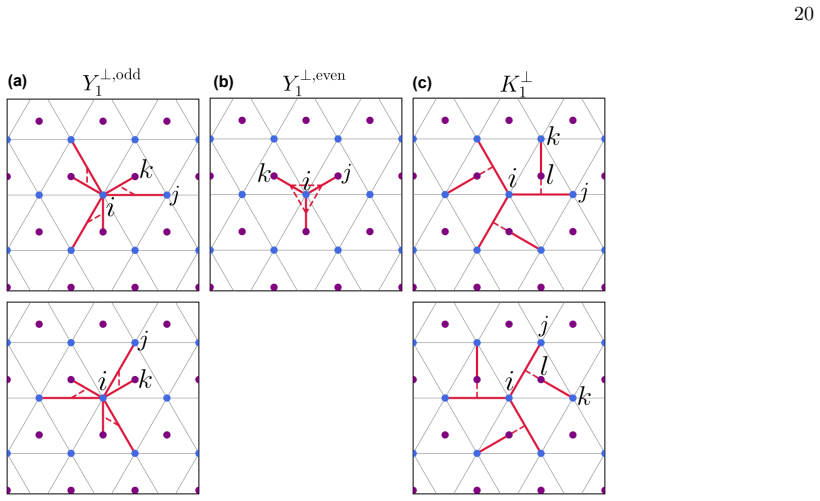
The load-bearing object is an atomistic spin Hamiltonian for a hexagonal magnetic bilayer, extended beyond Heisenberg exchange and DMI by higher-order exchange terms. For the interlayer part, the paper adds a biquadratic term $B^{\perp}_1$, two 4-spin 3-site terms $Y^{\perp,\mathrm{odd}}_1$ and $Y^{\perp,\mathrm{even}}_1$, and a 4-spin 4-site tetrahedral term $K^{\perp}_1$. The classification that carries the argument is parity under flipping all moments in one layer: the odd terms ($Y^{\perp,\mathrm{odd}}_1$, $K^{\perp}_1$) change sign when the interlayer alignment switches between the antiferromagnetic (⇄) and ferromagnetic (⇒) arrangements, while the even terms do not. In the key identity, the energy separates as $E^{\rightleftarrows,\Rightarrow} = E^\parallel \pm E^\perp + E_{\mathrm{even}} \pm E_{\mathrm{odd}}$, so taking differences between a multi-Q state and its 1Q counterpart cancels the bilinear exchange and isolates the higher-order terms. For the 3Q versus row-wise antiferromagnetic pair at the $M'$-point, the DFT-derived odd contribution is about twice the even one and has the sign that favours the ideal 3Q⇄ state.
What would settle it
A first-principles total-energy calculation of a spin spiral at a generic wave vector in the enlarged bilayer Brillouin zone, or an atomistic spin-dynamics or Monte Carlo relaxation starting from disordered moments, that finds a state below the ideal 3Q⇄ energy would show the ground-state claim is wrong; experimentally, spin-polarized scanning tunneling microscopy or neutron scattering that finds a different spin texture on hcp-Mn/hcp-Mn/Ir(111) would also contradict the prediction.
Extended reading notes
Core claim
The central claim is that in a pseudomorphic hcp-Mn/hcp-Mn bilayer on Ir(111), the magnetic ground state is the 3Q⇄ state, also called the ideal bilayer triple-Q state. In this state each Mn layer hosts a triple-Q texture with tetrahedron angles between neighboring moments, and the two layers are stacked so that interlayer nearest neighbors also form tetrahedron angles. The total spin moment cancels, while the non-coplanarity induces topological orbital moments in each layer that align parallel and add up to a large topological orbital magnetization. Pair-wise Heisenberg exchange alone leaves the 3Q state degenerate with its row-wise antiferromagnetic 1Q building blocks, and the DFT energy differences show that the stabilization of the 3Q⇄ state, which gains about 45 meV per two Mn atoms over the row-wise antiferromagnetic state, requires interlayer higher-order exchange. The authors develop a bilayer spin Hamiltonian with four interlayer higher-order terms and show that the odd terms, which change sign when the moments of one layer are flipped, favor the antiferromagnetically coupled 3Q⇄ state while disfavoring the ferromagnetically coupled 3Q⇒ state.
Load-bearing premise
The claim that the ideal bilayer triple-Q state is the true ground state rests on the assumption that the tested magnetic configurations, which are spin spirals along high-symmetry directions plus a few multi-Q states, include the lowest-energy arrangement, since the paper did not scan arbitrary wave vectors or run stochastic spin sampling.
Editorial extensions
If this is right
- For the Mn bilayer on Ir(111), the ideal bilayer 3Q state is the lowest-energy configuration among all magnetic states tested in DFT, lying about 45 meV per two Mn atoms below the row-wise antiferromagnetic state.
- The ground state carries no net spin moment but a significant topological orbital magnetization, because the topological orbital moments of the two layers align parallel.
- The odd interlayer higher-order exchange terms are the deciding ingredient: they stabilize the antiferromagnetically coupled 3Q⇄ state and penalize the ferromagnetically coupled 3Q⇒ state.
- The same even/odd classification applies to arbitrary multi-Q states, not just 3Q, so the energy balance of any multi-Q versus 1Q pair is controlled by interlayer higher-order exchange of the appropriate parity.
- In a Mn monolayer on Ir(111), stacking decides the ground state: fcc stacking selects a triple-Q state through intralayer higher-order exchange, while hcp stacking keeps the 120° Néel state.
Reading between the lines
- Going beyond the paper, the even/odd classification suggests a design rule for other bilayer magnets: if the odd interlayer higher-order constants have the right sign and the interlayer pair exchange is antiferromagnetic, the ideal bilayer 3Q state should win; this can be screened by computing four-spin interlayer terms for candidate 3d and 5d bilayers.
- If the predicted texture is confirmed, the parallel topological orbital moments point to a measurable topological Hall response despite zero net magnetization, which would give an electrical fingerprint of the 3Q state.
- The model could be extended to asymmetric and multilayer films by fitting the additional higher-order constants, which would predict how the 3Q⇄ versus 3Q⇒ splitting evolves with layer thickness and stacking.
Editorial analysis
A structured set of objections, weighed in public.
Referee Report
Summary. The paper combines first-principles DFT (FLAPW and PAW codes) with atomistic spin models to study the magnetic ground states of Mn monolayers and bilayers on Ir(111). For the fcc-stacked Mn monolayer the authors find a triple-Q (3Q) state below the Néel state, while for hcp stacking the Néel state remains lowest. For the hcp-Mn/hcp-Mn/Ir(111) bilayer they identify an 'ideal bilayer 3Q state' (3Q⇄) as the lowest-energy configuration among the tested states, stabilized by 45 meV per two Mn atoms with respect to the row-wise antiferromagnetic 1Q state. They attribute this stabilization to previously unconsidered interlayer higher-order exchange interactions, classifying these into even and odd terms and using Eqs. (17)-(18) and Table IV to extract their contributions. The paper also reports a large topological orbital magnetization in the ideal bilayer 3Q state and discusses the generalization of the even/odd classification to arbitrary multi-Q states.
Significance. If the central claim is robust, the paper identifies a new microscopic mechanism for stabilizing a non-coplanar magnetic texture in a two-layer film: interlayer higher-order exchange interactions. This is a genuine conceptual extension of the established intralayer-HOI framework for monolayers and is likely to be of interest to the skyrmionics and non-collinear magnetism community. The methodological contribution is substantial: the authors develop the first systematic treatment of interlayer HOI terms in a hexagonal bilayer, provide explicit energy expressions for 1Q and multi-Q states, and tabulate a large set of exchange constants from converged DFT spin-spiral calculations. The comparison between a freestanding Mn bilayer and the supported hcp-Mn/hcp-Mn/Ir(111) film is a strength, as is the explicit demonstration that the raw DFT energy ordering is robust to DMI at the M′ point. The paper does not ship machine-checked proofs or code, but the DFT methodology is state of the art and the energy ordering among the computed states is likely reliable.
major comments (3)
- [Section V and Section IV B (Multi-Q states)] The abstract and Section V state that the ideal bilayer 3Q state 'becomes the ground state of the Mn bilayer on Ir(111).' This claim is load-bearing and is supported only by the finite set of configurations studied: flat spin spirals along ΓM′ and ΓK′M′, the four uudd states, and the two commensurate 3Q states. No systematic search over generic wave vectors is reported, and no conical spin spirals, distorted multi-Q states with unequal amplitudes, or states with additional q components are considered. The 45 meV/u.c. energy gain at the M′ point is large, but it only places a lower bound on the energy of any unsampled competitor; it does not exclude, for example, a spin spiral at a generic q vector or a lower-energy multi-Q texture. This concern is independent of the HOI mechanism. I recommend either softening the 'ground state' language to 'lowest among the tested magnetic configurations' or strengthening the claim with a full-BZ scan of the fitted eight-shell exchange model, a spin-dynamics or Monte Carlo sampling of the model including HOI, or additional DFT calculations at generic q points.
- [Section IV B (Higher-order exchange interactions), Eqs. (17)-(18), Table IV] The even and odd HOI energy contributions in Table IV are obtained from Eqs. (17) and (18), which are algebraic combinations of the same DFT energy differences (E⇄3Q − E⇒3Q etc.) that the paper then 'explains' using these HOI contributions. This is not an error in the underlying DFT total energies, but it means Table IV is a restatement of the data in a decomposed form, not independent evidence for the interlayer-HOI mechanism. The stronger statement that stabilization 'can only be explained upon taking the effect of interlayer higher-order exchange interactions into account' is therefore contingent on the assumed NN operator structure in Eq. (10) and on the neglect of other mechanisms such as lattice relaxation, moment-magnitude changes, longer-range HOI, or anisotropic symmetric exchange. Please either rephrase the claim to say that the DFT energy ordering is reproduced by a model containing interlayer HOI, or provide an independent estimate of the HOI constants (for example from a Hubbard-model perturbation theory construction along the lines of Ref. [8]) and test the predicted energies on additional magnetic states.
- [Section IV B (Intralayer exchange, Figs. 7 and 8)] The spin-model interpretation assumes rigid, normalized local moments, but the DFT calculations show large moment variations in the bottom Mn layer (for example, moments from about 1.1 to 2.5 μB in Fig. 7(d) and a 94% variation in Fig. 8(f)). The authors acknowledge that these variations are 'mapped effectively into the interaction constants,' but the HOI decomposition of Table IV is performed on total-energy differences without explicitly controlling for this effect. This introduces an uncontrolled error in the quantitative claim that the 45 meV stabilization is due to interlayer HOI. I recommend adding a robustness check, for example by recalculating the energy differences with constrained fixed moments or by comparing the fitted exchange constants against a model that explicitly includes moment-magnitude dependence.
minor comments (5)
- [Section I] In the Introduction, 'magneocrystalline anisotropy energy' should be 'magnetocrystalline anisotropy energy.'
- [Section II B, Eq. (10)] The summation conventions in Eq. (10) are described only verbally as 'over unit-cells i, j, k, l' and 'over triangles of nearest neighbors.' Please make the summation domains explicit, since the operator structure is central to the paper's mechanism.
- [Figure 3(a)] The label '(60° shift)' in the caption of Fig. 3(a) is not explained in the text; please clarify what is shifted by 60 degrees.
- [Section IV B (Multi-Q states)] In the paragraph beginning 'Following this classification of HOI terms,' the text refers to 'uuud states' where the tables and figures use 'uudd.' Please correct this typo for consistency.
- [General] The paper is very dense and would benefit from a summary table listing all tested spin configurations, their unit cells, and DFT total energies relative to a common reference. This would make the completeness of the configuration scan immediately visible to the reader.
Circularity Check
Partial circularity: the interlayer-HOI energy contributions are defined via Eqs. (17)-(18) from the same DFT energy differences they are then used to explain, while the DFT ground-state energies themselves are independent.
-
self definitional
[Section IV B 'Higher-order exchange interactions', Eqs. (17)-(18), Table IV, and Section V]
"The contributions from odd and even HOI terms can be calculated via Eqs. (17) and (18), respectively, using the DFT total energies of the 1Q state and the corresponding multi-Q state. ... Subtracting these two values explains the nearly 15 meV energy difference between the 3Q ⇒ state and the R W-AFM ⇒ state observed in Fig. 9(a). For the opposite alignment between the two layers (⇄) the odd and even HOI energy contributions add up which results in the large energy gain of the 3Q⇄ state of about 45 meV with respect to the R W-AFM ⇄ state."
Eqs. (17)-(18) define the odd/even HOI contributions as linear combinations of the very DFT energy differences they are used to explain: 2(E_MQ^odd − E_1Q^odd) = (E⇄_MQ − E⇒_MQ) − (E⇄_1Q − E⇒_1Q), and analogously for even. The Table IV values (−31.08 and −15.46 meV) are therefore not independent parameters; adding and subtracting them reproduces the DFT values in Table VIII exactly (∆E⇄_3Q = −46.54 = even + odd; ∆E⇒_3Q = +15.62 = even − odd). Thus the statement that odd interlayer HOI 'contribute with about twice the strength' and stabilize the 3Q⇄ state is a restatement of the observed energy asymmetry, not an independent derivation. The qualitative symmetry argument (only odd terms can produce an alignment asymmetry) is meaningful, but the quantitative attribution is by construction.
full rationale
The paper's central ground-state result—that the ideal bilayer 3Q state has the lowest DFT total energy among the tested configurations (Fig. 9(a), Table VIII)—is an ab initio energy comparison and is not circular. The same holds for extracting Heisenberg exchange constants from spin-spiral dispersions, which is a standard mapping to a spin model. The circular element is confined to the mechanistic claim: the 'energy contributions from even and odd HOI terms' in Table IV are computed via Eqs. (17)-(18) from the same DFT energy differences (Table VIII) that they are then used to explain. Because Eq. (17) defines the odd contribution as half the difference between the alignment asymmetries of multi-Q and 1Q states, the statement that odd interlayer HOI drive the 45 meV stabilization is an algebraic identity, not an independent prediction. The symmetry-based classification (even vs odd under layer flip) does carry independent content, and the DFT energies themselves are not fitted, so the circularity is partial. No load-bearing self-citation was found: Ref. [25] supplies relaxed geometries, and the HOI form is traced to Ref. [8] (not by the present authors); the phase-space completeness critique is a validity concern, not circularity.
Assumptions & free parameters
free parameters (4)
- J∥_1 (intralayer NN Heisenberg, fcc-Mn/Ir(111)) =
-31.22 meV/Mn atom
- J⊥_1 (interlayer NN Heisenberg, Mn/Mn/Ir(111)) =
-19.65 meV/magnetic u.c.
- Intralayer HOI constants for Mn ML (B∥_1, Y∥_1, K∥_1) =
fcc: -3.19, -3.02, -1.22 meV/Mn atom
- Even/odd interlayer HOI energy contributions for Mn BL =
E_even=-15.46, E_odd=-31.08 meV/2 Mn atoms (M' point)
assumptions (4)
- domain assumption Mn magnetic moments are treated as classical unit vectors of fixed magnitude in the spin model; all moment-magnitude variations in DFT are absorbed into effective exchange constants.
- ad hoc to paper The interlayer higher-order exchange interactions are restricted to nearest-neighbor terms of the form in Eq. (10); longer-range or multi-site interlayer HOI are neglected.
- domain assumption The set of computed magnetic states (spin spirals along high-symmetry paths, uudd, 3Q) is assumed to contain the ground state.
- domain assumption Higher-order exchange interactions can be derived from a multi-band Hubbard model via fourth-order perturbation theory, and this derivation extends to the bilayer geometry.
invented entities (1)
-
Interlayer higher-order exchange interactions (B⊥_1, Y⊥,odd_1, Y⊥,even_1, K⊥_1)
Cite this review
Pith. "Pith review of Bilayer triple-Q state driven by interlayer higher-order exchange interactions." pith.science (2026). https://pith.science/paper/MYUZOWCM
@misc{pith2026250605091,
  author       = {Pith},
  title        = {Pith review of: Bilayer triple-Q state driven by interlayer higher-order exchange interactions},
  year         = {2026},
  howpublished = {\url{https://pith.science/paper/MYUZOWCM}},
  note         = {Machine review of arXiv:2506.05091}
}
read the original abstract
Using first-principles calculations and an atomistic spin model we predict the stabilization of a bilayer triple-Q state in an atomic Mn bilayer on Ir(111) due to interlayer higher-order exchange interactions. Based on density functional theory (DFT) we study the magnetic interactions and ground state in a Mn monolayer and bilayer on the Ir(111) surface. We calculate the energy dispersion of spin spirals (single-Q states) to scan a large part of the magnetic phase space and to obtain constants of pair-wise exchange interactions. By including spin-orbit coupling we determine the strength of the Dzyaloshinskii-Moriya interaction. To reveal the role of higher-order exchange interactions in these films, we consider multi-Q states obtained by a superposition of spin spirals. For the Mn monolayer in fcc stacking on Ir(111), the triple-Q state exhibits the lowest total energy in DFT, while the N\'eel state is most favorable for hcp stacking. For the Mn bilayer on Ir(111), two types of the triple-Q state are possible. In both magnetic configurations, a triple-Q state occurs within each of the Mn layers. However, only in one of them the spin alignment between the layers is such that nearest-neighbor spins of different layers also exhibit the tetrahedron angles which characterize the triple-Q state. We denote this state -- which has the lowest total energy in our DFT calculations -- as the ideal bilayer triple-Q state. This state exhibits significant topological orbital moments within each of the two Mn layers which are aligned in parallel resulting in a large topological orbital magnetization. We interpret the DFT results within an atomistic spin model which includes pair-wise Heisenberg exchange, the Dzyaloshinskii-Moriya interaction, as well as higher-order exchange interactions....
Figures


Figures from the paper (9 more)





Reference graph
Works this paper leans on
-
[8]
M. Hoffmann and S. Bl¨ ugel, Systematic derivation of re- alistic spin models for beyond-Heisenberg solids, Phys. 22 T ABLE V:Intralayer Heisenberg exchange constants (J∥ i ) calculated via DFT for fcc- and hcp-stacked Mn MLs on Ir(111). The values have been extracted from fitting the spin spiral energy dispersionE(q) neglecting HOI shown in Fig. 6(a) of ...
work page 2020
-
[1]
A. Fert, N. Reyren, and V. Cros, Magnetic skyrmions: advances in physics and potential applications, Nat. Rev. Mater.2, 17031 (2017)
2017
-
[2]
C. Back, V. Cros, H. Ebert, K. Everschor-Sitte, A. Fert, M. Garst, T. Ma, S. Mankovsky, T. L. Monchesky, M. Mostovoy, N. Nagaosa, S. S. P. Parkin, C. Pfleiderer, N. Reyren, A. Rosch, Y. Taguchi, Y. Tokura, K. von Bergmann, and J. Zang, The 2020 skyrmionics roadmap, J. Phys. D: Appl. Phys.53, 363001 (2020)
work page 2020
-
[3]
B. Rimmler, B. Pal, and S. Parkin, Non-collinear antifer- romagnetic spintronics, Nat. Rev. Mater. (2024)
work page 2024
-
[4]
Moriya, New Mechanism of Anisotropic Superex- change Interaction, Phys
T. Moriya, New Mechanism of Anisotropic Superex- change Interaction, Phys. Rev. Lett.4, 228 (1960)
work page 1960
-
[5]
Dzyaloshinsky, A thermodynamic theory of “weak” fer- romagnetism of antiferromagnetics, Sov
I. Dzyaloshinsky, A thermodynamic theory of “weak” fer- romagnetism of antiferromagnetics, Sov. Phys. JETP5, 1259–1262 (1957)
work page 1957
-
[6]
M. Takahashi, Half-filled Hubbard model at low temper- ature, Journal of Physics C: Solid State Physics10, 1289 (1977)
work page 1977
-
[7]
A. H. MacDonald, S. M. Girvin, and D. Yoshioka, t U expansion for the Hubbard model, Phys. Rev. B37, 9753 (1988)
work page 1988
Show all 46 references
-
[9]
P. Kurz, G. Bihlmayer, K. Hirai, and S. Bl¨ ugel, Three- Dimensional Spin Structure on a Two-Dimensional Lat- tice: Mn/Cu(111), Phys. Rev. Lett.86, 1106 (2001)
2001
-
[10]
Spethmann, S
J. Spethmann, S. Meyer, K. von Bergmann, R. Wiesen- danger, S. Heinze, and A. Kubetzka, Discovery of mag- netic single- and triple-Q states in Mn/Re(0001), Phys. Rev. Lett.124, 227203 (2020)
2020
-
[11]
Haldar, S
S. Haldar, S. Meyer, A. Kubetzka, and S. Heinze, Dis- torted 3Q state driven by topological-chiral magnetic in- teractions, Phys. Rev. B104, L180404 (2021)
2021
-
[12]
Nickel, A
F. Nickel, A. Kubetzka, S. Haldar, R. Wiesendanger, S. Heinze, and K. von Bergmann, Coupling of the triple- q state to the atomic lattice by anisotropic symmetric exchange, Physical Review B108, L180411 (2023)
2023
-
[13]
Yoshida, S
Y. Yoshida, S. Schr¨ oder, P. Ferriani, D. Serrate, A. Ku- betzka, K. von Bergmann, S. Heinze, and R. Wiesen- danger, Conical Spin-Spiral State in an Ultrathin Film Driven by Higher-Order Spin Interactions, Phys. Rev. Lett.108, 087205 (2012)
2012
-
[14]
P. M. Weber, T. Drevelow, J. Qi, M. Bode, and S. Heinze, Evidence for a conical spin spiral state in the Mn triple layer on W(001): Spin-polarized scanning tunneling mi- croscopy and first-principles calculations, Phys. Rev. B 108, 134419 (2023)
2023
-
[15]
Kr¨ onlein, M
A. Kr¨ onlein, M. Schmitt, M. Hoffmann, J. Kemmer, N. Seubert, M. Vogt, J. K¨ uspert, M. B¨ ohme, B. Alonazi, J. K¨ ugel, H. A. Albrithen, M. Bode, G. Bihlmayer, and S. Bl¨ ugel, Magnetic Ground State Stabilized by Three- Site Interactions: Fe/Rh(111), Phys. Rev. Lett.120, 207...
2018
-
[16]
Romming, H
N. Romming, H. Pralow, A. Kubetzka, M. Hoffmann, S. von Malottki, S. Meyer, B. Dup´ e, R. Wiesendan- ger, K. von Bergmann, and S. Heinze, Competition of Dzyaloshinskii-Moriya and Higher-Order Exchange Inter- actions in Rh/Fe Atomic Bilayers on Ir(111), Phys. Rev. Lett.120, 207...
2018
-
[17]
Heinze, K
S. Heinze, K. von Bergmann, M. Menzel, J. Brede, A. Ku- betzka, R. Wiesendanger, G. Bihlmayer, and S. Bl¨ ugel, Spontaneous Atomic-Scale Magnetic Skyrmion Lattice in Two Dimensions, Nat Phys7, 713 (2011)
2011
-
[18]
von Bergmann, M
K. von Bergmann, M. Menzel, A. Kubetzka, and R. Wiesendanger, Influence of the local atom configu- ration on a hexagonal skyrmion lattice, Nano Lett.15, 3280 (2015)
2015
-
[19]
Gutzeit, T
M. Gutzeit, T. Drevelow, M. A. Goerzen, S. Haldar, and S. Heinze, Spontaneous square versus hexagonal nanoscale skyrmion lattices in Fe/Ir(111), Phys. Rev. B 108, L060405 (2023)
2023
-
[20]
Nickel, A
F. Nickel, A. Kubetzka, M. Gutzeit, R. Wiesendan- ger, K. von Bergmann, and S. Heinze, Antiferromag- netic order of topological orbital moments in atomic-scale skyrmion lattices, npj Spintronics3, 7 (2025)
2025
-
[21]
S. Paul, S. Haldar, S. Malottki, and S. Heinze, Role of higher-order exchange interactions for skyrmion stability, Nat. Commun.11, 4756 (2020)
2020
-
[22]
Rodr ´ ıguez-Sota, V
A. Rodr ´ ıguez-Sota, V. Saxena, J. Spethmann, R. Wiesen- danger, R. Lo Conte, A. Kubetzka, and K. von Bergmann, Phase coexistence of Mn trimer clusters and antiferromagnetic Mn islands on Ir(111), ACS nano18 (2024)
2024
-
[23]
Aldarawsheh, M
A. Aldarawsheh, M. Sallermann, M. Abusaa, and S. Lou- nis, Intrinsic N´ eel antiferromagnetic multimeronic spin textures in ultrathin films, J. Phys. Chem. Lett.14, 8970 (2023)
2023
-
[24]
Hanke, F
J.-P. Hanke, F. Freimuth, A. K. Nandy, H. Zhang, S. Bl¨ ugel, and Y. Mokrousov, Role of berry phase theory for describing orbital magnetism: From magnetic het- erostructures to topological orbital ferromagnets, Physi- cal Review B94, 121114 (2016)
2016
-
[25]
Saxena, M
V. Saxena, M. Gutzeit, A. Rodr ´ ıguez-Sota, S. Haldar, F. Zahner, R. Wiesendanger, A. Kubetzka, S. Heinze, and K. von Bergmann, Strain-driven domain wall net- work with chiral junctions in an antiferromagnet (2024), arXiv:2408.12580
2024
-
[26]
Hardrat, A
B. Hardrat, A. Al-Zubi, P. Ferriani, S. Bl¨ ugel, G. Bihlmayer, and S. Heinze, Complex magnetism of iron monolayers on hexagonal transition metal surfaces from 23 T ABLE VII:DFT calculated intralayer higher-order exchange interactions for both stackings of the Mn ML on Ir(111)...
2009
-
[27]
Note that the distance alongzdoes not matter in our setups since only spin spirals withq= (q x, qy,0) T are being investigated in this work
-
[28]
Gutzeit, A
M. Gutzeit, A. Kubetzka, S. Haldar, H. Pralow, M. Goerzen, R. Wiesendanger, S. Heinze, and K. von Bergmann, Nano-scale collinear multi-q states driven by higher-order interactions, Nat. Commun.13, 5764 (2022)
2022
-
[29]
Seehttps://www.flapw.de
-
[30]
P. Kurz, F. F¨ orster, L. Nordstr¨ om, G. Bihlmayer, and S. Bl¨ ugel,Ab initiotreatment of noncollinear magnets with the full-potential linearized augmented plane wave method, Phys. Rev. B69, 024415 (2004)
2004
-
[31]
P. E. Bl¨ ochl, Projector augmented-wave method, Phys. Rev. B50, 17953 (1994)
1994
-
[32]
Seehttps://www.vasp.at
-
[33]
Kresse and J
G. Kresse and J. Furthm¨ uller, Efficient iterative schemes for ab initio total-energy calculations using a plane-wave basis set, Phys. Rev. B54, 11169 (1996)
1996
-
[34]
Kresse and D
G. Kresse and D. Joubert, From ultrasoft pseudopoten- tials to the projector augmented-wave method, Phys. Rev. B59, 1758 (1999)
1999
-
[35]
Dup´ e, M
B. Dup´ e, M. Hoffmann, C. Paillard, and S. Heinze, Tai- loring magnetic skyrmions in ultra-thin transition metal films, Nat. Commun.5, 4030 (2014)
2014
-
[36]
von Bergmann, S
K. von Bergmann, S. Heinze, M. Bode, E. Y. Vedme- denko, G. Bihlmayer, S. Bl¨ ugel, and R. Wiesendanger, Observation of a complex nanoscale magnetic structure in a hexagonal Fe monolayer, Phys. Rev. Lett.96, 167203 (2006)
2006
-
[37]
S. H. Vosko, L. Wilk, and M. Nusair, Accurate spin- dependent electron liquid correlation energies for local spin density calculations: a critical analysis, Can. J. Phys.58, 1200 (1980)
1980
-
[38]
Heide, G
M. Heide, G. Bihlmayer, and S. Bl¨ ugel, Describing Dzyaloshinskii–Moriya spirals from first principles, Phys- ica B Condens. Matter404, 2678 (2009)
2009
-
[39]
Li and A
C. Li and A. J. Freeman and H. J. F. Jansen and C. L. Fu, Magnetic anisotropy in low-dimensional ferromag- 24 T ABLE VIII:DFT calculated energy differences between multi- and single-Q states for a freestanding Mn bilayer and the hcp-Mn/hcp-Mn/Ir(111) film system. The values ∆E...
1990
-
[40]
Kurz,Non-collinear magnetism at surfaces and in ul- trathin films, Ph.D
P. Kurz,Non-collinear magnetism at surfaces and in ul- trathin films, Ph.D. thesis, R WTH Aachen, J¨ ulich (2001), record converted from VDB: 12.11.2012; Aachen, Techn. Hoch., Diss., 2000
2001
-
[41]
Schr¨ oder,First-Principles Study of Non-Collinear Magnetism and Spin-Orbit Driven Physics in Nanos- tructures at Surfaces, Ph.D
S. Schr¨ oder,First-Principles Study of Non-Collinear Magnetism and Spin-Orbit Driven Physics in Nanos- tructures at Surfaces, Ph.D. thesis, Christian-Albrechts- Universit¨ at zu Kiel, Kiel (2013)
2013
-
[42]
In principle, both intra- and interlayer pairwise Heisen- berg exchange constants could be determined simulta- neously from a fit to the energy dispersion of⇄or⇒ coupled magnetic layers. However, this only works for a symmetric bilayer with the same atom type in both lay- ers ...
-
[43]
Note that due to inversion symmetry no DMI contribu- tions for the freestanding Mn bilayer are possible
-
[44]
P. Park, W. Cho, C. Kim, Y. An, Y.-G. Kang, M. Avdeev, R. Sibille, K. Iida, R. Kajimoto, K. H. Lee, et al., Tetrahedral triple-Q magnetic ordering and large spontaneous Hall conductivity in the metallic triangu- lar antiferromagnet Co 1/3TaS2, Nat. Commun.14, 8346 (2023)
2023
-
[45]
Takagi, R
H. Takagi, R. Takagi, S. Minami, T. Nomoto, K. Ohishi, M.-T. Suzuki, Y. Yanagi, M. Hirayama, N. Khanh, K. Karube,et al., Spontaneous topological Hall effect induced by non-coplanar antiferromagnetic order in in- tercalated van der Waals materials, Nat. Phys.19, 961 (2023)
2023
-
[46]
Seehttps://www.nhr-verein.de/unsere-partner
Reviewed August 7, 2026 · model on record in the stance chip above.
Discussion (0). Sign in to comment.