REVIEW 3 major objections 5 minor 1 cited by
Discrete quantum systems from topological field theory
T0 review · 3 major / 5 minor · reviewed 2026-08-07 · deepseek-v4-flash
Pith's one-line read This paper proves that any Reshetikhin–Turaev topological field theory, in particular any 3d Chern–Simons theory, is the low-energy limit of a gapped lattice model built from point defects, with a Hamiltonian that is a sum of commuting…
desk verdict New defect-to-Hamiltonian recipe that plausibly embeds any RT theory into a commuting-projector lattice model; exposition is uneven where it matters most. read the letter →
The pith
A machine-rendered reading of the paper's core claim, the machinery that carries it, and where it could break.
The reading
What carries the argument
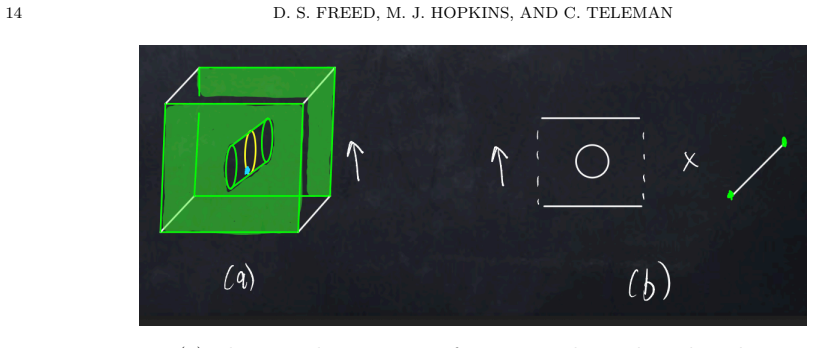
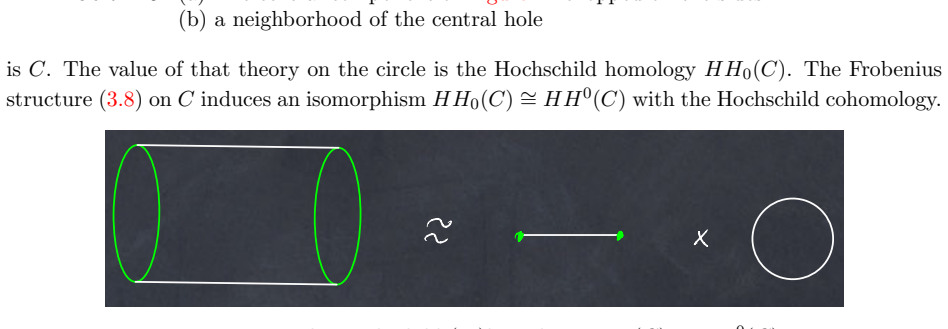
The central machinery is the evaluation of a topological field theory on bordisms with codimension-two point defects. The key identity is the eigenspace decomposition (2.6), which makes each $H_y$ a projector: inserting the endomorphism $h_y=\begin{pmatrix}0&0\\0&\mathrm{id}_b\end{pmatrix}$ splits the state space into a kernel summand (defect replaced by $1$) and an image summand (defect replaced by $b$). For the Levin–Wen part, the machinery is the dimensional reduction of the Turaev–Viro theory on an interval with Dirichlet endpoints, together with the Frobenius trace $\tau_x(\mathrm{id}_x)=\dim(x)$ and the defect $p=\bigoplus_i 1/\dim(c_i)$, which together force the central component of the projector calculation to evaluate to the identity operator.
What would settle it
For a case beyond the toric code, such as SU(2)$_k$ Chern–Simons on a torus with two point defects, compute the Hamiltonian from the TFT state sum; the claim predicts integer spectrum and a kernel equal to the Chern–Simons Hilbert space of the torus. A negative eigenvalue, a non-integer spectrum, or a kernel dimension different from that Hilbert space would refute the central claim.
Extended reading notes
Core claim
On the paper's own terms, the discovery is a construction. For any Reshetikhin–Turaev theory $F$ on the bordism category of $1$-, $2$- and $3$-manifolds with $(w_1,p_1)$-structure, with modular tensor category $\mathcal{B}=F(S^1)$, fix a finite set $D$ of objects of the form $1+b$. For a closed surface $Y$ with a finite set of points $\Delta$ and normal framings, a labeling $\delta:\Delta\to D$ defines the state space $H(Y,\Delta,\delta)$. Each point $y$ contributes an operator $H_y$: evaluate $F$ on the cylinder $[0,1]\times Y$ with the defect lines and one extra point defect at $\{1/2\}\times\{y\}$ labeled by the endomorphism $\begin{pmatrix}0&0\\0&\mathrm{id}_b\end{pmatrix}$ of $1+b$. The paper invokes standard TFT gluing arguments to show the $H_y$ are self-adjoint projections and pairwise commute, with an eigenspace decomposition in which the defect at $y$ is replaced either by the transparent object $1$ or by $b$. Hence the spectrum of $H=\sum_y H_y$ is contained in $\mathbb{Z}_{\ge0}$ and its kernel is $F(Y)$. The paper then verifies that the toric code is the special case of finite $\mathbb{Z}/2$ gauge theory with defect set $\{1+e,1+m\}$, and constructs Levin–Wen models from Turaev–Viro theories with a Dirichlet boundary theory, again with spectrum in $\mathbb{Z}_{\ge0}$ and kernel $T_{\mathcal{C}}(Y)$.
Load-bearing premise
The load-bearing premise is that a fully extended Reshetikhin–Turaev topological field theory with point defects exists and satisfies the standard gluing rules used to compute the Hamiltonian operators; the paper defers this framework to cited work rather than proving it here, so a failure of those gluing identities would undermine the projection, commutation, and kernel claims.
Editorial extensions
If this is right
- Every 3d Chern–Simons theory (with a $p_1$-structure) admits gapped lattice models with commuting-projector Hamiltonians and ground-state space equal to the Chern–Simons state space on the spatial surface.
- The models are local in a generalized sense: cutting the surface along a circle decomposes the state space as $\bigoplus_a (H_1)_a\otimes (H_2)_{a^\vee}$ over simple objects; for Hopf-algebra Turaev–Viro models this improves to a plain tensor product indexed by edges.
- The toric code is exactly the special case of finite $\mathbb{Z}/2$ gauge theory with defects $1+e$ and $1+m$, so the toric code's gapped behavior follows from the same TFT mechanism.
- For any spherical unitary fusion category $\mathcal{C}$, the Turaev–Viro theory $T_{\mathcal{C}}$ gives a Levin–Wen Hamiltonian whose spectrum is contained in $\mathbb{Z}_{\ge0}$ and whose kernel is $T_{\mathcal{C}}(Y)$; applied to $\mathrm{Vect}[G]$ this is another toric-code realization.
- Because the Hamiltonian is a sum of commuting projections with integer spectrum, the models are gapped with a spectral gap bounded below by $1$ independently of the lattice.
Reading between the lines
- An implicit consequence is discretization independence: since the Hamiltonian is defined by evaluating a TFT, the ground-state sector should be invariant under refining or changing the defect layout, though the paper does not formulate this as a theorem.
- The same defect-insertion recipe is explicitly said to generalize to other dimensions, so the natural next step is a 4d version producing gapped lattice models for 4d TFTs; the paper does not carry this out.
- The Ising reprise suggests a broader principle: any TFT boundary theory or domain wall can be converted into a discrete statistical-mechanical model, with dualities of the TFT descending to dualities of the lattice models; the paper only gestures at this via its earlier Ising work.
- A testable extension is to run the construction on a nonabelian modular tensor category such as SU(2)$_k$ on a torus and compare excited-state degeneracies with the anyonic content; the paper explicitly checks only the toric-code case.
Editorial analysis
A structured set of objections, weighed in public.
Referee Report
Summary. The paper proposes a method for constructing gapped lattice models from 3-dimensional Reshetikhin–Turaev topological field theories by placing codimension-two point defects on a surface. For a defect label of the form 1+b, the Hamiltonian term H_y is defined as the value of the TFT on a cylinder with an endomorphism h_y=diag(0,id_b) inserted on the defect line; the authors assert that these are commuting projections with the eigenspace decomposition (2.6), so that the total Hamiltonian H has integer spectrum and kernel equal to the no-defect TFT state space F(Y). They then argue that the toric code arises from finite Z/2 gauge theory with defects 1+e and 1+m, and give a TFT construction of Levin–Wen models using a Dirichlet boundary theory, with projection operators P_{v,e} and face terms H_f. Section 4 recaps the authors' earlier TFT treatment of the 1+1 dimensional Ising model.
Significance. If the key projection/decomposition lemma in Section 2 holds, the paper gives a clean and general construction of commuting-projector Hamiltonians whose ground-state sectors are the state spaces of arbitrary Chern–Simons theories, unifying the toric code and Levin–Wen models under one TFT framework. This is conceptually valuable and likely correct. The paper is honest about deferring technical foundations to [F], [FT2], [FT1], and [FMT], and the identification ker H = F(Y) is an implementation rather than a circular argument. However, the most load-bearing step—the proof of (2.6)—is not supplied, and the toric code and Levin–Wen sections contain further sketched identifications; in its current form the note is too terse to be a complete research paper.
major comments (3)
- [Section 2, Eqs. (2.5)–(2.7)] The claim that H_y is a projection with eigenspace decomposition (2.6) is the foundation of the spectral and ground-state statements, but the proof is replaced by the phrase 'elementary standard arguments in topological field theory.' What is needed is a precise state-splitting/gluing statement: the bordism of Figure 3 with h_y inserted acts on the local object 1+b at y and induces an isomorphism H(Y,∆,δ) ≅ H(Y,∆,δ') ⊕ H(Y,∆,δ''), compatible with cutting and gluing along circles. This is not a formal consequence of the Atiyah–Segal axioms alone for codimension-two point defects with normal framings. Please either prove this lemma or give a theorem-and-verse reference in [F], [FT2], or [FMT]; without it, the assertions 'spec H ⊂ Z_{≥0}' and 'ker H = F(Y)' are unsupported. The text should also state whether H_y is self-adjoint and whether the summands in (2.6) are orthogonal.
- [Section 2, toric code identification] The verification that the D={1+e,1+m} model is the toric code is a series of assertions: the evaluations of the bordisms in Figure 8 to 1+e and 1+m are not computed, and the final step says the semiclassical description 'reproduces precisely' the toric code of Section 1. Remark 2.12 then concedes that the analogous quantum gluing argument is 'too naive' and requires a blow-up construction as in [D]. Since the toric code is the paper's only explicit check that the general Section 2 construction yields a known lattice model, this identification should be proved in detail or replaced by a precise citation to a computation in [FMT] or elsewhere.
- [Section 3, P_{v,e}, H_v, H_f] The proof that P_{v,e} is a projection is a sketch: the statement that the central component of Figure 14 evaluates to the identity is justified by a chain of assertions about dimensional reduction, Hochschild (co)homology, and the compensating effect of p in (3.7) that are not fully demonstrated. In addition, the operator H_v = id − ∏_e P_{v,e} is claimed to have spectrum {0,1}, which requires that the P_{v,e} for edges e at a fixed vertex v commute; this is not proved. The face operators H_f are introduced by reference to [FT1, §7A], and the assertion that the Hamiltonian (3.12) has integer spectrum and kernel T_C(Y) is supported only by 'The construction makes clear...' Please supply the missing projection and commutativity proofs, or state and prove the precise lemma from [FT1] that applies to this Levin–Wen setting.
minor comments (5)
- [Eq. (2.6)] Define δ' and δ'' explicitly: δ' replaces the defect at y by the transparent object 1, and δ'' replaces it by b.
- [Section 2, footnote 2] The foundational setup is deferred to [F], which is listed as lecture notes; if the key gluing lemma is not in a published source, the paper should include a short proof or state precisely which axiom of [FT2] covers point defects with normal framings.
- [Figure 15(b)] The phrase 'the vertical sides of the square are dotted in the sense of [FT2,§2.1.2]' is too cryptic for a reader who does not have [FT2] at hand; please explain what the dotted sides mean.
- [Figure 19] The term 'antisphere' is used without definition.
- [Abstract and Introduction] The paper advertises 'gapped systems whose low energy limit is Chern–Simons theory,' but the precise statement proven (modulo (2.6)) is only that the kernel of H is F(Y); please clarify whether 'low energy limit' is meant to include excited states and anyonic data or only the ground-state sector.
Circularity Check
No significant circularity: Section 2 is an explicit construction whose kernel is F(Y) by design; cited prior work is independent published mathematics.
full rationale
The paper's central construction in Section 2 is definitional rather than predictive: H_y is the TFT evaluation of a bordism carrying the defect endomorphism h_y = diag(0,id_b), and the asserted direct-sum decomposition (2.6) is the eigenspace decomposition of that idempotent. Consequently `spec H subset Z_{>=0}` and `ker H = F(Y)` are structural consequences of the projector setup, not fitted outputs; no parameter is tuned to data and then renamed a prediction. The toric-code recovery in Section 2 is verified by an explicit semiclassical path-integral computation, and the Levin-Wen construction in Section 3 is an independent reformulation following [KK], with the computations of the Frobenius trace and the value d(C) taken from the published [FT1] and [ENO]; these citations are external theorems with stated assumptions, not self-referential validations of the present claim. The only flagged weakness is a proof gap: after (2.5) the paper asserts that `elementary standard arguments` prove idempotence, commutativity, and the splitting (2.6) without supplying the full gluing/state-splitting identity for codimension-two defects with normal framings. If that identity failed, the spectral and ground-state conclusions would not be established. This is a correctness risk, not circularity, because the asserted identity is not assumed as an input equivalent to the conclusion. The self-citations to [F], [FT2], and [FT1] are load-bearing for technical background but do not reduce the central derivation to a prior statement of the same result.
Assumptions & free parameters
assumptions (5)
- standard math There exists a well-defined extended Reshetikhin-Turaev TFT F: Bord<1,2,3>(F) -> Cat_C for each modular tensor category B with central charge lift (Eq. (2.1)-(2.3)).
- domain assumption F satisfies Atiyah-Segal gluing and locality on stratified manifolds with codimension-two defects and normal framings (used in Eq. (2.5), (2.6), (2.9), and Figures 3, 8, 12, 15).
- standard math The Turaev-Viro theory T_C associated to a spherical unitary fusion category C extends to a fully local TFT with Dirichlet boundary theory rho (Eq. (3.1); [TV], [FMT, Definition 3.2]).
- domain assumption The dimensional reduction of T_C on an interval with rho-endpoints has value C, and its Frobenius trace is tau_x(id_x)=dim(x) ([FT1, Proposition 6.18], Eq. (3.8)).
- standard math The cobordism hypothesis and classification of fully extended TFTs are valid (used in Section 4 for Kramers-Wannier duality and Ising duals).
Cite this review
Pith. "Pith review of Discrete quantum systems from topological field theory." pith.science (2026). https://pith.science/paper/SPEPLRSY
@misc{pith2026250605131,
  author       = {Pith},
  title        = {Pith review of: Discrete quantum systems from topological field theory},
  year         = {2026},
  howpublished = {\url{https://pith.science/paper/SPEPLRSY}},
  note         = {Machine review of arXiv:2506.05131}
}
read the original abstract
We introduce a technique to construct gapped lattice models using defects in topological field theory. We illustrate with 2+1 dimensional models, for example Chern-Simons theories. These models are local, though the state space is not necessarily a tensor product of vector spaces over the complex numbers. The Hamiltonian is a sum of commuting projections. We also give a topological field theory construction of Levin-Wen models.
Figures


Figures from the paper (20 more)




Forward citations
Cited by 1 Pith paper
-
Cobordism of nested manifolds
Nested cobordism of manifolds is, whenever the outer submanifold has a framed normal direction, identical to link cobordism, transferring Wang's link invariants to nested manifolds.
Reference graph
Works this paper leans on
-
[1]
M. F. Atiyah, On framings of 3 -manifolds , Topology 29 (1990), no. 1, 1--7
work page 1990
-
[2]
David Aasen, Roger S. K. Mong, and Paul Fendley, Topological Defects on the Lattice I: The Ising model , J. Phys. A 49 (2016) http://dx.doi.org/10.1088/1751-8113/49/35/354001, no. 35, 354001, http://arxiv.org/abs/1601.07185 arXiv:1601.07185 [cond-mat.stat-mech]
arXiv 2016
-
[3]
C. Blanchet, N. Habegger, G. Masbaum, and P. Vogel, Topological quantum field theories derived from the K auffman bracket , Topology 34 (1995), no. 4, 883--927
work page 1995
-
[4]
5, Cambridge University Press, Cambridge, 1996
John Cardy, Scaling and renormalization in statistical physics, Cambridge Lecture Notes in Physics, vol. 5, Cambridge University Press, Cambridge, 1996
work page 1996
-
[5]
Yichul Choi, Clay Cordova, Po-Shen Hsin, Ho Tat Lam, and Shu-Heng Shao, Non-Invertible Duality Defects in 3+1 Dimensions, http://arxiv.org/abs/arXiv:2111.01139 arXiv:2111.01139
-
[6]
thesis, University of Texas at Austin, 2011
Orit Davidovich, State sums in two dimensional fully extended topological field theories , Ph.D. thesis, University of Texas at Austin, 2011
work page 2011
-
[7]
Pavel Etingof, Dmitri Nikshych, and Viktor Ostrik, On fusion categories, Ann. of Math. (2) 162 (2005) http://dx.doi.org/10.4007/annals.2005.162.581, no. 2, 581--642, http://arxiv.org/abs/arXiv:math/0203060 arXiv:math/0203060
arXiv 2005
-
[8]
Freed, Quantum theory from a geometric viewpoint
Daniel S. Freed, Quantum theory from a geometric viewpoint. https://people.math.harvard.edu/ dafr/. Lecture notes
Show all 24 references
-
[9]
u rg Fr\
J\" u rg Fr\" o hlich, J\" u rgen Fuchs, Ingo Runkel, and Christoph Schweigert, Kramers- W annier duality from conformal defects , Phys. Rev. Lett. 93 (2004) http://dx.doi.org/10.1103/PhysRevLett.93.070601, no. 7, 070601, 4, http://arxiv.org/abs/arXiv:cond-mat/0404051 arXiv:co...
2004 arXiv
-
[10]
Freed, Gregory W
Daniel S. Freed, Gregory W. Moore, and Constantin Teleman, Topological symmetry in quantum field theory, Quantum Topol. 15 (2024) http://dx.doi.org/10.4171/qt/223, no. 3, 779--869, http://arxiv.org/abs/arXiv:2209.07471 arXiv:2209.07471
2024 arXiv
-
[11]
Freed and Constantin Teleman, Topological dualities in the I sing model , Geom
Daniel S. Freed and Constantin Teleman, Topological dualities in the I sing model , Geom. Topol. 26 (2022) http://dx.doi.org/10.2140/gt.2022.26.1907, no. 5, 1907--1984, http://arxiv.org/abs/arXiv:1806.00008 arXiv:1806.00008
2022 arXiv
-
[12]
, Gapped boundary theories in three dimensions, Comm. Math. Phys. 388 (2021) http://dx.doi.org/10.1007/s00220-021-04192-x, no. 2, 845--892, http://arxiv.org/abs/arXiv:2006.10200 arXiv:2006.10200
2021 arXiv
-
[13]
Claude Itzykson and Jean-Michel Drouffe, Statistical field theory. V ol. 1 , Cambridge Monographs on Mathematical Physics, Cambridge University Press, Cambridge, 1989. From Brownian motion to renormalization and lattice gauge theory
1989
-
[14]
1, 2--30, http://arxiv.org/abs/arXiv:quant-ph/9707021 arXiv:quant-ph/9707021
Alexei Kitaev, Fault-tolerant quantum computation by anyons, Annals of Physics 303 (2003), no. 1, 2--30, http://arxiv.org/abs/arXiv:quant-ph/9707021 arXiv:quant-ph/9707021
2003 arXiv
-
[15]
Alexei Kitaev and Liang Kong, Models for Gapped Boundaries and Domain Walls , Commun. Math. Phys. 313 (2012) http://dx.doi.org/10.1007/s00220-012-1500-5, no. 2, 351--373, http://arxiv.org/abs/arXiv:1104.5047 arXiv:arXiv:1104.5047 [cond-mat.str-el]
2012 arXiv
-
[16]
Justin Kaidi, Kantaro Ohmori, and Yunqin Zheng, Kramers-Wannier-like Duality Defects in (3+1)D Gauge Theories , Phys. Rev. Lett. 128 (2022) http://dx.doi.org/10.1103/PhysRevLett.128.111601, no. 11, 111601, http://arxiv.org/abs/2111.01141 arXiv:2111.01141 [hep-th]
2022 arXiv
-
[17]
Maxim Kontsevich and Graeme Segal, Wick rotation and the positivity of energy in quantum field theory, Q. J. Math. 72 (2021) http://dx.doi.org/10.1093/qmath/haab027, no. 1-2, 673--699, http://arxiv.org/abs/arXiv:2105.10161 arXiv:2105.10161
2021 arXiv
-
[18]
Levin and Xiao-Gang Wen, String net condensation: A Physical mechanism for topological phases , Phys
Michael A. Levin and Xiao-Gang Wen, String net condensation: A Physical mechanism for topological phases , Phys. Rev. B 71 (2005) http://dx.doi.org/10.1103/PhysRevB.71.045110, 045110, http://arxiv.org/abs/cond-mat/0404617 arXiv:cond-mat/0404617
2005 arXiv
-
[19]
N. Yu. Reshetikhin and V. G. Turaev, Ribbon graphs and their invariants derived from quantum groups, Comm. Math. Phys. 127 (1990), no. 1, 1--26
1990
-
[20]
Reshetikhin and V
N. Reshetikhin and V. G. Turaev, Invariants of 3 -manifolds via link polynomials and quantum groups , Invent. Math. 103 (1991), no. 3, 547--597
1991
-
[21]
https://online.kitp.ucsb.edu/online/strings05/segal/rm/jwvideo.html
Graeme Segal, On the locality of the statespace of quantum field theory. https://online.kitp.ucsb.edu/online/strings05/segal/rm/jwvideo.html
-
[22]
V. G. Turaev and O. Ya. Viro, State sum invariants of 3 -manifolds and quantum 6j -symbols , Topology 31 (1992) http://dx.doi.org/10.1016/0040-9383(92)90015-A, no. 4, 865--902
1992 doi
-
[23]
Edward Witten, Quantum field theory and the J ones polynomial , Comm. Math. Phys. 121 (1989), no. 3, 351--399
1989
-
[24]
Richard Wedeen, Volume-dependent field theories, http://arxiv.org/abs/arXiv:2402.06691 arXiv:2402.06691
Reviewed August 7, 2026 · model on record in the stance chip above.
Discussion (0). Sign in to comment.