REVIEW 6 major objections 6 minor 104 references
LLM-First Search: Self-Guided Exploration of the Solution Space
T0 review · 6 major / 6 minor · reviewed 2026-08-07 · deepseek-v4-flash
Pith's one-line read LLM-First Search replaces the fixed exploration constant of MCTS with a single model-made "continue or jump" decision, and claims this wins more hard Countdown and Sudoku games while spending fewer tokens.
desk verdict LFS is a plausible new LLM-guided backtracking variant, but Algorithm 1 isn't executable as written and the reported wins are statistically fragile. read the letter →
The pith
A machine-rendered reading of the paper's core claim, the machinery that carries it, and where it could break.
The reading
What carries the argument
The load-bearing mechanism is a two-prompt loop. At a state, an evaluate prompt asks the LLM to score every legal next action; the best action is taken and all others are pushed onto a priority queue ordered by those scores. Then an explore prompt asks the LLM for a single boolean: continue from the current state, or pop the highest-value alternative from the queue and switch to it. This single binary decision replaces the exploration constant $C$ in PUCT, the beam width in ToT-BFS, and the greedy queue rule in BestFS, and is meant to let the same prompt work across tasks and models.
What would settle it
Solve a fixed set of Countdown diff=7 games, log every explore decision, and after each run determine by exhaustive search whether the abandoned path actually contained a solution within the remaining token budget; if LFS's explore decisions agree with that oracle no more than chance, yet LFS still wins, then the win rate is not explained by self-guided backtracking and the central mechanism is not doing the claimed work.
Extended reading notes
Core claim
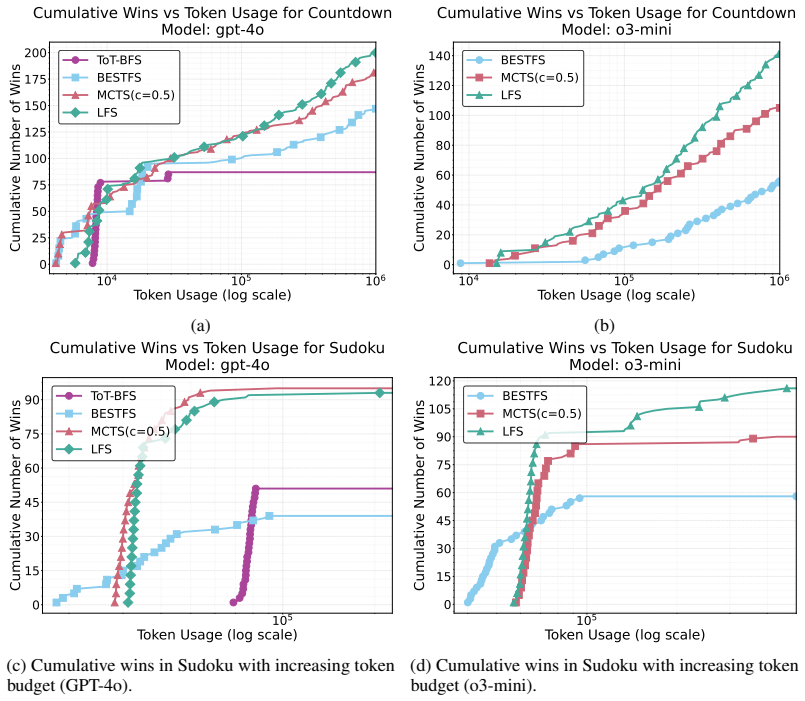
The central claim is that an LLM can internalise the search strategy itself: it can both evaluate its options and decide when to abandon the current reasoning path, and this is enough to outperform fixed search algorithms. Concretely, LFS achieves 47.37% on Countdown diff=7 with GPT-4o versus 32.63% for the best tuned MCTS, and 78.95% with o3-mini versus 41.05%; on 6x6 Sudoku with GPT-4o it is the only method to solve any game, and with o3-mini it reaches 25.26% versus 4.21% for MCTS. The paper reads these results as evidence that self-guided exploration scales better with task difficulty, model strength, and token budget, and that the need for hand-tuned search hyperparameters can be removed.
Load-bearing premise
The whole method rests on one binary judgment: the model must be able to tell, from its own internal estimate, when the current path is hopeless and when another branch is worth jumping to, without any task-specific tuning; an overconfident model never backtracks and an underconfident model thrashes.
Editorial extensions
If this is right
- On harder Countdown instances the gap widens: at diff=7 LFS beats MCTS by 14.74 points with GPT-4o and by 37.9 points with o3-mini.
- On 6x6 Sudoku with GPT-4o LFS is the only method with nonzero win rate, and with o3-mini it reaches 25.26% versus 4.21% for MCTS.
- LFS has the highest Area Under Performance Profile for both win rate and win-rate-per-token on both models, meaning the advantage holds in aggregate rather than on a single cherry-picked setting.
- Because LFS needs no search hyperparameters, switching tasks, difficulty levels, or base models requires no re-tuning, unlike MCTS whose best $C$ changed across tasks.
- LFS builds smaller or equal-sized search trees than MCTS on Countdown and Sudoku, consistent with a more targeted exploration strategy.
Reading between the lines
- Beyond the paper: if LFS's advantage comes from the explore decision, then measuring that decision against an oracle (was the abandoned path actually unsolvable within budget?) would directly test the mechanism; the paper reports only end-task win rates.
- Beyond the paper: LFS's requirement to revert to prior states limits it to reversible environments; applying it to irreversible settings would need a memory of visited states or a bounded rollback budget.
- Beyond the paper: the same binary explore prompt could be layered onto MCTS as an adaptive halting rule for simulations, potentially removing the need to retune $C$ while retaining MCTS's statistical backups.
- Beyond the paper: on tasks where model self-evaluation is miscalibrated, one could add a cheap external check, such as one-step lookahead, to veto explore decisions; the paper does not test this.
Editorial analysis
A structured set of objections, weighed in public.
Referee Report
Summary. The paper proposes LLM-First Search (LFS), a search method in which a single LLM both decides whether to continue along the current solution path or pop an alternative from a priority queue, and evaluates the value of available actions at the current state. The method is presented as removing the need for hand-tuned exploration hyperparameters such as MCTS's C constant, and is evaluated on Countdown and Sudoku against ToT-BFS, BestFS, and MCTS using GPT-4o and o3-mini. The reported results show that LFS matches or exceeds the baselines on most tasks, uses fewer tokens on several tasks, and scales better with model strength and compute budget. The authors also report Area Under Performance Profile (AUP) scores, cumulative wins as a function of token budget, and tree-size comparisons.
Significance. If the central claims hold, LFS is a meaningful contribution to inference-time LLM reasoning: it replaces an explicit exploration constant with an LLM-driven exploration decision, and the reported efficiency gains are practically relevant. The paper includes several strengths: the code is publicly available, the comparison spans two complementary benchmarks and two model families, token usage is reported alongside accuracy, and the AUP methodology is appropriate for aggregating heterogeneous tasks. The main results are plausible and the experimental design is mostly standard. However, the significance is currently limited by three issues: the algorithm as written in the manuscript is not executable, several evaluation choices weaken the statistical and comparative claims, and the central 'no handcrafted heuristics' assertion is contradicted by the task-specific prompts in Appendix E. These issues are fixable and do not, in my view, invalidate the underlying idea, but they must be addressed before the claims can be accepted.
major comments (6)
- [§4, Algorithm 1] Algorithm 1 is internally inconsistent. Lines 5 and 14 add raw actions to the priority queue Q (for example, Q := Q ∪ {a ∈ A0 | a ≠ a*_0}), but line 10 pops a state-action pair: (s'_t, A'_t) ← pop(Q). Since Q never stores states or (state, action) pairs, the algorithm cannot be executed as written. The accompanying text also says the method 'pops the highest-value node', which does not match the queue contents. Additionally, line 15 contains typos: 'st'' should be 'st' and 'a*_t''' should be 'a*_t'. The public code may resolve this, but the manuscript must specify the actual data structure (for example, storing successor states along with their values, or storing (state, action, value) tuples and applying the transition function on pop). Without this, the reported empirical results cannot be attributed to the described method.
- [§5.1, Table 1 and Appendix F] The MCTS exploration constant C is selected on the same test tasks that are used in the final comparison. The hyperparameter sweep in Table 1 evaluates C ∈ {0.5, 1.0, 2.5} on Countdown variants and Sudoku 4x4 with GPT-4o, and C = 0.5 is then adopted for all main results, including Sudoku 4x4 where the sweep shows a very large gap (100% vs 2.2% for C = 1.0). This is a form of test-set selection that gives MCTS an advantage and risks overfitting the baseline to the specific tasks. The paper should either select C on a held-out validation set, report all C values in the main table, or otherwise justify that the sweep does not materially affect the conclusions.
- [§5.3.1] The evaluation protocol is underspecified and the statistical treatment is questionable. The paper states that each game is run n = 5 times at temperature t = 0.0, but greedy decoding at temperature 0.0 is deterministic, so the five runs are not independent samples; the reported Wilson confidence intervals therefore overstate the effective sample size. The number of games per difficulty level is never stated, so the percentages in Table 2 and the confidence intervals in Appendix G cannot be interpreted without knowing the denominators. The authors should report the number of games per task, justify why temperature 0.0 is used despite the stated goal of measuring stochastic variation, and either use a nonzero sampling temperature or treat the results as deterministic and omit the Wilson intervals.
- [§5.1, §6.1, Table 2] ToT-BFS is absent from all o3-mini comparisons, despite the paper's claim that all methods are evaluated with two models. Table 2 shows no ToT-BFS row for o3-mini on any task, and the text only mentions that 'TOT-BFS-O3MINI is not tested' in the Countdown diff=3 discussion. This missing baseline affects the o3-mini AUP scores and weakens the 'scales better with a stronger model' claim, which is only made relative to MCTS and BestFS. The authors should either run ToT-BFS with o3-mini or explicitly state in the main text that this baseline is missing and discuss how it affects the comparison.
- [Table 3 and Appendix G.1] The AUP numbers are inconsistent between the main text and the appendix. For example, the BestFS GPT-4o WinRate AUP is 5.98 in Table 3 but 6.204 in Figure 9; the MCTS (C=0.5) GPT-4o EfficiencyScore AUP is 3.68 in Table 3 but 3.544 in Figure 10. Table 1 reports MCTS (C=0.5) WinRate AUP 7.20 and EfficiencyScore 7.16, while Figures 3 and 4 report 7.200 and 7.157, respectively. These discrepancies may be due to different subsets of tasks or minor rounding, but the paper does not explain them. Because AUP is a headline aggregate metric, the values must be reproducible from a single, clearly defined computation.
- [§1, §4, Appendix E] The paper repeatedly claims that LFS removes the need for 'handcrafted heuristics' and 'task-specific adaptation', but the prompts in Appendix E contain substantial task-specific, handcrafted guidance. For Countdown, the exploration prompt instructs the model that 'Creating small, flexible numbers (1-10) can be valuable' and lists four detailed scoring criteria; for Sudoku, it instructs the model to look for 'naked singles or hidden singles' and to consider 'how actions might create naked singles or hidden singles in other cells'. These are exactly the kind of handcrafted heuristics that the abstract and introduction say are eliminated. The authors should either qualify the claim (e.g., 'no hand-tuned numerical exploration parameters') or demonstrate that the same generic prompt works across both tasks without task-specific content.
minor comments (6)
- [§5.3.1] The sentence 'Due to the stochastic nature of language model generation' is at odds with the use of temperature 0.0; please clarify whether the API introduces nondeterminism despite the temperature setting.
- [§6.1] The text refers to 'Figure 22' for cumulative Sudoku wins, but the figure numbering in the appendix places these panels as part of a larger Figure 22; please verify all cross-references.
- [Appendix H] The caption of Figure 32 calls LFS 'Limited-Depth Forward Search', but the method is 'LLM-First Search'; please correct the acronym expansion.
- [§5.2.2] The Sudoku notation is inconsistent: the main text uses 'ℓ × w' grids with '2 × 3' subgrids for the 6x6 case, while Appendix C uses 'l × l' and '2 × 2' subgrids for the 4x4 case; please unify the notation.
- [Table 2] The row labels 'TOT-BFS-GPT4 O' and 'MCTS (C=0.5)' contain formatting irregularities (extra spaces and inconsistent capitalization); please standardize the method names throughout.
- [Appendix G] Several figure captions contain typos, such as 'furtehr' in the main text and inconsistent use of 'WinRate' vs 'Win Rate'; a careful proofread is recommended.
Circularity Check
No significant circularity: LFS has no fitted parameters and its results are not forced by construction.
full rationale
The paper's central claim is an empirical comparison of LFS against ToT-BFS, BestFS, and MCTS. LFS has no fitted parameters; its only inputs are the LLM and the fixed prompts. The reported WinRates are measurements, not quantities derived from the method's definition, so there is no self-definitional reduction. The MCTS baseline's exploration constant is selected by a sweep over the same tasks used in the final comparison (Appendix F), which is a test-set tuning concern for the baseline, but it cannot force LFS's results and is not a prediction by the paper. The LFS prompts embed task-specific heuristics ('small flexible numbers 1-10 are valuable', 'Only choose to explore if you are certain'), which contradicts the paper's 'no handcrafted heuristics' framing, but this is an internal-consistency issue rather than a circular derivation. Algorithm 1 is internally inconsistent (Q stores actions while pop(Q) returns states), making the method non-reproducible from the manuscript; again, this is a correctness defect, not circularity. No self-citations are load-bearing, and no uniqueness theorem or ansatz is imported from the authors' prior work. Accordingly, no step reduces by construction to its inputs.
Assumptions & free parameters
free parameters (1)
- MCTS exploration constant C =
0.5
assumptions (3)
- domain assumption LLM-provided scalar value estimates are reliable enough to guide both action selection and exploration decisions across tasks of different search depth and branching factor.
- domain assumption Running the same game five times at temperature 0.0 yields statistically independent samples of model behavior.
- domain assumption Countdown and Sudoku are representative benchmarks for drawing conclusions about general LLM search scalability.
Cite this review
Pith. "Pith review of LLM-First Search: Self-Guided Exploration of the Solution Space." pith.science (2026). https://pith.science/paper/BIS6STTA
@misc{pith2026250605213,
  author       = {Pith},
  title        = {Pith review of: LLM-First Search: Self-Guided Exploration of the Solution Space},
  year         = {2026},
  howpublished = {\url{https://pith.science/paper/BIS6STTA}},
  note         = {Machine review of arXiv:2506.05213}
}
read the original abstract
Large Language Models (LLMs) have demonstrated remarkable improvements in reasoning and planning through increased test-time compute, often by framing problem-solving as a search process. While methods like Monte Carlo Tree Search (MCTS) have proven effective in some domains, their reliance on fixed exploration hyperparameters limits their adaptability across tasks of varying difficulty, rendering them impractical or expensive in certain settings. In this paper, we propose \textbf{LLM-First Search (LFS)}, a novel \textit{LLM Self-Guided Search} method that removes the need for pre-defined search strategies by empowering the LLM to autonomously control the search process via self-guided exploration. Rather than relying on external heuristics or hardcoded policies, the LLM evaluates whether to pursue the current search path or explore alternative branches based on its internal scoring mechanisms. This enables more flexible and context-sensitive reasoning without requiring manual tuning or task-specific adaptation. We evaluate LFS on Countdown and Sudoku against three classic widely-used search algorithms, Tree-of-Thoughts' Breadth First Search (ToT-BFS), Best First Search (BestFS), and MCTS, each of which have been used to achieve SotA results on a range of challenging reasoning tasks. We found that LFS (1) performs better on more challenging tasks without additional tuning, (2) is more computationally efficient compared to the other methods, especially when powered by a stronger model, (3) scales better with stronger models, due to its LLM-First design, and (4) scales better with increased compute budget. Our code is publicly available at \href{https://github.com/NathanHerr/LLM-First-Search}{LLM-First-Search}.
Figures


Figures from the paper (29 more)




Reference graph
Works this paper leans on
-
[1]
Thinking, fast and slow penguin books, 2011
Daniel Kahneman. Thinking, fast and slow penguin books, 2011
2011
-
[2]
Chain-of-thought prompting elicits reasoning in large language models
Jason Wei, Xuezhi Wang, Dale Schuurmans, Maarten Bosma, Fei Xia, Ed Chi, Quoc V Le, Denny Zhou, et al. Chain-of-thought prompting elicits reasoning in large language models. Advances in neural information processing systems, 35:24824–24837, 2022
2022
-
[3]
Tree search for language model agents
Jing Yu Koh, Stephen McAleer, Daniel Fried, and Ruslan Salakhutdinov. Tree search for language model agents. arXiv preprint arXiv:2407.01476, 2024
arXiv 2024
-
[4]
On the emergence of thinking in llms i: Searching for the right intuition
Guanghao Ye, Khiem Duc Pham, Xinzhi Zhang, Sivakanth Gopi, Baolin Peng, Beibin Li, Janardhan Kulkarni, and Huseyin A Inan. On the emergence of thinking in llms i: Searching for the right intuition. arXiv preprint arXiv:2502.06773, 2025
arXiv 2025
-
[5]
The harpy speech recognition system
Bruce T Lowerre. The harpy speech recognition system. Carnegie Mellon University, 1976
1976
-
[6]
The Art of Computer Programming: Sorting and Searching, volume 3
Donald E Knuth. The Art of Computer Programming: Sorting and Searching, volume 3 . Addison-Wesley Professional, 1998
1998
-
[7]
The shortest path through a maze
Edward F Moore. The shortest path through a maze. In Proc. of the International Symposium on the Theory of Switching, pages 285–292. Harvard University Press, 1959
1959
-
[8]
A formal basis for the heuristic determination of minimum cost paths
Peter E Hart, Nils J Nilsson, and Bertram Raphael. A formal basis for the heuristic determination of minimum cost paths. IEEE transactions on Systems Science and Cybernetics, 4(2):100–107, 1968
1968
Show all 104 references
-
[9]
Efficient selectivity and backup operators in monte-carlo tree search
Rémi Coulom. Efficient selectivity and backup operators in monte-carlo tree search. In International conference on computers and games, pages 72–83. Springer, 2006
2006
-
[10]
Bandit based monte-carlo planning
Levente Kocsis and Csaba Szepesvári. Bandit based monte-carlo planning. In European conference on machine learning, pages 282–293. Springer, 2006
2006
-
[11]
Pathbench: A benchmarking platform for classical and learned path planning algorithms
Alexandru-Iosif Toma, Hao-Ya Hsueh, Hussein Ali Jaafar, Riku Murai, Paul HJ Kelly, and Sajad Saeedi. Pathbench: A benchmarking platform for classical and learned path planning algorithms. In 2021 18th Conference on Robots and Vision (CRV), pages 79–86. IEEE, 2021
2021
-
[12]
Visualwebarena: Evaluating multimodal agents on realistic visual web tasks
Jing Yu Koh, Robert Lo, Lawrence Jang, Vikram Duvvur, Ming Chong Lim, Po-Yu Huang, Graham Neubig, Shuyan Zhou, Ruslan Salakhutdinov, and Daniel Fried. Visualwebarena: Evaluating multimodal agents on realistic visual web tasks. arXiv preprint arXiv:2401.13649, 2024
2024 arXiv
-
[13]
Webarena: A realistic web environment for building autonomous agents
Shuyan Zhou, Frank F Xu, Hao Zhu, Xuhui Zhou, Robert Lo, Abishek Sridhar, Xianyi Cheng, Tianyue Ou, Yonatan Bisk, Daniel Fried, et al. Webarena: A realistic web environment for building autonomous agents. arXiv preprint arXiv:2307.13854, 2023
2023 arXiv
-
[14]
Reasoning with language model is planning with world model
Shibo Hao, Yi Gu, Haodi Ma, Joshua Jiahua Hong, Zhen Wang, Daisy Zhe Wang, and Zhit- ing Hu. Reasoning with language model is planning with world model. arXiv preprint arXiv:2305.14992, 2023
2023 arXiv
-
[15]
Language agent tree search unifies reasoning acting and planning in language models
Andy Zhou, Kai Yan, Michal Shlapentokh-Rothman, Haohan Wang, and Yu-Xiong Wang. Language agent tree search unifies reasoning acting and planning in language models. arXiv preprint arXiv:2310.04406, 2023
2023 arXiv
-
[16]
Rex: Rapid exploration and exploitation for ai agents
Rithesh Murthy, Shelby Heinecke, Juan Carlos Niebles, Zhiwei Liu, Le Xue, Weiran Yao, Yihao Feng, Zeyuan Chen, Akash Gokul, Devansh Arpit, et al. Rex: Rapid exploration and exploitation for ai agents. arXiv preprint arXiv:2307.08962, 2023. 10
2023 arXiv
-
[17]
Exact: Teaching ai agents to explore with reflective-mcts and exploratory learning
Xiao Yu, Baolin Peng, Vineeth Vajipey, Hao Cheng, Michel Galley, Jianfeng Gao, and Zhou Yu. Exact: Teaching ai agents to explore with reflective-mcts and exploratory learning. arXiv preprint arXiv:2410.02052, 2024
2024 arXiv
-
[18]
Rethinkmcts: Refining erroneous thoughts in monte carlo tree search for code generation
Qingyao Li, Wei Xia, Kounianhua Du, Xinyi Dai, Ruiming Tang, Yasheng Wang, Yong Yu, and Weinan Zhang. Rethinkmcts: Refining erroneous thoughts in monte carlo tree search for code generation. arXiv preprint arXiv:2409.09584, 2024
2024
-
[19]
Interpretable contrastive monte carlo tree search reasoning
Zitian Gao, Boye Niu, Xuzheng He, Haotian Xu, Hongzhang Liu, Aiwei Liu, Xuming Hu, and Lijie Wen. Interpretable contrastive monte carlo tree search reasoning. arXiv preprint arXiv:2410.01707, 2024
2024 arXiv
-
[20]
Mutual reasoning makes smaller llms stronger problem-solvers
Zhenting Qi, Mingyuan Ma, Jiahang Xu, Li Lyna Zhang, Fan Yang, and Mao Yang. Mutual reasoning makes smaller llms stronger problem-solvers. arXiv preprint arXiv:2408.06195, 2024
2024 arXiv
-
[21]
Accessing gpt-4 level mathematical olympiad solutions via monte carlo tree self-refine with llama-3 8b: A technical report
Xiaoshui Huang Di Zhang, Dongzhan Zhou, Yuqiang Li, and Wanli Ouyang. Accessing gpt-4 level mathematical olympiad solutions via monte carlo tree self-refine with llama-3 8b: A technical report. arXiv preprint arXiv:2406.07394, 8, 2024
2024 arXiv
-
[22]
Hyperparameter opti- mization: Foundations, algorithms, best practices, and open challenges
Bernd Bischl, Martin Binder, Michel Lang, Tobias Pielok, Jakob Richter, Stefan Coors, Janek Thomas, Theresa Ullmann, Marc Becker, Anne-Laure Boulesteix, et al. Hyperparameter opti- mization: Foundations, algorithms, best practices, and open challenges. Wiley Interdisciplinary ...
2023
-
[23]
A unified perspective on value backup and exploration in monte-carlo tree search
Tuan Dam, Carlo D’Eramo, Jan Peters, and Joni Pajarinen. A unified perspective on value backup and exploration in monte-carlo tree search. Journal of Artificial Intelligence Research, 81:511–577, 2024
2024
-
[24]
Analysis of the impact of randomization of search- control parameters in monte-carlo tree search
Chiara F Sironi and Mark HM Winands. Analysis of the impact of randomization of search- control parameters in monte-carlo tree search. Journal of Artificial Intelligence Research , 72:717–757, 2021
2021
-
[25]
Combining simulated annealing and monte carlo tree search for expression simplification
Ben Ruijl, Jos Vermaseren, Aske Plaat, and Jaap van den Herik. Combining simulated annealing and monte carlo tree search for expression simplification. arXiv preprint arXiv:1312.0841, 2013
2013 arXiv
-
[26]
Towards efficient discovery of green synthetic pathways with monte carlo tree search and reinforcement learning
Xiaoxue Wang, Yujie Qian, Hanyu Gao, Connor W Coley, Yiming Mo, Regina Barzilay, and Klavs F Jensen. Towards efficient discovery of green synthetic pathways with monte carlo tree search and reinforcement learning. Chemical science, 11(40):10959–10972, 2020
2020
-
[27]
Test-time computing: from system-1 thinking to system-2 thinking
Yixin Ji, Juntao Li, Hai Ye, Kaixin Wu, Jia Xu, Linjian Mo, and Min Zhang. Test-time computing: from system-1 thinking to system-2 thinking. arXiv preprint arXiv:2501.02497, 2025
2025 arXiv
-
[28]
S1-bench: A simple benchmark for evaluating system 1 thinking capability of large reasoning models
Wenyuan Zhang, Shuaiyi Nie, Xinghua Zhang, Zefeng Zhang, and Tingwen Liu. S1-bench: A simple benchmark for evaluating system 1 thinking capability of large reasoning models. arXiv preprint arXiv:2504.10368, 2025
2025 arXiv
-
[29]
Omni: Open-endedness via models of human notions of interestingness
Jenny Zhang, Joel Lehman, Kenneth Stanley, and Jeff Clune. Omni: Open-endedness via models of human notions of interestingness. arXiv preprint arXiv:2306.01711, 2023
2023 arXiv
-
[30]
Dynamic Programming
Richard Bellman. Dynamic Programming. Princeton University Press, 1957
1957
-
[31]
V oyager: An open-ended embodied agent with large language models
Guanzhi Wang, Yuqi Xie, Yunfan Jiang, Ajay Mandlekar, Chaowei Xiao, Yuke Zhu, Linxi Fan, and Anima Anandkumar. V oyager: An open-ended embodied agent with large language models. arXiv preprint arXiv:2305.16291, 2023
2023 arXiv
-
[32]
Aios: Llm agent operating system
Kai Mei, Xi Zhu, Wujiang Xu, Wenyue Hua, Mingyu Jin, Zelong Li, Shuyuan Xu, Ruosong Ye, Yingqiang Ge, and Yongfeng Zhang. Aios: Llm agent operating system. arXiv preprint arXiv:2403.16971, 2024
2024 arXiv
-
[33]
Understanding the planning of llm agents: A survey
Xu Huang, Weiwen Liu, Xiaolong Chen, Xingmei Wang, Hao Wang, Defu Lian, Yasheng Wang, Ruiming Tang, and Enhong Chen. Understanding the planning of llm agents: A survey. arXiv preprint arXiv:2402.02716, 2024. 11
2024 arXiv
-
[34]
Automatic chain of thought prompting in large language models
Zhuosheng Zhang, Aston Zhang, Mu Li, and Alex Smola. Automatic chain of thought prompting in large language models. arXiv preprint arXiv:2210.03493, 2022
2022 arXiv
-
[35]
Large language models are zero-shot reasoners
Takeshi Kojima, Shixiang Shane Gu, Machel Reid, Yutaka Matsuo, and Yusuke Iwasawa. Large language models are zero-shot reasoners. Advances in neural information processing systems, 35:22199–22213, 2022
2022
-
[36]
Chain-of-thought reasoning without prompting
Xuezhi Wang and Denny Zhou. Chain-of-thought reasoning without prompting. arXiv preprint arXiv:2402.10200, 2024
2024 arXiv
-
[37]
Chain of draft: Thinking faster by writing less
Silei Xu, Wenhao Xie, Lingxiao Zhao, and Pengcheng He. Chain of draft: Thinking faster by writing less. arXiv preprint arXiv:2502.18600, 2025
2025 arXiv
-
[38]
s1: Simple test-time scaling
Niklas Muennighoff, Zitong Yang, Weijia Shi, Xiang Lisa Li, Li Fei-Fei, Hannaneh Hajishirzi, Luke Zettlemoyer, Percy Liang, Emmanuel Candès, and Tatsunori Hashimoto. s1: Simple test-time scaling. arXiv preprint arXiv:2501.19393, 2025
2025 arXiv
-
[39]
Meta-in-context learning in large language models
Julian Coda-Forno, Marcel Binz, Zeynep Akata, Matt Botvinick, Jane Wang, and Eric Schulz. Meta-in-context learning in large language models. Advances in Neural Information Processing Systems, 36:65189–65201, 2023
2023
-
[40]
Algorithm of thoughts: Enhancing exploration of ideas in large language models
Bilgehan Sel, Ahmad Al-Tawaha, Vanshaj Khattar, Ruoxi Jia, and Ming Jin. Algorithm of thoughts: Enhancing exploration of ideas in large language models. arXiv preprint arXiv:2308.10379, 2023
2023 arXiv
-
[41]
Evolve: Evaluating and optimizing llms for exploration
Allen Nie, Yi Su, Bo Chang, Jonathan N Lee, Ed H Chi, Quoc V Le, and Minmin Chen. Evolve: Evaluating and optimizing llms for exploration. arXiv preprint arXiv:2410.06238, 2024
2024 arXiv
-
[42]
Self-consistency improves chain of thought reasoning in language models
Xuezhi Wang, Jason Wei, Dale Schuurmans, Quoc Le, Ed Chi, Sharan Narang, Aakanksha Chowdhery, and Denny Zhou. Self-consistency improves chain of thought reasoning in language models. arXiv preprint arXiv:2203.11171, 2022
2022 arXiv
-
[43]
React: Synergizing reasoning and acting in language models
Shunyu Yao, Jeffrey Zhao, Dian Yu, Nan Du, Izhak Shafran, Karthik Narasimhan, and Yuan Cao. React: Synergizing reasoning and acting in language models. In International Conference on Learning Representations (ICLR), 2023
2023
-
[44]
Self-refine: Iterative refinement with self-feedback
Aman Madaan, Niket Tandon, Prakhar Gupta, Skyler Hallinan, Luyu Gao, Sarah Wiegreffe, Uri Alon, Nouha Dziri, Shrimai Prabhumoye, Yiming Yang, et al. Self-refine: Iterative refinement with self-feedback. Advances in Neural Information Processing Systems , 36:46534–46594, 2023
2023
-
[45]
Reflexion: Language agents with verbal reinforcement learning.Advances in Neural Information Processing Systems, 36:8634–8652, 2023
Noah Shinn, Federico Cassano, Ashwin Gopinath, Karthik Narasimhan, and Shunyu Yao. Reflexion: Language agents with verbal reinforcement learning.Advances in Neural Information Processing Systems, 36:8634–8652, 2023
2023
-
[46]
Llms are in-context reinforcement learners
Giovanni Monea, Antoine Bosselut, Kianté Brantley, and Yoav Artzi. Llms are in-context reinforcement learners. 2024
2024
-
[47]
Improv- ing factuality and reasoning in language models through multiagent debate
Yilun Du, Shuang Li, Antonio Torralba, Joshua B Tenenbaum, and Igor Mordatch. Improv- ing factuality and reasoning in language models through multiagent debate. In Forty-first International Conference on Machine Learning, 2023
2023
-
[48]
Debate only when necessary: Adaptive multiagent collaboration for efficient llm reasoning
Sugyeong Eo, Hyeonseok Moon, Evelyn Hayoon Zi, Chanjun Park, and Heuiseok Lim. Debate only when necessary: Adaptive multiagent collaboration for efficient llm reasoning. arXiv preprint arXiv:2504.05047, 2025
2025 arXiv
-
[49]
Self-evaluation guided beam search for reasoning.Advances in Neural Information Processing Systems, 36:41618–41650, 2023
Yuxi Xie, Kenji Kawaguchi, Yiran Zhao, James Xu Zhao, Min-Yen Kan, Junxian He, and Michael Xie. Self-evaluation guided beam search for reasoning.Advances in Neural Information Processing Systems, 36:41618–41650, 2023
2023
-
[50]
Tree of thoughts: Deliberate problem solving with large language models
Shunyu Yao, Dian Yu, Jeffrey Zhao, Izhak Shafran, Tom Griffiths, Yuan Cao, and Karthik Narasimhan. Tree of thoughts: Deliberate problem solving with large language models. Ad- vances in neural information processing systems, 36:11809–11822, 2023. 12
2023
-
[51]
Graph of thoughts: Solving elaborate problems with large language models
Maciej Besta, Nils Blach, Ales Kubicek, Robert Gerstenberger, Michal Podstawski, Lukas Gianinazzi, Joanna Gajda, Tomasz Lehmann, Hubert Niewiadomski, Piotr Nyczyk, et al. Graph of thoughts: Solving elaborate problems with large language models. In Proceedings of the AAAI Confe...
2024
-
[52]
Forest-of-thought: Scaling test-time compute for enhancing llm reasoning
Zhenni Bi, Kai Han, Chuanjian Liu, Yehui Tang, and Yunhe Wang. Forest-of-thought: Scaling test-time compute for enhancing llm reasoning. arXiv preprint arXiv:2412.09078, 2024
2024 arXiv
-
[53]
Wider or deeper? scaling llm inference-time compute with adaptive branching tree search.arXiv preprint arXiv:2503.04412, 2025
Kou Misaki, Yuichi Inoue, Yuki Imajuku, So Kuroki, Taishi Nakamura, and Takuya Akiba. Wider or deeper? scaling llm inference-time compute with adaptive branching tree search.arXiv preprint arXiv:2503.04412, 2025
2025
-
[54]
Openai api
OpenAI. Openai api. https://platform.openai.com/, 2024. Accessed: 2025-05-16
2024
-
[55]
Mas- tering the game of go with deep neural networks and tree search
David Silver, Aja Huang, Chris J Maddison, Arthur Guez, Laurent Sifre, George Van Den Driess- che, Julian Schrittwieser, Ioannis Antonoglou, Veda Panneershelvam, Marc Lanctot, et al. Mas- tering the game of go with deep neural networks and tree search. nature, 529(7587):484–489, 2016
2016
-
[56]
Beyond autoregression: Discrete diffusion for complex reasoning and planning
Jiacheng Ye, Jiahui Gao, Shansan Gong, Lin Zheng, Xin Jiang, Zhenguo Li, and Lingpeng Kong. Beyond autoregression: Discrete diffusion for complex reasoning and planning. arXiv preprint arXiv:2410.14157, 2024
2024 arXiv
-
[57]
Sudoku-Bench
Jeffrey Seely, Yuki Imajuku, Tianyu Zhao, Edoardo Cetin, and Llion Jones. Sudoku-Bench. https://github.com/SakanaAI/Sudoku-Bench, 2025
2025
-
[58]
Countdown (game show)
Wikipedia contributors. Countdown (game show). https://en.wikipedia.org/wiki/ Countdown_(game_show), 2024. Accessed: 2024-03-29
2024
-
[59]
Stream of search (sos): Learning to search in language
Kanishk Gandhi, Denise Lee, Gabriel Grand, Muxin Liu, Winson Cheng, Archit Sharma, and Noah D Goodman. Stream of search (sos): Learning to search in language. arXiv preprint arXiv:2404.03683, 2024
2024 arXiv
-
[60]
On the dangers of stochastic parrots: Can language models be too big? In Proceedings of the 2021 ACM conference on fairness, accountability, and transparency, pages 610–623, 2021
Emily M Bender, Timnit Gebru, Angelina McMillan-Major, and Shmargaret Shmitchell. On the dangers of stochastic parrots: Can language models be too big? In Proceedings of the 2021 ACM conference on fairness, accountability, and transparency, pages 610–623, 2021
2021
-
[61]
Probable inference, the law of succession, and statistical inference
Edwin B Wilson. Probable inference, the law of succession, and statistical inference. Journal of the American Statistical Association, 22(158):209–212, 1927
1927
-
[62]
Mlgym: A new framework and benchmark for advancing ai research agents
Deepak Nathani, Lovish Madaan, Nicholas Roberts, Nikolay Bashlykov, Ajay Menon, Vin- cent Moens, Amar Budhiraja, Despoina Magka, Vladislav V orotilov, Gaurav Chaurasia, et al. Mlgym: A new framework and benchmark for advancing ai research agents. arXiv preprint arXiv:2502.14499, 2025
2025 arXiv
-
[63]
Benchmarking optimization software with performance profiles
Elizabeth D Dolan and Jorge J Moré. Benchmarking optimization software with performance profiles. Mathematical programming, 91:201–213, 2002
2002
-
[64]
Automl decathlon: Diverse tasks, modern methods, and efficiency at scale
Nicholas Roberts, Samuel Guo, Cong Xu, Ameet Talwalkar, David Lander, Lvfang Tao, Linhang Cai, Shuaicheng Niu, Jianyu Heng, Hongyang Qin, et al. Automl decathlon: Diverse tasks, modern methods, and efficiency at scale. In NeurIPS 2022 Competition Track, pages 151–170. PMLR, 20...
2022
-
[65]
You are given a set of numbers and a target number to reach
-
[66]
You can only use each number once
-
[67]
You must combine numbers using only four operations: addition (+), subtraction (-), multipli- cation (*), and division (/)
-
[68]
Division is only allowed when it results in a whole number (no fractions or decimals)
-
[69]
You can only combine two numbers at a time to create a new number
-
[70]
After each operation, the original numbers are removed, and the result is added to your available numbers
-
[71]
You win when you have exactly one number left that matches the target. For example, with target 50 and numbers [39, 66, 33, 13]: State 0 Target: 50 Operations: [] Available Numbers: [39, 66, 33, 13] Action 0 Operation: ’39 + 13 = 52’ State 1 (After performing 39 + 13 = 52) Tar...
-
[72]
Target Progress: How much closer the operation gets to the target • Operations resulting in numbers exactly at or very close to target should receive higher scores • Operations creating useful intermediate numbers should be favored
-
[73]
Number Creation: The utility of the resulting number • Creating small, flexible numbers (1-10) can be valuable • Creating numbers that are factors of the target • Creating numbers that offer efficient pathways to the target
-
[74]
Available Number Management: How the operation affects the number pool • Operations that use less useful numbers while preserving useful ones • Operations that create a more workable set of available numbers • Avoiding operations that result in unusable large numbers
-
[75]
operation_scores
Mathematical Strategy: Using operations optimally • Using division to create useful small numbers • Using multiplication for larger adjustments toward the target • Using addition/subtraction for precise movements toward the target Your task is to evaluate the possible actions ...
-
[76]
Proximity to Target: How close the current numbers are to the target • States with numbers exactly equal to or close to the target are more valuable • States with numbers that can be easily combined to reach the target have higher value
-
[77]
Available Number Quality: How useful the remaining numbers are • Having small numbers (1-10) increases flexibility • Having numbers that are factors or multiples of target numbers is valuable • Having complementary numbers that work well together
-
[78]
State Progress: How much progress has been made • Number of operations performed so far • Reduction in the total number of available numbers • Quality of the operations performed so far
-
[79]
state_value_estimation
Potential for Success: Overall likelihood of reaching the target • Presence of clear pathways to the target • Absence of unusable or problematic numbers • Balance between large and small numbers Your task is to estimate the value of the current state and possible operations by...
-
[80]
Target Progress: How much each operation moves toward the target • Operations that result in numbers close to the target • Operations that create useful intermediate numbers for future steps
-
[81]
Number Creation: The strategic value of the resulting number • Creating small, useful numbers (1-10) for fine adjustments • Creating numbers that are easily combinable with others • Creating numbers that are factors or related to the target
-
[82]
Operation Strategy: How the operation affects solution paths • Using division to create useful small numbers • Using multiplication to make larger jumps toward the target • Using addition/subtraction for precise adjustments
-
[83]
operation_values
Future Potential: How an operation affects future possibilities • Operations that open up multiple future paths • Operations that eliminate problematic numbers • Operations that maintain flexibility in the number set Your task is to evaluate each possible operation and assign ...
-
[84]
Current Path Quality: How promising the current path appears • Presence of numbers close to the target • Quality and usefulness of available numbers • Clear pathways to reach the target from current numbers
-
[85]
Current Path Issues: Signs the current path may be problematic • Numbers far from the target with no clear way to combine them • Repeated patterns or circular operations • No beneficial operations remaining
-
[86]
Exploration Value: Potential benefit of trying other paths • Number of operations already performed on current path • Quality of alternative unexplored paths • Diminishing returns on current path
-
[87]
Before deciding, carefully consider the current sequence of states and actions, as well as the available operations
Decision Confidence: Certainty about current path viability • Clear evidence current path cannot reach target • Presence of obviously better unexplored paths • Risk assessment of continuing vs exploring Your task is to decide whether to continue with the current state or to vi...
-
[88]
Each row must contain each number from 1 to {grid_size} exactly once
-
[89]
Each column must contain each number from 1 to {grid_size} exactly once
-
[90]
Each {box_width} × {box_height} box must contain each number from 1 to {grid_size} exactly once These constraints create a logical puzzle where placing a number in a cell immediately restricts what numbers can be placed in other cells in the same row, column, and box. Board St...
-
[91]
How actions might create naked singles or hidden singles in other cells
-
[92]
Actions targeting cells with few remaining alternatives
-
[93]
How actions may constrain multiple other cells simultaneously
-
[94]
How actions contribute to a balanced distribution of numbers across the board
-
[95]
operation_scores
Whether actions might lead to contradictions or cells with no legal moves Your task is to evaluate the possible actions in the current state, scoring them based on how likely they are to help solve the Sudoku puzzle. The scores should form a probability distribution over the a...
-
[96]
Factors that may indicate higher likelihood of success: • The number of cells with few possible remaining values • Whether all cells have at least one possible legal value • How close rows, columns, and boxes are to completion • The presence of obvious next moves such as naked...
-
[97]
state_value_estimation
Factors that may indicate lower likelihood of success: • The presence of cells with zero possible legal values (contradictions) • Many cells having numerous possible values (high uncertainty) • Limited constraints between remaining empty cells • Patterns that typically lead to...
-
[98]
The presence of naked singles or hidden singles in the current board state
-
[99]
Whether the current board state contains contradictions or cells with no valid moves
-
[100]
few possible values)
The level of certainty in the remaining cells (many vs. few possible values)
-
[101]
Before deciding, carefully consider the current board and the available actions
Whether the board shows signs of making progress or appears to be in a deadlock Your task is to decide whether to continue with the current board state or to visit an unexplored board state. Before deciding, carefully consider the current board and the available actions. Only ...
-
[102]
Constraint Propagation: How each move affects future possibilities • Whether the move creates naked singles or hidden singles • How the move constrains other cells in the same row, column, and box
-
[103]
Strategic Value: The quality of the move in solving the puzzle • Whether the move targets cells with few remaining possibilities • Whether the move maintains flexibility in other cells • Whether the move creates a balanced distribution of numbers
-
[104]
move_values
Future Impact: How the move affects future solving paths • Whether the move opens up multiple solving techniques • Whether the move might lead to contradictions • Whether the move maintains good solving options Your task is to evaluate each possible move and assign a value bet...
Reviewed August 7, 2026 · model on record in the stance chip above.
Discussion (0). Sign in to comment.