REVIEW 4 major objections 4 minor 65 references
Stable Vision Concept Transformers for Medical Diagnosis
T0 review · 4 major / 4 minor · reviewed 2026-08-07 · deepseek-v4-flash
Pith's one-line read This paper claims that adding denoised diffusion smoothing to a concept-aware vision transformer keeps the top-k concept explanations and predictions stable under input noise, while preserving classification accuracy on medical images.
desk verdict The stability guarantee is a proof artifact: the theorem assumes a probability vector while the method outputs an unnormalized linear projection, and the experiments measure cosine similarity, not top-k overlap. read the letter →
The pith
A machine-rendered reading of the paper's core claim, the machinery that carries it, and where it could break.
The reading
What carries the argument
The load-bearing object is the stable concept module g(X)=fc(T(X+S)), where fc is the concept projection learned by CLIP-Dissect in the label-free CBM, T is a denoised diffusion probabilistic model, and S is Gaussian noise. The mechanism that carries the argument is the Rényi-divergence bound between two Gaussians with the same variance but shifted means, combined with the post-processing property of Rényi divergence: this gives D_α(g(X),g(X')) ≤ αR²/(2σ²) for any two inputs within radius R. The top-k overlap half of the proof rests on a lemma that computes the minimum Rényi divergence between two unit-ℓ1 probability vectors whose top-k sets overlap by at least a fraction β, which is then inverted to express the required noise level σ² in terms of k, α, and the concept weights.
What would settle it
On any image from the four medical datasets, compute fc(X)=Wc f(X) and check whether all entries are nonnegative and sum to 1; if they are not, the probability-vector assumption in Lemma 2 is violated and the certified stability bound of Theorem 2 does not apply. A direct experiment would be to run the SVCT pipeline with and without ℓ1-normalization of fc and compare the measured top-k overlap at the same perturbation radius and noise level.
Extended reading notes
Core claim
On its own terms, the paper discovers and proves a stability guarantee for an interpretable medical classifier. It defines a stable concept module as a function g whose top-k concept overlap between an input and any perturbed input within radius R is at least β, and whose prediction distributions are within γ in Rényi divergence. It then constructs such a module by taking the VCT's concept feature fc(X)=Wc f(X) and evaluating it on the denoised output of a diffusion model applied to a Gaussian-smoothed input, i.e. g(X)=fc(T(X+S)) with S~N(0,σ²I). Theorem 2 states a lower bound on σ² that, when satisfied, makes g a (R, D_α, γ, β, k, ℓ2)-stable concept module; the proof chains the post-processing inequality for Rényi divergence, a Gaussian divergence bound, and a new lemma characterizing the minimum Rényi divergence between two probability vectors that have at least β top-k overlap.
Load-bearing premise
The stability proof assumes the concept feature vector fc(X) is a probability vector—nonnegative and summing to one—but the method never normalizes this linear projection, so the claimed top-k overlap bound may not follow from the stated conditions.
Editorial extensions
If this is right
- If the stability certificate holds, concept-bottleneck-style models can be deployed in noisy clinical settings while preserving human-readable reasoning.
- The noise-level bound provides a concrete, tunable mechanism: raising σ² trades a bit of accuracy for a formally guaranteed explanation-stability radius.
- Because the concept layer is label-free, the same recipe can be applied to any ViT backbone without gathering concept annotations, making faithful explanations scalable to new medical tasks.
- Test-time concept intervention, where a clinician corrects a wrongly predicted concept, would remain reliable under input perturbation, supporting human-machine co-diagnosis.
- The theoretical template extends beyond medical images to any high-stakes domain where both prediction and explanation must be certified against small input changes.
Reading between the lines
- A natural implementation step the authors leave implicit is to ℓ1-normalize fc(X) before applying the stability theorem; doing so would make the probability-vector assumption explicit and testable.
- The same diffusion-smoothing wrapper could be combined with other interpretable architectures, such as attention-based explainers, to transfer the top-k stability definition beyond concept bottlenecks.
- The empirical evaluation only covers Gaussian noise; a matched experiment with non-Gaussian perturbations (e.g., uniform or adversarial-patch noise) would clarify how far the certified radius transfers to real clinical degradation.
- Because Theorem 2's bound depends on the largest and second-largest concept weights, an interesting corollary is that nearly flat concept vectors require very large smoothing noise to stabilize, suggesting a testable trade-off between concept selectivity and explanation stability.
Editorial analysis
A structured set of objections, weighed in public.
Referee Report
Summary. The manuscript proposes Vision Concept Transformer (VCT), which adds a label-free concept bottleneck layer to a ViT and fuses concept features with backbone features for classification, and Stable VCT (SVCT), which applies Denoised Diffusion Smoothing to stabilize concept explanations under input perturbations. The authors claim a theoretical guarantee (Theorem 2) that SVCT's concept vector is stable in top-k indices under perturbations, and they present experiments on four medical datasets measuring accuracy, concept faithfulness (CFS), and concept perturbation cosine similarity (CPCS), along with ablations and concept-intervention examples.
Significance. If the theoretical guarantee were valid, the paper would make a useful contribution to interpretable medical image classification by combining concept bottleneck models with ViT feature fusion and diffusion-based smoothing. The empirical evaluation has strengths: four medical datasets, comparisons to standard and concept-based baselines, ablations of the DDS components, and details of concept generation and computational cost. However, the central formal claim is undermined by a mismatch between the theorem's assumptions (probability vectors) and the implemented unnormalized projection, and the experiments measure cosine/Euclidean stability rather than the top-k overlap ratio the theorem promises. The empirical results may still be of interest, but the paper does not currently deliver a valid stability certificate.
major comments (4)
- [Section 3.2, Theorem 2 and Appendix C, Lemma 2] The proof of the top-k stability portion applies Lemma 2, which minimizes Rényi divergence over 'the set of all vectors with unit ℓ1-norm in R^T' (probability vectors), to the concept feature w~ = fc(X). However, Eq. (1) defines fc(X) = Wc f(X) as an unnormalized linear projection of ViT features, and Algorithm 1 returns this vector without any normalization; the components can be negative and need not sum to one. For such vectors, the Rényi divergence Dα used in Lemma 2 is undefined when α > 1 (the logarithm of a nonpositive argument), and the minimization in Lemma 2 does not apply. Consequently, the claimed bound on the top-k overlap ratio V_k does not follow for the implemented method.
- [Section 3.2, Theorem 2] The statement defines w~(X) = fc(T(X+S)) with S a random Gaussian variable, but Definition 2 defines a stable concept module as a deterministic function g. The theorem does not state whether the stability condition must hold for every realization of S or in probability, and the proof bounds the Rényi divergence between the distributions of w~(X) and w~(X′), not between deterministic outputs. In addition, the theorem's condition on σ² depends on the concept values w~_i through the sum over the index set S, making the condition data-dependent and not a verifiable a priori guarantee. Both issues need to be resolved for the theorem to be a meaningful stability certificate.
- [Section 4.3, Table 2] The empirical stability evaluation reports CFS (relative Euclidean distance between concept weight vectors) and CPCS (cosine similarity), but Definition 2 and Theorem 2 are about the top-k overlap ratio V_k(g(X′), g(X)). The reported metrics do not measure top-k index stability; high cosine similarity can coexist with different top-k sets, and large Euclidean changes can leave top-k sets unchanged. The paper should report V_k for the same perturbations and, ideally, check the radius condition of Theorem 2.
- [Section 4.1 and Section J (Limitations)] The experiments evaluate stability under PGD adversarial perturbations with ℓ∞ radius ρu, while the theory in Section 3.2 is developed for additive Gaussian noise S ~ N(0, σ²I) and an ℓ2 perturbation radius R; no mapping between ρu and (R, σ) is given. Moreover, the Limitations section states that the method was 'only tested in the case of Gaussian noise,' which is contradicted by the PGD-based experiments. These inconsistencies prevent the experimental section from testing the theoretical guarantee.
minor comments (4)
- [Definition 1] The definition of T_k(x) mixes index sets: for x ∈ R^n it writes 'i ∈ [d]' and 'j ∈ [n]', which should be a single consistent index set of the same dimension.
- [Algorithm 1 and Table 7] Algorithm 1 takes an input standard deviation σ, but the experimental setup in Section 4.1 and Table 7 refers to a parameter S=8/255 without clarifying whether S is σ or the noise standard deviation; please use consistent notation.
- [Section 4.1] The text states that 'All results are the average score running 10 times to reduce variance,' but Table 7 lists trial_num=5; please reconcile these numbers.
- [Abstract] The phrase 'while remaining interpretability' is grammatically incorrect and should be 'while remaining interpretable'.
Circularity Check
No significant circularity; the central stability claim is an independently evaluated theorem, though the proof has a non-circular technical gap and there is a mild self-referential flavor.
full rationale
The paper's derivation chain is: (i) VCT defines fc(X)=Wc f(X) via CLIP-Dissect; (ii) DDS maps X to w̃=fc(T(X+S)); (iii) Theorem 2 with Lemma 2 asserts that for σ² satisfying the displayed bound, w̃ is an (R,Dα,γ,β,k,||·||₂)-stable concept module; (iv) experiments on four public datasets compare SVCT with LF-CBM, P-CBM and VCT. I find no step in which a prediction is equivalent to its inputs by construction. The theorem's bound is a stated sufficient condition, not a parameter fitted to the evaluation data; the CFS/CPCS results are external measurements, and the concept set/projection training (GPT-3 + CLIP-Dissect) is not used to manufacture the stability outcome. The main same-lab citations, [20] and [59], are not load-bearing: Lemma 2 is proved in Appendix C, and the Rényi lower bound used for prediction robustness is attributed to external work [34]; Theorem 1 is also restated in the paper rather than used as an unexamined uniqueness constraint. The self-referential flavor comes from Definition 2, which is customized around top-k overlap, and from Theorem 2's bound being written in terms of w̃_i*, the components of the very concept vector being certified. This is a conditional certificate rather than a by-construction identity, so it does not make the derivation circular. A separate, non-circular weakness is that Lemma 2 optimizes over unit-ℓ1, nonnegative vectors, while Algorithm 1 returns fc(X̂) from Eq. (1), an unnormalized linear projection that can be negative; hence the proof of Theorem 2 does not apply as written. Appendix J also limits the empirical claim to Gaussian noise. These are correctness/scope concerns, not circularity.
Assumptions & free parameters
free parameters (5)
- Gaussian noise standard deviation S =
8/255
- Time step t* of the diffusion schedule =
chosen so that (1 - beta_t)/beta_t = S^2
- Concept filtering thresholds =
length <= 40 chars; similarity 0.85 and 0.9; CLIP cutoff 0.25; interpretability cutoff 0.45
- Sparsity regularization lambda =
0.0007
- Number of concepts M =
79, 21, 82, 48 for HAM10000, Covid19-CT, BloodMNIST, OCT2017
assumptions (5)
- ad hoc to paper Concept feature vectors can be treated as probability distributions for Rényi divergence
- domain assumption A denoising diffusion model for the token-embedding domain exists and is available
- domain assumption The ViT backbone is fixed and the projection Wc learned via CLIP-Dissect reliably maps features to human concepts
- standard math Rényi divergence post-processing and Lemma 1 from prior work hold
- domain assumption Gaussian smoothing on token embeddings corresponds to perturbations of radius R on the input image
Cite this review
Pith. "Pith review of Stable Vision Concept Transformers for Medical Diagnosis." pith.science (2026). https://pith.science/paper/ULFDKD2K
@misc{pith2026250605286,
  author       = {Pith},
  title        = {Pith review of: Stable Vision Concept Transformers for Medical Diagnosis},
  year         = {2026},
  howpublished = {\url{https://pith.science/paper/ULFDKD2K}},
  note         = {Machine review of arXiv:2506.05286}
}
read the original abstract
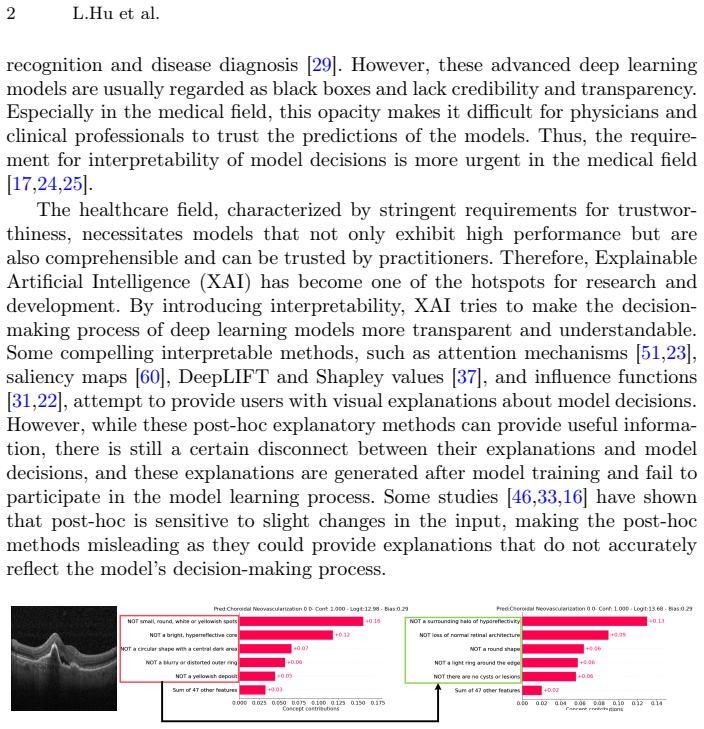
Transparency is a paramount concern in the medical field, prompting researchers to delve into the realm of explainable AI (XAI). Among these XAI methods, Concept Bottleneck Models (CBMs) aim to restrict the model's latent space to human-understandable high-level concepts by generating a conceptual layer for extracting conceptual features, which has drawn much attention recently. However, existing methods rely solely on concept features to determine the model's predictions, which overlook the intrinsic feature embeddings within medical images. To address this utility gap between the original models and concept-based models, we propose Vision Concept Transformer (VCT). Furthermore, despite their benefits, CBMs have been found to negatively impact model performance and fail to provide stable explanations when faced with input perturbations, which limits their application in the medical field. To address this faithfulness issue, this paper further proposes the Stable Vision Concept Transformer (SVCT) based on VCT, which leverages the vision transformer (ViT) as its backbone and incorporates a conceptual layer. SVCT employs conceptual features to enhance decision-making capabilities by fusing them with image features and ensures model faithfulness through the integration of Denoised Diffusion Smoothing. Comprehensive experiments on four medical datasets demonstrate that our VCT and SVCT maintain accuracy while remaining interpretable compared to baselines. Furthermore, even when subjected to perturbations, our SVCT model consistently provides faithful explanations, thus meeting the needs of the medical field.
Figures


Figures from the paper (6 more)


Reference graph
Works this paper leans on
-
[1]
arXiv preprint arXiv:2106.03734 (2021)
Aldahdooh, A., Hamidouche, W., Deforges, O.: Reveal of vision transformers ro- bustness against adversarial attacks. arXiv preprint arXiv:2106.03734 (2021)
arXiv 2021
-
[2]
Electronics10(17), 2132 (2021)
Apostolidis, K.D., Papakostas, G.A.: A survey on adversarial deep learning robust- ness in medical image analysis. Electronics10(17), 2132 (2021)
work page 2021
-
[3]
Brown, T.B., Mann, B., Ryder, N., Subbiah, M., Kaplan, J., Dhariwal, P., Nee- lakantan, A., Shyam, P., Sastry, G., Askell, A., Agarwal, S., Herbert-Voss, A., Krueger, G., Henighan, T., Child, R., Ramesh, A., Ziegler, D.M., Wu, J., Win- ter, C., Hesse, C., Chen, M., Sigler, E., Litwin, M., Gray, S., Chess, B., Clark, J., Berner, C., McCandlish, S., Radford...
work page 2020
-
[4]
In: Proceedings of the AAAI Conference on Artificial In- telligence
Chauhan, K., Tiwari, R., Freyberg, J., Shenoy, P., Dvijotham, K.: Interactive con- cept bottleneck models. In: Proceedings of the AAAI Conference on Artificial In- telligence. vol. 37(5), pp. 5948–5955 (2023)
2023
-
[5]
In: International Con- ference on Learning Representations (2020)
Dosovitskiy, A., Beyer, L., Kolesnikov, A., Weissenborn, D., Zhai, X., Unterthiner, T., Dehghani, M., Minderer, M., Heigold, G., Gelly, S., et al.: An image is worth 16x16 words: Transformers for image recognition at scale. In: International Con- ference on Learning Representations (2020)
2020
-
[6]
Expert Systems with Applications (2025)
Fang, X., Easwaran, A., Genest, B., Suganthan, P.N.: Your data is not perfect: To- wards cross-domain out-of-distribution detection in class-imbalanced data. Expert Systems with Applications (2025)
work page 2025
-
[7]
In: Proceedings of the AAAI Conference on Artificial Intelligence
Fang, X., Liu, D., Fang, W., Zhou, P., Xu, Z., Xu, W., Chen, J., Li, R.: Fewer steps, better performance: Efficient cross-modal clip trimming for video moment retrieval using language. In: Proceedings of the AAAI Conference on Artificial Intelligence. vol. 38(2), pp. 1735–1743 (2024)
work page 2024
-
[8]
IEEE Transactions on Multimedia25, 7517–7532 (2022)
Fang, X., Liu, D., Zhou, P., Hu, Y.: Multi-modal cross-domain alignment net- work for video moment retrieval. IEEE Transactions on Multimedia25, 7517–7532 (2022)
work page 2022
Show all 65 references
-
[9]
In: Proceedings of the IEEE/CVF Conference on Computer Vision and Pattern Recognition
Fang, X., Liu, D., Zhou, P., Nan, G.: You can ground earlier than see: An effec- tive and efficient pipeline for temporal sentence grounding in compressed videos. In: Proceedings of the IEEE/CVF Conference on Computer Vision and Pattern Recognition. pp. 2448–2460 (2023)
2023
-
[10]
IEEE Transactions on Multimedia (2023)
Fang, X., Liu, D., Zhou, P., Xu, Z., Li, R.: Hierarchical local-global transformer for temporal sentence grounding. IEEE Transactions on Multimedia (2023)
2023
-
[11]
short-length
Fu, S., Ding, L., Wang, D.: " short-length" adversarial training helps llms defend" long-length" jailbreak attacks: Theoretical and empirical evidence. arXiv preprint arXiv:2502.04204 (2025)
2025
-
[12]
Ghorbani, A., Abid, A., Zou, J.: Interpretation of neural networks is fragile (2018)
2018
-
[13]
In: Proceedings of the 1st ACM SIGSPATIAL International Workshop on Geo-Privacy and Data Utility for Smart Societies
Gou, X., Hu, L., Wang, D., Zhang, X.: A fundamental model with stable inter- pretability for traffic forecasting. In: Proceedings of the 1st ACM SIGSPATIAL International Workshop on Geo-Privacy and Data Utility for Smart Societies. pp. 10–13 (2023)
2023
-
[14]
Ho, J., Jain, A., Abbeel, P.: Denoising diffusion probabilistic models (2020)
2020
-
[15]
arXiv preprint arXiv:2406.18992 (2024)
Hu, L., Huang, T., Xie, H., Gong, X., Ren, C., Hu, Z., Yu, L., Ma, P., Wang, D.: Semi-supervised concept bottleneck models. arXiv preprint arXiv:2406.18992 (2024)
2024 arXiv
-
[16]
arXiv preprint arXiv:2410.06950 (2024) 16 L.Hu et al
Hu, L., Huang, T., Yu, L., Lin, W., Zheng, T., Wang, D.: Faithful interpretation for graph neural networks. arXiv preprint arXiv:2410.06950 (2024) 16 L.Hu et al
2024 arXiv
-
[17]
Advances in Neural Information Processing Systems37, 129640–129671 (2024)
Hu, L., Lai, S., Chen, W., Xiao, H., Lin, H., Yu, L., Zhang, J., Wang, D.: Towards multi-dimensional explanation alignment for medical classification. Advances in Neural Information Processing Systems37, 129640–129671 (2024)
2024
-
[18]
arXiv preprint arXiv:2406.12255 (2024)
Hu, L., Liu, L., Yang, S., Chen, X., Xiao, H., Li, M., Zhou, P., Ali, M.A., Wang, D.: A hopfieldian view-based interpretation for chain-of-thought reasoning. arXiv preprint arXiv:2406.12255 (2024)
2024 arXiv
-
[19]
12907–12915 (2023)
Hu, L., Liu, Y., Liu, N., Huai, M., Sun, L., Wang, D.: Seat: stable and explainable attention.In:ProceedingsoftheAAAIConferenceonArtificialIntelligence.vol.37, pp. 12907–12915 (2023)
2023
-
[20]
In: Forty-first International Conference on Ma- chine Learning (2024)
Hu, L., Liu, Y., Liu, N., Huai, M., Sun, L., Wang, D.: Improving interpretation faithfulness for vision transformers. In: Forty-first International Conference on Ma- chine Learning (2024)
2024
-
[21]
arXiv preprint arXiv:2405.15476 (2024)
Hu, L., Ren, C., Hu, Z., Lin, H., Wang, C.L., Xiong, H., Zhang, J., Wang, D.: Editable concept bottleneck models. arXiv preprint arXiv:2405.15476 (2024)
2024 arXiv
-
[22]
arXiv preprint arXiv:2411.11667 (2024)
Hu, L., Ren, C., Xie, H., Saadi, K., Yang, S., Tan, Z., Zhang, J., Wang, D.: Dis- secting representation misalignment in contrastive learning via influence function. arXiv preprint arXiv:2411.11667 (2024)
2024 arXiv
-
[23]
IEEE Transactions on Knowledge and Data Engineering (2025)
Hu, L., Wang, X., Liu, Y., Liu, N., Huai, M., Sun, L., Wang, D.: Towards stable and explainable attention mechanisms. IEEE Transactions on Knowledge and Data Engineering (2025)
2025
-
[24]
In: 2020 IEEE International Conference on Bioinformatics and Biomedicine (BIBM)
Huai, M., Miao, C., Liu, J., Wang, D., Chou, J., Zhang, A.: Global interpreta- tion for patient similarity learning. In: 2020 IEEE International Conference on Bioinformatics and Biomedicine (BIBM). pp. 589–594. IEEE (2020)
2020
-
[25]
In: Proceedings of the AAAI Conference on Artificial Intelligence
Huai, M., Wang, D., Miao, C., Zhang, A.: Towards interpretation of pairwise learn- ing. In: Proceedings of the AAAI Conference on Artificial Intelligence. vol. 34, pp. 4166–4173 (2020)
2020
-
[26]
AL-Rafidain Journal of Computer Sciences and Mathematics (2020),https://api.semanticscholar.org/CorpusID:219491413
Ismael, S., Kareem, S.W., Almukhtar, F.H.: Medical image classification using dif- ferent machine learning algorithms. AL-Rafidain Journal of Computer Sciences and Mathematics (2020),https://api.semanticscholar.org/CorpusID:219491413
2020
-
[27]
In: The Twelfth International Conference on Learning Representations (2023)
Ismail, A.A., Adebayo, J., Bravo, H.C., Ra, S., Cho, K.: Concept bottleneck genera- tive models. In: The Twelfth International Conference on Learning Representations (2023)
2023
-
[28]
Jacovi, A., Goldberg, Y.: Towards faithfully interpretable nlp systems: How should we define and evaluate faithfulness? (2020)
2020
-
[29]
Cell172, 1122–1131.e9 (2018),https:// api.semanticscholar.org/CorpusID:3516426
Kermany,D.S.,Kermany,D.S.,Goldbaum,M.H.,Cai,W.,Valentim,C.C.S.,Liang, H., Baxter, S.L., McKeown, A., Yang, G., Wu, X., Yan, F., Dong, J., Prasadha, M.K., Pei, J., Pei, J., Ting, M.Y.L., Zhu, J., Li, C.M., Hewett, S., Hewett, S., Dong, J., Ziyar, I., Shi, A., Zhang, R., Zheng, ...
2018
-
[30]
BMC medical imaging22(1), 69 (2022)
Kim, H.E., Cosa-Linan, A., Santhanam, N., Jannesari, M., Maros, M.E., Gans- landt, T.: Transfer learning for medical image classification: a literature review. BMC medical imaging22(1), 69 (2022)
2022
-
[31]
Koh, P.W., Liang, P.: Understanding black-box predictions via influence functions (2020)
2020
-
[32]
In: International conference on machine learning
Koh, P.W., Nguyen, T., Tang, Y.S., Mussmann, S., Pierson, E., Kim, B., Liang, P.: Concept bottleneck models. In: International conference on machine learning. pp. 5338–5348. PMLR (2020) Stable Vision Concept Transformers 17
2020
-
[33]
In: The Twelfth International Con- ference on Learning Representations (2023)
Lai, S., Hu, L., Wang, J., Berti-Equille, L., Wang, D.: Faithful vision-language interpretation via concept bottleneck models. In: The Twelfth International Con- ference on Learning Representations (2023)
2023
-
[34]
Li, B., Chen, C., Wang, W., Carin, L.: Certified adversarial robustness with addi- tive noise (2019)
2019
-
[35]
International Journal of Network Dynamics and Intelligence pp
Li, X., Li, M., Yan, P., Li, G., Jiang, Y., Luo, H., Yin, S.: Deep learning attention mechanism in medical image analysis: Basics and beyonds. International Journal of Network Dynamics and Intelligence pp. 93–116 (2023)
2023
-
[36]
arXiv preprint arXiv:2107.01561 (2021)
Liu, A., Chen, X., Liu, S., Xia, L., Gan, C.: Certifiably robust interpretation via renyi differential privacy. arXiv preprint arXiv:2107.01561 (2021)
2021 arXiv
-
[37]
Lundberg, S., Lee, S.I.: A unified approach to interpreting model predictions (2017)
2017
-
[38]
arXiv preprint arXiv:1706.06083 (2017)
Madry, A., Makelov, A., Schmidt, L., Tsipras, D., Vladu, A.: Towards deep learning models resistant to adversarial attacks. arXiv preprint arXiv:1706.06083 (2017)
2017 arXiv
-
[39]
In: Proceedings of the IEEE/CVF International Conference on Computer Vision
Mahmood, K., Mahmood, R., Van Dijk, M.: On the robustness of vision trans- formers to adversarial examples. In: Proceedings of the IEEE/CVF International Conference on Computer Vision. pp. 7838–7847 (2021)
2021
-
[40]
In: Proceedings of the IEEE/CVF Conference on Computer Vision and Pattern Recognition
Mao, X., Qi, G., Chen, Y., Li, X., Duan, R., Ye, S., He, Y., Xue, H.: Towards robust vision transformer. In: Proceedings of the IEEE/CVF Conference on Computer Vision and Pattern Recognition. pp. 12042–12051 (2022)
2022
-
[41]
Advances in Neural Information Processing Systems34, 23296–23308 (2021)
Naseer, M.M., Ranasinghe, K., Khan, S.H., Hayat, M., Shahbaz Khan, F., Yang, M.H.: Intriguing properties of vision transformers. Advances in Neural Information Processing Systems34, 23296–23308 (2021)
2021
-
[42]
In: The Eleventh International Conference on Learning Representations (2022)
Oikarinen, T., Das, S., Nguyen, L.M., Weng, T.W.: Label-free concept bottleneck models. In: The Eleventh International Conference on Learning Representations (2022)
2022
-
[43]
Oikarinen, T., Das, S., Nguyen, L.M., Weng, T.W.: Label-free concept bottleneck models (2023)
2023
-
[44]
Oikarinen, T., Weng, T.W.: Clip-dissect: Automatic description of neuron repre- sentations in deep vision networks (2023)
2023
-
[45]
In: Proceedings of the AAAI Conference on Artificial Intelligence
Paul, S., Chen, P.Y.: Vision transformers are robust learners. In: Proceedings of the AAAI Conference on Artificial Intelligence. vol. 36, pp. 2071–2081 (2022)
2022
-
[46]
Rudin, C.: Stop explaining black box machine learning models for high stakes decisions and use interpretable models instead (2019)
2019
-
[47]
In: Proceedings of the IEEE/CVF Conference on Computer Vision and Pattern Recognition
Salman, H., Jain, S., Wong, E., Madry, A.: Certified patch robustness via smoothed vision transformers. In: Proceedings of the IEEE/CVF Conference on Computer Vision and Pattern Recognition. pp. 15137–15147 (2022)
2022
-
[48]
In: Proceedings of the IEEE/CVF Conference on Computer Vision and Pattern Recognition
Sarkar, A., Vijaykeerthy, D., Sarkar, A., Balasubramanian, V.N.: A framework for learning ante-hoc explainable models via concepts. In: Proceedings of the IEEE/CVF Conference on Computer Vision and Pattern Recognition. pp. 10286– 10295 (2022)
2022
-
[49]
Szegedy, C., Zaremba, W., Sutskever, I., Bruna, J., Erhan, D., Goodfellow, I., Fergus, R.: Intriguing properties of neural networks (2014)
2014
-
[50]
Scientific Data5(1) (Aug 2018).https://doi.org/10.1038/sdata.2018.161,http://dx
Tschandl, P., Rosendahl, C., Kittler, H.: The ham10000 dataset, a large collection of multi-source dermatoscopic images of common pigmented skin lesions. Scientific Data5(1) (Aug 2018).https://doi.org/10.1038/sdata.2018.161,http://dx. doi.org/10.1038/sdata.2018.161
2018 doi
-
[51]
Advances in neural information pro- cessing systems30(2017) 18 L.Hu et al
Vaswani,A.,Shazeer,N.,Parmar,N.,Uszkoreit,J.,Jones,L.,Gomez,A.N.,Kaiser, Ł., Polosukhin, I.: Attention is all you need. Advances in neural information pro- cessing systems30(2017) 18 L.Hu et al
2017
-
[52]
arXiv preprint arXiv:2310.13345 (2023)
Xu, X., Kong, K., Liu, N., Cui, L., Wang, D., Zhang, J., Kankanhalli, M.: An llm can fool itself: A prompt-based adversarial attack. arXiv preprint arXiv:2310.13345 (2023)
2023 arXiv
-
[53]
Journal of Big data6(1), 1–18 (2019)
Yadav, S.S., Jadhav, S.M.: Deep convolutional neural network based medical image classification for disease diagnosis. Journal of Big data6(1), 1–18 (2019)
2019
-
[54]
arXiv preprint arXiv:2310.03182 (2023)
Yan, A., Wang, Y., Zhong, Y., He, Z., Karypis, P., Wang, Z., Dong, C., Gentili, A., Hsu, C.N., Shang, J., et al.: Robust and interpretable medical image classifiers via concept bottleneck models. arXiv preprint arXiv:2310.03182 (2023)
2023 arXiv
-
[55]
Scientific Data10(1) (Jan 2023).https://doi.org/10.1038/ s41597-022-01721-8,http://dx.doi.org/10.1038/s41597-022-01721-8
Yang, J., Shi, R., Wei, D., Liu, Z., Zhao, L., Ke, B., Pfister, H., Ni, B.: Medm- nist v2 - a large-scale lightweight benchmark for 2d and 3d biomedical im- age classification. Scientific Data10(1) (Jan 2023).https://doi.org/10.1038/ s41597-022-01721-8,http://dx.doi.org/10.103...
2023 doi
-
[56]
Yeh, C.K., Hsieh, C.Y., Suggala, A.S., Inouye, D.I., Ravikumar, P.: On the (in)fidelity and sensitivity for explanations (2019)
2019
-
[57]
Yuksekgonul, M., Wang, M., Zou, J.: Post-hoc concept bottleneck models (2023)
2023
-
[58]
arXiv preprint arXiv:2003.13865 (2020)
Zhao, J., Zhang, Y., He, X., Xie, P.: Covid-ct-dataset: a ct scan dataset about covid-19. arXiv preprint arXiv:2003.13865 (2020)
2020 arXiv
-
[59]
arXiv preprint arXiv:2005.07347 (2020)
Zheng, T., Wang, D., Li, B., Xu, J.: Towards assessment of randomized mechanisms for certifying adversarial robustness. arXiv preprint arXiv:2005.07347 (2020)
2020 arXiv
-
[60]
In: 2016 IEEE Conference on Computer Vision and Pattern Recognition (CVPR)
Zhou, B., Khosla, A., Lapedriza, A., Oliva, A., Torralba, A.: Learning deep features for discriminative localization. In: 2016 IEEE Conference on Computer Vision and Pattern Recognition (CVPR). pp. 2921–2929 (2016).https://doi.org/10.1109/ CVPR.2016.319 Stable Vision Concept T...
2016
-
[61]
To reach the minimum, there are exactlyk0 different components in the top-k of˜wandq
-
[62]
To reach the minimum,qk−k0+1,· · ·, qk are not in the top-kofq
-
[63]
To reach the minimum,qk+1,· · ·, qk+k0 must appear in the top-kofq
-
[64]
Thus, based on Lemma 3, we only need to solve the following optimization problem to find a minimizerq: min q1,···,q T = TX i=1 qi( ˜wi qi )α s.t
[34] To reach the minimum, we must haveqi ≥q j for alli≤j. Thus, based on Lemma 3, we only need to solve the following optimization problem to find a minimizerq: min q1,···,q T = TX i=1 qi( ˜wi qi )α s.t. TX i=1 qi = 1 s.t.q i ≤q j, i≥j s.t.q i ≥0 s.t.q i −q j = 0,∀i, j∈ S={k−...
-
[65]
via the OpenAI API to generate concept sets. Since GPT-3 is stocked with a great deal of expertise in the medical domain when it is correctly questioned, it is possible to efficiently output important features for recognizing a certain category. In this paper, we ask GPT-3 the...
2015
Reviewed August 7, 2026 · model on record in the stance chip above.
Discussion (0). Sign in to comment.