REVIEW 4 major objections 8 minor 60 references
UniPTMs: The First Unified Multi-type PTM Site Prediction Model via Master-Slave Architecture-Based Multi-Stage Fusion Strategy and Hierarchical Contrastive Loss
T0 review · 4 major / 8 minor · reviewed 2026-08-07 · deepseek-v4-flash
Pith's one-line read This paper argues that a single master-slave network can accurately predict five different types of protein post-translational modification sites, outperforming dedicated single-modification predictors on every benchmark.
desk verdict A plausible and useful PTM prediction tool, but the headline performance claims are not reproducible as written and the 'first unified' framing is overstated. read the letter →
The pith
A machine-rendered reading of the paper's core claim, the machinery that carries it, and where it could break.
The reading
What carries the argument
The load-bearing object is the master-slave dual-path fusion architecture. The master branch processes high-dimensional sequence embeddings, ProtT5 and ESM-2, through a Bidirectional Gated Cross-Attention module that lets each embedding attend to the other through grouped QKV projections, multi-scale 3/5/7-mer dynamic convolutions, and a learned gating fusion. The slave branch aligns low-dimensional auxiliary features, EMBER2 structural embeddings, PseAAC, BLOSUM62, and AAIndex, with a Low-Dimensional Fusion Network using cross-dense attention, dynamic gating, and multi-scale convolutions. A Multi-scale Adaptive Convolutional Pyramid produces three levels of features, a Bidirectional Hierarchical Gated Fusion Network performs mid-stage master-slave interaction with asymmetric attention and dynamic convolution, and a Hierarchical Dynamic Weighting Fusion performs late-stage channel-spatial weighting with a temperature-like term driven by master-branch statistics. The final piece is a Hierarchical Contrastive Loss with intra-layer and cross-layer terms, whose job is to keep positive sites compact and multi-level features of the same sample aligned. These modules together carry the claim that multi-stage, bidirectional fusion is what lets one model generalize across modification types.
What would settle it
Retrain every baseline on the exact training partitions used for UniPTMs, with the same windowing, feature preprocessing, and a hyperparameter search of comparable effort, then compare MCC and AP on the same independent test sets; if UniPTMs' margins fall below the reported 3.2% to 11.4% MCC range, the comparative claim would not survive.
Extended reading notes
Core claim
UniPTMs claims that multi-type PTM site prediction is better solved by one master-slave network than by the single-modification predictors that dominate the field. The master path takes two large protein language model embeddings, ProtT5 and ESM-2, and merges them with a Bidirectional Gated Cross-Attention module; the slave path takes a structural embedding, EMBER2, plus conventional sequence descriptors (PseAAC, BLOSUM62, AAIndex) and merges them in a Low-Dimensional Fusion Network. The two paths are fused mid-way by a Bidirectional Hierarchical Gated Fusion Network and late by a Hierarchical Dynamic Weighting Fusion mechanism, with a Multi-scale Adaptive Convolutional Pyramid extracting shallow, intermediate, and deep features. A hierarchical contrastive loss enforces consistency within and across these levels. Tested on eight datasets covering five PTM types, the model reports higher MCC, AUC, and AP than the best published single-type model on every dataset, and a case study shows the model can scan a full protein sequence and flag three modification types at once.
Load-bearing premise
The load-bearing premise is that the published baseline predictors were evaluated fairly, on the same independent test sets and with equivalent preprocessing, even though several were originally trained on different data and may not have been retuned on UniPTMs' splits.
Editorial extensions
If this is right
- A single UniPTMs model can replace five separate predictors for the five studied PTM types, so whole-proteome scans can flag multiple modification types simultaneously.
- Rare modifications such as S-carboxyethylation and S-sulfhydration receive larger relative lifts, suggesting that shared features from common PTM types help data-scarce types.
- UniPTMs-mini keeps most of the accuracy while improving inference speed by roughly 10% to 26%, making large-scale screening more practical.
- Full-sequence scanning with a sliding window can recover experimentally known modification sites across a 136-residue protein, not just fragments.
- The modular design lets researchers swap in different pretrained embeddings without rebuilding the fusion machinery, as supported by the plug-and-play auxiliary feature experiments.
Reading between the lines
- Editorial inference: If the multi-task gains come from shared cross-type representations, then adding more PTM types to the same master-slave model should improve rare-modification prediction further, a trend the paper reports internally but does not test outside its five types.
- Editorial inference: The fusion design suggests a direct experiment: freeze the master path and retrain only the slave path on a new modification type, to measure how much structural and conventional features transfer.
- Editorial inference: Because the discussion notes that newer structural embeddings could add information, a testable next step is replacing EMBER2 with a more recent structural embedding and checking whether the reported gains on glycosylation and phosphorylation increase.
Editorial analysis
A structured set of objections, weighed in public.
Referee Report
Summary. The manuscript proposes UniPTMs, a unified deep-learning framework for predicting five types of post-translational modification (PTM) sites: threonine O-glycosylation, histidine N-phosphorylation, lysine succinylation, cysteine S-carboxyethylation, and cysteine S-sulfhydration. The architecture combines a master branch (ProtT5/ESM-2 embeddings processed by a Bidirectional Gated Cross-Attention module) with a slave branch (EMBER2 and conventional features processed by a Low-Dimensional Fusion Network), further augmented by a Multi-scale Adaptive Convolutional Pyramid, a Bidirectional Hierarchical Gated Fusion Network, and a Hierarchical Dynamic Weighting Fusion module. A hierarchical contrastive loss is introduced to align intra-layer and cross-layer features. Experiments are reported on eight independent datasets, claiming MCC improvements of 3.2%–11.4% and AP improvements of 4.2%–14.3% over existing tools, together with a lightweight variant UniPTMs-mini and a case study on whole-protein prediction.
Significance. If the empirical claims are reliable, UniPTMs would be a practically useful multi-type PTM predictor and a rich source of architectural ideas (BGCA, LDFN, BHGFN, HDWF, MACP, hierarchical contrastive loss). The manuscript provides code and data links at GitHub and includes extensive ablation studies, which are strengths. However, the central quantitative claims are not currently established: the baseline comparison protocol is underspecified, no error bars or significance tests are reported, and one of the key loss equations appears malformed. These issues are fixable but require careful re-evaluation of the experimental evidence.
major comments (4)
- [Section 3.3.1, Tables 10–14] The central quantitative claim—that UniPTMs outperforms state-of-the-art models by 3.2%–11.4% MCC and 4.2%–14.3% AP—rests on comparisons whose protocol is not documented. The text states that open-source toolkits were 'selectively curated' but does not state whether each baseline was (a) run locally on the same independent test sequences with identical preprocessing, window sizes, and decision thresholds, or (b) represented by metrics from its original publication. Several listed tools (e.g., NetOGlyc-4.0, GlycoMine, DOGpred, pCysMod) are web servers or fixed models trained on different datasets and cannot be retrained on the UniPTMs splits. If the latter is the case, the performance deltas are confounded by dataset and preprocessing differences. Please specify the exact evaluation protocol for each baseline and, where possible, rerun all baselines under a common protocol on the same test instances.
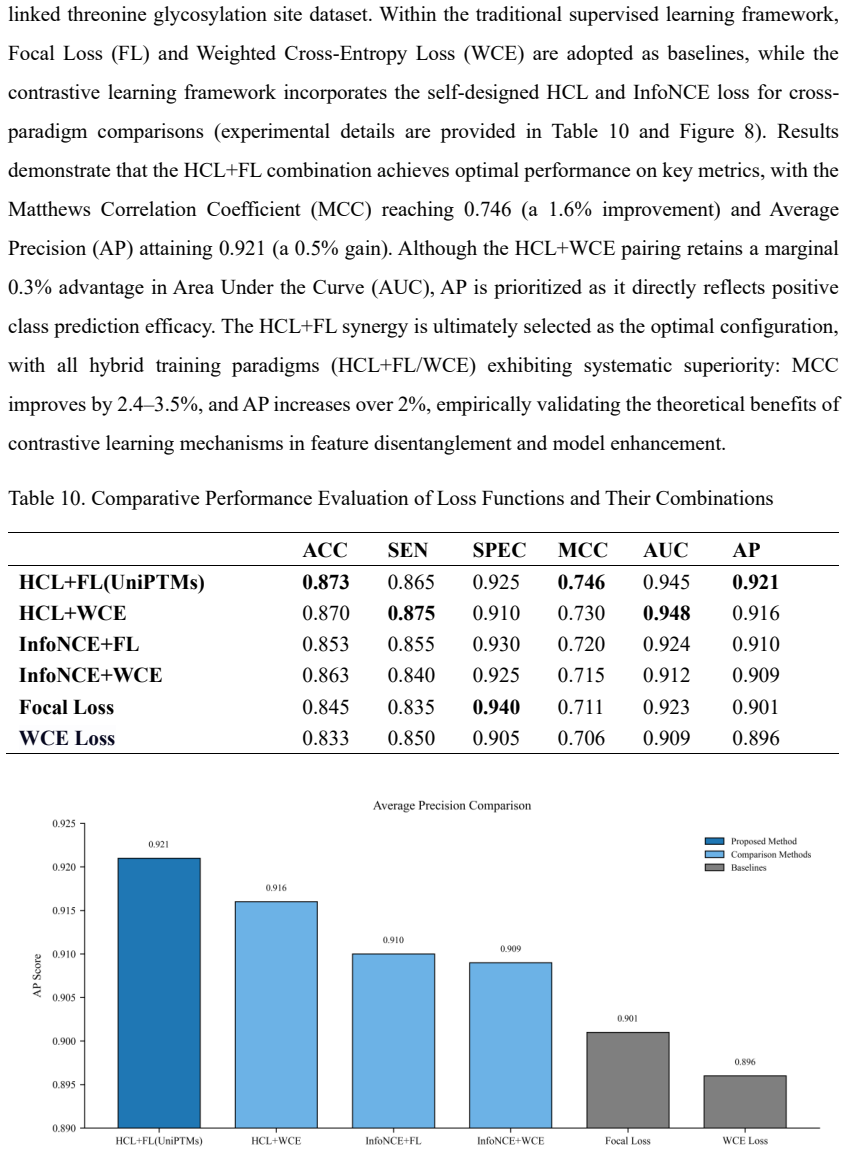
- [Section 3.3.1 and Tables 6–15] No error bars or significance tests are reported anywhere, despite the statement that two rounds of 5-fold cross-validation were conducted. All tables give single point estimates, and some decisive comparisons are small (e.g., Table 10: HCL+WCE AUC 0.948 vs. HCL+FL 0.945; Section 3.3.1: 3.2% MCC gain on C2). Overlap of error bars could change several conclusions. Please report mean ± standard deviation over the CV folds and perform appropriate statistical tests (e.g., paired tests across folds) for the UniPTMs-versus-baseline and ablation comparisons.
- [Equation (38)] The cross-layer contrastive loss is not written as a valid contrastive loss. The numerator is z_i^k · z_i^{k+1} / Γ without an exponential, while the denominator is a sum over the same index i, so the expression does not implement the described softmax over batch samples. As written it is also dimensionally inconsistent. Please correct the equation to the standard form with exp in the numerator and a denominator over all samples (including the positive pair), and add exact implementation details, since this loss is one of the paper's key contributions and its ablation (Section 3.1.5) depends on it.
- [Abstract, Section 1, Section 5] The claim that UniPTMs is 'the first unified framework for multi-type PTM prediction' is contradicted by the manuscript's own references: DeepPTM [15] and pCysMod [55] both address multiple PTM types. Either demonstrate the distinction (e.g., first to cover these five types, or first to use master-slave fusion) through a systematic comparison with existing multi-type tools, or temper the 'first' claim. This does not affect the technical soundness of the architecture, but it is a load-bearing novelty statement in the abstract.
minor comments (8)
- [Section 3.1.5 and Section 3.3.1] Table numbering is duplicated: Table 10 appears both for the loss-function comparison in Section 3.1.5 and for the O-glycosylation comparison in Section 3.3.1. Please renumber the tables.
- [Section 3.3.1, O-glycosylation paragraph] The reported MCC improvement range '4.3%–4.6%' is inconsistent with Table 10, where the T2 improvement is 10.6 percentage points (0.746 vs. 0.640 for DOGpred). Please correct the summary values.
- [Equation (37)] The intra-layer contrastive loss is also garbled: the denominator's summation index and the variable j in the exponent are not clearly defined. Please rewrite with explicit indices so that the positive and negative sets are unambiguous.
- [Equations (26) and (40)] The hyperparameter α introduced in Eq. (26) and the dynamic weighting schedule λ(t) in Eq. (40) are not specified in the main text. Please provide their values or functional forms (or point to a specific supplement section) to enable reproduction.
- [General] The manuscript repeatedly refers to 'Supplementary Materials' for dataset statistics, hyperparameters, and additional results, but the supplementary file is not included in the submitted version. Please ensure it is available to reviewers and readers.
- [References] Several reference entries concatenate multiple citations into one item (e.g., [9] contains Bileschi et al. and Chang et al.; [10] and [32] are similarly mixed). Please split these into separate numbered references.
- [Figures 12] Figure 12 is used twice: once for the MCC scatter plot in Section 3.3.1 and once for the case-study probability curves in Section 3.3.2. Please renumber the figures.
- [Section 3.1.2] The text refers to 'Supplementary Table 7' but Table 7 appears in the main text; the reference should be to Table 7.
Circularity Check
No circularity: UniPTMs' central claims rest on empirical benchmark comparisons and ablations, not on a derivation that reduces to its own inputs.
full rationale
The paper's contribution is an empirical deep-learning architecture evaluated on fixed datasets. The headline gains (3.2%-11.4% MCC, 4.2%-14.3% AP) are computed from Tables 10-14 comparing UniPTMs against external predictors; no equation in Section 2 is derived from those tables, and no parameter fitted to a subset is renamed as an independent prediction. The contrastive weight beta=0.7 is tuned experimentally (Section 2.4), but the total loss (Eqs. 39-40) is an optimization objective, not a generator of the reported benchmark numbers. The self-citations that appear (DLBWE-Cys [21] as a comparison baseline, PPSNO [60] as context in the Discussion) do not carry the load of the central claim, which is an empirical performance comparison rather than a citation-dependent uniqueness or derivation argument. The 'first unified framework' statement is a novelty assertion and is not backed by a self-referential proof. Two validity concerns exist but are not circularity: baseline evaluation protocol is not fully specified (so fairness of the comparison is hard to audit), and Eq. 38 is mathematically malformed as written (numerator lacks an exponential and the denominator includes the positive pair). Neither concern makes the reported results definitionally equivalent to the model's inputs or to a fitted parameter.
Assumptions & free parameters
free parameters (4)
- contrastive loss weighting beta =
0.7
- dynamic temperature offset alpha in HDWF =
not stated (learnable)
- contrastive loss schedule lambda(t) =
not stated
- case-study confidence threshold =
0.5
assumptions (4)
- domain assumption Protein language model embeddings (ProtT5, ESM-2) capture biologically relevant PTM-relevant features
- domain assumption EMBER2 embeddings provide structural information useful for PTM prediction
- domain assumption Public PTM datasets are accurate and have no leakage between train and test
- domain assumption Evaluation protocol is identical for UniPTMs and all baselines
Cite this review
Pith. "Pith review of UniPTMs: The First Unified Multi-type PTM Site Prediction Model via Master-Slave Architecture-Based Multi-Stage Fusion Strategy and Hierarchical Contrastive Loss." pith.science (2026). https://pith.science/paper/EHCD5B23
@misc{pith2026250605443,
  author       = {Pith},
  title        = {Pith review of: UniPTMs: The First Unified Multi-type PTM Site Prediction Model via Master-Slave Architecture-Based Multi-Stage Fusion Strategy and Hierarchical Contrastive Loss},
  year         = {2026},
  howpublished = {\url{https://pith.science/paper/EHCD5B23}},
  note         = {Machine review of arXiv:2506.05443}
}
read the original abstract
As a core mechanism of epigenetic regulation in eukaryotes, protein post-translational modifications (PTMs) require precise prediction to decipher dynamic life activity networks. To address the limitations of existing deep learning models in cross-modal feature fusion, domain generalization, and architectural optimization, this study proposes UniPTMs: the first unified framework for multi-type PTM prediction. The framework innovatively establishes a "Master-Slave" dual-path collaborative architecture: The master path dynamically integrates high-dimensional representations of protein sequences, structures, and evolutionary information through a Bidirectional Gated Cross-Attention (BGCA) module, while the slave path optimizes feature discrepancies and recalibration between structural and traditional features using a Low-Dimensional Fusion Network (LDFN). Complemented by a Multi-scale Adaptive convolutional Pyramid (MACP) for capturing local feature patterns and a Bidirectional Hierarchical Gated Fusion Network (BHGFN) enabling multi-level feature integration across paths, the framework employs a Hierarchical Dynamic Weighting Fusion (HDWF) mechanism to intelligently aggregate multimodal features. Enhanced by a novel Hierarchical Contrastive loss function for feature consistency optimization, UniPTMs demonstrates significant performance improvements (3.2%-11.4% MCC and 4.2%-14.3% AP increases) over state-of-the-art models across five modification types and transcends the Single-Type Prediction Paradigm. To strike a balance between model complexity and performance, we have also developed a lightweight variant named UniPTMs-mini.
Figures


Figures from the paper (4 more)



Reference graph
Works this paper leans on
-
[15]
Ertelt, M., Mulligan, V . K., Maguire, J. B., Lyskov, S., Moretti, R., Schiffner, T., ... & Schoeder, C. T. (2024). Combining machine learning with structure-based protein design to predict and engineer post -translational modifications of proteins. PLOS Computational Biology , 20(3), e1011939
work page 2024
- [55]
-
[1]
Watanabe, N., & Osada, H. (2012). Phosphorylation -dependent protein -protein interaction modules as potential molecular targets for cancer therapy. Current drug targets, 13(13), 1654- 1658
work page 2012
-
[2]
Singh, V ., Ram, M., Kumar, R., Prasad, R., Roy, B. K., & Singh, K. K. (2017). Phosphorylation: implications in cancer. The protein journal, 36(1), 1-6
work page 2017
-
[3]
Bagdonaite, I., Malaker, S. A., Polasky, D. A., Riley, N. M., Schjoldager, K., Vakhrushev, S. Y ., ... & Scott, N. E. (2022). Glycoproteomics. Nature Reviews Methods Primers, 2(1), 48
work page 2022
-
[4]
However, it exhibits relatively high model complexity
UniPTMs-mini UniPTMs integrates all modules proposed in this study and demonstrates outstanding performance in practical applications. However, it exhibits relatively high model complexity. To achieve a more optimal balance between model complexity and performance, we have developed a lightweight version, UniPTMs-mini. This version judiciously streamlines...
-
[5]
Pickart, C. M. (2001). Mechanisms underlying ubiquitination. Annual review of biochemistry, 70(1), 503-533
work page 2001
-
[6]
Yang, Y ., & Gibson, G. E. (2019). Succinylation links metabolism to protein functions. Neurochemical research, 44(10), 2346-2359
work page 2019
Show all 60 references
-
[7]
B., Spiess, S., Fuhrmann, J., Ammerer, G., Mechtler, K., & Clausen, T
Schmidt, A., Trentini, D. B., Spiess, S., Fuhrmann, J., Ammerer, G., Mechtler, K., & Clausen, T. (2014). Quantitative phosphoproteomics reveals the role of protein arginine phosphorylation in the bacterial stress response. Molecular & Cellular Proteomics, 13(2), 537- 550
2014
-
[8]
W., Gilligan, L
Mueller, J. W., Gilligan, L. C., Idkowiak, J., Arlt, W., & Foster, P. A. (2015). The regulation of steroid action by sulfation and desulfation. Endocrine reviews, 36(5), 526-563
2015
-
[9]
H., Chen, Z
Zhai, Y., Chen, L., Zhao, Q., Zheng, Z. H., Chen, Z. N., Bian, H., ... & Zhu, P. (2023). Cysteine carboxyethylation generates neoantigens to induce HLA -restricted autoimmunity. Science, 379(6637), eabg2482
2023
-
[10]
L., Belanger, D., Bryant, D
Bileschi, M. L., Belanger, D., Bryant, D. H., Sanderson, T., Carter, B., Sculley, D., ... & Colwell, L. J. (2022). Using deep learning to annotate the protein universe. Nature Biotechnology, 40(6), 932-937.Chang, X., Zhu, Y ., Chen, Y ., & Li, L. (2024). DeepNphos: A deep -lea...
2022
-
[11]
X., Ding, R
Zhao, M. X., Ding, R. F., Chen, Q., Meng, J., Li, F., Fu, S., ... & Zhao, Y . (2024). Nphos: Database and Predictor of Protein N -phosphorylation. Genomics, Proteomics & Bioinformatics, 22(3), qzae032
2024
-
[12]
Alsharif, H. (2024). Extensive comparison of protein sequence -based bioinformatics applications for predicting lysine succinylation sites: a comparative review. Biotechnology & Biotechnological Equipment, 38(1), 2425694
2024
-
[13]
Ramazi, S., & Zahiri, J. (2021). Post -translational modifications in proteins: resources, tools and prediction methods. Database, 2021, baab012
2021
-
[14]
S., Huang, L., Liu, L., Chen, X., Zhang, W.,
Meng, L., Chan, W. S., Huang, L., Liu, L., Chen, X., Zhang, W., ... & Wong, K. C. (2022). Mini-review: recent advances in post-translational modification site prediction based on deep learning. Computational and Structural Biotechnology Journal, 20, 3522-3532
2022
-
[16]
N., & Sefer, E
Soylu, N. N., & Sefer, E. (2024). DeepPTM: protein post-translational modification prediction from protein sequences by combining deep protein language model with vision transformers. Current Bioinformatics, 19(9), 810-824
2024
-
[17]
C., Pokharel, S., Saigo, H., & Kc, D
Pakhrin, S. C., Pokharel, S., Saigo, H., & Kc, D. B. (2022). Deep learning–based advances in protein posttranslational modification site and protein cleavage prediction. In Computational methods for predicting post -translational modification sites (pp. 285 -322). New York, NY...
2022
-
[18]
Esmaili, F., Pourmirzaei, M., Ramazi, S., Shojaeilangari, S., & Yavari, E. (2023). A review of machine learning and algorithmic methods for protein phosphorylation site prediction. Genomics, Proteomics & Bioinformatics, 21(6), 1266-1285
2023
-
[19]
Tang, H., Tang, Q., Zhang, Q., & Feng, P. (2023). O -GlyThr: prediction of human O -linked threonine glycosites using multi -feature fusion. International Journal of Biological Macromolecules, 242, 124761
2023
-
[20]
T., Zhang, Y ., Rakkiyappan, R., & Manavalan, B
Pham, N. T., Zhang, Y ., Rakkiyappan, R., & Manavalan, B. (2024). HOTGpred: Enhancing human O -linked threonine glycosylation prediction using integrated pretrained protein language model -based features and multi -stage feature selection approach. Computers in Biology and Med...
2024
-
[21]
Jia, J., Wu, G., Li, M., & Qiu, W. (2022). pSuc-EDBAM: Predicting lysine succinylation sites in proteins based on ensemble dense blocks and an attention module. BMC bioinformatics, 23(1), 450
2022
-
[22]
Luo, Z., Wang, Q., Xia, Y ., Zhu, X., Yang, S., Xu, Z., & Gu, L. (2025). DLBWE-Cys: a deep- learning-based tool for identifying cysteine S -carboxyethylation sites using binary -weight encoding. Frontiers in Genetics, 15, 1464976
2025
-
[23]
Wei, X., Ning, Q., Che, K., Liu, Z., Li, H., & Guo, S. (2025). Sul -BertGRU: An Ensemble Deep Learning Method integrating Information Entropy -enhanced BERT and Directional Multi-GRU for S-sulfhydration Sites prediction. Bioinformatics, btaf078
2025
-
[24]
& Rost, B
Elnaggar, A., Heinzinger, M., Dallago, C., Rehawi, G., Wang, Y ., Jones, L., ... & Rost, B. (2021). ProtTrans: towards cracking the language of life’s code through self -supervised learning. IEEE Transactions on Pattern Analysis and Machine Intelligence, 44, 7112-7127
2021
-
[25]
& Rives, A
Lin, Z., Akin, H., Rao, R., Hie, B., Zhu, Z., Lu, W., ... & Rives, A. (2022). Language models of protein sequences at the scale of evolution enable accurate structure prediction. BioRxiv, 2022, 500902
2022
-
[26]
Weissenow, K., Heinzinger, M., & Rost, B. (2022). Protein language -model embeddings for fast, accurate, and alignment-free protein structure prediction. Structure, 30(8), 1169-1177
2022
-
[27]
J., Khan, R., & Khan, Y
Malebary, S. J., Khan, R., & Khan, Y . D. (2021). ProtoPred: advancing oncological research through identification of proto-oncogene proteins. IEEE Access, 9, 68788-68797
2021
-
[28]
Wang, M., Song, L., Zhang, Y ., Gao, H., Yan, L., & Y u, B. (2022). Malsite-deep: prediction of protein malonylation sites through deep learning and multi -information fusion based on NearMiss-2 strategy. Knowledge-Based Systems, 240, 108191
2022
-
[29]
Wang, M., Jia, J., Xu, F., Zhou, H., Liu, Y ., & Yu, B. (2024). Res-GCN: Identification of protein phosphorylation sites using graph convolutional network and residual network. Computational Biology and Chemistry, 112, 108183
2024
-
[30]
Li, H., & Wu, X. J. (2024). CrossFuse: A novel cross attention mechanism based infrared and visible image fusion approach. Information Fusion, 103, 102147
2024
-
[32]
Vaswani, A., Shazeer, N., Parmar, N., Uszkoreit, J., Jones, L., Gomez, A. N., ... & Polosukhin, I. (2017). Attention is all you need. Advances in neural information processing systems, 30
2017
-
[33]
Xie, J., Dong, R., Zhu, J., Lin, H., Wang, S., & Lai, L. (2025). MMFuncPhos: A Multi‐Modal Learning Framework for Identifying Functional Phosphorylation Sites and Their Regulatory Types. Advanced Science, 2410981
2025
-
[34]
H., Liu, Y
Tseng, Y. H., Liu, Y. C., Malik, M. S., & Ou, Y. Y. (2024). VesiMCNN: Using pre -trained protein language models and multiple window scanning convolutional neural networks to identify vesicular transport proteins. International Journal of Biological Macromolecules, 280, 136048
2024
-
[36]
J., & Tao, D
Gou, J., Yu, B., Maybank, S. J., & Tao, D. (2021). Knowledge distillation: A survey. International Journal of Computer Vision, 129(6), 1789-1819
2021
-
[37]
Wei, Y., & Bai, Y. (2024). Dynamic temperature knowledge distillation. arXiv preprint arXiv:2404.12711
2024 arXiv
-
[38]
L., Kiros, J
Ba, J. L., Kiros, J. R., & Hinton, G. E. (2016). Layer normalization. arxiv preprint arxiv:1607.06450
2016 arXiv
-
[39]
Hu, J., Shen, L., & Sun, G. (2018). Squeeze -and-excitation networks. In Proceedings of the IEEE conference on computer vision and pattern recognition (pp. 7132-7141)
2018
-
[40]
Hou, Q., Zhou, D., & Feng, J. (2021). Coordinate attention for efficient mobile network design. In Proceedings of the IEEE/CVF conference on computer vision and pattern recognition (pp. 13713-13722)
2021
-
[41]
Hochreiter, S., & Schmidhuber, J. (1997). Long short-term memory. Neural computation, 9(8), 1735-1780
1997
-
[42]
Gu, A., & Dao, T. (2023). Mamba: Linear -time sequence modeling with selective state spaces. arxiv preprint arxiv:2312.00752
2023 arXiv
-
[43]
(2020, August)
Wang, L., Zhang, J., Wang, Y., Lu, H., & Ruan, X. (2020, August). Cliffnet for monocular depth estimation with hierarchical embedding loss. In European Conference on Computer Vision (pp. 316-331). Cham: Springer International Publishing
2020
-
[44]
Oord, A. V. D., Li, Y., & Vinyals, O. (2018). Representation learning with contrastive predictive coding. arXiv preprint arXiv:1807.03748
2018 arXiv
-
[45]
W., Pham, N
Lee, K. W., Pham, N. T., Min, H. J., Park, H. W., Lee, J. W., Lo, H. E., ... & Jeon, Y. J. (2025). DOGpred: A Novel Deep Learning Framework for Accurate Identification of Human O-linked Threonine Glycosylation Sites. Journal of Molecular Biology, 168977
2025
-
[46]
I., Zhang, Y ., Whisstock, J
Li, F., Li, C., Wang, M., Webb, G. I., Zhang, Y ., Whisstock, J. C., & Song, J. (2015). GlycoMine: a machine learning -based approach for predicting N -, C-and O-linked glycosylation in the human proteome. Bioinformatics, 31(9), 1411-1419
2015
-
[47]
& Cao, W
Huang, J., Wu, M., Zhang, Y ., Kong, S., Liu, M., Jiang, B., ... & Cao, W. (2021). OGP: a repository of experimentally characterized O -glycoproteins to facilitate studies on O - glycosylation. Genomics, proteomics & bioinformatics, 19(4), 611-618
2021
-
[48]
C., Chauhan, N., Khan, S., Upadhyaya, J., Beck, M
Pakhrin, S. C., Chauhan, N., Khan, S., Upadhyaya, J., Beck, M. R., & Blanco, E. (2024). Prediction of human O-linked glycosylation sites using stacked generalization and embeddings from pre-trained protein language model. Bioinformatics, 40(11), btae643
2024
-
[49]
& Xue, Y
Zhang, C., Tang, D., Han, C., Gou, Y ., Chen, M., Huang, X., ... & Xue, Y . (2024). GPS-pPLM: A Language Model for Prediction of Prokaryotic Phosphorylation Sites. Cells, 13(22), 1854
2024
-
[50]
& Song, X
Zhao, J., Zhuang, M., Liu, J., Zhang, M., Zeng, C., Jiang, B., ... & Song, X. (2022). pHisPred: a tool for the identification of histidine phosphorylation sites by integrating amino acid patterns and properties. BMC bioinformatics, 23(Suppl 3), 399
2022
-
[51]
Pokharel, S., Pratyush, P., Heinzinger, M., Newman, R., & Dukka, K. C. (2022). LMSuccSite: Improving Protein Succinylation Sites Prediction Using Embeddings from Protein Language Model
2022
-
[52]
Wang, H., Zhao, H., Zhang, J., Han, J., & Liu, Z. (2022). A parallel model of DenseCNN and ordered‐neuron LSTM for generic and species‐specific succinylation site prediction. Biotechnology and Bioengineering, 119(7), 1755-1767
2022
-
[53]
Huang, G., Shen, Q., Zhang, G., Wang, P., & Yu, Z. G. (2021). LSTMCNNsucc: A bidirectional LSTM and CNN‐based deep learning method for predicting lysine succinylation sites. BioMed research international, 2021(1), 9923112
2021
-
[54]
H., Saigo, H., & Kc, D
Thapa, N., Chaudhari, M., McManus, S., Roy, K., Newman, R. H., Saigo, H., & Kc, D. B. (2020). DeepSuccinylSite: a deep learning based approach for protein succinylation site prediction. BMC bioinformatics, 21, 1-10
2020
-
[56]
& Cheng, H
Li, S., Yu, K., Wu, G., Zhang, Q., Wang, P., Zheng, J., ... & Cheng, H. (2021). pCysMod: prediction of multiple cysteine modifications based on deep learning framework. Frontiers in Cell and Developmental Biology, 9, 617366
2021
-
[57]
Yang, Z., Zeng, X., Zhao, Y ., & Chen, R. (2023). AlphaFold2 and its applications in the fields of biology and medicine. Signal Transduction and Targeted Therapy, 8(1), 115
2023
-
[58]
& Jumper, J
Abramson, J., Adler, J., Dunger, J., Evans, R., Green, T., Pritzel, A., ... & Jumper, J. M. (2024). Accurate structure prediction of biomolecular interactions with AlphaFold
2024
-
[59]
Nature, 630(8016), 493-500
-
[60]
Behrouz, A., Zhong, P., & Mirrokni, V . (2024). Titans: Learning to memorize at test time. arxiv preprint arxiv:2501.00663
2024 arXiv
-
[61]
Wu, Z., Pan, S., Chen, F., Long, G., Zhang, C., & Yu, P. S. (2020). A comprehensive survey on graph neural networks. IEEE transactions on neural networks and learning systems, 32(1), 4- 24
2020
-
[62]
Zhu, L., Wang, L., Yang, Z., Xu, P., & Yang, S. (2024). PPSNO: A Feature -Rich SNO Sites Predictor by Stacking Ensemble Strategy from Protein Sequence -Derived Information. Interdisciplinary Sciences: Computational Life Sciences, 16(1), 192-217
2024
Reviewed August 7, 2026 · model on record in the stance chip above.
Discussion (0). Sign in to comment.