REVIEW 4 major objections 7 minor 34 references
Applying Informer for Option Pricing: A Transformer-Based Approach
T0 review · 4 major / 7 minor · reviewed 2026-08-07 · deepseek-v4-flash
Pith's one-line read Informer, a transformer for long time series, beats Black-Scholes, Heston, and LSTM on 30-day Apple option price forecasts.
desk verdict A plausible but thin Informer-for-option-pricing application whose headline tables appear to be validation-set numbers; the core claim is not yet demonstrated on a held-out test set. read the letter →
The pith
A machine-rendered reading of the paper's core claim, the machinery that carries it, and where it could break.
The reading
What carries the argument
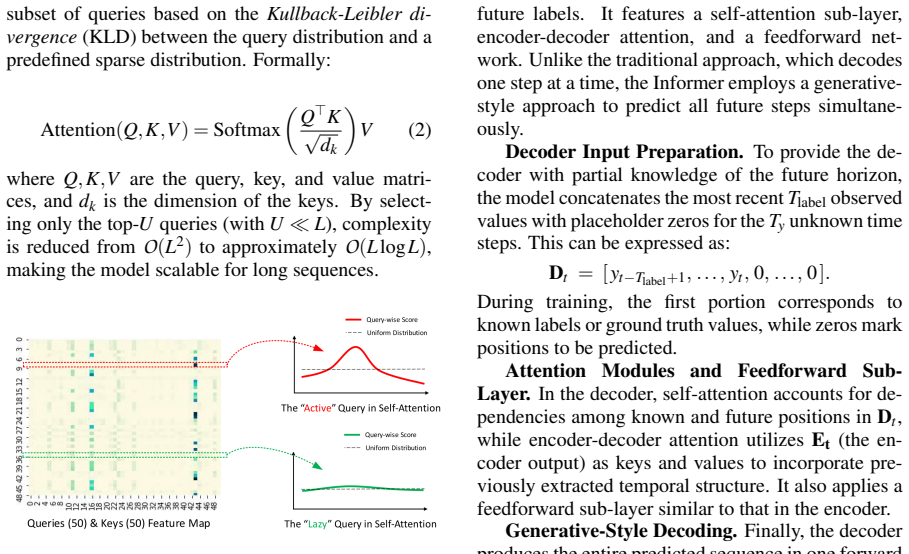
The load-bearing object is the Informer model, a Transformer variant for long-sequence time-series forecasting. Its ProbSparse self-attention computes a sparse set of query-key pairs, selecting the most informative queries by the KL divergence between their attention distribution and a uniform distribution; this drops complexity from $O(L^2)$ to about $O(L\log L)$ for input length $L$. A generative-style decoder receives the last five known prices followed by zeros for the next 30 steps and emits the full forecast in a single forward pass. The model is fed 30-day windows of underlying price, implied volatility, time to maturity, strike price, and call/put type, normalized to $[0,1]$, and trained with a weighted mean-squared-error loss. This machinery carries the argument because it is the only component that differs between the Informer and the baseline models.
What would settle it
Re-run the experiment with a strictly chronological split, training on early years and testing only on later dates; if Informer's MAE, RMSE, and net value stop beating LSTM and Black-Scholes by the reported margins, the claimed advantage is an artifact of overlapping data periods.
Extended reading notes
Core claim
The paper's central claim is that Informer is the most accurate of the four tested models for predicting option prices 30 days ahead. On the AAPL dataset, Informer attains MAE 2.7145 and RMSE 3.6766, compared with LSTM (3.9343, 5.0373), Black-Scholes (4.1765, 5.3840), and Heston (4.1282, 5.3565). It also records the highest final-day direction accuracy (54.43%) and the highest cumulative net value from the paper's trading rule (1.30, versus 1.21 for LSTM and 1.14-1.15 for the traditional models). The paper interprets these results as showing that the architecture's attention mechanism tracks market fluctuations better than recurrent or closed-form baselines.
Load-bearing premise
The reported outperformance rests on the assumption that the 70/15/15 train/validation/test split does not leak future information into training; the paper does not state whether the split is chronological, so the same 30-day window could appear in both training and test sets.
Editorial extensions
If this is right
- If the reported numbers hold, Informer is the most accurate model on this AAPL dataset across all published metrics, so the conclusion does not rest on a single error measure.
- The single-pass generative decoder means a 30-day forecast is produced without autoregressive steps, which is faster than step-by-step decoding for deployment.
- ProbSparse attention's reduced complexity makes longer input histories feasible, so the same architecture could be trained on larger option panels.
- The trading-rule result—net value 1.30 versus 1.21 for LSTM and 1.14-1.15 for Black-Scholes and Heston—shows that lower average error coincides with better directional bets on this dataset.
Reading between the lines
- A strictly chronological train/validation/test split is not reported; re-running the comparison with the test set entirely after the training period would show whether the margins survive without overlapping 30-day windows.
- The 54.43% direction accuracy is just above chance, so a practical extension is to test the trading rule after realistic bid-ask spreads and transaction costs; the net-value gap may be smaller in practice.
- Because the input already includes implied volatility, strike, and time to maturity, the model may be relearning the volatility surface; comparing it against a simple implied-volatility interpolation baseline would isolate the contribution of the attention architecture.
Editorial analysis
A structured set of objections, weighed in public.
Referee Report
Summary. The paper applies the Informer transformer architecture to option pricing on eight years of AAPL options data (2016–2023), comparing its prediction accuracy (MAE, RMSE, final-day MAE, direction accuracy) and a simple direction-based trading rule's cumulative net value against LSTM, Black-Scholes, and Heston baselines. The central claim is that Informer outperforms all baselines on this dataset. The paper reports an Informer MAE of 2.7145 and RMSE of 3.6766 versus 3.9343/5.0373 for LSTM and higher errors for the traditional models, as well as the highest net value of 1.30. The experimental design, however, leaves several load-bearing ambiguities—most importantly, whether the reported results come from the validation set or the held-out test set—and omits key implementation and statistical details.
Significance. The contribution is incremental: it applies an existing architecture (Informer, Zhou et al. 2021) to a new domain (option pricing) and reports an empirical comparison on a single asset. If the results were reproducible and based on a genuine out-of-sample test, they would provide a useful data point on transformer-based option pricing. The paper does not ship code, data, or baseline implementations, and it lacks error bars or statistical tests, so the strength of the evidence is currently insufficient to support the stated superiority claims. The topic is relevant to computational finance, but the novelty and rigor are limited.
major comments (4)
- [Section 4.3–4.4] The evaluation set is ambiguous. Section 4.3 states that the model's outputs are compared with the ground truth on the validation set, while Section 4.4 presents Tables 1–3 without specifying whether these are validation or test results. Because Section 4.2 describes early stopping on validation loss and hyperparameter tuning by random search, any results computed on the validation set are in-sample for model selection and therefore optimistically biased. The central claim that Informer achieves the lowest MAE and RMSE and the highest net value is not supported unless the reported numbers come from the 15% held-out test set described in Section 4.1. The authors must clarify this or rerun the evaluation on the test set.
- [Section 4.1] The data split is not described as chronological. The paper says only that 70% is used for training, 15% for validation, and 15% for testing. For a time-series task with 30-day input windows and 30-day prediction horizons, a random split over contracts or dates can place overlapping windows from the same period in both training and test sets, allowing the model to memorize price levels rather than learn to forecast. The authors should state whether the split is by date and, if so, ensure no temporal overlap; alternatively, a walk-forward or rolling-window evaluation would be more appropriate.
- [Section 4.1 and 4.4] The implementation of the Black-Scholes and Heston baselines is not described. It is not stated how volatility is estimated (e.g., historical volatility, implied volatility, or a calibrated surface), how Heston parameters are chosen, or whether the baselines use the same input features as the neural models. Without this information, the comparison cannot be reproduced and may not be a fair benchmark. Please provide complete specifications for all baseline models, including parameter estimation procedures.
- [Tables 1–3] All reported metrics are single-point estimates without standard errors, confidence intervals, or statistical tests. The differences between models are small in relative terms (for example, direction accuracy of 54.43% versus 52.19%), and may be within sampling variability. The authors should report results across multiple random seeds or use bootstrap resampling to demonstrate that the Informer's advantage is statistically reliable. This is load-bearing for the paper's main claim of superiority.
minor comments (7)
- [Figure 2 caption] The caption says 'Copied from (Zhou et al., 2021)'; this should be replaced with 'Reprinted with permission' and the permission obtained, as copying a published figure without permission raises copyright concerns.
- [Figure 1 caption] There is a typo in 'concepcual', which should be 'conceptual'.
- [Equation (1)] The normalization uses x_min and x_max without specifying that these should be computed on the training set only; otherwise, the normalization itself can leak information from the test set.
- [Equation (2)] The displayed attention formula is the standard softmax attention, not the ProbSparse variant described in the text. Either the formula should be specialized to ProbSparse or the text should clarify that Eq. (2) is the general attention form and the ProbSparse selection is applied separately.
- [General notation] The notation is inconsistent in places: 'DMODEL' appears in Section 4.2 while Section 3.2 uses 'dmodel'; 'Tlabel' in Section 3.2.2 should be formatted as T_label and defined more clearly. The reference 'Yue Liu, 2023' in the text should use the full citation format with initials.
- [Section 4.2] The random search procedure is described only as 'fine-tuned via random search'; the search space, number of trials, and the final hyperparameter values are not given. This information is needed for reproducibility.
- [Abstract and Section 5] The claim that 'Informer outperforms traditional approaches' is stated without qualification; given the single-asset dataset and the caveats above, the conclusion should be scoped to this dataset and experimental setup.
Circularity Check
The claimed 'prediction accuracy' and trading profitability are computed on the validation set that was used for early stopping and hyperparameter search, so Tables 1–3 do not provide independent out-of-sample evidence.
-
fitted input called prediction
[Section 4.2–4.4 (training/evaluation/results), Tables 1–3]
"Training proceeds over 300 epochs, with early stopping applied based on validation loss, using a patience of 30 epochs. ... Hyperparameters ... were fine-tuned via random search. ... The model’s outputs are compared with the ground truth on the validation set to evaluate the prediction accuracy. ... The Informer model achieves the lowest MAE (2.7145) and RMSE (3.6766) among all models, demonstrating its superior ability to predict option prices with high accuracy."
The validation set is used twice: as the target for early stopping and random-search hyperparameter selection (§4.2) and as the 'ground truth' for the reported MAE, RMSE, DA, and Net Value (§4.3). Consequently Tables 1–3 report performance on the same data that selected the model, not on an independent test set. The claim that Informer 'demonstrat[es] its superior ability to predict option prices' is therefore an in-selection performance measurement: the model was chosen to minimize validation loss, and the same validation loss surface is relabeled as 'prediction accuracy.' The untouched 15% test set from §4.1 is never referenced in §4.3–4.4, so the reported superiority is not shown to be out-of-sample.
full rationale
One circular step is present in the evaluation chain: the reported metrics are computed on the validation set that already guided early stopping and hyperparameter search, so the claimed out-of-sample superiority reduces to in-sample model selection. Self-citations (Szydlowski and Chudziak 2024a/b; Chudziak and Wawer 2024) are not load-bearing: they appear only in a figure caption, related-work context, and future-work suggestions, not as evidence for the performance claim. The Informer architecture is taken from Zhou et al. (2021), an external source, and no equation defines the performance result in terms of fitted parameters. The 70/15/15 split is stated, but Section 4.3 says evaluation is on the validation set; if the final tables were instead from the untouched test set, this step would not be circular, but the text as written specifies validation.
Assumptions & free parameters
free parameters (2)
- Model hyperparameter set =
Tx=30, Ty=30, label_len=5, 1 encoder layer, 2 decoder layers, 3 heads, d_model=32, d_ff=8, dropout=0.06…
- Data filtering thresholds =
TTM >= 30 days; moneyness in [0.6, 1.3]; low-volume contracts removed
assumptions (4)
- domain assumption The 70/15/15 data split avoids lookahead leakage.
- domain assumption The selected features are sufficient to predict future option prices.
- domain assumption Black-Scholes and Heston baselines are calibrated fairly and correctly.
- domain assumption The Informer implementation follows Zhou et al. 2021 faithfully.
Cite this review
Pith. "Pith review of Applying Informer for Option Pricing: A Transformer-Based Approach." pith.science (2026). https://pith.science/paper/CWOIAB76
@misc{pith2026250605565,
  author       = {Pith},
  title        = {Pith review of: Applying Informer for Option Pricing: A Transformer-Based Approach},
  year         = {2026},
  howpublished = {\url{https://pith.science/paper/CWOIAB76}},
  note         = {Machine review of arXiv:2506.05565}
}
read the original abstract
Accurate option pricing is essential for effective trading and risk management in financial markets, yet it remains challenging due to market volatility and the limitations of traditional models like Black-Scholes. In this paper, we investigate the application of the Informer neural network for option pricing, leveraging its ability to capture long-term dependencies and dynamically adjust to market fluctuations. This research contributes to the field of financial forecasting by introducing Informer's efficient architecture to enhance prediction accuracy and provide a more adaptable and resilient framework compared to existing methods. Our results demonstrate that Informer outperforms traditional approaches in option pricing, advancing the capabilities of data-driven financial forecasting in this domain.
Figures


Figures from the paper (3 more)


Reference graph
Works this paper leans on
-
[1]
write newline
" write newline "" before.all 'output.state := FUNCTION fin.entry add.period write newline FUNCTION new.block output.state before.all = 'skip after.block 'output.state := if FUNCTION new.sentence output.state after.block = 'skip output.state before.all = 'skip after.sentence 'output.state := if if FUNCTION not #0 #1 if FUNCTION and 'skip pop #0 if FUNCTIO...
-
[2]
Amilon, H. (2003). A neural network versus black-scholes: A comparison of pricing and hedging performances. Journal of Forecasting , 22(4):317--335
work page 2003
-
[3]
Assaf Eisdorfer, R. S. and Zhdanov, A. (2022). Maturity driven mispricing of options. Journal of Financial and Quantitative Analysis , 57(2):514--542
work page 2022
-
[4]
Bakshi, G., Cao, C., and Chen, Z. (2000). Pricing and hedging long-term options. Journal of Econometrics , 94(1):277--318
work page 2000
-
[5]
Bao, W., Yue, J., and Rao, Y. (2017). A deep learning framework for financial time series using stacked autoencoders and long-short term memory. PLOS ONE , 12(7):1--24
work page 2017
-
[6]
Binkowski, M., Marti, G., and Donnat, P. (2018). Autoregressive convolutional neural networks for asynchronous time series. In International Conference on Machine Learning , pages 580--589. PMLR
work page 2018
-
[7]
Black, F. and Scholes, M. (1973). The pricing of options and corporate liabilities. In Journal of Political Economy . Journal of Political Economy
work page 1973
-
[8]
Bollerslev, T. (1986). Generalized autoregressive conditional heteroscedasticity. Journal of Econometrics , 31(3):307--327
work page 1986
Show all 34 references
-
[9]
Bryan Lim, S. Z. and Roberts, S. (2019). Enhancing time-series momentum strategies using deep neural networks. The Journal of Financial Data Science , 1(4):19--38
2019
-
[10]
Christoffersen, P. F. (2009). Elements of Financial Risk Management . Academic Press, San Diego, CA
2009
-
[11]
Chudziak, J. A. and Wawer, M. (2024). Elliottagents: A natural language-driven multi-agent system for stock market analysis and prediction. In Proceedings of the 38th Pacific Asia Conference on Language, Information and Computation , Tokyo, Japan, (in press)
2024
-
[12]
C., Ross, S
Cox, J. C., Ross, S. A., and Rubinstein, M. (1979). Option pricing: A simplified approach. Journal of Financial Economics , 7:229--263
1979
-
[13]
Gatheral, J. (2006). The Volatility Surface: A Practitioner's Guide . Wiley, Hoboken, NJ
2006
-
[14]
Gradojevic, N., Gencay, B., and Kukolj, S. (2009). Option pricing with modular neural networks. Neural Networks , 22(5):716--723
2009
-
[15]
and Tian, B
Guo, T. and Tian, B. (2022). The study of option pricing problems based on transformer model. In Proceedings of the IEEE Conference . IEEE
2022
-
[16]
Heston, S. L. (1993). A closed-form solution for options with stochastic volatility with applications to bond and currency options. The Review of Financial Studies , 6(2):327--343
1993
-
[17]
and Schmidhuber, J
Hochreiter, S. and Schmidhuber, J. (1997). Long short-term memory. Neural Computation , 9:1735--1780
1997
-
[18]
Hull, J. C. (2006). Options, Futures, and Other Derivatives . Pearson Prentice Hall
2006
-
[19]
Jones, C. M. (2019). Volatility estimation and financial markets. Journal of Financial Markets , 42:12--36
2019
-
[20]
Kingma, D. P. and Ba, J. (2014). Adam: A method for stochastic optimization. arXiv , 1412.6980
2014 arXiv
-
[21]
Kolm, P. N. and Ritter, G. (2019). Dynamic replication and hedging: A reinforcement learning approach. The Journal of Financial Data Science , 1(1):159--171
2019
-
[22]
Kristoufek, L. (2012). Fractal markets hypothesis and the global financial crisis: Scaling, investment horizons and liquidity. Advances in Complex Systems , 15(06):1250065
2012
-
[23]
and Suzumura, T
Matsunaga, D. and Suzumura, T. (2019). Long-term rolling window for stock market predictions. arXiv preprint, 1911.05009
2019 arXiv
-
[24]
Merton, R. C. (1973). Theory of rational option pricing. The Bell Journal of Economics and Management Science , 4(1):141--183
1973
-
[25]
N., Halim, J
Mintarya, L. N., Halim, J. N., Angie, C., Achmad, S., and Kurniawan, A. (2023). Machine learning approaches in stock market prediction: A systematic literature review. Procedia Computer Science , 216:96--102
2023
-
[26]
and Wang, W
Ruf, J. and Wang, W. (2020). Neural networks for option pricing and hedging: a literature review
2020
-
[27]
Sagen, L. K. (2024). Applied option pricing using transformers. Master's thesis, Norwegian University of Science and Technology (NTNU)
2024
-
[28]
Szydlowski, K. L. and Chudziak, J. A. (2024a). Toward predictive stock trading with hidformer integrated into reinforcement learning strategy. In Proceedings of the 36th International Conference on Tools for Artificial Intelligence (ICTAI 2024) , Herndon, VA, USA
2024
-
[29]
Szydlowski, K. L. and Chudziak, J. A. (2024b). Transformer-style neural network in stock price forecasting. In Proceedings of the 21th International Conference on Modeling Decisions for Artificial Intelligence (MDAI 2024) , Tokyo, Japan
2024
-
[30]
Vaswani, A., Shazeer, N., Parmar, N., Uszkoreit, J., Jones, L., Gomez, A., Kaiser, L., and Polosukhin, I. (2017). Attention is all you need. Advances in Neural Information Processing Systems , 30
2017
-
[31]
Wang, C., Chen, Y., Zhang, S., and Zhang, Q. (2022). Stock market index prediction using deep transformer model. Expert Systems with Applications , 208:118128
2022
-
[32]
A., and Niewiadomska-Szynkiewicz, E
Wawer, M., Chudziak, J. A., and Niewiadomska-Szynkiewicz, E. (2024). Large language models and the elliott wave principle: A multi-agent deep learning approach to big data analysis in financial markets. Applied Sciences , 14(24)
2024
-
[33]
Yue Liu, X. Z. (2023). Option pricing using lstm: A perspective of realized skewness. Mathematics , 11(2):314
2023
-
[34]
Zhou, H., Zhang, S., Peng, J., Zhang, S., Li, J., Xiong, H., and Zhang, W. (2021). Informer: Beyond efficient transformer for long sequence time-series forecasting. In Proceedings of the AAAI Conference on Artificial Intelligence , volume 35, pages 11106--11115
2021
Reviewed August 7, 2026 · model on record in the stance chip above.
Discussion (0). Sign in to comment.