REVIEW 4 major objections 4 minor 29 references
Contextually Guided Transformers via Low-Rank Adaptation
T0 review · 4 major / 4 minor · reviewed 2026-08-07 · deepseek-v4-flash
Pith's one-line read This paper claims that a Transformer can compress any prefix into a context vector and use that vector to generate low-rank weight updates, letting the model specialize to the prefix without keeping it in the input.
desk verdict A genuinely new architecture with solid synthetic results, but the headline 'eliminates prompts' claim is only weakly supported on text and should be scoped down. read the letter →
The pith
A machine-rendered reading of the paper's core claim, the machinery that carries it, and where it could break.
The reading
What carries the argument
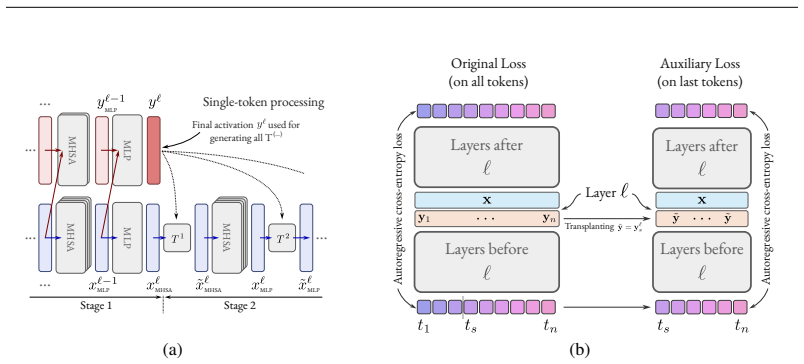
The load-bearing mechanism is the low-rank weight generator driven by the context summary. For each insertion point $\kappa$, the model produces $\delta W_\kappa(y^{\ell}) = \sum_{k=1}^{r} L_\kappa(y^{\ell})_k R_\kappa(y^{\ell})_k^T$, where $L_\kappa(y^{\ell}) = \sum_m L_{\kappa,m} \sigma_m(y^{\ell})$, $R_\kappa(y^{\ell}) = \sum_m R_{\kappa,m} \sigma_m(y^{\ell})$, and $\sigma(y^{\ell}) = h(S_\kappa y^{\ell})$ are template-mixing coefficients from a learned linear map followed by a tanh or softmax nonlinearity. The supporting pieces are the dual-pathway architecture ($x$ independent of $y$ before layer $\ell$, $y$ seeing both), the auxiliary loss that freezes $y^{\ell}_{s-1}$ at a random cut and trains it to predict the tokens after the cut, the continuity regularizer $R_C = \sum_s \zeta_C(s) \|n_s - n_{s-1}\|^2$ on normalized summaries, and the batch-decorrelation regularizer $R_D$ that pushes summaries from different samples toward orthogonality. Together they make a single frozen vector $y^{\ell}$ capable of generating the per-token linear modulations that specialize the rest of the network.
What would settle it
A concrete falsifying experiment: take a text mixture where the topic changes sharply at the split point, freeze $y^{\ell}$ just before the change, and measure the specialized model's cross-entropy as a function of distance from the split. If for every split position the frozen model's loss converges to the uninformed baseline and never stays below the dynamic model beyond roughly 200 tokens, the claim that any prefix can be summarized into a sufficient frozen vector is false for natural text.
Extended reading notes
Core claim
The paper's central claim is that a Transformer can be split into two roles—parsing the prefix and generating the weights that specialize the model to that prefix—and that both roles can live in one architecture. In the Contextually Guided Transformer (CGT), the first $\ell$ layers maintain separate $x$ and $y$ activation pathways; the $x$ pathway is computed from prior $x$ alone, while the $y$ pathway sees both, so the final summary $y^{\ell}$ aggregates all prefix information. Starting at layer $\ell+1$, each MLP and self-attention block is preceded by a linear operator $T_\kappa(x; y^{\ell}) = x + \delta W_\kappa(y^{\ell})x$, with $\delta W_\kappa$ generated as a low-rank combination of learned template matrices whose mixing coefficients are a nonlinear function of $y^{\ell}$. When $y^{\ell}$ is frozen, these operators become position-independent and fold into the surrounding linear layers, producing a specialized model that runs on the remainder without the prefix. The auxiliary loss—cross-entropy on tokens after a randomly chosen cut, with $y^{\ell}$ taken from the intact prefix—is what forces $y^{\ell}$ to be a sufficient summary, and element-wise regularizers make it slow and decorrelated. Table 1 reports 77.5% specialized accuracy versus 77.7% for the full-context baseline; on text, the frozen summary helps only for about 200 tokens, after which a moving-average update of $y^{\ell}$ is used to retain the benefit.
Load-bearing premise
The whole construction rests on the assumption that one frozen vector $y^{\ell}_s$, extracted at an arbitrary sequence position, contains all the prefix information needed to generate a good specialized model for everything after that position, even when the future text drifts to a different topic.
Editorial extensions
If this is right
- Freezing the context after two examples yields 77.5% specialized accuracy on the synthetic in-context-learning task, close to the 77.7% baseline that still attends to all four demonstrations.
- Because the generated transformations are linear, a frozen $y^{\ell}$ can be folded into fixed position-independent weights, so the remainder of the sequence can be processed without carrying the prefix tokens or their activations.
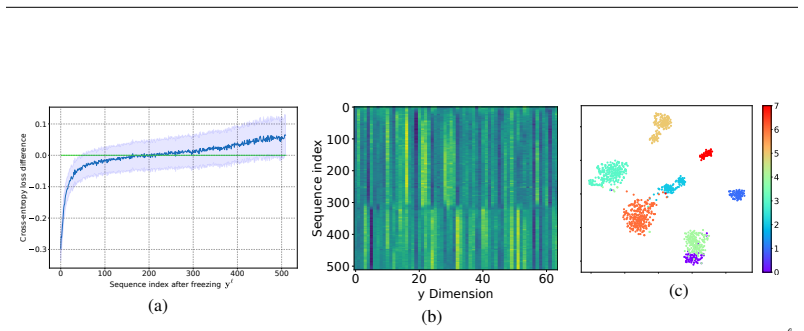
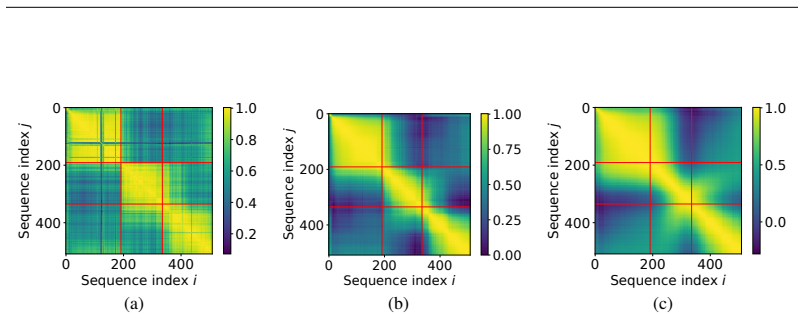
- Element-wise regularization turns $y^{\ell}$ into a slowly changing topic vector: the dot-product matrix shows clear blocks at task boundaries, and averaged summaries cluster Wikipedia pages by category.
- The auxiliary loss alone raises specialized accuracy from 15.3% to 77.0%, and adding element-wise regularization raises it to 77.5% while also slightly improving dynamic-context accuracy.
- On text, the specialized model is better than the dynamic model immediately after freezing but is overtaken after roughly 200 tokens; updating $y^{\ell}$ with a moving average keeps the contextual benefit across the whole sequence.
Reading between the lines
- If a frozen context summary can be reused, the expensive part of prompting can be amortized: compute $y^{\ell}$ once for a fixed instruction set, fold the resulting weight updates, and serve many continuations without the prompt; the paper does not make this serving argument, but it follows directly from the foldability of frozen linear updates.
- The text results suggest the representation the method learns is not a constant summary but a slowly drifting latent, pointing toward learned update rates or learned covariance kernels $K_{s,t}$ rather than a fixed moving-average rate; this connects CGT to recurrent state-space sequence models.
- Because the paper shows task coefficients $a$ and $b$ are nearly linear functions of $y^{\ell}$, a natural untested prediction is that arithmetic on summaries (averaging or adding them) should steer behavior predictably, giving a direct intervention test of whether $y^{\ell}$ is a true task variable.
- The batch orthogonality regularizer presumes different sequences have unrelated context summaries; for open-domain text this may be too rigid, and a learned per-dimension scaling of $R_D$ could preserve smoothness without forcing global orthogonality.
Editorial analysis
A structured set of objections, weighed in public.
Referee Report
Summary. The paper proposes Contextually Guided Transformers (CGT), a modification of the Transformer architecture in which a context summary vector y_l, computed at layer l, is used to generate low-rank weight updates for the layers above l. The model is trained with an auxiliary loss so that freezing y_l after a prefix yields a specialized model for the rest of the sequence, ostensibly removing the need to keep prompts in the input during inference. The authors also introduce a smoothness prior on y_l, motivated by a variational-autoencoder view with a Gaussian process prior, and derive a simpler element-wise regularizer. Experiments cover a synthetic in-context-learning task, linear regression, and text mixtures (c4/wikipedia). The synthetic ICL experiment shows that freezing y_l after two examples achieves 77.5% accuracy versus 77.7% for the dynamic baseline, and the linear-regression results show plausible specialization curves. In the text experiment, however, the frozen model is overtaken by the dynamic model after roughly 200 tokens, and the paper resorts to a moving-average update of y_l as a fallback.
Significance. If the central claim held for arbitrary prefixes, CGT would be a noteworthy step toward prompt-free inference: a single model that computes its own weight adaptation from context, with potential efficiency gains from folding the generated linear maps into the network. The synthetic ICL result is clean and well-controlled, with multiple runs and error bars, and the interpretability analysis (linear decoding of task parameters from y_l, t-SNE clustering of topics) is interesting. The derivation from a GP-VAE prior to the element-wise regularizer is a useful conceptual contribution. However, the text-domain evidence does not support the advertised generality: the frozen model fails over longer horizons, and the efficiency motivation is never measured. The paper's value is therefore real but narrower than the abstract and introduction claim.
major comments (4)
- [Section 4.4, Fig. 6(a)] The central claim of Section 1 ('CGT model maps any given prefix into a specialized model that performs well on the remainder of the sequence') is directly contradicted by the text experiment. After the context representation is frozen at roughly 100 tokens, the specialized model is better than the dynamic model only near the freezing point, and the dynamic model surpasses it after about 200 tokens. The paper attributes this to thematic shifts from training on two concatenated excerpts, but no experiment tests that explanation. Please add a control experiment on a single coherent document (or topically homogeneous text) and, if the crossover persists, revise the claim to be scoped to short or topically stable contexts. This is load-bearing because the text experiment is the only language-domain evidence for the frozen-prefix mechanism.
- [Section 4.4, Fig. 14] The moving-average variant of y_l (the 'informed' model) is not a frozen context representation; it updates y_l throughout the second part of the text. Consequently, Fig. 14 does not demonstrate the advertised mechanism of generating a specialized model from a fixed prefix. The only text-domain evidence for long-range benefit relies on this non-freezing mechanism. The paper should explicitly state that the frozen-y_l variant is effective only over a limited horizon and that the moving-average variant is a separate contribution (or a fallback), not evidence for the central claim.
- [Section 4.3 and Appendix D.2, Fig. 11] The linear-regression experiments show a similar horizon dependence: the specialized (frozen y_l) model's error grows as more samples arrive after the freezing point, and some models diverge beyond the training length of 64 samples. This suggests that the 'performs well on the remainder' claim holds only within a limited horizon in this setup as well. Please report the horizon over which the frozen model remains competitive (e.g., number of samples after freezing) and discuss the limits of the specialization mechanism.
- [Section 3.1 and Abstract] The paper motivates CGT by the computational overhead of prompts and states that folding the generated linear maps into subsequent layers reduces cost when y_l is frozen. However, no experiment measures wall-clock time, FLOPs, or latency, and the accuracy-only results do not validate the efficiency motivation. Please add a cost analysis (theoretical FLOPs with and without folding, or measured latency) or explicitly re-scope the contribution to accuracy and representation properties.
minor comments (4)
- [Section 1, first sentence] The phrase 'laying at the foundation' should be 'lying at the foundation'.
- [Section 4.1, paragraph on synthetic dataset] There is a typo: 'whcih' should be 'which' in the description of the signed integer.
- [Section 4.4, reference to figure] The text refers to 'Fig. 4.4' in the y_l representation analysis; this should be 'Fig. 6(c)' or the appropriate figure number.
- [Section 3.2, mutual information claim] The statement that optimizing the auxiliary cross-entropy 'maximizes the lower bound on the mutual information I(t>s; y_l_s)' should be clarified: minimizing the conditional cross-entropy with respect to a fixed data distribution maximizes a lower bound on mutual information only if the entropy of t>s is treated as constant. A brief clarifying sentence would help.
Circularity Check
No significant circularity: the specialized-model result is the trained auxiliary objective, and self-citations are minor and non-load-bearing.
full rationale
The paper's central mechanism is constructively defined: the architecture separates x and y pathways, generates low-rank weight updates from the context summary y^l, and folds these updates when y^l is frozen. The auxiliary loss in Section 3.2 explicitly trains the model so that a frozen y^l performs well on the remainder of the sequence; the specialized-accuracy results in Table 1 and Section 4.3 are therefore evaluations of this trained objective rather than independent predictions. This is a limitation of what the experiment demonstrates, but it is not a circular reduction: the model could fail to optimize the auxiliary loss, and the paper shows that without this loss freezing fails. The mutual-information argument is a stated identity and the VAE derivation is an explicit modeling assumption with a factorized encoder and Gaussian-process prior, not an input disguised as an output. The self-citations, including the von Oswald et al. 2023 works with overlapping authors, are used only as related work and are not load-bearing for the correctness of CGT. One explicit limitation appears in Section 4.4: the frozen specialized model is surpassed by the dynamic model after roughly 200 tokens, and the authors resort to a moving-average update of y^l (Figure 14). This undermines the scope of the 'any prefix' claim and is a genuine correctness/scope concern, but it is not circularity.
Assumptions & free parameters
free parameters (6)
- Layer index ell (context readout layer) =
4 (ICL), 8 (text), 7 (linear regression)
- Regularization weights w_C and w_D =
w_C=0.08, w_D=0.04 for ICL; w_C=0.04 and w_D=0.02 in Section 4.4 for text, but w_C=0.08, w_D=0.04 in Appendix B.2.2
- Loss mixing coefficient eta =
0.5
- Low-rank rank r and template count M =
r=4, M=16 for ICL; r=4, M=8 for linear regression
- Context embedding dimensionality dim y =
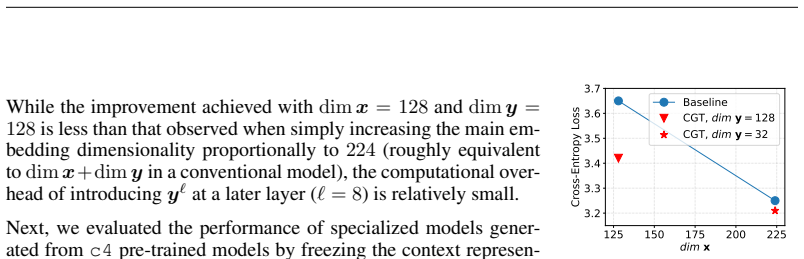
64 (ICL), 128 or 32 (text), 64 (linear regression)
- Temporal weighting profile zeta_C(s) =
Constant for ICL; empirical for other experiments
assumptions (4)
- domain assumption Optimizing the auxiliary cross-entropy loss maximizes a lower bound on mutual information I(t>s; y_s), and this makes y_s condense all prefix information useful for future prediction.
- ad hoc to paper The context representation y follows a Gaussian process prior with known kernel K, and the causal encoder factorizes into independent Gaussians.
- ad hoc to paper Low-rank weight updates with rank r and M template matrices are expressive enough to represent the context-dependent specialization.
- domain assumption The x activation path can remain independent of y before layer ell, so y can be frozen and folded into later layers.
Cite this review
Pith. "Pith review of Contextually Guided Transformers via Low-Rank Adaptation." pith.science (2026). https://pith.science/paper/EBBZXQZE
@misc{pith2026250605672,
  author       = {Pith},
  title        = {Pith review of: Contextually Guided Transformers via Low-Rank Adaptation},
  year         = {2026},
  howpublished = {\url{https://pith.science/paper/EBBZXQZE}},
  note         = {Machine review of arXiv:2506.05672}
}
read the original abstract
Large Language Models (LLMs) based on Transformers excel at text processing, but their reliance on prompts for specialized behavior introduces computational overhead. We propose a modification to a Transformer architecture that eliminates the need for explicit prompts by learning to encode context into the model's weights. Our Contextually Guided Transformer (CGT) model maintains a contextual summary at each sequence position, allowing it to update the weights on the fly based on the preceding context. This approach enables the model to self-specialize, effectively creating a tailored model for processing information following a given prefix. We demonstrate the effectiveness of our method on synthetic in-context learning tasks and language modeling benchmarks. Furthermore, we introduce techniques for enhancing the interpretability of the learned contextual representations, drawing connections to Variational Autoencoders and promoting smoother, more consistent context encoding. This work offers a novel direction for efficient and adaptable language modeling by integrating context directly into the model's architecture.
Figures


Figures from the paper (16 more)




Reference graph
Works this paper leans on
-
[1]
write newline
" write newline "" before.all 'output.state := FUNCTION n.dashify 't := "" t empty not t #1 #1 substring "-" = t #1 #2 substring "--" = not "--" * t #2 global.max substring 't := t #1 #1 substring "-" = "-" * t #2 global.max substring 't := while if t #1 #1 substring * t #2 global.max substring 't := if while FUNCTION format.date year duplicate empty "emp...
-
[2]
Language models are few-shot learners
Tom Brown, Benjamin Mann, Nick Ryder, Melanie Subbiah, Jared D Kaplan, Prafulla Dhariwal, Arvind Neelakantan, Pranav Shyam, Girish Sastry, Amanda Askell, Sandhini Agarwal, Ariel Herbert-Voss, Gretchen Krueger, Tom Henighan, Rewon Child, Aditya Ramesh, Daniel Ziegler, Jeffrey Wu, Clemens Winter, Chris Hesse, Mark Chen, Eric Sigler, Mateusz Litwin, Scott Gr...
1901
-
[3]
Gaussian process prior variational autoencoders
Francesco Paolo Casale, Adrian V Dalca, Luca Saglietti, Jennifer Listgarten, and Nicolo Fusi. Gaussian process prior variational autoencoders. 32nd Conference on Neural Information Processing Systems, 2018
work page 2018
-
[4]
Cf-vit: A general coarse-to-fine method for vision transformer
Mengzhao Chen, Mingbao Lin, Ke Li, Yunhang Shen, Yongjian Wu, Fei Chao, and Rongrong Ji. Cf-vit: A general coarse-to-fine method for vision transformer. Proceedings of the AAAI Conference on Artificial Intelligence, 37 0 (6): 0 7042--7052, Jun. 2023. doi:10.1609/aaai.v37i6.25860. URL https://ojs.aaai.org/index.php/AAAI/article/view/25860
-
[5]
Transformer-based conditional variational autoencoder for controllable story generation
Le Fang, Tao Zeng, Chaochun Liu, Liefeng Bo, Wen Dong, and Changyou Chen. Transformer-based conditional variational autoencoder for controllable story generation. arXiv preprint arXiv:2101.00828, 2021
arXiv 2021
-
[6]
In-context learning creates task vectors
Roee Hendel, Mor Geva, and Amir Globerson. In-context learning creates task vectors. In Houda Bouamor, Juan Pino, and Kalika Bali (eds.), Findings of the Association for Computational Linguistics: EMNLP 2023, pp.\ 9318--9333, Singapore, December 2023. Association for Computational Linguistics. doi:10.18653/v1/2023.findings-emnlp.624. URL https://aclanthol...
-
[7]
A VAE for Transformers with Nonparametric Variational Information Bottleneck
James Henderson and Fabio Fehr. A VAE for Transformers with Nonparametric Variational Information Bottleneck . In International Conference on Learning Representations, 2023. URL https://openreview.net/forum?id=6QkjC_cs03X
work page 2023
-
[8]
Kingma and Max Welling
Diederik P. Kingma and Max Welling. Auto-Encoding Variational Bayes . In 2nd International Conference on Learning Representations, ICLR 2014, Banff, AB, Canada, April 14-16, 2014, Conference Track Proceedings , 2014
2014
Show all 29 references
-
[9]
Jiachang Liu, Dinghan Shen, Yizhe Zhang, Bill Dolan, Lawrence Carin, and Weizhu Chen. What makes good in-context examples for GPT -3? In Eneko Agirre, Marianna Apidianaki, and Ivan Vuli \'c (eds.), Proceedings of Deep Learning Inside Out (DeeLIO 2022): The 3rd Workshop on Know...
2022 doi
-
[10]
Sewon Min, Xinxi Lyu, Ari Holtzman, Mikel Artetxe, Mike Lewis, Hannaneh Hajishirzi, and Luke Zettlemoyer. Rethinking the role of demonstrations: What makes in-context learning work? In Yoav Goldberg, Zornitsa Kozareva, and Yue Zhang (eds.), Proceedings of the 2022 Conference o...
2022 doi
-
[11]
Fast-slow recurrent neural networks
Asier Mujika, Florian Meier, and Angelika Steger. Fast-slow recurrent neural networks. In I. Guyon, U. Von Luxburg, S. Bengio, H. Wallach, R. Fergus, S. Vishwanathan, and R. Garnett (eds.), Advances in Neural Information Processing Systems, volume 30. Curran Associates, Inc., ...
2017
-
[12]
Hypertuning: Toward adapting large language models without back-propagation
Jason Phang, Yi Mao, Pengcheng He, and Weizhu Chen. Hypertuning: Toward adapting large language models without back-propagation. In Andreas Krause, Emma Brunskill, Kyunghyun Cho, Barbara Engelhardt, Sivan Sabato, and Jonathan Scarlett (eds.), International Conference on Machin...
2023
-
[13]
Language models are unsupervised multitask learners
Alec Radford, Jeff Wu, Rewon Child, David Luan, Dario Amodei, and Ilya Sutskever. Language models are unsupervised multitask learners. 2019
2019
-
[14]
Colin Raffel, Noam Shazeer, Adam Roberts, Katherine Lee, Sharan Narang, Michael Matena, Yanqi Zhou, Wei Li, and Peter J. Liu. Exploring the limits of transfer learning with a unified text-to-text transformer. Journal of Machine Learning Research, 21 0 (140): 0 1--67, 2020. URL...
2020
-
[15]
Orthogonal projection loss
Kanchana Ranasinghe, Muzammal Naseer, Munawar Hayat, Salman Khan, and Fahad Shahbaz Khan. Orthogonal projection loss. In Proceedings of the IEEE/CVF international conference on computer vision, pp.\ 12333--12343, 2021
2021
-
[16]
Dynamicvit: Efficient vision transformers with dynamic token sparsification
Yongming Rao, Wenliang Zhao, Benlin Liu, Jiwen Lu, Jie Zhou, and Cho-Jui Hsieh. Dynamicvit: Efficient vision transformers with dynamic token sparsification. In M. Ranzato, A. Beygelzimer, Y. Dauphin, P.S. Liang, and J. Wortman Vaughan (eds.), Advances in Neural Information Pro...
2021
-
[17]
Learning to control fast-weight memories: An alternative to dynamic recurrent networks
Jürgen Schmidhuber. Learning to control fast-weight memories: An alternative to dynamic recurrent networks. Neural Computation, 4 0 (1): 0 131--139, 1992. doi:10.1162/neco.1992.4.1.131
1992 doi
-
[18]
Neural machine translation of rare words with subword units
Rico Sennrich, Barry Haddow, and Alexandra Birch. Neural machine translation of rare words with subword units. arXiv preprint arXiv:1508.07909, 2015
2015 arXiv
-
[19]
Patch slimming for efficient vision transformers
Yehui Tang, Kai Han, Yunhe Wang, Chang Xu, Jianyuan Guo, Chao Xu, and Dacheng Tao. Patch slimming for efficient vision transformers. In 2022 IEEE/CVF Conference on Computer Vision and Pattern Recognition (CVPR), pp.\ 12155--12164, 2022. doi:10.1109/CVPR52688.2022.01185
2022
-
[20]
Visualizing data using t-sne
Laurens van der Maaten and Geoffrey Hinton. Visualizing data using t-sne. Journal of Machine Learning Research, 9 0 (86): 0 2579--2605, 2008. URL http://jmlr.org/papers/v9/vandermaaten08a.html
2008
-
[21]
Transformers learn in-context by gradient descent
Johannes Von Oswald, Eyvind Niklasson, Ettore Randazzo, Joao Sacramento, Alexander Mordvintsev, Andrey Zhmoginov, and Max Vladymyrov. Transformers learn in-context by gradient descent. In Andreas Krause, Emma Brunskill, Kyunghyun Cho, Barbara Engelhardt, Sivan Sabato, and Jona...
2023
-
[22]
Uncovering mesa-optimization algorithms in transformers, 2023
Johannes von Oswald, Eyvind Niklasson, Maximilian Schlegel, Seijin Kobayashi, Nicolas Zucchet, Nino Scherrer, Nolan Miller, Mark Sandler, Blaise Agüera y Arcas, Max Vladymyrov, Razvan Pascanu, and João Sacramento. Uncovering mesa-optimization algorithms in transformers, 2023
2023
-
[23]
T-cvae: Transformer-based conditioned variational autoencoder for story completion
Tianming Wang and Xiaojun Wan. T-cvae: Transformer-based conditioned variational autoencoder for story completion. In Proceedings of the Twenty-Eighth International Joint Conference on Artificial Intelligence, IJCAI-19 , pp.\ 5233--5239. International Joint Conferences on Arti...
2019 doi
-
[24]
Wikimedia downloads
Wikimedia Foundation . Wikimedia downloads. URL https://dumps.wikimedia.org
-
[25]
Evo-vit: Slow-fast token evolution for dynamic vision transformer
Yifan Xu, Zhijie Zhang, Mengdan Zhang, Kekai Sheng, Ke Li, Weiming Dong, Liqing Zhang, Changsheng Xu, and Xing Sun. Evo-vit: Slow-fast token evolution for dynamic vision transformer. In Proceedings of the AAAI Conference on Artificial Intelligence, volume 36, pp.\ 2964--2972, 2022
2022
-
[26]
Chi, Jason Wei, Jeff Dean, Liam B
Barret Zoph, Colin Raffel, Dale Schuurmans, Dani Yogatama, Denny Zhou, Don Metzler, Ed H. Chi, Jason Wei, Jeff Dean, Liam B. Fedus, Maarten Paul Bosma, Oriol Vinyals, Percy Liang, Sebastian Borgeaud, Tatsunori B. Hashimoto, and Yi Tay. Emergent abilities of large language mode...
2022
-
[27]
@esa (Ref
\@ifxundefined[1] #1\@undefined \@firstoftwo \@secondoftwo \@ifnum[1] #1 \@firstoftwo \@secondoftwo \@ifx[1] #1 \@firstoftwo \@secondoftwo [2] @ #1 \@temptokena #2 #1 @ \@temptokena \@ifclassloaded agu2001 natbib The agu2001 class already includes natbib coding, so you should ...
-
[28]
\@lbibitem[] @bibitem@first@sw\@secondoftwo \@lbibitem[#1]#2 \@extra@b@citeb \@ifundefined br@#2\@extra@b@citeb \@namedef br@#2 \@nameuse br@#2\@extra@b@citeb \@ifundefined b@#2\@extra@b@citeb @num @parse #2 @tmp #1 NAT@b@open@#2 NAT@b@shut@#2 \@ifnum @merge>\@ne @bibitem@firs...
-
[29]
Rethinking the Role of Demonstrations: What Makes In-Context Learning Work?
@open @close @open @close and [1] URL: #1 \@ifundefined chapter * \@mkboth \@ifxundefined @sectionbib * \@mkboth * \@mkboth\@gobbletwo \@ifclassloaded amsart * \@ifclassloaded amsbook * \@ifxundefined @heading @heading NAT@ctr thebibliography [1] @ \@biblabel @NAT@ctr \@bibset...
2009
Reviewed August 7, 2026 · model on record in the stance chip above.
Discussion (0). Sign in to comment.