REVIEW 3 major objections 4 minor 2 cited by
Simulating Fokker-Planck equations via mean field control of score-based normalizing flows
T0 review · 3 major / 4 minor · reviewed 2026-08-07 · deepseek-v4-flash
Pith's one-line read A single trained flow reproduces stochastic Fokker-Planck densities
desk verdict Useful framework with good small-scale numerics, but the convergence theorem covers a static one-step problem, not the self-consistent loop the algorithm actually runs. read the letter →
The pith
A machine-rendered reading of the paper's core claim, the machinery that carries it, and where it could break.
The reading
What carries the argument
The score-based normalizing flow ODE system (8) is the load-bearing mechanism. For a trajectory $\dot{x}_t=f(t,x_t)$, it gives the dynamics of the log-density $l_t=\log\rho(t,x_t)$ as $\partial_t l_t=-\nabla\cdot f$, and of the score $s_t=\nabla_x\log\rho(t,x_t)$ as $\partial_t s_t=-\nabla f^\top s_t-\nabla(\nabla\cdot f)$, with analogous equations for the density and Hessian. Because the score is propagated along the learned flow, the training loss (10) can be evaluated through automatic differentiation of the network $f_\theta$, closing the loop between the controlled continuity equation and the FP drift.
What would settle it
Run the training on a double-well or Lorenz Fokker-Planck problem with a high-resolution particle or spectral reference solution, then compare the transported density and the free-energy dissipation to the reference: if the learned flow's density departs from the reference while the training loss stays small, the score self-consistency assumption is violated.
Extended reading notes
Core claim
Flow matching for the Fokker-Planck equation is a mean field control problem. Writing the FP equation as a continuity equation for the composed velocity $f(t,x)=b(x)-\varepsilon\nabla_x\log\rho(t,x)$, the paper solves $\inf_{f,\rho}\int_0^T\int |f-b+\varepsilon\nabla\log\rho|^2\rho\,dx\,dt$ subject to $\partial_t\rho+\nabla\cdot(\rho f)=0$. The minimizer is exactly the FP velocity, so the deterministic ODE $\dot{x}=f(t,x)$ reproduces the density evolution of the SDE. The score along trajectories is advanced by the ODE system (8) rather than estimated by density kernels, which is what makes the approach scalable to chaotic and high-dimensional examples. The paper proves convergence of gradient descent on the empirical loss for the OU process with linear parametrization and Gaussian initial data.
Load-bearing premise
The algorithm assumes that the score computed along the flow's own trajectories converges, during training, to the score of the true Fokker-Planck density; the paper proves this only for the one-step linear Ornstein-Uhlenbeck case with Gaussian initial data.
Editorial extensions
If this is right
- A stochastic Fokker-Planck evolution can be simulated by a deterministic neural ODE, with no Brownian path sampling during inference.
- Free energy and its dissipation follow directly from the learned log-density and score along trajectories, giving estimators (14) and (15).
- Long-horizon and chaotic dynamics are treatable by decomposing time into stages with warm-started networks (Algorithm 2), as shown for the Lorenz, Arctangent Lorenz, and stochastic van der Pol systems.
- For the linear OU case with Gaussian initial data, gradient descent on the empirical loss converges at a rate controlled by $\lambda_0$, the smallest curvature of the loss landscape.
Reading between the lines
- The paper's convergence proof only covers the one-step linear Gaussian case, so the same guarantee should not be assumed for nonlinear or chaotic drifts; a natural test is whether low training loss on a double-well or Lorenz system always implies that the transported density matches a faithful Monte Carlo FP reference.
- The method implicitly assumes a unique fixed point: the score propagated along $f_\theta$ must become the score of the density that $f_\theta$ actually transports. If that self-consistency fails, minimizing the loss could fit the objective while producing the wrong density.
- The same score-propagation idea could be used to compute stationary distributions or normalizing constants, since the paper already estimates $Z\approx\exp(-D_V(\rho(T,\cdot)))$ once the flow has relaxed.
- Because the deterministic flow is invertible, the trained map may also provide a sampler for the invariant measure, a direction the paper does not develop.
Editorial analysis
A structured set of objections, weighed in public.
Referee Report
Summary. The manuscript proposes a mean-field-control (MFC) formulation for simulating Fokker-Planck equations. The FP equation is rewritten as a continuity equation with velocity f = b - ε∇logρ, and flow matching is posed as minimizing ∫|f - b + ε∇logρ|²ρ over f and ρ subject to the continuity equation. The score is transported along deterministic trajectories via the score-based normalizing-flow ODE system (8), and a neural-network velocity field is trained by minimizing the discretized loss (10). The paper presents Algorithms 1-4 for single-stage and multi-stage training, numerical experiments for Langevin dynamics, underdamped Langevin dynamics, and chaotic systems, and a convergence analysis for the OU process (Theorem 1).
Significance. If correct, the paper provides an appealing bridge between MFC, flow matching, and FP simulation, with the score transported along deterministic trajectories rather than estimated by separate density models. The Gaussian and low-dimensional experiments report concrete quantitative errors (e.g., errf = 1.68e-2, errρ = 6.93e-3, normalization-constant errors around 1%), which is a strength, and the pseudo-code is sufficiently detailed to reproduce the algorithms. However, the central convergence theorem does not cover the self-consistent score-update loop that the algorithm actually runs, and the ULD score update contains an algebraic error; these issues currently weaken the support for the paper's main claims.
major comments (3)
- [Section 5 / Algorithm 1] Section 5 proves convergence for a static one-step problem, not for the self-consistent loop in Algorithm 1. The loss in (26) fixes the score at its initial value s(x)=∇logρ0 and considers one Euler step with a linear parameterization; the theorem then gives gradient-descent convergence for that empirical least-squares problem. The objective actually minimized in Algorithm 1, Eq. (10), uses scores s_tj updated through (9d) along trajectories of f_theta, so the regression target b - εs_theta is itself a functional of theta. For nonlinear drifts, chaotic dynamics, and the staged Algorithm 2, the paper gives no contraction, uniqueness, or approximation argument showing that iterates of this moving-target problem approach the unique zero-loss pair (f*, ρ_FP) or that no inconsistent fixed point exists. Since the abstract and Section 5 present this as the convergence analysis of the proposed algorithm, the gap is load-bearing and should be addressed by an analysis of the self-consistent score update or by an explicit restriction of the claim.
- [Appendix B.1 / Algorithms 3 and 4] Appendix B.1 and Algorithms 3-4 contain a wrong term in the score ODE for the velocity component. From Proposition 2 with z=(x,v), f=(v,fv), and s=(sx,sv), the correct evolution is ∂t sv = -sx - (∇v fv)^T sv - ∇v(∇v·fv), but the manuscript's update uses ∇x(∇v·fv) in the last term. This error appears in the derivation in Appendix B.1 and in both ULD algorithms, so the underdamped Langevin experiments are not implementing the score-based normalizing flow described in Section 2.3. Correcting this term and re-running the ULD experiments is necessary before the ULD results can be relied upon.
- [Abstract / Section 4] The abstract states that numerical results validate the method on 'high-dimensional interacting particle systems,' but Section 4 contains no such experiment: the examples are a two-dimensional Langevin system, four-dimensional ULD, and three-dimensional Lorenz/van der Pol systems. The claimed validation of scalability to high-dimensional interacting particle systems is unsupported as written. Either add the experiment or remove this claim from the abstract and introduction.
minor comments (4)
- [Section 2.3] Proposition 2 is quoted from [13,14] without proof or derivation; because Eq. (8c) is the computational backbone of the method, a self-contained derivation or a precise pointer to the statement in each cited work would strengthen the paper.
- [Figures 5-7] The chaotic-system comparisons are visual only; adding a quantitative discrepancy measure, such as Wasserstein distance between density projections or moment errors, would substantiate the claim that the chaotic experiments 'validate effectiveness.'
- [Equation (23)] In the scaled stochastic Lorenz system (23), the first equation reads σ(y_t - x_T), where x_T appears to be a typo for x_t.
- [Algorithms 3 and 4] In Algorithms 3 and 4, the initial samples are indexed from n=0 in the sampling line but from n=1 in the subsequent sums; the indexing should be made consistent.
Circularity Check
No significant circularity: the FP-to-MFC reformulation is an algebraic equivalence, the score ODE system is externally grounded, and the noted convergence gap is a correctness limitation rather than a circular reduction.
full rationale
The paper's central equivalence is not circular by construction. The MFC objective (6) has zero loss exactly when f = b - eps*grad_log_rho; substituting this into the continuity constraint (7) yields the Fokker-Planck equation (1), so the claimed optimal velocity is an algebraic reformulation of the FP equation, not a fitted parameter disguised as a prediction. The score ODE system in Proposition 2 is quoted from [13, 41, 14]; the first two are external works and the system itself is a standard, parameter-free consequence of the continuity equation and is externally verifiable. The self-citation to [14] is therefore not load-bearing for the mathematical validity of the score dynamics. Algorithm 1 does solve a self-consistent fixed-point problem, because the score s_tj in loss (10) is generated along trajectories of the very f_theta being optimized; however, this is a moving-target optimization whose convergence is unproved for nonlinear and chaotic systems, not a tautology or an equation-level circularity. The convergence analysis in Theorem 1 indeed covers only the static one-step OU loss (26) with s(x)=grad_log_rho_0, and the paper itself remarks that the theorem does not include resampling and that broader classes are future work. That is an overstatement/limitation gap, but no fitted constant is renamed as a prediction and no claim reduces to its own input. Numerical validation against external Gaussian reference solutions and RK4 covariance evolutions makes the empirical claims self-contained.
Assumptions & free parameters
free parameters (2)
- Lorenz scaling parameter s =
0.2 (Lorenz), 0.1 (Arctangent Lorenz)
- Hyperparameter set (Δt, learning rate, network width, Nx, NT, T) =
Δt=0.01, lr=0.01, 2-layer MLP with 100 tanh units, Nx=500-1000, T=1-5, NT=1-25
assumptions (3)
- domain assumption The Fokker-Planck equation admits a smooth stationary density π satisfying ∇·(π b)=εΔπ, used in Proposition 1.
- standard math The density ρ(t,x) and its log-score remain sufficiently smooth along trajectories so the ODE system (8a)-(8d) is valid.
- ad hoc to paper The self-consistent fixed point of loss (10), where the score is computed along fθ trajectories, coincides with the true FP solution for general nonlinear dynamics.
Cite this review
Pith. "Pith review of Simulating Fokker-Planck equations via mean field control of score-based normalizing flows." pith.science (2026). https://pith.science/paper/6LXLEDAA
@misc{pith2026250605723,
  author       = {Pith},
  title        = {Pith review of: Simulating Fokker-Planck equations via mean field control of score-based normalizing flows},
  year         = {2026},
  howpublished = {\url{https://pith.science/paper/6LXLEDAA}},
  note         = {Machine review of arXiv:2506.05723}
}
read the original abstract
The Fokker--Planck (FP) equation governs the evolution of densities for stochastic dynamics of physical systems, such as the Langevin dynamics and the Lorenz system. This work simulates FP equations through a mean field control (MFC) problem. We first formulate the FP equation as a continuity equation, where the velocity field consists of the drift function and the score function, i.e., the gradient of the logarithm of the density function. Next, we design a MFC problem that matches the velocity fields in a continuity equation with the ones in the FP equation. The score functions along deterministic trajectories are computed efficiently through the score-based normalizing flow, which only relies on the derivatives of the parameterized velocity fields. Numerical results, including Langevin dynamics, underdamped Langevin dynamics, chaotic systems, and high-dimensional interacting particle systems validate the effectiveness and scalability of our proposed algorithm. A convergence analysis is conducted for our algorithm on the FP equation of Ornstein--Uhlenbeck processes.
Figures
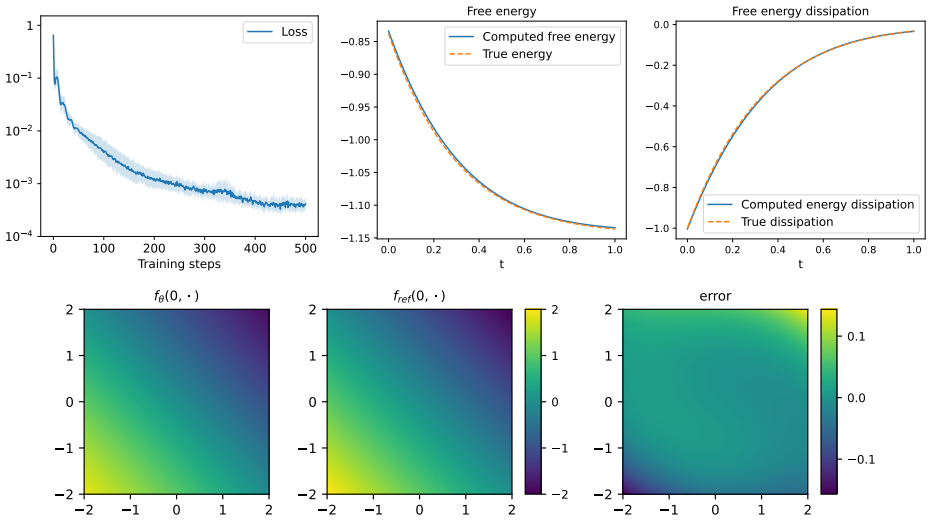


Figures from the paper (4 more)


Forward citations
Cited by 2 Pith papers
-
A transition-density-based operator learning method for Fokker-Planck equations with various initial conditions
Conditional normalizing flow PINN approximates FPE solution operator for range of initial conditions via Chapman-Kolmogorov reformulation and linearized SDE base distribution.
-
Inf-Sup Neural Networks for High Dimensional PDEs
Inf-sup neural networks with dual Lagrange multipliers solve high-dimensional PDEs with proven error decomposition for linear convection-diffusion and empirical success on nonlinear cases.
Reference graph
Works this paper leans on
-
[14]
M. Zhou, S. Osher, W. Li, Score-based neural ordinary differential equations for com- puting mean field control problems, arXiv preprint arXiv:2409.16471 (2024)
arXiv 2024
-
[1]
Y. Yang, L. Nurbekyan, E. Negrini, R. Martin, M. Pasha, Optimal transport for pa- rameter identification of chaotic dynamics via invariant measures, SIAM Journal on Applied Dynamical Systems 22 (1) (2023) 269–310
work page 2023
-
[2]
L. Bertini, A. De Sole, D. Gabrielli, G. Jona-Lasinio, C. Landim, Macroscopic fluctua- tion theory, Reviews of Modern Physics 87 (2) (2015) 593–636
work page 2015
-
[3]
Amari, Information geometry and its applications, Vol
S.-i. Amari, Information geometry and its applications, Vol. 194, Springer, 2016
work page 2016
-
[4]
W. Li, J. Lu, L. Wang, Fisher information regularization schemes for wasserstein gra- dient flows, Journal of Computational Physics 416 (2020) 109449
work page 2020
-
[5]
M. te Vrugt, H. L¨ owen, R. Wittkowski, Classical dynamical density functional theory: from fundamentals to applications, Advances in Physics 69 (2) (2020) 121–247
work page 2020
-
[6]
W. Lee, S. Liu, H. Tembine, W. Li, S. Osher, Controlling propagation of epidemics via mean-field control, SIAM Journal on Applied Mathematics 81 (1) (2021) 190–207
work page 2021
-
[7]
R. Carmona, M. Lauri` ere, et al., Deep learning for mean field games and mean field control with applications to finance, arXiv preprint arXiv:2107.04568 7 (2021)
arXiv 2021
Show all 57 references
-
[8]
L. Li, S. Hurault, J. M. Solomon, Self-consistent velocity matching of probability flows, Advances in Neural Information Processing Systems 36 (2023) 57038–57057
2023
-
[9]
M. S. Albergo, N. M. Boffi, E. Vanden-Eijnden, Stochastic interpolants: A unifying framework for flows and diffusions, arXiv preprint arXiv:2303.08797 (2023)
2023 arXiv
-
[10]
Lindsey, Mne: overparametrized neural evolution with applications to diffusion pro- cesses and sampling, arXiv preprint arXiv:2502.03645 (2025)
M. Lindsey, Mne: overparametrized neural evolution with applications to diffusion pro- cesses and sampling, arXiv preprint arXiv:2502.03645 (2025)
2025 arXiv
-
[11]
Rezende, S
D. Rezende, S. Mohamed, Variational inference with normalizing flows, in: International conference on machine learning, PMLR, 2015, pp. 1530–1538. 26
2015
-
[12]
R. T. Chen, Y. Rubanova, J. Bettencourt, D. K. Duvenaud, Neural ordinary differential equations, Advances in neural information processing systems 31 (2018)
2018
-
[13]
Z. Shen, Z. Wang, S. Kale, A. Ribeiro, A. Karbasi, H. Hassani, Self-consistency of the Fokker Planck equation, in: Conference on Learning Theory, PMLR, 2022, pp. 817–841
2022
-
[15]
Ambrosio, N
L. Ambrosio, N. Gigli, G. Savar´ e, Gradient flows: in metric spaces and in the space of probability measures, Springer Science & Business Media, 2008
2008
-
[16]
Jordan, D
R. Jordan, D. Kinderlehrer, F. Otto, The variational formulation of the Fokker–Planck equation, SIAM journal on mathematical analysis 29 (1) (1998) 1–17
1998
-
[17]
Carmona, F
R. Carmona, F. Delarue, et al., Probabilistic theory of mean field games with applica- tions I-II, Springer, 2018
2018
-
[18]
Bensoussan, J
A. Bensoussan, J. Frehse, P. Yam, et al., Mean field games and mean field type control theory, Vol. 101, Springer, 2013
2013
-
[19]
Albi, Y.-P
G. Albi, Y.-P. Choi, M. Fornasier, D. Kalise, Mean field control hierarchy, Applied Mathematics & Optimization 76 (2017) 93–135
2017
-
[20]
Fornasier, F
M. Fornasier, F. Solombrino, Mean-field optimal control, ESAIM: Control, Optimisation and Calculus of Variations 20 (4) (2014) 1123–1152
2014
-
[21]
Li, Stochastic maximum principle in the mean-field controls, Automatica 48 (2) (2012) 366–373
J. Li, Stochastic maximum principle in the mean-field controls, Automatica 48 (2) (2012) 366–373
2012
-
[22]
J. Yong, X. Y. Zhou, Stochastic controls: Hamiltonian systems and HJB equations, Vol. 43, Springer Science & Business Media, 1999
1999
-
[23]
Ruthotto, S
L. Ruthotto, S. J. Osher, W. Li, L. Nurbekyan, S. W. Fung, A machine learning frame- work for solving high-dimensional mean field game and mean field control problems, Proceedings of the National Academy of Sciences 117 (17) (2020) 9183–9193
2020
-
[24]
X. Guo, A. Hu, R. Xu, J. Zhang, Learning mean-field games, Advances in neural infor- mation processing systems 32 (2019)
2019
-
[25]
R. Hu, M. Lauriere, Recent developments in machine learning methods for stochastic control and games, arXiv preprint arXiv:2303.10257 (2023)
2023 arXiv
-
[26]
Reisinger, Y
C. Reisinger, Y. Zhang, Rectified deep neural networks overcome the curse of dimen- sionality for nonsmooth value functions in zero-sum games of nonlinear stiff systems, Analysis and Applications 18 (06) (2020) 951–999
2020
-
[27]
K. Hu, Z. Ren, D. ˇSiˇ ska, L. Szpruch, Mean-field Langevin dynamics and energy land- scape of neural networks, in: Annales de l’Institut Henri Poincare (B) Probabilites et statistiques, Vol. 57, Institut Henri Poincar´ e, 2021, pp. 2043–2065. 27
2021
-
[28]
Hyv¨ arinen, P
A. Hyv¨ arinen, P. Dayan, Estimation of non-normalized statistical models by score matching., Journal of Machine Learning Research 6 (4) (2005)
2005
-
[29]
S. Lyu, Interpretation and generalization of score matching, in: Proceedings of the Twenty-Fifth Conference on Uncertainty in Artificial Intelligence, UAI ’09, AUAI Press, Arlington, Virginia, USA, 2009, p. 359–366
2009
-
[30]
E. L. Epstein, R. Dwaraknath, T. Sornwanee, J. Winnicki, J. W. Liu, Score-Debiased Kernel Density Estimation, arXiv preprint arXiv:2504.19084 (2025). URL https://arxiv.org/abs/2504.19084
2025 arXiv
-
[31]
M. Zhou, S. Osher, W. Li, A deep learning algorithm for computing mean field con- trol problems via forward-backward score dynamics, arXiv preprint arXiv:2401.09547 (2024)
2024 arXiv
-
[32]
Vincent, H
P. Vincent, H. Larochelle, Y. Bengio, P.-A. Manzagol, Extracting and composing ro- bust features with denoising autoencoders, in: Proceedings of the 25th international conference on Machine learning, 2008, pp. 1096–1103
2008
-
[33]
Vincent, A connection between score matching and denoising autoencoders, Neural computation 23 (7) (2011) 1661–1674
P. Vincent, A connection between score matching and denoising autoencoders, Neural computation 23 (7) (2011) 1661–1674
2011
-
[34]
Y. Song, J. Sohl-Dickstein, D. P. Kingma, A. Kumar, S. Ermon, B. Poole, Score-based generative modeling through stochastic differential equations, in: International Confer- ence on Learning Representations, 2021. URL https://openreview.net/forum?id=PxTIG12RRHS
2021
-
[35]
De Bortoli, J
V. De Bortoli, J. Thornton, J. Heng, A. Doucet, Diffusion schr¨ odinger bridge with appli- cations to score-based generative modeling, Advances in Neural Information Processing Systems 34 (2021) 17695–17709
2021
-
[36]
Papamakarios, E
G. Papamakarios, E. Nalisnick, D. J. Rezende, S. Mohamed, B. Lakshminarayanan, Normalizing flows for probabilistic modeling and inference, Journal of Machine Learning Research 22 (57) (2021) 1–64
2021
-
[37]
Lipman, R
Y. Lipman, R. T. Q. Chen, H. Ben-Hamu, M. Nickel, M. Le, Flow Matching for Gen- erative Modeling, in: International Conference on Learning Representations, 2023. URL https://openreview.net/forum?id=PqvMRDCJT9t
2023
-
[38]
Grathwohl, R
W. Grathwohl, R. T. Chen, J. Bettencourt, I. Sutskever, D. Duvenaud, FFJORD: Free- form Continuous Dynamics for Scalable Reversible Generative Models, in: International Conference on Learning Representations, 2019
2019
-
[39]
S. P. Meyn, R. L. Tweedie, Stability of Markovian processes III: Foster–Lyapunov criteria for continuous-time processes, Advances in Applied Probability 25 (3) (1993) 518–548
1993
-
[40]
Agmon, A
N. Agmon, A. Szabo, Theory of reversible diffusion-influenced reactions, The Journal of Chemical Physics 92 (9) (1990) 5270–5284. 28
1990
-
[41]
N. M. Boffi, E. Vanden-Eijnden, Probability flow solution of the Fokker–Planck equa- tion, Machine Learning: Science and Technology 4 (3) (2023) 035012
2023
-
[42]
D. P. Kingma, J. Ba, Adam: A method for stochastic optimization, in: Y. Bengio, Y. LeCun (Eds.), 3rd International Conference on Learning Representations, ICLR 2015, San Diego, CA, USA, May 7-9, 2015, Conference Track Proceedings, 2015
2015
-
[43]
M. Zhou, J. Han, M. Rachh, C. Borges, A neural network warm-start approach for the inverse acoustic obstacle scattering problem, Journal of Computational Physics 490 (2023) 112341
2023
-
[44]
Cheng, N
X. Cheng, N. S. Chatterji, P. L. Bartlett, M. I. Jordan, Underdamped Langevin MCMC: A non-asymptotic analysis, in: Conference on learning theory, PMLR, 2018, pp. 300– 323
2018
-
[45]
S. L. Brunton, J. L. Proctor, J. N. Kutz, Discovering governing equations from data by sparse identification of nonlinear dynamical systems, Proceedings of the national academy of sciences 113 (15) (2016) 3932–3937
2016
-
[46]
E. N. Lorenz, Deterministic nonperiodic flow 1, in: Universality in Chaos, 2nd edition, Routledge, 2017, pp. 367–378
2017
-
[47]
Y. Xu, R. Gu, H. Zhang, W. Xu, J. Duan, Stochastic bifurcations in a bistable duffing– van der Pol oscillator with colored noise, Physical Review E—Statistical, Nonlinear, and Soft Matter Physics 83 (5) (2011) 056215
2011
-
[48]
M. Zhou, J. Han, J. Lu, Actor-critic method for high dimensional static Hamilton– Jacobi–Bellman partial differential equations based on neural networks, SIAM Journal on Scientific Computing 43 (6) (2021) A4043–A4066
2021
-
[49]
J. Han, R. Hu, J. Long, Convergence of deep fictitious play for stochastic differential games, arXiv preprint arXiv:2008.05519 (2020)
2020 arXiv
-
[50]
H. Gu, X. Guo, X. Wei, R. Xu, Mean-field controls with Q-learning for cooperative MARL: convergence and complexity analysis, SIAM Journal on Mathematics of Data Science 3 (4) (2021) 1168–1196
2021
-
[51]
Carmona, M
R. Carmona, M. Lauri` ere, Convergence analysis of machine learning algorithms for the numerical solution of mean field control and games I: The ergodic case, SIAM Journal on Numerical Analysis 59 (3) (2021) 1455–1485
2021
-
[52]
Carmona, M
R. Carmona, M. Lauri` ere, Convergence analysis of machine learning algorithms for the numerical solution of mean field control and games: II—the finite horizon case, The Annals of Applied Probability 32 (6) (2022) 4065–4105
2022
-
[53]
M. Zhou, J. Lu, A policy gradient framework for stochastic optimal control problems with global convergence guarantee, arXiv preprint arXiv:2302.05816 (2023). 29
2023 arXiv
-
[54]
Sethi, D
D. Sethi, D. ˇSiˇ ska, Y. Zhang, Entropy annealing for policy mirror descent in continuous time and space, arXiv preprint arXiv:2405.20250 (2024)
2024 arXiv
-
[55]
M. Zhou, J. Lu, Solving time-continuous stochastic optimal control problems: Algorithm design and convergence analysis of actor-critic flow, arXiv preprint arXiv:2402.17208 (2024)
2024 arXiv
-
[56]
J. Ma, G. Wang, J. Zhang, Convergence analysis for entropy-regularized control prob- lems: A probabilistic approach, arXiv preprint arXiv:2406.10959 (2024)
2024 arXiv
-
[57]
Vershynin, High-dimensional probability: An introduction with applications in data science, Vol
R. Vershynin, High-dimensional probability: An introduction with applications in data science, Vol. 47, Cambridge university press, 2018. 30 Algorithm 2Flow matching solver for long time horizon 1: Input: Flow matching problem, neural network structure for each stage, number o...
2018
Reviewed August 7, 2026 · model on record in the stance chip above.
Discussion (0). Sign in to comment.