REVIEW 5 major objections 5 minor 1 cited by
BestServe: Serving Strategies with Optimal Goodput in Collocation and Disaggregation Architectures
T0 review · 5 major / 5 minor · reviewed 2026-08-07 · deepseek-v4-flash
Pith's one-line read BestServe claims that the optimal LLM serving strategy — architecture, instance ratio, and parallelism — can be determined in minutes on a standard CPU by simulating inference with an adapted roofline model, replacing costly…
desk verdict A useful dispatch-aware goodput simulator with an overstated headline and a key missing check: does its top-ranked strategy match ground truth? read the letter →
The pith
A machine-rendered reading of the paper's core claim, the machinery that carries it, and where it could break.
The reading
What carries the argument
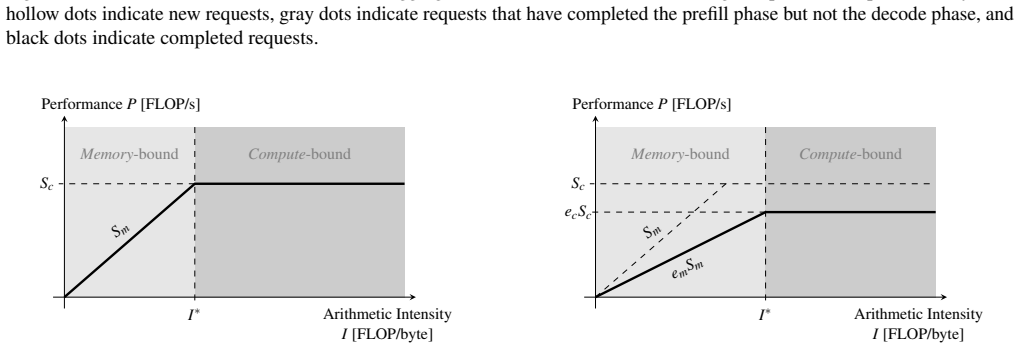
The load-bearing object is the hierarchical analyzer: an Estimator built on an adapted roofline model, $P = \min\{e_c S_c, I e_m S_m\}$, which says an operator runs at the smaller of its compute peak and its memory-bandwidth peak, each discounted by an efficiency factor; a Simulator that treats disaggregated serving as a tandem queue and reproduces prefill-prioritizing, non-mixing scheduling for collocated serving; and an Optimizer that bisects arrival rates to find goodput. The two mechanisms that make the whole thing fast are the pseudo batch size $b^\dagger = \max(\lfloor(b+1)/\tau\rfloor, 1)$ with $\tau=2.5$, which approximates continuous batching interference without token-level loops, and caching of the latency oracle by its functional arguments.
What would settle it
Take a long-generation, short-input workload like the paper's OP4, run the simulator and the real serving system over several prefill-to-decode ratios and collocated configurations, and compare which strategy achieves the highest measured goodput. If the simulated rank order disagrees with the measured rank order — not just the magnitude of the error — the pseudo batch heuristic is misleading for the very decisions the tool is built to make. A more direct test isolates the decode phase: measure per-request token-generation latency as the number of concurrently served requests grows, and check whether the ratios follow the $b^\dagger$ curve for generation lengths of 1024 or more.
Extended reading notes
Core claim
The paper's central claim is that the maximum goodput of an LLM serving strategy — the highest request arrival rate whose P90 time-to-first-token and time-per-output-token stay within SLO bounds — can be estimated by lightweight simulation instead of measured by repeated benchmark runs. BestServe decomposes inference into operator-level work and memory traffic, applies an adapted roofline model with hardware efficiency parameters (MFU and MBU), and explicitly charges the time for the CPU to dispatch operators to the GPU, which the paper argues makes the decode phase dispatch-bound rather than memory-bound. A pseudo batch size heuristic, $b^\dagger = \max(\lfloor(b+1)/\tau\rfloor, 1)$ with $\tau = 2.5$, stands in for the full dynamics of continuous batching so each request is simulated once rather than token by token. An optimizer then bisects on arrival rate to produce the goodput of every candidate strategy. Validation against manual benchmarking across four operating scenarios reports average absolute relative errors of 11.2%, 12.1%, 8.6%, and 30.1%, with the largest error in the long-generation scenario attributed to the decode heuristic.
Load-bearing premise
The framework stands on one assumption: that a single heuristic formula, the pseudo batch size $b^\dagger = \max(\lfloor(b+1)/\tau\rfloor, 1)$ with $\tau = 2.5$, correctly captures how much slower token generation gets when requests share a GPU, for every generation length and load level.
Editorial extensions
If this is right
- Service providers can compare collocation versus disaggregation, and different prefill-to-decode instance ratios, for their own traffic mix without renting GPUs for trial-and-error benchmarking.
- Strategy search becomes a minutes-scale CPU job, so the optimal configuration can be re-derived as request patterns, model sizes, or SLOs change.
- The framework backs the finding that disaggregation is not uniformly better than collocation: the winner depends on input length, generation length, and SLO thresholds, and BestServe predicts which configuration wins in each scenario.
- If the dispatch-bound characterization of decode is correct, decode-phase hardware and software tuning should target CPU-GPU dispatch overhead rather than raw memory bandwidth alone.
Reading between the lines
- The paper's own data fixes the failure regime: expect errors near 30% whenever generation length is long and input short (its OP4), and much lower errors in the opposite corner where prefill dominates. The abstract's 20% margin is a claim about typical scenarios, not a uniform bound.
- The single global value $\tau=2.5$ in the pseudo batch size is the most promising lever: a generation-length-dependent or occupancy-dependent $\tau$ could recover OP4-style accuracy while keeping one simulation loop per request.
- Because BestServe ignores memory capacity entirely, its 'optimal' strategy should be read as optimal up to memory feasibility; strategies it ranks first could still fail to load on small-memory hardware, especially under PagedAttention-style dynamic caching.
- The dispatch-bound account yields a concrete prediction the authors only gesture at: reducing CPU-to-GPU dispatch overhead (for example by fusing operators) should improve decode-phase goodput roughly in proportion to the dispatch share of estimated latency, and BestServe's estimator could quantify that gain before any code is written.
Editorial analysis
A structured set of objections, weighed in public.
Referee Report
Summary. BestServe proposes a three-level framework (Estimator, Simulator, Optimizer) for ranking LLM serving strategies in collocated and disaggregated architectures by predicted goodput. The Estimator uses an adapted roofline model with MFU/MBU efficiency parameters and explicitly models CPU-GPU dispatch latency; the Simulator approximates request-level dynamics of prefill and decode phases with a pseudo batch size heuristic; and the Optimizer enumerates configurations and uses bisection on the arrival rate to find the maximum goodput satisfying SLO constraints. The paper validates on vLLM-Ascend with the CodeLlama-34b-Instruct model on Ascend 910B3 NPUs across four fixed-length operating scenarios, reporting average absolute relative errors of 11.2%, 12.1%, 8.6%, and 30.1% for OP1-OP4. The stated goal is to eliminate costly case-by-case benchmarking by determining the optimal serving strategy in minutes on a standard CPU.
Significance. If the framework's ranking accuracy were established, BestServe would be a practically valuable tool for early-stage deployment planning, as it replaces expensive trial-and-error benchmarking with lightweight simulation. The paper's strengths include its modular hierarchical design, explicit modeling of dispatch-bound decode behavior, and a detailed, mostly self-contained presentation of the estimator's operator-level cost tables in the appendices. The paper is also candid in Section 5 about the decode-phase heuristic and parameter-tuning limitations. However, the central claim is currently under-supported: the validation measures per-strategy goodput error rather than strategy-ranking accuracy; the efficiency parameters are calibrated on the same manual benchmarking data used as ground truth; and the abstract's 20% error claim is contradicted by the OP4 result. These issues are load-bearing for the paper's main contribution and must be addressed before the framework's usefulness for strategy selection can be accepted.
major comments (5)
- [§4.3 and Figure 11] The paper's stated purpose is strategy selection, but the validation reports only the per-strategy average absolute relative error of predicted goodput. It never reports whether the strategy with maximal predicted goodput matches the strategy with maximal ground-truth goodput in each operating scenario, nor any rank correlation between predicted and ground-truth orderings. A per-strategy mean error of 11.2-30.1% does not by itself guarantee correct ranking: strategies with similar goodput can be swapped without a large mean error, and Section 5 states that the OP4 error is concentrated in collocated strategies. Please report, for each scenario, the ground-truth and predicted argmax strategies and the goodput gap between them, and provide a rank correlation (e.g., Spearman) over the enumerated strategies. Also state the uncertainty in the manually interpolated ground truth, which the paper's own Figure 10a suggests can fluctuate by about 5% in P90 TTFT.
- [Abstract and §4.3] The abstract's claim of 'achieving predictions within a 20% error margin' is not supported by the reported numbers: §4.3 gives average absolute relative errors of 11.2%, 12.1%, 8.6%, and 30.1% for OP1-OP4, so OP4 violates the stated margin by a wide margin. The paper itself attributes this to the pseudo batch size heuristic in §5. The abstract and the conclusion should be revised to a qualified claim (e.g., 'within 20% for scenarios with short-to-moderate generation lengths'), or the validation must be extended to show that decode-heavy scenarios are also within the claimed margin.
- [§4.1 vs §4.3] The efficiency parameters ec, em, and e+ are determined in §4.1 by aligning the simulator's intermediate results (Figures 6 and 8) with real inference data from manual benchmarking, and the same manual benchmarking data are then used as the ground truth in §4.3. The reported error rates are therefore a measure of in-sample fit rather than predictive accuracy. Please state this explicitly, quantify how sensitive the predicted goodput and the selected strategy are to perturbations of these parameters within plausible ranges, and, if feasible, hold out one or more operating scenarios or strategies during calibration and report errors on the held-out cases.
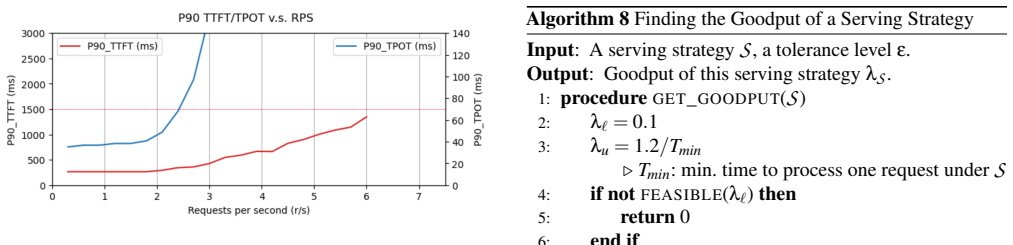
- [§3.5, Algorithm 8] The bisection loop condition in Algorithm 8, 'while λu − λℓ < ε do', is inverted; it should be 'while λu − λℓ > ε do' so that the loop terminates when the interval is sufficiently small. As written, the pseudocode enters the loop when the difference is already below the tolerance and would not terminate. Please correct the algorithm and confirm that the implemented Optimizer uses the correct stopping condition.
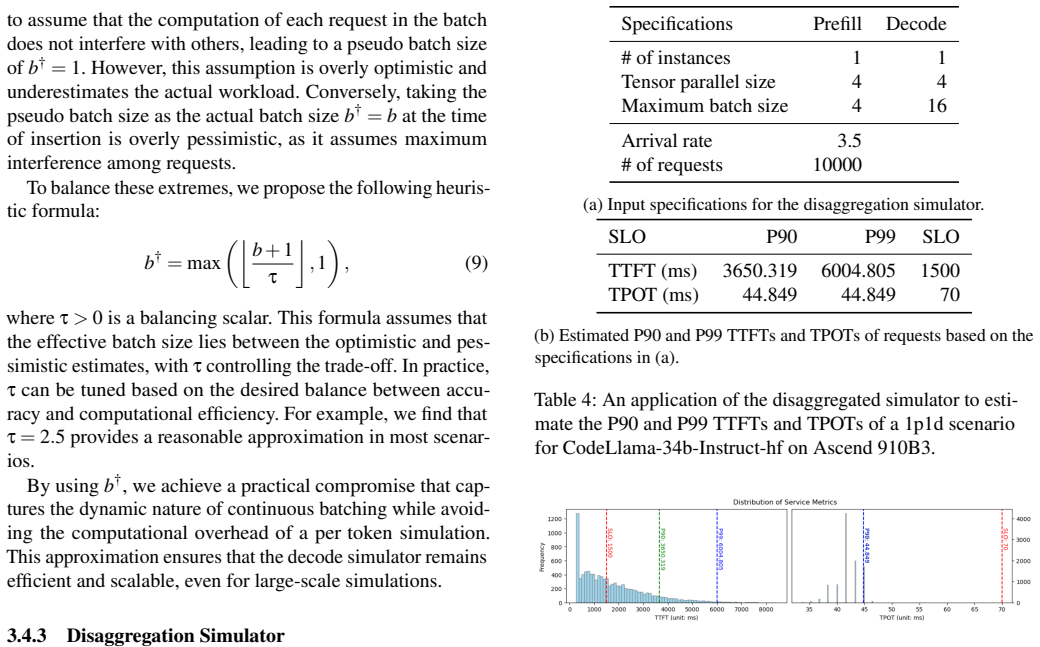
- [Eq. (9) and §5] The pseudo batch size heuristic with the single global scalar τ=2.5 is the current bottleneck for decode-heavy scenarios. Section 5 states that in OP4 this heuristic overestimates goodput 'especially for serving strategies using the collocation architecture,' which is precisely the regime where a collocation-versus-disaggregation recommendation could invert. Please add a sensitivity analysis over τ (for example, τ ∈ {1.5, 2.5, 4.0}) and over the feasibility relaxation factor in Algorithm 9, showing whether the top-ranked strategy changes, and report OP4 ranking quality separately for collocated and disaggregated strategies.
minor comments (5)
- [Throughout] The name 'BestServe' is frequently concatenated with surrounding words (e.g., 'WepresentBestServe', 'BestServeleverages', 'BestServedemonstrates'); please fix the LaTeX spacing.
- [§4.1] The sentence 'linear regressions are conducted exploit the linear relationship' should read 'conducted to exploit the linear relationship'.
- [§3.4.2 and §4.1] Section 3.4.2 states that τ=2.5 provides a reasonable approximation, but §4.1's hyperparameter list mentions only MFU, MBU, and communication efficiency; please clarify how τ was set in the validation and whether it was tuned per scenario.
- [Appendix B.2] The sentence 'We still use (12) to estimate the computation time of the prefill phase of Attention module when TP is considered' should refer to the decode phase, since Eq. (12) is the decode-phase formula.
- [Figure 11] The histograms are sorted by predicted goodput but do not visually distinguish collocated from disaggregated strategies; adding markers or labels for the two architecture types would make it easier to see where ranking errors occur.
Circularity Check
Efficiency parameters are fit to the same manual-benchmark data later used as ground truth, so the reported 20% error margin is in-sample; the optimal-strategy claim is additionally not directly validated.
-
fitted input called prediction
[Section 4.1 (Hyperparameters) and Section 4.3 (Comparison)]
"To determine appropriate values for ec and em, we aligned the intermediate results of BestServe’s simulator, such as Figures 6 and 8, with real inference data obtained from manual benchmarking. ... These values are only roughly tuned to reflect the practical efficiency of the hardware and software environment used in our experiments without losing too much generality. ... Using the ground truth obtained from manual benchmarking, we query BestServe to approximate the maximum goodput for each serving strategy across all four operating scenarios."
The efficiency parameters ec, em, and e+ are calibrated by aligning BestServe's simulator outputs with manual-benchmarking data from the testbed (Section 4.1). Section 4.3 then measures 'prediction' error against that same manual-benchmarking ground truth. The reported average absolute relative errors (11.2%, 12.1%, 8.6%, and 30.1%) are therefore in-sample residuals after fitting, not out-of-sample prediction errors. The roofline per-operator estimates and queueing-inspired simulation have independent structure, so the framework is not wholly circular, but the headline claim of 'predictions within a 20% error margin' is partially forced by the fitting step.
full rationale
BestServe's construction is largely self-contained: the Estimator uses explicit FLOP and memory-traffic tables with an adapted roofline model, the Simulator implements queueing-inspired temporal dynamics, and the Optimizer searches configurations by simulated goodput. There is no load-bearing self-citation chain, and the cited systems (vLLM, DistServe, Mooncake) are external baselines. The concrete circularity is in the validation protocol: Section 4.1 fits ec, em, and e+ by aligning simulator outputs with manual-benchmarking data, and Section 4.3 evaluates the simulator's predictions against the same manual-benchmarking ground truth. The headline 20% error margin is thus an in-sample fit residual, not an independent prediction test, and the discrepancy is especially visible in OP4 (30.1% error, which the authors attribute to the pseudo-batch-size decode heuristic). This does not make the whole derivation circular, because the per-operator accounting, roofline equations, and temporal simulation contribute independent content. But the central quantitative promise is supported only by same-data residuals, so a partial-circularity score of 6 is appropriate. The separate gap that the paper never reports whether the Optimizer's top-ranked strategy equals the ground-truth optimal strategy is a missing validation rather than a circularity, so it is not counted in this score.
Assumptions & free parameters
free parameters (10)
- MFU (e_c) =
0.65 for prefill and decode
- MBU prefill (e_m) =
0.6
- MBU decode (e_m) =
0.3
- Communication efficiency prefill (e_+) =
0.6
- Communication efficiency decode (e_+) =
0.3
- Pseudo batch size balancing scalar tau =
2.5
- Feasibility relaxation factor tau =
0.1
- Goodput upper bound slack constant =
1.2
- KV-cache update/repeat/upcast coefficients (kappa_update, kappa_kv, kappa_upcast) =
not disclosed
- Per-module dispatch time constants =
e.g., 0.024 ms for RMSNorm, 0.190 ms for Attention (Table 3)
assumptions (6)
- domain assumption Adapted roofline model with MFU/MBU efficiency caps predicts operator-level latency on the target hardware.
- domain assumption Decode phase is dispatch-bound, dominated by CPU-to-GPU instruction dispatch rather than memory bandwidth.
- domain assumption Dispatch times per module are constant across models in the LLaMa family and can be profiled on a small model.
- domain assumption Request arrivals follow a Poisson process.
- domain assumption vLLM scheduling behavior (prefill priority, no prefill/decode batching) is an accurate model for the collocation baseline.
- standard math Queueing-theoretic upper bound lambda_u = 1.2/T_min with slack factor 1.2 bounds achievable goodput.
invented entities (1)
-
Pseudo batch size b†
Cite this review
Pith. "Pith review of BestServe: Serving Strategies with Optimal Goodput in Collocation and Disaggregation Architectures." pith.science (2026). https://pith.science/paper/3G4WEZZ3
@misc{pith2026250605871,
  author       = {Pith},
  title        = {Pith review of: BestServe: Serving Strategies with Optimal Goodput in Collocation and Disaggregation Architectures},
  year         = {2026},
  howpublished = {\url{https://pith.science/paper/3G4WEZZ3}},
  note         = {Machine review of arXiv:2506.05871}
}
abstract
Serving large language models (LLMs) to millions of users requires efficient resource allocation and parallelism strategies. It is a labor intensive trial-and-error process to find such a strategy. We present BestServe, a novel framework for ranking serving strategies by estimating goodput under various operating scenarios. Supporting both collocated and disaggregated architectures, BestServe leverages an inference simulator built on an adapted roofline model and CPU-GPU dispatch dynamics. Our framework determines the optimal strategy in minutes on a single standard CPU, eliminating the need for costly benchmarking, while achieving predictions within a $20\%$ error margin. It appeals to be practical for rapid deployment planning because of its lightweight design and strong extensibility.
Figures


Figures from the paper (7 more)





Forward citations
Cited by 1 Pith paper
-
Simple is Better: Multiplication May Be All You Need for LLM Request Scheduling
Multiplying new-prefill-token count by instance batch size yields a hyperparameter-free LLM scheduler that matches or beats tuned linear and simulation policies on real production traces.
Reference graph
Works this paper leans on
-
[1]
Gqa: Training generalized multi-query transformer models from multi-head checkpoints, 2023
Joshua Ainslie, James Lee-Thorp, Michiel de Jong, Yury Zemlyanskiy, Federico Lebrón, and Sumit Sanghai. Gqa: Training generalized multi-query transformer models from multi-head checkpoints, 2023
2023
-
[2]
How continuous batching enables 23x throughput in LLM inference while reducing p50 latency
Anyscale. How continuous batching enables 23x throughput in LLM inference while reducing p50 latency. https://www.anyscale.com/blog/continuous- batching-llm-inference, 2023
work page 2023
-
[3]
Microsoft Azure.https://azure.microsoft.com/
-
[4]
Jimmy Lei Ba, Jamie Ryan Kiros, and Geoffrey E. Hinton. Layer normalization, 2016
2016
-
[5]
Junda Chen, Yinmin Zhong, Shengyu Liu, Yibo Zhu, Xin Jin, and Hao Zhang. Throughput is not all you need: Maximizing goodput in llm serving using prefill-decode disaggregation.https://hao-ai- lab.github.io/blogs/distserve/, 2024
work page 2024
-
[6]
Google Cloud.https://cloud.google.com/
-
[7]
Huawei Cloud.https://www.huaweicloud.com/
-
[8]
EleutherAI and the HuggingFace Inc. team. modelling_llama.py. https://github.com/huggingface/ transformers/blob/main/src/transformers/ models/llama/modeling_llama.py, 2022
work page 2022
Show all 36 references
-
[9]
Sigmoid-weighted linear units for neural network function approximation in reinforcement learning, 2017
Stefan Elfwing, Eiji Uchibe, and Kenji Doya. Sigmoid-weighted linear units for neural network function approximation in reinforcement learning, 2017
2017
-
[10]
Text generation inference
Hugging Face. Text generation inference. https://huggingface.co/docs/text-generation- inference/en/index
-
[11]
Low latency rnn inference with cellular batching
Pin Gao, Lingfan Yu, Yongwei Wu, and Jinyang Li. Low latency rnn inference with cellular batching. In Proceedings of the Thirteenth EuroSys Conference, EuroSys ’18, New York, NY , USA, 2018. Association for Computing Machinery
2018
-
[12]
Getting started with CUDA graphs
Alan Gray. Getting started with CUDA graphs. https: //developer.nvidia.com/blog/cuda-graphs/, 2019
2019
-
[13]
Shortle, James M
Donald Gross, John F. Shortle, James M. Thompson, and Carl M. Harris.Fundamentals of Queueing Theory. Wiley-Interscience, USA, 4th edition, 2008
2008
-
[14]
Pipedream: Fast and efficient pipeline parallel dnn training, 2018
Aaron Harlap, Deepak Narayanan, Amar Phanishayee, Vivek Seshadri, Nikhil Devanur, Greg Ganger, and Phil Gibbons. Pipedream: Fast and efficient pipeline parallel dnn training, 2018
2018
-
[15]
Inference without interference: Disaggregate llm inference for mixed downstream workloads, 2024
Cunchen Hu, Heyang Huang, Liangliang Xu, Xusheng Chen, Jiang Xu, Shuang Chen, Hao Feng, Chenxi Wang, Sa Wang, Yungang Bao, Ninghui Sun, and Yizhou Shan. Inference without interference: Disaggregate llm inference for mixed downstream workloads, 2024
2024
-
[16]
Le, Yonghui Wu, and Zhifeng Chen.GPipe: efficient training of giant neural networks using pipeline parallelism
Yanping Huang, Youlong Cheng, Ankur Bapna, Orhan Firat, Mia Xu Chen, Dehao Chen, HyoukJoong Lee, Jiquan Ngiam, Quoc V . Le, Yonghui Wu, and Zhifeng Chen.GPipe: efficient training of giant neural networks using pipeline parallelism. Curran Associates Inc., Red Hook, NY , USA, 2019
2019
-
[17]
Albert Q. Jiang, Alexandre Sablayrolles, Antoine Roux, Arthur Mensch, Blanche Savary, Chris Bamford, Devendra Singh Chaplot, Diego de las Casas, Emma Bou Hanna, Florian Bressand, Gianna Lengyel, Guillaume Bour, Guillaume Lample, Lélio Renard Lavaud, Lucile Saulnier, Marie-Anne...
2024
-
[18]
Efficient memory management for large language model serving with PagedAttention
Woosuk Kwon, Zhuohan Li, Siyuan Zhuang, Ying Sheng, Lianmin Zheng, Cody Hao Yu, Joseph Gonzalez, Hao Zhang, and Ion Stoica. Efficient memory management for large language model serving with PagedAttention. InProceedings of the 29th Symposium on Operating Systems Principles, SO...
2023
-
[19]
Transformers KV caching explained
João Lages. Transformers KV caching explained. https://medium.com/@joaolages/kv-caching- explained-276520203249, 2023
2023
-
[20]
Sequence parallelism: Long sequence training from system perspective, 2022
Shenggui Li, Fuzhao Xue, Chaitanya Baranwal, Yongbin Li, and Yang You. Sequence parallelism: Long sequence training from system perspective, 2022
2022
-
[21]
Llama 3.2: Revolutionizing edge AI and vision with open, customizable models
Meta. Llama 3.2: Revolutionizing edge AI and vision with open, customizable models. https://ai.meta.com/blog/llama-3-2-connect- 2024-vision-edge-mobile-devices/, 2024
2024
-
[22]
NVIDIA TensorRT-LLM.https: //docs.nvidia.com/tensorrt-llm/index.html
NVIDIA. NVIDIA TensorRT-LLM.https: //docs.nvidia.com/tensorrt-llm/index.html
-
[23]
OpenAI o3-mini
OpenAI. OpenAI o3-mini. https://openai.com/index/openai-o3-mini/, 2025. 23
2025
-
[24]
Splitwise: Efficient generative llm inference using phase splitting, 2024
Pratyush Patel, Esha Choukse, Chaojie Zhang, Aashaka Shah, Íñigo Goiri, Saeed Maleki, and Ricardo Bianchini. Splitwise: Efficient generative llm inference using phase splitting, 2024
2024
-
[25]
Mooncake: A KVCache-centric disaggregated architecture for LLM serving, 2024
Ruoyu Qin, Zheming Li, Weiran He, Mingxing Zhang, Yongwei Wu, Weimin Zheng, and Xinran Xu. Mooncake: A KVCache-centric disaggregated architecture for LLM serving, 2024
2024
-
[26]
Focus: For tech giants, AI like Bing and Bard poses billion-dollar search problem
Reuters. Focus: For tech giants, AI like Bing and Bard poses billion-dollar search problem. https://www.reuters.com/technology/tech- giants-ai-like-bing-bard-poses-billion- dollar-search-problem-2023-02-22/, 2023
2023
-
[27]
Amazon Web Services.https://aws.amazon.com/
-
[28]
Megatron-lm: Training multi-billion parameter language models using model parallelism, 2020
Mohammad Shoeybi, Mostofa Patwary, Raul Puri, Patrick LeGresley, Jared Casper, and Bryan Catanzaro. Megatron-lm: Training multi-billion parameter language models using model parallelism, 2020
2020
-
[29]
Gomez, Łukasz Kaiser, and Illia Polosukhin
Ashish Vaswani, Noam Shazeer, Niki Parmar, Jakob Uszkoreit, Llion Jones, Aidan N. Gomez, Łukasz Kaiser, and Illia Polosukhin. Attention is all you need. InProceedings of the 31st International Conference on Neural Information Processing Systems, NIPS’17, pages 6000–6010, Red H...
2017
-
[30]
https://docs.vllm.ai/en/v0.4.2/index.html
vLLM. https://docs.vllm.ai/en/v0.4.2/index.html
-
[31]
https://github.com/vllm-project/vllm-ascend
vLLM Ascend. https://github.com/vllm-project/vllm-ascend
-
[32]
Simai: Unifying architecture design and performance tuning for large-scale large language model training with scalability and precision
Xizheng Wang, Qingxu Li, Yichi Xu, Gang Lu, Dan Li, Li Chen, Heyang Zhou, Linkang Zheng, Sen Zhang, Yikai Zhu, Yang Liu, Pengchang Zhang, Kun Qian, Kunling He, Jiaqi Gao, Ennan Zhai, Dennis Cai, and Binzhang Fu. Simai: Unifying architecture design and performance tuning for la...
2025
-
[33]
Roofline: an insightful visual performance model for multicore architectures.Commun
Samuel Williams, Andrew Waterman, and David Patterson. Roofline: an insightful visual performance model for multicore architectures.Commun. ACM, 52(4):65–76, April 2009
2009
-
[34]
Orca: A distributed serving system for Transformer-Based generative models
Gyeong-In Yu, Joo Seong Jeong, Geon-Woo Kim, Soojeong Kim, and Byung-Gon Chun. Orca: A distributed serving system for Transformer-Based generative models. In16th USENIX Symposium on Operating Systems Design and Implementation (OSDI 22), pages 521–538, Carlsbad, CA, July 2022. ...
2022
-
[35]
Root mean square layer normalization, 2019
Biao Zhang and Rico Sennrich. Root mean square layer normalization, 2019
2019
-
[36]
DistServe: Disaggregating prefill and decoding for goodput-optimized large language model serving
Yinmin Zhong, Shengyu Liu, Junda Chen, Jianbo Hu, Yibo Zhu, Xuanzhe Liu, Xin Jin, and Hao Zhang. DistServe: Disaggregating prefill and decoding for goodput-optimized large language model serving. In USENIX Symposium on Operating Systems Design and Implementation, 2024. 24
2024
Reviewed August 7, 2026 · model on record in the stance chip above.
Discussion (0). Sign in to comment.