REVIEW 4 major objections 5 minor 39 references
FADE: Frequency-Aware Diffusion Model Factorization for Video Editing
T0 review · 4 major / 5 minor · reviewed 2026-08-07 · deepseek-v4-flash
Pith's one-line read A low-pass-filtered difference of early-block attention outputs steers text-to-video diffusion for training-free appearance and motion editing.
desk verdict A plausible training-free video editor with a genuinely new frequency-based guidance mechanism, but the validation is thin and the central spectral assumption is a heuristic rather than a proven principle. read the letter →
The pith
A machine-rendered reading of the paper's core claim, the machinery that carries it, and where it could break.
The reading
What carries the argument
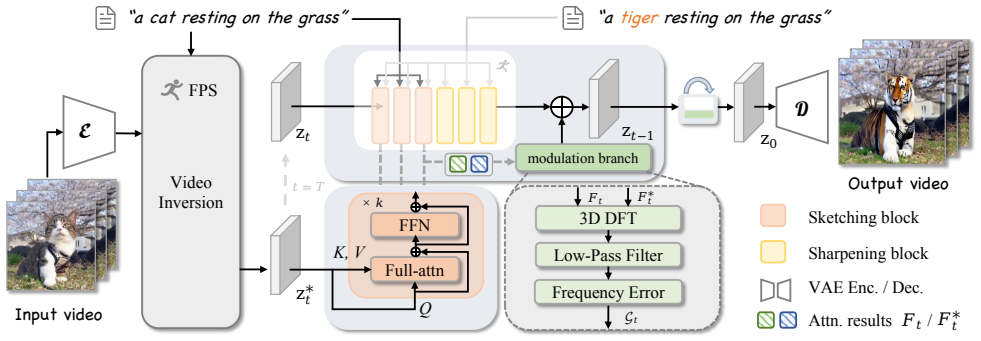
The load-bearing object is the sketching block, the first four transformer blocks of the text-to-video diffusion model, whose full-attention outputs are dominated by low-frequency spatial and temporal structure. The guidance is built from the 3D DFT of those outputs, $F_t = \operatorname{DFT}_3(F_t)$, followed by a low-pass filter $\operatorname{LP}$ that keeps roughly the low-frequency two-thirds of the spectrum. The difference of low-passed source and target attention outputs, $G_t = \Vert \operatorname{LP}(F_t) - \operatorname{LP}(F_t^*)\Vert_2^2$, is differentiated with respect to the latent and subtracted from the DDIM step with a normalized weight $\lambda$. This carries the argument because it turns the model's internal frequency decomposition into a steering signal that preserves structure without copying high-frequency details.
What would settle it
Use a synthetic video whose essential spatial and temporal structure is concentrated in the high-frequency band, such as a rapidly alternating checkerboard pattern or a small object moving very fast, and run FADE with the fixed two-thirds low-pass cutoff; if the edited video does not preserve that structure, or if the optimal cutoff shifts substantially across videos, the central frequency assumption is falsified.
Extended reading notes
Core claim
FADE's central discovery is that a pretrained text-to-video model factorizes naturally by frequency across its transformer blocks: the first few blocks (the sketching blocks) produce low-frequency attention outputs that encode the video's spatial layout and temporal movement, while later blocks (the sharpening blocks) refine high-frequency texture and detail. The paper turns this factorization into a spectrum-guided modulation. At each DDIM sampling step, it takes the full-attention outputs of the sketching blocks for the source video and the edited video under the same prompt, transforms them with a 3D discrete Fourier transform, applies a low-pass filter, and forms the guidance $G_t = \Vert \operatorname{LP}(F_t) - \operatorname{LP}(F_t^*)\Vert_2^2$. The sampling update is $z_{t-1} = \operatorname{DDIM}(\epsilon_\theta, z_t, t, y_{\mathrm{tgt}}) - \lambda \operatorname{Norm}(\nabla_{z_t} G_t)$, so the trajectory is pushed to preserve the low-frequency structure of the source while leaving high-frequency content free to follow the target prompt. The claim is that this single mechanism handles both appearance and motion edits, with no optimization, no attention-map swapping, and no per-video model tuning.
Load-bearing premise
The load-bearing premise is that the low-frequency content of the first four blocks' attention outputs captures exactly the spatial arrangement and motion that should stay fixed, so filtering out higher frequencies removes only editable detail.
Editorial extensions
If this is right
- The same training-free pipeline handles both appearance edits and motion edits, so a user can change nouns or verbs without switching methods.
- Editing a real video takes about three to four minutes on one GPU, compared with over fifteen minutes for optimization-based baselines.
- Computing guidance only on the first four blocks keeps memory near 23.6 GB with CPU offloading, while using all blocks raises it to 67.6 GB without improving editing quality.
- On the DAVIS benchmark, the reported CLIP scores and object-semantic variance are better than the compared baselines, indicating stronger prompt alignment and temporal consistency.
- The method requires no per-video fine-tuning and no null-text optimization, so it can be applied directly to a new input video after DDIM inversion.
Reading between the lines
- If the same frequency factorization holds in other transformer-based generators, this low-pass guidance could transfer to other video backbones or even to image editing, but the paper demonstrates it on only one pretrained model.
- The fixed choices of the first four blocks and roughly two-thirds of the spectrum are likely video- and edit-dependent; an adaptive cutoff is a natural extension that the paper does not explore.
- Because the guidance penalizes any change in low-frequency structure, edits that intentionally change global layout or camera motion would be suppressed; the paper does not claim support for such structural edits.
- The method could be combined with a mask to restrict guidance to the edited object, since the implementation already uses a masking trick, but the paper reports this only as an implementation detail.
Editorial analysis
A structured set of objections, weighed in public.
Referee Report
Summary. FADE proposes a training-free video editing method built on a pre-trained text-to-video diffusion transformer. Its core idea is to factorize the model's transformer blocks into 'sketching' blocks (the first four) that encode low-frequency spatial and temporal structure and 'sharpening' blocks that encode high-frequency detail. The method runs DDIM inversion to obtain a source trajectory, then during sampling computes the 3D DFT of the attention outputs in the sketching blocks, applies a low-pass filter, and uses the gradient of the squared filtered difference between the source and target attention outputs as a guidance term that modulates the DDIM step (Eqs. 5–7). The paper reports qualitative and quantitative results on 20 DAVIS videos and in-the-wild clips, comparing with Tune-A-Video, Video-P2P, FateZero, and CogVideoX-V2V, and provides ablations for the block factorization and the low-pass filter.
Significance. If the method works as claimed, it would be a useful contribution: training-free video editing with a modern DiT-based video diffusion model, without per-video optimization or attention injection, and with support for both appearance and motion edits. The paper's observational analysis of block-wise frequency behavior (Fig. 2, Supp. Fig. D) is interesting and the proposed spectrum-guided modulation is a plausible mechanism for preserving structure while allowing detail changes. The code release and the honest supplement, which acknowledges small quantitative gains and discloses an auxiliary guidance term and mask strategy, are also strengths. However, the quantitative evidence is thin and the central frequency-separation assumption is not rigorously validated, so the significance of the contribution relative to existing methods remains uncertain until those gaps are addressed.
major comments (4)
- [§4.2, Table 1] The quantitative evidence does not support the main-text claim of 'consistently delivers high-quality ... both qualitatively and quantitatively' (Abstract). The evaluation uses only 20 videos, with no error bars, significance tests, or reporting of variance across videos. In Table 1 the CLIP gains over CogVideoX-V2V are 0.0008 (appearance) and 0.0005 (motion), while LPIPS for appearance is worse than FateZero (0.3085 vs. 0.3057). The supplement states 'quantitative improvement is not very significant compared with the existing methods.' As it stands, the quantitative case rests on a few hundredths of a point in metrics that are known to be noisy, and the paper should either provide a larger evaluation with significance tests or temper the quantitative claims.
- [§3.3, Eq. (6)] The frequency-separation assumption is load-bearing but not quantitatively validated. The paper asserts (Sec. 3.3) that 'fundamental spatial structures and temporal movements are encapsulated within this range' of low frequencies, and uses a low-pass filter with 'about two-thirds of the frequency components' (Sec. 4.3). No precise definition of the filter (per-axis cutoff? box vs. radial region?) is given, and no sweep of the cutoff is reported. The supplement's admission that using all blocks and the full spectrum improves M.PSNR but hurts CLIP confirms that the frequency boundary is a tradeoff, not a clean separation. Since appearance edits such as 'black swan → white duck' change global color and luminance—energy that lies in the low-frequency band—and motion edits can affect either low or high temporal frequencies depending on speed, the authors should provide quantitative evidence that the chosen cutoff actually aligns with the preservation/editability boundary across diverse edit types, not just one illustrative example.
- [Supp. A vs. §3.3–3.4] The main method description is incomplete. Supplement A states that 'the output of the last block in DiT is utilized to compute an auxiliary guidance term' and that a mask is used during sampling, but neither is mentioned in the main text or in Eq. (7). This auxiliary term materially changes the guidance, so the reported contribution cannot be isolated or reproduced from the main paper alone. The authors should either integrate the auxiliary guidance and mask into the main derivation, including how they are weighted and combined with Eq. (7), or show through ablations that they do not affect the reported results.
- [§4.1, §4.3] Several free parameters are tuned per task or per video without a stated criterion. The guidance weight λ is said to 'vary between 10 and 15, tailored to each editing task'; the guidance interval [0, 0.6T], the mask interval [0, 0.8T], and the choice of the first four blocks as sketching blocks are also fixed choices. The ablation in Table 2 does not vary the number of sketching blocks (e.g., 2, 3, 5), so the claim that exactly four blocks constitute the optimal 'sketching' set is not established. The paper should report the selection protocol for these hyperparameters and provide sensitivity analyses, at least for λ and the sketching-block count, so that the comparisons in Table 1 are not driven by per-example tuning.
minor comments (5)
- [§3.3, Eq. (5)] The same symbol F_t is used for the attention output in the time domain and its 3D DFT; use a different notation, e.g., ℱ(F_t), to avoid confusion.
- [§3.3, Eq. (7)] The 'Norm' applied to the gradient is not defined; specify the exact normalization (e.g., L2 normalization along which axes, and whether it is per-tensor or per-sample). This matters because λ is said to be in [10,15] and its effect is reported in Supp. Fig. C.
- [§4.1, Table 1] The metric 'PF' is used in Table 1 but never defined in the text. Also, the user study ('human preference') should report the number of participants and the protocol. The acronym 'OSV' should be expanded and its computation referenced precisely.
- [§4.1] The GPU is described as 'NVIDIA LS20'; presumably this is an L20. Please correct the typo.
- [Abstract vs. Supplement] The abstract claims 'consistently delivers high-quality, realistic and temporally coherent editing results both qualitatively and quantitatively,' but the supplement concedes that the quantitative improvement is not very significant. Please align these statements by supporting the quantitative claim with stronger evidence or by softening it.
Circularity Check
No significant circularity: FADE's central claims are evaluated against external benchmarks and its design choices are not definitional reductions of its reported results.
full rationale
FADE's core contribution is a training-free video editing procedure: it computes a spectrum-guided modulation term from low-pass-filtered differences of attention outputs (Eq. 6) and uses its gradient to adjust DDIM sampling (Eq. 7). The paper does not define its evaluation metrics in terms of this guidance term. Editing quality is measured externally with CLIP score, Mask-PSNR, LPIPS, OSV, and human preference on the DAVIS benchmark and in-the-wild videos, and the method is compared against published baselines such as Video-P2P, FateZero, Tune-A-Video, and CogVideoX-V2V. There is no fitted parameter being renamed as a prediction: the guidance weight, block choice, and low-pass cutoff are hyperparameters validated by ablations, not quantities derived from the reported metrics. The observation that early blocks produce low-frequency attention outputs (Sec. 3.2, Fig. 2) motivates the design, but the actual editing results are not a restatement of that observation. The supplementary passages honestly note that using all blocks and the full spectrum can slightly improve preservation metrics while degrading editing quality, which is an empirical tradeoff rather than a circular dependency. No load-bearing self-citation appears: the paper cites external works for diffusion models, editing methods, and the base T2V model, and the authors do not rely on their own prior uniqueness claims or definitions to force the result. The mild internal dependency noted by the reader, namely that the sketching-block boundary and frequency cutoff are chosen from the same attention analysis the method later validates, is a standard design-and-ablate workflow and does not reduce the reported performance to an identity or to a fitted prediction. Therefore the derivation chain is self-contained against external evidence and no circular step can be exhibited with the paper's own equations.
Assumptions & free parameters
free parameters (4)
- Guidance weight lambda =
10 to 15
- Low-pass filter cutoff =
about two-thirds of frequency components
- Number of sketching blocks =
4 (first blocks)
- Modulation interval and mask interval =
[0, 0.6T] and [0, 0.8T]
assumptions (4)
- domain assumption Low-frequency energy of attention outputs encodes fundamental spatial and temporal structure; high-frequency components are details or noise.
- ad hoc to paper The first 4 transformer blocks act as sketching blocks, and this role is stable across sampling timesteps.
- domain assumption DDIM inversion provides a reverse trajectory close enough to the source that gradient modulation around it preserves fidelity.
- ad hoc to paper Gradient of the squared L2 frequency error with respect to the latent z_t points in a direction that improves editing.
invented entities (1)
-
Sketching vs sharpening block dichotomy
Cite this review
Pith. "Pith review of FADE: Frequency-Aware Diffusion Model Factorization for Video Editing." pith.science (2026). https://pith.science/paper/5RLMCTDS
@misc{pith2026250605934,
  author       = {Pith},
  title        = {Pith review of: FADE: Frequency-Aware Diffusion Model Factorization for Video Editing},
  year         = {2026},
  howpublished = {\url{https://pith.science/paper/5RLMCTDS}},
  note         = {Machine review of arXiv:2506.05934}
}
read the original abstract
Recent advancements in diffusion frameworks have significantly enhanced video editing, achieving high fidelity and strong alignment with textual prompts. However, conventional approaches using image diffusion models fall short in handling video dynamics, particularly for challenging temporal edits like motion adjustments. While current video diffusion models produce high-quality results, adapting them for efficient editing remains difficult due to the heavy computational demands that prevent the direct application of previous image editing techniques. To overcome these limitations, we introduce FADE, a training-free yet highly effective video editing approach that fully leverages the inherent priors from pre-trained video diffusion models via frequency-aware factorization. Rather than simply using these models, we first analyze the attention patterns within the video model to reveal how video priors are distributed across different components. Building on these insights, we propose a factorization strategy to optimize each component's specialized role. Furthermore, we devise spectrum-guided modulation to refine the sampling trajectory with frequency domain cues, preventing information leakage and supporting efficient, versatile edits while preserving the basic spatial and temporal structure. Extensive experiments on real-world videos demonstrate that our method consistently delivers high-quality, realistic and temporally coherent editing results both qualitatively and quantitatively. Code is available at https://github.com/EternalEvan/FADE .
Figures


Figures from the paper (2 more)


Reference graph
Works this paper leans on
-
[1]
Blended diffusion for text-driven editing of natural images
Omri Avrahami, Dani Lischinski, and Ohad Fried. Blended diffusion for text-driven editing of natural images. In CVPR, pages 18208–18218, 2022. 2
2022
-
[2]
Stable video diffusion: Scaling latent video diffusion models to large datasets
Andreas Blattmann, Tim Dockhorn, Sumith Kulal, Daniel Mendelevitch, Maciej Kilian, Dominik Lorenz, Yam Levi, Zion English, Vikram V oleti, Adam Letts, et al. Stable video diffusion: Scaling latent video diffusion models to large datasets. arXiv preprint arXiv:2311.15127, 2023. 3
arXiv 2023
-
[3]
In- structpix2pix: Learning to follow image editing instructions
Tim Brooks, Aleksander Holynski, and Alexei A Efros. In- structpix2pix: Learning to follow image editing instructions. In CVPR, pages 18392–18402, 2023. 3
work page 2023
-
[4]
Video generation models as world simu- lators
Tim Brooks, Bill Peebles, Connor Holmes, Will DePue, Yufei Guo, Li Jing, David Schnurr, Joe Taylor, Troy Luhman, Eric Luhman, et al. Video generation models as world simu- lators. URL https://openai. com/research/video-generation- models-as-world-simulators, 3, 2024. 3, 4
work page 2024
-
[5]
Masactrl: Tuning-free mu- tual self-attention control for consistent image synthesis and editing
Mingdeng Cao, Xintao Wang, Zhongang Qi, Ying Shan, Xi- aohu Qie, and Yinqiang Zheng. Masactrl: Tuning-free mu- tual self-attention control for consistent image synthesis and editing. In ICCV, pages 22560–22570, 2023. 2
work page 2023
-
[6]
Diffusion mod- els beat gans on image synthesis
Prafulla Dhariwal and Alexander Nichol. Diffusion mod- els beat gans on image synthesis. NeurIPS, 34:8780–8794,
-
[7]
Tokenflow: Consistent diffusion features for consistent video editing
Michal Geyer, Omer Bar-Tal, Shai Bagon, and Tali Dekel. Tokenflow: Consistent diffusion features for consistent video editing. arXiv preprint arXiv:2307.10373, 2023. 3
arXiv 2023
-
[8]
Prompt-to-prompt im- age editing with cross attention control
Amir Hertz, Ron Mokady, Jay Tenenbaum, Kfir Aberman, Yael Pritch, and Daniel Cohen-Or. Prompt-to-prompt im- age editing with cross attention control. arXiv preprint arXiv:2208.01626, 2022. 2, 3
arXiv 2022
Show all 39 references
-
[9]
Denoising diffu- sion probabilistic models
Jonathan Ho, Ajay Jain, and Pieter Abbeel. Denoising diffu- sion probabilistic models. NeurIPS, 33:6840–6851, 2020. 2, 3, 4
2020
-
[10]
Imagen video: High definition video generation with diffusion mod- els
Jonathan Ho, William Chan, Chitwan Saharia, Jay Whang, Ruiqi Gao, Alexey Gritsenko, Diederik P Kingma, Ben Poole, Mohammad Norouzi, David J Fleet, et al. Imagen video: High definition video generation with diffusion mod- els. arXiv preprint arXiv:2210.02303, 2022. 2
-
[11]
Video dif- fusion models
Jonathan Ho, Tim Salimans, Alexey Gritsenko, William Chan, Mohammad Norouzi, and David J Fleet. Video dif- fusion models. NeurIPS, 35:8633–8646, 2022. 3
2022
-
[12]
Video dif- fusion models
Jonathan Ho, Tim Salimans, Alexey Gritsenko, William Chan, Mohammad Norouzi, and David J Fleet. Video dif- fusion models. NeurIPS, 35:8633–8646, 2022. 2
2022
-
[13]
Imagic: Text-based real image editing with diffusion models
Bahjat Kawar, Shiran Zada, Oran Lang, Omer Tov, Huiwen Chang, Tali Dekel, Inbar Mosseri, and Michal Irani. Imagic: Text-based real image editing with diffusion models. In CVPR, pages 6007–6017, 2023. 2
2023
-
[14]
Blip: Bootstrapping language-image pre-training for unified vision-language understanding and generation
Junnan Li, Dongxu Li, Caiming Xiong, and Steven Hoi. Blip: Bootstrapping language-image pre-training for unified vision-language understanding and generation. In ICML, pages 12888–12900. PMLR, 2022. 7
2022
-
[15]
Video-p2p: Video editing with cross-attention control
Shaoteng Liu, Yuechen Zhang, Wenbo Li, Zhe Lin, and Jiaya Jia. Video-p2p: Video editing with cross-attention control. In CVPR, pages 8599–8608, 2024. 2, 3, 5, 7
2024
-
[16]
Latte: Latent diffusion transformer for video generation
Xin Ma, Yaohui Wang, Gengyun Jia, Xinyuan Chen, Zi- wei Liu, Yuan-Fang Li, Cunjian Chen, and Yu Qiao. Latte: Latent diffusion transformer for video generation. arXiv preprint arXiv:2401.03048, 2024. 3, 4
2024 arXiv
-
[17]
Sdedit: Guided image synthesis and editing with stochastic differential equa- tions
Chenlin Meng, Yutong He, Yang Song, Jiaming Song, Jia- jun Wu, Jun-Yan Zhu, and Stefano Ermon. Sdedit: Guided image synthesis and editing with stochastic differential equa- tions. In ICLR, 2021. 3
2021
-
[18]
Null-text inversion for editing real images using guided diffusion models
Ron Mokady, Amir Hertz, Kfir Aberman, Yael Pritch, and Daniel Cohen-Or. Null-text inversion for editing real images using guided diffusion models. In CVPR, pages 6038–6047,
-
[19]
Dreamix: Video diffusion models are general video editors
Eyal Molad, Eliahu Horwitz, Dani Valevski, Alex Rav Acha, Yossi Matias, Yael Pritch, Yaniv Leviathan, and Yedid Hoshen. Dreamix: Video diffusion models are general video editors. arXiv preprint arXiv:2302.01329, 2023. 2, 3
2023 arXiv
-
[20]
Zero-shot image-to-image translation
Gaurav Parmar, Krishna Kumar Singh, Richard Zhang, Yijun Li, Jingwan Lu, and Jun-Yan Zhu. Zero-shot image-to-image translation. In ACM SIGGRAPH, pages 1–11, 2023. 2, 3
2023
-
[21]
Scalable diffusion models with transformers
William Peebles and Saining Xie. Scalable diffusion models with transformers. In ICCV, pages 4195–4205, 2023. 3
2023
-
[22]
The 2017 davis challenge on video object segmentation.arXiv preprint arXiv:1704.00675, 2017
Jordi Pont-Tuset, Federico Perazzi, Sergi Caelles, Pablo Ar- bel´aez, Alex Sorkine-Hornung, and Luc Van Gool. The 2017 davis challenge on video object segmentation.arXiv preprint arXiv:1704.00675, 2017. 2, 7
2017 arXiv
-
[23]
Fatezero: Fus- ing attentions for zero-shot text-based video editing
Chenyang Qi, Xiaodong Cun, Yong Zhang, Chenyang Lei, Xintao Wang, Ying Shan, and Qifeng Chen. Fatezero: Fus- ing attentions for zero-shot text-based video editing. In ICCV, pages 15932–15942, 2023. 2, 3, 7
2023
-
[24]
Learn- ing transferable visual models from natural language super- vision
Alec Radford, Jong Wook Kim, Chris Hallacy, Aditya Ramesh, Gabriel Goh, Sandhini Agarwal, Girish Sastry, Amanda Askell, Pamela Mishkin, Jack Clark, et al. Learn- ing transferable visual models from natural language super- vision. In ICML, pages 8748–8763. PMLR, 2021. 7
2021
-
[25]
High-resolution image syn- thesis with latent diffusion models
Robin Rombach, Andreas Blattmann, Dominik Lorenz, Patrick Esser, and Bj¨orn Ommer. High-resolution image syn- thesis with latent diffusion models. In CVPR, pages 10684– 10695, 2022. 3
2022
-
[26]
U-net: Convolutional networks for biomedical image segmentation
Olaf Ronneberger, Philipp Fischer, and Thomas Brox. U-net: Convolutional networks for biomedical image segmentation. In MICCAI, pages 234–241. Springer, 2015. 3, 4
2015
-
[27]
Edit-a-video: Single video editing with object-aware consistency
Chaehun Shin, Heeseung Kim, Che Hyun Lee, Sang-gil Lee, and Sungroh Yoon. Edit-a-video: Single video editing with object-aware consistency. In ACML, pages 1215–1230. PMLR, 2024. 2
2024
-
[28]
Make-a-video: Text-to-video generation without text-video data
Uriel Singer, Adam Polyak, Thomas Hayes, Xi Yin, Jie An, Songyang Zhang, Qiyuan Hu, Harry Yang, Oron Ashual, Oran Gafni, et al. Make-a-video: Text-to-video generation without text-video data. arXiv preprint arXiv:2209.14792 ,
-
[29]
Denois- ing diffusion implicit models
Jiaming Song, Chenlin Meng, and Stefano Ermon. Denois- ing diffusion implicit models. In ICLR, 2020. 3
2020
-
[30]
Guide-and-rescale: Self- guidance mechanism for effective tuning-free real image editing
Vadim Titov, Madina Khalmatova, Alexandra Ivanova, Dmitry Vetrov, and Aibek Alanov. Guide-and-rescale: Self- guidance mechanism for effective tuning-free real image editing. arXiv preprint arXiv:2409.01322, 2024. 2, 5
2024 arXiv
-
[31]
Plug-and-play diffusion features for text-driven image-to-image translation
Narek Tumanyan, Michal Geyer, Shai Bagon, and Tali Dekel. Plug-and-play diffusion features for text-driven image-to-image translation. In CVPR, pages 1921–1930,
1921
-
[32]
Phenaki: Variable length video generation from open domain textual descriptions
Ruben Villegas, Mohammad Babaeizadeh, Pieter-Jan Kin- dermans, Hernan Moraldo, Han Zhang, Mohammad Taghi Saffar, Santiago Castro, Julius Kunze, and Dumitru Erhan. Phenaki: Variable length video generation from open domain textual descriptions. In ICLR, 2022. 2
2022
-
[33]
Zero-shot video editing using off-the-shelf image diffusion models
Wen Wang, Yan Jiang, Kangyang Xie, Zide Liu, Hao Chen, Yue Cao, Xinlong Wang, and Chunhua Shen. Zero-shot video editing using off-the-shelf image diffusion models. arXiv preprint arXiv:2303.17599, 2023. 2
2023 arXiv
-
[34]
Tune-a-video: One-shot tuning of image diffusion models for text-to-video generation
Jay Zhangjie Wu, Yixiao Ge, Xintao Wang, Stan Weixian Lei, Yuchao Gu, Yufei Shi, Wynne Hsu, Ying Shan, Xiaohu Qie, and Mike Zheng Shou. Tune-a-video: One-shot tuning of image diffusion models for text-to-video generation. In ICCV, pages 7623–7633, 2023. 3, 7
2023
-
[35]
Cogvideox: Text-to-video diffusion models with an expert transformer
Zhuoyi Yang, Jiayan Teng, Wendi Zheng, Ming Ding, Shiyu Huang, Jiazheng Xu, Yuanming Yang, Wenyi Hong, Xiao- han Zhang, Guanyu Feng, et al. Cogvideox: Text-to-video diffusion models with an expert transformer. arXiv preprint arXiv:2408.06072, 2024. 3, 4, 7, 8, 1
2024 arXiv
-
[36]
The unreasonable effectiveness of deep features as a perceptual metric
Richard Zhang, Phillip Isola, Alexei A Efros, Eli Shechtman, and Oliver Wang. The unreasonable effectiveness of deep features as a perceptual metric. In CVPR, pages 586–595,
-
[37]
Open-sora: Democratizing efficient video production for all
Zangwei Zheng, Xiangyu Peng, Tianji Yang, Chenhui Shen, Shenggui Li, Hongxin Liu, Yukun Zhou, Tianyi Li, and Yang You. Open-sora: Democratizing efficient video production for all. URL https://github. com/hpcaitech/Open-Sora, 2024. 3, 4
2024
-
[38]
Detecting twenty-thousand classes using image-level supervision
Xingyi Zhou, Rohit Girdhar, Armand Joulin, Philipp Kr¨ahenb¨uhl, and Ishan Misra. Detecting twenty-thousand classes using image-level supervision. In ECCV, 2022. 1 FADE: Frequency-Aware Diffusion Model Factorization for Video Editing Supplementary Material block[4] block[10] b...
2022
-
[39]
taxi”+“autumn
at timesteps t = [10, 20, 30]. D. More Comparisons In this section, we add qualitative results (Row 1&2) and comparisons with FLATTEN, TokenFlow, Rerender- 4 30 t = 10 4 30 4 30 t = 20 t = 30 Figure D. The spectral energy distribution and visualization of the attention results...
Reviewed August 7, 2026 · model on record in the stance chip above.
Discussion (0). Sign in to comment.