REVIEW 3 major objections 5 minor 71 references
Comparing observations of the closely located JUICE and STEREO-A spacecraft during the widespread solar energetic particle event of 2024 May 13
T0 review · 3 major / 5 minor · reviewed 2026-08-07 · deepseek-v4-flash
Pith's one-line read During a lucky close encounter between JUICE and STEREO-A, the radiation monitor aboard the Jupiter-bound spacecraft measured solar energetic proton fluxes matching STEREO-A within 25 percent, with intercalibration factors near unity.
desk verdict First credible cross-calibration of JUICE/RADEM against STEREO-A, with four plausible but uncertainty-free intercalibration factors; the 31.2 MeV channel and the assumed reservoir isotropy are the soft spots. read the letter →
The pith
A machine-rendered reading of the paper's core claim, the machinery that carries it, and where it could break.
The reading
What carries the argument
The carrier of the argument is RADEM's Proton Detector Head operating in single-coincidence mode, where each silicon sensor acts as an integral counter with a threshold energy. The authors build four differential channels by subtracting combinations of bins, and the bow-tie method uses simulated channel response functions to find the effective energy and geometric factor $G\,dE$ at which the channel response is least sensitive to the assumed power-law spectral index. On the comparison side, the machinery is a broken power-law fit to the STEREO-A spectrum obtained with orthogonal distance regression, evaluated over an isotropy window selected using first- and second-order anisotropy from Wind and STEREO-A pitch-angle distributions; the reservoir effect justifies using that fit at JUICE without radial scaling.
What would settle it
Recompute the STA/JUICE intercalibration factors using a different isotropic window during the same decay phase, for instance the 2024 May 15 18:00–May 16 02:00 interval that was excluded because the STEREO-A pitch-angle coverage changed; the authors note that altering the accumulated-spectrum window shifts the broken-power-law break energy and can change the $31.2$ MeV factor, so factors that move by more than the quoted uncertainties would show the calibration is window-dependent. A cleaner test is a second conjunction event with a differently located calibrated spacecraft, which would distinguish instrumental offsets from environmental gradients.
Extended reading notes
Core claim
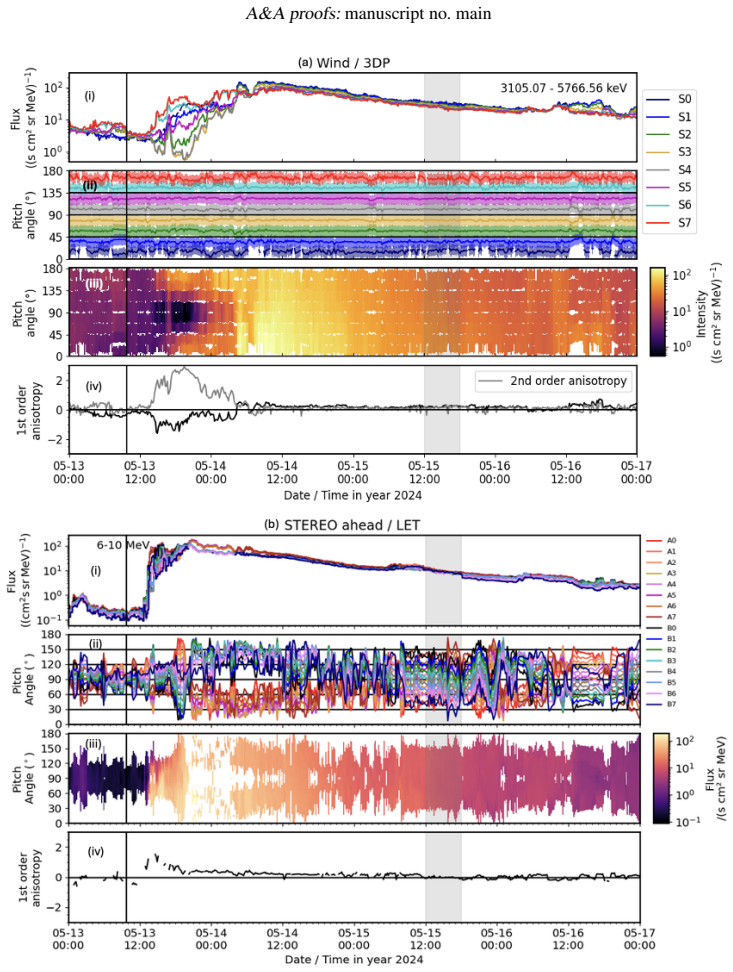
On the paper's own terms, the central result is that RADEM's integral proton channels, combined linearly and calibrated with a bow-tie method, reproduce the differential proton spectrum measured by STEREO-A during the isotropic interval 2024 May 15 12:00–18:00 UT. The authors treat the STEREO-A broken-power-law fit as the reference particle environment at both locations and compute the STA/JUICE intercalibration factors $1.02$, $1.23$, $1.12$, and $0.95$ at the four effective energies. They therefore conclude that RADEM data collected before 2024 July 10 can be converted to differential SEP proton fluxes, making JUICE a valid heliospheric particle observatory between $0.65$ and $5.2$ au.
Load-bearing premise
The result assumes that during 2024 May 15 12:00–18:00 UT the proton spectrum at JUICE, $0.13$ au farther out and without its own magnetometer or pitch-angle data, was identical to the spectrum measured by STEREO-A, so that any difference between the two instruments is purely instrumental.
Editorial extensions
If this is right
- RADEM cruise data from 2023 September to 2024 July 10 can be converted into differential SEP proton fluxes at roughly $6.9$–$31.2$ MeV, with deviations from STEREO-A under $25\%$.
- JUICE becomes a third inner-heliosphere vantage point alongside near-Earth spacecraft and STEREO-A for studying how SEP events spread in longitude and radius.
- The near-unity intercalibration factors give a direct check on RADEM's geometric calibration for its pre-July-2024 configuration.
- The same isotropic-window comparison can be repeated for other SEP events with different spectral shapes to test how robust the factors are.
Reading between the lines
- An implicit corollary is that this comparison cannot separate a small instrumental offset from a small real spectral difference at JUICE, since the two spacecraft were only $1.6^\circ$ apart in longitude; a future event observed by JUICE alongside another well-calibrated platform at a larger separation would test how much of the $<25\%$ deviation is environmental.
- The method generalises to other planetary missions carrying radiation monitors without full directional or energy information: any such monitor can be cross-calibrated during a close conjunction with a well-instrumented heliophysics spacecraft, provided an isotropy window can be identified.
- The spectral-index dependence of the channel response suggests that applying these factors to events with much harder or softer proton spectra could introduce errors larger than the $25\%$ quoted here, and the authors' own fit uncertainty in the high-energy index already hints at this.
- If the calibration is confirmed on more events, a fleet of planetary cruise-phase monitors could extend the sparse network of SEP observers to heliocentric distances beyond 2 au, where direct radiation and solar-wind measurements are scarce.
Editorial analysis
A structured set of objections, weighed in public.
Referee Report
Summary. The paper analyzes the widespread solar energetic particle (SEP) event of 2024 May 13 using observations from JUICE/RADEM, STEREO-A, and near-Earth spacecraft, exploiting the unusually close alignment of JUICE and STEREO-A (0.13 au radial, 0.3 deg latitude, 1.6 deg longitude). The authors characterize the interplanetary context, use Wind and STEREO-A pitch-angle distributions to identify an isotropic decay-phase interval (2024 May 15, 12:00-18:00 UT), fit the STEREO-A LET+HET spectrum with a broken power law, and compare that reference spectrum with SOHO/ERNE and with JUICE/RADEM proton channels reconstructed via a GEANT4-based bow-tie method. The central result is a set of STEREO-A/JUICE intercalibration factors of 1.02, 1.23, 1.12, and 0.95 at effective energies 6.9, 13.3, 21.6, and 31.2 MeV, with the claim that the fluxes agree to better than 25%. The authors explicitly restrict the validity of the result to RADEM data acquired before the instrument configuration change on 2024 July 10.
Significance. If the central claim holds, the paper provides the first quantitative cross-calibration of RADEM proton measurements against STEREO-A during the JUICE cruise phase, turning RADEM into a usable heliospheric SEP observatory between 0.65 and 5.2 au. This would be a valuable contribution to multi-spacecraft SEP studies. The paper has genuine strengths: the bow-tie reconstruction is based on GEANT4 response functions, the isotropic window is selected from explicit pitch-angle anisotropy criteria, the STEREO-A spectral fit is shown together with SOHO/ERNE data, and the authors state the instrument-configuration validity window and several caveats. The main weaknesses are that the headline intercalibration factors are quoted without propagated uncertainties and that the assumption of an identical isotropic reservoir spectrum at JUICE and STEREO-A is load-bearing but not quantitatively bounded at JUICE, where no magnetometer or pitch-angle measurements are available.
major comments (3)
- [§4.4 and Table 2] The intercalibration factors in Table 2 are quoted to two decimal places with no uncertainties, despite substantial uncertainties in the inputs: the broken-power-law fit gives delta2 = -6.46 +- 1.92 and Eb = 33.9 +- 8.2 MeV, and the bow-tie geometric factors in Table 1 have 5th-95th percentile spreads as large as -9.31%/+24.6% for the 13.3 MeV channel. The authors themselves note that changing the accumulation time interval alters Eb and can affect the 31.2 MeV factor. Because the central claim is agreement 'with a deviation of less than 25%', the factors must be reported with propagated uncertainties; otherwise the reader cannot tell whether the four deviations are statistically significant or consistent with unity.
- [§4.3–4.4 and Fig. 5] The reference spectrum is the omnidirectional STEREO-A fit, but JUICE observes only an anti-sunward 20-degree field of view, and the comparison assumes that the isotropic reservoir spectrum at STEREO-A also describes the particle environment at JUICE, 0.13 au farther out. The paper has no JUICE magnetometer or pitch-angle data to verify this assumption. The authors' own radial-scaling example (alpha = 2.14 +- 0.26 from Lario et al. 2006) corresponds to a flux difference of roughly 30% over 0.13 au at 4-13 MeV, comparable to or larger than the claimed <25% agreement, and the STEREO-A/LET B7 anti-sunward sector is visibly dissimilar from JUICE at 6.9 MeV in Fig. 5. A quantitative bound on this environmental systematic (for example, the B7-to-omni ratio during the selected window, or a radial-gradient systematic added to Table 2) is needed before the <25% statement can be considered supported.
- [§2.1 and Eq. (1)] The bow-tie reconstruction of the RADEM channels was calibrated assuming power-law spectral indices in the range [-5, -2], but the fitted STEREO-A spectrum has delta2 = -6.46 +- 1.92 above Eb = 33.9 MeV, and the 21.6 and 31.2 MeV RADEM channels extend up to 37.4 MeV. Since the authors state that the reconstruction quality depends on the spectral shape at each time, the two highest-energy intercalibration factors may be biased by the spectrum falling outside the calibrated index range. This should be quantified, for example by evaluating the channel responses against the actual fitted broken power law, or explicitly argued to be negligible.
minor comments (5)
- [§4.3] There is a typo in the sentence 'the the radial correction is small'.
- [§3] The active region is identified once as 'AR 13364' instead of 'AR 13664'.
- [Acknowledgements] The word 'finnancial' should be 'financial'.
- [§6] The opening sentence contains a capitalization/grammar error: 'This work illustrates that The RADEM instrument'.
- [§4.4] The abstract and conclusions state the '<25%' agreement, but the body of the paper does not define how this number is computed from the four intercalibration factors; a sentence specifying the metric (for example, maximum deviation across channels) would remove ambiguity.
Circularity Check
No circularity: the intercalibration factors are measured ratios between independently reconstructed JUICE/RADEM fluxes and a STEREO-A/LET+HET spectral fit, with no fitted parameter or self-citation reducing to the claimed result.
full rationale
The paper's central result is a set of measured flux ratios between two spacecraft. The JUICE/RADEM differential proton fluxes are reconstructed from RADEM count rates via GEANT4-derived response functions and a bow-tie method (Sect. 2.1, Table 1), while the reference spectrum is fitted to STEREO-A/LET and HET omnidirectional data using a broken power law (Sect. 4.4, Eq. 1). No parameter of the STEREO-A fit enters the RADEM flux reconstruction, and no RADEM data are used in fitting the STEREO-A spectrum. The quoted intercalibration factors (Table 2) are therefore measured ratios, not outputs of a model that contains them as free parameters. The selection of the isotropic window from STEREO-A and Wind PADs and the assumption that the reservoir-phase spectrum also describes JUICE are physical assumptions, and the paper explicitly does not apply radial or longitudinal scaling ('We did not apply any radial/longitudinal scaling for the spacecraft measurements based on the reservoir effect discussed in Sect. 4.3'), so the near-unity ratios are not forced by construction. Self-citations (Pinto 2019; Hajdas et al. 2025; Rodríguez-García et al. 2023, 2025) describe instrument response, ENLIL context, or radial-scaling parameters, but none of these is load-bearing for the derived intercalibration factors; the instrument response is based on GEANT4 simulations and the reference spectrum is anchored to an external benchmark (STEREO-A/LET+HET). The acknowledged uncertainties, such as the possible radial gradient and the absence of JUICE magnetometer data, concern the validity of the reservoir assumption, not a circular reduction. No circular step is present.
Assumptions & free parameters
free parameters (7)
- STEREO-A spectral index below the break (delta1) =
-2.26 ± 0.05
- STEREO-A spectral index above the break (delta2) =
-6.46 ± 1.92
- Spectral break energy (Eb) =
33.9 ± 8.2 MeV
- Break sharpness parameter (alpha) =
not reported numerically
- Reference energy (E0) =
0.1 MeV
- RADEM effective energies and G·dE for the four channels =
6.9, 13.3, 21.6, 31.2 MeV and G·dE = 0.214, 0.837, 1.22, 0.844 cm^2 sr MeV
- Radial scaling exponents from Lario et al. (2006) =
a=2.14, b=0.26 (4-13 MeV); a=1.97, b=0.27 (27-37 MeV)
assumptions (8)
- domain assumption The SEP differential flux is a power law with spectral index in [-5,-2] over each RADEM channel
- domain assumption Proton flux above 70 MeV is negligible during the event
- domain assumption Reservoir effect makes SEP intensities nearly uniform in longitude and radial distance during the decay phase
- domain assumption JUICE and STEREO-A were embedded in the same magnetic ejecta structures
- domain assumption STEREO-A pitch-angle data define isotropy for both spacecraft
- domain assumption GEANT4 simulations of the RADEM PDH response are correct
- domain assumption The broken power-law form of Eq. (1) represents the true accumulated spectrum
- domain assumption CNO ions have the same anisotropy as protons in the STEREO-A B7 gap proxy
Cite this review
Pith. "Pith review of Comparing observations of the closely located JUICE and STEREO-A spacecraft during the widespread solar energetic particle event of 2024 May 13." pith.science (2026). https://pith.science/paper/QT2SILJO
@misc{pith2026250605978,
  author       = {Pith},
  title        = {Pith review of: Comparing observations of the closely located JUICE and STEREO-A spacecraft during the widespread solar energetic particle event of 2024 May 13},
  year         = {2026},
  howpublished = {\url{https://pith.science/paper/QT2SILJO}},
  note         = {Machine review of arXiv:2506.05978}
}
read the original abstract
JUICE was launched in April 2023, and it is now in its cruise phase to Jupiter, where it is scheduled to arrive in July 2031. JUICE carries a radiation monitor, namely the RADiation hard Electron Monitor (RADEM) to measure protons, electrons, and ions, detecting particles coming mainly from the anti-Sun direction. On 2024 May 13, a large solar energetic particle (SEP) event took place in association with an eruption close to the western limb of the Sun as seen from Earth. Providentially, at that time JUICE was located very close to STEREO-A, being separated by 0.13 au in radial distance, 0.3 deg in latitude, and 1.6 deg in longitude. Methods. We analysed the IP context using in-situ measurements and studied the proton anisotropies measured by near-Earth spacecraft and STEREO-A. We focused on an isotropic period during the decay phase of the SEP event to compute the proton energy spectrum. We fit the STEREO-A spectrum and compared it to that measured by SOHO and JUICE. Conclusions. The RADEM instrument aboard JUICE is a valuable tool for measuring SEP events in the heliosphere, providing an excellent opportunity to study and characterise the energetic particle environment in the solar wind between 0.65 and 5.2 au. The intercalibration factors between the fluxes measured by STEREO-A and JUICE at the effective energies of 6.9 MeV, 13.3 MeV, 21.6 MeV, and 31.2 MeV are 1.02, 1.23, 1.12, and 0.95 respectively. These intercalibration factors are valid only until 2024 July 10, when the configuration of the RADEM instrument was changed.
Figures


Figures from the paper (3 more)


Reference graph
Works this paper leans on
-
[1]
H., Curtis , D., Scheifele , J
Acu \ n a , M. H., Curtis , D., Scheifele , J. L., et al. 2008, , 136, 203
work page 2008
-
[2]
Allison, J., Amako, K., Apostolakis, J., et al. 2016, Nuclear Instruments and Methods in Physics Research Section A: Accelerators, Spectrometers, Detectors and Associated Equipment, 835, 186
work page 2016
-
[3]
Benkhoff , J., Murakami , G., Baumjohann , W., et al. 2021, , 217, 90
work page 2021
-
[4]
Boggs, P. T. & Rogers, J. E. 1990, in Contemp. Math., Vol. 112, Statistical analysis of measurement error models and applications ( A rcata, CA , 1989) (Amer. Math. Soc., Providence, RI), 183--194
work page 1990
-
[5]
Burlaga , L., Sittler , E., Mariani , F., & Schwenn , R. 1981, , 86, 6673
work page 1981
- [6]
-
[7]
Domingo , V., Fleck , B., & Poland , A. I. 1995, , 162, 1
work page 1995
-
[8]
Dresing , N., Effenberger , F., G \'o mez-Herrero , R., et al. 2020, , 889, 143
work page 2020
Show all 71 references
-
[9]
2014, , 567, A27
Dresing , N., G \'o mez-Herrero , R., Heber , B., et al. 2014, , 567, A27
2014
-
[10]
C., et al
Dresing , N., Rodr \' guez-Garc \' a , L., Jebaraj , I. C., et al. 2023, , 674, A105
2023
-
[11]
, Jebaraj, I
Dresing, N. , Jebaraj, I. C. , Wijsen, N. , et al. 2025, A&A, 695, A127
2025
-
[12]
2019, , 880, 18
Dumbovi \'c , M., Guo , J., Temmer , M., et al. 2019, , 880, 18
2019
-
[13]
J., Velli , M
Fox , N. J., Velli , M. C., Bale , S. D., et al. 2016, , 204, 7
2016
-
[14]
B., Kistler , L
Galvin , A. B., Kistler , L. M., Popecki , M. A., et al. 2008, , 136, 437
2008
-
[15]
2023, , 9, 384
Gieseler , J., Dresing , N., Palmroos , C., et al. 2023, , 9, 384
2023
-
[16]
E., Krimigis , S
Gold , R. E., Krimigis , S. M., Hawkins , S. E., I., et al. 1998, , 86, 541
1998
-
[17]
K., Coustenis , A., et al
Grasset , O., Dougherty , M. K., Coustenis , A., et al. 2013, , 78, 1
2013
-
[18]
2025, Space Science Reviews, 221, 43
Hajdas, W., Gon c alves, P., Pinto, M., et al. 2025, Space Science Reviews, 221, 43
2025
-
[19]
T., Lakhina , G
Hajra , R., Tsurutani , B. T., Lakhina , G. S., Lu , Q., & Du , A. 2024, , 974, 264
2024
-
[20]
Hapgood , M. A. 1992, , 40, 711
1992
-
[21]
2025, , 979, 49
Hayakawa , H., Ebihara , Y., Mishev , A., et al. 2025, , 979, 49
2025
-
[22]
A., Moses , J
Howard , R. A., Moses , J. D., Vourlidas , A., et al. 2008, , 136, 67
2008
-
[23]
2014, , 4, A20
Jiggens , P., Chavy-Macdonald , M.-A., Santin , G., et al. 2014, , 4, A20
2014
-
[24]
L., Kucera , T
Kaiser , M. L., Kucera , T. A., Davila , J. M., et al. 2008, , 136, 5
2008
-
[25]
C., Abiad , R., Austin , G., et al
Kasper , J. C., Abiad , R., Austin , G., et al. 2016, , 204, 131
2016
-
[26]
Y., S \'a nchez-Cano , B., Lee , C
Khoo , L. Y., S \'a nchez-Cano , B., Lee , C. O., et al. 2024, , 963, 107
2024
-
[27]
2021, , 656, A20
Kollhoff , A., Kouloumvakos , A., Lario , D., et al. 2021, , 656, A20
2021
-
[28]
2024, , 970, L13
Kruparova , O., Krupar , V., Szabo , A., et al. 2024, , 970, L13
2024
-
[29]
2010, in American Institute of Physics Conference Series, Vol
Lario , D. 2010, in American Institute of Physics Conference Series, Vol. 1216, Twelfth International Solar Wind Conference, ed. M. Maksimovic , K. Issautier , N. Meyer-Vernet , M. Moncuquet , & F. Pantellini , 625--628
2010
-
[30]
B., et al
Lario , D., Kallenrode , M.-B., Decker , R. B., et al. 2006, , 653, 1531
2006
-
[31]
Y., et al
Lario , D., Wijsen , N., Kwon , R. Y., et al. 2022, , 934, 55
2022
-
[32]
R., Title , A
Lemen , J. R., Title , A. M., Akin , D. J., et al. 2012, , 275, 17
2012
-
[33]
P., Ac \ u na , M
Lepping , R. P., Ac \ u na , M. H., Burlaga , L. F., et al. 1995, , 71, 207
1995
-
[34]
P., Anderson , K
Lin , R. P., Anderson , K. A., Ashford , S., et al. 1995, , 71, 125
1995
-
[35]
D., Hu , H., Zhao , X., Chen , C., & Wang , R
Liu , Y. D., Hu , H., Zhao , X., Chen , C., & Wang , R. 2024, , 974, L8
2024
-
[36]
Lugaz , N., Temmer , M., Wang , Y., & Farrugia , C. J. 2017, , 292, 64
2017
-
[37]
G., Curtis , D
Luhmann , J. G., Curtis , D. W., Schroeder , P., et al. 2008, , 136, 117
2008
-
[38]
J., Alexander , N., Angold , N., et al
McComas , D. J., Alexander , N., Angold , N., et al. 2016, , 204, 187
2016
-
[39]
McKibben , R. B. 1972, , 77, 3957
1972
-
[40]
A., Cohen , C
Mewaldt , R. A., Cohen , C. M. S., Cook , W. R., et al. 2008, , 136, 285
2008
-
[41]
M \"u ller , D., St. Cyr , O. C., Zouganelis , I., et al. 2020, , 642, A1
2020
-
[42]
1995, , 162, 483
M \"u ller-Mellin , R., Kunow , H., Flei ner , V., et al. 1995, , 162, 483
1995
-
[43]
Odstrcil , D., Riley , P., & Zhao , X. P. 2004, Journal of Geophysical Research (Space Physics), 109, A02116
2004
-
[44]
W., Chornay , D
Ogilvie , K. W., Chornay , D. J., Fritzenreiter , R. J., et al. 1995, , 71, 55
1995
-
[45]
Ogilvie , K. W. & Desch , M. D. 1997, , 20, 559
1997
-
[46]
J., Bruno , R., Livi , S., et al
Owen , C. J., Bruno , R., Livi , S., et al. 2020, , 642, A16
2020
-
[47]
Palmerio , E., Kilpua , E. K. J., Witasse , O., et al. 2021, Space Weather, 19, e2020SW002654
2021
-
[48]
D., Thompson , B
Pesnell , W. D., Thompson , B. J., & Chamberlin , P. C. 2012, , 275, 3
2012
-
[49]
2019, PhD thesis, University of Lisbon - Instituto Superior Tecnico
Pinto, M. 2019, PhD thesis, University of Lisbon - Instituto Superior Tecnico
2019
-
[50]
2020, in European Planetary Science Congress, EPSC2020--311
Pinto , M., Goncalves , P., Hajdas , W., & Socha , P. 2020, in European Planetary Science Congress, EPSC2020--311
2020
-
[51]
2020, Journal of Space Weather and Space Climate, 10, 24
Raukunen , O., Paassilta , M., Vainio , R., et al. 2020, Journal of Space Weather and Space Climate, 10, 24
2020
-
[52]
Richardson , I. G. & Cane , H. V. 1996, , 101, 27521
1996
-
[53]
2025, , 694, A64
Rodr \' guez-Garc \' a , L., G \'o mez-Herrero , R., Dresing , N., et al. 2025, , 694, A64
2025
-
[54]
2023, , 670, A51
Rodr \' guez-Garc \' a , L., G \'o mez-Herrero , R., Dresing , N., et al. 2023, , 670, A51
2023
-
[55]
2021, , 653, A137
Rodr \' guez-Garc \' a , L., G \'o mez-Herrero , R., Zouganelis , I., et al. 2021, , 653, A137
2021
-
[56]
F., Mason , G
Rodr \' guez-Pacheco , J., Wimmer-Schweingruber , R. F., Mason , G. M., et al. 2020, , 642, A7
2020
-
[57]
C., Gold , R
Roelof , E. C., Gold , R. E., Simnett , G. M., et al. 1992, , 19, 1243
1992
-
[58]
W., et al
S \'a nchez-Cano , B., Witasse , O., Knutsen , E. W., et al. 2023, Space Weather, 21, e2023SW003540
2023
-
[59]
A., Larson , D., Aoustin , C., et al
Sauvaud , J. A., Larson , D., Aoustin , C., et al. 2008, , 136, 227
2008
-
[60]
C., Frandsen , A
Stone , E. C., Frandsen , A. M., Mewaldt , R. A., et al. 1998, , 86, 1
1998
-
[61]
D., Dresing , N., Kollhoff , A., & Br \"u dern , M
Strauss , R. D., Dresing , N., Kollhoff , A., & Br \"u dern , M. 2020, , 897, 24
2020
-
[62]
Thernisien , A., Vourlidas , A., & Howard , R. A. 2009, , 256, 111
2009
-
[63]
Thernisien , A. F. R., Howard , R. A., & Vourlidas , A. 2006, , 652, 763
2006
-
[64]
1995, , 162, 505
Torsti , J., Valtonen , E., Lumme , M., et al. 1995, , 162, 505
1995
-
[65]
A., Baker , D
Van Allen , J. A., Baker , D. N., Randall , B. A., & Sentman , D. D. 1974, , 79, 3559
1974
-
[66]
E., et al
Virtanen, P., Gommers, R., Oliphant, T. E., et al. 2020, Nature Methods, 17, 261
2020
-
[67]
T., Reames , D
von Rosenvinge , T. T., Reames , D. V., Baker , R., et al. 2008, , 136, 391
2008
-
[68]
E., et al
Weiler , E., M \"o stl , C., Davies , E. E., et al. 2025, Space Weather, 23, e2024SW004260
2025
-
[69]
G., et al
Whitman , K., Egeland , R., Richardson , I. G., et al. 2023, , 72, 5161
2023
-
[70]
E., Angold , N
Wiedenbeck , M. E., Angold , N. G., Birdwell , B., et al. 2017, in International Cosmic Ray Conference, Vol. 301, 35th International Cosmic Ray Conference (ICRC2017), 16
2017
-
[71]
Zurbuchen , T. H. & Richardson , I. G. 2006, , 123, 31
2006
Reviewed August 7, 2026 · model on record in the stance chip above.
Discussion (0). Sign in to comment.