REVIEW 4 major objections 4 minor 23 references
End-to-End Framework for Robot Lawnmower Coverage Path Planning using Cellular Decomposition
T0 review · 4 major / 4 minor · reviewed 2026-08-07 · deepseek-v4-flash
Pith's one-line read AdaptiveDecompositionCPP, which sweeps the decomposition angle and merges adjacent cells by deleting the first critical point in each column, reduces non-mowing travel—to 471 units versus 1,946 and 2,504 for two standard…
desk verdict Solid engineering paper with a real hardware test, but the 'adaptive merging' is a fixed rule and the efficiency claim isn't supported by the paper's own data—worth reviewing, needs major revision. read the letter →
The pith
A machine-rendered reading of the paper's core claim, the machinery that carries it, and where it could break.
The reading
What carries the argument
The central object is the AdaptiveDecompositionCPP algorithm, a modified cellular decomposition. It rotates the input map by 90°−θ for each candidate angle θ, collects critical points where the lawn's connectedness changes between adjacent columns (split or merge conditions), applies the Merge procedure that removes the first critical point from each column's ordered set, and draws region boundaries through the remaining points. The optimization criterion is minimizing the number of regions |D| across all angles, with fewer regions serving as the paper's proxy for lower turn and transfer costs.
What would settle it
For a fixed lawn, compute the full path under every decomposition angle from 0° to 180° and under both the merged and unmerged options, then compare non-mowing distance and Distance per Coverage; if any angle-merge combination beats the configuration the algorithm selects (fewest regions), the central claim is false. The paper's Table II already shows two such instances, so this exhaustive search over the algorithm's own parameter space would settle it.
Extended reading notes
Core claim
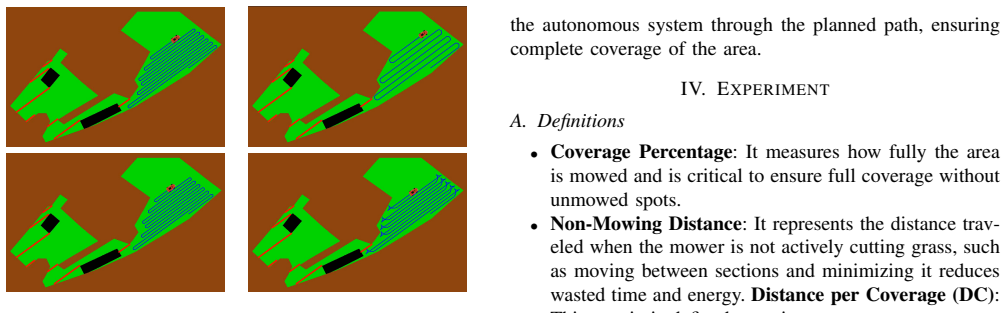
The central discovery is an algorithmic recipe: choose the decomposition angle that produces the fewest regions, then coarsen each column's critical-point set by deleting its first element before drawing region boundaries. This yields fewer, larger regions, and the paper argues that fewer regions means fewer inter-section transfers and turns, hence less non-mowing distance. The quantitative support is a simulation where the method reaches 97.2% coverage with a non-mowing distance of 471 units versus 1,946 for trapezoidal decomposition and 2,504 for boustrophedon decomposition, plus an autonomous run of a medium-sized lawnmower along the planned path.
Load-bearing premise
The load-bearing premise is that the decomposition with the fewest regions will also have the least non-mowing travel and the best overall efficiency; the paper does not prove this link, and its own Table II contains cases where the minimum-section choice does not yield the lowest Distance per Coverage.
Editorial extensions
If this is right
- If the algorithm works as claimed, an operator can draw a boundary once and the mower executes the entire job—including boundary border and section transfers—without further input, as shown in the hardware test.
- Because the pipeline parameterizes mowing width, turning radius, and boundary offset, the same decomposition and merging code can be adapted to different mower sizes and user preferences.
- The exhaustive angle sweep and simple merge rule keep the planner deterministic and fast (under 100 ms in simulation), so it can run online or on embedded hardware.
- Within the paper's own Table II, the merged configuration consistently lowers non-mowing distance compared with the unmerged configuration at the same angle, indicating that the merging step is the main source of the reported efficiency gain.
Reading between the lines
- The same sweeping-angle-plus-merging recipe could be transferred to other strip-coverage tasks (cleaning, painting, inspection), where the angle sweep replaces manual orientation choice and the merge rule could be made condition-based rather than fixed.
- Because the min-sections objective does not always minimize Distance per Coverage in the paper's data, a planner that directly estimates turn and transfer cost at each angle would likely dominate the reported results; this is a testable extension of the paper's own pipeline.
- The merging rule that always drops the first critical point could be replaced by a geometry-aware test that only merges when the combined region remains convex or when the estimated turn cost decreases, which would likely improve coverage on irregular shapes—the paper's conclusion flags the merging strategy as simplistic.
- The hardware validation is a single run with RTK-GNSS localization; computing a lateral deviation metric between planned and traced paths would let the same pipeline be audited across sites and mower models.
Editorial analysis
A structured set of objections, weighed in public.
Referee Report
Summary. The paper proposes an end-to-end coverage path planning (CPP) pipeline for robotic lawnmowers, starting from user-defined GPS polygon boundaries and ending with executable GPS waypoints. The central contribution is the AdaptiveDecompositionCPP algorithm, which performs cellular decomposition of the lawn, sweeps the decomposition angle from 0 to 180 degrees, and merges adjacent sections to reduce the number of decomposed regions. The authors claim this merging reduces non-mowing travel and improves operational efficiency. The algorithm is evaluated in simulation against trapezoidal, boustrophedon, and grid-based baselines, and the full pipeline is demonstrated on a real lawnmower with RTK-GNSS tracking.
Significance. If the central efficiency claim holds, the paper would offer a practical, modular CPP pipeline with a useful angle-sweep and region-merging mechanism, supported by hardware validation. The paper is clearly written and the end-to-end integration is a strength, as are the direct comparisons against standard decomposition baselines. However, the significance is substantially tempered by two load-bearing weaknesses: the merging procedure is a fixed heuristic rather than an adaptive decision, and the optimization objective (minimizing the number of regions) is not consistently aligned with the paper's own reported efficiency metrics. The empirical claims also rest on single runs without error bars or repeated trials.
major comments (4)
- [Algorithm 1, lines 24-26] The term 'adaptive merging strategy' is not supported by the pseudocode. The Merge procedure unconditionally removes the first element from the ordered set C_i, with no condition that evaluates whether merging is beneficial for the specific local geometry or for the overall path. This contradicts the abstract and Section III.A.3, which describe merging as an adaptive strategy that optimizes the decomposition. The authors should either implement a conditional merge criterion (e.g., based on region counts, non-mowing distance, or connectivity) or rename the method to avoid overstating the contribution.
- [Algorithm 1, line 6; Section IV-C, Table II] The algorithm's objective is to minimize the number of regions |D|, but the headline claim is reduction of non-mowing travel and enhanced operational efficiency. The paper does not establish that minimum region count is a reliable proxy for these metrics; the mowing order between regions also matters. More importantly, the paper's own data contradict the proxy: in Result #1, the 36° no-merge configuration achieves DC 20.03 while the min-sections merged configuration achieves DC 20.65; in Result #4, the 0° no-merge configuration achieves DC 13.94 versus 14.26 for the min-sections merged configuration. Thus the stated mechanism does not consistently deliver the claimed improvement, and the lower non-mowing distance in Table I cannot be attributed to the stated optimization without a dedicated ablation that measures non-mowing distance directly.
- [Section IV-C, Table II, Result #2] The claim in Section IV-C that 'Merging sections and optimizing the decomposition angle usually reduces non-mowing distance across all maps' is not robustly supported. In Result #2, at the reference angle 0°, merging increases non-mowing distance from 114.8 m to 148.4 m, which is a substantial regression. This shows that the fixed Merge rule can hurt efficiency, and the algorithm has no mechanism to detect or avoid such cases. A load-bearing part of the paper's contribution is the merging strategy; the present evidence does not show that it is reliably beneficial.
- [Section IV-B, IV-C; Section V] All simulation results are reported as single deterministic values with no repeated trials, error bars, or statistical significance tests. Given the small differences in some key metrics (e.g., coverage 97.61% vs. 97.35% in Table II), single-run values are insufficient to support comparative claims. In addition, the conclusion concedes that 'the pre-planning of the mowing order for sub-sections could be optimized to minimize non-mowing travel,' which is a direct admission that the present algorithm does not optimize the quantity highlighted in the title and abstract. The hardware validation in Section IV-D shows trajectories but reports no quantitative tracking error, so the claim of execution 'without significant deviation' is unquantified.
minor comments (4)
- [Section IV.A] The definition of Distance per Coverage is malformatted: 'This metric is defined as ratio:' is missing a colon and an equation, and 'Mowing Distance+Non Mowing Distance' should have proper spacing and mathematical notation.
- [Algorithm 1, lines 2-6] The notation for the set N_opt is inconsistent: the pseudocode uses 'Nopt' while the text uses 'N opt'; also, line 6's argmin over (D,θ) in N_opt should be clarified as a set of pairs, which would make the objective explicit.
- [Section III.A.3] The text states that 'If at least one critical point is detected, the start and end points of the lawn area in that specific column are also added to complete the set,' but this behavior is not present in the pseudocode of CriticalPoints or Merge. This discrepancy should be resolved, as it affects the resulting decomposition.
- [Table I, Section IV-B] Table I shows that the grid-based baseline achieves a better Distance per Coverage (199.8) than the proposed method (208.9), yet the discussion states that 'comparable or better coverage percentages clearly indicate reduced unnecessary travel' without acknowledging this exception. The comparison should be addressed explicitly, including the trade-off with the number of turns.
Circularity Check
No circular derivation found: reported values are measured, not forced by construction, but the headline efficiency claim rests on an unvalidated proxy objective that the paper's own ablations contradict.
full rationale
The paper's central claim — AdaptiveDecompositionCPP 'combines cellular decomposition with an adaptive merging strategy to reduce non-mowing travel thereby enhancing operational efficiency' (Abstract) — is not derived from itself. The pipeline (Algorithm 1) sweeps θ over 0–180°, calls DecomposeMerge per angle, and selects 'the decomposition with the fewest regions' (Line 6); Merge (Lines 24–26) 'removes the first element from the ordered set C_i,' an unconditional fixed rule rather than an adaptive decision. The reported outputs (coverage, non-mowing distance, DC) are measurements of a planner configuration on a fixed map against external baselines (Table I: TCD, BCD, grid-based), so none is forced by construction: no metric is defined in terms of the optimized quantity |D|, no parameter is fitted to a data subset and then renamed as a prediction, and there are zero self-citations or imported uniqueness/ansatz claims. The paper even states candidly that its contribution is 'a modified approach' to boustrophedon decomposition, not a renaming of a known result. The genuine weaknesses are validity concerns, not circularity: the proxy objective is asserted rather than derived ('We attribute the lower non-mowing distance to merging, which reduces the number of decompositions leading to fewer travels between decompositions,' Section IV.B), and Table II contradicts that attribution — Result #4's min-sections merged configuration has DC 14.26 versus 13.94 for the no-merge reference, and Result #2's min-sections angle raises non-mowing distance from 114.8 m to 125.7 m. The conclusion concedes 'the pre-planning of the mowing order for sub-sections could be optimized to minimize non-mowing travel,' meaning the algorithm does not actually minimize the quantity named in the headline claim. These are over-claiming and experimental-design issues belonging under correctness risk; because no equation or fitted value makes the reported result equal to its input by construction, the circularity score is 1, not higher.
Assumptions & free parameters
assumptions (4)
- domain assumption The lawn can be represented as a binary image and rotated without loss of geometric fidelity.
- domain assumption Fewer decomposed regions implies less non-mowing travel and better operational efficiency.
- domain assumption Critical points can be detected by changes in region classification between adjacent columns of a binary image.
- domain assumption The environment is static, two-dimensional, and relatively flat, and a single mower is used.
Cite this review
Pith. "Pith review of End-to-End Framework for Robot Lawnmower Coverage Path Planning using Cellular Decomposition." pith.science (2026). https://pith.science/paper/XAEEDJ7Q
@misc{pith2026250606028,
  author       = {Pith},
  title        = {Pith review of: End-to-End Framework for Robot Lawnmower Coverage Path Planning using Cellular Decomposition},
  year         = {2026},
  howpublished = {\url{https://pith.science/paper/XAEEDJ7Q}},
  note         = {Machine review of arXiv:2506.06028}
}
read the original abstract
Efficient Coverage Path Planning (CPP) is necessary for autonomous robotic lawnmowers to effectively navigate and maintain lawns with diverse and irregular shapes. This paper introduces a comprehensive end-to-end pipeline for CPP, designed to convert user-defined boundaries on an aerial map into optimized coverage paths seamlessly. The pipeline includes user input extraction, coordinate transformation, area decomposition and path generation using our novel AdaptiveDecompositionCPP algorithm, preview and customization through an interactive coverage path visualizer, and conversion to actionable GPS waypoints. The AdaptiveDecompositionCPP algorithm combines cellular decomposition with an adaptive merging strategy to reduce non-mowing travel thereby enhancing operational efficiency. Experimental evaluations, encompassing both simulations and real-world lawnmower tests, demonstrate the effectiveness of the framework in coverage completeness and mowing efficiency.
Figures


Figures from the paper (2 more)

Reference graph
Works this paper leans on
-
[1]
Coverage for robotics – a survey of recent results,
H. Choset, “Coverage for robotics – a survey of recent results,”Annals of Mathematics and Artificial Intelligence, vol. 31, no. 1, pp. 113–126, 2001
work page 2001
-
[2]
A survey on coverage path planning for robotics,
E. Galceran and M. Carreras, “A survey on coverage path planning for robotics,”Robotics Auton. Syst., vol. 61, pp. 1258–1276, 2013
work page 2013
-
[3]
Coverage path planning: The boustrophedon cellular decomposition,
H. Choset and P. Pignon, “Coverage path planning: The boustrophedon cellular decomposition,” 1998. [Online]. Available: https://api.semanticscholar.org/CorpusID:16233318
work page 1998
-
[4]
Planning paths of complete coverage of an unstructured environment by a mobile robot,
A. Zelinsky, R. Jarvis, J. Byrne, and S. Yuta, “Planning paths of complete coverage of an unstructured environment by a mobile robot,” 2007
work page 2007
-
[5]
A solution to vicinity problem of obstacles in complete coverage path planning,
C. Luo, S. X. Yang, D. A. Stacey, and J. C. Jofriet, “A solution to vicinity problem of obstacles in complete coverage path planning,”Proceedings 2002 IEEE International Conference on Robotics and Automation (Cat. No.02CH37292), vol. 1, pp. 612–617 vol.1, 2002. [Online]. Available: https://api.semanticscholar.org/CorpusID:33262037
work page 2002
-
[6]
M. Sportelli, M. Fontanelli, M. Pirchio, C. Frasconi, M. Raffaelli, L. Caturegli, S. Magni, M. V olterrani, and A. Peruzzi, “Robotic mowing of tall fescue at 90 mm cutting height: Random trajectories vs. systematic trajectories,”Agronomy, vol. 11, no. 12, 2021. [Online]. Available: https://www.mdpi.com/2073-4395/11/12/2567
work page 2021
-
[7]
Ub-anc plan- ner: Energy efficient coverage path planning with multiple drones,
J. Modares, F. Ghanei, N. Mastronarde, and K. Dantu, “Ub-anc plan- ner: Energy efficient coverage path planning with multiple drones,” 2017 IEEE International Conference on Robotics and Automation (ICRA), pp. 6182–6189, 2017
work page 2017
-
[8]
P. T. Kyaw, A. Paing, T. T. Thu, R. E. Mohan, A. V . Le, and V . Prabakaran, “Coverage path planning for decomposition reconfig- urable grid-maps using deep reinforcement learning based travelling salesman problem,”IEEE Access, vol. 8, pp. 225 945–225 956, 2020
work page 2020
Show all 23 references
-
[9]
Approximation algorithms for the geometric covering salesman problem,
E. M. Arkin and R. Hassin, “Approximation algorithms for the geometric covering salesman problem,”Discrete Appl. Math., vol. 55, no. 3, p. 197–218, dec 1994. [Online]. Available: https://doi.org/10.1016/0166-218X(94)90008-6
1994 doi
-
[10]
Spanning-tree based coverage of contin- uous areas by a mobile robot,
Y . Gabriely and E. Rimon, “Spanning-tree based coverage of contin- uous areas by a mobile robot,”Annals of mathematics and artificial intelligence, vol. 31, pp. 77–98, 2001
2001
-
[11]
Discrete cuckoo search algorithm for the travelling salesman problem,
A. Ouaarab, B. Ahiod, and X.-S. Yang, “Discrete cuckoo search algorithm for the travelling salesman problem,”Neural Computing and Applications, vol. 24, pp. 1659–1669, 2014
2014
-
[12]
Approximation algorithms for lawn mowing and milling,
E. M. Arkin, S. P. Fekete, and J. S. B. Mitchell, “Approximation algorithms for lawn mowing and milling,”Comput. Geom. Theory Appl., vol. 17, no. 1–2, p. 25–50, oct 2000. [Online]. Available: https://doi.org/10.1016/S0925-7721(00)00015-8
-
[13]
Region filling operations with random obstacle avoidance for mobile robots,
Z. L. Cao, Y . Huang, and E. L. Hall, “Region filling operations with random obstacle avoidance for mobile robots,” J. Field Robotics, vol. 5, pp. 87–102, 1988. [Online]. Available: https://api.semanticscholar.org/CorpusID:5131874
1988
-
[14]
Cleaning robot control,
F. Yasutomi, M. Yamada, and K. Tsukamoto, “Cleaning robot control,” inProceedings. 1988 IEEE International Conference on Robotics and Automation, 1988, pp. 1839–1841 vol.3
1988
-
[15]
Coverage path planning for uavs based on enhanced exact cellular decomposition method,
Y . Li, H. Chen, M. Er, and X. Wang, “Coverage path planning for uavs based on enhanced exact cellular decomposition method,” Mechatronics, vol. 21, pp. 876–885, 2011
2011
-
[16]
The constriction decomposition method for coverage path planning,
S. Brown and S. L. Waslander, “The constriction decomposition method for coverage path planning,”2016 IEEE/RSJ International Conference on Intelligent Robots and Systems (IROS), pp. 3233–3238, 2016
2016
-
[17]
Complete coverage control for nonholo- nomic mobile robots in dynamic environments,
Y . Guo and M. Balakrishnan, “Complete coverage control for nonholo- nomic mobile robots in dynamic environments,” inProceedings 2006 IEEE International Conference on Robotics and Automation, 2006. ICRA 2006., 2006, pp. 1704–1709
2006
-
[18]
Coverage path planning software for autonomous robotic lawn mower using dubins’ curve,
I. A. Hameed, “Coverage path planning software for autonomous robotic lawn mower using dubins’ curve,” in2017 IEEE International Conference on Real-time Computing and Robotics (RCAR), 2017, pp. 517–522
2017
-
[19]
An efficient hybrid data clustering method based on k-harmonic means and particle swarm optimization,
F. Yang, T. Sun, and C. Zhang, “An efficient hybrid data clustering method based on k-harmonic means and particle swarm optimization,” Expert Syst. Appl., vol. 36, pp. 9847–9852, 2009
2009
-
[20]
Coverage of known spaces: The boustrophedon cellular decomposition,
H. Choset, “Coverage of known spaces: The boustrophedon cellular decomposition,”Autonomous Robots, vol. 9, pp. 247–253, 2000. [On- line]. Available: https://api.semanticscholar.org/CorpusID:43524659
2000
-
[21]
Spiral-stc: an on-line coverage algorithm of grid environments by a mobile robot,
Y . Gabriely and E. D. Rimon, “Spiral-stc: an on-line coverage algorithm of grid environments by a mobile robot,”Proceedings 2002 IEEE International Conference on Robotics and Automation (Cat. No.02CH37292), vol. 1, pp. 954–960 vol.1, 2002. [Online]. Available: https://api.sem...
2002
-
[22]
Gps/imu data fusion using multisensor kalman filtering: introduction of contextual aspects,
F. Caron, E. Duflos, D. Pomorski, and P. Vanheeghe, “Gps/imu data fusion using multisensor kalman filtering: introduction of contextual aspects,”Inf. Fusion, vol. 7, pp. 221–230, 2006
2006
-
[23]
Performance evaluation of the rtk-gnss navigating under different landscape,
K. Ng, J. Johari, S. Abdullah, A. Ahmad, and B. Laja, “Performance evaluation of the rtk-gnss navigating under different landscape,” in 2018 18th International Conference on Control, Automation and Systems (ICCAS). IEEE, 2018, pp. 1424–1428. Presented at the 2025 IEEE ICRA Wor...
2018
Reviewed August 7, 2026 · model on record in the stance chip above.
Discussion (0). Sign in to comment.