REVIEW 5 major objections 8 minor 47 references
SDS-Net: Shallow-Deep Synergism-detection Network for infrared small target detection
T0 review · 5 major / 8 minor · reviewed 2026-08-07 · deepseek-v4-flash
Pith's one-line read SDS-Net claims that infrared small target detection improves when shallow and deep features are processed by separate branches with scale-specific inputs and fused by a learnable adaptive module, reporting the best mIoU among twelve…
desk verdict The efficiency story is real; the SOTA claim is not yet supported by the tables as printed, but this is a fixable reporting problem, not a broken architecture. read the letter →
The pith
A machine-rendered reading of the paper's core claim, the machinery that carries it, and where it could break.
The reading
What carries the argument
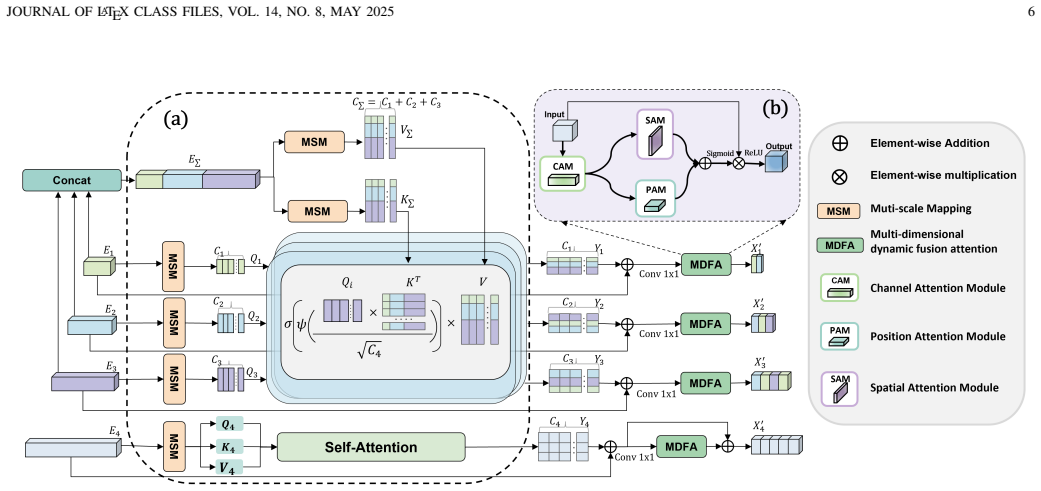
The load-bearing machinery is the separation of feature levels into two branches with heterogeneous inputs. The shallow branch concatenates the first three feature maps and uses vertical strip convolutions (kernels such as 1×k and k×1) inside a multiscale spatial cross-attention module to build queries from each shallow level against keys and values from the fused shallow representation, preserving fine detail over long ranges. The deep branch applies multiscale spatial self-attention to the fourth level for semantic abstraction. Both branch outputs pass through MDFA, which combines channel, spatial, and positional attention with a 7×7 dilated convolution and a positional attention matrix. Finally, ADSF compresses shallow and deep features with global average pooling, computes a correlation matrix between band-filtered and diagonal channel encodings, and derives sigmoid-gated fusion weights that decide how much shallow texture to inject into the deep stream. These modules let the network model cross-layer dependencies instead of concatenating features blindly.
What would settle it
Retrain SDS-Net and the twelve baselines on the same three splits with at least five random seeds each using the released code; if the average mIoU gap over SDS-Net shrinks to less than one point or reverses on any benchmark, the central accuracy claim fails.
Extended reading notes
Core claim
The central claim is that explicitly modeling the structural-semantic gap between shallow and deep features yields both higher accuracy and lower cost in infrared small-target detection. SDS-Net routes the first three backbone levels into a shallow branch built from multiscale spatial cross-attention (MSCA) and a multidimensional dynamic fusion attention (MDFA) module, while the fourth level enters a deep branch with multiscale spatial self-attention (MSSA). An adaptive deep-shallow fusion (ADSF) module learns channel-wise gating weights that balance edge-texture information against semantic target cues. With multilevel supervision on four prediction maps, the network reaches 82.26% mIoU on the NUAA-SIRST benchmark, 95.04% on NUDT-SIRST, and 67.74% on IRSTD-1K, beating prior best methods while reducing parameters by roughly half relative to DNA-Net and running faster than UIU-Net.
Load-bearing premise
The reported benchmark victory assumes that every compared method was retrained under the same protocol and that the single run reported, without error bars or released seeds, is representative of the method's true performance.
Editorial extensions
If this is right
- SDS-Net reports the highest mIoU, nIoU, F-measure, and detection probability on three public benchmarks, with false-alarm rates at or below prior methods.
- The dual-branch design cuts parameters by 57.5% and FLOPs by 47.8% relative to DNA-Net on IRSTD-1K, and uses about 2.5 times less GPU memory than UIU-Net, so accuracy gains do not come at the cost of efficiency.
- Ablations attribute most of the gain to the shallow branch: adding it to a U-Net baseline raises mIoU by 5.85 points, while increasing deep layers beyond one reduces accuracy because repeated downsampling destroys target detail.
- Replacing standard channel cross-attention fusion with ADSF improves mIoU by about 0.9 points on NUDT-SIRST with fewer parameters, showing that learnable gated fusion outperforms fixed fusion.
- Single-head attention outperforms multi-head attention for small infrared targets, suggesting that simpler attention is better when the object occupies very few pixels.
Reading between the lines
- The heterogeneous-input strategy might transfer to other tiny-object segmentation tasks, such as small lesion detection in medical images or small vessel detection in aerial imagery, where shallow detail is equally decisive.
- The finding that one deep layer suffices and extra depth hurts suggests a testable design rule: for objects near the few-pixel scale, U-Net depth should be traded for input resolution and shallow processing.
- The ADSF correlation-gating mechanism could be combined with temporal or multi-frame inputs, since it already models cross-level dependencies that might generalize to cross-frame dependencies.
- If the released code reproduces the reported numbers on identical hardware, the efficiency claims (6.8 GFLOPs at 512×512 resolution) would make SDS-Net a practical candidate for embedded infrared systems, but this is not demonstrated in the paper.
Editorial analysis
A structured set of objections, weighed in public.
Referee Report
Summary. The paper proposes SDS-Net, a deep network for infrared small target detection built around a dual-branch architecture that processes shallow structural features and deep semantic features separately, with modules MSCA/MSSA, MDFA, and an ADSF fusion mechanism. The authors report state-of-the-art mIoU on NUAA-SIRST (82.26%), NUDT-SIRST (95.04%), and IRSTD-1K (67.74%), together with a parameter count of 2.701M and 6.823 GFLOPs, and support the main claim with comparative tables, ROC analyses, ablations, and qualitative visualizations.
Significance. If the reported results are reliable, the work offers a favorable accuracy-efficiency trade-off for infrared small target detection and a reasonably novel architecture: a heterogeneous-input dual-branch design with adaptive fusion. The paper is empirical and falsifiable: it trains on public benchmarks and compares against standard baselines, with no fitted constants presented as predictions. The main value lies in the architectural combination and the claimed efficiency. However, the significance is currently tempered by multiple reporting inconsistencies in the experimental section, including a contradictory loss description, a cross-table copy error, and ablation deltas that do not match the corresponding tables. These issues do not necessarily invalidate the central claim, but they must be corrected and verified before the SOTA claim can be accepted.
major comments (5)
- [Section IV-B and Section III-A] The training protocol is internally inconsistent: Section IV-B states that the Adam optimizer is used 'with MSE loss', while Section III-A Eq. (7) defines the total loss as a weighted sum of binary cross-entropy terms O_i. Since the loss function is part of the training protocol and affects all comparative results, the correct loss must be stated. In addition, the optimizer description gives only 'β=0.9' without specifying β2, weight decay, or whether the identical protocol was used for all 12 baselines; this is needed to assess the fairness of the comparisons.
- [Table II vs. Table I] There is a likely copy error in the efficiency table: Table II lists RDIAN with mIoU 65.25 on IRSTD-1K, while Table I reports RDIAN's IRSTD-1K mIoU as 56.45; the value 65.25 is exactly the mIoU Table I assigns to IAANet. Because the central claim rests on the benchmark tables, this inconsistency must be resolved and all baseline numbers re-checked against a single source before the comparisons can be considered reliable.
- [Section IV-E, Tables V and VI] The ablation deltas reported in the text do not match the numbers in the tables. For MSCA (Table V), the text claims reductions of 1.70%/1.66%/2.26% when comparing MSCA w/ MH with MSCA on NUAA-SIRST, but the table yields 1.84/1.61/1.70 percentage points. For MDFA (Table VI), the text claims mIoU/nIoU/F1 improvements of 0.33%/0.07% for the first dataset and 1.19%/0.36%/0.64% for the second when adding PAM, but the table shows 1.74/1.49/2.30 and 1.19/0.36/0.84, respectively. These discrepancies undermine the module-level attribution claims and must be corrected.
- [Table VI] Table VI is headed with 'NUDT-SIRST' but the values in the second dataset column (e.g., CFN 66.33/66.42/79.84) are the IRSTD-1K numbers from Table I, and the surrounding text says the table covers NUAA-SIRST and IRSTD-1K. Additionally, the text states MDFA w/o PAM achieves 'overall improvements' over CBAM on both datasets, yet on the second dataset the F1-score decreases from 79.88 to 79.72. The table header and the comparative claims need to be corrected.
- [Section IV-B and Section IV-D] The SOTA claim on IRSTD-1K rests on a margin of about 1.4–1.6 mIoU points over UIU-Net and SCTransNet, yet the paper reports a single run with no random seeds, no error bars, and no repeated-run statistics. To establish that this margin is not run-to-run noise, the authors should provide either multiple-seed results with variance, or a reproducibility statement with code and fixed seeds. The same applies to the efficiency comparisons in Table II, where memory and inference-time measurements can vary with implementation and hardware.
minor comments (8)
- [Section IV-D] The efficiency reductions claimed in the text are arithmetically inconsistent with Table II: compared with DNA-Net, SDS-Net reduces parameters by 42.5% (not 57.5%), FLOPs by 52.2% (not 47.8%), and GPU memory by 41.5% (not 58.5%). The raw numbers in Table II should be used to compute correct percentages.
- [Introduction, Fig. 2] The introduction says SDS-Net shows a '2.5× reduction in GPU memory usage compared with that of UIU-Net, saving approximately 37.4% of the memory per image.' A 2.5× reduction corresponds to a 60.8% saving (14747 vs. 5777 MB in Table II), not 37.4%; the text and figure need to be reconciled.
- [Section IV-C] In the evaluation metrics, Table I and the text label columns as 'Precision (P d), Recall (F a)'. However, Eq. (28) defines P d as a ratio of detected targets to all targets (recall), and Eq. (29) defines F a as false alarm rate, not recall. The notation and headers should be corrected to avoid misinterpreting the detection metrics.
- [Section III-B, Eq. (14)] Eq. (14) for the spatial attention module uses DL(GMP(F_ci)) twice as the two concatenated inputs; following CBAM, one input should likely be derived from average pooling and the other from max pooling. This appears to be a typo and should be clarified.
- [Section III-A and Section III-C] The module is named 'Adaptive Deep-Shallow Fusion (ADSF)' in the heading, but Eq. (2) and part of the text refer to 'ASDF'. Please make the acronym consistent. Also, Eq. (19) uses the same symbol U for both shallow and deep descriptors; using U_s and U_d throughout would avoid confusion.
- [Table V] The two ablated variants 'MSCA w/ MH' and 'MSCA w/o MSM' report identical IRSTD-1K values (66.45/66.69/79.59), which is surprising and suggests a copy error; please verify the results.
- [Section IV-B] Mentioning 'non-maximum suppression (NMS) IoU threshold of 0.5' is confusing for a pixel-wise segmentation framework; if this threshold is not used in the segmentation pipeline, it should be removed, or its role clarified.
- [Table IX] The row '3 1' is formatted as '3 12.701' with a missing space, making the table hard to read; this should be fixed in the camera-ready version.
Circularity Check
No circularity: SDS-Net is an empirical architecture paper whose performance claims rest on held-out benchmark evaluations, not on a derivation that reduces to its own inputs.
full rationale
This is an empirical deep-learning paper with no formal derivation whose conclusions could reduce to its inputs by construction. The network forward pass is specified by Eqs. (1)-(24), but those equations define an architecture, not a prediction fitted to the evaluation data. All reported results (mIoU, nIoU, F-measure, Pd, Fa) are measured on held-out test splits of public benchmarks (NUAA-SIRST, NUDT-SIRST, IRSTD-1K) after training, so the SOTA claim is an experimental comparison rather than a self-defined quantity. The ablations add or remove modules and report the resulting measured metrics; they do not fit a parameter to a subset and then 'predict' a closely related quantity. SCTransNet is used as a baseline and as the starting architecture in one ablation series, but all methods are retrained on the same data, so this is a fair comparison, not a circular reuse of the target result. No load-bearing premise is justified solely by a self-citation: none of the references appears to be authored by the present authors, and no 'uniqueness theorem' or prior-work ansatz is invoked to force the design. The table inconsistencies noted by reviewers (e.g., RDIAN's IRSTD-1K mIoU differing between Table I and Table II, and Table VI's header/value mismatch) are internal consistency and verification concerns that affect the reliability of the benchmark numbers, but they are not circularity. The paper is self-contained as an empirical study; its weaknesses are about experimental reporting and reproducibility, not about deriving a claim from its own assumptions.
Assumptions & free parameters
free parameters (4)
- channel widths in backbone (C1-C4) =
32, 64, 128, 128
- number of shallow/deep modules =
3 shallow, 1 deep
- ADSF bandwidth k =
not specified
- MDFA temperature lambda and residual weight alpha =
not specified
assumptions (3)
- standard math Standard CNN and attention building blocks behave as specified in prior literature.
- domain assumption Infrared small targets are well represented as pixel-level segmentation masks and are detectable from intensity and structural cues.
- domain assumption Public benchmark datasets and fixed-threshold protocols provide fair and comparable evaluation across methods.
Cite this review
Pith. "Pith review of SDS-Net: Shallow-Deep Synergism-detection Network for infrared small target detection." pith.science (2026). https://pith.science/paper/PEOLA3O6
@misc{pith2026250606042,
  author       = {Pith},
  title        = {Pith review of: SDS-Net: Shallow-Deep Synergism-detection Network for infrared small target detection},
  year         = {2026},
  howpublished = {\url{https://pith.science/paper/PEOLA3O6}},
  note         = {Machine review of arXiv:2506.06042}
}
read the original abstract
Current CNN-based infrared small target detection(IRSTD) methods generally overlook the heterogeneity between shallow and deep features, leading to inefficient collaboration between shallow fine grained structural information and deep high-level semantic representations. Additionally, the dependency relationships and fusion mechanisms across different feature hierarchies lack systematic modeling, which fails to fully exploit the complementarity of multilevel features. These limitations hinder IRSTD performance while incurring substantial computational costs. To address these challenges, this paper proposes a shallow-deep synergistic detection network (SDS-Net) that efficiently models multilevel feature representations to increase both the detection accuracy and computational efficiency in IRSTD tasks. SDS-Net introduces a dual-branch architecture that separately models the structural characteristics and semantic properties of features, effectively preserving shallow spatial details while capturing deep semantic representations, thereby achieving high-precision detection with significantly improved inference speed. Furthermore, the network incorporates an adaptive feature fusion module to dynamically model cross-layer feature correlations, enhancing overall feature collaboration and representation capability. Comprehensive experiments on three public datasets (NUAA-SIRST, NUDT-SIRST, and IRSTD-1K) demonstrate that SDS-Net outperforms state-of-the-art IRSTD methods while maintaining low computational complexity and high inference efficiency, showing superior detection performance and broad application prospects. Our code will be made public at https://github.com/PhysiLearn/SDS-Net.
Figures


Figures from the paper (6 more)



Reference graph
Works this paper leans on
-
[1]
Balanced ring top-hat transformation for infrared small-target detection with guided filter kernel,
H. Zhu, J. Zhang, G. Xu, and L. Deng, “Balanced ring top-hat transformation for infrared small-target detection with guided filter kernel,” vol. 56, no. 5, pp. 3892–3903
-
[2]
Infrared small target detection via self-regularized weighted sparse model,
T. Zhang, Z. Peng, H. Wu, Y . He, C. Li, and C. Yang, “Infrared small target detection via self-regularized weighted sparse model,”Neurocomputing, vol. 420, pp. 124–148, 2021
work page 2021
-
[3]
R. Lu, X. Yang, W. Li, J. Fan, D. Li, and X. Jing, “Robust infrared small target detection via multidirectional derivative- based weighted contrast measure,”IEEE Geoscience and Re- mote Sensing Letters, vol. 19, pp. 1–5, 2020
work page 2020
-
[4]
Classification of small boats in infrared images for maritime surveillance,
M. Teutsch and W. Kr ¨uger, “Classification of small boats in infrared images for maritime surveillance,” pp. 1–7, 2010
work page 2010
-
[5]
Y . Sun, J. Yang, and W. An, “Infrared dim and small target detection via multiple subspace learning and spatial-temporal patch-tensor model,” vol. 59, no. 5, pp. 3737–3752
-
[6]
Review on recent development in infrared small target detection algorithms,
S. S. Rawat, S. K. Verma, and Y . Kumar, “Review on recent development in infrared small target detection algorithms,” vol. 167, pp. 2496–2505
-
[7]
Srcanet: Stacked residual coordinate attention network for infrared ship detection,
P. Wu, H. Huang, H. Qian, S. Su, B. Sun, and Z. Zuo, “Srcanet: Stacked residual coordinate attention network for infrared ship detection,” vol. 60, pp. 1–14
-
[8]
Airborne infrared imaging simulation for target recognition,
X. Li, Z. Luo, Q. Yang, W. Miao, and S. Zhang, “Airborne infrared imaging simulation for target recognition,” vol. 6, pp. 846–850
Show all 47 references
-
[9]
Analysis of new top-hat transformation and the application for infrared dim small target detection,
X. Bai and F. Zhou, “Analysis of new top-hat transformation and the application for infrared dim small target detection,” vol. 43, no. 6, pp. 2145–2156
-
[10]
A local contrast method for small infrared target detection,
C. L. P. Chen, H. Li, Y . Wei, T. Xia, and Y . Y . Tang, “A local contrast method for small infrared target detection,” vol. 52, no. 1, pp. 574–581
-
[11]
Scale invariant small target detection by optimizing signal-to-clutter ratio in heterogeneous background for infrared search and track,
S. Kim and J. Lee, “Scale invariant small target detection by optimizing signal-to-clutter ratio in heterogeneous background for infrared search and track,” vol. 45, no. 1, pp. 393–406
-
[12]
Robust principal component analysis?
E. J. Cand `es, X. Li, Y . Ma, and J. Wright, “Robust principal component analysis?” vol. 58, no. 3, pp. 11:1–11:37
-
[13]
Godec: Randomized low-rank & sparse matrix decomposition in noisy case,
T. Zhou and D. Tao, “Godec: Randomized low-rank & sparse matrix decomposition in noisy case,” 2011
2011
-
[14]
Infrared small target segmentation networks: A survey,
R. Kou, C. Wang, Z. Peng, Z. Zhao, Y . Chen, J. Han, F. Huang, Y . Yu, and Q. Fu, “Infrared small target segmentation networks: A survey,”Pattern recognition, vol. 143, p. 109788, 2023
2023
-
[15]
Swin transformer embedding unet for remote sensing image semantic segmentation,
X. He, Y . Zhou, J. Zhao, D. Zhang, R. Yao, and Y . Xue, “Swin transformer embedding unet for remote sensing image semantic segmentation,” vol. 60, pp. 1–15
-
[16]
Dc-net: A dual- channel and cross-scale feature fusion infrared small target detection network,
Y .-B. Liu, H.-Y . Huang, and Y .-H. Zeng, “Dc-net: A dual- channel and cross-scale feature fusion infrared small target detection network,” vol. 62, pp. 1–9
-
[17]
Asymmetric contextual modulation for infrared small target detection,
Y . Dai, Y . Wu, F. Zhou, and K. Barnard, “Asymmetric contextual modulation for infrared small target detection,” pp. 950–959
-
[18]
Dense nested attention network for infrared small target detection,
B. Li, C. Xiao, L. Wang, Y . Wang, Z. Lin, M. Li, W. An, and Y . Guo, “Dense nested attention network for infrared small target detection,” vol. 32, pp. 1745–1758
-
[19]
Uiu-net: U-net in u-net for infrared small object detection,
X. Wu, D. Hong, and J. Chanussot, “Uiu-net: U-net in u-net for infrared small object detection,” vol. 32, pp. 364–376
-
[20]
Mtu-net: Multilevel transunet for space- based infrared tiny ship detection,
T. Wu, B. Li, Y . Luo, Y . Wang, C. Xiao, T. Liu, J. Yang, W. An, and Y . Guo, “Mtu-net: Multilevel transunet for space- based infrared tiny ship detection,” vol. 61, pp. 1–15
-
[21]
Sctransnet: Spatial-channel cross transformer network for infrared small target detection,
S. Yuan, H. Qin, X. Yan, N. Akhtar, and A. Mian, “Sctransnet: Spatial-channel cross transformer network for infrared small target detection,” vol. 62, pp. 1–15
-
[22]
Bisenet v2: Bilateral network with guided aggregation for real-time semantic segmentation,
C. Yu, C. Gao, J. Wang, G. Yu, C. Shen, and N. Sang, “Bisenet v2: Bilateral network with guided aggregation for real-time semantic segmentation,” vol. 129, no. 11, pp. 3051–3068
-
[23]
Bisenet: Bilateral segmentation network for real-time semantic segmentation,
C. Yu, J. Wang, C. Peng, C. Gao, G. Yu, and N. Sang, JOURNAL OF LATEX CLASS FILES, VOL. 14, NO. 8, MAY 2025 13 “Bisenet: Bilateral segmentation network for real-time semantic segmentation,” pp. 334–349
2025
-
[24]
U-net: Convolutional networks for biomedical image segmentation,
O. Ronneberger, P. Fischer, and T. Brox, “U-net: Convolutional networks for biomedical image segmentation,” pp. 234–241
-
[25]
Attentional local contrast networks for infrared small target detection,
Y . Dai, Y . Wu, F. Zhou, and K. Barnard, “Attentional local contrast networks for infrared small target detection,” vol. 59, no. 11, pp. 9813–9824
-
[26]
Attention-guided pyramid context networks for detecting infrared small target under complex background,
T. Zhang, L. Li, S. Cao, T. Pu, and Z. Peng, “Attention-guided pyramid context networks for detecting infrared small target under complex background,” vol. 59, no. 4, pp. 4250–4261
-
[27]
Isnet: Shape matters for infrared small target detection,
M. Zhang, R. Zhang, Y . Yang, H. Bai, J. Zhang, and J. Guo, “Isnet: Shape matters for infrared small target detection,” pp. 877–886
-
[28]
Receptive-field and direction induced attention network for infrared dim small target detection with a large-scale dataset irdst,
H. Sun, J. Bai, F. Yang, and X. Bai, “Receptive-field and direction induced attention network for infrared dim small target detection with a large-scale dataset irdst,” vol. 61, pp. 1–13
-
[29]
Ftc-net: Fusion of transformer and cnn features for infrared small target detection,
M. Qi, L. Liu, S. Zhuang, Y . Liu, K. Li, Y . Yang, and X. Li, “Ftc-net: Fusion of transformer and cnn features for infrared small target detection,” vol. 15, pp. 8613–8623
-
[30]
Guided attention and joint loss for infrared dim small target detection,
Y . Tong, J. Liu, Z. Fu, Z. Wang, H. Yang, S. Niu, and Q. Tan, “Guided attention and joint loss for infrared dim small target detection,” vol. 62, pp. 1–14
-
[31]
Msaffnet: A multiscale label-supervised attention feature fu- sion network for infrared small target detection,
X. Tong, S. Su, P. Wu, R. Guo, J. Wei, Z. Zuo, and B. Sun, “Msaffnet: A multiscale label-supervised attention feature fu- sion network for infrared small target detection,” vol. 61, pp. 1–16
-
[32]
Fddba-net: Frequency domain decoupling bidirectional inter- active attention network for infrared small target detection,
Y . Huang, X. Zhi, J. Hu, L. Yu, Q. Han, W. Chen, and W. Zhang, “Fddba-net: Frequency domain decoupling bidirectional inter- active attention network for infrared small target detection,” vol. 62, pp. 1–16
-
[33]
Local contrast attention guide network for detecting infrared small targets,
B. Nian, B. Jiang, H. Shi, and Y . Zhang, “Local contrast attention guide network for detecting infrared small targets,” vol. 61, pp. 1–13
-
[34]
Feature extraction for hyperspectral imagery: The evolution from shallow to deep: Overview and toolbox,
B. Rasti, D. Hong, R. Hang, P. Ghamisi, X. Kang, J. Chanussot, and J. A. Benediktsson, “Feature extraction for hyperspectral imagery: The evolution from shallow to deep: Overview and toolbox,” vol. 8, no. 4, pp. 60–88
-
[35]
Deep encoder, shallow decoder: Reevaluating non-autoregressive ma- chine translation
J. Kasai, N. Pappas, H. Peng, J. Cross, and N. Smith, “Deep encoder, shallow decoder: Reevaluating non-autoregressive ma- chine translation.”
-
[36]
Shallow-deep collaborative learn- ing for unsupervised visible-infrared person re-identification,
B. Yang, J. Chen, and M. Ye, “Shallow-deep collaborative learn- ing for unsupervised visible-infrared person re-identification,” pp. 16 870–16 879
-
[37]
Dmf2net: Dynamic multi-level feature fusion network for heterogeneous remote sensing image change detection,
W. Cheng, Y . Feng, L. Song, and X. Wang, “Dmf2net: Dynamic multi-level feature fusion network for heterogeneous remote sensing image change detection,” vol. 300, p. 112159
-
[38]
Isdnet: Integrating shallow and deep networks for efficient ultra-high resolution segmentation,
S. Guo, L. Liu, Z. Gan, Y . Wang, W. Zhang, C. Wang, G. Jiang, W. Zhang, R. Yi, L. Ma, and K. Xu, “Isdnet: Integrating shallow and deep networks for efficient ultra-high resolution segmentation,” pp. 4361–4370
-
[39]
Abc: Attention with bilinear correlation for infrared small target detection,
P. Pan, H. Wang, C. Wang, and C. Nie, “Abc: Attention with bilinear correlation for infrared small target detection,” in 2023 IEEE International Conference on Multimedia and Expo (ICME), pp. 2381–2386
2023
-
[40]
Cbam: Convo- lutional block attention module,
S. Woo, J. Park, J.-Y . Lee, and I. S. Kweon, “Cbam: Convo- lutional block attention module,” inComputer Vision – ECCV 2018, V . Ferrari, M. Hebert, C. Sminchisescu, and Y . Weiss, Eds. Springer International Publishing, pp. 3–19
2018
-
[41]
Cbam vgg16: An efficient driver distraction classification using cbam embedded vgg16 architecture,
C. H. Praharsha and A. Poulose, “Cbam vgg16: An efficient driver distraction classification using cbam embedded vgg16 architecture,” vol. 180, p. 108945
-
[42]
Defect recognition of solar panel in efficientnet-b3 network based on cbam attention mech- anism,
H. Zhang, Z. Yang, and N. Lei, “Defect recognition of solar panel in efficientnet-b3 network based on cbam attention mech- anism,” inProceedings of the 2024 International Conference on Generative Artificial Intelligence and Information Security, ser. GAIIS ’24. Association for...
2024
-
[43]
Infrared small target detection based on the weighted strengthened local contrast measure,
J. Han, S. Moradi, I. Faramarzi, H. Zhang, Q. Zhao, X. Zhang, and N. Li, “Infrared small target detection based on the weighted strengthened local contrast measure,” vol. 18, no. 9, pp. 1670– 1674
-
[44]
Infrared patch-image model for small target detection in a single image,
C. Gao, D. Meng, Y . Yang, Y . Wang, X. Zhou, and A. G. Haupt- mann, “Infrared patch-image model for small target detection in a single image,” vol. 22, no. 12, pp. 4996–5009
-
[45]
Istdu- net: Infrared small-target detection u-net,
Q. Hou, L. Zhang, F. Tan, Y . Xi, H. Zheng, and N. Li, “Istdu- net: Infrared small-target detection u-net,” vol. 19, pp. 1–5
-
[46]
Interior attention-aware network for infrared small target detection,
K. Wang, S. Du, C. Liu, and Z. Cao, “Interior attention-aware network for infrared small target detection,” vol. 60, pp. 1–13
-
[47]
S. Li, Z. Wang, Z. Liu, C. Tan, H. Lin, D. Wu, Z. Chen, J. Zheng, and S. Z. Li. Moganet: Multi-order gated aggregation network
Reviewed August 7, 2026 · model on record in the stance chip above.
Discussion (0). Sign in to comment.