REVIEW 3 major objections 4 minor 42 references
Self driving algorithm for an active four wheel drive racecar
T0 review · 3 major / 4 minor · reviewed 2026-08-07 · deepseek-v4-flash
Pith's one-line read The paper reports that an end-to-end reinforcement-learning policy trained with PPO can control an active four-wheel-drive racecar by directly commanding steering and per-wheel torques, implicitly learning torque-vectoring and stability…
desk verdict A credible RL torque-vectoring demo whose headline comparison to physics-based controllers is unsupported by the experiments. read the letter →
The pith
A machine-rendered reading of the paper's core claim, the machinery that carries it, and where it could break.
The reading
What carries the argument
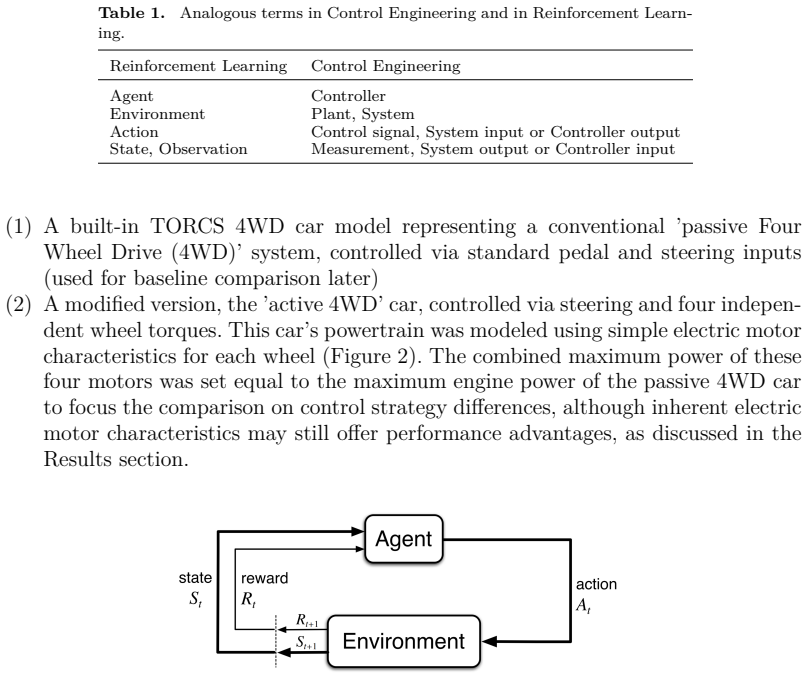
The load-bearing element is the end-to-end policy: a multilayer perceptron with three shared hidden layers (300, 600, 600 neurons) that maps a state vector of velocities, accelerations, yaw rate, wheel speeds, track geometry, and lidar into a five-dimensional action vector, one steering command and one torque per wheel, normalized to [-1, 1]. The agent is trained with PPO on a progress-based reward measuring distance along the track centerline, and the resulting torque patterns are the mechanism through which the paper claims the agent implicitly learns torque vectoring and stability control.
What would settle it
A transfer test would settle the claim: run the trained policy on the same vehicle dynamics in a high-fidelity simulator with a detailed combined-slip tire model (or on a physical A4WD test vehicle) and measure whether the inside-front-wheel spin and the mid-corner maximum-steering behavior still produce competitive lap times, or whether they cause overheating, wear, or grip loss that makes the policy slower than a physics-based torque-vectoring controller.
Extended reading notes
Core claim
The central claim is that an end-to-end deep reinforcement learning policy, trained with Proximal Policy Optimization, can learn time-optimal control of an active four-wheel-drive racecar by directly outputting a steering angle and independent torque commands for all four wheels. Analyzing the trained policy corner by corner, the paper reports the agent dynamically shifts torque between inside and outside wheels to counteract the vehicle's understeer, applies braking predominantly to the rear wheels in some corners, and reproduces yaw-stability behaviors analogous to ABS, ASR, and torque vectoring without those functions being encoded. The paper presents this as evidence that RL can serve as a unified alternative to classical vehicle-dynamics-control architectures for grip-limited driving.
Load-bearing premise
The result stands on the assumption that TORCS's simplified tire model is faithful enough that behaviors learned there, such as intentionally spinning the inside front wheel or using maximum steering in a hairpin, are genuine control strategies rather than artifacts that a real tire would punish.
Editorial extensions
If this is right
- A single policy can simultaneously solve path following, stabilization, and torque allocation for an A4WD racecar, removing the need for separate vehicle-dynamics-control modules.
- The learned torque patterns adapt across corner types on the same track, showing the policy changes torque distribution with corner phase rather than memorizing a single strategy.
- The agent implicitly reproduces ABS, ASR, and yaw-moment control from reward alone, implying that stability functions could emerge from end-to-end learning rather than explicit design.
- Because electric motor characteristics affect results, matching powertrain characteristics is essential when comparing RL control strategies against physics-based baselines.
- A 20 Hz control frequency is enough to learn competitive racing behavior, and the paper notes that a higher control frequency could yield further gains from finer torque modulation.
Reading between the lines
- The reported 25% higher combined g-forces during braking and turn-in suggests the learned policy uses independent wheel torque authority to approach the tire friction ellipse more aggressively than the passive 4WD baseline; a natural next step, which the paper does not include, is a direct comparison against an explicit model-predictive torque-vectoring controller on the same active vehicle model.
- If the learned strategies are confirmed on higher-fidelity tire models, the same end-to-end formulation could be extended to other actuators such as active suspension or rear steering, and to sim-to-real pipelines with domain randomization.
- The paper's own caveat about the simplified tire model implies a testable hypothesis: in a simulator with tire wear and thermal effects, the inside-wheel spin strategy would become suboptimal, and the agent would need a penalty or a richer tire model to rediscover a less abusive strategy.
Editorial analysis
A structured set of objections, weighed in public.
Referee Report
Summary. The paper trains a PPO-based deep RL agent to control an active four-wheel-drive (A4WD) racecar in the TORCS simulator, with an action space consisting of steering angle and four independent wheel torques, and an observation space of vehicle dynamic states. The agent is trained with a progress-based reward plus termination and action penalties, and its learned behavior is analyzed corner-by-corner, including steering traces, wheel torque patterns, wheel speeds, and GG-diagrams. The authors report that the agent learns to mitigate understeer through differential torque application, implicitly mimics ABS/ASR-like behaviors, and achieves lap times competitive with a passively controlled 4WD vehicle. The paper claims that the learned policy mimics and potentially surpasses traditional physics-based A4WD controllers, though no such controller is implemented or benchmarked.
Significance. If the empirical findings are fully supported, the paper would be a useful demonstration that a single end-to-end RL policy can coordinate steering and per-wheel torque commands for limit-handling driving, potentially reducing the need for layered vehicle dynamics controllers. The paper is transparent about many training details, provides extensive visual and quantitative analysis of learned behaviors, and includes appendices with hyperparameters and turn-by-turn figures. The main scientific value is the evidence that DRL can discover non-trivial torque-vectoring strategies that mitigate understeer and manage yaw dynamics in a simulated racing scenario. However, the significance is substantially tempered by the absence of a physics-based A4WD baseline and by the acknowledged exploitation of TORCS's simplified tire model, which leaves the central comparative claim unsupported and raises questions about transferability.
major comments (3)
- [Abstract; Section 4; Figure 4] The claim that the learned policy 'mimics and, in aspects of grip utilization, potentially surpasses traditional physics-based A4WD controllers' is not supported by the reported experiments, because no physics-based A4WD controller is implemented or benchmarked. The only comparison is against a passive 4WD vehicle controlled by steering and pedals (Figure 4), and the lap-time difference is confounded by the powertrain difference between the electric motors of the active car and the engine of the passive car, as the authors themselves acknowledge in Section 4. To substantiate the headline claim, the paper needs either a classical torque-vectoring A4WD controller evaluated on the same active vehicle model, or an ablation in which the torque action space is constrained (e.g., equal torques across wheels) while keeping the powertrain identical.
- [Section 4; Figure 4] The evaluation relies on single representative laps for each agent, with no reporting of variance across training seeds, evaluation episodes, or repeated runs. The approximately 25% higher combined g-forces and the lap-time advantage are based on one lap each, so it is unclear whether these differences are statistically meaningful rather than the result of selecting a favorable lap. The paper should report mean and standard deviation over multiple evaluation episodes (e.g., 10–20 deterministic runs) and, ideally, across multiple training seeds, to support quantitative claims of improvement.
- [Section 4, Turn 2 analysis] The paper states that the inside-front-wheel spin during corner exit 'incurs no penalty in TORCS's simplified model and might be exploited by the agent if it aids rotation or acceleration.' This admission directly undermines the interpretation of the learned torque strategy as a transferable A4WD control law. Since the central claim involves implicit learning of real-world-relevant control logic (ABS, ASR, torque vectoring), the manuscript must either (a) provide evidence that the learning is robust to penalizing such simulator-specific exploitation, e.g., by adding a slip penalty or using a more realistic tire model, or (b) substantially temper the claims of generalizable A4WD control and reframe the contribution as a simulation-specific demonstration.
minor comments (4)
- [Section 3.3, Eq. (2)] The action penalty in Eq. (2) is unclear: with the given parameters psc=15 and pbnd=1.2, the expression (|a|/psc - pbnd + 1)^2 yields a small but always positive penalty even for actions within the normalized [-1,1] range, which contradicts the stated purpose of discouraging actions outside the feasible range. Please clarify whether actions are clipped before this penalty and what the intended shape of the penalty is.
- [Section 4, Turn 2 text] There are several typos and grammatical errors that impede readability, including 'TurIn' (likely 'turn-in'), 'cars thends to US' (likely 'cars tend to understeer'), and a stray ']' in 'based on their characteristics]'. These should be corrected.
- [Table B2] Table B2 lists 'ASR_ONFalse' twice, which appears to be a formatting error. Additionally, the table would benefit from a note clarifying which settings correspond to the passive and active vehicle models, respectively.
- [Appendix Tables B1–B3] The appendix tables are introduced as 'T able B1' etc. in the captions, which is a rendering inconsistency. Also, the observation vector in Table B3 includes LiDaR signals and 'Episode dist.', but the main text describes the observation as consisting of vehicle dynamic states; please clarify whether LiDaR and episode distance are actually used as inputs.
Circularity Check
No circularity: the RL training result is measured independently of its reward proxy, and the only self-citation is a non-load-bearing contrast with prior work.
full rationale
The paper's central result is an empirical reinforcement-learning outcome: a PPO policy maps vehicle states to steering and four wheel-torque actions, and lap times are measured directly by the TORCS environment rather than derived from the reward function. The progress reward is a training proxy, but no fitted parameter is reused as a prediction, and no equation in the paper defines the output in terms of the input or vice versa. The one self-citation (the authors' precursor work, [37]) is used only to state what is different about the present approach and is not load-bearing for any conclusion. Claims that the learned torque patterns 'mimic' classical A4WD behaviors are interpretive analyses of recorded signals, not circular reductions; the absence of a physics-based A4WD baseline is an experimental-comparison limitation, not a circularity. The paper's own caveat that TORCS's simplified tire model may allow the agent to exploit unrealistic slip penalties is an honest limitation statement, and it strengthens rather than weakens the finding that the learning itself is not circular. No self-definition, fitted-input-as-prediction, or self-citation-chain pattern exists in the derivation chain.
Assumptions & free parameters
free parameters (5)
- Action penalty scaling psc =
15
- Action penalty boundary pbnd =
1.2
- Termination rewards =
+100 / -10
- Learning rate schedule =
[1:2.5, 0:0.5] * 10^-4
- Observation scaling factors =
e.g., /300, /80, /pi, /100
assumptions (3)
- domain assumption TORCS simulator's vehicle and tire dynamics are a valid testbed for evaluating grip-limit driving control.
- domain assumption The modified active 4WD car model, with per-wheel electric motor torque characteristics, adequately represents an A4WD electric powertrain.
- ad hoc to paper Progress along the track centerline is a faithful surrogate for minimizing lap time.
Cite this review
Pith. "Pith review of Self driving algorithm for an active four wheel drive racecar." pith.science (2026). https://pith.science/paper/J4ZYHUBG
@misc{pith2026250606077,
  author       = {Pith},
  title        = {Pith review of: Self driving algorithm for an active four wheel drive racecar},
  year         = {2026},
  howpublished = {\url{https://pith.science/paper/J4ZYHUBG}},
  note         = {Machine review of arXiv:2506.06077}
}
read the original abstract
Controlling autonomous vehicles at their handling limits is a significant challenge, particularly for electric vehicles with active four wheel drive (A4WD) systems offering independent wheel torque control. While traditional Vehicle Dynamics Control (VDC) methods use complex physics-based models, this study explores Deep Reinforcement Learning (DRL) to develop a unified, high-performance controller. We employ the Proximal Policy Optimization (PPO) algorithm to train an agent for optimal lap times in a simulated racecar (TORCS) at the tire grip limit. Critically, the agent learns an end-to-end policy that directly maps vehicle states, like velocities, accelerations, and yaw rate, to a steering angle command and independent torque commands for each of the four wheels. This formulation bypasses conventional pedal inputs and explicit torque vectoring algorithms, allowing the agent to implicitly learn the A4WD control logic needed for maximizing performance and stability. Simulation results demonstrate the RL agent learns sophisticated strategies, dynamically optimizing wheel torque distribution corner-by-corner to enhance handling and mitigate the vehicle's inherent understeer. The learned behaviors mimic and, in aspects of grip utilization, potentially surpass traditional physics-based A4WD controllers while achieving competitive lap times. This research underscores DRL's potential to create adaptive control systems for complex vehicle dynamics, suggesting RL is a potent alternative for advancing autonomous driving in demanding, grip-limited scenarios for racing and road safety.
Figures


Figures from the paper (4 more)


Reference graph
Works this paper leans on
-
[1]
Coordinating Tire Forces to Avoid Obstacles Using Nonlin- ear Model Predictive Control
Brown M, Gerdes JC. Coordinating Tire Forces to Avoid Obstacles Using Nonlin- ear Model Predictive Control. IEEE Transactions on Intelligent Vehicles. 2020 Mar; 5(1):21–31. Conference Name: IEEE Transactions on Intelligent Vehicles; Available from: 14 https://ieeexplore.ieee.org/document/8910387/?arnumber=8910387
-
[2]
Control Informed Design of the IAC Autonomous Racecar for Operation at the Dynamic Envelope
Zhu Q, Schmid M, Prucka R, et al. Control Informed Design of the IAC Autonomous Racecar for Operation at the Dynamic Envelope ; 2024. ArXiv:2407.17737 [eess]; Available from: http://arxiv.org/abs/2407.17737
work page Pith review arXiv 2024
-
[3]
Autonomous Vehicles on the Edge: A Survey on Au- tonomous Vehicle Racing
Betz J, Zheng H, Liniger A, et al. Autonomous Vehicles on the Edge: A Survey on Au- tonomous Vehicle Racing. IEEE Open Journal of Intelligent Transportation Systems. 2022;3:458–488. ArXiv:2202.07008 [cs]; Available from: http://arxiv.org/abs/2202.07008
arXiv 2022
-
[4]
Motion control in an electric vehicle with four independently driven in-wheel motors
Sakai S, Sado H, Hori Y. Motion control in an electric vehicle with four independently driven in-wheel motors. IEEE/ASME Transactions on Mechatronics. 1999 Mar;4(1):9–16. Available from: http://ieeexplore.ieee.org/document/752079/
work page 1999
-
[5]
Yoichi Hori, Hori Y. Future vehicle driven by electricity and Control-research on four- wheel-motored "UOT electric march II". IEEE Transactions on Industrial Electronics. 2004 Oct;51(5):954–962. MAG ID: 2019708972
work page 2004
-
[6]
Yu Z, Zhao R, Yuan T. Lateral-Stability-Oriented Path-Tracking Control Design for Four- Wheel Independent Drive Autonomous Vehicles with Tire Dynamic Characteristics under Extreme Conditions. World Electric Vehicle Journal. 2024 Oct;15(10):465. Number: 10 Publisher: Multidisciplinary Digital Publishing Institute; Available from: https://www. mdpi.com/2032...
work page 2024
-
[7]
He P, Hori Y. Optimum traction force distribution for stability improvement of 4WD EV in critical driving condition. In: 9th IEEE International Workshop on Advanced Motion Control, 2006.; Mar.; 2006. p. 596–601. ISSN: 1943-6580; Available from: https: //ieeexplore.ieee.org/abstract/document/1631727
-
[8]
Research on Robust Control for longitudinal Impact of 4 Wheel-Drive Hybrid Electric Vehicle
Xiong L, Yu Z. Research on Robust Control for longitudinal Impact of 4 Wheel-Drive Hybrid Electric Vehicle. Procedia Engineering. 2011 Jan;15:293–297. Available from: https://www.sciencedirect.com/science/article/pii/S187770581101558X
work page 2011
Show all 42 references
-
[9]
Time Optimal Control of Four-in-Wheel-Motors Driven Electric Cars
Max G, Lantos B. Time Optimal Control of Four-in-Wheel-Motors Driven Electric Cars. Periodica Polytechnica Electrical Engineering and Computer Science. 2014;58(4):149–159. Number: 4; Available from: https://pp.bme.hu/eecs/article/view/7806
2014
-
[10]
Model predictive control allocation for stability improvement of four-wheel drive electric vehicles in critical driving condition
Zhao H, Ren B, Chen H, et al. Model predictive control allocation for stability improvement of four-wheel drive electric vehicles in critical driving condition. IET Control Theory & Applications. 2015;9(18):2688–2696. _eprint: https://onlinelibrary.wiley.com/doi/pdf/10.1049/ie...
2015
-
[11]
Learning-Based Model Predictive Control for Autonomous Racing
Kabzan J, Hewing L, Liniger A, et al. Learning-Based Model Predictive Control for Autonomous Racing. IEEE Robotics and Automation Letters. 2019 Oct;4(4):3363–3370. Available from: https://ieeexplore.ieee.org/document/8754713/
2019
-
[12]
GoodfellowI,BengioY,CourvilleA.Deeplearning.MITpressCambridge;2016.Available from: https://www.deeplearningbook.org/
2016
-
[13]
Reinforcement learning: An introduction
Sutton RS, Barto AG. Reinforcement learning: An introduction. MIT press; 2018
2018
-
[14]
Dota 2 with Large Scale Deep Reinforcement Learning ; 2019
OpenAI, :, Berner C, et al. Dota 2 with Large Scale Deep Reinforcement Learning ; 2019. Version Number: 1; Available from: https://arxiv.org/abs/1912.06680
2019 arXiv
-
[15]
Grandmaster level in StarCraft II using multi-agent reinforcement learning
Vinyals O, Babuschkin I, Czarnecki WM, et al. Grandmaster level in StarCraft II using multi-agent reinforcement learning. Nature. 2019 Nov;575(7782):350–354. Number: 7782 Publisher: Nature Publishing Group; Available from: https://www.nature.com/articles/ s41586-019-1724-z
2019
-
[16]
Human-level control through deep reinforcement learning
Mnih V, Kavukcuoglu K, Silver D, et al. Human-level control through deep reinforcement learning. nature. 2015;518(7540):529–533. Publisher: Nature Publishing Group
2015
-
[17]
Solving Rubik’s Cube with a Robot Hand
OpenAI, Akkaya I, Andrychowicz M, et al. Solving Rubik’s Cube with a Robot Hand
-
[18]
Emergence of Locomotion Behaviours in Rich Environ- ments ; 2017
Heess N, TB D, Sriram S, et al. Emergence of Locomotion Behaviours in Rich Environ- ments ; 2017. ArXiv:1707.02286 [cs]; Available from: http://arxiv.org/abs/1707.02286
2017 arXiv
-
[19]
Soft Actor-Critic: Off-Policy Maximum Entropy DeepReinforcementLearningwithaStochasticActor.In:Proceedingsofthe35thInterna- tional Conference on Machine Learning; Jul
Haarnoja T, Zhou A, Abbeel P, et al. Soft Actor-Critic: Off-Policy Maximum Entropy DeepReinforcementLearningwithaStochasticActor.In:Proceedingsofthe35thInterna- tional Conference on Machine Learning; Jul. PMLR; 2018. p. 1861–1870. ISSN: 2640-3498; 15 Available from: https://pr...
2018
-
[20]
Proximal Policy Optimization Algorithms ; 2017
Schulman J, Wolski F, Dhariwal P, et al. Proximal Policy Optimization Algorithms ; 2017. ArXiv:1707.06347 [cs]; Available from: http://arxiv.org/abs/1707.06347
2017 arXiv
-
[21]
Available from: https://sourceforge
TORCS - The Open Racing Car Simulator ; 2020. Available from: https://sourceforge. net/projects/torcs/
2020
-
[22]
Minimum lap time trajectory optimisation of per- formance vehicles with four-wheel drive and active aerodynamic control
de Buck P, Martins JRRA. Minimum lap time trajectory optimisation of per- formance vehicles with four-wheel drive and active aerodynamic control. Ve- hicle System Dynamics. 2023 Aug;61(8):2103–2119. Publisher: Taylor & Francis _eprint: https://doi.org/10.1080/00423114.2022.210...
2023
-
[23]
Contextual Tuning of Model Predictive Control for Autonomous Racing
Fröhlich LP, Küttel C, Arcari E, et al. Contextual Tuning of Model Predictive Control for Autonomous Racing. In: 2022 IEEE/RSJ International Conference on Intelligent Robots and Systems (IROS); Oct.; 2022. p. 10555–10562. ArXiv:2110.02710 [cs]; Available from: http://arxiv.org...
2022 arXiv
-
[24]
Two-timescale Mechanism-and-Data-Driven Control for Aggressive Driving of Autonomous Cars ; 2023
Lu Y, Yang B, Mo Y. Two-timescale Mechanism-and-Data-Driven Control for Aggressive Driving of Autonomous Cars ; 2023. ArXiv:2109.05170 [cs]; Available from: http://arxiv. org/abs/2109.05170
2023 arXiv
-
[25]
Sim-to-real: Quadruped Robot Control with Deep Reinforcement Learning and Parallel Training
Jiang H, Chen T, Cao J, et al. Sim-to-real: Quadruped Robot Control with Deep Reinforcement Learning and Parallel Training. In: 2022 IEEE International Confer- ence on Robotics and Biomimetics (ROBIO); 2022. p. 489–494. Available from: https: //ieeexplore.ieee.org/document/10011921
2022
-
[26]
DeepGait: Planning and Control of Quadrupedal Gaits Using Deep Reinforcement Learning
Tsounis V, Alge M, Lee J, et al. DeepGait: Planning and Control of Quadrupedal Gaits Using Deep Reinforcement Learning. IEEE Robotics and Automation Letters. 2020 Apr; 5(2):3699–3706. Conference Name: IEEE Robotics and Automation Letters; Available from: https://ieeexplore.iee...
2020
-
[27]
Practicability analy- sis of online deep reinforcement learning towards energy management strat- egy of 4WD-BEVs driven by dual-motor in-wheel motors
Zhiyan Feng, Qingang Zhang, Yiming Zhang, et al. Practicability analy- sis of online deep reinforcement learning towards energy management strat- egy of 4WD-BEVs driven by dual-motor in-wheel motors. Energy. 2023;S2ID: 80fc325cb4162bac42946dede3b3eab429a02fff
2023
-
[28]
Physics-Guided Reinforcement Learning System for Realistic Vehicle Active Suspension Control ; 2024
Nhu AN, Le NA, Li S, et al. Physics-Guided Reinforcement Learning System for Realistic Vehicle Active Suspension Control ; 2024. ArXiv:2408.08425; Available from: http://arxiv. org/abs/2408.08425
2024 arXiv
-
[29]
Deep reinforcement learning based direct torque control strategy for distributed drive electric vehicles considering active safety and energy saving performance
Wei H, Zhang N, Liang J, et al. Deep reinforcement learning based direct torque control strategy for distributed drive electric vehicles considering active safety and energy saving performance. Energy. 2022 Jan;238:121725. Available from: https://www.sciencedirect. com/science...
2022
-
[30]
Deep Reinforcement Learning-Based Torque Vector- ing Control Considering Economy and Safety
Deng H, Zhao Y, Lin F, et al. Deep Reinforcement Learning-Based Torque Vector- ing Control Considering Economy and Safety. Machines. 2023 Apr;11(4):459. Num- ber: 4 Publisher: Multidisciplinary Digital Publishing Institute; Available from: https: //www.mdpi.com/2075-1702/11/4/459
2023
-
[31]
Path Tracking Control for Four-Wheel Independent Steering and Driving Vehicles Based on Improved Deep Reinforcement Learning
Hua X, Zhang T, Cheng X, et al. Path Tracking Control for Four-Wheel Independent Steering and Driving Vehicles Based on Improved Deep Reinforcement Learning. Tech- nologies.2024Nov;12(11):218.Number:11Publisher:MultidisciplinaryDigitalPublishing Institute; Available from: http...
-
[32]
Champion-level drone racing us- ing deep reinforcement learning
Kaufmann E, Bauersfeld L, Loquercio A, et al. Champion-level drone racing us- ing deep reinforcement learning. Nature. 2023 Aug;620(7976):982–987. Number: 7976 Publisher: Nature Publishing Group; Available from: https://www.nature.com/articles/ s41586-023-06419-4
2023
-
[33]
On learning racing policies with re- inforcement learning ; 2025
Czechmanowski G, Węgrzynowski J, Kicki P, et al. On learning racing policies with re- inforcement learning ; 2025. ArXiv:2504.02420 [cs]; Available from: http://arxiv.org/abs/ 2504.02420
2025 arXiv
-
[34]
Towards Optimal Head-to-head Autonomous Racing with Curriculum Reinforcement Learning ; 2023
Kalaria D, Lin Q, Dolan JM. Towards Optimal Head-to-head Autonomous Racing with Curriculum Reinforcement Learning ; 2023. ArXiv:2308.13491 [cs]; Available from: http: //arxiv.org/abs/2308.13491. 16
2023 arXiv
-
[35]
ArXiv:2412.03803 [cs]; Available from: http://arxiv.org/abs/2412.03803
SubositsJ,LeeJ,ManuelS,etal.TowardsanAutonomousTestDriver:High-Performance Driver Modeling via Reinforcement Learning ; 2024. ArXiv:2412.03803 [cs]; Available from: http://arxiv.org/abs/2412.03803
2024 arXiv
-
[36]
Version Number: 1; Available from: https://arxiv.org/abs/2410.00358
BockmanJ, HoweM,OrensteinA,etal.AARK:AnOpenToolkitforAutonomousRacing Research ; 2024. Version Number: 1; Available from: https://arxiv.org/abs/2410.00358
2024 arXiv
-
[37]
Vision based driving agent for race car simulation environments
Bári G, Palkovics L. Vision based driving agent for race car simulation environments
-
[38]
Stable-Baselines3: Reliable Reinforcement Learning Im- plementations
Raffin A, Hill A, Gleave A, et al. Stable-Baselines3: Reliable Reinforcement Learning Im- plementations. Journal of Machine Learning Research. 2021;22(268):1–8. Available from: http://jmlr.org/papers/v22/20-1364.html
2021
-
[39]
Super-Human Performance in Gran Turismo Sport Using Deep Reinforcement Learning
Fuchs F, Song Y, Kaufmann E, et al. Super-Human Performance in Gran Turismo Sport Using Deep Reinforcement Learning. arXiv:200807971 [cs]. 2020 Aug;ArXiv: 2008.07971; Available from: http://arxiv.org/abs/2008.07971
2020 arXiv
-
[40]
Outracing champion Gran Turismo drivers with deep reinforcement learning
Wurman PR, Barrett S, Kawamoto K, et al. Outracing champion Gran Turismo drivers with deep reinforcement learning. Nature. 2022 Feb;602(7896):223–228. Available from: https://www.nature.com/articles/s41586-021-04357-7. 17 Appendix A. List of Acronyms Appendix B. Training param...
2022
-
[2019]
ArXiv:1910.07113 [cs, stat]; Available from: http://arxiv.org/abs/1910.07113
1910 arXiv
-
[2025]
ArXiv:2504.10266 [cs]; Available from: http://arxiv.org/abs/2504.10266
Reviewed August 7, 2026 · model on record in the stance chip above.
Discussion (0). Sign in to comment.