REVIEW 3 major objections 5 minor 48 references
A comprehensive Darcy-type law for viscoplastic fluids: I. Framework
T0 review · 3 major / 5 minor · reviewed 2026-08-07 · deepseek-v4-flash
Pith's one-line read A Darcy-type law for viscoplastic fluids is proposed and validated: the pressure drop across a porous medium is the sum of a Newtonian-limit drag term and a geometry-only yield term, with no interaction term.
desk verdict Useful engineering correlation for Bingham flow in 2D square-obstacle porous media; the additivity ansatz is unproven but the DNS validation is broad enough to make it credible. read the letter →
The pith
A machine-rendered reading of the paper's core claim, the machinery that carries it, and where it could break.
The reading
What carries the argument
The load-bearing objects are the two dissipation integrals entering the energy balance, Eq. (19): the viscous dissipation $a(u,u) = \int_{\Omega\setminus\bar{X}} \dot{\gamma}:\dot{\gamma} \, dA$ and the plastic dissipation $j(u) = \int_{\Omega\setminus\bar{X}} \|\dot{\gamma}\| \, dA$, which together fix the pressure gradient $\Delta P/L$ for a prescribed flow rate. The argument's central identity is the additivity ansatz that $\Delta P/L = \lim_{B\to 0} f(\phi,B) + \lim_{B\to\infty} f(\phi,B)$, i.e., that the two limiting regimes exhaust the pressure drop at every $B$ with no interaction term. The yield-limit branch is carried by the geometrical critical-yield-number scale $Y_c = B/(\Delta P/L) \to (1/\pi)(1-\phi)/\phi$, while the Newtonian branch is carried by the series-based drag formula for arrays of cylinders, whose $1/(-\log(R/L) + b + c(R/L) + d(R/L)^2)$ form becomes the $\phi$-dependent denominator of Eq. (30).
What would settle it
Run the same pore-scale simulations at intermediate Bingham numbers and compute the viscous and plastic dissipation ratios $a(u,u)/\int u\, dA$ and $j(u)/\int u\, dA$; if either ratio drifts by more than the statistical error across $B \in [10^{-2}, 10^{4}]$, the additivity assumption underlying Eq. (30) fails. A simpler check is to measure $\Delta P/L$ in a quasi-2D Hele-Shaw cell filled with a yield-stress fluid at fixed flow rate and compare the outcome with Eq. (30) at the same $\phi$ and $B$.
Extended reading notes
Core claim
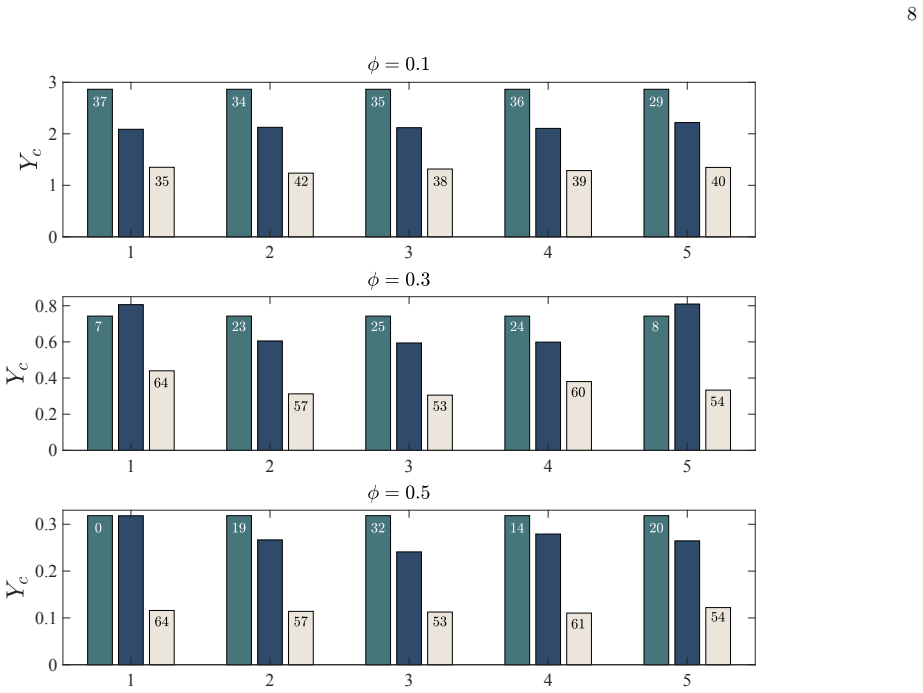
The central claim is that the pressure drop of a Bingham fluid through a random two-dimensional porous medium is, to the accuracy of the reported simulations, simply the sum of its Newtonian and yield-limit pressure drops at every Bingham number. Specifically, Eq. (30) states $$\frac{\$\Delta$ P}{L} = \frac{a}{-\log \phi + b + c\phi + d\$phi^{{2}}$} + \frac{\pi\phi}{1-\phi}B,$$ where the first term is the $B\to 0$ viscous limit (with coefficients $a=0.4091$, $b=-2.1954$, $c=4.1141$, $d=-2.1874$ fitted to ensemble-averaged simulations for random square obstacles) and the second term is the $B\to\infty$ yield limit, equivalent to the critical yield number $Y_c = \frac{1}{\pi}\frac{1-\phi}{\phi}$ from the author's previous percolation study. The paper reports that this formula agrees with pore-scale DNS across $B \in [10^{-2}, 10^{4}]$ and $\phi \in [0.1, 0.55]$, with 20 random realizations per solid fraction.
Load-bearing premise
The law assumes that at every intermediate flow strength the pressure drop is exactly the Newtonian-limit pressure drop plus the yield-limit pressure drop, with no extra term due to the flow pattern reorganizing as the yield stress becomes more important.
Editorial extensions
If this is right
- For a fixed random 2D geometry of monodisperse square obstacles, the pressure gradient required to sustain a given flow rate can be computed from $\phi$ and $B$ alone, without resolving the pore-scale velocity field.
- The effective permeability of a Bingham fluid decreases monotonically with $B$, and the $B\to\infty$ asymptote is fixed purely by geometry, $\pi\phi/(1-\phi)$, independent of the plastic viscosity.
- Because the yield-limit term does not involve viscosity, the same combination strategy extends to Herschel–Bulkley fluids by replacing only the Newtonian-limit term with a shear-thinning drag law.
- The law provides a macroscale closure that interpolates between the onset-of-flow regime and the near-Newtonian regime, filling the gap where neither limit alone is accurate.
- For periodic arrangements of obstacles, the same functional form holds with different fitted coefficients, and the square and triangular array fits bracket the random-media result.
Reading between the lines
- A testable consequence of the additivity ansatz is that the ratios $a(u,u)/\int u\, dA$ and $j(u)/\int u\, dA$ in the energy balance are independent of $B$; checking their drift at intermediate $B$ would either sharpen or refute the model.
- The logarithmic denominator of the Newtonian term reflects the two-dimensional Stokes paradox structure, so in three dimensions the same additivity construction would need a different permeability model (e.g., Blake–Carman–Kozeny type) and a three-dimensional yield-limit scale, which the paper notes is still missing.
- Since the law is an ensemble-averaged closure, individual realizations scatter around it; for engineering safety factors the upper and lower bound fits for periodic arrays give the natural uncertainty envelope.
- The same 'two limits added' construction could in principle be applied to other two-mechanism rheologies, such as Carreau-yield-stress fluids, with only the viscous-limit term modified.
Editorial analysis
A structured set of objections, weighed in public.
Referee Report
Summary. The paper proposes a Darcy-type law for Bingham fluids in two-dimensional porous media, Eq. (30), which is the sum of a Newtonian-limit term (29) and a yield-limit term (28). The Newtonian term is fitted to the author's own DNS data for randomized square obstacles at B=0, and the yield term is taken from the author's prior work [12], Eq. (25). The combined law is then compared with augmented-Lagrangian DNS over φ ∈ [0.1, 0.55] and B ∈ [10^-2, 10^4]. The central claim is that this simple linear combination is valid across the entire range of Bingham numbers. The paper also compares the yield-limit prediction (25) with Castañeda's upper bound (26) for a set of individual realizations.
Significance. If Eq. (30) is indeed valid across the full parameter range, it would provide a practically valuable closure for viscoplastic flow in porous media, replacing earlier models that require prior knowledge of the Newtonian permeability or undetermined prefactors. The computational study is careful in its use of randomized geometries and 20 realizations per solid fraction, and the intermediate-B comparison is genuinely out-of-sample because all fitted constants are determined at B=0. However, the central additivity assumption is not derived, and the quantitative validation is incomplete, so the claimed comprehensive validity is not yet firmly established.
major comments (3)
- [Section V, Eq. (30), and Eq. (19)] The proposed law is a linear superposition of the Newtonian and yield limits. From the exact energy balance (19), ΔP/L = a(u,u)/I + B j(u)/I with I = ∫u dA, so Eq. (30) is equivalent to assuming that a(u,u)/I is equal to its B→0 value and that j(u)/I is equal to its B→∞ value for every B. The paper does not derive this assumption and does not test the two dissipation ratios separately; Fig. 5 compares only the total pressure drop with the sum. If the two ratios vary with B while their variations compensate, the law could fit the tested data without exhibiting the claimed limit-combination mechanism. Please compute A(B)=a(u,u)/I and J(B)=j(u)/I from the DNS and report them as functions of B; if they are constant within numerical error, the additivity is confirmed, and if they are not, the law is an interpolation rather than a derived limit combination.
- [Section V, Fig. 4 and Appendix C] The coefficients a, b, c, d in Eq. (29) are fitted to the ensemble-average DNS at B=0 using exactly the four solid-volume fractions that appear in the subsequent validation (φ = 0.1, 0.3, 0.5, 0.55). With four free parameters and four data points, the reported R² = 1 is a tautology, not evidence for the functional form. The Newtonian limit is therefore only an interpolation of the same data used to exhibit that limit. To support Eq. (29) as a genuine Darcy law, the authors should either use more solid fractions, impose the asymptotic dilute-limit coefficient from the series solution (14), or compare with independent data from regular arrays with the same fit; in all cases, a measure of predictive error beyond in-sample R² is needed.
- [Section V, Fig. 5(b–e)] No quantitative error metric is reported for the comparison between Eq. (30) and the DNS at finite B. The text states 'Great agreement' but does not give the relative error, the maximum deviation, or the deviation relative to the plotted uncertainty bars. Since the central claim is that the law holds 'across the entire range of Bingham numbers', the validation should include, for each φ and B, the mean and maximum relative error of ΔP/L over the 20 realizations. Without such metrics, the intermediate-B agreement remains anecdotal and cannot be compared against alternative models such as Castañeda's bound or the linearized BCK expression (B5).
minor comments (5)
- [Eq. (16) description] A typo: 'Bignham model' should be 'Bingham model'.
- [Section II C and Eq. (29)] The connection between the drag expansion (14) with O((R/L)^2) and the porosity expansion (29) with O(φ^3) is not explained; note that φ ~ (R/L)^2 in two dimensions, so the orders are consistent only if one accounts for the square root. Please state this explicitly.
- [Section IV, Eq. (25)] Equation (25) is presented as a universal scale, but its ingredients, the scalings (24), are inherited from prior work [12]. The present paper re-validates the final expression against 15 realizations in Fig. 3, but it does not re-derive the statistical scaling. This distinction should be stated so that the reader understands which parts of the yield-limit model are newly supported here.
- [Fig. 4 caption] The inset showing the square and triangular arrangements is not described in the caption or the text; please label the inset or point the reader to a prior figure.
- [Section V, after Eq. (20)] The definition of κ in Eq. (20) involves L_inl/L, but the domain description states L=50 and does not define L_inl separately; please clarify the relationship between the inlet length and the domain length, and whether L_inl equals the side length of the square domain.
Circularity Check
No significant circularity: the finite-B validation is out-of-sample; the B=0 coefficients are fitted and disclosed, and the yield-limit term is independently re-validated in Fig. 3.
full rationale
The central proposed law, Eq. (30), is a linear combination of a Newtonian-limit term and a yield-limit term. The Newtonian-limit coefficients (a,b,c,d) are explicitly fitted to DNS at B=0 in Fig. 4 and reported in Table I; the paper does not present the B=0 agreement as an out-of-sample prediction, so this is disclosed fitting rather than a fitted input masquerading as a prediction. The yield-limit term, lim_{B->infty} f = pi phi/(1-phi) B, comes from the author's prior work [12], but the present paper independently compares Eq. (25) against new DNS in Fig. 3 and against an upper bound from Castaneda, giving in-paper supporting evidence; thus the self-citation is not load-bearing in a circular way. The finite-B predictions shown in Fig. 5 use coefficients fixed at B=0 and a yield-limit term fixed by the independently checked Yc model, so the intermediate-B DNS data are genuinely out-of-sample. The main weakness is that Eq. (30) assumes, without derivation, that the energy-balance contributions a(u,u)/I and B j(u)/I can be superposed as their B=0 and B->infty limits; this is an untested additivity ansatz that could be flagged as a modeling or correctness risk, but it is not a circularity because the finite-B output is not built into the inputs by construction. No circular reduction, self-definitional fit, or renamed known result is exhibited in the text.
Assumptions & free parameters
free parameters (5)
- a (Newtonian fit coefficient) =
0.4091
- b (Newtonian fit coefficient) =
-2.1954
- c (Newtonian fit coefficient) =
4.1141
- d (Newtonian fit coefficient) =
-2.1874
- Yield-limit scaling exponents =
1 and 1
assumptions (5)
- domain assumption Stokes flow, inertial terms neglected in Eq. (15)
- domain assumption Bingham constitutive model with von Mises yield criterion
- ad hoc to paper Additivity of Newtonian and yield-limit pressure drops
- domain assumption Ensemble averaging over randomized obstacle realizations
- domain assumption 2D square monodisperse obstacles
Cite this review
Pith. "Pith review of A comprehensive Darcy-type law for viscoplastic fluids: I. Framework." pith.science (2026). https://pith.science/paper/76HXFIFO
@misc{pith2026250606184,
  author       = {Pith},
  title        = {Pith review of: A comprehensive Darcy-type law for viscoplastic fluids: I. Framework},
  year         = {2026},
  howpublished = {\url{https://pith.science/paper/76HXFIFO}},
  note         = {Machine review of arXiv:2506.06184}
}
read the original abstract
A comprehensive Darcy-type law for viscoplastic fluids is proposed. Different regimes of yield-stress fluid flow in porous media can be categorised based on the Bingham number (i.e. the ratio of the yield stress to the characteristic viscous stress). In a recent study (Chaparian, J. Fluid Mech., vol. 980, A14, 2024), we addressed the yield/plastic limit (infinitely large Bingham number), namely, the onset of flow when the applied pressure gradient is just sufficient to overcome the yield stress resistance and initiate the flow. A purely geometrical universal scale was derived for the non-dimensional critical pressure gradient, which was thoroughly validated against computational data. In the present work, we investigate the Newtonian limit (infinitely large pressure difference compared to the yield stress of the fluid - ultra low Bingham number) both theoretically and computationally. We then propose a Darcy-type law applicable across the entire range of Bingham numbers by combining the mathematical models of the yield/plastic and Newtonian limits. Exhaustive computational data generated in this study (using augmented Lagrangian method coupled with anisotropic adaptive mesh at the pore scale) confirm the validity of the theoretical proposed law.
Figures


Figures from the paper (2 more)


Reference graph
Works this paper leans on
-
[12]
Chaparian, Yielding to percolation: a universal scale, J
E. Chaparian, Yielding to percolation: a universal scale, J. Fluid Mech. 980, A14 (2024)
work page 2024
-
[1]
Darcy, Les fontaines publiques de la ville de Dijon(Dalmont, 1856)
H. Darcy, Les fontaines publiques de la ville de Dijon(Dalmont, 1856)
-
[2]
Whitaker, Flow in porous media i: A theoretical derivation of Darcy’s law, Transp
S. Whitaker, Flow in porous media i: A theoretical derivation of Darcy’s law, Transp. Porous Med. 1, 3 (1986)
work page 1986
-
[3]
Y. Wang, X. Han, J. Li, R. Liu, Q. Wang, C. Huang, X. Wang, L. Zhang, and R. Lin, Review on oil displacement technologies of enhanced oil recovery: state-of-the-art and outlook, Energy & Fuels 37, 2539 (2023)
work page 2023
-
[4]
L. Zou, U. H ˚ akansson, and V. Cvetkovic, Analysis of cement grout propagation in fractured rocks, Tech. Rep. (Rock Engineering Research Foundation Report 200, 2021)
work page 2021
-
[5]
S. da Rocha Gomes, L. Ferrara, L. S´ anchez, and M. S. Moreno, A comprehensive review of cementitious grouts: Compo- sition, properties, requirements and advanced performance, Constr. Build. Mater. 375, 130991 (2023)
work page 2023
- [6]
-
[7]
Z. Trivedi, D. Gehweiler, J. K. Wychowaniec, T. Ricken, B. Gueorguiev, A. Wagner, and O. R¨ ohrle, A continuum mechanical porous media model for vertebroplasty: Numerical simulations and experimental validation, Biomech. Model. Mechanobiol. 22, 1253 (2023)
work page 2023
Show all 48 references
-
[8]
Talon and D
L. Talon and D. Bauer, On the determination of a generalized Darcy equation for yield-stress fluid in porous media using a Lattice-Boltzmann TRT scheme, Eur. Phys. J. E 36, 139 (2013)
2013
-
[9]
C. Liu, A. De Luca, A. Rosso, and L. Talon, Darcy’s law for yield stress fluids, Phys. Rev. Lett. 122, 245502 (2019)
2019
-
[10]
Chaparian and O
E. Chaparian and O. Tammisola, Sliding flows of yield-stress fluids, J. Fluid Mech. 911, A17 (2021)
2021
-
[11]
Fraggedakis, E
D. Fraggedakis, E. Chaparian, and O. Tammisola, The first open channel for yield-stress fluids in porous media, J. Fluid Mech. 911, A58 (2021)
2021
-
[13]
I. A. Frigaard, K. G. Paso, and P. R. de Souza Mendes, Bingham’s model in the oil and gas industry, Rheol. Acta 56, 259 (2017). 14
2017
-
[14]
Waisbord, N
N. Waisbord, N. Stoop, D. M. Walkama, J. Dunkel, and J. S. Guasto, Anomalous percolation flow transition of yield stress fluids in porous media, Phys. Rev. Fluids 4, 063303 (2019)
2019
-
[15]
Chaparian, D
E. Chaparian, D. Izbassarov, F. De Vita, L. Brandt, and O. Tammisola, Yield-stress fluids in porous media: a comparison of viscoplastic and elastoviscoplastic flows, Meccanica 55, 331 (2020)
2020
-
[16]
Parvar, E
S. Parvar, E. Chaparian, and O. Tammisola, General hydrodynamic features of elastoviscoplastic fluid flows through randomised porous media, Theor. Comput. Fluid Dyn. 38, 531 (2024)
2024
-
[17]
Al-Fariss and K
T. Al-Fariss and K. L. Pinder, Flow through porous media of a shear-thinning liquid with yield stress, Can. J. Chem. Eng. 65, 391 (1987)
1987
-
[18]
D. R. Hewitt, M. Daneshi, N. J. Balmforth, and D. M. Martinez, Obstructed and channelized viscoplastic flow in a Hele-Shaw cell, J. Fluid Mech. 790, 173 (2016)
2016
-
[19]
Daneshi, J
M. Daneshi, J. MacKenzie, N. J. Balmforth, D. M. Martinez, and D. R. Hewitt, Obstructed viscoplastic flow in a Hele-Shaw cell, Phys. Rev. Fluids 5, 013301 (2020)
2020
-
[20]
Chevalier, C
T. Chevalier, C. Chevalier, X. Clain, J. C. Dupla, J. Canou, S. Rodts, and P. Coussot, Darcy’s law for yield stress fluid flowing through a porous medium, J. Non-Newtonian Fluid Mech. 195, 57 (2013)
2013
-
[21]
Chevalier, S
T. Chevalier, S. Rodts, X. Chateau, C. Chevalier, and P. Coussot, Breaking of non-Newtonian character in flows through a porous medium, Phys. Rev. E 89, 023002 (2014)
2014
-
[22]
Bleyer and P
J. Bleyer and P. Coussot, Breakage of non-Newtonian character in flow through a porous medium: evidence from numerical simulation, Phys. Rev. E 89, 063018 (2014)
2014
-
[23]
Shahsavari and G
S. Shahsavari and G. H. McKinley, Mobility and pore-scale fluid dynamics of rate-dependent yield-stress fluids flowing through fibrous porous media, J. Non-Newtonian Fluid Mech. 235, 76 (2016)
2016
-
[24]
Shahsavari and G
S. Shahsavari and G. H. McKinley, Mobility of power-law and Carreau fluids through fibrous media, Phys. Rev. E 92, 063012 (2015)
2015
-
[25]
Chevalier and L
T. Chevalier and L. Talon, Generalization of Darcy’s law for Bingham fluids in porous media: From flow-field statistics to the flow-rate regimes, Phys. Rev. E 91, 023011 (2015)
2015
-
[26]
Bauer, L
D. Bauer, L. Talon, Y. Peysson, H. B. Ly, G. Batˆ ot, T. Chevalier, and M. Fleury, Experimental and numerical determination of Darcy’s law for yield stress fluids in porous media, Phys. Rev. Fluids 4, 063301 (2019)
2019
-
[27]
P. P. Casta˜ neda, Variational linear comparison homogenization estimates for the flow of yield stress fluids through porous media, J. Non-Newtonian Fluid Mech. 321, 105104 (2023)
2023
-
[28]
Roquet and P
N. Roquet and P. Saramito, An adaptive finite element method for Bingham fluid flows around a cylinder, Comput. Meth. Appl. Mech. Eng. 192, 3317 (2003)
2003
-
[29]
Chaparian and O
E. Chaparian and O. Tammisola, An adaptive finite element method for elastoviscoplastic fluid flows, J. Non-Newtonian Fluid Mech. 271, 104148 (2019)
2019
-
[30]
Chaparian, C
E. Chaparian, C. E. Owens, and G. H. McKinley, Computational rheometry of yielding and viscoplastic flow in vane-and- cup rheometer fixtures, J. Non-Newtonian Fluid Mech. 307, 104857 (2022)
2022
-
[31]
Prager, Viscous flow through porous media, Phys
S. Prager, Viscous flow through porous media, Phys. Fluids 4, 1477 (1961)
1961
-
[32]
H. L. Weissberg and S. Prager, Viscous flow through porous media. ii. approximate three-point correlation function, Phys. Fluids 5, 1390 (1962)
1962
-
[33]
H. L. Weissberg and S. Prager, Viscous flow through porous media. iii. upper bounds on the permeability for a simple random geometry, Phys. Fluids 13, 2958 (1970)
1970
-
[34]
Doi, A new variational approach to the diffusion and the flow problem in porous media, J
M. Doi, A new variational approach to the diffusion and the flow problem in porous media, J. Phys. Soc. Jpn. 40, 567 (1976)
1976
-
[35]
J. G. Berryman, Bounds on fluid permeability for viscous flow through porous media, J. Chem. Phys. 82, 1459 (1985)
1985
-
[36]
Bignonnet, Upper bounds on the permeability of random porous media, Transp
F. Bignonnet, Upper bounds on the permeability of random porous media, Transp. Porous Med. 122, 57 (2018)
2018
-
[37]
M. J. MacDonald, C. Chu, P. P. Guilloit, and K. M. Ng, A generalized Blake-Kozeny equation for multisized spherical particles, AIChE J. 37, 1583 (1991)
1991
-
[38]
Guyon, J
E. Guyon, J. P. Hulin, L. Petit, and C. D. Mitescu, Physical hydrodynamics(Oxford university press, 2015)
2015
-
[39]
A. A. Zick and G. M. Homsy, Stokes flow through periodic arrays of spheres, J. Fluid Mech. 115, 13 (1982)
1982
-
[40]
H. C. Brinkman, A calculation of the viscous force exerted by a flowing fluid on a dense swarm of particles, Appl. Sci. Res. AI, 27 (1947)
1947
-
[41]
Cancelliere, C
A. Cancelliere, C. Chang, E. Foti, D. H. Rothman, and S. Succi, The permeability of a random medium: comparison of simulation with theory, Phys. Fluids A: Fluid Dyn. 2, 2085 (1990)
1990
-
[42]
Hasimoto, On the periodic fundamental solutions of the Stokes equations and their application to viscous flow past a cubic array of spheres, J
H. Hasimoto, On the periodic fundamental solutions of the Stokes equations and their application to viscous flow past a cubic array of spheres, J. Fluid Mech. 5, 317 (1959)
1959
-
[43]
J. E. Drummond and M. I. Tahir, Laminar viscous flow through regular arrays of parallel solid cylinders, Int. J. Multiph. Flow 10, 515 (1984)
1984
-
[44]
Hecht, New development in freefem++, J
F. Hecht, New development in freefem++, J. Numer. Math. 20, 251 (2012)
2012
-
[45]
Chaparian and I
E. Chaparian and I. A. Frigaard, Yield limit analysis of particle motion in a yield-stress fluid, J. Fluid Mech. 819, 311 (2017)
2017
-
[46]
J. A. Iglesias, G. Mercier, E. Chaparian, and I. A. Frigaard, Computing the yield limit in three-dimensional flows of a yield stress fluid about a settling particle, J. Non-Newtonian Fluid Mech. 284, 104374 (2020)
2020
-
[47]
E. F. Medina-Ba˜ nuelos, B. M. Mar ´ ın-Santib´ a˜ nez, E. Chaparian, C. E. Owens, G. H. McKinley, and J. P´ erez-Gonz´ alez, Rheo-PIV of yield-stress fluids in a 3D-printed fractal vane-in-cup geometry, J. Rheol. 67, 891 (2023)
2023
-
[48]
Chaparian and O
E. Chaparian and O. Tammisola, Stability of particles inside yield-stress fluid Poiseuille flows, J. Fluid Mech. 885, A45 (2020)
2020
Reviewed August 7, 2026 · model on record in the stance chip above.
Discussion (0). Sign in to comment.