REVIEW 4 major objections 4 minor 26 references
Building Models of Neurological Language
T0 review · 4 major / 4 minor · reviewed 2026-08-07 · deepseek-v4-flash
Pith's one-line read Fine-tuning a small open-weight model with QLoRA and adding retrieval-augmented generation brings neurology question-answering accuracy close to GPT-4 while keeping deployment local.
desk verdict A useful project report whose central claim is contradicted by its own Table 1 and a contaminated TextbookQA benchmark. read the letter →
The pith
A machine-rendered reading of the paper's core claim, the machinery that carries it, and where it could break.
The reading
What carries the argument
Retrieval-augmented generation is the load-bearing mechanism: textbook and clinical-guideline passages are embedded with a general-purpose embedding model, retrieved by vector search, and prepended to prompts so answers are grounded in domain text. Parameter-efficient fine-tuning with QLoRA is the second half of the recipe, adapting a 7B Gemma model to neurology on a single consumer-grade GPU. A separate machinery powers the ontology work: pointwise mutual information on co-occurring terms builds a weighted graph, soft Louvain clustering finds non-exclusive communities, and eigenvector centrality picks the high-centrality 'head' terms.
What would settle it
Split the textbook corpus so that no passage used to generate a textbook-derived question appears in any fine-tuning set, rerun the evaluation on that clean split, and compare the fine-tuned Gemma-7b model against GPT-4. If the fine-tuned model's accuracy falls back toward its level on the professional exam set, where the best score is 0.3827 against GPT-4's 0.5802, the near-GPT-4 claim is largely explained by training-set exposure.
Extended reading notes
Core claim
The paper's central claim is that domain adaptation for neurology no longer requires a large bespoke model. Fine-tuning a 7-billion-parameter Gemma model with QLoRA on case reports, radiology reports, and textbook text, then prepending retrieved passages from a vector store built over the same textbooks and clinical guidelines, produces a system that answers neurology multiple-choice questions at near-GPT-4 accuracy: retrieval lifts accuracy on the textbook-derived set for every configuration and improves most fine-tuned models on the professional set, and the best fine-tuned configuration reaches 0.9655 on the textbook-derived set compared with GPT-4's 0.9105 without retrieval and 0.974 with it. On the harder professional exam set, the small models remain clearly below GPT-4 (best 0.3827 versus 0.5802 without retrieval and 0.6419 with it). For summarisation, retrieval gives little benefit and the fine-tuned models stay below GPT-3.5. The same project contributes an unsupervised graph pipeline that derives a neurology terminology ontology from radiology reports using pointwise mutual information, soft Louvain clustering, and eigenvector centrality.
Load-bearing premise
The near-GPT-4 scores only mean something if the textbook-derived questions are new to the model, yet the same textbook corpus was used to fine-tune the models and to generate the questions with GPT-4; if that overlap inflates the scores, the central result is an artefact of exposure rather than of domain adaptation.
Editorial extensions
If this is right
- The Gemma-7b-plus-retrieval stack can be hosted locally and gives near-GPT-4 accuracy on neurology multiple-choice questions, so a clinic can keep patient data on-site while getting competitive answers.
- Retrieval, not fine-tuning alone, drives most of the question-answering gains: on the textbook-derived set scores improve or stay flat for every configuration when retrieval is added, and on the specialist exam set most fine-tuned configurations improve.
- Summarisation does not benefit from retrieval, and fine-tuned small models stay below GPT-3.5 on ROUGE-L, BLEU, and METEOR; the recipe is specific to question answering.
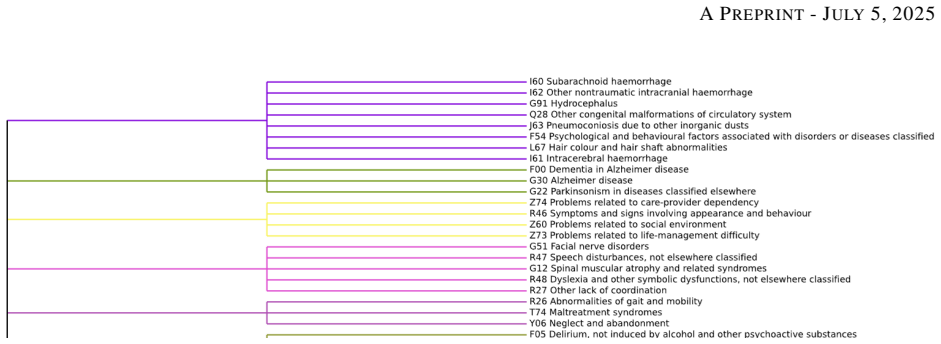
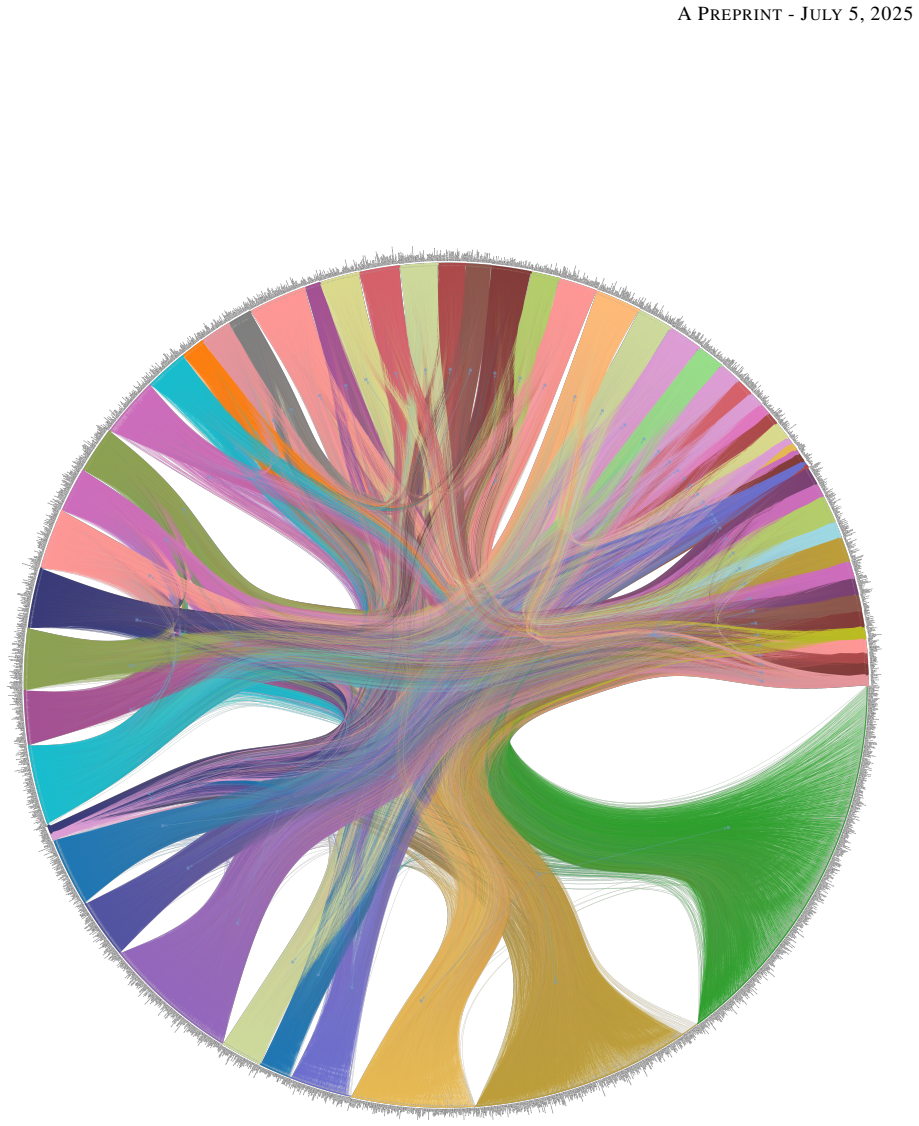
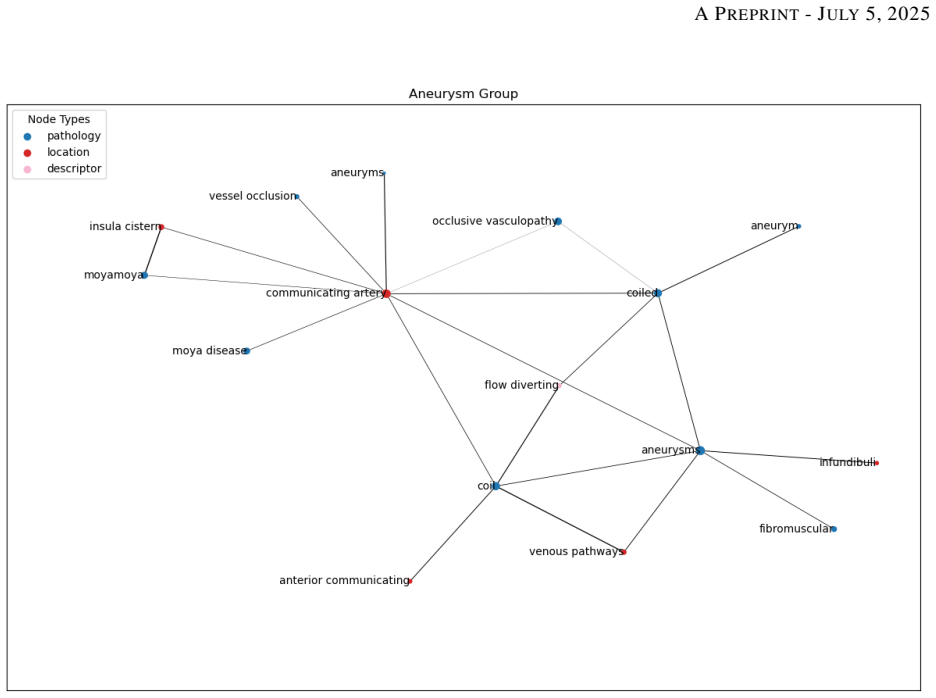
- The PMI-and-Louvain graph pipeline can build a neurology terminology ontology directly from radiology reports, with clusters such as meningioma, encephalitis, and aneurysm surfacing expected clinical associations without manual curation.
- The containerised deployment scripts make the whole pipeline reproducible and extensible, so new models, datasets, or evaluation metrics can be added without rebuilding the infrastructure.
Reading between the lines
- A cleanly split version of the textbook-derived set would be the decisive test of the paper's central comparison, and the much larger gap on the specialist exam set suggests the overlap effect could be substantial.
- The same architecture is a natural template for other medical specialties or expert domains where a small local model plus a curated retrieval corpus is the constraint; nothing in the mechanism is neurology-specific except the data.
- The safety and alignment section is explicitly only an outline, so safe-deployment statements are design goals to be validated, not properties the evaluation demonstrates.
- Given the specialist-exam gap, a clinician relying on this stack would need confidence calibration or human review before use, which the paper lists as future work.
Editorial analysis
A structured set of objections, weighed in public.
Referee Report
Summary. The paper reports a project to build a neurology-specific language model, shifting from a bespoke foundation model to fine-tuned Gemma-7b models combined with retrieval-augmented generation (RAG). It introduces several neurology datasets (case reports, NICE guidelines, textbook-derived MCQA, MRCPUK exam questions), a multi-word expression toolkit (pyMWE), graph-based terminology analyses, Dockerized deployment scripts, and a safety/alignment framework. Evaluation in Section 4.2 claims RAG consistently improves QA accuracy and that fine-tuned Gemma models approach GPT-4 performance on neurology QA tasks, based on accuracy on the MRCPUK and TextbookQA datasets.
Significance. If the empirical claims were sound, the paper would provide a useful blueprint for locally deployable, secure neurology QA systems using small open-source models augmented with RAG. The project does contribute tangible open-source artefacts (pyMWE, NeuroBase deployment scripts, Docker containers) and a large radiology corpus through Neuradicon, and the MRCPUK benchmark is a relevant independent evaluation resource. However, the central empirical claims are undermined by a contaminated evaluation set and by internal contradictions in Table 1, so the reported findings do not currently support the paper's main conclusions.
major comments (4)
- [Section 4.2 / Table 1] The sentence 'RAG consistently improves QA accuracy across models' is directly contradicted by Table 1: on MRCQA, Omni accuracy drops from 0.3704 to 0.3457 with RAG, TB drops from 0.3827 to 0.3456, and base Gemma stays identical at 0.4444. The claim should be corrected to 'RAG improves accuracy in some configurations' and supported with statistical analysis, not presented as a general trend.
- [Section 2.5 / Table 1] TextbookQA is generated from the same textbook corpus used to fine-tune the CR, QA, TB, and Omni models, so it is not a held-out test of generalization. Furthermore, GPT-4 generates the questions and is then used as the reference model for comparison, which introduces circularity into the benchmark. Consequently, the near-GPT-4 accuracy on TextbookQA is training-influenced and cannot support the conclusion that fine-tuned Gemma models approach GPT-4; the only cleanly held-out benchmark, MRCPUK (N=81, Section 2.2), shows the best fine-tuned configuration at 0.3827 versus GPT-4 at 0.5802, which is substantially lower.
- [Section 4.2 / Table 1] No confidence intervals, standard errors, or significance tests are reported for any accuracy value. With MRCQA comprising only 81 questions, the observed differences between configurations (e.g., 0.3827 vs. 0.3457) are within sampling variability, so the relative ranking of models is not established. The paper should either report uncertainty or refrain from drawing strong comparative conclusions.
- [Abstract and Section 9] The abstract and discussion state that fine-tuned Gemma models with RAG 'nearly matched GPT-4's accuracy on diagnostic MCQA tasks' and 'approach GPT-4 accuracy' on neurology QA. These statements are not supported by the held-out MRCPUK results and are only plausible on the contaminated TextbookQA set. The conclusions should be substantially revised to reflect the actual evidence, or the evaluation should be redone on a properly held-out, independently authored benchmark.
minor comments (4)
- [Section 2.5] The procedure for generating TextbookQA should specify the number of questions generated, whether any quality filtering was applied, and how distractor generation was validated, since these choices affect benchmark validity.
- [Section 6.1] Figure 1 is referenced but not included in the preprint text; please ensure all figures are present or clearly marked as supplementary.
- [Section 8] The sentence 'This work package was the last part of the project, and so only an outline has been completed' indicates the safety and alignment work is not fully realized; this should be moved to the limitations section so it does not overstate the completeness of the safety framework.
- [Section 9] There is a typo in 'point's-mutual-information' and a stray 'd' at the end of Section 8.2; these should be corrected in a final revision.
Circularity Check
TextbookQA evaluation is contaminated by training-set overlap and GPT-4 self-authorship; the independent MRCPUK benchmark contradicts the central 'approaching GPT-4' claim.
-
fitted input called prediction
[Section 2.5 (Textbook Datasets) with Section 4.1/4.2 (fine-tuning description and Table 1)]
"In addition to training data, we can also construct multiple-choice-question-answering (MCQA) datasets from these textbooks... First, we choose a random passage from the textbook and generate a question-answer pair using OpenAI's GPT-4. ... CR is the model fine-tuned on case reports, QA is the model fine-tuned on question-answering pairs, TB is the model fine-tuned on textbook data, and Omni is the model fine-tuned on a combination of all three datasets."
TextbookQA is built by sampling random passages from the same neurology textbooks used to fine-tune the TB model and the Omni model (and used for the textbook-derived QA-pair fine-tuning data). The high TextbookQA accuracies in Table 1 (e.g., Omni 0.9655, TB+RAG 0.899, base+RAG 0.958) are therefore not held-out generalization scores; they measure retention of training passages. The paper's central claim that fine-tuned Gemma models 'approach GPT-4 accuracy' rests mainly on this contaminated column, while the one cleanly held-out set, MRCPUK (N=81, Section 2.2), shows the best fine-tuned model at 0.3827 versus GPT-4's 0.5802. The TextbookQA 'prediction' is thus statistically forced by training-set exposure rather than independent model competence.
-
self definitional
[Section 2.5 (TextbookQA construction) and Section 4.1 (benchmark setup)]
"First, we choose a random passage from the textbook and generate a question-answer pair using OpenAI's GPT-4. The false 'distractor' answers are then generated by a second call, such that the answers are incorrect. ... Benchmarks: GPT-4 serves as an external gold standard."
The 'external gold standard' is not external to the TextbookQA benchmark: OpenAI's GPT-4 both writes the question-answer pairs and serves as the reference model in Table 1. Its near-ceiling scores on TextbookQA (0.9105 without RAG, 0.974 with RAG) partly reflect self-agreement with its own item-generation process, and comparing Gemma models against GPT-4 on those items is comparing them against the test's author. This makes the 'approaching GPT-4' claim on TextbookQA circular in evaluation design, even though the MRCPUK benchmark remains independent.
full rationale
The circularity is concentrated in the QA evaluation rather than in the derivation chain. Section 2.5 states that TextbookQA is constructed by sampling random passages from the same neurology textbooks used for fine-tuning the TB and Omni models, so the near-GPT-4 accuracy in Table 1 is inflated by training-set exposure. In addition, GPT-4 is both the item writer for TextbookQA and the 'external gold standard' comparator, making the benchmark self-referential. The paper also contains an internal inconsistency that weakens the central claim: Section 4.2 asserts 'RAG consistently improves QA accuracy across models,' but Table 1 shows RAG decreasing accuracy for Omni on MRCQA (0.3704 to 0.3457) and for TB (0.3827 to 0.3456), with no change for base Gemma. The independent MRCPUK evaluation shows the opposite of the headline: no fine-tuned model approaches GPT-4's 0.5802, with the best fine-tuned configuration at 0.3827. The non-QA components—pyMWE extraction, terminology graphs, and phenotyping analyses—are self-contained and do not reduce to their inputs. Because the central claim rests on the contaminated TextbookQA column, the score is 6: partial circularity through fitted-input-called-prediction and a self-referential benchmark, but with an independent benchmark present that prevents a fully forced result.
Assumptions & free parameters
assumptions (3)
- domain assumption QLoRA fine-tuning (Dettmers et al. 2023) preserves the base model's capabilities while adding domain knowledge
- domain assumption Retrieval-augmented generation improves QA accuracy for small models (Lewis et al. 2020; Soudani et al. 2024)
- ad hoc to paper GPT-4 can generate valid, unbiased multiple-choice questions from textbook passages
Cite this review
Pith. "Pith review of Building Models of Neurological Language." pith.science (2026). https://pith.science/paper/N3BQE66W
@misc{pith2026250606208,
  author       = {Pith},
  title        = {Pith review of: Building Models of Neurological Language},
  year         = {2026},
  howpublished = {\url{https://pith.science/paper/N3BQE66W}},
  note         = {Machine review of arXiv:2506.06208}
}
read the original abstract
This report documents the development and evaluation of domain-specific language models for neurology. Initially focused on building a bespoke model, the project adapted to rapid advances in open-source and commercial medical LLMs, shifting toward leveraging retrieval-augmented generation (RAG) and representational models for secure, local deployment. Key contributions include the creation of neurology-specific datasets (case reports, QA sets, textbook-derived data), tools for multi-word expression extraction, and graph-based analyses of medical terminology. The project also produced scripts and Docker containers for local hosting. Performance metrics and graph community results are reported, with future possible work open for multimodal models using open-source architectures like phi-4.
Figures

Figures from the paper (3 more)


Reference graph
Works this paper leans on
-
[1]
Oversimplification: They flatten complex neurological findings into a narrow set of standardised fields, which limits how faithfully the data reflect true clinical nuance
-
[2]
Arguably, the only way to break this deadlock is with a machine model grounded in logical grammar
Manual coding: They painstakingly annotate and parameterise free-text records by hand, which preserves detail but is too slow and labour-intensive to apply on a large scale. Arguably, the only way to break this deadlock is with a machine model grounded in logical grammar. By precisely defining the facts we care about and their interrelationships, such a m...
work page 2019
-
[3]
Rich logico-grammatical expressivity, to represent intricate medical facts and relationships faithfully
-
[4]
Non-technical operability, so neurologists and neuroscientists can design and run tasks without any program- ming
-
[5]
Extract all mentions of tremor onset and progression from this set of clinic letters,
Safe clinical deployment, ensuring seamless integration into patient-care environments. A PREPRINT - J ULY 5, 2025 This kind of NLP would generate high-fidelity, structured descriptions of neurological phenomena and enable domain experts to work directly with their data—finally resolving the Catch-22 that has stalled progress toward truly nuanced, individ...
work page 2025
-
[6]
Fine-tune the best available LLM on large-scale, comprehensive free-text data from NHNN to create a foundational model of neurological language
-
[7]
Develop a suite of natural language ‘prompt’ queries for extracting structured phenotypic features from clinical and investigation text records
-
[8]
Analyse the model’s latent space to uncover a hierarchically organised, deep representation of neurological phenomena
Show all 26 references
-
[9]
Validate the model and associated tools against manual parameterizations, both prospectively and externally using data from King’s College and Guy’s & St Thomas’s Hospitals
-
[10]
Prototype a foundational model that integrates free text and brain imaging data
-
[11]
medical copilots
Conduct a rigorous safety analysis to ensure alignment, privacy, and resistance to misuse. 1.2 Change of Focus Initially, our objective was to develop a fine-tuned, domain-specific language model tailored to neurological practice. However, the pace of innovation in large langu...
2025
-
[14]
Reproducibility: Version-controlled Docker images and scripted workflows guarantee that experiments can be reliably rerun across diverse environments
-
[15]
Scalability: Services can be distributed—or orchestrated with tools like Kubernetes—to accommodate increasing data volumes and concurrent users
-
[16]
Interoperability: Standardised APIs (HTTP/JSON) allow seamless integration with electronic health record (EHR) systems, web applications, or downstream analytics pipelines
-
[17]
This architecture supports rapid iteration and deployment of LLMs in sensitive medical contexts
Extensibility: New models, datasets, or evaluation metrics can be incorporated by extending existing scripts or adding new Dockerfiles without disrupting the core infrastructure. This architecture supports rapid iteration and deployment of LLMs in sensitive medical contexts. 6...
2025
-
[19]
– Preprocessing steps (GROBID version, TEI-to-JSON conversion parameters)
Process-Based Governance (PBG) Framework • Maintain a comprehensive Dataset Factsheet that logs: – Source provenance (e.g., journal name, textbook edition). – Preprocessing steps (GROBID version, TEI-to-JSON conversion parameters). 16 A PREPRINT - J ULY 5, 2025 Figure 6: The c...
2025
-
[20]
• Log every inference transaction with anonymised input metadata and output summaries; store logs for at least two years to support retrospective analysis
Accountability-by-Design • Assign domain experts as pipeline stewards: one neurologist oversees dataset curation; one ML engineer owns fine-tuning; one DevOps lead handles deployment. • Log every inference transaction with anonymised input metadata and output summaries; store ...
-
[21]
explanation mode
Transparency & Explainability • Surface RAG provenance in inference responses: – Attach document identifiers, section headers, and retrieval relevance scores alongside model answers. – Provide an optional “explanation mode” where underlying token-level attributions (e.g., atte...
2025
-
[22]
phi-4-multimodal) to jointly process radiological images and text, enabling richer phenotypic representations
Multimodal Integration: Adapting open-source multimodal architectures (e.g. phi-4-multimodal) to jointly process radiological images and text, enabling richer phenotypic representations
-
[23]
Longitudinal Phenotyping: Leveraging deep latent representations to model temporal trajectories of neuro- logical disease, linking text-derived phenotypes to imaging bio-markers and outcomes data
-
[24]
Shiny apps or web dashboards) enabling neurologists to query the ontology graph, refine MWE thresholds, and inspect RAG provenance in real-time
Interactive Clinical Tools: Building user-friendly interfaces (e.g. Shiny apps or web dashboards) enabling neurologists to query the ontology graph, refine MWE thresholds, and inspect RAG provenance in real-time
-
[25]
Principles of Neurology
Regulatory Alignment: Collaborating with clinical governance bodies to validate model outputs against established guidelines, and to navigate data protection regulations (e.g. GDPR, NHS IG Toolkit). This project demonstrates that a hybrid approach—marrying small, locally deplo...
2025 arXiv
-
[2008]
inflammation
to identify communities within the network, allowing for the detection of non-exclusive thematic groups. Unlike traditional Louvain clustering, soft Louvain clustering ascribes a probability of membership to each node in the graph, therefore I can use this parameter to find no...
1972
-
[2009]
stroke”, “dementia
to extract the structured text. The extracted text is then converted into JSON format for downstream use. These guidelines are used as a source of retrieval-augmented generation (RAG) data, where the model is provided with additional context from the guidelines during inferenc...
2022
-
[2022]
Gatortron: A Large Clinical Language Model to Unlock Patient Information from Unstructured Electronic Health Records
“Gatortron: A Large Clinical Language Model to Unlock Patient Information from Unstructured Electronic Health Records.” arXiv Preprint arXiv:2203.03540. Zakka, Cyril, Rohan Shad, Akash Chaurasia, Alex R Dalal, Jennifer L Kim, Michael Moor, Robyn Fong, et al. 2024. “Almanac—Ret...
2024 arXiv
-
[2025]
User interface dashboards have also been built alongside Neuradicon as a back end; this neurodash software is also available open-source (also linked in Section 10)
which is available as an open-source code base (see Section 10). User interface dashboards have also been built alongside Neuradicon as a back end; this neurodash software is also available open-source (also linked in Section 10). 4.1 Methodology The methodology for building N...
2024
Reviewed August 7, 2026 · model on record in the stance chip above.
Discussion (0). Sign in to comment.