REVIEW 4 major objections 4 minor 30 references
El0ps: An Exact L0-regularized Problems Solver
T0 review · 4 major / 4 minor · reviewed 2026-08-07 · deepseek-v4-flash
Pith's one-line read This paper presents El0ps, a Python toolbox that solves L0-regularized optimization problems exactly, allowing custom loss and penalty functions, and claims a branch-and-bound solver that is both more flexible and faster than existing…
desk verdict A genuinely useful L0 toolbox with a real gap: the default exactness guarantee for user-defined penalties rests on unsupported numerical approximations of the BnB constants. read the letter →
The pith
A machine-rendered reading of the paper's core claim, the machinery that carries it, and where it could break.
The reading
What carries the argument
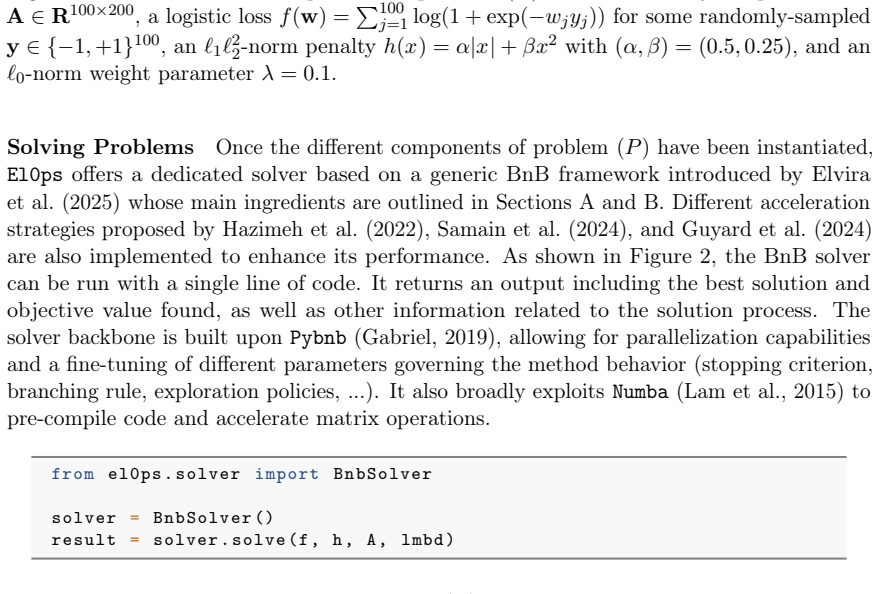
The load-bearing mechanism is a branch-and-bound solver with pruning tests built on convex relaxations. Each region of the search space fixes a set of variables to zero and a set to nonzero; the solver computes a lower bound from a convex problem involving the tightest convex relaxation of each coordinate penalty, and an upper bound from a restricted convex problem. The key identities are the closed-form expressions for the conjugate and biconjugate of $g(x)=h(x)+\lambda\|x\|_0$, which reduce to scalar parameters $\tau$, $\mu$, and $\kappa$ defined from $h^\star$ and its subdifferential. These quantities let El0ps evaluate the lower-bound problem efficiently. The solver also uses a simultaneous pruning strategy, a working-set method with coordinate descent, and screening tests to accelerate the search.
What would settle it
Run El0ps on a small L0-regularized instance where the global optimum is known by exhaustive enumeration, using a user-defined penalty whose $\tau$ value is computed numerically rather than in closed form. If the solver's reported objective value exceeds the known optimum, or if its dual bound surpasses the true optimal value at any node, the pruning machinery is not sound.
Extended reading notes
Core claim
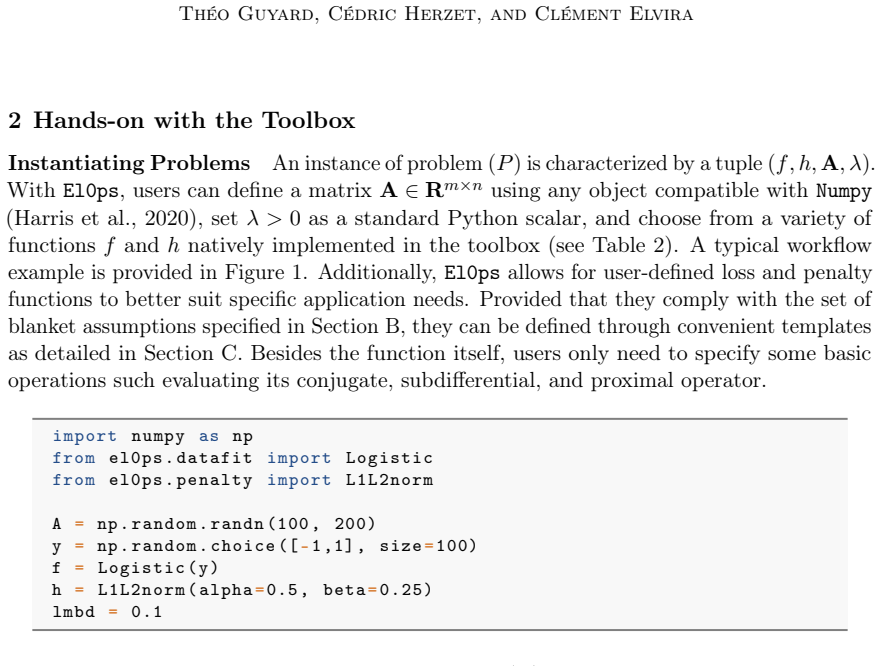
The paper's central claim is that El0ps makes exact L0-regularized problems solvable in practice: it instantiates a generic problem of the form $\min_x f(Ax)+\lambda\|x\|_0+\sum_i h(x_i)$, lets the user plug in any loss and penalty satisfying a set of convexity and symmetry assumptions, and solves it to global optimality with a branch-and-bound method. The solver's efficiency comes from closed-form quantities (denoted $\tau$, $\mu$, $\kappa$) derived from the convex conjugate of the penalty, which make the pruning tests cheap, plus a working-set coordinate descent and screening rules for the inner lower-bound problems. Experiments on the Riboflavin, Leukemia, and Arcene datasets show that El0ps handles every tested combination of loss and penalty while each competitor cannot handle at least one such instance, and that its solving times are consistently lower. The paper presents these results as evidence that El0ps outperforms existing toolboxes both in variety and in speed.
Load-bearing premise
The exactness of the solver rests on the correctness of the branch-and-bound theory and the closed-form bound quantities that the paper takes from a companion preprint not included here; if those bounds were invalid, or if the numerical approximation used for user-defined penalties produced an invalid bound, the solver could return a suboptimal solution.
Editorial extensions
If this is right
- Users can now solve exact L0 problems with losses such as logistic or squared hinge and custom penalties, going beyond the quadratic-and-box constraints of prior exact solvers.
- The solver can be embedded in common Python machine-learning pipelines via an estimator class, enabling cross-validation and hyperparameter search over L0 models.
- The built-in regularization path routine produces solutions for many $\lambda$ values, letting practitioners pick a sparsity level with a certificate of global optimality.
- Because it is exact, El0ps can measure the suboptimality gap of heuristic and relaxation-based sparse solvers on given instances.
- The user-defined function templates and just-in-time compilation lower the barrier to adopting exact L0 in new applications.
Reading between the lines
- A broader consequence, if the toolbox performs as described, is that exact L0 could replace L1 relaxation as the default sparse model selector for problems with up to tens of thousands of features, since optimality guarantees change model-selection practice.
- The BnB framework's dependence on scalar closed-form quantities suggests it may extend to group-sparse or structured regularizers by generalizing the conjugate computations.
- The weak spot is the numerical estimation of $\tau$ for user-defined penalties: a rigorous guarantee would require either closed forms or validated interval arithmetic.
- The benchmarks are small enough that scaling to much larger datasets would likely need additional screening rules; the modular design allows such experiments.
Editorial analysis
A structured set of objections, weighed in public.
Referee Report
Summary. This paper introduces El0ps, a Python toolbox for exactly solving L0-regularized optimization problems of the form min_x f(Ax) + lambda||x||_0 + sum_i h(x_i). The toolbox provides a flexible class-based framework for user-defined losses and penalties, a dedicated branch-and-bound solver, regularization-path utilities, and a scikit-learn interface. The manuscript describes the solver's main pruning, branching, working-set, and screening components, collects these in appendices, and reports a small benchmark against Gurobi, Oa, L0bnb, and Mimosa on three datasets. The central claims are that El0ps supports a wider variety of problem instances than existing toolboxes and achieves state-of-the-art solving time.
Significance. If the exactness and efficiency claims hold, El0ps is a timely and useful contribution: it is open-source, the code for experiments is available, and it offers a genuinely flexible interface for custom L0-regularized instances. The use of a dual-based lower bound D^nu as a safe surrogate when the lower-bounding problem is solved approximately is a sound and valuable design, and the integration with scikit-learn broadens the practical reach of exact L0 methods. The main caveat is that the exactness guarantee for the flagship user-defined penalty feature is not fully established in this manuscript, and the performance comparison is too narrow to support the broad 'state-of-the-art' phrasing.
major comments (4)
- [C.2 and B.1, Eqs. (9)-(11)] The automatic approximation of tau by bisection and the numerical derivation of mu and kappa from d h and d h* for user-defined penalties are not accompanied by any proof that the approximations are conservative in the direction needed by the pruning bounds. The bounds in Eqs. (2), (8), (13)-(14) require g** to be a pointwise lower bound on g(x)=h(x)+lambda||x||_0; if the bisection returns a value above the true tau defined in Eq. (9), the relaxed penalty can cease to be a lower bound, and the screening implications in Eq. (19) and any pruning decision based on the approximate relaxation could be invalid. This directly threatens the advertised exactness for custom instances. Please either prove that the numerical approximations always undershoot (or otherwise preserve the required inequality), restrict the exactness guarantee to user-supplied closed forms and native penalties, or validate the default path against a brute-force search on many small random instances.
- [Section 3, Table 1] The claim that El0ps 'outperforms its competitors both in terms of variety in instances it can handle and solving time' is supported by only three datasets and nine instances, with no repeated runs, no variance measures, and no experiments involving user-defined penalties. A single timing observation per cell is insufficient for a state-of-the-art performance claim. Please add repeated runs with error bars or at least report per-instance variability, include more datasets or synthetic problems, and add at least one user-defined penalty experiment; alternatively, tone down the wording to a more specific and defensible claim.
- [Section D, Mimosa comparison] The appendix states that the original Mimosa solver was modified to use the hyperparameters selected by the authors' grid search instead of its own settings. This modification could disadvantage a baseline that may have been tuned internally for its default regime, and the paper does not report how strong the effect is. For a fair comparison, please report Mimosa's timings with its default hyperparameters as well, or justify why the modification is neutral for the comparison.
- [Sections 2 and B.1] The exactness of the whole solver rests on results cited to Elvira et al. (2025), an unpublished arXiv preprint. In particular, the reformulation in Eqs. (6)-(8), the closed-form expressions for g* and g**, and the safe-duality strategy in Section B.2.2 are taken from that work. The present manuscript therefore does not on its own provide enough material for a reader to verify the central exactness guarantee. Please state the needed propositions as theorems (or provide rigorous proof sketches) in an appendix, or clearly mark them as imported results with precise statements so the dependency is transparent.
minor comments (4)
- [Table 1 and surrounding text] The symbol for 'did not terminate within 1 hour' appears as a blank in the rendered table; please ensure the legend symbols are visibly typeset in the final version.
- [Section B.2.2, Eq. (13)] The notation a_i in Eq. (13) and in Eqs. (18)-(19) is not explicitly defined where it first appears; the Notations paragraph defines columns for matrices but not for A specifically. Please state explicitly that a_i is the i-th column of A.
- [Section 3, footnote 2] The footnote says any term in the penalty not matching beta x^2 or the indicator can be 'incorporated into the loss', but this is not generally true because the loss is a single composition f(Ax) while the penalty is coordinate-wise. This remark needs a more careful statement or a reference.
- [Section 1 and Conclusion] The phrase 'state-of-the-art performance' appears in the abstract and conclusion without qualification; given the limited benchmark, it should be replaced by a more measured claim such as 'competitive on the considered instances' unless the experiments are expanded.
Circularity Check
No circular derivation: El0ps implements and benchmarks an independently checkable branch-and-bound framework; the numerical approximations in Section C.2 are correctness risks, not circular reductions.
full rationale
The paper makes no claim to derive a new mathematical result from its own assumptions; it implements a branch-and-bound framework and compares it against external solvers. The core equations (6)-(8) and the duality relation (13)-(14) are attributed to Elvira et al. (2025), a self-citation, but they are stated as mathematical ingredients with standard convex-analysis content and are not defined in terms of El0ps's outputs. The performance claim in Table 1 is tested against Gurobi, Oa, L0bnb, and Mimosa on public OpenML datasets, with open-source code, so the central claim has independent empirical content. The approximation of (tau, mu, kappa) in Section C.2 and the inexact lower-bound solves in Section B.2.2 raise validation and correctness concerns for user-defined penalties, but they are numerical estimates of quantities whose exact definitions are given in equations (9)-(11), not fitted parameters relabeled as predictions. No equation reduces to another by construction, and no cited theorem is invoked to forbid alternatives. Accordingly, no circular step is exhibited.
Assumptions & free parameters
assumptions (4)
- domain assumption Assumptions (H0)-(H5) on f and h (closedness, convexity, coercivity, evenness, etc.) hold for the native and user-defined functions.
- domain assumption Correctness of the BnB reformulation and bounds from (Elvira et al., 2025), including the closed-form expressions for g* and g** involving tau, mu, kappa.
- ad hoc to paper The lower-bound solver (working set plus coordinate descent) converges and the duality-based pruning strategy (Section B.2.2) provides valid bounds even when the subproblem is not solved to machine accuracy.
- domain assumption For screening tests, f has an L-Lipschitz continuous gradient; otherwise screening is skipped.
Cite this review
Pith. "Pith review of El0ps: An Exact L0-regularized Problems Solver." pith.science (2026). https://pith.science/paper/EIECZ7VE
@misc{pith2026250606373,
  author       = {Pith},
  title        = {Pith review of: El0ps: An Exact L0-regularized Problems Solver},
  year         = {2026},
  howpublished = {\url{https://pith.science/paper/EIECZ7VE}},
  note         = {Machine review of arXiv:2506.06373}
}
read the original abstract
This paper presents El0ps, a Python toolbox providing several utilities to handle L0-regularized problems related to applications in machine learning, statistics, and signal processing, among other fields. In contrast to existing toolboxes, El0ps allows users to define custom instances of these problems through a flexible framework, provides a dedicated solver achieving state-of-the-art performance, and offers several built-in machine learning pipelines. Our aim with El0ps is to provide a comprehensive tool which opens new perspectives for the integration of L0-regularized problems in practical applications.
Figures

Figures from the paper (3 more)


Reference graph
Works this paper leans on
-
[1]
Convex analysis and monotone operator theory in Hilbert spaces
Heinz Bauschke and Patrick Combettes. Convex analysis and monotone operator theory in Hilbert spaces. Springer, 2017
work page 2017
-
[2]
Beyond l1: Faster and better sparse models with skglm
Quentin Bertrand, Quentin Klopfenstein, Pierre-Antoine Bannier, Gauthier Gidel, and Mathurin Massias. Beyond l1: Faster and better sparse models with skglm. Advances in Neural Information Processing Systems, 35: 0 38950--38965, 2022
work page 2022
-
[3]
A unified approach to mixed-integer optimization problems with logical constraints
Dimitris Bertsimas, Ryan Cory-Wright, and Jean Pauphilet. A unified approach to mixed-integer optimization problems with logical constraints. SIAM Journal on Optimization, 31 0 (3): 0 2340--2367, 2021 a
work page 2021
-
[4]
Sparse classification: a scalable discrete optimization perspective
Dimitris Bertsimas, Jean Pauphilet, and Bart Van Parys. Sparse classification: a scalable discrete optimization perspective. Machine Learning, 110: 0 3177--3209, 2021 b
work page 2021
-
[5]
Solving large-scale sparse pca to certifiable (near) optimality
Dimitris Bertsimas, Ryan Cory-Wright, and Jean Pauphilet. Solving large-scale sparse pca to certifiable (near) optimality. Journal of Machine Learning Research, 23 0 (13): 0 1--35, 2022
work page 2022
-
[6]
Learning sparse classifiers: Continuous and mixed integer optimization perspectives
Antoine Dedieu, Hussein Hazimeh, and Rahul Mazumder. Learning sparse classifiers: Continuous and mixed integer optimization perspectives. Journal of Machine Learning Research, 22 0 (135): 0 1--47, 2021
work page 2021
-
[7]
A generic branch-and-bound algorithm for l0-penalized problems
Cl \'e ment Elvira, Th \'e o Guyard, and C \'e dric Herzet. A generic branch-and-bound algorithm for l0-penalized problems. arXiv preprint, 2025
work page 2025
-
[8]
Regularization paths for generalized linear models via coordinate descent
Jerome H Friedman, Trevor Hastie, and Rob Tibshirani. Regularization paths for generalized linear models via coordinate descent. Journal of statistical software, 33: 0 1--22, 2010
work page 2010
Show all 30 references
-
[9]
https://github.com/ghackebeil/pybnb, 2019
Hackebeil Gabriel. https://github.com/ghackebeil/pybnb, 2019
2019
-
[10]
Gurobi optimizer reference manual, 2024
Gurobi. Gurobi optimizer reference manual, 2024
2024
-
[11]
A new branch-and-bound pruning framework for l0-regularized problems
Theo Guyard, C \'e dric Herzet, Cl \'e ment Elvira, and Ayse-Nur Arslan. A new branch-and-bound pruning framework for l0-regularized problems. In International Conference on Machine Learning, pages 48077--48096. PMLR, 2024
2024
-
[12]
Harris, K
Charles R. Harris, K. Jarrod Millman, St \' e fan J. van der Walt, Ralf Gommers, Pauli Virtanen, David Cournapeau, Eric Wieser, Julian Taylor, Sebastian Berg, Nathaniel J. Smith, Robert Kern, Matti Picus, Stephan Hoyer, Marten H. van Kerkwijk, Matthew Brett, Allan Haldane, Jai...
2020
-
[13]
Sparse regression at scale: Branch-and-bound rooted in first-order optimization
Hussein Hazimeh, Rahul Mazumder, and Ali Saab. Sparse regression at scale: Branch-and-bound rooted in first-order optimization. Mathematical Programming, 196 0 (1): 0 347--388, 2022
2022
-
[14]
L0learn: A scalable package for sparse learning using l0 regularization
Hussein Hazimeh, Rahul Mazumder, and Tim Nonet. L0learn: A scalable package for sparse learning using l0 regularization. Journal of Machine Learning Research, 24 0 (205): 0 1--8, 2023
2023
-
[15]
Blitz: A principled meta-algorithm for scaling sparse optimization
Tyler Johnson and Carlos Guestrin. Blitz: A principled meta-algorithm for scaling sparse optimization. In International Conference on Machine Learning, pages 1171--1179. PMLR, 2015
2015
-
[16]
Numba: A llvm-based python jit compiler
Siu Kwan Lam, Antoine Pitrou, and Stanley Seibert. Numba: A llvm-based python jit compiler. In Proceedings of the Second Workshop on the LLVM Compiler Infrastructure in HPC, pages 1--6, 2015
2015
-
[17]
Branch-and-bound methods: A survey
Eugene L Lawler and David E Wood. Branch-and-bound methods: A survey. Operations research, 14 0 (4): 0 699--719, 1966
1966
-
[18]
Falcon: Flop-aware combinatorial optimization for neural network pruning
Xiang Meng, Wenyu Chen, Riade Benbaki, and Rahul Mazumder. Falcon: Flop-aware combinatorial optimization for neural network pruning. In International Conference on Artificial Intelligence and Statistics, pages 4384--4392. PMLR, 2024
2024
-
[19]
Sparse branch and bound for exact optimization of l0-norm penalized least squares
Ramzi Ben Mhenni, S \'e bastien Bourguignon, Marcel Mongeau, Jordan Ninin, and Herv \'e Carfantan. Sparse branch and bound for exact optimization of l0-norm penalized least squares. In International Conference on Acoustics, Speech and Signal Processing, pages 5735--5739. IEEE, 2020
2020
-
[20]
Global optimization for sparse solution of least squares problems
Ramzi Ben Mhenni, S \'e bastien Bourguignon, and Jordan Ninin. Global optimization for sparse solution of least squares problems. Optimization Methods and Software, 37 0 (5): 0 1740--1769, 2022
2022
-
[21]
Screening rules and its complexity for active set identification
Eugene Ndiaye, Olivier Fercoq, and Joseph Salmon. Screening rules and its complexity for active set identification. Journal of Convex Analysis, 28 0 (4): 0 1053--1072, 2021
2021
-
[22]
Scikit-learn: Machine learning in python
Fabian Pedregosa, Ga \"e l Varoquaux, Alexandre Gramfort, Vincent Michel, Bertrand Thirion, Olivier Grisel, Mathieu Blondel, Peter Prettenhofer, Ron Weiss, Vincent Dubourg, et al. Scikit-learn: Machine learning in python. the Journal of machine Learning research, 12: 0 2825--2...
2011
-
[23]
Techniques for accelerating branch-and-bound algorithms dedicated to sparse optimization
Gwena \"e l Samain, S \'e bastien Bourguignon, and Jordan Ninin. Techniques for accelerating branch-and-bound algorithms dedicated to sparse optimization. Optimization Methods and Software, 39 0 (1): 0 4--41, 2024
2024
-
[24]
Estimating the dimension of a model
Gideon Schwarz. Estimating the dimension of a model. The annals of statistics, pages 461--464, 1978
1978
-
[25]
From bernoulli--gaussian deconvolution to sparse signal restoration
Charles Soussen, J \'e r \^o me Idier, David Brie, and Junbo Duan. From bernoulli--gaussian deconvolution to sparse signal restoration. IEEE Transactions on Signal Processing, 59 0 (10): 0 4572--4584, 2011
2011
-
[26]
Cardinality minimization, constraints, and regularization: a survey
Andreas M Tillmann, Daniel Bienstock, Andrea Lodi, and Alexandra Schwartz. Cardinality minimization, constraints, and regularization: a survey. SIAM Review, 66 0 (3): 0 403--477, 2024
2024
-
[27]
One to beat them all:"ryu"--a unifying framework for the construction of safe balls
Thu-Le Tran, Cl \'e ment Elvira, Hong-Phuong Dang, and C \'e dric Herzet. One to beat them all:"ryu"--a unifying framework for the construction of safe balls. arXiv preprint, 2023
2023
-
[28]
Computational methods for sparse solution of linear inverse problems
Joel A Tropp and Stephen J Wright. Computational methods for sparse solution of linear inverse problems. Proceedings of the IEEE, 98 0 (6): 0 948--958, 2010
2010
-
[29]
van Rijn, Bernd Bischl, and Luis Torgo
Joaquin Vanschoren, Jan N. van Rijn, Bernd Bischl, and Luis Torgo. Openml: networked science in machine learning. SIGKDD Explorations, 15 0 (2): 0 49--60, 2013
2013
-
[30]
Coordinate descent algorithms
Stephen J Wright. Coordinate descent algorithms. Mathematical programming, 151 0 (1): 0 3--34, 2015
2015
Reviewed August 7, 2026 · model on record in the stance chip above.
Discussion (0). Sign in to comment.