REVIEW 4 major objections 5 minor 64 references
Enhancing Decision-Making of Large Language Models via Actor-Critic
T0 review · 4 major / 5 minor · reviewed 2026-08-07 · deepseek-v4-flash
Pith's one-line read The paper claims that a 7B/8B open-source LLM, paired with a critic built from its own GOOD/BAD token logits and a gradient-free KL-constrained policy update, outperforms GPT-4+ReAct on most evaluated multi-step decision tasks.
desk verdict A useful and mostly sound method for improving LLM agents, but the headline comparison against GPT-4+ReAct is confounded by unmatched fine-tuning. read the letter →
The pith
A machine-rendered reading of the paper's core claim, the machinery that carries it, and where it could break.
The reading
What carries the argument
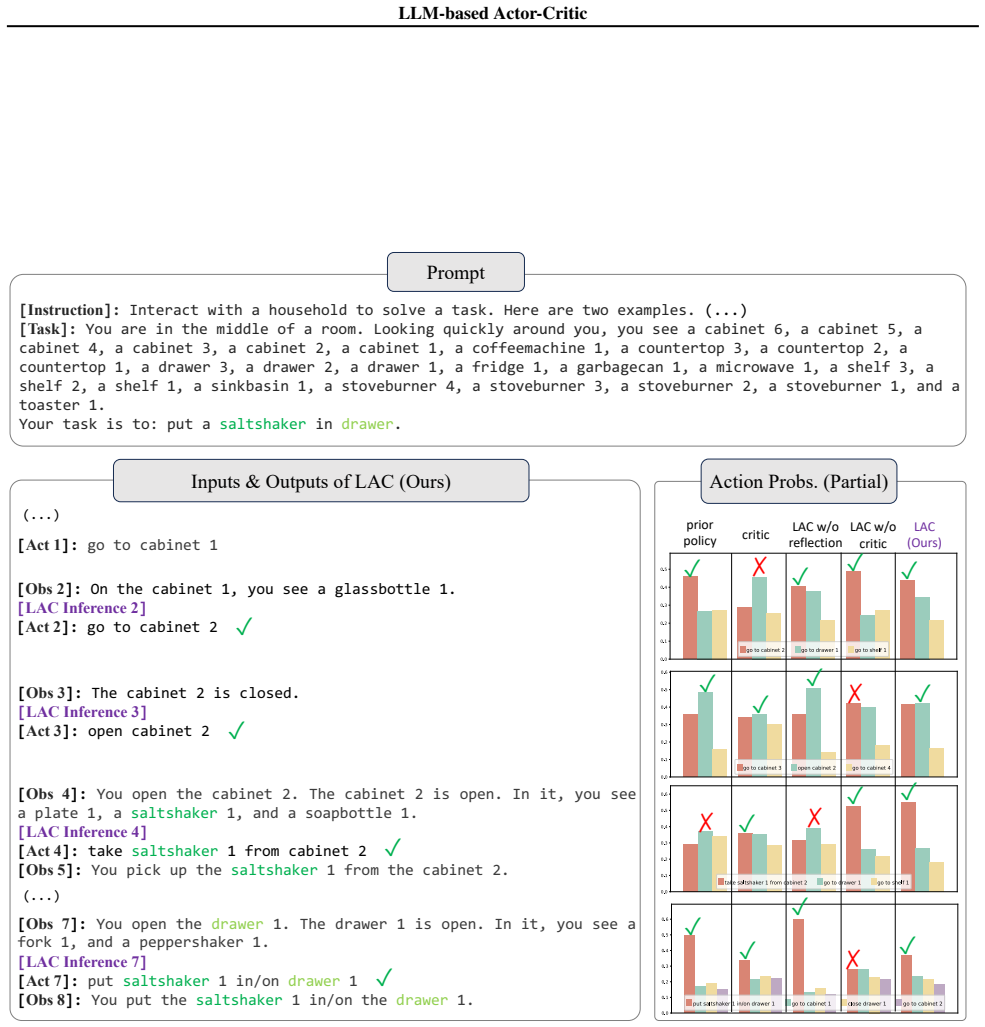
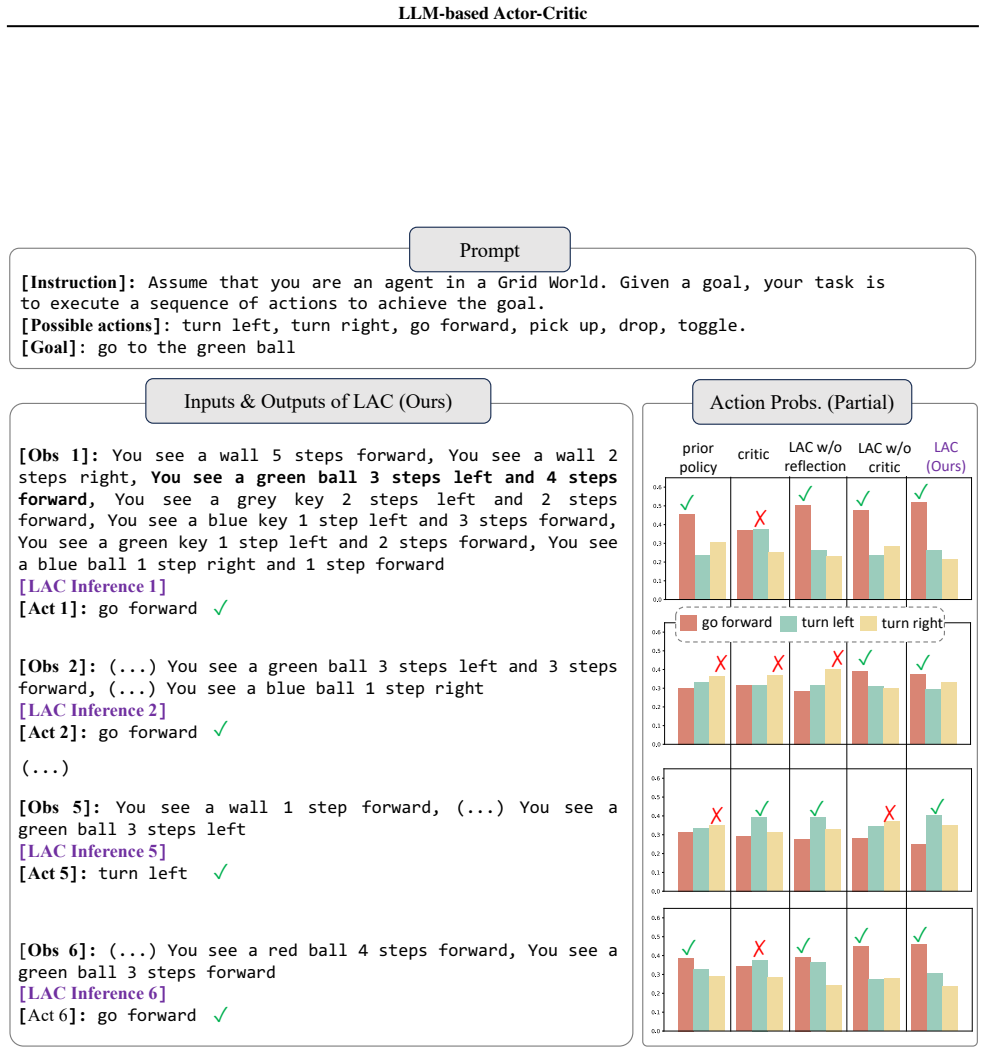
The load-bearing object is the identity in Equation (3): $Q_{\mathrm{LLM}}(g,h_t,a_t,u_t)=\log[P(\mathrm{GOOD}\mid \cdot)/P(\mathrm{BAD}\mid \cdot)]$, connected to success probability by the logistic relation in Equation (1). The critic reads the probabilities the model assigns to paired positive/negative tokens after a forward model $f_{\mathrm{LLM}}$ rolls out a few future steps and a reflection judges the step. The policy improvement step in Equation (6), $\pi_{\mathrm{new}}(a_t\mid g,h_t)\propto \pi_{\mathrm{LLM}}(a_t\mid g,h_t)\exp(\alpha Q_{\mathrm{LLM}}(g,h_t,a_t,u_t))$, is the closed-form solution of the KL-constrained objective in Equation (4), with $\alpha$ controlling how far the new policy may deviate from the original one.
What would settle it
Compare LAC's Q-values against empirical success rates on a held-out set of ALFWorld or WebShop states: if actions rated higher by $Q_{\mathrm{LLM}}$ are not more likely to succeed, or if the GOOD/BAD probabilities are systematically overconfident, then the critic is not estimating success probability and the reported gains would not transfer to new tasks.
Extended reading notes
Core claim
The central discovery is that the log-odds of a model's own GOOD versus BAD token probabilities, taken after a short imagined rollout and a reflection, act as a usable Q-function for sparse-reward goal tasks, and that exponentiating these Q-values onto the prior action distribution yields a policy that outperforms both the prior policy and the critic alone.
Load-bearing premise
The whole method rests on the assumption that the log-ratio of the LLM's GOOD and BAD token probabilities, read after an imagined rollout, is a faithful estimate of how likely a candidate action is to lead to task success; if the model's self-evaluations are miscalibrated, the exponential reweighting could amplify its biases rather than correct them.
Editorial extensions
If this is right
- Seven- and eight-billion-parameter open models can match or exceed the decision-making performance of GPT-4+ReAct on ALFWorld, BabyAI-Text, and WebShop, so strong task performance no longer requires a closed frontier model.
- Because the policy update is gradient-free and only reweights sampled candidates, the method avoids expensive per-task fine-tuning of the policy; only the reflection generator is fine-tuned on a few trajectories.
- The ablations support that all three components—future rollouts, reflections, and critic-guided reweighting—contribute, since removing any of them lowers success rates.
- Statistical analyses link Q-values to task progression and show the improved policy follows the more confident of prior and critic, suggesting the mechanism is confidence-weighted agreement rather than blind score chasing.
Reading between the lines
- A natural next test, not run in the paper, is whether the same GOOD/BAD logit critic stays calibrated in longer-horizon or partially observable environments; the paper's Crafter result is preliminary and limited to one model.
- If the critic's calibration holds, the same reweighting recipe could be applied to other sparse-reward domains without collecting reward labels, since the success signal is read from the model's own tokens.
- The paper samples only top-5 candidate actions and acknowledges this may miss the true argmax; a distributional or temperature-widened sampling variant could make the method more robust in open-ended action spaces.
- The confidence analysis suggests an explicit confidence-weighted arbitration rule could be studied as a standalone component, separating when to trust prior versus critic.
Editorial analysis
A structured set of objections, weighed in public.
Referee Report
Summary. The paper introduces LAC (LLM-based Actor-Critic), a framework in which an LLM serves as both actor (generating candidate actions) and critic (evaluating actions via the log-odds of GOOD/BAD token probabilities after imagined rollouts), with policy improvement performed by a closed-form KL-constrained reweighting. Experiments on ALFWorld, BabyAI-Text, and WebShop claim state-of-the-art results using 7B/8B LLMs, including outperforming GPT-4+ReAct in most settings.
Significance. The proposed gradient-free actor-critic update is simple and computationally attractive, and the paper provides extensive ablations, hyperparameter analyses, and public code. If the issues below are remedied, the method could be a useful contribution to LLM-based decision-making. However, the headline result is confounded by task-specific LoRA fine-tuning, and the formal objective in Section 4.2 does not match the implemented algorithm, so the paper's central 'principled and scalable' claim needs revision.
major comments (4)
- [Abstract; Section 5.2; Table 11] The claim in the Abstract and Section 5.2 that 'LAC outperforms all other baselines in both ALFWorld and BabyAI-Text, and is even better than GPT-4+ReAct in most settings' is only supported when LAC includes LoRA fine-tuning on 18 task-specific trajectories (Appendix B.2), whereas GPT-4+ReAct is not fine-tuned. Table 11 shows that LAC without fine-tuning achieves ALFWorld success rates of 0.39 (CodeLlama-7B), 0.59 (Gemma-7B), 0.71 (Llama-3-8B), and 0.57 (Mistral-7B), which are below the GPT-4+ReAct level in the same benchmark (about 0.66 in Figure 8) for three of the four models. This unmatched comparison makes the headline overstatement; please qualify the claim as applying to the fine-tuned version of LAC or present a matched comparison in the main figures.
- [Section 4.2, Eqs. (4)-(6); Appendix B.1] The objective in Eq. (4) contains an expectation over u_i^t ~ f_LLM(g,h_t,a_i^t), but the closed-form solution in Eq. (5) uses exp(α Q_LLM(g,h_t,a_i^t,u_i^t)) for a specific sampled rollout u_i^t. Appendix B.1 drops the expectation over u and solves a different objective. The correct solution to Eq. (4) is π_new(a) ∝ π_LLM(a) exp(α E_{u~f(a)} Q(a,u)). Either Q should be redefined as the marginal value after integrating out rollout uncertainty, or the algorithm should be stated as a single-sample Monte Carlo approximation with a justification. As written, the derivation does not match the algorithm.
- [Section 5.2; Appendix C.3] The paper sets temperature to 0 and states that generation is deterministic (Section 5.2), yet Algorithm 1 samples n=5 candidate actions from π_LLM and Appendix C.3 says it 'samples the top 5 candidate actions'. Greedy decoding with temperature 0 yields one deterministic action sequence, so the mechanism for obtaining five distinct candidates is unspecified. Please clarify whether candidates are obtained via top-k token selection, beam search, or stochastic sampling. If stochastic sampling is used, the 'no error bar' justification is invalid and multiple seeds should be reported.
- [Section 4.1.2, Eq. (3); Section 5.5] The construction of Q as log(P(GOOD)/P(BAD)) in Eq. (3) is an assumption that LLM token probabilities correspond to the success probability in Eq. (1). The statistical analysis in Table 1 shows a correlation between Q-values and timesteps within successful/failed trajectories, but correlation does not establish calibration. Because Eq. (6) exponentiates Q, systematic miscalibration (e.g., overconfidence) is amplified rather than corrected. Please report calibration of the predicted success probabilities against actual outcomes, or at least show that the ranking-based performance is invariant to monotone transformations of Q.
minor comments (5)
- [Introduction; Related Work] The citation 'ichter et al., 2023' should be 'Ichter et al., 2023'.
- [Section 5.5, Table 2] The text says that when the prior and Q disagree, the improved policy 'tends to trust the more confident model', but in the row 'Prior agrees, Q disagrees' the prior's confidence (0.34) exceeds the improved policy's confidence (0.28), so the improved policy does not fully follow the more confident model. Please reconcile the interpretation with the numbers.
- [Section 4.1.2] The notation P(y_{w,l}|...) is unconventional; please write P(y_w|...) and P(y_l|...) explicitly.
- [Figure 8] The bars for the GPT-4 family and the fine-tuning baselines are crowded and their values are hard to read; consider adding a table with exact numbers.
- [Abstract] The phrase 'even outperforming baseline methods employing GPT-4 in complex tasks' is vague; specify which benchmark and which base model.
Circularity Check
No significant circularity: the policy-update formula is independently derived and the headline results are evaluated against external benchmarks; the actor/critic same-model concern is an assumption, not a by-construction equivalence.
full rationale
LAC's policy update (Eq. 6) is the closed-form solution to the KL-constrained objective (Eq. 4), and the derivation in Appendix B.1 is self-contained; it reduces the objective to a KL divergence against an explicitly constructed distribution and does not assume the conclusion. The Q-estimator (Eqs. 2-3) is a definitional log-odds transformation of GOOD/BAD token probabilities, not a fitted prediction of the benchmark outcomes; whether those log-odds faithfully estimate true success probability is a calibration assumption that is empirically testable, not a by-construction equivalence. The critic and actor are the same base model, but the critic conditions on imagined rollouts and reflections, so the final action is not identical to the actor's prior by construction. The appendix's Table 11 shows that fine-tuning contributes substantially to the margin over GPT-4+ReAct, which is a legitimate experimental-design concern about matched comparisons, but it is not a circularity in the derivation chain. The only self-citation (Dong et al., 2022) appears in related work and is not load-bearing. Benchmark results on ALFWorld, BabyAI-Text, WebShop, and Crafter are external, so the central claims are not self-confirming. Overall, no significant circularity is present.
Assumptions & free parameters
free parameters (4)
- alpha (KL penalty coefficient) =
ALFWorld: 1; BabyAI-Text: per-model grid search (e.g., 2 for Gemma-7B, 10 for Mistral-7B); WebShop: grid search over…
- candidate action count n =
5
- maximum rollout steps =
4
- fine-tuning trajectory count =
18 per benchmark
assumptions (4)
- domain assumption The LLM's token probabilities for GOOD/BAD tokens correspond to the true success/failure probabilities of the task.
- ad hoc to paper The logistic link Q = log(P(yw)/P(yl)) is an appropriate transformation of success probability.
- domain assumption The forward model fLLM produces plausible future trajectories for evaluating actions.
- standard math The KL-constrained optimization has the closed-form solution pi proportional to pi_LLM exp(alpha Q).
Cite this review
Pith. "Pith review of Enhancing Decision-Making of Large Language Models via Actor-Critic." pith.science (2026). https://pith.science/paper/BATOEOY5
@misc{pith2026250606376,
  author       = {Pith},
  title        = {Pith review of: Enhancing Decision-Making of Large Language Models via Actor-Critic},
  year         = {2026},
  howpublished = {\url{https://pith.science/paper/BATOEOY5}},
  note         = {Machine review of arXiv:2506.06376}
}
read the original abstract
Large Language Models (LLMs) have achieved remarkable advancements in natural language processing tasks, yet they encounter challenges in complex decision-making scenarios that require long-term reasoning and alignment with high-level objectives. Existing methods either rely on short-term auto-regressive action generation or face limitations in accurately simulating rollouts and assessing outcomes, leading to sub-optimal decisions. This paper introduces a novel LLM-based Actor-Critic framework, termed LAC, that effectively improves LLM policies with long-term action evaluations in a principled and scalable way. Our approach addresses two key challenges: (1) extracting robust action evaluations by computing Q-values via token logits associated with positive/negative outcomes, enhanced by future trajectory rollouts and reasoning; and (2) enabling efficient policy improvement through a gradient-free mechanism. Experiments across diverse environments -- including high-level decision-making (ALFWorld), low-level action spaces (BabyAI-Text), and large action spaces (WebShop) -- demonstrate the framework's generality and superiority over state-of-the-art methods. Notably, our approach achieves competitive performance using 7B/8B parameter LLMs, even outperforming baseline methods employing GPT-4 in complex tasks. These results underscore the potential of integrating structured policy optimization with LLMs' intrinsic knowledge to advance decision-making capabilities in multi-step environments.
Figures


Figures from the paper (9 more)



Reference graph
Works this paper leans on
-
[1]
L., Almeida, D., Altenschmidt, J., Altman, S., Anadkat, S., et al
Achiam, J., Adler, S., Agarwal, S., Ahmad, L., Akkaya, I., Aleman, F. L., Almeida, D., Altenschmidt, J., Altman, S., Anadkat, S., et al. Gpt-4 technical report. arXiv preprint arXiv:2303.08774, 2023
arXiv 2023
-
[2]
Barto, A. G., Sutton, R. S., and Watkins, C. Learning and sequential decision making, volume 89. University of Massachusetts Amherst, MA, 1989
work page 1989
-
[3]
Brooks, E., Walls, L., Lewis, R. L., and Singh, S. Large language models can implement policy iteration. Advances in Neural Information Processing Systems, 36, 2024
work page 2024
-
[4]
The computational complexity of propositional strips planning
Bylander, T. The computational complexity of propositional strips planning. Artificial Intelligence, 69 0 (1-2): 0 165--204, 1994
work page 1994
-
[5]
Grounding large language models in interactive environments with online reinforcement learning
Carta, T., Romac, C., Wolf, T., Lamprier, S., Sigaud, O., and Oudeyer, P.-Y. Grounding large language models in interactive environments with online reinforcement learning. In International Conference on Machine Learning, pp.\ 3676--3713. PMLR, 2023 a
work page 2023
-
[6]
Carta, T., Romac, C., Wolf, T., Lamprier, S., Sigaud, O., and Oudeyer, P.-Y. Grounding large language models in interactive environments with online reinforcement learning, 2023 b
work page 2023
-
[7]
Decision transformer: Reinforcement learning via sequence modeling
Chen, L., Lu, K., Rajeswaran, A., Lee, K., Grover, A., Laskin, M., Abbeel, P., Srinivas, A., and Mordatch, I. Decision transformer: Reinforcement learning via sequence modeling. Advances in neural information processing systems, 34: 0 15084--15097, 2021
2021
-
[8]
Chevalier-Boisvert, M., Bahdanau, D., Lahlou, S., Willems, L., Saharia, C., Nguyen, T. H., and Bengio, Y. Babyai: A platform to study the sample efficiency of grounded language learning. arXiv preprint arXiv:1810.08272, 2018
arXiv 2018
Show all 64 references
-
[9]
Efficient selectivity and backup operators in monte-carlo tree search
Coulom, R. Efficient selectivity and backup operators in monte-carlo tree search. In International conference on computers and games, pp.\ 72--83. Springer, 2006
2006
-
[10]
G., Xia, T., Mao, H., et al
Cuadron, A., Li, D., Ma, W., Wang, X., Wang, Y., Zhuang, S., Liu, S., Schroeder, L. G., Xia, T., Mao, H., et al. The danger of overthinking: Examining the reasoning-action dilemma in agentic tasks. arXiv preprint arXiv:2502.08235, 2025
2025 arXiv
-
[11]
Deepseek-r1: Incentivizing reasoning capability in llms via reinforcement learning, 2025
DeepSeek-AI. Deepseek-r1: Incentivizing reasoning capability in llms via reinforcement learning, 2025. URL https://arxiv.org/abs/2501.12948
2025 arXiv
-
[12]
Task and motion planning with large language models for object rearrangement
Ding, Y., Zhang, X., Paxton, C., and Zhang, S. Task and motion planning with large language models for object rearrangement. In 2023 IEEE/RSJ International Conference on Intelligent Robots and Systems (IROS), pp.\ 2086--2092. IEEE, 2023
2023
-
[13]
Low-rank modular reinforcement learning via muscle synergy
Dong, H., Wang, T., Liu, J., and Zhang, C. Low-rank modular reinforcement learning via muscle synergy. Advances in Neural Information Processing Systems, 35: 0 19861--19873, 2022
2022
-
[14]
Preact: Predicting future in react enhances agent's planning ability
Fu, D., Huang, J., Lu, S., Dong, G., Wang, Y., He, K., and Xu, W. Preact: Predicting future in react enhances agent's planning ability. arXiv preprint arXiv:2402.11534, 2024
2024 arXiv
-
[15]
Addressing function approximation error in actor-critic methods
Fujimoto, S., Hoof, H., and Meger, D. Addressing function approximation error in actor-critic methods. In International conference on machine learning, pp.\ 1587--1596. PMLR, 2018
2018
-
[16]
Aligning language models with preferences through f -divergence minimization
Go, D., Korbak, T., Kruszewski, G., Rozen, J., Ryu, N., and Dymetman, M. Aligning language models with preferences through f -divergence minimization. In Krause, A., Brunskill, E., Cho, K., Engelhardt, B., Sabato, S., and Scarlett, J. (eds.), Proceedings of the 40th Internatio...
2023
-
[17]
Benchmarking the spectrum of agent capabilities
Hafner, D. Benchmarking the spectrum of agent capabilities. In International Conference on Learning Representations, 2022. URL https://openreview.net/forum?id=1W0z96MFEoH
2022
-
[18]
Reasoning with language model is planning with world model
Hao, S., Gu, Y., Ma, H., Hong, J., Wang, Z., Wang, D., and Hu, Z. Reasoning with language model is planning with world model. In Bouamor, H., Pino, J., and Bali, K. (eds.), Proceedings of the 2023 Conference on Empirical Methods in Natural Language Processing, pp.\ 8154--8173,...
2023 doi
-
[19]
J., Shen, Y., Wallis, P., Allen-Zhu, Z., Li, Y., Wang, S., Wang, L., and Chen, W
Hu, E. J., Shen, Y., Wallis, P., Allen-Zhu, Z., Li, Y., Wang, S., Wang, L., and Chen, W. Lora: Low-rank adaptation of large language models, 2021
2021
-
[20]
and Chang, K
Huang, J. and Chang, K. C.-C. Towards reasoning in large language models: A survey. arXiv preprint arXiv:2212.10403, 2022
2022 arXiv
-
[21]
One policy to control them all: Shared modular policies for agent-agnostic control
Huang, W., Mordatch, I., and Pathak, D. One policy to control them all: Shared modular policies for agent-agnostic control. In International Conference on Machine Learning, pp.\ 4455--4464. PMLR, 2020
2020
-
[22]
Language models as zero-shot planners: Extracting actionable knowledge for embodied agents
Huang, W., Abbeel, P., Pathak, D., and Mordatch, I. Language models as zero-shot planners: Extracting actionable knowledge for embodied agents. In International Conference on Machine Learning, pp.\ 9118--9147. PMLR, 2022 a
2022
-
[23]
Inner monologue: Embodied reasoning through planning with language models
Huang, W., Xia, F., Xiao, T., Chan, H., Liang, J., Florence, P., Zeng, A., Tompson, J., Mordatch, I., Chebotar, Y., et al. Inner monologue: Embodied reasoning through planning with language models. arXiv preprint arXiv:2207.05608, 2022 b
2022 arXiv
-
[24]
ichter, b., Brohan, A., Chebotar, Y., Finn, C., Hausman, K., Herzog, A., Ho, D., Ibarz, J., Irpan, A., Jang, E., Julian, R., Kalashnikov, D., Levine, S., Lu, Y., Parada, C., Rao, K., Sermanet, P., Toshev, A. T., Vanhoucke, V., Xia, F., Xiao, T., Xu, P., Yan, M., Brown, N., Ahn...
2023
-
[25]
Learning trajectory preferences for manipulators via iterative improvement
Jain, A., Wojcik, B., Joachims, T., and Saxena, A. Learning trajectory preferences for manipulators via iterative improvement. Advances in neural information processing systems, 26, 2013
2013
-
[26]
Q., Sablayrolles, A., Mensch, A., Bamford, C., Chaplot, D
Jiang, A. Q., Sablayrolles, A., Mensch, A., Bamford, C., Chaplot, D. S., Casas, D. d. l., Bressand, F., Lengyel, G., Lample, G., Saulnier, L., et al. Mistral 7b. arXiv preprint arXiv:2310.06825, 2023
2023 arXiv
-
[27]
A comprehensive survey on process-oriented automatic text summarization with exploration of llm-based methods
Jin, H., Zhang, Y., Meng, D., Wang, J., and Tan, J. A comprehensive survey on process-oriented automatic text summarization with exploration of llm-based methods. arXiv preprint arXiv:2403.02901, 2024
2024
-
[28]
Jordan, M. I. et al. Why the logistic function? a tutorial discussion on probabilities and neural networks, 1995
1995
-
[29]
and Szepesv \'a ri, C
Kocsis, L. and Szepesv \'a ri, C. Bandit based monte-carlo planning. In European conference on machine learning, pp.\ 282--293. Springer, 2006
2006
-
[30]
Y., McAleer, S., Fried, D., and Salakhutdinov, R
Koh, J. Y., McAleer, S., Fried, D., and Salakhutdinov, R. Tree search for language model agents. arXiv preprint arXiv:2407.01476, 2024
2024
-
[31]
S., Reid, M., Matsuo, Y., and Iwasawa, Y
Kojima, T., Gu, S. S., Reid, M., Matsuo, Y., and Iwasawa, Y. Large language models are zero-shot reasoners. Advances in neural information processing systems, 35: 0 22199--22213, 2022
2022
-
[32]
X., Nie, J.-Y., and Wen, J.-R
Li, J., Tang, T., Zhao, W. X., Nie, J.-Y., and Wen, J.-R. Pre-trained language models for text generation: A survey. ACM Comput. Surv., 56 0 (9), April 2024 a . ISSN 0360-0300. doi:10.1145/3649449. URL https://doi.org/10.1145/3649449
2024 doi
-
[33]
Unigen: A unified generative framework for retrieval and question answering with large language models
Li, X., Zhou, Y., and Dou, Z. Unigen: A unified generative framework for retrieval and question answering with large language models. In Proceedings of the AAAI Conference on Artificial Intelligence, volume 38, pp.\ 8688--8696, 2024 b
2024
-
[34]
Littman, M. L. Algorithms for sequential decision-making. Brown University, 1996
1996
-
[35]
Reason for future, act for now: A principled framework for autonomous llm agents with provable sample efficiency
Liu, Z., Hu, H., Zhang, S., Guo, H., Ke, S., Liu, B., and Wang, Z. Reason for future, act for now: A principled framework for autonomous llm agents with provable sample efficiency. arXiv preprint arXiv:2309.17382, 2023
2023 arXiv
-
[36]
McCarthy, J. et al. Situations, actions, and causal laws. Comtex Scientific, 1963
1963
-
[37]
Meta llama 3
Meta. Meta llama 3. https://llama.meta.com/llama3/, 2024 a
2024
-
[38]
Meta llama 3.1
Meta. Meta llama 3.1. https://ai.meta.com/blog/meta-llama-3-1/, 2024 b
2024
-
[39]
Augmented language models: a survey
Mialon, G., Dessi, R., Lomeli, M., Nalmpantis, C., Pasunuru, R., Raileanu, R., Roziere, B., Schick, T., Dwivedi-Yu, J., Celikyilmaz, A., Grave, E., LeCun, Y., and Scialom, T. Augmented language models: a survey. Transactions on Machine Learning Research, 2023. ISSN 2835-8856. ...
2023
-
[40]
N., Parker-Holder, J., and Rockt \"a schel, T
Paglieri, D., Cupia , B., Coward, S., Piterbarg, U., Wo czyk, M., Khan, A., Pignatelli, E., Kuci \'n ski, ., Pinto, L., Fergus, R., Foerster, J. N., Parker-Holder, J., and Rockt \"a schel, T. Benchmarking agentic llm and vlm reasoning on games. arXiv preprint arXiv:2411.13543, 2024
2024 arXiv
-
[41]
B., Kumar, A., Zhang, G., and Levine, S
Peng, X. B., Kumar, A., Zhang, G., and Levine, S. Advantage-weighted regression: Simple and scalable off-policy reinforcement learning. arXiv preprint arXiv:1910.00177, 2019
1910 arXiv
-
[42]
and Schaal, S
Peters, J. and Schaal, S. Reinforcement learning by reward-weighted regression for operational space control. In Proceedings of the 24th international conference on Machine learning, pp.\ 745--750, 2007
2007
-
[43]
Why think step by step? reasoning emerges from the locality of experience
Prystawski, B., Li, M., and Goodman, N. Why think step by step? reasoning emerges from the locality of experience. Advances in Neural Information Processing Systems, 36, 2024
2024
-
[44]
D., Ermon, S., and Finn, C
Rafailov, R., Sharma, A., Mitchell, E., Manning, C. D., Ermon, S., and Finn, C. Direct preference optimization: Your language model is secretly a reward model. Advances in Neural Information Processing Systems, 36, 2024
2024
-
[45]
E., Adi, Y., Liu, J., Remez, T., Rapin, J., et al
Roziere, B., Gehring, J., Gloeckle, F., Sootla, S., Gat, I., Tan, X. E., Adi, Y., Liu, J., Remez, T., Rapin, J., et al. Code llama: Open foundation models for code. arXiv preprint arXiv:2308.12950, 2023
2023 arXiv
-
[46]
Proximal policy optimization algorithms
Schulman, J., Wolski, F., Dhariwal, P., Radford, A., and Klimov, O. Proximal policy optimization algorithms. arXiv preprint arXiv:1707.06347, 2017
2017 arXiv
-
[47]
Reflexion: Language agents with verbal reinforcement learning
Shinn, N., Cassano, F., Gopinath, A., Narasimhan, K., and Yao, S. Reflexion: Language agents with verbal reinforcement learning. Advances in Neural Information Processing Systems, 36, 2024
2024
-
[48]
Alfred: A benchmark for interpreting grounded instructions for everyday tasks
Shridhar, M., Thomason, J., Gordon, D., Bisk, Y., Han, W., Mottaghi, R., Zettlemoyer, L., and Fox, D. Alfred: A benchmark for interpreting grounded instructions for everyday tasks. In Proceedings of the IEEE/CVF conference on computer vision and pattern recognition, pp.\ 10740...
2020
-
[49]
Alfworld: Aligning text and embodied environments for interactive learning, 2021
Shridhar, M., Yuan, X., Côté, M.-A., Bisk, Y., Trischler, A., and Hausknecht, M. Alfworld: Aligning text and embodied environments for interactive learning, 2021
2021
-
[50]
Progprompt: Generating situated robot task plans using large language models
Singh, I., Blukis, V., Mousavian, A., Goyal, A., Xu, D., Tremblay, J., Fox, D., Thomason, J., and Garg, A. Progprompt: Generating situated robot task plans using large language models. In 2023 IEEE International Conference on Robotics and Automation (ICRA), pp.\ 11523--11530. ...
2023
-
[51]
D., and Toshev, A
Szot, A., Schwarzer, M., Agrawal, H., Mazoure, B., Metcalf, R., Talbott, W., Mackraz, N., Hjelm, R. D., and Toshev, A. T. Large language models as generalizable policies for embodied tasks. In The Twelfth International Conference on Learning Representations, 2023
2023
-
[52]
True knowledge comes from practice: Aligning large language models with embodied environments via reinforcement learning
Tan, W., Zhang, W., Liu, S., Zheng, L., Wang, X., and An, B. True knowledge comes from practice: Aligning large language models with embodied environments via reinforcement learning. In ICLR, 2024
2024
-
[53]
S., Love, J., et al
Team, G., Mesnard, T., Hardin, C., Dadashi, R., Bhupatiraju, S., Pathak, S., Sifre, L., Rivi \`e re, M., Kale, M. S., Love, J., et al. Gemma: Open models based on gemini research and technology. arXiv preprint arXiv:2403.08295, 2024
2024 arXiv
-
[54]
Llama 2: Open foundation and fine-tuned chat models
Touvron, H., Martin, L., Stone, K., Albert, P., Almahairi, A., Babaei, Y., Bashlykov, N., Batra, S., Bhargava, P., Bhosale, S., et al. Llama 2: Open foundation and fine-tuned chat models. arXiv preprint arXiv:2307.09288, 2023
2023 arXiv
-
[55]
Watkins, C. J. and Dayan, P. Q-learning. Machine learning, 8: 0 279--292, 1992
1992
-
[56]
V., Zhou, D., et al
Wei, J., Wang, X., Schuurmans, D., Bosma, M., Xia, F., Chi, E., Le, Q. V., Zhou, D., et al. Chain-of-thought prompting elicits reasoning in large language models. Advances in neural information processing systems, 35: 0 24824--24837, 2022
2022
-
[57]
Webshop: Towards scalable real-world web interaction with grounded language agents
Yao, S., Chen, H., Yang, J., and Narasimhan, K. Webshop: Towards scalable real-world web interaction with grounded language agents. Advances in Neural Information Processing Systems, 35: 0 20744--20757, 2022
2022
-
[58]
React: Synergizing reasoning and acting in language models
Yao, S., Zhao, J., Yu, D., Du, N., Shafran, I., Narasimhan, K., and Cao, Y. React: Synergizing reasoning and acting in language models. In International Conference on Learning Representations (ICLR), 2023
2023
-
[59]
C., Liu, Z., Feng, Y., Xue, L., Rithesh, R., Chen, Z., Zhang, J., Arpit, D., et al
Yao, W., Heinecke, S., Niebles, J. C., Liu, Z., Feng, Y., Xue, L., Rithesh, R., Chen, Z., Zhang, J., Arpit, D., et al. Retroformer: Retrospective large language agents with policy gradient optimization. In The Twelfth International Conference on Learning Representations
-
[60]
Controlling large language model-based agents for large-scale decision-making: An actor-critic approach
Zhang, B., Mao, H., Ruan, J., Wen, Y., Li, Y., Zhang, S., Xu, Z., Li, D., Li, Z., Zhao, R., et al. Controlling large language model-based agents for large-scale decision-making: An actor-critic approach. arXiv preprint arXiv:2311.13884, 2023
2023 arXiv
-
[61]
Large language models are semi-parametric reinforcement learning agents
Zhang, D., Chen, L., Zhang, S., Xu, H., Zhao, Z., and Yu, K. Large language models are semi-parametric reinforcement learning agents. Advances in Neural Information Processing Systems, 36, 2024
2024
-
[62]
Language agent tree search unifies reasoning, acting, and planning in language models
Zhou, A., Yan, K., Shlapentokh-Rothman, M., Wang, H., and Wang, Y.-X. Language agent tree search unifies reasoning, acting, and planning in language models. In Forty-first International Conference on Machine Learning, 2024 a
2024
-
[63]
Archer: Training language model agents via hierarchical multi-turn rl
Zhou, Y., Zanette, A., Pan, J., Levine, S., and Kumar, A. Archer: Training language model agents via hierarchical multi-turn rl. In Forty-first International Conference on Machine Learning, 2024 b
2024
-
[64]
write newline
" write newline "" before.all 'output.state := FUNCTION n.dashify 't := "" t empty not t #1 #1 substring "-" = t #1 #2 substring "--" = not "--" * t #2 global.max substring 't := t #1 #1 substring "-" = "-" * t #2 global.max substring 't := while if t #1 #1 substring * t #2 gl...
Reviewed August 7, 2026 · model on record in the stance chip above.
Discussion (0). Sign in to comment.