REVIEW 4 major objections 7 minor 27 references
Evaluating Large Language Model Capabilities in Assessing Spatial Econometrics Research
T0 review · 4 major / 7 minor · reviewed 2026-08-07 · deepseek-v4-flash
Pith's one-line read Large language models can reliably check whether variables in a spatial econometrics study make economic sense, but they are far less dependable at judging whether the coefficients or the whole paper are sound, according to tests on 28…
desk verdict A useful bounded benchmark for LLM assessment of spatial econometrics, but the variable-choice result is tautological and the headline F1 overstates the case; the central conclusion about human oversight still holds. read the letter →
The pith
A machine-rendered reading of the paper's core claim, the machinery that carries it, and where it could break.
The reading
What carries the argument
The machinery is a paired counterfactual benchmark. For each of 28 published papers the authors write a three-part summary, research aim, variable descriptions, and a coefficient table, stripped of metadata, author interpretation, and citations. They then create a twin version by manually flipping the sign or statistical significance of a theoretically pivotal coefficient, so the counterfactual contradicts established economics while the aim and variables stay identical. Each summary runs through a two-phase prompt: first a qualitative expert-role assessment that invites reasoning, then a forced binary JSON judgment on variable choice, coefficient plausibility, and publication suitability. The binary labels are scored as precision, recall, and F1 against the known original-versus-counterfactual status, and analysis of variance (ANOVA) decomposes the variance by LLM, by paper summary, and by their interaction.
What would settle it
Have a panel of independent spatial econometricians classify the 56 summaries (28 published, 28 counterfactual) under the same three binary questions without being told which are which; if the panel's agreement with the authors' labels is much below the LLMs' reported F1, or if a substantial share of flipped summaries is judged economically plausible, then the benchmark labels are contestable and the LLM scores measure agreement with the authors' editorial judgment rather than economic soundness.
Extended reading notes
Core claim
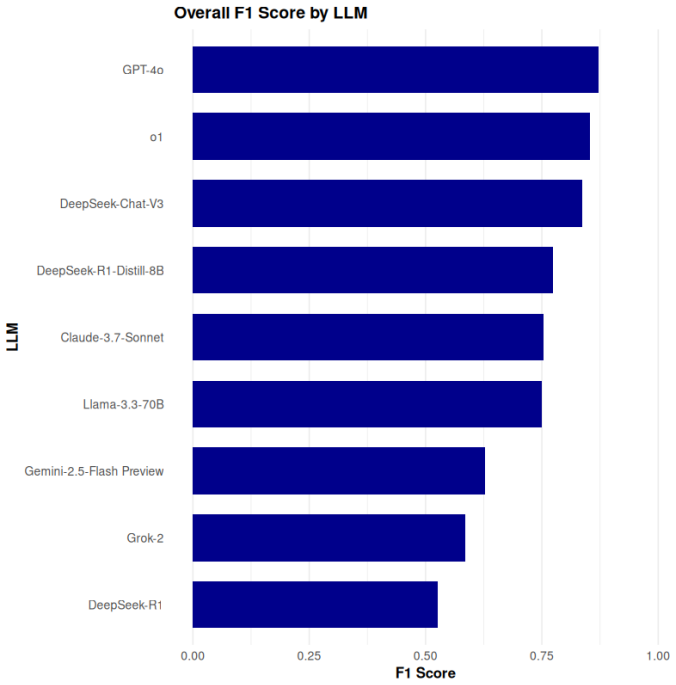
This paper claims that current LLMs have a reliable but narrow role in peer review of applied spatial econometrics. In a sample of 28 papers from four journals (2005-2024), each summarized in a standardized form and paired with a counterfactual version whose key coefficient signs or significance markers are manually flipped, nine LLMs were asked for a qualitative assessment followed by binary judgments on three criteria. The paper reports near-universal success on "economic sense of variable choice" (precision 1.00 for every model, F1 up to 1.00), but F1 scores for coefficient plausibility peak at 0.81 (GPT-4o and DeepSeek-Chat-V3) and for publication suitability at 0.82 (GPT-4o), with several models collapsing on recall, for example DeepSeek-R1 at 0.07 F1 on publication suitability. Analysis of variance shows that the LLM, the paper summary, and their interaction are each highly significant (p<0.001), with these effects growing stronger as the judgment becomes deeper. The paper concludes that LLMs are useful as initial sense checks in review workflows but require robust human oversight for substantive economic reasoning.
Load-bearing premise
The load-bearing premise is that the authors' labels are the truth, that counterfactual summaries are genuinely implausible economics and published summaries genuinely sound; because only coefficients are altered, the near-perfect variable-choice score is partly an artifact of the manipulation design.
Editorial extensions
If this is right
- Top LLMs are reliable triage instruments for spotting incoherent variable choices in applied spatial econometrics, so journals could use them for initial screening before human review.
- LLM judgments about coefficient plausibility and publication suitability are too model-dependent to use as decisive signals, because the interaction between model and paper means a model that performs well on one manuscript may fail on another.
- Peer-review tools should treat LLM outputs as flags for human inspection rather than as verdicts, especially for the deeper economic-reasoning criteria.
- Benchmarks of LLM review ability should report per-criterion scores and model-paper interaction, not just aggregate F1, because the aggregate hides substantial variation.
- The gap between near-perfect variable-selection performance and weaker coefficient judgment delimits where current LLM assistance is safe: checking internal consistency, not economic substance.
Reading between the lines
- Because the counterfactual manipulation changes coefficients but never variable sets, the near-perfect variable-choice scores are partly built into the design; a test that also swaps variables in and out would give a truer measure and might lower those scores.
- The study's ground truth is the authors' economic priors rather than an external panel; an expert inter-rater study would show how much of the reported 0.87 ceiling is agreement with plausible economics versus agreement with one editorial view.
- A direct extension would present LLMs with full papers instead of stripped summaries; the paper suggests this, and the added context could plausibly improve deep coefficient judgments or introduce new confounds.
- The strong LLM-by-paper interaction implies a practical selection rule: choose review models per task or per manuscript type using a small validation set, rather than relying on one globally 'best' model.
Editorial analysis
A structured set of objections, weighed in public.
Referee Report
Summary. The paper proposes an evaluation of nine LLMs on a binary classification task designed to emulate three components of peer review for spatial econometrics papers: economic sense of variable choice, economic sense of significant coefficients, and suitability for publication. For 28 published papers, the authors construct standardized summaries and a parallel set of 'counterfactual' summaries in which the signs or significance of key coefficients are manually altered. Each LLM provides a qualitative assessment (Phase 1) and then a structured JSON judgment on the three criteria (Phase 2) for every original and counterfactual summary. The paper reports precision, recall, and F1 scores per criterion and per model, ANOVA results on the binary outcomes, and concludes that LLMs can reliably assess variable-choice coherence but struggle with coefficient plausibility and publication suitability, thus supporting a triage role with human oversight. The central empirical claim is that top models (e.g., GPT-4o, overall F1 0.87) are strong at surface-level checks but weaker at deep economic reasoning.
Significance. If the central claims were fully supported, the study would provide a useful, fairly modern benchmark of LLM performance on domain-specific review tasks in a quantitative social science, with a diverse model suite and a structured protocol. The paper also contributes a distinction among three evaluation criteria, and the ANOVA analysis draws attention to paper-specific and interaction effects that are often ignored in LLM-as-judge studies. The authors have made an effort to control the input by stripping summaries of identifying metadata, and they report failure rates for JSON outputs, which is a useful reliability signal. However, the significance of the contribution is currently limited by a design flaw in the variable-criterion and by the absence of independent validation of the ground-truth counterfactual labels; both issues directly affect the paper's headline conclusions.
major comments (4)
- [§3.3 and §5.2, Table 3] The variable-choice criterion is not actually varied by the counterfactual design. Section 3.3 states that the counterfactual summaries are constructed by 'manually altering the sign of key coefficients or adjusting the statistical significance of theoretically pivotal variables' while 'preserving the original research aim and variable descriptions.' Thus, with respect to variable selection, the original and counterfactual inputs are identical. Assigning the ground-truth label 1 to original summaries and 0 to counterfactual summaries for the variable-choice criterion (§3.4 Phase 2) therefore does not reflect an independent judgment that the variable selection is economically wrong; it is a consequence of the counterfactual status. The near-perfect precision and F1 scores in Table 3 indicate only that LLMs are internally consistent or that they use the altered coefficient signs to flag the summary; they do not demonstrate an ability to detect poor variable selection. This undermines the abstract's and §6's claim that LLMs 'can expertly assess the coherence of variable choices' and inflates the overall F1 in Table 9 through the uninformative variable-choice component.
- [§3.3, Tables 5 and 7] The ground-truth labels for coefficient plausibility and publication suitability are author-constructed without independent expert validation. The manual flips of signs and significance are asserted to be 'deliberately constructed to be theoretically inconsistent,' but no inter-rater reliability, expert panel, or pre-registered protocol is reported. If some flipped results are economically plausible under alternative theories, or if some original results are themselves questionable, then every precision, recall, and F1 number measures agreement with the authors' editorial judgment rather than economic correctness. The manuscript should report an independent validation of the counterfactual labels (e.g., a blinded panel of spatial econometricians rating a sample of summaries) or explicitly frame the metrics as agreement with the authors' design rather than as objective correctness.
- [§5.1–§5.5, Tables 4, 6, 8] The statistical analysis is under-specified. The ANOVA tables treat individual binary judgments as the unit of analysis, but the paper does not report the number of repeated runs per LLM-summary pair, the temperature/sampling settings, or the criteria for re-querying and handling the JSON failures reported in Table 2 (especially the 13.62% failure rate for DeepSeek-R1-Distill-8B). Without this information, the residual degrees of freedom cannot be verified, and the F-tests may be optimistic or pessimistic depending on how repeated draws are treated. The 'model' factor in Tables 4, 6, and 8 has 57 degrees of freedom, implying 58 levels, which conflicts with the stated sample of 28 papers (and 56 original+counterfactual summaries). The authors should clarify what the 'model' factor indexes and justify the error structure.
- [§3.4 Phase 2 and Appendix B] The 'suitability for publication' criterion is ill-posed because the summaries are explicitly stripped of all identifying metadata (Section 3.2), including the journal, but the prompt instructs the LLM to judge 'the standards of the Journal [implied based on the context of the papers selected].' Since the LLM cannot know which journal is intended, this criterion mixes an assessment of scientific rigor with an undefined journal-fit standard. This ambiguity likely contributes to the wide variation in publication-suitability scores (e.g., recall 0.03–0.99 in Table 7) and makes the metric difficult to interpret. The authors should either specify a concrete, named journal standard for all summaries or remove the journal-fit component and frame the criterion purely as perceived scientific rigor.
minor comments (7)
- [Abstract] The sentence 'top models like GPT-4o achieving an overall F1 score of 0.87' appears immediately after a clause about variable choice; readers may misread 0.87 as the variable-choice F1. Please clarify that 0.87 is the overall F1 averaged across all three criteria, while the variable-choice F1 for GPT-4o is 0.98.
- [§7 (Data availability)] The GitHub link in Section 7 reads 'https://github.com/lmorandini/impact econometrics' with a space and is not a valid URL. Please provide the correct repository link or remove the statement if the repository is not yet public.
- [Table 1] For several models the parameter count is listed as 'NS' (not specified). Where public information is available (e.g., approximate parameter counts for GPT-4o and Claude 3.7 Sonnet are widely reported), providing it would help readers interpret the architecture-based discussion in Section 6.
- [§6 Discussion] The interpretations linking specific architectures ('Unified,' 'Hybrid Reasoning') to observed performance differences are plausible but not directly tested. Consider framing these as hypotheses to avoid over-attributing causality from a single observational comparison.
- [§3.4 Phase 2 and Appendix B] The protocol as described does not specify whether the Phase 2 structured prompt is fed the Phase 1 qualitative output or only the original summary again. This detail matters for reproducibility, as chain-of-thought style reasoning could change the Phase 2 judgments.
- [Tables 4, 6, 8] The factor labeled 'model' is confusing because the papers themselves contain econometric models; renaming it to 'paper' or 'summary' would avoid ambiguity.
- [§5.5 and Table 9] The aggregation method for the 'Overall Evaluation Metrics' is not stated. State whether the overall precision/recall/F1 is the macro-average of the three criterion-specific metrics or computed from pooled true positives, false positives, and false negatives across criteria.
Circularity Check
Variable-choice 'strength' is tautological: counterfactual summaries preserve variable descriptions, so near-perfect F1 on that criterion measures self-consistency, not discrimination, and inflates the headline 0.87.
-
self definitional
[Abstract; Section 3.3; Section 3.4 Phase 2; Tables 3 and 9]
"This involved manually altering the sign of key coefficients or adjusting the statistical significance of theoretically pivotal variables. These targeted edits were designed to introduce specific deviations from established economic theory, effectively creating versions of the results that exhibit theoretical inconsistencies or implausibility, while preserving the original research aim and variable descriptions."
The counterfactual manipulation changes only the model-results table (signs/significance), while the research aim and variable descriptions are preserved. The Phase 2 criterion 'economic sense of the variable choice' is therefore evaluated on identical inputs in the original and counterfactual conditions; there is no negative case in which the variable selection is economically wrong. A model that always answers 1 on the unchanged variable-choice input achieves perfect precision and near-perfect recall, which is exactly what Table 3 shows.
full rationale
The paper's central empirical chain is: original summaries are labeled theoretically consistent, counterfactual summaries are labeled inconsistent, and LLM accuracy is measured against those labels. For the variable-choice criterion this chain breaks: Section 3.3 states that counterfactual edits alter only signs and significance 'while preserving the original research aim and variable descriptions,' and Section 3.4 Phase 2 defines the variable-choice judgment as whether the selection is 'logical and justified within the economic context of the research aim.' Since research aim and variable descriptions are identical in both conditions, the correct label for this criterion is determined by a change that does not affect the judged feature. Thus the perfect precision and near-1.0 F1 scores in Table 3, and their contribution to the aggregate GPT-4o F1 of 0.87, are partly artifacts of self-consistency rather than evidence of discriminative ability. The coefficient-plausibility and publication-suitability results are less circular because the manipulated coefficients do alter those inputs, but their ground truth still rests on the authors' unvalidated judgment that the flipped signs/significance are economically implausible, a construct-validity concern the paper itself only partially acknowledges in Section 7 ('The study's own limitations, such as using summaries and the specific design of counterfactuals'). The self-citation to Pataranutaporn et al. (2025), which includes three of this paper's authors, supports background claims about LLM bias and peer review and is not load-bearing for the main result. Overall, one of the three headline criteria and the aggregate F1 are partially forced by construction, while the deeper-evaluation results retain independent content, warranting a score of 6 rather than higher.
Assumptions & free parameters
assumptions (3)
- domain assumption Published papers selected from four leading journals are, with their primary results tables, economically sound representatives against which counterfactuals are judged.
- ad hoc to paper Manually flipped signs or significance levels in §3.3 produce results that are genuinely economically implausible.
- domain assumption The three binary judgments can be meaningfully aggregated with precision, recall, and F1 against these author-created labels.
Cite this review
Pith. "Pith review of Evaluating Large Language Model Capabilities in Assessing Spatial Econometrics Research." pith.science (2026). https://pith.science/paper/7LR2MJA6
@misc{pith2026250606377,
  author       = {Pith},
  title        = {Pith review of: Evaluating Large Language Model Capabilities in Assessing Spatial Econometrics Research},
  year         = {2026},
  howpublished = {\url{https://pith.science/paper/7LR2MJA6}},
  note         = {Machine review of arXiv:2506.06377}
}
read the original abstract
This paper investigates Large Language Models (LLMs) ability to assess the economic soundness and theoretical consistency of empirical findings in spatial econometrics. We created original and deliberately altered "counterfactual" summaries from 28 published papers (2005-2024), which were evaluated by a diverse set of LLMs. The LLMs provided qualitative assessments and structured binary classifications on variable choice, coefficient plausibility, and publication suitability. The results indicate that while LLMs can expertly assess the coherence of variable choices (with top models like GPT-4o achieving an overall F1 score of 0.87), their performance varies significantly when evaluating deeper aspects such as coefficient plausibility and overall publication suitability. The results further revealed that the choice of LLM, the specific characteristics of the paper and the interaction between these two factors significantly influence the accuracy of the assessment, particularly for nuanced judgments. These findings highlight LLMs' current strengths in assisting with initial, more surface-level checks and their limitations in performing comprehensive, deep economic reasoning, suggesting a potential assistive role in peer review that still necessitates robust human oversight.
Figures


Figures from the paper (2 more)

Reference graph
Works this paper leans on
-
[1]
Anselin, L. (1988). Spatial Econometrics: Methods and Models . Dordrecht: Kluwer Academic Publishers
work page 1988
-
[2]
Anselin, L. and R. J. G. M. Florax (Eds.) (1995). New directions in spatial econometrics . Springer Science & Business Media
work page 1995
-
[3]
Claude 3.7 sonnet and claude code
Anthropic (2025a). Claude 3.7 sonnet and claude code. Anthropic News. Accessed: April 2025
work page 2025
-
[4]
Anthropic (2025b). Claude 3.7 sonnet system card. Accessed: April 2025
work page 2025
-
[5]
Arbia, G. (2014). A Primer for Spatial Econometrics , Volume 230 of Palgrave Texts in Econometrics . Basingstoke: Palgrave Macmillan
work page 2014
-
[6]
Birhane, A., A. Kasirzadeh, D. Leslie, and S. Wachter (2023). Science in the age of large language models. Nature Reviews Physics\/ 5\/ (5), 277--280
work page 2023
-
[7]
DeepSeek AI (2025a). Deepseek-r1. GitHub Repository. Accessed: April 2025
work page 2025
-
[8]
DeepSeek AI (2025b). Deepseek-v3. GitHub Repository. Accessed: April 2025
work page 2025
Show all 27 references
-
[9]
Deepseek-v3-0324 release
DeepSeek API Docs (2025, March 25). Deepseek-v3-0324 release
2025
-
[10]
Gemini api models
Google AI for Developers Docs (2025). Gemini api models. Accessed: April 2025
2025
-
[11]
Gemini model thinking updates march 2025
Google Blog (2025, March). Gemini model thinking updates march 2025. Google Blog\/
2025
-
[12]
Hosseini, M. and S. P. Horbach (2023). Fighting reviewer fatigue or amplifying bias? considerations and recommendations for use of ChatGPT and other large language models in scholarly peer review. Research Integrity and Peer Review\/ 8\/ (1), 4
2023
-
[13]
LeSage, J. P. and R. K. Pace (2009). Introduction to Spatial Econometrics . Boca Raton, FL: CRC Press
2009
-
[14]
Perez, A
Lewis, P., E. Perez, A. Piktus, F. Petroni, V. Karpukhin, N. Goyal, H. K \"u ttler, M. Ott, W.-t. Chen, A. Conneau, et al. (2020). Retrieval-augmented generation for knowledge-intensive NLP tasks. In Advances in Neural Information Processing Systems , Volume 33, pp.\ 9459--9474
2020
-
[15]
Yuksekgonul, Y
Liang, W., M. Yuksekgonul, Y. Mao, E. Wu, and J. Zou (2024). Can large language models provide useful feedback on research papers? A large-scale empirical analysis. NEJM AI\/ 1\/ (1), AIoa2300037
2024
-
[16]
Llama 3.3 model card and prompt format
Llama Team (2025). Llama 3.3 model card and prompt format. Accessed: April 2025
2025
-
[17]
Naddaf, M. (2025). AI is transforming peer review—and many scientists are worried. Nature\/ 639\/ (8056), 852--854
2025
-
[18]
Introducing 4o image generation
OpenAI (2025a, March 25). Introducing 4o image generation. OpenAI Blog\/
-
[19]
Openai o1 system card
OpenAI (2025b). Openai o1 system card. Accessed: April 2025
2025
-
[20]
Model: o1-pro
OpenAI API Documentation (2025). Model: o1-pro. Accessed: April 2025
2025
-
[21]
Needleman, M
Pataranutaporn, P., K. Needleman, M. Vianna, V. Nardelli, G. Arbia, L. Morandini, and A. S. Pentland (2025). Can AI solve the peer review crisis? A large-scale experiment on LLM 's performance and biases in evaluating economics papers. Working Paper
2025
-
[22]
Shin, J., H. Lee, Y. Kim, J. Lee, J. Thorne, and J. Lee (2025). Automatically evaluating the paper reviewing capability of large language models. arXiv preprint arXiv:2502.17086\/
2025
-
[23]
Tobler, W. R. (1970). A computer movie simulating urban growth in the D etroit region. Economic Geography\/ 46\/ (sup1), 234--240
1970
-
[24]
xAI Developer Docs (2025a). Models. Accessed: April 2025
2025
-
[25]
Overview
xAI Developer Docs (2025b). Overview. Accessed: April 2025
2025
-
[26]
Zhao, W. X., K. Zhou, J. Li, T. Tang, X. Wang, Y. Hou, Y. Min, B. Zhang, J. Zhang, Z. Dong, Y. Du, C. Yang, Y. Chen, Z. Chen, J. Jiang, R. Pan, Y. Li, Y. Li, and J.-R. Wen (2023). A survey on large language model based autonomous agents. arXiv preprint arXiv:2303.18223\/
2023 arXiv
-
[27]
Chiang, Y
Zheng, L., W.-L. Chiang, Y. Sheng, S. Zhuang, Z. Wu, A. Gholami, J. E. K. Zhao, Z. L. Li, E. P. Xing, J. E. Gonzalez, and I. Stoica (2023). Judging LLM -as-a-judge with MT - B ench and C hatbot A rena. arXiv preprint arXiv:2306.05685\/
2023 arXiv
Reviewed August 7, 2026 · model on record in the stance chip above.
Discussion (0). Sign in to comment.