REVIEW 4 major objections 6 minor 32 references
Textile Analysis for Recycling Automation using Transfer Learning and Zero-Shot Foundation Models
T0 review · 4 major / 6 minor · reviewed 2026-08-07 · deepseek-v4-flash
Pith's one-line read A standard RGB camera, paired with transfer learning and a zero-shot text-prompted segmentation pipeline, can classify four textile types at 81.25 percent accuracy and segment buttons and zippers with a mean IoU of 0.90, showing that…
desk verdict The dataset section makes the reported 81.25% test accuracy impossible as described; the paper has a plausible feasibility idea but the evaluation is invalid and the metrics are not independently assessable. read the letter →
The pith
A machine-rendered reading of the paper's core claim, the machinery that carries it, and where it could break.
The reading
What carries the argument
The argument rests on two mechanisms. The first is transfer learning from ImageNet: the convolutional base of EfficientNetB0 is initialised with pre-trained weights, its classification head is replaced with a four-class softmax head, and training proceeds in two phases—frozen-base feature extraction followed by fine-tuning of the top layers—under 5-fold cross-validation. The second is a zero-shot segmentation cascade: Grounding DINO turns text prompts such as 'button' and 'zipper' into bounding boxes, and SAM turns each bounding box prompt into a pixel-level mask, so the system can segment objects it was never trained on. The reported performance is attributed to these pre-trained representations rather than to any custom architecture.
What would settle it
Run the exact EfficientNetB0 checkpoint and the Grounding DINO/SAM pipeline on a fresh dataset from an operating or pilot recycling line that includes varied lighting, motion blur, wrinkled and worn garments, and unseen fabric types; if classification accuracy or segmentation mIoU falls substantially below the reported 81.25% and 0.90, the feasibility claim is falsified.
Extended reading notes
Core claim
The central discovery is that the combination of two off-the-shelf deep-learning techniques suffices for both pre-processing tasks in a simulated conveyor-belt setup. First, ImageNet-pretrained convolutional networks adapted by transfer learning—specifically EfficientNetB0—can distinguish Cotton, Polyester, Cotton-Polyester blend, and Viscose-Polyester blend from static RGB images, with the blend class being the main source of error. Second, a text-prompted open-vocabulary detector (Grounding DINO) feeding bounding boxes into the promptable Segment Anything Model (SAM) localises buttons and zippers without any task-specific training, producing masks whose mean Intersection over Union against manual annotations is 0.90. The paper treats these numbers as evidence that RGB imagery plus pre-trained foundation models is a feasible, low-cost basis for the analysis steps that precede robotic sorting or targeted contaminant removal.
Load-bearing premise
The 80-image dataset, shot with one smartphone camera under similar indoor lighting with garments laid flat on a stationary belt, is assumed to stand in for the variety of lighting, fabric wear, and garment states found in working textile recycling facilities.
Editorial extensions
If this is right
- Automated textile pre-sorting could be built from standard RGB cameras and publicly available model weights, removing the need for near-infrared spectrometers for the four tested material classes.
- Segmentation of non-textile parts requires no manually annotated training data; a text prompt is enough, so new contaminants could be targeted simply by changing the prompt.
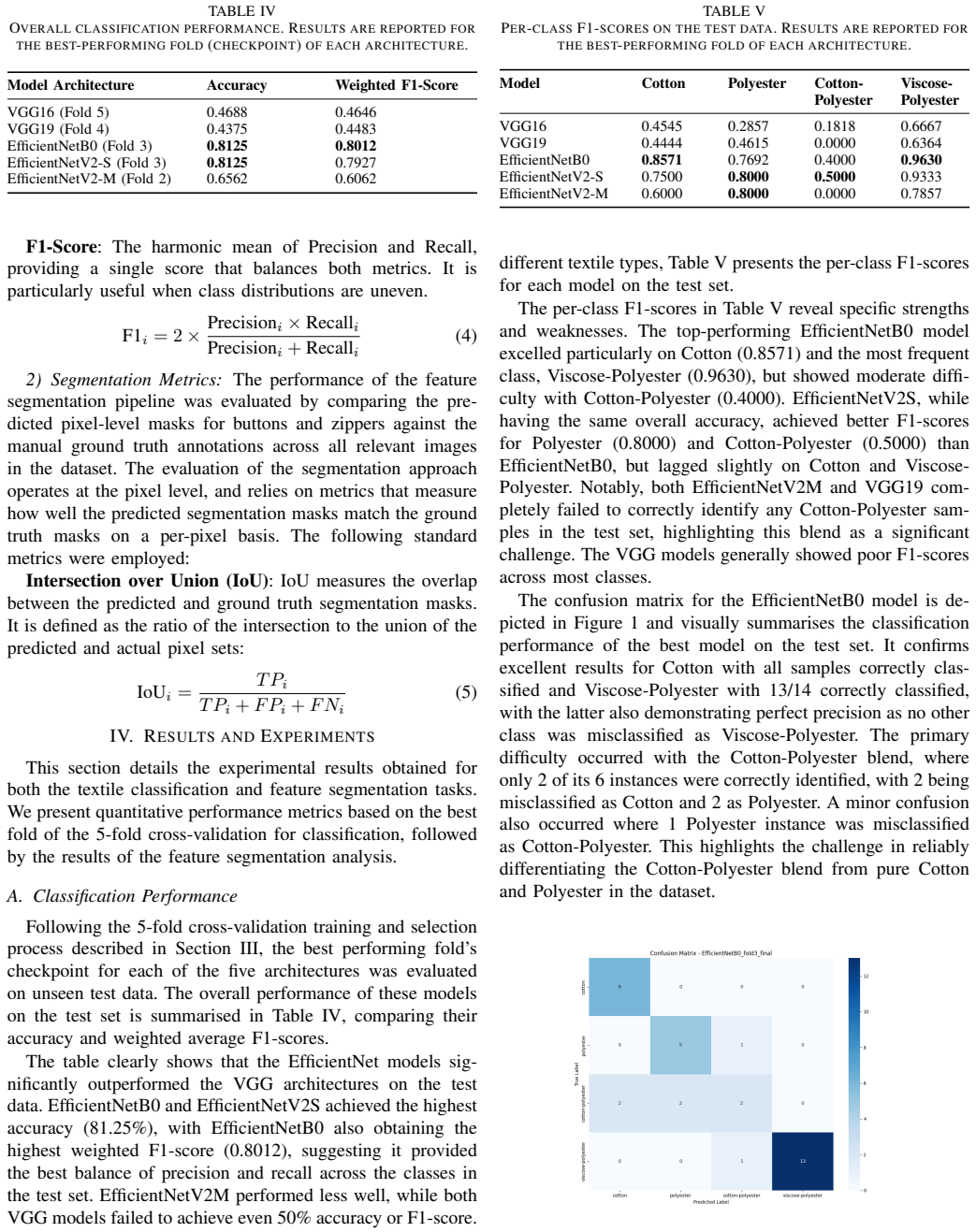
- The Cotton-Polyester blend is the hardest class, with only two of six test samples correctly identified by the best model, suggesting blends need more data or an additional sensing modality.
- A 5-fold cross-validation framework with early stopping and checkpointing provides a template for benchmarking small, real-world recycling datasets.
- Perfect detection recall and precision along with a mask mIoU of 0.90 indicate that the zero-shot pipeline can serve as a reliable upstream step for downstream feature removal.
Reading between the lines
- The reported perfect precision/recall for segmentation likely reflects the small, homogeneous dataset; a stress test with wrinkled garments, varied lighting, and occluded fasteners would show how close the zero-shot pipeline is to production readiness.
- The same text-prompted pipeline could be pointed at other contaminants in textile streams—snaps, zipper pulls, sequins, tags—without retraining, a direction the paper does not test.
- Because the classification test set contains 14 of 32 images from the Viscose-Polyester class, the overall accuracy is weighted toward that class, so per-class scores are the better guide to real-world performance.
- Combining RGB classification with a low-cost NIR sensor might close the blend-classification gap while preserving much of the cost advantage, a hybrid direction the paper leaves open.
Editorial analysis
A structured set of objections, weighed in public.
Referee Report
Summary. The paper proposes two computer-vision components for textile recycling: a transfer-learning classifier that distinguishes four textile types (Cotton, Polyester, Cotton-Polyester, Viscose-Polyester) and a zero-shot segmentation pipeline combining Grounding DINO with SAM to locate buttons and zippers. The authors report that EfficientNetB0 achieves 81.25% accuracy on a held-out test set and that the segmentation pipeline reaches a mean IoU of 0.90. The paper argues that these results demonstrate the feasibility of using standard RGB imagery for automated textile-sorting preprocessing.
Significance. If the reported results were valid, the paper would provide a useful low-cost baseline for RGB-only textile analysis in recycling pipelines. The work has some concrete strengths: it uses real image data with no post-processing, compares several pretrained architectures under transfer learning, reports per-class results, and applies modern zero-shot foundation models in a practical setting. These aspects make the study potentially relevant to the recycling-automation community. However, the evaluation protocol contains internal contradictions and undisclosed model-selection choices that undermine the headline claims as written.
major comments (4)
- [Section III-B] The dataset description is internally inconsistent. The text states that the total dataset consists of 80 unique images, that the 80 images were randomly partitioned into 5 mutually exclusive folds of 16 images each, and then introduces a final test set of 32 images 'completely separate from the training and validation process.' Since 5 × 16 = 80, all images are already assigned to folds, leaving no images for a separate held-out test set. The reported 81.25% accuracy is therefore not defined by the stated protocol; the authors must clarify whether the folds cover only part of the data, whether the test set overlaps the folds, or whether additional images were collected, and must re-evaluate with a coherent split.
- [Section IV-A, Table IV] The headline results are reported for the 'best-performing fold (checkpoint)' of each architecture, with Fold numbers listed in Table IV. Because the best fold is identified by evaluating all five fold checkpoints on the final test set, the test set is used for model selection. The reported 0.8125 accuracy and 0.8012 F1-score are thus maxima over five checkpoints rather than a pre-specified evaluation of a single trained model, which inflates the expected generalization estimate. The selection procedure should be corrected, for example by fixing the fold before test evaluation or by using nested cross-validation.
- [Section IV-C, Table VI] The segmentation evaluation reports Precision, Recall, and F1 of exactly 1.00 for both bounding-box and mask predictions, with mean IoU of 0.92 and 0.90. The paper does not specify the confidence threshold used for Grounding DINO, the IoU matching criterion for the object-level metrics, whether metrics are aggregated per image or per object, or the number of buttons and zippers annotated. Without these details the perfect scores cannot be interpreted, and the claimed 'excellent performance' is not reproducible. Section III-E's statement that default parameters were 'generally sufficient' is too vague for a quantitative claim.
- [Section III-A and Section V] The abstract and conclusion generalize the results to feasibility for automated textile recycling pipelines, but the dataset consists of 80 images captured with one smartphone camera under 'similar ambient indoor lighting conditions,' with items placed flat on a stationary belt. No analysis addresses variability in lighting, garment pose, occlusion, wear, or camera placement. This is a scope limitation rather than an internal error, but it should be stated explicitly; as written, the feasibility claim exceeds the evidence.
minor comments (6)
- [Section III-B] The sentence beginning 'gmentation task' appears truncated; it should read 'For the segmentation task, images containing buttons and zippers were used.'
- [Section III-D, Table III] The number of unfrozen layers for the VGG models is described in the text as 'top 4 layers (VGG16) and top 6 layers (VGG19)' but Table III says 'top 30 base layers (4-6 for VGG)'; this ambiguity should be resolved.
- [Section IV-A, Table IV] Table IV reports point estimates without confidence intervals or standard deviations across folds; given the small test set (32 images) and the fold-selection procedure, this is misleading.
- [Section III-F] The definitions of precision, recall, and F1 for the segmentation task are not provided; Eq. (5) defines IoU only. Please state how object-level and pixel-level metrics are computed.
- [Section IV-A, Table V] The test-set class distribution is imbalanced (6, 6, 6, 14), and the weighted F1-score is reported without specifying the weighting scheme; the class weights should be stated explicitly.
- [Section IV-B, Figures 2 and 3] Figures 2 and 3 show training and validation curves, but the captions do not describe the curves or the axes fully; additional legend or caption detail would improve readability.
Circularity Check
Headline classification accuracy is the best-of-five fold checkpoint evaluated on a test set that, by the paper's own split arithmetic, cannot be held out; the 81.25% figure is therefore a selected maximum rather than an unbiased held-out prediction.
-
fitted input called prediction
[Section III-B, Section III-D, Section IV-A, Section IV-B, Table IV]
"All reported results in Section IV are based on the best-performing fold for each model. ... While the checkpoint from Fold 3 yielded the best performance on the final test set, it is worth noting that a different Fold, namely Fold 4 achieved higher peak validation accuracies during the cross-validation process."
The reported accuracy is not a pre-specified evaluation of a fixed model. By the authors' own description, the result is the best-performing fold checkpoint per architecture, and the text identifies Fold 3 as the checkpoint that 'yielded the best performance on the final test set.' Choosing the best of five checkpoints (at minimum by inspecting test performance, as Section IV-B does) turns the headline 81.25% into a maximum over five evaluations. A maximum of five accuracies is fitted to the test set in expectation and overstates the accuracy of any single pre-registered model.
full rationale
The paper's central classification claim is an empirical benchmark, not a derivation, and there is no definitional equivalence between the RGB-input method and the reported outcome. The transfer-learning pipeline uses external ImageNet-pretrained weights and is validated against manually collected ground-truth labels, so the method itself is not circular. Likewise, the Grounding DINO + SAM segmentation evaluation compares predicted masks to manual annotations and is externally anchored, so its perfect precision/recall and mIoU 0.90 are not circular. The load-bearing circularity concern is confined to the headline classification number: the paper reports the best-performing fold checkpoint and, in Section IV-B, explicitly compares fold checkpoints on the final test set, making the 81.25% a selected maximum rather than a held-out prediction. The described split arithmetic (5 folds x 16 images = the entire 80-image dataset, plus a separate 32-image test set) makes the claimed held-out test set impossible, strengthening the conclusion that the reported accuracy is fitted to the evaluation process rather than an independent estimate. Self-citations in the references are not load-bearing. Overall circularity score is therefore moderate, driven by the selection of the reported prediction from the evaluation data.
Assumptions & free parameters
free parameters (4)
- Best-fold checkpoint selection for test evaluation =
Fold 3 (EfficientNetB0)
- Grounding DINO confidence threshold =
Default, not specified
- Data augmentation ranges =
Rotation up to 90, shift/zoom up to 30%, flip 50%
- Fine-tuning depth =
Top 30 layers (EfficientNet), top 4 or 6 (VGG)
assumptions (4)
- domain assumption ImageNet pre-trained weights provide a useful feature space for textile fabric classification.
- domain assumption Manual annotations of buttons and zippers are correct ground truth.
- domain assumption The 80-image dataset captured with a single camera and lighting setup represents industrial conveyor-belt conditions.
- domain assumption The text prompts 'button' and 'zipper' are sufficient to detect all instances of interest.
Cite this review
Pith. "Pith review of Textile Analysis for Recycling Automation using Transfer Learning and Zero-Shot Foundation Models." pith.science (2026). https://pith.science/paper/EQX7RFCN
@misc{pith2026250606569,
  author       = {Pith},
  title        = {Pith review of: Textile Analysis for Recycling Automation using Transfer Learning and Zero-Shot Foundation Models},
  year         = {2026},
  howpublished = {\url{https://pith.science/paper/EQX7RFCN}},
  note         = {Machine review of arXiv:2506.06569}
}
read the original abstract
Automated sorting is crucial for improving the efficiency and scalability of textile recycling, but accurately identifying material composition and detecting contaminants from sensor data remains challenging. This paper investigates the use of standard RGB imagery, a cost-effective sensing modality, for key pre-processing tasks in an automated system. We present computer vision components designed for a conveyor belt setup to perform (a) classification of four common textile types and (b) segmentation of non-textile features such as buttons and zippers. For classification, several pre-trained architectures were evaluated using transfer learning and cross-validation, with EfficientNetB0 achieving the best performance on a held-out test set with 81.25\% accuracy. For feature segmentation, a zero-shot approach combining the Grounding DINO open-vocabulary detector with the Segment Anything Model (SAM) was employed, demonstrating excellent performance with a mIoU of 0.90 for the generated masks against ground truth. This study demonstrates the feasibility of using RGB images coupled with modern deep learning techniques, including transfer learning for classification and foundation models for zero-shot segmentation, to enable essential analysis steps for automated textile recycling pipelines.
Figures


Figures from the paper (1 more)

Reference graph
Works this paper leans on
-
[1]
The growing problem of textile waste generation—the current state of textile waste management,
I. Wojnowska-Baryła, K. Bernat, M. Zaborowska, and D. Kulikowska, “The growing problem of textile waste generation—the current state of textile waste management,”Energies, vol. 17, no. 7, p. 1528, 2024
work page 2024
-
[2]
Reducing the carbon footprint of the textile sector: an overview of impacts and solutions,
W. Leal Filho, M. A. P. Dinis, O. Liakh, A. Pac ¸o, K. Dennis, F. Shollo, and H. Sidsaph, “Reducing the carbon footprint of the textile sector: an overview of impacts and solutions,”Textile Research Journal, vol. 94, no. 15-16, pp. 1798–1814, 2024
work page 2024
-
[3]
C. Alpert, M. Turkowski, and T. Tasneem, “Scalability solutions for automated textile sorting: a case study on how dynamic capabilities can overcome scalability challenges,” 2021
work page 2021
-
[4]
Opportunities and challenges for the sorting of post-consumer textile waste,
R. Ben Amor, K. T. W. Ng, T. T. Sithi, and T. S. Mahmud, “Opportunities and challenges for the sorting of post-consumer textile waste,” in Canadian Society of Civil Engineering Annual Conference. Springer, 2023, pp. 89–99
work page 2023
-
[5]
Fabric composition classification using hyper-spectral imaging,
J. Clark, G. Johnson, O. Duran, and V . Argyriou, “Fabric composition classification using hyper-spectral imaging,” in2023 19th International Conference on Distributed Computing in Smart Systems and the Internet of Things (DCOSS-IoT), 2023, pp. 347–353
work page 2023
-
[6]
Contamination threshold values for textile recycling,
T. Behrendt and E. Eppinger, “Contamination threshold values for textile recycling,” inITC-ICEE. Springer, 2023, pp. 468–479
work page 2023
-
[7]
State of the art of post-consumer textile waste upcycling to reach the zero waste milestone,
M. D. Stanescu, “State of the art of post-consumer textile waste upcycling to reach the zero waste milestone,”Environmental Science and Pollution Research, vol. 28, no. 12, pp. 14 253–14 270, 2021
work page 2021
-
[8]
Textile fiber identification using near-infrared spectroscopy and pattern recognition,
J. Zhou, L. Yu, Q. Ding, and R. Wang, “Textile fiber identification using near-infrared spectroscopy and pattern recognition,”Autex Research Journal, vol. 19, no. 2, pp. 201–209, 2019
work page 2019
Show all 32 references
-
[9]
Identification and classification of textile fibres using atr-ft-ir spectroscopy with chemometric methods,
P. Peets, I. Leito, J. Pelt, and S. Vahur, “Identification and classification of textile fibres using atr-ft-ir spectroscopy with chemometric methods,” Spectrochimica Acta Part A: Molecular and Biomolecular Spectroscopy, vol. 173, pp. 175–181, 2017
2017
-
[10]
Classification of textile fabrics by use of spectroscopy-based pattern recognition methods,
X. Sun, M. Zhou, and Y . Sun, “Classification of textile fabrics by use of spectroscopy-based pattern recognition methods,”Spectroscopy Letters, vol. 49, no. 2, pp. 96–102, 2016
2016
-
[11]
Circular economy of post-consumer textile waste: Classification through infrared spec- troscopy,
J.-R. Riba, R. Cantero, T. Canals, and R. Puig, “Circular economy of post-consumer textile waste: Classification through infrared spec- troscopy,”Journal of Cleaner Production, vol. 272, p. 123011, 2020
2020
-
[12]
Efficient recognition and automatic sorting technology of waste textiles based on online near infrared spectroscopy and convolutional neural network,
W. Du, J. Zheng, W. Li, Z. Liu, H. Wang, and X. Han, “Efficient recognition and automatic sorting technology of waste textiles based on online near infrared spectroscopy and convolutional neural network,” Resources, Conservation and Recycling, vol. 180, p. 106157, 2022
2022
-
[13]
Post-consumer textile waste classification through near-infrared spectroscopy, using an advanced deep learning approach,
J.-R. Riba, R. Cantero, P. Riba-Mosoll, and R. Puig, “Post-consumer textile waste classification through near-infrared spectroscopy, using an advanced deep learning approach,”Polymers, vol. 14, no. 12, p. 2475, 2022
2022
-
[14]
Photometric stereo with an arbitrary number of illuminants,
V . Argyriou, M. Petrou, and S. Barsky, “Photometric stereo with an arbitrary number of illuminants,”Computer Vision and Image Under- standing, vol. 114, no. 8, pp. 887–900, 2010
2010
-
[15]
A computer vision based online quality control system for textile yarns,
N. Haleem, M. Bustreo, and A. Del Bue, “A computer vision based online quality control system for textile yarns,”Computers in Industry, vol. 133, p. 103550, 2021
2021
-
[16]
Development of a real-time machine vision system for functional textile fabric defect detection using a deep yolov4 model,
S. Dlamini, C.-Y . Kao, S.-L. Su, and C.-F. Jeffrey Kuo, “Development of a real-time machine vision system for functional textile fabric defect detection using a deep yolov4 model,”Textile Research Journal, vol. 92, no. 5-6, pp. 675–690, 2022
2022
-
[17]
A modular deep learning framework for scene understanding in augmented reality ap- plications,
V . Li, B. Villarini, J.-C. Nebel, and A. Vasileios, “A modular deep learning framework for scene understanding in augmented reality ap- plications,” in2023 IEEE IAICT. IEEE, 2023, pp. 45–51
2023
-
[18]
A closer look at data augmentation strategies for finetuning-based low/few-shot object detection,
V . Li, G. Tsoumplekas, I. Siniosoglou, V . Argyriou, A. Lytos, E. Foun- toukidis, and P. Sarigiannidis, “A closer look at data augmentation strategies for finetuning-based low/few-shot object detection,” in2024 IEEE 14th International Symposium on Industrial Embedded Systems ...
2024
-
[19]
Enhancing 3d object detection in autonomous vehicles based on synthetic virtual environment analysis,
V . Li, I. Siniosoglou, T. Karamitsou, A. Lytos, I. D. Moscholios, S. K. Goudos, J. S. Banerjee, P. Sarigiannidis, and V . Argyriou, “Enhancing 3d object detection in autonomous vehicles based on synthetic virtual environment analysis,”IVC, vol. 154, p. 105385, 2025
2025
-
[20]
An innovative approach of textile fabrics identification from mobile images using computer vision based on deep transfer learning,
A. C. da Silva BarrosM, E. Firmeza Ohata, S. P. P. da Silva, J. Silva Almeida, and P. P. Rebouc ¸as Filho, “An innovative approach of textile fabrics identification from mobile images using computer vision based on deep transfer learning,” in2020 International Joint Conference...
2020
-
[21]
Computer vision-based color sorting for waste textile recycling,
J. Zhou, X. Zou, and W. K. Wong, “Computer vision-based color sorting for waste textile recycling,”International Journal of Clothing Science and Technology, vol. 34, no. 1, pp. 29–40, 2022
2022
-
[22]
Very deep convolutional networks for large-scale image recognition,
K. Simonyan and A. Zisserman, “Very deep convolutional networks for large-scale image recognition,” 2015. [Online]. Available: https://arxiv.org/abs/1409.1556
2015 arXiv
-
[23]
Efficientnet: Rethinking model scaling for convolutional neural networks,
M. Tan and Q. V . Le, “Efficientnet: Rethinking model scaling for convolutional neural networks,” 2020. [Online]. Available: https://arxiv.org/abs/1905.11946
2020 arXiv
-
[24]
Imagenet-21k pretraining for the masses,
T. Ridnik, E. Ben-Baruch, A. Noy, and L. Zelnik-Manor, “Imagenet-21k pretraining for the masses,”arXiv preprint arXiv:2104.10972, 2021
2021 arXiv
-
[25]
Deep learning (cnn) and transfer learning: a review,
J. Gupta, S. Pathak, and G. Kumar, “Deep learning (cnn) and transfer learning: a review,” inJournal of Physics: Conference Series, vol. 2273, no. 1. IOP Publishing, 2022, p. 012029
2022
-
[26]
A review of machine learning and deep learning for object detection, semantic segmentation, and human action recognition in machine and robotic vision,
N. Manakitsa, G. S. Maraslidis, L. Moysis, and G. F. Fragulis, “A review of machine learning and deep learning for object detection, semantic segmentation, and human action recognition in machine and robotic vision,”Technologies, vol. 12, no. 2, p. 15, 2024
2024
-
[27]
A review of object detection: Datasets, performance evaluation, architecture, applications and current trends,
W. Chen, J. Luo, F. Zhang, and Z. Tian, “A review of object detection: Datasets, performance evaluation, architecture, applications and current trends,”Multimedia Tools and Applications, vol. 83, no. 24, pp. 65 603– 65 661, 2024
2024
-
[28]
Yolo-based object detection models: A review and its applications,
A. Vijayakumar and S. Vairavasundaram, “Yolo-based object detection models: A review and its applications,”Multimedia Tools and Applica- tions, vol. 83, no. 35, pp. 83 535–83 574, 2024
2024
-
[29]
Segment anything,
A. Kirillov, E. Mintun, N. Ravi, H. Mao, C. Rolland, L. Gustafson, T. Xiao, S. Whitehead, A. C. Berg, W.-Y . Loet al., “Segment anything,” inProceedings of the IEEE/CVF international conference on computer vision, 2023, pp. 4015–4026
2023
-
[30]
Grounding dino: Marrying dino with grounded pre-training for open-set object detection,
S. Liu, Z. Zeng, T. Ren, F. Li, H. Zhang, J. Yang, Q. Jiang, C. Li, J. Yang, H. Suet al., “Grounding dino: Marrying dino with grounded pre-training for open-set object detection,” inEuropean Conference on Computer Vision. Springer, 2024, pp. 38–55
2024
-
[31]
Fabric defect detection in textile manufacturing: a survey of the state of the art,
C. Li, J. Li, Y . Li, L. He, X. Fu, and J. Chen, “Fabric defect detection in textile manufacturing: a survey of the state of the art,”Security and Communication Networks, vol. 2021, no. 1, p. 9948808, 2021
2021
-
[32]
The mvtec anomaly detection dataset: a comprehensive real-world dataset for unsupervised anomaly detection,
P. Bergmann, K. Batzner, M. Fauser, D. Sattlegger, and C. Steger, “The mvtec anomaly detection dataset: a comprehensive real-world dataset for unsupervised anomaly detection,”International Journal of Computer Vision, vol. 129, no. 4, pp. 1038–1059, 2021
2021
Reviewed August 7, 2026 · model on record in the stance chip above.
Discussion (0). Sign in to comment.