REVIEW 3 major objections 5 minor 56 references
DONUT: A Decoder-Only Model for Trajectory Prediction
T0 review · 3 major / 5 minor · reviewed 2026-08-07 · deepseek-v4-flash
Pith's one-line read The paper argues that trajectory forecasting can be done with one decoder-only Transformer that unrolls future motion step by step, and reports state-of-the-art results on Argoverse 2.
desk verdict Solid decoder-only variant for Argoverse 2 with a defensible non-ensemble SOTA claim; the load-bearing comparisons rest on single runs, so the gains need seed-level evidence before I'd call them settled. read the letter →
The pith
A machine-rendered reading of the paper's core claim, the machinery that carries it, and where it could break.
The reading
What carries the argument
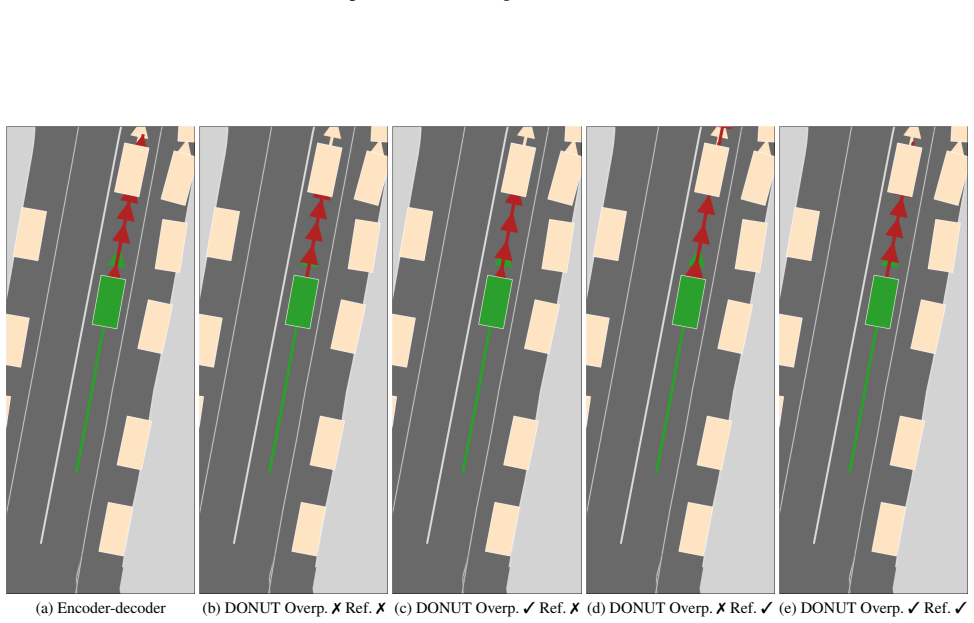
The mechanism is autoregressive trajectory unrolling in a query-centric Transformer. Future time is divided into sub-trajectories of $T_{\mathrm{sub}}=10$ steps (one second); a proposer module tokenizes the previous sub-trajectory, applies temporal, map, social, and mode attention with relative positional encodings, and detokenizes to predict the next sub-trajectory plus an overpredicted one. The reference frame is then moved to the endpoint of the proposed segment before a refiner predicts offsets, and moved again after refinement, so every relative encoding is recomputed against the latest predicted position. A mixture-of-Laplace loss supervises positions, a von Mises distribution supervises headings, and mode probabilities are trained by the joint negative log-likelihood.
What would settle it
Run the same training configuration multiple times with different random seeds and measure the spread of b-minFDE6 on the Argoverse 2 validation set. If the observed gap between DONUT (1.807) and the encoder-decoder baseline (1.874), or the test-set gap to the nearest non-ensemble competitor (1.79 vs 1.84), falls within one standard deviation of that spread, the state-of-the-art and ablation claims would not be distinguishable from training noise.
Extended reading notes
Core claim
On the paper's own terms, the discovery is that the encoder-decoder separation used by most motion-forecasting models is not required, and is in fact a bottleneck for long-horizon accuracy. A single decoder-only Transformer that processes observed and future trajectory segments in the same way, always attending to scene elements from the endpoint of its latest prediction, predicts more accurate endpoints than the encoder-decoder baseline, and the advantage grows with prediction length. Adding the overprediction objective and a refinement module gives b-minFDE6 of 1.79 on the Argoverse 2 test set, ahead of every published non-ensemble method, with the largest gains on turn-heavy scenes where the baseline performs worst.
Load-bearing premise
The load-bearing premise is that the reported single-training-run numbers on one benchmark are stable enough to rank configurations; no repeated seeds, confidence intervals, or significance tests are reported, while several decisive differences are small.
Editorial extensions
If this is right
- If DONUT's results hold, a separate agent encoder is not needed for state-of-the-art single-agent forecasting: the same decoder can read history and generate future.
- Per-step reference-point updates are what buy far-future accuracy: the decoder-only model's endpoint-error advantage over the encoder-decoder baseline grows over the 60 prediction steps, and the relative gain is larger (14.6% vs 6.1% in minFDE) on scenes with turns above 45 degrees.
- Overprediction and refinement each do little alone, but together they give the best configuration, and overprediction also removes the training instabilities seen with refinement alone.
- DONUT establishes a new non-ensemble state of the art on Argoverse 2 (b-minFDE6 1.79), ahead of the nearest non-ensemble competitor (1.84) and close behind the best ensemble model (1.73).
Reading between the lines
- An implication the authors leave implicit is that the decoder-only recipe—short segments, endpoint-anchored attention, and overprediction—could transfer to other multimodal sequence-prediction problems, such as pedestrian intent or marine traffic, where stale context also degrades far-future forecasts.
- The supplement's efficiency numbers point to a trade-off: decoder-only unrolling roughly triples inference time versus the baseline (65.7 ms vs 23.7 ms) and refinement roughly doubles it again (129 ms), so reducing latency through sparser attention or caching is a natural next step for deployment.
- A testable extension would be to evaluate calibration of the six mode probabilities separately from endpoint accuracy, since b-minFDE6 merges the two and the paper does not report them independently.
- Because all comparisons come from single training runs, repeated-seed experiments on the validation set would show whether the small decisive margins (1.807 vs 1.874 in the full ablation, 1.79 vs 1.84 on the test set) are robust to training noise.
Editorial analysis
A structured set of objections, weighed in public.
Referee Report
Summary. The paper proposes DONUT, a decoder-only Transformer for motion forecasting on Argoverse 2. In place of the usual encoder-decoder structure, DONUT processes historical and future trajectory sub-steps with a single autoregressive decoder, updates the query-centric reference point after each predicted segment, adds an auxiliary overprediction loss inspired by multi-token prediction, and combines this with a refinement module. The authors report ablation results on the Argoverse 2 validation set against a QCNet-based encoder-decoder baseline, plus one submission to the Argoverse 2 hidden test leaderboard, claiming non-ensemble state-of-the-art b-minFDE6 of 1.79 and arguing that the decoder-only formulation improves far-future predictions.
Significance. If the empirical claims hold, the contribution is meaningful: DONUT offers a conceptually clean architectural shift for trajectory prediction, with a plausible mechanism (regular reference-point updates and autoregressive consistency) for improving long-horizon endpoints, and it adapts multi-token prediction to a forecasting setting. The paper has several strengths: evaluation is on the official hidden test set with standard benchmark metrics, comparisons are made against published leaderboard entries, ablations are reasonably complete, and the supplementary material includes additional qualitative results, failure cases, and an efficiency analysis. The main reservations are statistical: every configuration is evaluated with a single training run, the encoder-decoder baseline is not retrained under the same protocol, and the headline margins are small, so the central claims are not yet established at the level of rigor expected for a benchmark-state-of-the-art assertion.
major comments (3)
- [§4.2, Tables 1 and 4; §4.3, Table 2] All load-bearing comparisons rest on single runs: Table 1 and supplementary Table 4 report one training run per configuration, and Table 2 is based on a single test submission, with no repeated seeds, confidence intervals, or significance tests. The decisive margins are small (decoder-only vs baseline b-minFDE6 1.874 vs 1.838; adding overprediction plus refinement 1.838 vs 1.807; test-set DONUT vs DeMo 1.79 vs 1.84). The authors also report 'minor training instabilities' when refinement is used alone (§4.2), which indicates sensitivity to optimization randomness. On this evidence, the reported ordering could be a single-luck draw, and the decoder-only advantage and the state-of-the-art claim do not follow until seed-level variability or equivalent statistical evidence is provided.
- [§4.1, Table 1] The comparison against the encoder-decoder baseline is not controlled: the baseline uses the publicly released code and weights of QCNet (§4.1) and is therefore not retrained under the same training recipe as DONUT (epochs, batch size, learning-rate schedule, data pipeline). The claimed 0.036 b-minFDE6 gain from switching to decoder-only thus conflates architecture with training differences. The authors should retrain QCNet under their own training protocol, or otherwise demonstrate that the reported baseline number is comparable under identical conditions.
- [Abstract and §4.3] The abstract's unqualified statement 'achieves new state-of-the-art results on the Argoverse 2 single-agent motion forecasting benchmark' is stronger than what Table 2 supports: QCNet*, SEPT*, and DeMo* (all ensemble methods) achieve lower b-minFDE6 values of 1.78, 1.74, and 1.73, respectively. The claim is defensible only when restricted to non-ensemble methods, as the conclusion itself phrases it. This wording should be corrected consistently throughout the paper.
minor comments (5)
- [§4.1] The sentence 'Each scene is 11 slong, sampled at 10 Hz' appears to have a missing space; it should read '11 s long'.
- [Table 1] The header of Table 1 uses '✓' and '✗' for the decoder-only, overprediction, and refinement rows, but the encoder-decoder baseline row uses 'N/A' for overprediction and refinement. Using the same cross/check symbols throughout would make the row more readable.
- [Figure 2] In Figure 2, the labels for the reference-point updates are partially blank ('from to ', 'from to '), which makes the figure hard to parse; the intended coordinate frames should be labeled explicitly.
- [§4.3] The statement that unimodal metrics are 'not suitable' because an optimal mean prediction would stop in the middle of an intersection is not fully justified; a strong unimodal prediction can still be a meaningful indicator of trajectory quality, and the comparison against DeMo on minADE1 and minFDE1 should be discussed more carefully rather than dismissed.
- [§4.2] The sentence 'the benefit of overprediction is larger when using refinement because ... effectively reducing the overprediction horizon from 20 steps to 10' is unclear; the intended meaning of 'overprediction horizon' in this context should be explained.
Circularity Check
No circularity: DONUT's claims are empirical benchmark results with auxiliary supervision, not derivations from fitted parameters or self-citations.
full rationale
The paper's central claims are empirical: a decoder-only architecture is compared against an encoder-decoder baseline (QCNet) on the Argoverse 2 validation set, and the full model is submitted to the external hidden test leaderboard. The overprediction and refinement losses are supervised with ground-truth future positions via the Laplace and von-Mises likelihoods in Eqs. (1) and (2), and the overpredictions are explicitly discarded at inference time, so no evaluation metric is forced by a fitted parameter. The decoder-only design is an architectural modification relative to QCNet and is tested in Table 1; the state-of-the-art claim rests on Table 2 against published external results. The only reused prior work is QCNet [55], which is cited as a baseline and codebase, not as a self-citation or as a load-bearing uniqueness theorem. The abstract's phrase 'new state-of-the-art results' is slightly broader than the conclusion's accurate 'non-ensemble' qualification, since ensemble entries in Table 2 have lower b-minFDE6 values, but that is a wording imprecision, not circularity. No equation is equivalent to its input by construction, and no fitted quantity is renamed as a prediction.
Assumptions & free parameters
free parameters (4)
- Sub-trajectory length Tsub =
10 time steps (1 second)
- Interaction radius r =
50 m
- Embedding dimension D and dropout =
D=128, dropout=10%
- Training schedule hyperparameters =
lr=5e-4, 60 epochs, batch size 64
assumptions (4)
- domain assumption Argoverse 2 train/val/test splits, K=6 mode evaluation, and the b-minFDE/minFDE/minADE/MR metrics measure motion-forecasting quality as claimed.
- domain assumption Each reported configuration is deterministic or stable enough that single-run differences reflect true ordering.
- ad hoc to paper Query-centric relative positional encodings and the map encoder from QCNet can be reused in DONUT without losing validity.
- domain assumption The mixture of Laplace and von Mises likelihoods with winner-mode optimization is a suitable training objective.
Cite this review
Pith. "Pith review of DONUT: A Decoder-Only Model for Trajectory Prediction." pith.science (2026). https://pith.science/paper/XC4RKD7K
@misc{pith2026250606854,
  author       = {Pith},
  title        = {Pith review of: DONUT: A Decoder-Only Model for Trajectory Prediction},
  year         = {2026},
  howpublished = {\url{https://pith.science/paper/XC4RKD7K}},
  note         = {Machine review of arXiv:2506.06854}
}
read the original abstract
Predicting the motion of other agents in a scene is highly relevant for autonomous driving, as it allows a self-driving car to anticipate. Inspired by the success of decoder-only models for language modeling, we propose DONUT, a Decoder-Only Network for Unrolling Trajectories. Unlike existing encoder-decoder forecasting models, we encode historical trajectories and predict future trajectories with a single autoregressive model. This allows the model to make iterative predictions in a consistent manner, and ensures that the model is always provided with up-to-date information, thereby enhancing performance. Furthermore, inspired by multi-token prediction for language modeling, we introduce an 'overprediction' strategy that gives the model the auxiliary task of predicting trajectories at longer temporal horizons. This allows the model to better anticipate the future and further improves performance. Through experiments, we demonstrate that our decoder-only approach outperforms the encoder-decoder baseline, and achieves new state-of-the-art results on the Argoverse 2 single-agent motion forecasting benchmark.
Figures


Figures from the paper (20 more)


Reference graph
Works this paper leans on
-
[1]
Josh Achiam, Steven Adler, Sandhini Agarwal, Lama Ah- mad, Ilge Akkaya, Florencia Leoni Aleman, Diogo Almeida, Janko Altenschmidt, Sam Altman, Shyamal Anadkat, et al. GPT-4 Technical Report. arXiv preprint arXiv:2303.08774,
-
[2]
Social LSTM: Human Trajectory Prediction in Crowded Spaces
Alexandre Alahi, Kratarth Goel, Vignesh Ramanathan, Alexandre Robicquet, Li Fei-Fei, and Silvio Savarese. Social LSTM: Human Trajectory Prediction in Crowded Spaces. In CVPR, 2016. 3
work page 2016
-
[3]
MultiPath: Multiple Probabilistic Anchor Trajec- tory Hypotheses for Behavior Prediction
Yuning Chai, Benjamin Sapp, Mayank Bansal, and Dragomir Anguelov. MultiPath: Multiple Probabilistic Anchor Trajec- tory Hypotheses for Behavior Prediction. In CoRL, 2020. 2
work page 2020
-
[4]
Forecast-MAE: Self-supervised Pre-training for Motion Forecasting with Masked Autoencoders
Jie Cheng, Xiaodong Mei, and Ming Liu. Forecast-MAE: Self-supervised Pre-training for Motion Forecasting with Masked Autoencoders. In ICCV, 2023. 8
work page 2023
-
[5]
Learning Phrase Representations using RNN Encoder–Decoder for Statistical Machine Translation
Kyunghyun Cho, Bart van Merri ¨enboer, C ¸ a˘glar G ˙ulc ¸ehre, Dzmitry Bahdanau, Fethi Bougares, Holger Schwenk, and Yoshua Bengio. Learning Phrase Representations using RNN Encoder–Decoder for Statistical Machine Translation. In EMNLP, 2014. 4
work page 2014
-
[6]
R-Pred: Two-Stage Motion Prediction Via Tube- Query Attention-Based Trajectory Refinement
Sehwan Choi, Jungho Kim, Junyong Yun, and Jun Won Choi. R-Pred: Two-Stage Motion Prediction Via Tube- Query Attention-Based Trajectory Refinement. In ICCV,
-
[7]
GoRela: Go Relative for Viewpoint- Invariant Motion Forecasting
Alexander Cui, Sergio Casas, Kelvin Wong, Simon Suo, and Raquel Urtasun. GoRela: Go Relative for Viewpoint- Invariant Motion Forecasting. In ICRA, 2023. 8
work page 2023
-
[8]
Multimodal Trajectory Predic- tions for Autonomous Driving using Deep Convolutional Networks
Henggang Cui, Vladan Radosavljevic, Fang-Chieh Chou, Tsung-Han Lin, Thi Nguyen, Tzu-Kuo Huang, Jeff Schnei- der, and Nemanja Djuric. Multimodal Trajectory Predic- tions for Autonomous Driving using Deep Convolutional Networks. In ICRA, 2019. 2
work page 2019
Show all 56 references
-
[9]
BERT: Pre-training of Deep Bidirectional Trans- formers for Language Understanding
Jacob Devlin, Ming-Wei Chang, Kenton Lee, and Kristina Toutanova. BERT: Pre-training of Deep Bidirectional Trans- formers for Language Understanding. In NAACL, 2019. 3
2019
-
[10]
Mac- Former: Map-Agent Coupled Transformer for Real-Time and Robust Trajectory Prediction
Chen Feng, Hangning Zhou, Huadong Lin, Zhigang Zhang, Ziyao Xu, Chi Zhang, Boyu Zhou, and Shaojie Shen. Mac- Former: Map-Agent Coupled Transformer for Real-Time and Robust Trajectory Prediction. IEEE RA-L, 2023. 8
2023
-
[11]
VectorNet: Encoding HD Maps and Agent Dynamics from Vectorized Representation
Jiyang Gao, Chen Sun, Hang Zhao, Yi Shen, Dragomir Anguelov, Congcong Li, and Cordelia Schmid. VectorNet: Encoding HD Maps and Agent Dynamics from Vectorized Representation. In CVPR, 2020. 2
2020
-
[12]
Dynamic Scenario Representation Learning for Motion Forecasting With Heterogeneous Graph Convolutional Re- current Networks
Xing Gao, Xiaogang Jia, Yikang Li, and Hongkai Xiong. Dynamic Scenario Representation Learning for Motion Forecasting With Heterogeneous Graph Convolutional Re- current Networks. IEEE RA-L, 8(5), 2023. 2, 8
2023
-
[13]
HOME: Heatmap Out- put for future Motion Estimation
Thomas Gilles, Stefano Sabatini, Dzmitry Tsishkou, Bogdan Stanciulescu, and Fabien Moutarde. HOME: Heatmap Out- put for future Motion Estimation. In IEEE ITSC, 2021. 2
2021
-
[14]
THOMAS: Trajec- tory Heatmap Output with learned Multi-Agent Sampling
Thomas Gilles, Stefano Sabatini, Dzmitry Tsishkou, Bog- dan Stanciulescu, and Fabien Moutarde. THOMAS: Trajec- tory Heatmap Output with learned Multi-Agent Sampling. In ICLR, 2022. 2, 8
2022
-
[15]
Better & Faster Large Language Models via Multi-token Prediction
Fabian Gloeckle, Badr Youbi Idrissi, Baptiste Roziere, David Lopez-Paz, and Gabriel Synnaeve. Better & Faster Large Language Models via Multi-token Prediction. In ICML,
-
[16]
Long Short-term Memory
Sepp Hochreiter and J ¨urgen Schmidhuber. Long Short-term Memory. Neural computation, 1997. 3
1997
-
[17]
Rules of the Road: Predicting Driving Behavior with a Convolutional Model of Semantic Interactions
Joey Hong, Benjamin Sapp, and James Philbin. Rules of the Road: Predicting Driving Behavior with a Convolutional Model of Semantic Interactions. In CVPR, 2019. 2
2019
-
[18]
SceneDiffuser: Efficient and Controllable Driving Simulation Initialization and Rollout
Max Jiang, Yijing Bai, Andre Cornman, Christopher Davis, Xiukun Huang, Hong Jeon, Sakshum Kulshrestha, John Lambert, Shuangyu Li, Xuanyu Zhou, et al. SceneDiffuser: Efficient and Controllable Driving Simulation Initialization and Rollout. In NeurIPS, 2024. 3
2024
-
[19]
SEPT: Towards Efficient Scene Repre- sentation Learning for Motion Prediction
Zhiqian Lan, Yuxuan Jiang, Yao Mu, Chen Chen, and Shengbo Eben Li. SEPT: Towards Efficient Scene Repre- sentation Learning for Motion Prediction. In ICLR, 2024. 1, 8
2024
-
[20]
Desire: Distant future prediction in dynamic scenes with interacting agents
Namhoon Lee, Wongun Choi, Paul Vernaza, Christopher B Choy, Philip HS Torr, and Manmohan Chandraker. Desire: Distant future prediction in dynamic scenes with interacting agents. In CVPR, 2017. 2
2017
-
[21]
Learning Lane Graph Represen- tations for Motion Forecasting
Ming Liang, Bin Yang, Rui Hu, Yun Chen, Renjie Liao, Song Feng, and Raquel Urtasun. Learning Lane Graph Represen- tations for Motion Forecasting. In ECCV, 2020. 2
2020
-
[22]
EDA: Evolving and Distinct Anchors for Multimodal Motion Prediction
Longzhong Lin, Xuewu Lin, Tianwei Lin, Lichao Huang, Rong Xiong, and Yue Wang. EDA: Evolving and Distinct Anchors for Multimodal Motion Prediction. In AAAI, 2024. 1, 2
2024
-
[23]
DeepSeek-V3 Technical Report
Aixin Liu, Bei Feng, Bing Xue, Bingxuan Wang, Bochao Wu, Chengda Lu, Chenggang Zhao, Chengqi Deng, Chenyu Zhang, Chong Ruan, et al. DeepSeek-V3 Technical Report. arXiv preprint arXiv:2412.19437, 2024. 3
2024 arXiv
-
[24]
Multimodal Motion Prediction with Stacked Transformers
Yicheng Liu, Jinghuai Zhang, Liangji Fang, Qinhong Jiang, and Bolei Zhou. Multimodal Motion Prediction with Stacked Transformers. In CVPR, 2021. 2
2021
-
[25]
Decoupled weight decay regularization
Ilya Loshchilov and Frank Hutter. Decoupled weight decay regularization. In ICLR, 2017. 6
2017
-
[26]
Social-STGCNN: A Social Spatio- Temporal Graph Convolutional Neural Network for Human Trajectory Prediction
Abduallah Mohamed, Kun Qian, Mohamed Elhoseiny, and Christian Claudel. Social-STGCNN: A Social Spatio- Temporal Graph Convolutional Neural Network for Human Trajectory Prediction. In CVPR, 2020. 2
2020
-
[27]
The Waymo Open Sim Agents Challenge
Nico Montali, John Lambert, Paul Mougin, Alex Kuefler, Nicholas Rhinehart, Michelle Li, Cole Gulino, Tristan Em- rich, Zoey Yang, Shimon Whiteson, et al. The Waymo Open Sim Agents Challenge. In NeurIPS, 2023. 3
2023
-
[28]
Wayformer: Motion Forecasting via Simple & Efficient Attention Net- works
Nigamaa Nayakanti, Rami Al-Rfou, Aurick Zhou, Kratarth Goel, Khaled S Refaat, and Benjamin Sapp. Wayformer: Motion Forecasting via Simple & Efficient Attention Net- works. In ICRA, 2023. 2, 3
2023
-
[29]
Scene Transformer: A unified architecture for predicting multiple agent trajectories
Jiquan Ngiam, Benjamin Caine, Vijay Vasudevan, Zheng- dong Zhang, Hao-Tien Lewis Chiang, Jeffrey Ling, Rebecca Roelofs, Alex Bewley, Chenxi Liu, Ashish Venugopal, et al. Scene Transformer: A unified architecture for predicting multiple agent trajectories. In ICLR, 2022. 2
2022
-
[30]
CoverNet: Multimodal 9 Behavior Prediction using Trajectory Sets
Tung Phan-Minh, Elena Corina Grigore, Freddy A Boulton, Oscar Beijbom, and Eric M Wolff. CoverNet: Multimodal 9 Behavior Prediction using Trajectory Sets. In CVPR, 2020. 2
2020
-
[31]
Trajeglish: Traffic Modeling as Next-Token Prediction
Jonah Philion, Xue Bin Peng, and Sanja Fidler. Trajeglish: Traffic Modeling as Next-Token Prediction. In ICLR, 2024. 3
2024
-
[32]
DySeT: A Dynamic Masked Self-distillation Approach for Robust Trajectory Prediction
Mozhgan Pourkeshavarz, Junrui Zhang, and Amir Rasouli. DySeT: A Dynamic Masked Self-distillation Approach for Robust Trajectory Prediction. In ECCV, 2024. 8
2024
-
[33]
Improving Language Understanding by Generative Pre-Training
Alec Radford, Karthik Narasimhan, Tim Salimans, Ilya Sutskever, et al. Improving Language Understanding by Generative Pre-Training. OpenAI Blog, 2018. 2, 3
2018
-
[34]
FJMP: Factorized Joint Multi-Agent Motion Prediction over Learned Directed Acyclic Interaction Graphs
Luke Rowe, Martin Ethier, Eli-Henry Dykhne, and Krzysztof Czarnecki. FJMP: Factorized Joint Multi-Agent Motion Prediction over Learned Directed Acyclic Interaction Graphs. In CVPR, 2023. 1
2023
-
[35]
Learning Cooperative Trajectory Representations for Motion Forecasting
Hongzhi Ruan, Haibao Yu, Wenxian Yang, Siqi Fan, and Za- iqing Nie. Learning Cooperative Trajectory Representations for Motion Forecasting. In NeurIPS, 2024. 1
2024
-
[36]
Trajectron++: Dynamically-feasible trajec- tory forecasting with heterogeneous data
Tim Salzmann, Boris Ivanovic, Punarjay Chakravarty, and Marco Pavone. Trajectron++: Dynamically-feasible trajec- tory forecasting with heterogeneous data. In ECCV, 2020. 2
2020
-
[37]
MotionLM: Multi-Agent Motion Forecast- ing as Language Modeling
Ari Seff, Brian Cera, Dian Chen, Mason Ng, Aurick Zhou, Nigamaa Nayakanti, Khaled S Refaat, Rami Al-Rfou, and Benjamin Sapp. MotionLM: Multi-Agent Motion Forecast- ing as Language Modeling. In ICCV, 2023. 1
2023
-
[38]
Motion Transformer with Global Intention Localization and Local Movement Refinement
Shaoshuai Shi, Li Jiang, Dengxin Dai, and Bernt Schiele. Motion Transformer with Global Intention Localization and Local Movement Refinement. In NeurIPS, 2022. 2, 8
2022
-
[39]
Fourier features let networks learn high frequency functions in low dimen- sional domains
Matthew Tancik, Pratul Srinivasan, Ben Mildenhall, Sara Fridovich-Keil, Nithin Raghavan, Utkarsh Singhal, Ravi Ra- mamoorthi, Jonathan Barron, and Ren Ng. Fourier features let networks learn high frequency functions in low dimen- sional domains. In NeurIPS, 2020. 3
2020
-
[40]
Multiple Futures Prediction
Charlie Tang and Russ R Salakhutdinov. Multiple Futures Prediction. In NeurIPS, 2019. 2
2019
-
[41]
HPNet: Dynamic Trajectory Fore- casting with Historical Prediction Attention
Xiaolong Tang, Meina Kan, Shiguang Shan, Zhilong Ji, Jin- feng Bai, and Xilin Chen. HPNet: Dynamic Trajectory Fore- casting with Historical Prediction Attention. In CVPR, 2024. 1, 2
2024
-
[42]
Gem- ini: A Family of Highly Capable Multimodal Models
Gemini Team, Rohan Anil, Sebastian Borgeaud, Jean- Baptiste Alayrac, Jiahui Yu, Radu Soricut, Johan Schalkwyk, Andrew M Dai, Anja Hauth, Katie Millican, et al. Gem- ini: A Family of Highly Capable Multimodal Models. arXiv preprint arXiv:2312.11805, 2023. 3
2023 arXiv
-
[43]
Llama 2: Open Foundation and Fine-Tuned Chat Models
Hugo Touvron, Louis Martin, Kevin Stone, Peter Albert, Amjad Almahairi, Yasmine Babaei, Nikolay Bashlykov, Soumya Batra, Prajjwal Bhargava, Shruti Bhosale, et al. Llama 2: Open Foundation and Fine-Tuned Chat Models. arXiv preprint arXiv:2307.09288, 2023. 3
2023 arXiv
-
[44]
Attention is All you Need
Ashish Vaswani, Noam Shazeer, Niki Parmar, Jakob Uszko- reit, Llion Jones, Aidan N Gomez, Łukasz Kaiser, and Illia Polosukhin. Attention is All you Need. In NeurIPS, 2017. 3
2017
-
[45]
GANet: Goal Area Network for Motion Forecasting
Mingkun Wang, Xinge Zhu, Changqian Yu, Wei Li, Yuexin Ma, Ruochun Jin, Xiaoguang Ren, Dongchun Ren, Mingxu Wang, and Wenjing Yang. GANet: Goal Area Network for Motion Forecasting. In ICRA, 2023. 1, 8
2023
-
[46]
ProphNet: Efficient Agent-Centric Motion Forecasting With Anchor-Informed Proposals
Xishun Wang, Tong Su, Fang Da, and Xiaodong Yang. ProphNet: Efficient Agent-Centric Motion Forecasting With Anchor-Informed Proposals. In CVPR, 2023. 1, 2, 8
2023
-
[47]
Argoverse 2: Next Generation Datasets for Self-Driving Perception and Forecasting
Benjamin Wilson, William Qi, Tanmay Agarwal, John Lam- bert, Jagjeet Singh, Siddhesh Khandelwal, Bowen Pan, Rat- nesh Kumar, Andrew Hartnett, Jhony Kaesemodel Pontes, Deva Ramanan, Peter Carr, and James Hays. Argoverse 2: Next Generation Datasets for Self-Driving Perception an...
2021
-
[48]
SMART: Scalable Multi-agent Real-time Motion Generation via Next-token Prediction
Wei Wu, Xiaoxin Feng, Ziyan Gao, and Yuheng Kan. SMART: Scalable Multi-agent Real-time Motion Generation via Next-token Prediction. In NeurIPS, 2024. 3
2024
-
[49]
Spatio-Temporal Graph Transformer Networks for Pedes- trian Trajectory Prediction
Cunjun Yu, Xiao Ma, Jiawei Ren, Haiyu Zhao, and Shuai Yi. Spatio-Temporal Graph Transformer Networks for Pedes- trian Trajectory Prediction. In ECCV, 2020. 2, 3
2020
-
[50]
Lanercnn: Distributed representations for graph-centric motion forecasting
Wenyuan Zeng, Ming Liang, Renjie Liao, and Raquel Urta- sun. Lanercnn: Distributed representations for graph-centric motion forecasting. In IROS, 2021. 2
2021
-
[51]
DeMo: Decou- pling Motion Forecasting into Directional Intentions and Dy- namic States
Bozhou Zhang, Nan Song, and Li Zhang. DeMo: Decou- pling Motion Forecasting into Directional Intentions and Dy- namic States. In NeurIPS, 2024. 1, 2, 7, 8
2024
-
[52]
TNT: Target-driveN Trajectory Pre- diction
Hang Zhao, Jiyang Gao, Tian Lan, Chen Sun, Ben Sapp, Balakrishnan Varadarajan, Yue Shen, Yi Shen, Yuning Chai, Cordelia Schmid, et al. TNT: Target-driveN Trajectory Pre- diction. In CoRL, 2021. 2
2021
-
[53]
Waslan- der, Hongsheng Li, and Yu Liu
Yang Zhou, Hao Shao, Letian Wang, Steven L. Waslan- der, Hongsheng Li, and Yu Liu. SmartRefine: A Scenario- Adaptive Refinement Framework for Efficient Motion Pre- diction. In CVPR, 2024. 2, 8
2024
-
[54]
HiVT: Hierarchical Vector Transformer for Multi-Agent Motion Prediction
Zikang Zhou, Luyao Ye, Jianping Wang, Kui Wu, and Kejie Lu. HiVT: Hierarchical Vector Transformer for Multi-Agent Motion Prediction. In CVPR, 2022. 2, 6
2022
-
[55]
Query-Centric Trajectory Prediction
Zikang Zhou, Jianping Wang, Yung-Hui Li, and Yu-Kai Huang. Query-Centric Trajectory Prediction. In CVPR,
-
[56]
BehaviorGPT: Smart Agent Simulation for Autonomous Driving with Next-Patch Prediction
Zikang Zhou, HU Haibo, Xinhong Chen, Jianping Wang, Nan Guan, Kui Wu, Yung-Hui Li, Yu-Kai Huang, and Chun Jason Xue. BehaviorGPT: Smart Agent Simulation for Autonomous Driving with Next-Patch Prediction. In NeurIPS, 2024. 3 10 D NUT: A Decoder-Only Model for Trajectory Predict...
2024
Reviewed August 7, 2026 · model on record in the stance chip above.
Discussion (0). Sign in to comment.