REVIEW 3 major objections 5 minor 44 references
Quantum cosmological perturbations in bouncing models with mimetic dark matter
T0 review · 3 major / 5 minor · reviewed 2026-08-07 · deepseek-v4-flash
Pith's one-line read Mimetic dark matter bouncing models can generate the observed primordial perturbation spectrum without inflation and without quantum gravity.
desk verdict Solid background work on mimetic bounces, but the scale-invariance claim rests on a k-matching step that looks wrong, and the numerics inherit a flat spectrum from a k-independent initial condition. read the letter →
The pith
A machine-rendered reading of the paper's core claim, the machinery that carries it, and where it could break.
The reading
What carries the argument
The load-bearing object is the scalar power spectrum $\delta^2_\psi(k)=k^3/(2\pi^2)|\psi_k|^2$, with the Newtonian potential $\psi$ linked to the mimetic field perturbation by $\psi=\delta\dot\phi$ through the mimetic constraint. The mode equation for the canonical variable $v\propto k\,\delta\phi_k$ is $v''+[c_s^2 k^2+a''/a-2(a'/a)^2]v=0$, where primes are conformal-time derivatives. Adiabatic vacuum initial conditions in the asymptotic past select the mode function, and matching to the long-wavelength solution $v=(1/a)(A_1+A_2\int a^2\,d\eta)$ yields $A_1\propto k^{-5/2}$; since $\delta^2_\psi\propto k^3(kA_1)^2$, the $k$-dependence cancels and the spectrum is scale invariant. The amplitude then depends on $t_0$ through $\delta^2_\psi=(c_s/(2\gamma))(l_p^2/t_0^2)\delta^2_{\psi,\mathrm{num}}$, converting the observed amplitude into a constraint on the bounce scale.
What would settle it
Measure the scalar spectral index and amplitude at percent level and solve the amplitude relation $\delta^2_\psi=(c_s/(2\gamma))(l_p^2/t_0^2)\delta^2_{\psi,\mathrm{num}}$ for $t_0$ from the observed $\delta^2_\psi$; the model is falsified if $t_0$ falls outside $10^5 l_p < t_0 < 10^9 l_p$. A detection of a running spectral index or of non-Gaussianity incompatible with a single scalar field in the adiabatic vacuum would also violate the setup.
Extended reading notes
Core claim
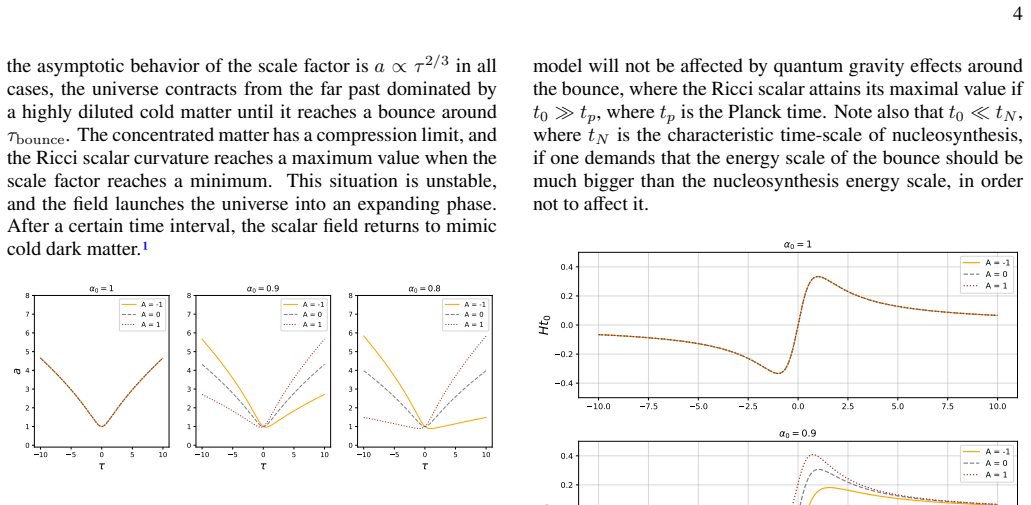
Read at face value, the paper shows that the observed scalar power spectrum can be produced by a nonsingular, purely classical bounce in mimetic gravity. Starting from the bounce solutions $a(\tau)=a_b(1+\tau^2)^{1/3}[\cos(\beta\arctan\tau)+A\sin(\beta\arctan\tau)]^{2/3}$, it quantizes the canonical perturbation variable $v\propto k\,\delta\phi_k$, imposes the adiabatic vacuum on sub-Hubble scales in the asymptotic past, and matches the vacuum mode onto the long-wavelength solution across the bounce. The matching gives $A_1\propto k^{-5/2}$, so the spectrum $\delta^2_\psi\propto k^3(kA_1)^2$ is scale invariant for the parameter range considered. The amplitude is $\delta^2_\psi = (c_s/(2\gamma))(l_p^2/t_0^2)\delta^2_{\psi,\mathrm{num}}$; with the observationally allowed sound speed $c_s=\sqrt{\gamma}=10^{-5}$ and the measured $\delta^2_\psi\approx 10^{-9}$, the bounce scale must satisfy $10^5 l_p < t_0 < 10^9 l_p$. With a modified potential the scale factor becomes $a(\tau)=a_b(1+\tau^2)^{1/[3(1+w)]}$, giving the spectral index $n_s=1+12w/(1+3w)$, whose small negative $w$ reproduces the observed red tilt.
Load-bearing premise
The calculation assumes that deep in the contracting phase the perturbations begin as adiabatic quantum vacuum fluctuations on sub-Hubble scales; if the initial state differed, the predicted amplitude and spectral index would change.
Editorial extensions
If this is right
- The observed scalar spectrum can be matched with a purely classical bounce, so no background quantum effect is required when the bounce scale lies in $10^5 l_p < t_0 < 10^9 l_p$.
- The measured amplitude effectively fixes the bounce scale $t_0$, turning it from a free parameter into a testable prediction.
- A red tilt $n_s\approx 0.965$ follows from a small negative $w$ in the mimetic potential, without introducing negative pressure or an unstable sound speed.
- Scale invariance holds across the single-bounce family parameterized by $0.75\le\alpha_0\le 1$ and $-1\le A\le 1$.
- The power spectrum is tied to quantum vacuum fluctuations in the asymptotic past, so the model inherits the standard vacuum choice of bouncing cosmologies.
Reading between the lines
- The paper does not compute the tensor power spectrum; under the same vacuum initial condition and matching, one would expect a gravitational-wave background whose amplitude also depends on $t_0$, giving an additional observational test.
- The matching that fixes $A_1$ could be replaced by a direct numerical integration of the full mode equation through the bounce, providing an independent check on $A_1\propto k^{-5/2}$.
- The relation $n_s=1+12w/(1+3w)$ implies that a precision measurement of $n_s$ would determine $w$ directly, linking the bounce potential to CMB data.
Editorial analysis
A structured set of objections, weighed in public.
Referee Report
Summary. This paper studies scalar cosmological perturbations in bouncing scenarios based on mimetic dark matter with the potential V(φ) = (2/3)(2-3γ)α/(t0^2+φ^2)^2 (and a modified version). The authors derive the background bounce solutions, quantize the scalar perturbations with an adiabatic vacuum in the far past, match the vacuum mode to the long-wavelength solution, and compute the power spectrum analytically and numerically. They claim a scale-invariant spectrum for the original potential and an amplitude compatible with Planck for bounce time t0 in 10^5 lp < t0 < 10^9 lp; a red-tilted spectrum n_s = 1 + 12w/(1+3w) is claimed for a slightly modified potential. The paper is clearly organized and presents explicit analytic formulas and numerical solutions.
Significance. If established, the result would constitute an interesting non-inflationary mechanism: a single mimetic scalar field would not only mimic dark matter but also produce the observed primordial spectrum, with the bounce at length scales far above the Planck length, avoiding quantum gravity corrections. The paper is careful in specifying the initial-state assumption and in deriving the background solutions, and the numerical mode equations are explicit and standard. However, the analytic derivation contains a normalization error that is load-bearing for the spectral index, and the red-tilt section conflates background and perturbation integration constants. These issues prevent the claims from being accepted in the present form.
major comments (3)
- [Sec. 4A, Eqs. (43)-(45), (52)] Eq. (43) gives the adiabatic vacuum mode as v_k ≈ exp(-i∫ν dη)/√(mν) = l_p√(c_s k) e^{-i c_s k η}. Since m=1/l_p^2 and ν=c_s k, the correct factor is √(mν)=√(c_s k)/l_p, so the amplitude should be l_p/√(c_s k), not l_p√(c_s k). With the printed normalization, taking the super-Hubble limit of Eq. (44) gives v_k ≈ -3 l_p/(c_s^{3/2} k^{3/2} η^2); matching to Eq. (45) with a ∝ η^2 yields A1 ∝ k^{-3/2}, and Eq. (52) then gives δ²_ψ ∝ k^2. With the corrected normalization, v_k ≈ -3 l_p/(c_s^{5/2} k^{5/2} η^2) and A1 ∝ k^{-5/2} as stated. The manuscript is internally inconsistent: Eq. (43) and the subsequent matching cannot both be correct. This must be repaired, and the numerical initial conditions (56), which appear to be consistent with the corrected normalization, should be re-derived explicitly from Eq. (44).
- [Sec. 4C, around Eqs. (63)-(65)] After Eq. (63), the text says that the adiabatic vacuum condition selects the mode function (43), 'which corresponds to setting the integration constant C2(k)=0', and that 'using this condition' the scale factor (64) is recovered. The constants C1, C2 in Eq. (63) are integration constants for the background equation (62), not the perturbation-mode coefficients of Eq. (41). The quantum vacuum fixes the perturbation initial state; it does not select a background branch. The choice C2=0 in Eq. (63) is an extra assumption about which bounce solution is realized, and the paper needs to state and justify it. In addition, the spectral index formula (65) is asserted without a derivation or a precise reference, and the relation between w in (61) and an effective equation of state should be explained.
- [Sec. 4C, amplitude claim] The sentence 'as |w|≪1, the modification will not modify the amplitudes' is not supported by any calculation in the manuscript. The amplitude analysis in Sec. 4B was performed for the original potential (19) and for specific values of α0 and A (Figs. 5-6). The modified potential (61) changes the background scale factor to (64) for every w≠0, and hence changes the mode equation and the normalization of the power spectrum. An O(w) change in the amplitude is relevant because the quoted interval 10^5 l_p < t0 < 10^9 l_p is derived by matching the numerical amplitude to the Planck value. The authors should either compute the amplitude for the modified potential or show analytically that the w-dependence cancels.
minor comments (5)
- [Eq. (35)] The notation '∂iδϕ′∂jδϕ′δij ⊃ S' is confusing; the kinetic term should be written unambiguously (e.g., (∂_i δϕ')^2).
- [Eq. (51)] The notation on the left of Eq. (51), 'Hχ k / a ≈ ˙χk/a', is not defined; this quantity is δφdot, and the equation should be written in terms of δφdot.
- [After Eq. (60)] The sentence 'scales from the Hubble radius to [42]' appears incomplete.
- [Throughout] The symbols w and ω are both used for the new parameter; please use one consistently.
- [Figs. 5-6] Figures 5 and 6 do not report numerical tolerances or convergence checks; a brief statement on the ODE solver settings would be useful.
Circularity Check
No significant circularity: the scale-invariant spectrum follows from the adiabatic-vacuum initial conditions and the known matter-bounce mechanism, while the red tilt and the t0 interval are parameter constraints rather than predictions; self-citations support standard techniques but the core derivation is self-contained.
full rationale
The paper's central chain is: (i) solve the mimetic background bounce (Eq. 21), (ii) write the perturbation equation (Eq. 39) and impose the adiabatic vacuum in the asymptotic past via Eq. (43), (iii) match the vacuum mode to the long-wavelength solution (45) to obtain A1 ∝ k^{-5/2} and hence a flat spectrum through Eq. (52), and (iv) integrate numerically the Hamilton equations (55) with initial conditions (56) that are stated to come from Eq. (44). The numerical flatness indeed follows because π_num,in is k-independent and the (cs kbar)^2 term is negligible, but this k-independence is not imposed to fit the final spectrum; it is a consequence of the vacuum mode (44) when expressed in the dimensionless variables (54). That is a physical assumption, not a fitted input called a prediction. The red-tilted result is obtained by the sentence 'Setting w < 0 with the appropriate value, we obtain the observed red tilt' (Sec. 4C), so the parameter ω is tuned to match the measured n_s; the paper carefully says 'obtain' rather than 'predict', making this a parameter constraint rather than a circular prediction. Likewise, the amplitude is used to infer t0 ('we can adjust t0 to give the observed amplitude'), and the abstract reports this as a compatibility interval, not as an independent prediction. The self-citations to Refs. [26], [39], and [40] support standard techniques (adiabatic vacuum, mode dominance in bouncing models) rather than supplying the target result itself; the scale-invariance argument is re-derived in Sec. 4A. Some technical steps, such as the precise k-scaling of A1 and the consistency of the initial conditions with the sub-Hubble vacuum, may warrant scrutiny, but they are correctness risks rather than circular reductions. Overall, the derivation is self-contained and the observable claims are not equivalent to their inputs by construction.
Assumptions & free parameters
free parameters (5)
- t0 =
10^5 lp to 10^9 lp (inferred from amplitude)
- c_s (or gamma) =
10^-5
- omega (w) =
approximately -0.003 (to give n_s = 0.965)
- alpha0 =
0.75 to 1 (scanned)
- A =
-1 to 1 (scanned)
assumptions (6)
- domain assumption Mimetic gravity action with constraint g^mu nu partial_mu phi partial_nu phi = 1
- domain assumption Homogeneous, isotropic, spatially flat background with phi = t
- domain assumption The added gamma (box phi)^2 term in the action does not affect the background and yields sound speed c_s^2 = gamma/(2 - 3 gamma)
- domain assumption Adiabatic vacuum initial conditions in the far past
- ad hoc to paper Spectral index formula n_s = 1 + 12 w/(1 + 3 w)
- ad hoc to paper Modified potential (61) is a slight modification for |omega| << 1 and does not change the amplitudes
Cite this review
Pith. "Pith review of Quantum cosmological perturbations in bouncing models with mimetic dark matter." pith.science (2026). https://pith.science/paper/AICCT4JS
@misc{pith2026250606901,
  author       = {Pith},
  title        = {Pith review of: Quantum cosmological perturbations in bouncing models with mimetic dark matter},
  year         = {2026},
  howpublished = {\url{https://pith.science/paper/AICCT4JS}},
  note         = {Machine review of arXiv:2506.06901}
}
abstract
We calculate the power spectrum of cosmological perturbations originated from quantum vacuum fluctuations in bouncing scenarios proposed in Ref.~\cite{chamseddine2014cosmology} in the framework of mimetic cosmology. We show that all physically relevant models produce scale invariant spectral indices, and amplitudes compatible with observations provided that the bounce occurs at length scales $t_0$ inside the physically reasonable interval $10^5 l_p < t_0 < 10^9 l_p$. We also show that by slightly modifying the scalar field potential proposed in Ref.~\cite{chamseddine2014cosmology}, we can also obtain the observed red-tilted spectral index, with the same amplitude constraints. Hence, mimetic cosmology provides reasonable bouncing cosmological models without the need of any background quantum effect.
Figures


Figures from the paper (2 more)


Reference graph
Works this paper leans on
-
[26]
P. Peter and N. Pinto-Neto, Phys. Rev. D 78, 063506 (2008), arXiv:0809.2022 [gr-qc]
arXiv 2008
-
[1]
A. H. Chamseddine, V. Mukhanov, and A. Vikman, Journal of Cosmology and Astroparticle Physics 2014 (06), 017
work page 2014
-
[2]
G. e. Gu, Dynamical dark energy in light of the desi dr2 baryonic acoustic oscillations measurements (2025), arXiv:2504.06118, arXiv:2504.06118 [astro-ph.CO]
arXiv 2025
-
[3]
A. H. Chamseddine and V. Mukhanov, Journal of High Energy Physics 2013, 1 (2013)
work page 2013
-
[4]
R. Myrzakulov, L. Sebastiani, S. Vagnozzi, and S. Zerbini, Clas- sical and quantum gravity 33, 125005 (2016)
work page 2016
-
[5]
Vagnozzi, Classical and Quantum Gravity34, 185006 (2017)
S. Vagnozzi, Classical and Quantum Gravity34, 185006 (2017)
work page 2017
-
[6]
Structure formation in mimetic gravity
B. Farsi and A. Sheykhi, Phys. Rev. D 106, 024053 (2022), arXiv:2202.04118 [gr-qc]
work page Pith review arXiv 2022
-
[7]
J. Matsumoto, S. D. Odintsov, and S. V. Sushkov, Physical Re- view D 91, 064062 (2015)
work page 2015
Show all 44 references
-
[8]
A. H. Chamseddine and V. Mukhanov, J. Cosmol. Astropart. Phys. 03 (03), 009, arXiv:1612.05860 [gr-qc]
-
[9]
A. H. Chamseddine and V. Mukhanov, Eur. Phys. J. C 77, 183 (2017), arXiv:1612.05861 [gr-qc]
2017 arXiv
-
[10]
Sheykhi and S
A. Sheykhi and S. Grunau, International Journal of Modern Physics A 36, 1 (2021), arXiv:1911.13072 [gr-qc]
2021 arXiv
-
[11]
C. Y. Chen, M. Bouhmadi-L ´opez, and P. Chen, Eur. Phys. J. C 78, 1 (2018), arXiv:1710.10638 [gr-qc]
2018 arXiv
-
[12]
Nasheda and S
G. Nasheda and S. Nojiri, J. Cosmol. Astropart. Phys.2022 (05), 011, arXiv:2110.08560 [gr-qc]
2022 arXiv
-
[13]
Calz `a, F
M. Calz `a, F. Gianesello, M. Rinaldi, and S. Vagnozzi, Scientific Reports 14, 31296 (2024)
2024
-
[14]
Casalino, M
A. Casalino, M. Rinaldi, L. Sebastiani, and S. Vagnozzi, Phys. Dark Univ. 22, 108 (2018), arXiv:1803.02620 [gr-qc]
2018 arXiv
-
[15]
Casalino, R
A. Casalino, R. Massimiliano, L. Sebastiani, and S. Vagnozzi, Class. Quantum Grav. 36, 1 (2019), arXiv:1811.06830 [gr-qc]
2019 arXiv
-
[16]
Sharafati, S
K. Sharafati, S. Heydari, and K. Karami, Modern Physics Letters A 38, 2350020 (2023), arXiv:2109.11810 [gr-qc]
2023 arXiv
-
[17]
Nojiri and S
S. Nojiri and S. D. Odintsov, Modern Physics Letters A 29, 1450211 (2014)
2014
-
[18]
Myrzakulov, L
R. Myrzakulov, L. Sebastiani, and S. Vagnozzi, The European Physical Journal C 75, 1 (2015)
2015
-
[19]
Cognola, R
G. Cognola, R. Myrzakulov, L. Sebastiani, S. Vagnozzi, and S. Zerbini, Classical and quantum gravity 33, 225014 (2016)
2016
-
[20]
Ramo Chothe, A
H. Ramo Chothe, A. Dutta, and S. Sur, International Journal of Modern Physics D 28, 1950174 (2019), arXiv:1907.12429 [gr-qc]
2019 arXiv
-
[21]
Chen, W.-D
J. Chen, W.-D. Guo, and Y.-X. Liu, Eur. Phys. J. C81, 1 (2021), arXiv:2011.03927 [gr-qc]
2021 arXiv
-
[22]
S. A. H. e. a. Mansoori, Phys. Rev. D 105, 023529 (2022), arXiv:2108.11666 [gr-qc]
2022 arXiv
-
[23]
A. Z. Kaczmarek, Nuclear Physics B 1007, 116677 (2024), arXiv:2401.04084 [gr-qc]. 10
2024 arXiv
-
[24]
Jirouˇsek, K
P. Jirouˇsek, K. Shimada, A. Vikman, and M. Yamaguchi, Journal of Cosmology and Astroparticle Physics 2022 (11), 019
2022
-
[25]
Novello and S
M. Novello and S. Bergliaffa, Phys. Rept. 463, 127 (2008), arXiv:0802.1634 [gr-qc]
2008 arXiv
-
[27]
Ijjas and P
A. Ijjas and P. J. Steinhardt, Classical and Quantum Gravity 35, 135004 (2018)
2018
-
[28]
Ijjas and P
A. Ijjas and P. J. Steinhardt, Phys. Lett. B 795, 666 (2019), arXiv:1904.08022 [gr-qc]
2019 arXiv
- [29]
-
[30]
E. A. Lim, I. Sawicki, and A. Vikman, Journal of Cosmology and Astroparticle Physics 2010 (05), 012
2010
-
[31]
Capozziello, J
S. Capozziello, J. Matsumoto, S. Nojiri, and S. D. Odintsov, Physics Letters B 693, 198 (2010)
2010
-
[32]
C. Gao, Y. Gong, X. Wang, and X. Chen, Physics Letters B702, 107 (2011)
2011
-
[33]
Sebastiani, S
L. Sebastiani, S. Vagnozzi, and R. Myrzakulov, Advances in High Energy Physics 2017, 3156915 (2017)
2017
-
[34]
Capela and S
F. Capela and S. Ramazanov, Journal of Cosmology and As- troparticle Physics 2015 (04), 051
2015
-
[35]
Ramazanov, F
S. Ramazanov, F. Arroja, M. Celoria, S. Matarrese, and L. Pilo, Journal of High Energy Physics 2016, 1 (2016)
2016
-
[36]
Babichev and S
E. Babichev and S. Ramazanov, Physical Review D 95, 024025 (2017)
2017
-
[37]
G. B. Pinto-Neto, N.; Santos and W. Struyve, Phys. Rev. D 85, 083506 (2012), arXiv:1110.1339 [gr-qc]
2012 arXiv
-
[38]
G. B. Pinto-Neto, N.; Santos and W. Struyve, Phys. Rev. D 89, 023517 (2014), arXiv:1309.2670 [gr-qc]
2014 arXiv
-
[39]
Penna-Lima, N
M. Penna-Lima, N. Pinto-Neto, and S. D. P. Vitenti, Phys. Rev. D 107, 065019 (2023), arXiv:2207.08270 [gr-qc]
2023 arXiv
-
[40]
S. D. P. Vitenti and N. Pinto-Neto, Phys. Rev. D 85, 023524 (2012), arXiv:1111.0888 [gr-qc]
2012 arXiv
-
[41]
Virtanen, R
P. Virtanen, R. Gommers, T. E. Oliphant, M. Haber- land, T. Reddy, D. Cournapeau, E. Burovski, P. Peterson, W. Weckesser, J. Bright,et al., Nature methods 17, 261 (2020)
2020
-
[42]
Collaboration, N
P. Collaboration, N. Aghanim, Y. Akrami, M. Ashdown, J. Au- mont, C. Baccigalupi, and et al., A&A 641, A6 (2020), arXiv:1807.06209 [astro-ph.CO]
2020 arXiv
-
[43]
Kunz, Martin; Nesseris and I
S. Kunz, Martin; Nesseris and I. Sawicki, Phys. Rev. D 94, 023510 (2016), arXiv:1604.05701 [astro-ph]
2016 arXiv
-
[44]
Akrami, F
Y. Akrami, F. Arroja, M. Ashdown, J. Aumont, C. Baccigalupi, M. Ballardini, A. J. Banday, R. Barreiro, N. Bartolo, S. Basak, et al., Astronomy & Astrophysics 641, A10 (2020)
2020
Reviewed August 7, 2026 · model on record in the stance chip above.
Discussion (0). Sign in to comment.