REVIEW 3 major objections 6 minor 1 cited by
An Agentic Framework for Autonomous Metamaterial Modeling and Inverse Design
T0 review · 3 major / 6 minor · reviewed 2026-08-07 · deepseek-v4-flash
Pith's one-line read A team of specialized LLM agents can carry out a full metamaterial inverse-design pipeline autonomously, producing forward models close to human quality.
desk verdict A genuinely agentic forward-modeling pipeline with credible forward results, but the inverse-design performance is overstated and the data-equivalence assumption in Sec 3.1 needs a real test before the autonomy claim holds. read the letter →
The pith
A machine-rendered reading of the paper's core claim, the machinery that carries it, and where it could break.
The reading
What carries the argument
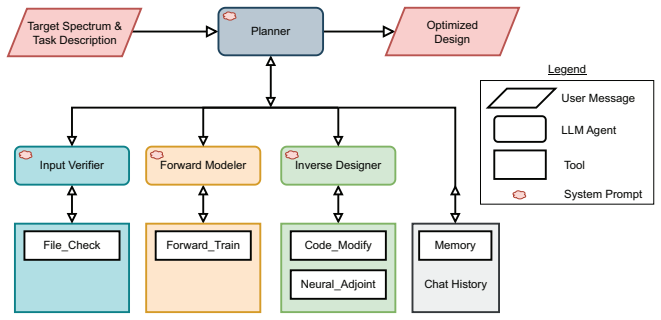
The carrying mechanism is a Controller loop inside a tool named Forward Train: a history log records each event as dataset size, validation MSE, action, and a plain-text reason, and an LLM Controller reads that history together with a target error to decide whether to generate new model code, test the current model on a larger dataset, or stop. The second carrying object is the Neural Adjoint tool, which reuses the trained forward surrogate for inverse design by gradient descent on the geometry parameters until the predicted spectrum matches the target. Memory stores the accumulated chat and event history so the Planner can keep a multi-step strategy coherent across a long run.
What would settle it
Run the same agent against fresh numerical simulations instead of the pre-existing dataset pool: if the forward target MSE is missed or the loop consumes the full 50,000-sample budget without converging, the paper's pooling assumption fails and the adaptive behavior is not validated.
Extended reading notes
Core claim
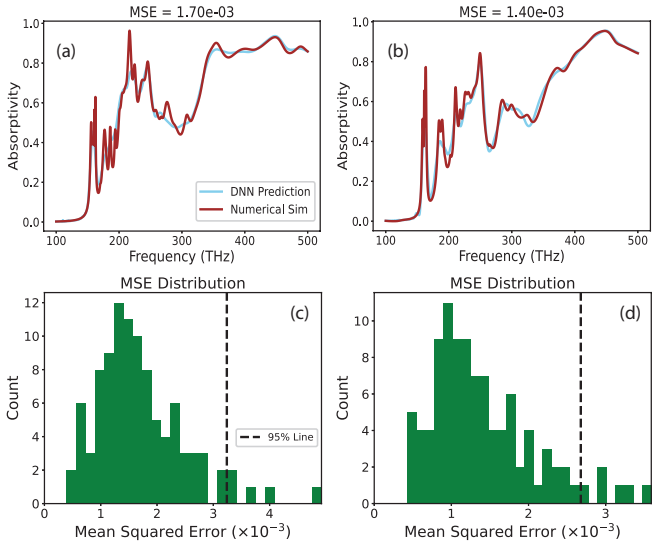
The central claim is that an LLM-based agent team can carry out the complete inverse design loop for an all-dielectric metamaterial without a human choosing the model or data sizes. Queried with a target spectrum and a target MSE, the agent commissions and trains a surrogate forward DNN, expands the dataset when validation error is still falling, generates new architectures when improvements stall, and passes the finished model to a gradient-based inverse tool (the Neural Adjoint method) that proposes a geometry. On the fixed 42,250-sample benchmark the agent's forward models reach $1.3$–$1.5\times10^{-3}$ test MSE, close to the $1.2\times10^{-3}$ of human-built models; its inverse designs score $1.4$–$1.8\times10^{-3}$ re-simulated MSE, worse than the human references of $0.3$–$0.94\times10^{-3}$. The paper attributes the inverse gap to fixed hyperparameters inside the pre-coded inverse tool, not to the forward surrogate.
Load-bearing premise
The agent's data expansion is treated as equivalent to running fresh simulations, so if the pre-existing sample pool is biased or finite in a way that new simulations would not be, the demonstrated adaptability is not a real test of live data acquisition.
Editorial extensions
If this is right
- An agent can reach a target forward MSE of $2\times10^{-3}$ from a small initial dataset, with no human selection of architecture or data size, using anywhere from about 11,500 to 24,000 samples in the reported runs.
- Once a forward surrogate is trained, the same model can be repurposed for inverse design without retraining, so forward-modeling progress directly transfers to geometry proposals.
- The reported forward errors (around $1.3$–$1.5\times10^{-3}$) are close enough to human references ($1.2\times10^{-3}$) to support the claim that agentic planning can replace much of the expert trial-and-error in this workflow.
- The inverse-design errors remain roughly two to five times worse than the human benchmarks, and the paper locates the cause in the fixed hyperparameters of the inverse tool rather than in the forward surrogate.
- Because the agent changed architectures mid-run when validation error stalled, the framework demonstrates adaptive strategy rather than a fixed scripted pipeline.
Reading between the lines
- A decisive extension beyond the paper's setup would be to connect the same Controller loop to an on-demand electromagnetic simulator instead of a fixed sample pool, showing whether the reported adaptive data acquisition survives real simulation cost.
- The logged reasoning strings, for example a predicted $\sim 6.45\times10^{-7}$ MSE gain per sample, provide a cheap quantitative probe of whether the agent's decisions are good, independent of final model accuracy.
- If the inverse tool's hyperparameters are made agent-controllable and the inverse gap closes, the framework would gain true end-to-end autonomy; if not, the fixed inverse tool is a boundary of the current design.
Editorial analysis
A structured set of objections, weighed in public.
Referee Report
Summary. The paper presents an LLM-based multi-agent framework (Planner, Input Verifier, Forward Modeler, Inverse Designer) that autonomously builds a DNN surrogate forward model for an all-dielectric metamaterial benchmark and then applies a neural-adjoint inverse design tool. It reports four runs in a target-MSE experiment and two architectures in a fixed 42,250-sample dataset experiment, comparing forward and inverse MSE to human-baseline results from prior literature.
Significance. If validated, the framework is a useful demonstration of end-to-end automation of a metamaterial inverse-design pipeline. Strengths include the dynamic Controller behavior with explicit reasoning logs, the use of AIDE for architecture search, and an established benchmark that enables direct comparison with human-designed models. The paper is candid in Section 3.2 that inverse errors are worse than human baselines, but this candor is inconsistent with the abstract and conclusion. The central novelty, adaptive data acquisition, rests on an untested equivalence between subsetting a fixed pool and running a simulator. With a proper reservoir protocol and corrected claims, the contribution would be significant for the cs.AI and machine-learning-for-photonics audience.
major comments (3)
- [3.1 (also Fig. 4 and Algorithm 1)] Section 3.1 states that drawing subsets from the existing ADM dataset is 'functionally identical to running new simulations.' This equivalence is load-bearing for the claim that the Controller's data-acquisition decisions demonstrate autonomous, simulation-driven expansion, but the paper provides no evidence for it. No sampling protocol (random vs ordered, with/without replacement), no pool description, and no overlap check between the pool and the 42,250-pair fixed dataset in Section 3.2 are given. At requested sizes of roughly 11,500-24,000 samples, if these are drawn from the same pool, finite-population effects and pool composition could explain the diminishing returns the Controller interprets as saturation; the four trajectories in Fig. 4 might reflect sampling order rather than planning. Please either run the loop against a genuine simulator API for at least one run, or specify a disjoint reservoir protocol that provably mimics fresh simulation, and report pool statistics and overlap checks.
- [Abstract and Section 4 vs Table 1] Table 1 shows inverse MSE of 1.8 and 1.4 (x10^-3) for the agent versus 0.94 and 0.3 (x10^-3) for human baselines, i.e., 1.5 to 4 times worse, while forward MSEs are comparable. The abstract and conclusion claim the framework achieves performance 'comparable to human expert-designed solutions' without this qualification. Since the second bullet contribution in the Introduction asserts 'similar performance to a human scientist,' this overstatement directly affects the central claim. Please revise the abstract and conclusion to distinguish forward performance (comparable) from inverse performance (worse), or improve the Neural Adjoint tool's hyperparameters and report updated inverse errors.
- [Table 1 and Section 3.2] The human baseline numbers are partly reconstructed from figures and repositories of the same group's earlier papers (Refs 8, 16, 19), with footnotes indicating that some values were not directly reported. Please specify whether all forward and inverse MSEs were computed on the same 100-target test set, with identical data splits, normalization, and neural-adjoint settings; otherwise the comparison conflates algorithmic progress with evaluation-protocol differences. At minimum, report standard errors or confidence intervals over multiple runs so the reader can judge whether the forward-MSE gap of 1.3 versus 1.2 (x10^-3) is meaningful.
minor comments (6)
- [3.1] Please explain how the inverse re-simulation MSE of 1.7 x 10^-3 translates to an 'average validation error of ~0.2% in the spectrum'; the mapping between MSE and percent error is not defined.
- [3.2] The text says results are 'shown in Fig. 4(a)-(d)' for the fixed large dataset experiment, but Fig. 4 already contains the target-MSE results from Section 3.1; the reference should point to Fig. 5. The caption of Fig. 6 also contains a duplicated label '(b)', and the in-text sentence 'we show the test set distribution in Fig.6(d)' is redundant.
- [Fig. 4 caption] The caption says the four experiments have 'identical initial conditions,' but the runs use different architectures and reach different dataset sizes; please state which initial conditions are identical (e.g., k0, prompt, seed) and which are allowed to vary.
- [Table 1] The agent's forward models use Smooth L1 loss in one trial and MSE in another, while the human baselines use MSE; please state why this does not affect comparability, or report the training-loss values for all models.
- [2.4 and Supporting Information] The text refers to 'Supporting Information 4' for the AIDE inverse performance comparison, but no supporting information is included in the arXiv version; please include the system prompts and the AIDE-inverse comparison in an appendix or provide a link to the SI.
- [2.1-2.4] For reproducibility, please name the specific LLM models and versions used (e.g., GPT-4 class), the API settings, and the total compute or API cost; none of these details are currently given.
Circularity Check
No significant circularity: the forward and inverse design numbers are validated against independent simulation ground truth, and the reported conclusions do not reduce to their inputs. The low score reflects only the mildly self-referential benchmark setup and the untested pool-sampling equivalence assumption, neither of which makes the central quantitative claims circular.
full rationale
The paper's central results are empirical measurements rather than derivations. The forward-model MSE values (1.3-1.5e-3) are evaluated on held-out test spectra from the ADM dataset, and the inverse-design MSE values (1.4-1.8e-3) are computed by re-simulating the proposed geometries with CST and comparing the resulting spectra to the target spectra. The inverse loop uses the trained forward surrogate inside the Neural Adjoint tool only to propose geometries; the final reported error is the re-simulation error, so the validation is independent of the surrogate's own predictions. The human baselines in Table 1 come from the same group's earlier papers (Refs 8, 16, 19), which is a self-referential benchmark, but those prior numbers are externally published, the agent's outputs are not fitted to them, and the comparison does not by itself force any conclusion. The one assumption that borders on circularity is in Section 3.1, where drawing subsets from the fixed ADM dataset is called 'functionally identical to running new simulations.' That equivalence is asserted rather than proven, and it is what allows the Controller's data-acquisition behavior in Fig. 4 to be interpreted as autonomous simulation-driven expansion. This is best understood as an external-validity risk, not a circular derivation, because the reported MSE values are still evaluated against ground-truth data. No equation in the paper reduces to its own input, and no fitted parameter is renamed as a prediction. Therefore, I find no significant circularity, and the low score reflects only the mildly self-referential benchmark without affecting the independence of the core measurements.
Assumptions & free parameters
free parameters (6)
- Target MSE Mt =
2e-3 (user-specified)
- Data budget =
50,000 samples
- Max rounds =
50
- Initial dataset size k0 =
not stated in main text
- Neural Adjoint hyperparameters =
fixed, not disclosed
- Training:validation split =
10:1
assumptions (4)
- domain assumption Numerical electromagnetic simulation (CEM) provides ground-truth spectra for metamaterial geometries.
- domain assumption The existing ADM benchmark dataset of 42,250 geometry-spectrum pairs is valid and comparable to prior human studies.
- ad hoc to paper Subset sampling from the fixed dataset is functionally identical to requesting new simulations.
- domain assumption The Neural Adjoint gradient path on the surrogate leads to designs that minimize the true (re-simulated) error.
Cite this review
Pith. "Pith review of An Agentic Framework for Autonomous Metamaterial Modeling and Inverse Design." pith.science (2026). https://pith.science/paper/PETT4X7O
@misc{pith2026250606935,
  author       = {Pith},
  title        = {Pith review of: An Agentic Framework for Autonomous Metamaterial Modeling and Inverse Design},
  year         = {2026},
  howpublished = {\url{https://pith.science/paper/PETT4X7O}},
  note         = {Machine review of arXiv:2506.06935}
}
read the original abstract
Recent significant advances in integrating multiple Large Language Model (LLM) systems have enabled Agentic Frameworks capable of performing complex tasks autonomously, including novel scientific research. We develop and demonstrate such a framework specifically for the inverse design of photonic metamaterials. When queried with a desired optical spectrum, the Agent autonomously proposes and develops a forward deep learning model, accesses external tools via APIs for tasks like simulation and optimization, utilizes memory, and generates a final design via a deep inverse method. The framework's effectiveness is demonstrated in its ability to automate, reason, plan, and adapt. Notably, the Agentic Framework possesses internal reflection and decision flexibility, permitting highly varied and potentially novel outputs.
Figures


Figures from the paper (3 more)


Forward citations
Cited by 1 Pith paper
-
Agentic Exploration of Physics Models
A general-purpose LLM agent can discover physics models, including ODEs and spin Hamiltonians, by autonomously choosing experiments and fitting hypotheses to numeric data.
Reference graph
Works this paper leans on
-
[1]
Khatib, O.; Ren, S.; Malof, J.; Padilla, W. J. Deep Learning the Electromagnetic Properties of Metamaterials—A Comprehensive Review. Advanced Functional Materials 2021, 31
work page 2021
-
[2]
A guidance to intelligent metamaterials and metamaterials intelligence
Qian, C.; Kaminer, I.; Chen, H. A guidance to intelligent metamaterials and metamaterials intelligence. Nature Communications 2025, 16
work page 2025
-
[3]
Machine intelligence in metamaterials design: a review
Cerniauskas, G.; Sadia, H.; Alam, P. Machine intelligence in metamaterials design: a review. Oxford Open Materials Science 2024, 4
work page 2024
-
[4]
Harnessing the Missing Spectral Correlation for Metasurface Inverse Design
Zhang, J.; Qian, C.; You, G.; Wang, T.; Saifullah, Y.; Abdi‐Ghaleh, R.; Chen, H. Harnessing the Missing Spectral Correlation for Metasurface Inverse Design. Advanced Science 2024, 11
work page 2024
-
[5]
Diffusion probabilistic model based accurate and high-degree-of-freedom metasurface inverse design
Zhang, Z.; Yang, C.; Qin, Y.; Feng, H.; Feng, J.; Li, H. Diffusion probabilistic model based accurate and high-degree-of-freedom metasurface inverse design. Nanophotonics 2023, 12, 3871–3881
work page 2023
-
[6]
Plasmonic nanostructure design and characterization via Deep Learning
Malkiel, I.; Mrejen, M.; Nagler, A.; Arieli, U.; Wolf, L.; Suchowski, H. Plasmonic nanostructure design and characterization via Deep Learning. Light: Science & Applications 2018, 7
work page 2018
-
[7]
A.; Boltasseva, A.; Cai, W.; Liu, Y
Ma, W.; Liu, Z.; Kudyshev, Z. A.; Boltasseva, A.; Cai, W.; Liu, Y. Deep learning for the design of photonic structures. Nature Photonics 2020, 15, 77–90
work page 2020
-
[8]
Deng, Y.; Ren, S.; Fan, K.; Malof, J. M.; Padilla, W. J. Neural-adjoint method for the inverse design of all-dielectric metasurfaces. Opt. Express 2021, 29, 7526
work page 2021
Show all 38 references
-
[9]
Prediction network of metamaterial with split ring resonator based on deep learning
Hou, Z.; Tang, T.; Shen, J.; Li, C.; Li, F. Prediction network of metamaterial with split ring resonator based on deep learning. Nanoscale research letters 2020, 15, 1--8
2020
-
[10]
G.; Joannopoulos, J
Peurifoy, J.; Shen, Y.; Jing, L.; Yang, Y.; Cano-Renteria, F.; DeLacy, B. G.; Joannopoulos, J. D.; Tegmark, M.; Soljačić, M. Nanophotonic particle simulation and inverse design using artificial neural networks. Science Advances 2018, 4
2018
-
[11]
Metamaterial design with nested-CNN and prediction improvement with imputation
K ym k, E.; Ercelebi, E. Metamaterial design with nested-CNN and prediction improvement with imputation. Applied Sciences 2022, 12, 3436
2022
-
[12]
Dispersion relation prediction and structure inverse design of elastic metamaterials via deep learning
Jiang, W.; Zhu, Y.; Yin, G.; Lu, H.; Xie, L.; Yin, M. Dispersion relation prediction and structure inverse design of elastic metamaterials via deep learning. Materials Today Physics 2022, 22, 100616
2022
-
[13]
Y.; Ang, Y
Zhang, T.; Kee, C. Y.; Ang, Y. S.; Ang, L. K. Deep learning-based design of broadband GHz complex and random metasurfaces. APL Photonics 2021, 6
2021
-
[14]
Broadband solar metamaterial absorbers empowered by transformer-based deep learning
Chen, W.; Gao, Y.; Li, Y.; Yan, Y.; Ou, J.-Y.; Ma, W.; Zhu, J. Broadband solar metamaterial absorbers empowered by transformer-based deep learning. Advanced Science 2023, 10, 2206718
2023
-
[15]
MetasurfaceViT: A generic AI model for metasurface inverse design
Yan, J.; Yi, J.; Ma, C.; Bao, Y.; Chen, Q.; Li, B. MetasurfaceViT: A generic AI model for metasurface inverse design. 2025; https://arxiv.org/abs/2504.14895
2025 arXiv
-
[16]
Benchmarking data-driven surrogate simulators for artificial electromagnetic materials
Deng, Y.; Dong, J.; Ren, S.; Khatib, O.; Soltani, M.; Tarokh, V.; Padilla, W.; Malof, J. Benchmarking data-driven surrogate simulators for artificial electromagnetic materials. Thirty-fifth Conference on Neural Information Processing Systems Datasets and Benchmarks Track (Roun...
2021
-
[17]
Graph Neural Networks for Metasurface Modeling
Khoram, E.; Wu, Z.; Qu, Y.; Zhou, M.; Yu, Z. Graph Neural Networks for Metasurface Modeling. ACS Photonics 2022,
2022
-
[18]
Inverse design of a metasurface based on a deep tandem neural network
Xu, P.; Lou, J.; Li, C.; Jing, X. Inverse design of a metasurface based on a deep tandem neural network. Journal of the Optical Society of America B 2023, 41, A1
2023
-
[19]
J.; Malof, J
Ren, S.; Mahendra, A.; Khatib, O.; Deng, Y.; Padilla, W. J.; Malof, J. M. Inverse deep learning methods and benchmarks for artificial electromagnetic material design. Nanoscale 2022, 14, 3958–3969
2022
-
[20]
Khaireh-Walieh, A.; Langevin, D.; Bennet, P.; Teytaud, O.; Moreau, A.; Wiecha, P. R. A newcomer’s guide to deep learning for inverse design in nano-photonics. Nanophotonics 2023, 12, 4387–4414
2023
-
[21]
Deng, Y.; Ren, S.; Malof, J.; Padilla, W. J. Deep inverse photonic design: A tutorial. Photonics and Nanostructures - Fundamentals and Applications 2022, 52, 101070
2022
-
[22]
nature 2021, 596, 583--589
Jumper, J.; Evans, R.; Pritzel, A.; Green, T.; Figurnov, M.; Ronneberger, O.; Tunyasuvunakool, K.; Bates, R.; Z \' dek, A.; Potapenko, A.; others Highly accurate protein structure prediction with AlphaFold. nature 2021, 596, 583--589
2021
-
[23]
Neural operators for accelerating scientific simulations and design
Azizzadenesheli, K.; Kovachki, N.; Li, Z.; Liu-Schiaffini, M.; Kossaifi, J.; Anandkumar, A. Neural operators for accelerating scientific simulations and design. Nature Reviews Physics 2024, 6, 320--328
2024
-
[24]
P.; Barzilay, R
Walters, W. P.; Barzilay, R. Applications of deep learning in molecule generation and molecular property prediction. Accounts of chemical research 2020, 54, 263--270
2020
-
[25]
Benchmarking deep inverse models over time, and the neural-adjoint method
Ren, S.; Padilla, W.; Malof, J. Benchmarking deep inverse models over time, and the neural-adjoint method. Advances in Neural Information Processing Systems 2020, 33, 38--48
2020
-
[26]
D.; Dhariwal, P.; Neelakantan, A.; Shyam, P.; Sastry, G.; Askell, A.; others Language models are few-shot learners
Brown, T.; Mann, B.; Ryder, N.; Subbiah, M.; Kaplan, J. D.; Dhariwal, P.; Neelakantan, A.; Shyam, P.; Sastry, G.; Askell, A.; others Language models are few-shot learners. Advances in neural information processing systems 2020, 33, 1877--1901
2020
-
[27]
V.; Zhou, D.; others Chain-of-thought prompting elicits reasoning in large language models
Wei, J.; Wang, X.; Schuurmans, D.; Bosma, M.; Xia, F.; Chi, E.; Le, Q. V.; Zhou, D.; others Chain-of-thought prompting elicits reasoning in large language models. Advances in neural information processing systems 2022, 35, 24824--24837
2022
-
[28]
Self-consistency improves chain of thought reasoning in language models
Wang, X.; Wei, J.; Schuurmans, D.; Le, Q.; Chi, E.; Narang, S.; Chowdhery, A.; Zhou, D. Self-consistency improves chain of thought reasoning in language models. arXiv preprint arXiv:2203.11171 2022,
2022 arXiv
-
[29]
Tree of thoughts: Deliberate problem solving with large language models
Yao, S.; Yu, D.; Zhao, J.; Shafran, I.; Griffiths, T.; Cao, Y.; Narasimhan, K. Tree of thoughts: Deliberate problem solving with large language models. Advances in neural information processing systems 2023, 36, 11809--11822
2023
-
[30]
Code complete: a practical handbook of software construction; Microsoft Press, 1993
MacConnell, S. Code complete: a practical handbook of software construction; Microsoft Press, 1993
1993
-
[31]
T.; Foerster, J.; Clune, J.; Ha, D
Lu, C.; Lu, C.; Lange, R. T.; Foerster, J.; Clune, J.; Ha, D. The AI Scientist: Towards Fully Automated Open-Ended Scientific Discovery. 2024; https://arxiv.org/abs/2408.06292
2024 arXiv
-
[32]
Agent Laboratory: Using LLM Agents as Research Assistants
Schmidgall, S.; Su, Y.; Wang, Z.; Sun, X.; Wu, J.; Yu, X.; Liu, J.; Liu, Z.; Barsoum, E. Agent Laboratory: Using LLM Agents as Research Assistants. 2025; https://arxiv.org/abs/2501.04227
2025 arXiv
-
[33]
Lupoiu, R.; Shao, Y.; Dai, T.; Mao, C.; Edee, K.; Fan, J. A. A multi-agentic framework for real-time, autonomous freeform metasurface design. 2025; https://arxiv.org/abs/2503.20479
2025 arXiv
-
[34]
AIDE: AI-Driven Exploration in the Space of Code
Jiang, Z.; Schmidt, D.; Srikanth, D.; Xu, D.; Kaplan, I.; Jacenko, D.; Wu, Y. AIDE: AI-Driven Exploration in the Space of Code. arXiv preprint arXiv:2502.13138 2025,
2025 arXiv
-
[35]
S.; Chowdhury, N.; Jaffe, O.; Aung, J.; Sherburn, D.; Mays, E.; Starace, G.; Liu, K.; Maksin, L.; Patwardhan, T.; Madry, A.; Weng, L
Chan, J. S.; Chowdhury, N.; Jaffe, O.; Aung, J.; Sherburn, D.; Mays, E.; Starace, G.; Liu, K.; Maksin, L.; Patwardhan, T.; Madry, A.; Weng, L. MLE -bench: Evaluating Machine Learning Agents on Machine Learning Engineering. The Thirteenth International Conference on Learning Re...
2025
-
[36]
Benchmarking Deep Inverse Models over time, and the Neural-Adjoint method
Ren, S.; Padilla, W.; Malof, J. Benchmarking Deep Inverse Models over time, and the Neural-Adjoint method. Advances in Neural Information Processing Systems. 2020; pp 38--48
2020
-
[37]
M.; Padilla, W
Deng, Y.; Ren, S.; Fan, K.; Malof, J. M.; Padilla, W. J. Neural-adjoint method for the inverse design of all-dielectric metasurfaces. Optics Express 2021, 29, 7526
2021
-
[38]
initialization
Zhang, J.; Hu, S.; Lu, C.; Lange, R.; Clune, J. Darwin Godel Machine: Open-Ended Evolution of Self-Improving Agents. arXiv preprint arXiv:2505.22954 2025, mcitethebibliography main.tex0000664000000000000000000012753715035430676011254 0ustar rootroot [journal=apchd5, manuscript...
2025 arXiv
Reviewed August 7, 2026 · model on record in the stance chip above.
Discussion (0). Sign in to comment.