REVIEW 3 major objections 6 minor 43 references
Spin pumping driven by magnon-polaritons in a ferromagnet-coplanar superconducting resonator hybrid system
T0 review · 3 major / 6 minor · reviewed 2026-08-07 · deepseek-v4-flash
Pith's one-line read Electrical readout catches magnons and photons coupling at 1.4 K
desk verdict A credible demonstration of electrical detection of strongly coupled magnon-photon modes in a superconducting resonator at 1.4 K, but the missing spin-rectification separation and inconsistent hybridization fields demand revision before the quantitative claims hold. read the letter →
The pith
A machine-rendered reading of the paper's core claim, the machinery that carries it, and where it could break.
The reading
What carries the argument
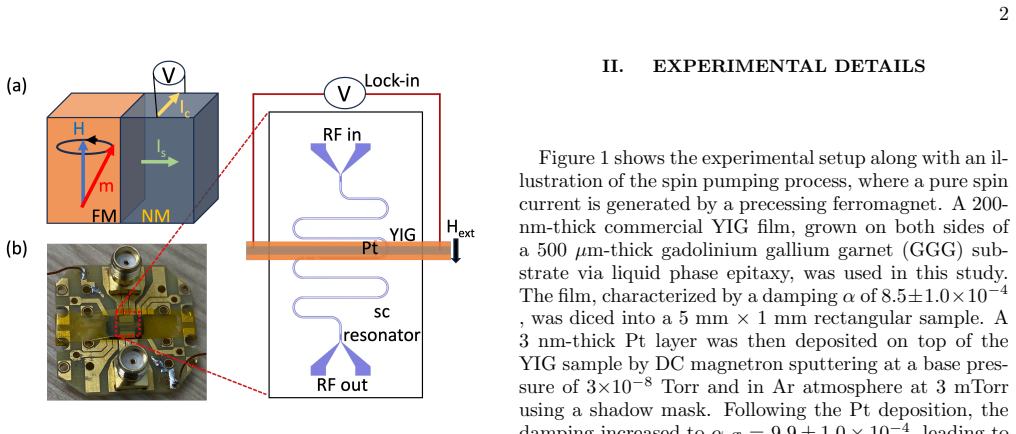
The load-bearing object is the flip-chip hybrid: a 200 nm YIG film with a 3 nm Pt strip placed on top of a NbN coplanar waveguide resonator, where the resonator mode volume is small and the magnon mode of YIG couples to the microwave magnetic field through the Zeeman interaction. Spin pumping turns the coherent precession into a spin current across the YIG/Pt interface, and the inverse spin Hall effect converts that spin current into a DC voltage measured with a lock-in. The argument is carried by the coupled-oscillator model expressed in Eq. (2), which gives both the resonance field positions (real part) and the coupled-mode linewidths (imaginary part), together with the proportionality $V_{\mathrm{SP}} \propto |m|^2$, which ties the measured voltage to the squared magnetization amplitude. This machinery lets the authors extract $g$, $\alpha$, $\beta$, and $4\pi M_{\mathrm{eff}}$ from electrical data alone and compare them with independent VNA transmission fits.
What would settle it
Re-measure the voltage signal with the external magnetic field reversed, or rotate the sample by 180 degrees in the plane, using the universal method of separating spin pumping from spin rectification; if a rectification component of comparable size appears, the electrically extracted linewidths and coupling strength would be distorted. A second check is to measure the coupling strength at low microwave powers where the resonator is linear: if $g$ still decreases with power in that regime, the nonlinear-resonator explanation would be incomplete.
Extended reading notes
Core claim
On the paper's own terms, the central discovery is that the inverse spin Hall voltage across a platinum stripe can serve as a direct electrical reporter of strongly coupled magnon-photon modes at 1.4 K. As the magnetic field is swept at fixed microwave frequency, the spin-pumping voltage follows a Kittel-like magnon mode that splits into two branches near the resonator frequency, and the magnon linewidth broadens as the modes hybridize. Fitting the field-frequency map to the coupled-oscillator dispersion of Eq. (2) gives an effective magnetization $4\pi M_{\mathrm{eff}} = 2.03$ kOe, damping $\alpha = 9.9 \pm 3 \times 10^{-4}$, resonator loss $\beta = 5.5 \pm 0.6 \times 10^{-3}$, and a coupling strength $g = 105 \pm 5$ MHz, all consistent with the parameters obtained from microwave transmission, where $g = 90 \pm 4$ MHz. The authors interpret the reduction of the coupling at high microwave power, and the simultaneous disappearance of the bare resonator mode, as the signature of a nonlinear regime of the NbN resonator driven into mode bifurcation, with the hybridized state partially restoring the observable signal.
Load-bearing premise
The analysis assumes that the DC voltage measured across the platinum strip comes entirely from inverse spin Hall spin pumping of coherent magnetization precession, with no separately measured spin-rectification or thermoelectric background.
Editorial extensions
If this is right
- Strongly coupled magnon-photon modes can be detected electrically in a thin-film, chip-compatible geometry, without a three-dimensional cavity.
- The coupling strength read out electrically ($g = 105 \pm 5$ MHz) agrees with microwave transmission ($g = 90 \pm 4$ MHz), so spin pumping provides an independent and comparable measure of the avoided-crossing gap.
- Magnon linewidth broadening near the coupling region confirms that hybridization increases the effective damping in a way consistent with the coupled-oscillator model.
- Microwave power tunes the coupling strength: above a threshold the NbN resonator enters a nonlinear regime, the coupling weakens, and the bare resonator mode is suppressed.
- Loading the resonator with the YIG/Pt bilayer shifts the nonlinearity threshold from about $-15$ dBm to above $+15$ dBm, because the added losses broaden the resonator and reduce its intensity.
Reading between the lines
- If the electrical readout survives at single-photon power levels, it could serve as an on-chip transducer that connects magnonic and superconducting quantum circuits without a separate microwave link.
- The power-dependent decrease of $g$ suggests a possible in-situ tuning knob for magnon-photon coupling, although here it is mediated by added dissipation rather than a clean dispersive shift.
- Applying the spin-pumping versus spin-rectification separation at 1.4 K would test whether the voltage lineshape asymmetry near the coupling region is purely a phase-correlation effect or contains a rectification admixture.
- Material-level control of NbN grain boundaries, which the paper identifies as weak links, could raise the power threshold for nonlinearity and widen the linear operating range of such hybrids.
Editorial analysis
A structured set of objections, weighed in public.
Referee Report
Summary. The manuscript reports the electrical detection of strongly coupled magnon-photon modes in a YIG/Pt bilayer flip-chipped onto a NbN superconducting coplanar resonator at 1.4 K. A DC voltage across the Pt layer, attributed to the inverse spin-Hall effect (ISHE) from spin pumping, is recorded as a function of magnetic field at fixed microwave frequencies. The data show an avoided crossing of the magnon and resonator modes, a linewidth increase of the magnon mode near the coupling region, and a coupling strength g = 105 ± 5 MHz extracted from fits to the coupled-oscillator dispersion of Ref. [20], in approximate agreement with g = 90 ± 4 MHz obtained from VNA transmission spectra under the same conditions. Power-dependent experiments show that the frequency separation of the hybrid modes shrinks with increasing power, which the authors attribute to the onset of nonlinearity/bifurcation in the superconducting resonator above a threshold power; the appearance of bifurcation in the unloaded and loaded resonator is documented. The central claim is that the spin-pumping voltage provides a faithful electrical readout of the magnon-polariton states and of the power dependence of the coupling.
Significance. The qualitative result — an electrically detected avoided crossing with a correlated linewidth broadening, cross-checked against microwave transmission — is a useful demonstration for hybrid magnon-superconductor circuits operating at cryogenic temperature, where electrical readout is a practical advantage. The paper should be credited for several strengths: the avoided crossing and linewidth enhancement are directly visible in the data rather than being generated by the model; the electrical and VNA channels are measured in a common cryogenic configuration; the fitted parameters (effective magnetization, damping, resonator loss) are consistent between the two channels; and the characterization of the resonator's power-dependent bifurcation is careful and includes the unloaded-resonator control. The power-dependent suppression of the coupling, if confirmed, is an interesting observation for the community.
major comments (3)
- [Sec. III, Fig. 2 and Eq. (2), with Ref. [41]] The identification of the measured DC voltage with ISHE spin pumping is not experimentally established. The analysis assumes V_SP ∝ |m|^2 and the text explicitly cites the universal separation method of Ref. [41], yet no field-reversal, in-plane-angle, or control-sample separation of spin pumping from spin-rectification and thermoelectric contributions is reported. All electrical data were taken at +20 dBm, where the authors' own VNA data (Figs. 3(c)-(d)) place the loaded resonator at or above the onset of bifurcation; in this regime spin-rectification and thermoelectric backgrounds are not negligible, and the approximately Lorentzian shape far from the crossing does not exclude a symmetric rectification component. Because the fits to Eq. (2) use only peak positions and widths, a background would directly bias the linewidth enhancement in Fig. 2(c) and the extracted g = 105 ± 5 MHz; the VNA comparison (g = 90 ± 4 MHz) does not resolve this because it is acquired in the same nonlinear regime. A quantitative bound on the rectification contribution, or the symmetry-based separation of Ref. [41], is needed to support the central electrical-detection claim.
- [Sec. III, Figs. 2-4] The hybridization field is quoted as approximately 1.25 kOe in Fig. 2(a), 1.220 kOe at -30 dBm and 1.215 kOe at +20 dBm in Fig. 3(b), and 1.275 kOe in Fig. 4(b), with the text asserting in one place that the hybridization field remains constant across powers. With the fitted 4πM_eff = 2.03 kOe and γ = 2.83 GHz/kOe, these fields correspond to bare Kittel frequencies of approximately 5.73, 5.64, and 5.81 GHz, respectively, which is a larger spread than the stated resonator-frequency uncertainty. Since g is extracted from the mode separation at the hybridization field, a roughly 200 MHz ambiguity in the underlying resonator frequency between the electrical and VNA data sets weakens the quantitative comparison (105 versus 90 MHz). The authors should report the resonator frequency actually used in each run, or provide a field/frequency calibration check, and explain the inconsistency.
- [Sec. III, Fig. 4(b) and Fig. 3(d)] The power dependence of the coupling is inferred from the frequency separation of the upper and lower hybrid branches at the crossing field, but the measurements in that regime are taken where the resonator is explicitly nonlinear: the unloaded resonator already bifurcates above -15 dBm and the loaded resonator above about +15 dBm, with strongly asymmetric lineshapes and abrupt jumps (Fig. 3(d)). Peak positions extracted from such distorted lineshapes are not a reliable proxy for 2g, so the decreasing separation with power does not by itself establish a decrease in the coupling strength. The trend should be validated either by measurements in the linear regime (below the bifurcation threshold of the loaded device) or by fitting the full coupled-oscillator model, including the nonlinear lineshape, to the spectra.
minor comments (6)
- [Secs. II and III] The loaded resonator frequency appears as approximately 5.8 GHz in Sec. II and as 5.9 GHz in the discussion of Fig. 3(d); please reconcile the value used for the loaded device.
- [Sec. III and Fig. 4(a)] The three microwave powers used in Fig. 4(a) are not specified in the text; please give the actual power values.
- [Sec. III, Fig. 4(b)] The parenthetical statement that the hybridization field remains constant at 1.275 kOe directly conflicts with the stated shift from 1.220 to 1.215 kOe in the VNA data; please clarify the measurement conditions for each run.
- [Sec. I] Typo: 'in an high-cooperativity system' should read 'in a high-cooperativity system'.
- [Sec. III] The sentence 'At the resonance frequency of the SC resonator of ~5.8 GHz, a vanishingly small signal is observed' is ambiguous; it is not clear whether it refers to the spin-pumping signal of the magnon mode at the crossing or to a resonator-frequency band in the voltage map, and it should be clarified.
- [Sec. III, Fig. 2 and Eq. (2)] The electrical fit to Eq. (2) quotes no uncertainties for 4πM_eff and γ, while the VNA fit quotes 4πM_eff = 2.02 ± 0.10 kOe; a brief description of the fitting procedure, fitting ranges, and uncertainty propagation for the five correlated parameters would strengthen the quantitative comparison between the two channels.
Circularity Check
No significant circularity: the coupled-mode model is fit to two independent datasets, and the central signatures are directly observed.
full rationale
The paper's derivation chain is empirical and self-contained. It measures the spin-pumping voltage as a function of frequency and magnetic field and separately measures VNA transmission under identical conditions, then fits an independently published coupled-mode dispersion relation (Eq. (2), from Ref. [20]) and an equivalent harmonic-oscillator model (SM Eq. SM1) to the two datasets. The avoided crossing, mode splitting, and linewidth broadening are directly visible in the raw spectra (Figs. 2(a), 2(b), 2(d), 3(a)) rather than generated by the fit. The extracted coupling strengths, g = 105 ± 5 MHz from electrical detection and g = 90 ± 4 MHz from VNA, are cross-compared, so the electrical result is not forced by the microwave fit or vice versa. The model is taken from prior literature rather than re-derived from the present data, which is normal use of an established theory and does not constitute a circular reduction. No fitted parameter is renamed as a prediction, and no uniqueness theorem or ansatz is imported from the authors' own prior work to force the conclusion. The self-citations present (Refs. 12, 19, 22, 36) are background, method, or parameter-characterization references and are not load-bearing for the central claim. The one notable weakness, namely that no explicit spin-rectification or thermoelectric background separation is reported even though Ref. [41] is cited, is a physical-interpretation and correctness risk for the electrical signal, not a logical circularity in the derivation chain. The paper is self-contained against external benchmarks: the avoided crossing is a direct experimental observation, and the extracted parameters are cross-checked between two independent measurement channels.
Assumptions & free parameters
free parameters (5)
- magnon-photon coupling strength g =
105 +/- 5 MHz (spin pumping); 90 +/- 4 MHz (VNA)
- effective magnetization 4*pi*M_eff =
2.03 kOe (spin pumping); 2.02 +/- 0.10 kOe (VNA)
- gyromagnetic ratio gamma =
2.83 GHz/kOe
- magnon damping parameter alpha =
9.9 +/- 3e-4 (spin pumping); 1.0 +/- 0.3e-3 (VNA)
- resonator intrinsic loss rate beta =
5.5 +/- 0.6e-3 (spin pumping); 4.0 +/- 1.1e-3 (VNA)
assumptions (3)
- domain assumption The hybrid system is described by two linearly coupled damped harmonic oscillators with constant damping rates, as in Eq. (2) from Ref. [20].
- domain assumption The measured DC voltage across the Pt stripe is proportional to |m|^2 and arises from ISHE spin pumping, with no significant spin-rectification or thermal background.
- domain assumption The power-dependent nonlinearity of the superconducting resonator is caused by local heating of weak links at NbN grain boundaries (Ref. [42]) and is the reason the coupling strength decreases at high power.
Cite this review
Pith. "Pith review of Spin pumping driven by magnon-polaritons in a ferromagnet-coplanar superconducting resonator hybrid system." pith.science (2026). https://pith.science/paper/ZAPPZ2BF
@misc{pith2026250606996,
  author       = {Pith},
  title        = {Pith review of: Spin pumping driven by magnon-polaritons in a ferromagnet-coplanar superconducting resonator hybrid system},
  year         = {2026},
  howpublished = {\url{https://pith.science/paper/ZAPPZ2BF}},
  note         = {Machine review of arXiv:2506.06996}
}
read the original abstract
We demonstrate spin pumping driven by a strongly coupled magnon-photon system using a ferromagnet-coplanar superconducting resonator hybrid system at 1.4 K. Electrical readout via the inverse spin-Hall effect reveals characteristic coupling features, including mode splitting and linewidth broadening, demonstrating the electrical detection of strongly coupled microwave photons and magnons. The magnon-photon coupling strength obtained by combined spin pumping and inverse spin-Hall effect measurements is compared to microwave transmission experiments. Furthermore, microwave power-dependent measurements reveal a decrease in the coupling strength with increasing microwave power alongside the onset of nonlinearities of the superconducting resonator above a critical microwave power threshold.
Figures


Figures from the paper (1 more)

Reference graph
Works this paper leans on
-
[41]
L. Bai, P. Hyde, Y. S. Gui, C.-M. Hu, V. Vlaminck, J. E. Pearson, S. D. Bader, and A. Hoffmann, Universal method for separating spin pumping from spin rectifica- tion voltage of ferromagnetic resonance, Phys. Rev. Lett. 111, 217602 (2013)
work page 2013
-
[20]
L. Bai, M. Harder, Y. P. Chen, X. Fan, J. Q. Xiao, and C.-M. Hu, Spin pumping in electrodynamically coupled magnon-photon systems, Phys. Rev. Lett.114, 227201 (2015)
2015
-
[1]
Tabuchi, S
Y. Tabuchi, S. Ishino, A. Noguchi, T. Ishikawa, R. Ya- mazaki, K. Usami, and Y. Nakamura, Coherent coupling between a ferromagnetic magnon and a superconducting qubit, Science349, 405 (2015)
2015
-
[2]
Zhang, C.-L
X. Zhang, C.-L. Zou, L. Jiang, and H. X. Tang, Strongly coupled magnons and cavity microwave photons, Phys. Rev. Lett.113, 156401 (2014)
2014
-
[3]
R. T. Sutherland and R. Srinivas, Universal hybrid quan- tum computing in trapped ions, Phys. Rev. A104, 032609 (2021)
2021
-
[4]
R. A. DeCrescent, Z. Wang, P. Imany, R. C. Boutelle, C. A. McDonald, T. Autry, J. D. Teufel, S. W. Nam, R. P. Mirin, and K. L. Silverman, Large single-phonon op- tomechanical coupling between quantum dots and tightly confined surface acoustic waves in the quantum regime, Phys. Rev. Appl.18, 034067 (2022)
work page 2022
-
[5]
D. Lachance-Quirion, Y. Tabuchi, A. Gloppe, K. Usami, and Y. Nakamura, Hybrid quantum systems based on magnonics, Applied Physics Express12, 070101 (2019). 6
work page 2019
-
[6]
A. V. Chumak, V. I. Vasyuchka, A. A. Serga, and B. Hillebrands, Magnon spintronics, Nature Phys11, 453 (2015)
work page 2015
Show all 43 references
-
[7]
J. O. Artman and P. E. Tannenwald, Measurement of permeability tensor in ferrites, Phys. Rev.91, 1014 (1953)
1953
-
[8]
¨O. O. Soykal and M. E. Flatt´ e, Strong Field Interactions between a Nanomagnet and a Photonic Cavity, Physical Review Letters104, 077202 (2010)
2010
-
[9]
Zhang, C.-L
X. Zhang, C.-L. Zou, L. Jiang, and H. X. Tang, Cavity magnomechanics, Sci. Adv.2, e1501286 (2016)
2016
-
[10]
J. Chen, C. Liu, T. Liu, Y. Xiao, K. Xia, G. E. W. Bauer, M. Wu, and H. Yu, Strong interlayer magnon-magnon coupling in magnetic metal-insulator hybrid nanostruc- tures, Phys. Rev. Lett.120, 217202 (2018)
2018
-
[11]
Klingler, H
S. Klingler, H. Maier-Flaig, R. Gross, C.-M. Hu, H. Huebl, S. T. B. Goennenwein, and M. Weiler, Com- bined Brillouin light scattering and microwave absorp- tion study of magnon-photon coupling in a split-ring resonator/yig film system, Applied Physics Letters109, 072402 (2016)
2016
-
[12]
Wagle, Y
D. Wagle, Y. Li, M. T. Kaffash, S. Lendinez, M. T. Hos- sain, V. Novosad, and M. B. Jungfleisch, Observation of thermally activated coherent magnon-magnon coupling in a magnonic hybrid system (2025), arXiv:2503.14875 [cond-mat.mes-hall]
2025
-
[13]
Tabuchi, S
Y. Tabuchi, S. Ishino, T. Ishikawa, R. Yamazaki, K. Usami, and Y. Nakamura, Hybridizing ferromagnetic magnons and microwave photons in the quantum limit, Phys. Rev. Lett.113, 083603 (2014)
2014
-
[14]
Huebl, C
H. Huebl, C. W. Zollitsch, J. Lotze, F. Hocke, M. Greifen- stein, A. Marx, R. Gross, and S. T. B. Goennenwein, High cooperativity in coupled microwave resonator ferri- magnetic insulator hybrids, Phys. Rev. Lett.111, 127003 (2013)
2013
-
[15]
B. Bhoi, T. Cliff, I. S. Maksymov, M. Kostylev, R. Aiyar, N. Venkataramani, S. Prasad, and R. L. Stamps, Study of photon–magnon coupling in a yig-film split-ring resonant system, Journal of Applied Physics116, 243906 (2014)
2014
-
[16]
Y. Li, T. Polakovic, Y.-L. Wang, J. Xu, S. Lendinez, Z. Zhang, J. Ding, T. Khaire, H. Saglam, R. Di- van, J. Pearson, W.-K. Kwok, Z. Xiao, V. Novosad, A. Hoffmann, and W. Zhang, Strong coupling between magnons and microwave photons in on-chip ferromagnet- superconductor thin-f...
2019
-
[17]
Osada, A
A. Osada, A. Gloppe, R. Hisatomi, A. Noguchi, R. Ya- mazaki, M. Nomura, Y. Nakamura, and K. Usami, Bril- louin light scattering by magnetic quasivortices in cavity optomagnonics, Phys. Rev. Lett.120, 133602 (2018)
2018
-
[18]
Hisatomi, A
R. Hisatomi, A. Osada, Y. Tabuchi, T. Ishikawa, A. Noguchi, R. Yamazaki, K. Usami, and Y. Nakamura, Bidirectional conversion between microwave and light via ferromagnetic magnons, Phys. Rev. B93, 174427 (2016)
2016
-
[19]
M. T. Kaffash, D. Wagle, A. Rai, T. Meyer, J. Q. Xiao, and M. B. Jungfleisch, Direct probing of strong magnon–photon coupling in a planar geometry, Quan- tum Science and Technology8, 01LT02 (2022)
2022
-
[21]
P.-C. Xu, J. W. Rao, Y. Wang, Y. S. Gui, J. Q. Xiao, X. Jin, and C.-M. Hu, Electrical detection of magnon- photon interactions via an auxiliary spin-wave mode, Phys. Rev. B102, 014453 (2020)
2020
-
[22]
Wagle, A
D. Wagle, A. Rai, M. T. Kaffash, and M. B. Jungfleisch, Controlling magnon-photon coupling in a planar geome- try, Journal of Physics: Materials7, 025005 (2024)
2024
-
[23]
Q. Xu, H. F. H. Cheung, D. S. Cormode, T. O. Puel, S. Pal, H. Yusuf, M. Chilcote, M. E. Flatt´ e, E. Johnston- Halperin, and G. D. Fuchs, Strong photon-magnon cou- pling using a lithographically defined organic ferrimag- net, Advanced Science11, 2310032 (2024)
2024
-
[24]
I. A. Golovchanskiy, N. N. Abramov, V. S. Stolyarov, M. Weides, V. V. Ryazanov, A. A. Golubov, A. V. Ustinov, and M. Y. Kupriyanov, Ultrastrong photon-to- magnon coupling in multilayered heterostructures involv- ing superconducting coherence via ferromagnetic layers, Science A...
2021
-
[25]
Ghirri, C
A. Ghirri, C. Bonizzoni, M. Maksutoglu, A. Mercu- rio, O. Di Stefano, S. Savasta, and M. Affronte, Ultra- strong magnon-photon coupling achieved by magnetic films in contact with superconducting resonators, Phys. Rev. Appl.20, 024039 (2023)
2023
-
[26]
R. G. E. Morris, A. F. van Loo, S. Kosen, and A. D. Karenowska, Strong coupling of magnons in a yig sphere to photons in a planar superconducting resonator in the quantum limit, Sci. Rep.7, 11511 (2017)
2017
-
[27]
Y. Li, V. G. Yefremenko, M. Lisovenko, C. Trevillian, T. Polakovic, T. W. Cecil, P. S. Barry, J. Pearson, R. Di- van, V. Tyberkevych, C. L. Chang, U. Welp, W.-K. Kwok, and V. Novosad, Coherent coupling of two remote magnonic resonators mediated by superconducting cir- cuits, P...
2022
-
[28]
Wandui, J
A. Wandui, J. J. Bock, C. Frez, M. Hollister, L. Minu- tolo, H. Nguyen, B. Steinbach, A. Turner, J. Zmuidzinas, and R. O’Brient, Thermal kinetic inductance detectors for millimeter-wave detection, Journal of Applied Physics 128, 044508 (2020)
2020
-
[29]
Ulbricht, B
G. Ulbricht, B. A. Mazin, P. Szypryt, A. B. Wal- ter, C. Bockstiegel, and B. Bumble, Highly multiplexi- ble thermal kinetic inductance detectors for x-ray imag- ing spectroscopy, Applied Physics Letters106, 251103 (2015)
2015
-
[30]
J. M. Martinis, Superconducting phase qubits, Quantum Information Processing8, 81 (2009)
2009
-
[31]
J. J. Morton and P. Bertet, Storing quantum informa- tion in spins and high-sensitivity esr, Journal of Magnetic Resonance287, 128 (2018)
2018
-
[32]
McKenzie-Sell, J
L. McKenzie-Sell, J. Xie, C.-M. Lee, J. W. A. Robinson, C. Ciccarelli, and J. A. Haigh, Low-impedance super- conducting microwave resonators for strong coupling to small magnetic mode volumes, Phys. Rev. B99, 140414 (2019)
2019
-
[33]
Mandal, L
S. Mandal, L. N. Kapoor, S. Ghosh, J. Jesudasan, S. Manni, A. Thamizhavel, P. Raychaudhuri, V. Singh, and M. M. Deshmukh, Coplanar cavity for strong cou- pling between photons and magnons in van der Waals antiferromagnet, Applied Physics Letters117, 263101 (2020)
2020
-
[34]
P. G. Baity, D. A. Bozhko, R. Macˆ edo, W. Smith, R. C. Holland, S. Danilin, V. Seferai, J. Barbosa, R. R. Peroor, S. Goldman, U. Nasti, J. Paul, R. H. Hadfield, S. McVi- tie, and M. Weides, Strong magnon–photon coupling with chip-integrated YIG in the zero-temperature limit, ...
2021
-
[35]
Haygood, M
I. Haygood, M. Pufall, E. Edwards, J. M. Shaw, and W. Rippard, Strong coupling of an Fe-Co alloy with ul- tralow damping to superconducting co-planar waveguide resonators, Phys. Rev. Appl.15, 054021 (2021)
2021
-
[36]
M. B. Jungfleisch, A. V. Chumak, A. Kehlberger, V. Lauer, D. H. Kim, M. C. Onbasli, C. A. Ross, M. Kl¨ aui, and B. Hillebrands, Thickness and power de- pendence of the spin-pumping effect in y 3fe5o12/pt het- erostructures measured by the inverse spin hall effect, Phys. Rev. B...
2015
-
[37]
Polakovic, S
T. Polakovic, S. Lendinez, J. E. Pearson, A. Hoffmann, V. Yefremenko, C. L. Chang, W. Armstrong, K. Hafidi, G. Karapetrov, and V. Novosad, Room temperature de- position of superconducting niobium nitride films by ion beam assisted sputtering, APL Materials6, 076107 (2018)
2018
-
[38]
Beaulieu, N
N. Beaulieu, N. Kervarec, N. Thiery, O. Klein, V. Nale- tov, H. Hurdequint, G. de Loubens, J. B. Youssef, and N. Vukadinovic, Temperature dependence of magnetic properties of a ultrathin yttrium-iron garnet film grown by liquid phase epitaxy: Effect of a pt overlayer, IEEE Mag...
2018
-
[39]
Hauser, T
C. Hauser, T. Richter, and N. H. et al., Yttrium iron garnet thin films with very low damping obtained by re- crystallization of amorphous material, Sci. Rep.6, 20827 (2016)
2016
-
[40]
A. A. Serga, A. V. Chumak, and B. Hillebrands, Yig magnonics, Journal of Physics D: Applied Physics43, 264002 (2010)
2010
-
[42]
B. Abdo, E. Segev, O. Shtempluck, and E. Buks, Nonlin- ear dynamics in the resonance line shape of NbN super- conducting resonators, Phys. Rev. B73, 134513 (2006)
2006
-
[43]
C. Liu, S. M. Wu, J. E. Pearson, J. S. Jiang, N. d’Ambrumenil, and A. Bhattacharya, Probing short- range magnetic order in a geometrically frustrated mag- net by means of the spin seebeck effect, Phys. Rev. B98, 060415 (2018)
2018
Reviewed August 7, 2026 · model on record in the stance chip above.
Discussion (0). Sign in to comment.