REVIEW 4 major objections 4 minor 10 references
Slow and Fast Neurons Cooperate in Contextual Working Memory through Timescale Diversity
T0 review · 4 major / 4 minor · reviewed 2026-08-07 · deepseek-v4-flash
Pith's one-line read This paper claims that in a recurrent network trained on a context-dependent working memory task, slow neurons sustain the memory and are causally more important for task performance than fast neurons, even though fast neurons encode task…
desk verdict A useful balance result and a confounded causal claim; send to review but expect major revision. read the letter →
The pith
A machine-rendered reading of the paper's core claim, the machinery that carries it, and where it could break.
The reading
What carries the argument
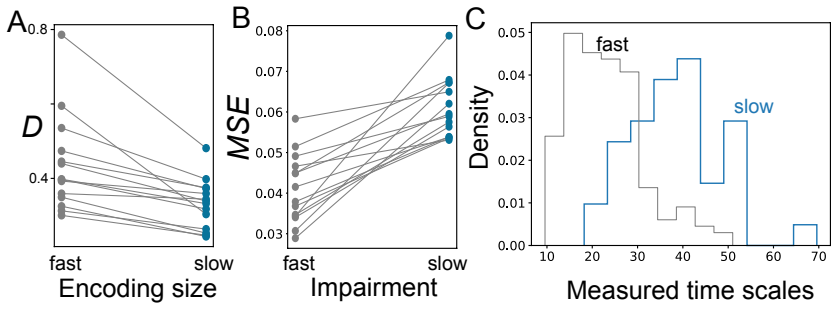
The load-bearing object is a recurrent rate network whose hidden units each carry a fixed intrinsic time constant, with 80% fast units at $\tau_{\mathrm{fast}}=1$ and 20% slow units at $\tau_{\mathrm{slow}}=10$. Training by backpropagation through time adjusts the recurrent, input, and output weights while the time constants stay fixed, so any functional specialization must emerge rather than be imposed. Three measurements carry the argument: the encoding strength $D$, defined as the maximum trial-averaged activity difference between two task conditions; the change in output mean-square error after clamping ten neurons of one type to zero during inference; and the empirical autocorrelation timescale of each neuron, fitted with an exponential and compared to the prescribed constants. The contrast between the stronger encoding of fast neurons and the stronger impairment after slow-neuron inactivation is the evidence for the two-role account.
What would settle it
Repeat the inactivation experiment with matched ablation fractions (for example, silence 25% of slow neurons and 25% of fast neurons) instead of matched counts; if the performance loss after fast-neuron inactivation becomes comparable to or larger than after slow-neuron inactivation, the claimed causal priority of slow neurons is not supported.
Extended reading notes
Core claim
The central claim is that a fixed mixture of fast and slow neurons is enough for a recurrent network to learn the task, and that the two populations take on different functional roles without those roles being designed in advance. With 80% of units at $\tau_{\mathrm{fast}}=1$ and 20% at $\tau_{\mathrm{slow}}=10$, training completes fastest and most reliably; when all units share $\tau=1$, no trained network succeeds. Fast units show larger encoding strengths for context, sensory, and decision signals (for example mean $D\approx 0.8$ versus $\approx 0.5$ for context), yet clamping ten slow units to zero raises the output mean-square error more than clamping ten fast units, in every trained network. Empirically measured activity timescales are longer for slow units ($\approx 38$ versus $\approx 23$), but the ratio is only about 1.5, much smaller than the prescribed 10, which the paper interprets as evidence that task structure shapes slow dynamics. The conclusion is a division of labor: fast dynamics give rapid, transient encoding, while slow dynamics maintain the stable internal state needed across the delay.
Load-bearing premise
The load-bearing assumption is that removing ten slow neurons is a fair comparison with removing ten fast neurons; since the network has only 40 slow neurons but 160 fast ones, the slow ablation removes a much larger fraction of that group, and if ablation fraction matters the causal conclusion would have to be revised.
Editorial extensions
If this is right
- If the central claim is correct, a fixed mixture of intrinsic time constants is sufficient for a network to learn a working memory task requiring nonlinear integration of temporally separated inputs.
- Because no network succeeds at $\tau_{\mathrm{slow}} = \tau_{\mathrm{fast}} = 1$, timescale diversity is necessary in this architecture rather than merely helpful.
- The model predicts that during the delay, activity in slow neurons carries behaviorally relevant context information even when their stimulus-evoked encoding is weaker than that of fast neurons.
- The optimal-balance result implies that biological circuits should not simply maximize slowness; there is a particular fast-to-slow mixture that best supports memory-guided behavior.
- Because measured timescales compress strongly relative to the prescribed constants, experiments should estimate effective timescales from activity autocorrelations rather than relying on biophysical time constants alone.
Reading between the lines
- An untested prediction that follows from the paper's logic is that decoding context from slow neurons' activity during the delay should stay accurate while decoding from fast neurons decays; the paper does not itself run this decoding test.
- The paper fixes the slow-neuron fraction at 20% and varies only $\tau_{\mathrm{slow}}$, so it leaves open whether the optimum is set by the time-constant ratio, the population fraction, or an interaction; varying both would map the full performance landscape.
- The same training setup could be applied to other nonlinear temporal tasks such as evidence accumulation or context gating; if the slow-sustain/fast-encode split reappears, the mechanism is likely general rather than specific to delayed match-to-sample.
- The compressed empirical timescale ratio suggests that recurrent feedback effectively renormalizes intrinsic time constants, so a follow-up could test whether effective timescales, not the preset $\tau$ values, are what actually set the optimal balance.
Editorial analysis
A structured set of objections, weighed in public.
Referee Report
Summary. The manuscript investigates how heterogeneity in intrinsic neuronal timescales affects performance in a context-dependent working-memory task. The author trains a 200-unit rate-based recurrent neural network in which 80% of neurons are 'fast' (τ_fast = 1) and 20% are 'slow' (τ_slow = 10), using BPTT on a delayed match-to-sample task with contextual cues. The reported findings are: (i) training success and speed are optimal near τ_slow ≈ 10; (ii) fast neurons show larger encoding of context, sensory, and decision-related signals than slow neurons; and (iii) inactivating 10 randomly chosen slow neurons degrades task performance (increases MSE) more than inactivating 10 fast neurons, which is interpreted as evidence that slow neurons play a causal role in sustaining memory despite weaker encoding. The paper also measures empirical activity timescales and reports that they are compressed relative to the prescribed time constants. The conclusion proposes a division of labor in which fast neurons encode transient signals and slow neurons maintain stable internal states.
Significance. The question addressed—how timescale diversity within a neural population contributes to working-memory computation—is timely and of broad interest. If the causal-role claim were well supported, the paper would offer a simple, readily testable mechanistic account of fast-versus-slow division of labor, with direct relevance to experimental observations of intrinsic timescale heterogeneity in frontal cortex. The model is clearly specified, the task is a canonical cognitive benchmark, and the analyses are transparent in intent. No machine-checked proofs or code are provided, but the model is simple enough to be reimplemented. The significance is real but conditional: the headline causal conclusion currently rests on a confounded ablation comparison, and the optimal-balance result lacks summary statistics. The manuscript would need substantial additional analyses before its central claims could be accepted.
major comments (4)
- [§3.3, Fig. 4B] The causal-role conclusion is confounded by ablation fraction. The hidden layer contains 160 fast neurons (80%) and 40 slow neurons (20%). Inactivating 10 random neurons removes 25% of the slow population but only 6.25% of the fast population. Under a null hypothesis of equal per-neuron importance, the larger MSE increase after slow inactivation is expected simply because a larger fraction of that population was removed. The paper states that the effect 'holds for all networks' but reports no distribution, no test statistic, and no control for ablation fraction. A proportion-matched ablation (e.g., inactivating 40 fast neurons, matching the 25% fraction) or a graded ablation curve for several fractions is necessary to support the claim that slow neurons are disproportionately critical. Because this claim is the paper's central causal statement, the current evidence is insufficient.
- [§3.1, Fig. 3] The optimal-balance result is presented without summary statistics or inferential support. The text states that performance is optimal around τ_slow ≈ 10 and shows 20 realizations per condition, but no means, confidence intervals, or statistical comparisons across τ_slow values are reported. For τ_slow = 1 the success rate is described as N/A, and it is unclear how many networks were analyzed at each value. Without a distribution over realizations or a pairwise comparison, the claim of a non-monotonic optimum is not quantitatively established. This is a load-bearing result because it motivates the subsequent division-of-labor narrative.
- [§3.4, Fig. 4C] The empirical timescale measurements are internally inconsistent. The main text reports that slow neurons have mean measured timescale ≈ 38 for τ_slow = 10, but the same section later states that for τ_slow = 5, 10, 20 the measured slow-neuron timescales are 33, 59, and 66, respectively. The τ_slow = 10 value of 59 directly contradicts the earlier mean of ≈ 38. This discrepancy affects the claim that the ratio of empirical timescales (≈1.5) is much smaller than the ratio of intrinsic time constants (10), which is used to argue that task structure shapes slow-neuron dynamics. The authors should clarify which measurement is correct, report the sample size and variability, and reconcile the two values.
- [Conclusion, last paragraph] The final sentence asserts that task-relevant signals are 'first encoded by fast neurons and then relayed to slow neurons,' but no analysis in the Results establishes temporal precedence or a directed influence from fast to slow populations. The earlier results show that fast neurons have stronger encoding and that slow neurons, when ablated in larger fraction, produce larger impairment; neither finding directly demonstrates a relay of information. This causal-temporal claim is a substantial interpretive leap and should be either supported with a dynamical analysis (e.g., cross-correlations, transfer entropy, or perturbation propagation) or removed.
minor comments (4)
- [§3.1] The statement that the optimized τ values 'correspond to membrane time constants' and the comparison with biological values from ref. [5] needs a modeling justification: time units in Eq. (1) are arbitrary discretization units unless a calibration to milliseconds is specified. Please clarify how the mapping to membrane time constants is made.
- [Figure 4] Figures 4A and 4B lack per-network or per-neuron error bars and summary statistics. Since the text reports paired t-tests for encoding strength, it would be helpful to show the distributions or at least mean ± SEM alongside the individual network lines.
- [§2.1] Training hyperparameters are incomplete: the learning rate, optimizer settings, minibatch size, number of trials per epoch, initialization scheme, and the precise discretization step for Eq. (1) are not given. Providing these details (or code) would substantially improve reproducibility.
- [Abstract] There is a typographical error in the abstract: 'di fferent' should read 'different.' The same spacing issue appears in the Introduction.
Circularity Check
No significant circularity: the study is a self-contained RNN modeling analysis, with conclusions drawn from simulations and internal comparisons rather than from input-equivalent derivations or load-bearing self-citations.
full rationale
The paper's derivation chain is self-contained. It defines an RNN with fixed fast/slow timescales, trains it on a context-dependent working memory task, and then reports measured quantities (training success, encoding strength, inactivation-induced MSE, and autocorrelation-derived timescales). None of these results is equal by construction to a fitted parameter or to the predefined timescales. The causal-role claim for slow neurons rests on an inactivation experiment comparing 10 ablated fast neurons (6.25% of the 160 fast pool) with 10 ablated slow neurons (25% of the 40 slow pool); this is an experimental-design confound, not circularity, because the reported MSE increase is still an independently simulated outcome rather than a quantity forced by the model definition. Self-citations [8-10] are prior related modeling studies cited only for background on multiple-timescale sequence generation, not as the evidentiary basis for the present quantitative conclusions. No uniqueness theorem, ansatz, or fitted value from prior author work is imported to make the central claim. Therefore, no circular step meets the required evidentiary bar, and the appropriate score is 0.
Assumptions & free parameters
free parameters (4)
- slow time constant τslow =
10 (default; varied in Fig. 3)
- slow neuron fraction =
0.2
- inactivation count =
10
- loss threshold =
0.01
assumptions (4)
- domain assumption Rate-based RNN with tanh nonlinearity and fixed time constants is a valid model of context-dependent working memory.
- domain assumption BPTT training with MSE loss finds networks representative of biological task learning.
- domain assumption Empirical timescales measured by exponential autocorrelation fits are reliable.
- ad hoc to paper Model time units can be mapped directly to milliseconds when comparing with biological membrane constants.
Cite this review
Pith. "Pith review of Slow and Fast Neurons Cooperate in Contextual Working Memory through Timescale Diversity." pith.science (2026). https://pith.science/paper/XHXHXSME
@misc{pith2026250607341,
  author       = {Pith},
  title        = {Pith review of: Slow and Fast Neurons Cooperate in Contextual Working Memory through Timescale Diversity},
  year         = {2026},
  howpublished = {\url{https://pith.science/paper/XHXHXSME}},
  note         = {Machine review of arXiv:2506.07341}
}
read the original abstract
Neural systems process information across a broad range of intrinsic timescales, both within and across cortical areas. While such diversity is a hallmark of biological networks, its computational role in nonlinear information processing remains elusive. In this study, we examine how heterogeneity in intrinsic neural timescales within the frontal cortex - a region central to cognitive control - enhances performance in a context-dependent working memory task. We develop a recurrent neural network (RNN) composed of units with distinct time constants to model a delayed match-to-sample task with contextual cues. This task demands nonlinear integration of temporally dispersed inputs and flexible behavioral adaptation. Our analysis shows that task performance is optimized when fast and slow timescales are appropriately balanced. Intriguingly, slow neurons, despite weaker encoding of task-relevant inputs, play a causal role in sustaining memory and improving performance. In contrast, fast neurons exhibit strong but transient encoding of input signals. These results highlight a division of computational roles among neurons with different timescales: slow dynamics support stable internal states, while fast dynamics enable rapid signal encoding. Our findings provide a mechanistic account of how temporal heterogeneity contributes to nonlinear information processing in neural circuits, shedding light on the dynamic architecture underlying cognitive flexibility.
Figures


Reference graph
Works this paper leans on
-
[1]
A hierarchy of intrinsic timescales across primate cor- tex.,
J. D. Murray, A. Bernacchia, D. J. Freedman, R. Romo, J. D. Wallis, X. Cai, C. Padoa-Schioppa, T. Pasternak, H. Seo, D. Lee, and X.-J. Wang, “A hierarchy of intrinsic timescales across primate cor- tex.,” Nature neuroscience, vol. 17, pp. 1661–1663, nov 2014
work page 2014
-
[2]
Distinct timescales of population coding across cortex,
C. A. Runyan, E. Piasini, S. Panzeri, and C. D. Har- vey, “Distinct timescales of population coding across cortex,” Nature, vol. 548, pp. 92–96, aug 2017
work page 2017
-
[3]
S. E. Cavanagh, J. D. Wallis, S. W. Kennerley, and L. T. Hunt, “Autocorrelation structure at rest predicts value correlates of single neurons during reward- guided choice,” eLife, vol. 5, no. OCTOBER2016, pp. 1–17, 2016
work page 2016
-
[4]
A Diversity of Intrinsic Timescales Underlie Neural Computations,
S. E. Cavanagh, L. T. Hunt, and S. W. Kennerley, “A Diversity of Intrinsic Timescales Underlie Neural Computations,” Frontiers in Neural Circuits, vol. 14, no. December, pp. 1–18, 2020
work page 2020
-
[5]
Neural heterogeneity promotes robust learning,
N. Perez-Nieves, V . C. Leung, P. L. Dragotti, and D. F. Goodman, “Neural heterogeneity promotes robust learning,” Nature Communications , vol. 12, no. 1, pp. 1–9, 2021
work page 2021
-
[6]
Intrinsic neuronal dynam- ics predict distinct functional roles during working memory,
D. F. Wasmuht, E. Spaak, T. J. Buschman, E. K. Miller, and M. G. Stokes, “Intrinsic neuronal dynam- ics predict distinct functional roles during working memory,” Nature Communications , vol. 9, p. 3499, dec 2018
work page 2018
-
[7]
Y . Yamashita and J. Tani, “Emergence of functional hierarchy in a multiple timescale neural network model: a humanoid robot experiment.,” PLoS com- putational biology, vol. 4, p. e1000220, nov 2008
work page 2008
-
[8]
T. Kurikawa and K. Kaneko, “Multiple-Timescale Neural Networks: Generation of History-Dependent Sequences and Inference Through Autonomous Bifurcations.,” Frontiers in computational neuro- science, vol. 15, p. 743537, jun 2021
work page 2021
Show all 10 references
-
[9]
Intermediate Sensitivity of Neural Ac- tivities Induces the Optimal Learning Speed in a Multiple-Timescale Neural Activity Model,
T. Kurikawa, “Intermediate Sensitivity of Neural Ac- tivities Induces the Optimal Learning Speed in a Multiple-Timescale Neural Activity Model,” in Neu- ral Information Processing. ICONIP 2021 (A. Man- toro, T., Lee, M., Ayu, M.A., Wong, K.W., Hidayanto, ed.), pp. 64–72, Sprin...
2021
-
[10]
Stability Control of Metastable States as a Unified Mechanism for Flex- ible Temporal Modulation in Cognitive Processing,
K. K. Tomoki Kurikawa, “Stability Control of Metastable States as a Unified Mechanism for Flex- ible Temporal Modulation in Cognitive Processing,” arXiv preprint, vol. 2504.09080, 2025
2025 arXiv
Reviewed August 7, 2026 · model on record in the stance chip above.
Discussion (0). Sign in to comment.