REVIEW 3 major objections 5 minor 49 references
MapBERT: Bitwise Masked Modeling for Real-Time Semantic Mapping Generation
T0 review · 3 major / 5 minor · reviewed 2026-08-07 · deepseek-v4-flash
Pith's one-line read MapBERT encodes one-hot semantic maps as bit tokens and uses object-aware masked generation to infer unseen indoor regions in 11 ms per map.
desk verdict A competent transfer of MaskBit to semantic map generation, but the headline SOTA claim rests on a metric that mirrors the training protocol; the honest limitation section is the best part. read the letter →
The pith
A machine-rendered reading of the paper's core claim, the machinery that carries it, and where it could break.
The reading
What carries the argument
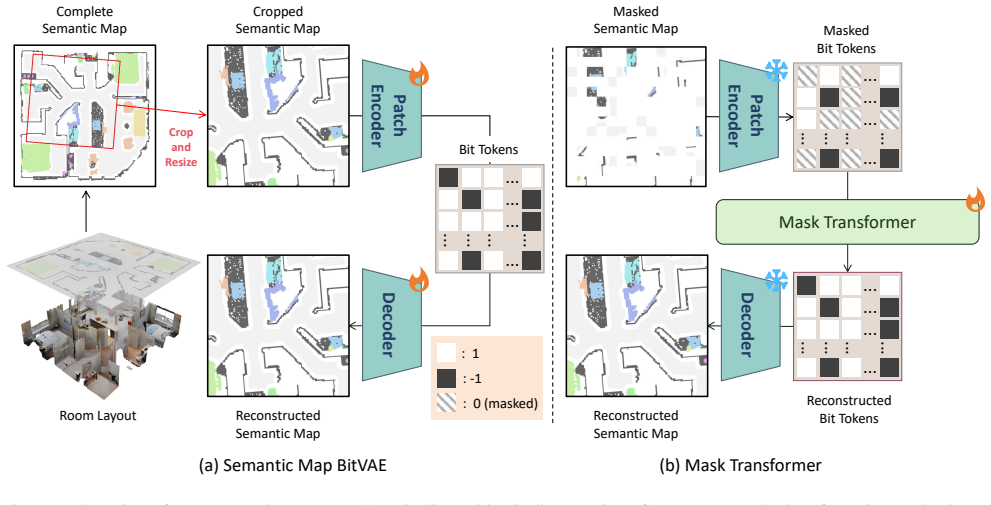
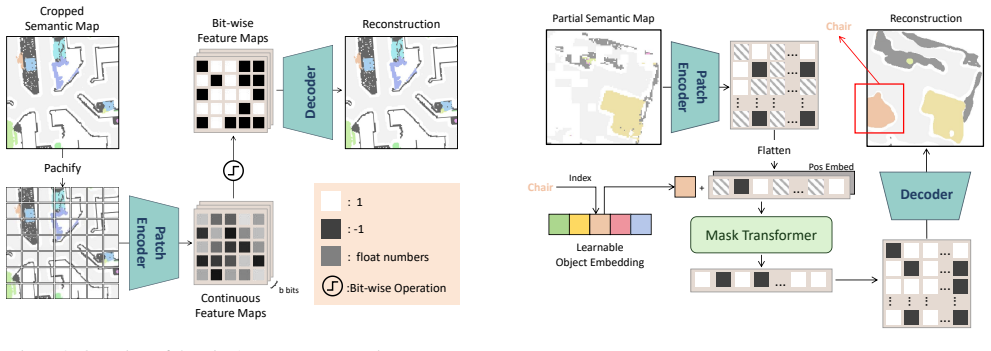
The central mechanism is the lookup-free BitVAE bit-token representation: an encoder $E(\cdot)$ maps a one-hot semantic map $M\in\mathbb{R}^{H\times W\times C}$ to a feature map $m\in\mathbb{R}^{h\times w\times b}$, then a sign function $B(m_{i,j,k})=1$ if $m_{i,j,k}>0$ and $-1$ otherwise converts features into $b$ bits per patch. Each patch's $b$ bits index $\{0,\ldots,2^b-1\}$, with $2^b$ reserved as the mask token, so no codebook lookup is needed. The mask transformer is a bidirectional self-attention network that takes partial bit indices plus, when an entire category is masked, a learnable embedding for that category, and is trained with cross-entropy over the $2^b$ possible indices; the embedding-to-token interaction is what lets the model reason about object locations in unobserved regions.
What would settle it
Run MapBERT and SGM on a masked-completion benchmark where the hidden patches are chosen uniformly at random and no category embedding is supplied; if the IoU and localization margins over SGM shrink to near zero, the claimed advantage is an artifact of the object-aware evaluation protocol.
Extended reading notes
Core claim
MapBERT is, to the authors' knowledge, the first framework to use a lookup-free BitVAE for semantic map generation. The paper's central discovery is that the binary structure of one-hot semantic maps aligns naturally with bitwise tokens, so a codebook-based vector-quantized latent space is unnecessary. A BitVAE binarizes patch features into compact bit tokens, and a BERT-style masked transformer predicts masked tokens to generate complete semantic maps from partial observations. The object-aware masking strategy, which hides all patches of one object category and concatenates that category's learnable embedding, is what drives the model's ability to localize target objects, lifting simulated success from 4.56% with random masking to 45.84%. The paper reports state-of-the-art map-generation quality on Gibson with 34.10% IoU, while keeping inference at 0.011 seconds per map and total model size at 0.41 GB, and shows that replacing an existing navigation stack's map generator with MapBERT gives 75.8% object-goal success.
Load-bearing premise
The headline sSR metric masks all patches of a target object category and tells the model which category to find, which is exactly the protocol MapBERT was trained on; if success were measured on generic masked completion instead, the reported localization lead over baselines could shrink.
Editorial extensions
If this is right
- Semantic map generation can be cast as bit-token prediction without a vector-quantized codebook, and 9-bit BitVAE tokens restore masked tokens more accurately than a 512-code VQVAE.
- Object-aware masking with category embeddings raises the simulated success ratio from 4.56% to 45.84% and improves IoU by roughly 4-5 points, making the masking strategy the main carrier of object-localization performance.
- The full model runs in 0.011 seconds per map with 0.41 GB of weights, which is fast and small enough to be practical for real-time robot deployment.
- Plugging MapBERT into an existing generative-map navigation pipeline reaches 75.8% success and 1.26 m distance-to-success on Gibson, comparable to the previous 75.4% success of the prior method it replaces.
Reading between the lines
- If the object-aware masking and target-embedding conditioning are what drive the sSR gain, the same idea should transfer to other sparse one-hot spatial outputs, such as floor plans, occupancy grids, or multi-class belief maps, where a category label can be injected as a conditioning token.
- A direct test of the paper's robustness claims would be to feed the model noisy semantic maps built from an agent's RGB-D observations during a simulated episode, matching the deployment distribution; the paper itself notes that its navigation gains remain modest under this mismatch.
- Because the bit-token vocabulary is fixed at $2^b$ and needs no codebook lookup, the approach is a candidate for embedded deployment; the 0.41 GB weight budget and 11 ms inference time suggest it could run alongside a real-time SLAM stack.
Editorial analysis
A structured set of objections, weighed in public.
Referee Report
Summary. MapBERT proposes a real-time semantic map generation framework for indoor scenes, using a lookup-free BitVAE to encode one-hot semantic maps into compact bitwise tokens and a BERT-style masked transformer to infer missing regions from partial observations. A second contribution is object-aware masking: during training, all patches of a randomly chosen object category are masked and a learnable category embedding is provided, which the authors argue improves object-centric reasoning. On the Gibson benchmark, the paper reports 34.10% IoU and 45.84% sSR, with 0.011 s inference time and 0.41 GB model weight, and claims state-of-the-art performance. The paper also evaluates the method in object goal navigation integrated into SGM's pipeline, achieving SR 75.8% and SPL 38.6%.
Significance. The technical core is well motivated: semantic maps are one-hot valued, so bitwise tokens are a natural alternative to codebook-based discrete tokens, and the reported inference speed and model size are genuinely practical for robotics. The ablation study in Table 3 is informative and shows that object-aware masking is the component responsible for the large sSR increase. However, the headline state-of-the-art claim rests on the sSR metric, whose evaluation protocol mirrors the paper's own training objective, while the baselines were not trained with object-aware conditioning. The downstream navigation results in Table 4 are essentially tied with SGM and even slightly worse in SPL. As reported, the evidence does not establish a clear SOTA advantage in general semantic map generation, although the method is plausibly competitive and the core architecture is sound. The paper would be a solid contribution after a fair, protocol-agnostic evaluation and more careful claims.
major comments (3)
- [§4.2, Table 1; §3.4, Table 3] The sSR comparison is not a fair measure of general semantic map generation against the baselines. The sSR protocol masks all patches of a target object category and measures whether the model locates it, which is exactly the task used in object-aware training in Section 3.4, where the target category's learnable embedding is also provided. Baselines SGM, RSMPNet, SSCNav, and AOT-GAN were not trained with object-category embeddings or object-aware masking, so they lack the conditioning channel that the metric tests. This is confirmed by the paper's own ablation: MapBERT with random masking (MapBERT w.o. ObMask) obtains only 4.56 sSR under the same protocol, about ten times lower than the 45.84 reported in Table 1. The claim in Section 4.2 that the method 'more than doubles' SGM's 21.88% sSR is therefore a restatement of the training-task advantage, not evidence of better map generation. Please add a neutral evaluation where all methods are tested on the same generic completion task (e.g., random masking without category embeddings), and report sSR or an equivalent localization metric under that protocol.
- [§4.4, Table 4] The downstream object goal navigation results do not support a practical improvement over SGM. MapBERT reaches SR 75.8% versus SGM's 75.4%, and its SPL is lower (38.6% vs. 39.3%), with identical DTS. Without error bars, multiple seeds, or a statistical test, this is effectively a tie. The paper's own discussion in Section 4.4 acknowledges that navigation gains are modest. I recommend tempering the conclusion and, if the SOTA claim is retained, reporting variance across runs.
- [Tables 1 and 4] All quantitative results are reported as single numbers with no standard deviations. Given that the key margins are small—IoU 34.10 vs. SSCNav's 33.56, and SR 75.8 vs. SGM's 75.4—readers cannot assess whether the reported differences are meaningful. Please add mean/std over multiple training seeds or confidence intervals for the main tables.
minor comments (5)
- [§4.2] The qualitative results paragraph says 'Figure 1 provides visual examples,' but the qualitative comparison is in Figure 4; the reference should be corrected.
- [Figure 4 caption] The caption uses 'BertMap' while the paper consistently uses 'MapBERT'; please unify the naming across figures, tables, and text.
- [§3.4] In Section 3.4, the input semantic map is denoted M ∈ R^{H×W×b}, but the semantic map is one-hot encoded over C categories as defined in Section 3.1; this notation should be H×W×C to avoid confusing the number of semantic channels with the number of bitwise latent bits b.
- [§4.3, Table 2] Table 2 shows that BitVAE with 10 bits achieves the best FID (1.65), yet the main model uses 9 bits; the paper should justify this choice, for example by reporting downstream masked-token accuracy for 10-bit BitVAE.
- [§4.1] The statement that all baselines are evaluated under 'identical masking conditions' is ambiguous: please state explicitly whether baselines receive the object-category embedding during sSR evaluation, since the sSR protocol includes object-aware masking while the baselines' training objectives do not.
Circularity Check
No derivation circularity; the only circularity-adjacent element is the sSR metric, whose protocol equals the object-aware training task.
-
other
[Section 4.1 (sSR definition) vs Section 3.4 (object-aware training)]
"Additionally, we introduce sSR (simulated success ratio) to evaluate the model’s ability to locate target objects in partially observed semantic maps. For sSR, we apply object-aware masking to conceal all pixels of a specific category, then measure the success rate of correctly identifying the target object locations across our 1,000 evaluation sub-maps."
Section 3.4 trains exactly this protocol: 'we perform target-specific masking by randomly selecting a category c and masking all patches Pc where that object appears' and concatenates the target embedding Ec. Hence the sSR test is the model's own training task with the same conditioning channel; the reported 45.84% (vs SGM's 21.88%) measures in-distribution task performance, and Table 3's w.o. ObMask variant drops to 4.56%, confirming the margin is largely a restatement of the object-aware training setup. This is an evaluation circularity; it does not make the map-generation IoU or efficiency results circular.
full rationale
The paper's core derivation chain is not circular: the BitVAE encoding (Eqs. 1-2), the mask-transformer objective (Eqs. 3 and 7), and the IoU/BCE losses (Eqs. 4-6) are standard empirical components, none of which is defined in terms of the final IoU or sSR claim. The state-of-the-art claim on Gibson is an empirical benchmark comparison, not a quantity derived from the result it asserts. The only step that shades into circularity is the sSR evaluation: the metric applies exactly the object-aware masking and category embedding that Section 3.4 uses as the training objective, and the baselines were not trained with that conditioning channel. This inflates the headline sSR margin and is confirmed by Table 3, where the without-ObMask variant scores only 4.56% sSR. However, this is metric-design circularity, not a derivation that reduces to its inputs; the IoU, efficiency, and downstream navigation results remain externally measured. No load-bearing self-citation chain or imported uniqueness theorem is present. Overall circularity is mild, so the score is 2.
Assumptions & free parameters
free parameters (3)
- Number of bits per patch (b) =
9
- Loss weights λ_BCE and λ_IoU =
Not reported
- Masking schedule =
15-20% initial, cosine up to 75%
assumptions (3)
- domain assumption Semantic maps are one-hot encoded and sparse
- domain assumption Patch-wise independence of the BitVAE encoder
- domain assumption Ground-truth complete maps are available for training and evaluation
Cite this review
Pith. "Pith review of MapBERT: Bitwise Masked Modeling for Real-Time Semantic Mapping Generation." pith.science (2026). https://pith.science/paper/O7D2HH3Y
@misc{pith2026250607350,
  author       = {Pith},
  title        = {Pith review of: MapBERT: Bitwise Masked Modeling for Real-Time Semantic Mapping Generation},
  year         = {2026},
  howpublished = {\url{https://pith.science/paper/O7D2HH3Y}},
  note         = {Machine review of arXiv:2506.07350}
}
read the original abstract
Spatial awareness is a critical capability for embodied agents, as it enables them to anticipate and reason about unobserved regions. The primary challenge arises from learning the distribution of indoor semantics, complicated by sparse, imbalanced object categories and diverse spatial scales. Existing methods struggle to robustly generate unobserved areas in real time and do not generalize well to new environments. To this end, we propose \textbf{MapBERT}, a novel framework designed to effectively model the distribution of unseen spaces. Motivated by the observation that the one-hot encoding of semantic maps aligns naturally with the binary structure of bit encoding, we, for the first time, leverage a lookup-free BitVAE to encode semantic maps into compact bitwise tokens. Building on this, a masked transformer is employed to infer missing regions and generate complete semantic maps from limited observations. To enhance object-centric reasoning, we propose an object-aware masking strategy that masks entire object categories concurrently and pairs them with learnable embeddings, capturing implicit relationships between object embeddings and spatial tokens. By learning these relationships, the model more effectively captures indoor semantic distributions crucial for practical robotic tasks. Experiments on Gibson benchmarks show that MapBERT achieves state-of-the-art semantic map generation, balancing computational efficiency with accurate reconstruction of unobserved regions.
Figures

Figures from the paper (3 more)


Reference graph
Works this paper leans on
-
[1]
Unseen object amodal instance segmentation via hierarchical occlu- sion modeling
Seunghyeok Back, Joosoon Lee, Taewon Kim, Sangjun Noh, Raeyoung Kang, Seongho Bak, and Kyoobin Lee. Unseen object amodal instance segmentation via hierarchical occlu- sion modeling. In 2022 International Conference on Robotics and Automation (ICRA), pages 5085–5092. IEEE, 2022. 1
work page 2022
-
[2]
Maskgit: Masked generative image transformer
Huiwen Chang, Han Zhang, Lu Jiang, Ce Liu, and William T Freeman. Maskgit: Masked generative image transformer. In Proceedings of the IEEE/CVF conference on computer vision and pattern recognition, pages 11315–11325, 2022. 2
work page 2022
-
[3]
Muse: Text-to- image generation via masked generative transformers
Huiwen Chang, Han Zhang, Jarred Barber, AJ Maschinot, Jose Lezama, Lu Jiang, Ming-Hsuan Yang, Kevin Murphy, William T Freeman, Michael Rubinstein, et al. Muse: Text-to- image generation via masked generative transformers. arXiv preprint arXiv:2301.00704, 2023. 2
arXiv 2023
-
[4]
Object goal navigation using goal-oriented semantic exploration
Devendra Singh Chaplot, Dhiraj Prakashchand Gandhi, Abhi- nav Gupta, and Russ R Salakhutdinov. Object goal navigation using goal-oriented semantic exploration. Advances in Neural Information Processing Systems, 33:4247–4258, 2020. 8
work page 2020
-
[5]
Neural topological slam for visual navigation
Devendra Singh Chaplot, Ruslan Salakhutdinov, Abhinav Gupta, and Saurabh Gupta. Neural topological slam for visual navigation. In Proceedings of the IEEE/CVF conference on computer vision and pattern recognition, pages 12875–12884,
-
[6]
Don’t look into the dark: Latent codes for pluralistic image inpainting
Haiwei Chen and Yajie Zhao. Don’t look into the dark: Latent codes for pluralistic image inpainting. In Proceedings of the IEEE/CVF Conference on Computer Vision and Pattern Recognition, pages 7591–7600, 2024. 2, 3
work page 2024
-
[7]
MultiTalk: Introspective and Extrospective Dialogue for Human-Environment-LLM Alignment
Venkata Naren Devarakonda, Ali Umut Kaypak, Shuai- hang Yuan, Prashanth Krishnamurthy, Yi Fang, and Farshad Khorrami. Multitalk: Introspective and extrospective dia- logue for human-environment-llm alignment. arXiv preprint arXiv:2409.16455, 2024. 1
work page Pith review arXiv 2024
-
[8]
Bert: Pre-training of deep bidirectional transform- ers for language understanding
Jacob Devlin, Ming-Wei Chang, Kenton Lee, and Kristina Toutanova. Bert: Pre-training of deep bidirectional transform- ers for language understanding. In Proceedings of the 2019 conference of the North American chapter of the association for computational linguistics: human language technologies, volume 1 (long and short papers), pages 4171–4186, 2019. 2, 3, 4
work page 2019
Show all 49 references
-
[9]
One step diffusion via shortcut models
Kevin Frans, Danijar Hafner, Sergey Levine, and Pieter Abbeel. One step diffusion via shortcut models. arXiv preprint arXiv:2410.12557, 2024. 2
2024 arXiv
-
[10]
Learning to map for active semantic goal navigation
Georgios Georgakis, Bernadette Bucher, Karl Schmeck- peper, Siddharth Singh, and Kostas Daniilidis. Learning to map for active semantic goal navigation. arXiv preprint arXiv:2106.15648, 2021. 1, 2
2021 arXiv
-
[11]
Momask: Generative masked modeling of 3d human motions
Chuan Guo, Yuxuan Mu, Muhammad Gohar Javed, Sen Wang, and Li Cheng. Momask: Generative masked modeling of 3d human motions. In Proceedings of the IEEE/CVF Conference on Computer Vision and Pattern Recognition, pages 1900– 1910, 2024. 2, 3, 5
1900
-
[12]
Neupan: Direct point robot nav- igation with end-to-end model-based learning
Ruihua Han, Shuai Wang, Shuaijun Wang, Zeqing Zhang, Jianjun Chen, Shijie Lin, Chengyang Li, Chengzhong Xu, Yonina C Eldar, Qi Hao, et al. Neupan: Direct point robot nav- igation with end-to-end model-based learning. arXiv preprint arXiv:2403.06828, 2024. 1
2024 arXiv
-
[13]
Masked autoencoders are scalable vision learners
Kaiming He, Xinlei Chen, Saining Xie, Yanghao Li, Piotr Doll´ar, and Ross Girshick. Masked autoencoders are scalable vision learners. In Proceedings of the IEEE/CVF conference on computer vision and pattern recognition , pages 16000– 16009, 2022. 1, 4, 8
2022
-
[14]
3d-trans: 3d hierarchical transformer for shape cor- respondence learning
Hao Huang, Shuaihang Yuan, Congcong Wen, Yu Hao, and Yi Fang. 3d-trans: 3d hierarchical transformer for shape cor- respondence learning. In 2024 10th International Conference on Automation, Robotics and Applications (ICARA) , pages 536–540. IEEE, 2024. 1
2024
-
[15]
Noisy few-shot 3d point cloud scene segmenta- tion
Hao Huang, Shuaihang Yuan, CongCong Wen, Yu Hao, and Yi Fang. Noisy few-shot 3d point cloud scene segmenta- tion. In 2024 IEEE International Conference on Robotics and Automation (ICRA), pages 11070–11077. IEEE, 2024
2024
-
[16]
Weakly scene segmentation using efficient trans- former
Hao Huang, Shuaihang Yuan, CongCong Wen, Yu Hao, and Yi Fang. Weakly scene segmentation using efficient trans- former. In 2024 IEEE/RSJ International Conference on Intel- ligent Robots and Systems (IROS), pages 9784–9790. IEEE,
2024
-
[17]
Out of sight, still in mind: Reasoning and planning about unobserved ob- jects with video tracking enabled memory models
Yixuan Huang, Jialin Yuan, Chanho Kim, Pupul Pradhan, Bryan Chen, Li Fuxin, and Tucker Hermans. Out of sight, still in mind: Reasoning and planning about unobserved ob- jects with video tracking enabled memory models. In 2024 IEEE International Conference on Robotics and Autom...
2024
-
[18]
Diffusion as reasoning: Enhancing object goal navigation with llm-biased diffusion model
Yiming Ji, Yang Liu, Zhengpu Wang, Boyu Ma, Zongwu Xie, and Hong Liu. Diffusion as reasoning: Enhancing object goal navigation with llm-biased diffusion model. arXiv preprint arXiv:2410.21842, 2024. 1, 2
2024 arXiv
-
[19]
Simple but effective: Clip embeddings for embodied ai
Apoorv Khandelwal, Luca Weihs, Roozbeh Mottaghi, and Aniruddha Kembhavi. Simple but effective: Clip embeddings for embodied ai. In Proceedings of the IEEE/CVF Conference on Computer Vision and Pattern Recognition, pages 14829– 14838, 2022. 8
2022
-
[20]
Optimizing automated picking systems in warehouse robots using machine learning
Keqin Li, Jin Wang, Xubo Wu, Xirui Peng, Runmian Chang, Xiaoyu Deng, Yiwen Kang, Yue Yang, Fanghao Ni, and Bo Hong. Optimizing automated picking systems in warehouse robots using machine learning. arXiv preprint arXiv:2408.16633, 2024. 1
2024
-
[21]
Mage: Masked generative en- coder to unify representation learning and image synthesis
Tianhong Li, Huiwen Chang, Shlok Mishra, Han Zhang, Dina Katabi, and Dilip Krishnan. Mage: Masked generative en- coder to unify representation learning and image synthesis. In Proceedings of the IEEE/CVF Conference on Computer Vision and Pattern Recognition, pages 2142–2152, 2023. 2
2023
-
[22]
Sscnav: Confidence-aware semantic scene completion for visual se- mantic navigation
Yiqing Liang, Boyuan Chen, and Shuran Song. Sscnav: Confidence-aware semantic scene completion for visual se- mantic navigation. In 2021 IEEE international conference on robotics and automation (ICRA), pages 13194–13200. IEEE,
2021
-
[23]
Autonomous warehouse robot using deep q-learning
Ismot Sadik Peyas, Zahid Hasan, Md Rafat Rahman Tushar, Al Musabbir, Raisa Mehjabin Azni, and Shahnewaz Siddique. Autonomous warehouse robot using deep q-learning. In TEN- CON 2021-2021 IEEE Region 10 Conference (TENCON) , pages 857–862. IEEE, 2021. 1
2021
-
[24]
Mmm: Generative masked motion model
Ekkasit Pinyoanuntapong, Pu Wang, Minwoo Lee, and Chen Chen. Mmm: Generative masked motion model. In Proceed- ings of the IEEE/CVF Conference on Computer Vision and Pattern Recognition, pages 1546–1555, 2024. 2, 3, 5
2024
-
[25]
Habitat 3.0: A co-habitat for humans, avatars and robots, 2023
Xavi Puig, Eric Undersander, Andrew Szot, Mikael Dallaire Cote, Ruslan Partsey, Jimmy Yang, Ruta Desai, Alexan- der William Clegg, Michal Hlavac, Tiffany Min, Theo Gervet, Vladim´ır V ondruˇs, Vincent-Pierre Berges, John Turner, Olek- sandr Maksymets, Zsolt Kira, Mrinal Kalakr...
2023
-
[26]
Poni: Potential functions for objectgoal navigation with interaction- free learning
Santhosh Kumar Ramakrishnan, Devendra Singh Chaplot, Ziad Al-Halah, Jitendra Malik, and Kristen Grauman. Poni: Potential functions for objectgoal navigation with interaction- free learning. In Proceedings of the IEEE/CVF Conference on Computer Vision and Pattern Recognition, p...
2022
-
[27]
Habitat: A Platform for Embodied AI Research
Manolis Savva, Abhishek Kadian, Oleksandr Maksymets, Yili Zhao, Erik Wijmans, Bhavana Jain, Julian Straub, Jia Liu, Vladlen Koltun, Jitendra Malik, Devi Parikh, and Dhruv Batra. Habitat: A Platform for Embodied AI Research. In Proceedings of the IEEE/CVF International Conferen...
2019
-
[28]
Consistency models
Yang Song, Prafulla Dhariwal, Mark Chen, and Ilya Sutskever. Consistency models. 2023. 2
2023
-
[29]
Rsmpnet: Relationship guided semantic map prediction
Jingwen Sun, Jing Wu, Ze Ji, and Yu-Kun Lai. Rsmpnet: Relationship guided semantic map prediction. In Proceed- ings of the IEEE/CVF Winter Conference on Applications of Computer Vision, pages 303–312, 2024. 1, 2, 6, 7
2024
-
[30]
Habitat 2.0: Training home assistants to rearrange their habitat
Andrew Szot, Alex Clegg, Eric Undersander, Erik Wijmans, Yili Zhao, John Turner, Noah Maestre, Mustafa Mukadam, Devendra Chaplot, Oleksandr Maksymets, Aaron Gokaslan, Vladimir V ondrus, Sameer Dharur, Franziska Meier, Wojciech Galuba, Angel Chang, Zsolt Kira, Vladlen Koltun, J...
2021
-
[31]
Spin: Simultaneous perception interaction and navigation
Shagun Uppal, Ananye Agarwal, Haoyu Xiong, Kenneth Shaw, and Deepak Pathak. Spin: Simultaneous perception interaction and navigation. In Proceedings of the IEEE/CVF Conference on Computer Vision and Pattern Recognition , pages 18133–18142, 2024. 1
2024
-
[32]
Maskbit: Embedding-free image generation via bit tokens
Mark Weber, Lijun Yu, Qihang Yu, Xueqing Deng, Xiaohui Shen, Daniel Cremers, and Liang-Chieh Chen. Maskbit: Embedding-free image generation via bit tokens. arXiv preprint arXiv:2409.16211, 2024. 3
2024 arXiv
-
[33]
Zero-shot object navigation with vision-language models rea- soning
Congcong Wen, Yisiyuan Huang, Hao Huang, Yanjia Huang, Shuaihang Yuan, Yu Hao, Hui Lin, Yu-Shen Liu, and Yi Fang. Zero-shot object navigation with vision-language models rea- soning. In International Conference on Pattern Recognition, pages 389–404. Springer, 2025. 1
2025
-
[34]
Dd-ppo: Learning near-perfect pointgoal navigators from 2.5 billion frames
Erik Wijmans, Abhishek Kadian, Ari Morcos, Stefan Lee, Irfan Essa, Devi Parikh, Manolis Savva, and Dhruv Batra. Dd-ppo: Learning near-perfect pointgoal navigators from 2.5 billion frames. arXiv preprint arXiv:1911.00357, 2019. 8
1911 arXiv
-
[35]
Fast diffusion model
Zike Wu, Pan Zhou, Kenji Kawaguchi, and Hanwang Zhang. Fast diffusion model. arXiv preprint arXiv:2306.06991, 2023. 2
2023 arXiv
-
[36]
Gibson env: Real-world per- ception for embodied agents
Fei Xia, Amir R Zamir, Zhiyang He, Alexander Sax, Jitendra Malik, and Silvio Savarese. Gibson env: Real-world per- ception for embodied agents. In Proceedings of the IEEE conference on computer vision and pattern recognition, pages 9068–9079, 2018. 5, 7, 8
2018
-
[37]
A frontier-based approach for autonomous exploration
Brian Yamauchi. A frontier-based approach for autonomous exploration. In Proceedings 1997 IEEE International Sym- posium on Computational Intelligence in Robotics and Au- tomation CIRA’97. ’Towards New Computational Principles for Robotics and Automation’, pages 146–151. IEEE, 1997. 8
1997
-
[38]
Magvit: Masked gen- erative video transformer
Lijun Yu, Yong Cheng, Kihyuk Sohn, Jos ´e Lezama, Han Zhang, Huiwen Chang, Alexander G Hauptmann, Ming- Hsuan Yang, Yuan Hao, Irfan Essa, et al. Magvit: Masked gen- erative video transformer. In Proceedings of the IEEE/CVF Conference on Computer Vision and Pattern Recognition ...
2023
-
[39]
Fed- erated learning for vision-based obstacle avoidance in the internet of robotic things
Xianjia Yu, Jorge Pena Queralta, and Tomi Westerlund. Fed- erated learning for vision-based obstacle avoidance in the internet of robotic things. In 2022 Seventh International Con- ference on Fog and Mobile Edge Computing (FMEC), pages 1–6. IEEE, 2022. 1
2022
-
[40]
Ross: Robust learning of one- shot 3d shape segmentation
Shuaihang Yuan and Yi Fang. Ross: Robust learning of one- shot 3d shape segmentation. In proceedings of the IEEE/CVF winter conference on applications of computer vision, pages 1961–1969, 2020. 1
1961
-
[41]
Meta- det3d: Learn to learn few-shot 3d object detection
Shuaihang Yuan, Xiang Li, Hao Huang, and Yi Fang. Meta- det3d: Learn to learn few-shot 3d object detection. In Pro- ceedings of the Asian Conference on Computer Vision, pages 1761–1776, 2022
2022
-
[42]
Retrieval-specific view learning for sketch-to-shape retrieval
Shuaihang Yuan, Congcong Wen, Yu-Shen Liu, and Yi Fang. Retrieval-specific view learning for sketch-to-shape retrieval. IEEE Transactions on Multimedia, 2023. 1
2023
-
[43]
Gamap: Zero-shot object goal nav- igation with multi-scale geometric-affordance guidance
Shuaihang Yuan, Hao Huang, Yu Hao, Congcong Wen, An- thony Tzes, Yi Fang, et al. Gamap: Zero-shot object goal nav- igation with multi-scale geometric-affordance guidance. Ad- vances in Neural Information Processing Systems, 37:39386– 39408, 2024. 1
2024
-
[44]
Zero-shot object navigation with vision-language foundation models reasoning
Shuaihang Yuan, Muhammad Shafique, Mohamed Riyadh Baghdadi, Farshad Khorrami, Anthony Tzes, and Yi Fang. Zero-shot object navigation with vision-language foundation models reasoning. In 2024 10th International Conference on Automation, Robotics and Applications (ICARA) , pages...
2024
-
[45]
Reference con- volutional networks for 3d deep point signature learning
Shuaihang Yuan, Anthony Tzes, and Yi Fang. Reference con- volutional networks for 3d deep point signature learning. In 2024 10th International Conference on Automation, Robotics and Applications (ICARA), pages 526–530. IEEE, 2024. 1
2024
-
[46]
Aggregated contextual transformations for high- resolution image inpainting
Yanhong Zeng, Jianlong Fu, Hongyang Chao, and Bain- ing Guo. Aggregated contextual transformations for high- resolution image inpainting. IEEE transactions on visual- ization and computer graphics, 29(7):3266–3280, 2022. 6, 7
2022
-
[47]
3d-aware object goal navigation via simultaneous exploration and identification
Jiazhao Zhang, Liu Dai, Fanpeng Meng, Qingnan Fan, Xuelin Chen, Kai Xu, and He Wang. 3d-aware object goal navigation via simultaneous exploration and identification. In Proceed- ings of the IEEE/CVF Conference on Computer Vision and Pattern Recognition, pages 6672–6682, 2023. 5, 8
2023
-
[48]
Imagine before go: Self-supervised generative map for object goal navigation
Sixian Zhang, Xinyao Yu, Xinhang Song, Xiaohan Wang, and Shuqiang Jiang. Imagine before go: Self-supervised generative map for object goal navigation. In Proceedings of the IEEE/CVF Conference on Computer Vision and Pattern Recognition, pages 16414–16425, 2024. 1, 2, 6, 7, 8
2024
-
[49]
Imag- inenav: Prompting vision-language mod-els as embodied nav- igator through scene imagination
Xinxin Zhao, Wenzhe Cai, Likun Tang, and Teng Wang. Imag- inenav: Prompting vision-language mod-els as embodied nav- igator through scene imagination. 1, 2
Reviewed August 7, 2026 · model on record in the stance chip above.
Discussion (0). Sign in to comment.