REVIEW 3 major objections 6 minor 14 references
SALT: A Lightweight Model Adaptation Method for Closed Split Computing Environments
T0 review · 3 major / 6 minor · reviewed 2026-08-07 · deepseek-v4-flash
Pith's one-line read A small client-side adapter can retune closed split models to user data and packet loss, needing only gradient feedback from the server.
desk verdict SALT is a clean, well-argued extension of residual adapters to closed split computing, with a solid but narrow empirical evaluation; the main caveat is that the training protocol assumes the server returns gradients, which needs to be stated as part of the closed contract. read the letter →
The pith
A machine-rendered reading of the paper's core claim, the machinery that carries it, and where it could break.
The reading
What carries the argument
The central object is the residual adapter S(·), a three-layer convolutional network (two 3×3 convs with batch norm and ReLU, then a 1×1 conv) that outputs a correction vector Δz = S(z) applied as z' = z + Δz. It is the only trainable component; all adaptation is compressed into this residual correction. Its training depends on the split-learning gradient exchange: the server computes δ = ∂L/∂z̃' from the frozen tail and transmits it back, allowing the client to update only S. The packet-loss robustness comes from training under a probabilistic mask m(p) applied element-wise to z'.
What would settle it
Set the server-to-client gradient channel to return only zeroes (or to withhold δ entirely) and train the adapter on the same CIFAR-10 subset; if SALT's reported 93.8% accuracy collapses toward the frozen original's 88.1%, the method's dependence on server-side gradient exposure is confirmed.
Extended reading notes
Core claim
Under the paper's closed-model assumptions, the only thing a user can change is what is sent between head and tail. SALT exploits this by inserting a compact convolutional adapter, S, on the client side that maps the head output z to a correction Δz and transmits z' = z + Δz. Because the server keeps the tail frozen, it can still form a loss and compute the derivative of that loss with respect to z', sending δ back to the client; the client then backpropagates through the adapter alone. With this loop, SALT claims to achieve user-specific adaptation and channel-robustness without ever exposing or modifying proprietary parameters, and reports higher accuracy with lower total training latency than retraining or fine-tuning the head.
Load-bearing premise
The whole training loop depends on the server returning gradients of its loss with respect to the received latent feature; if a closed API only returns the final prediction, the adapter can never be trained.
Editorial extensions
If this is right
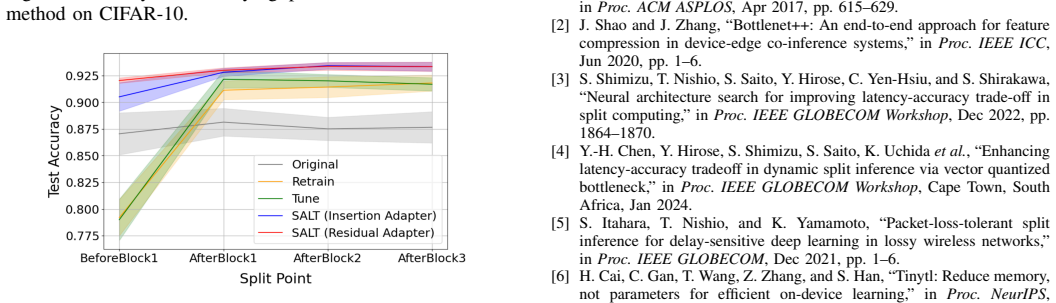
- On user-specific class subsets, SALT (Residual Adapter) reaches 93.8% on CIFAR-10 and 90.2% on CIFAR-100, beating both head retraining (92.4%/82.4%) and head fine-tuning (92.0%/88.9%).
- Training latency drops to roughly one-third of retraining's: 682 s versus 1968 s on CIFAR-10, because the residual adapter converges in about 20.5 epochs instead of 54.
- The adapter keeps accuracy high as packet loss rises to 0.75, so devices can skip retransmission and still get usable predictions over lossy links.
- Inference latency is unchanged (5.3 s per batch before and after the adapter), and the benefits hold across all four split depths tested.
Reading between the lines
- The same residual-correction mechanism could be trained against other feature-degradation channels, such as learned compression or adversarial perturbations, by swapping the channel model C(·) in Algorithm 1.
- The paper's 'closed' setting is really 'closed but gradient-accessible': a truly prediction-only API would require black-box optimization over the adapter, which the paper does not study.
- Because z' = z + Δz is transmitted in the clear, the adapter could in principle be probed by an attacker to learn something about the frozen tail or the user-specific correction; the paper does not analyze this leakage.
Editorial analysis
A structured set of objections, weighed in public.
Referee Report
Summary. The paper proposes SALT (Split-Adaptive Lightweight Tuning), a client-side adaption method for split computing in which the head and tail networks are proprietary and closed. SALT inserts a small trainable adapter between the head and tail that refines the transmitted latent features; the adapter is trained via split learning, with the server computing and returning gradients of the loss with respect to the received features. Experiments on CIFAR-10 and CIFAR-100 sub-tasks report that SALT achieves higher or comparable accuracy to head retraining and fine-tuning while converging in fewer epochs and lower total training latency, and that it maintains accuracy under simulated packet loss. The central claim is that SALT enables user-specific adaptation without modifying the closed models or increasing inference-time communication overhead.
Significance. If the required server-side gradient feedback is available, SALT addresses a real and timely problem: adapting models in split-computing settings where the model provider does not reveal parameters or architectures. The residual-adapter idea is simple, plausible, and is evaluated with a careful experimental protocol (10 trials, confidence intervals, per-component latency breakdown). The paper does not overclaim against stronger baselines, and its latency-accuracy results are internally consistent. However, the contribution is conditional on an unstated API contract (the server must return gradients), which is a load-bearing assumption that is not specified in the system model. The packet-loss comparison also needs clarification to be fair. Code is not released, which limits reproducibility.
major comments (3)
- [Section II-C, Algorithm 1] The training procedure in Algorithm 1 (lines 11-15) requires the server to compute and transmit ∂L/∂z′ to the client. This is a non-standard capability for a closed, proprietary model endpoint, and the closed-model assumption in Section II-A only states that parameters and structures cannot be accessed or modified. The paper must explicitly state as an assumption that the server provides a gradient-returning training API, and should discuss whether this is realistic and how it interacts with the closedness guarantees. Without this gradient oracle, the adapter cannot be trained and the accuracy/latency results in Table III have no object.
- [Section III-B2, Figure 5] The packet-loss robustness experiment is not fully specified. Section II-C states that SALT is trained under a degraded channel ('By training under this degraded channel...'), while Section III-A says that p=0 unless otherwise specified for the robustness experiments. The paper does not state whether the Retrain and Tune baselines are also trained under the same packet-loss process. If those baselines are trained at p=0 and evaluated at p>0, the comparison is unfair because it conflates the ability to adapt to loss with the adaptation method. Please clarify the training conditions for each method and, if the baselines were not trained under degradation, report an additional comparison where they are.
- [Section III-A, Baselines] The evaluation compares SALT only against full head retraining (Retrain) and fine-tuning (Tune). Given that the paper is specifically about lightweight adaptation, it would strengthen the claim to include a parameter-efficient baseline that operates under the same access assumptions, such as a bias-only or adapter-based method applied to the head if head access were allowed, or a distillation-based head replacement (e.g., [8]). At minimum, the authors should explain why such alternatives are not applicable, since the current comparison does not isolate the benefit of the closed-model adapter design.
minor comments (6)
- [Section III-A, Metrics] The reported inference latencies (e.g., 5.3 s per batch of 128 samples for CIFAR-10 in Table III) appear implausibly high for a ResNet-18 head on an NVIDIA Quadro RTX 6000; please verify the units or explain what is included in this measurement.
- [Abstract and Section II-B] The abstract and Section II-B state that SALT does not increase communication overhead, but the training procedure requires an additional server-to-client transmission of gradients. Please qualify this claim to inference-time communication, or clarify that the overhead is relative to other training methods.
- [Section III-A, Datasets and Tasks] The CIFAR-100 sub-task uses 10 of the 100 classes while the tail network outputs 100 logits. Please specify whether the cross-entropy loss is computed over all 100 logits or only the selected 10, and how the reported personalized accuracy is calculated from the full output vector.
- [Section III-B2, Figure 5] Figure 5 does not show error bars or confidence intervals, unlike Figure 4. If they are omitted for legibility, please state this in the caption.
- [Section II-B] The description of the Insertion Adapter mentions that bottleneck structures 'require a decoder on the server side,' but this sentence is easy to misread as applying to the Insertion Adapter itself. Please rephrase to clarify that the Insertion Adapter does not change the feature dimension.
- [General] No source code is released. Making the implementation available would improve reproducibility and help readers validate the latency and accuracy numbers.
Circularity Check
No significant circularity: SALT is evaluated on held-out user-specific test data, and the self-citations used for the packet-loss and split-learning assumptions are background modeling choices, not load-bearing evidence for the accuracy claim.
full rationale
The paper's central claim is that a trainable client-side adapter S(z) added to the frozen latent feature z, yielding z' = z + S(z), improves user-specific classification accuracy and packet-loss robustness without modifying the closed head/tail networks. This is not circular: the adapter is trained on user-specific training data and evaluated on held-out test data, and the reported accuracies are external benchmark results rather than consequences of the method's construction. The residual definition z' = z + Δz is a design choice, not a prediction derived from the same data. The packet-loss model is explicitly borrowed from prior work [5] as a channel assumption, and the split-learning gradient-return procedure is presented as a system assumption in Algorithm 1; neither is derived from the accuracy results, so no fitted input is renamed as a prediction. Self-citations ([3], [4], [5]) are used as background for split computing, communication models, and related adaptation techniques, but the paper's main accuracy and latency comparisons are self-contained against the CIFAR-10 and CIFAR-100 benchmarks. The reviewer's concern that a strictly closed API may not expose gradients is a correctness or assumption risk, not a circularity, because the gradient oracle is an input to the algorithm rather than an output of the derivation. No identified step reduces to its own inputs by definition or by self-citation chain.
Assumptions & free parameters
free parameters (4)
- Learning rate =
1e-3
- Batch size =
128
- Adapter capacity =
443K parameters
- Max training epochs =
100 with early stopping
assumptions (5)
- domain assumption Head and tail networks are frozen and their parameters and architectures are inaccessible to the client.
- domain assumption The server can compute gradients of the loss with respect to the received latent feature and transmit them to the client.
- domain assumption Packet loss manifests as element-wise independent random drops in the latent feature vector, zero-filled after transmission.
- domain assumption User-specific data is a class-subset of the pre-training dataset, not a true input-level domain shift.
- domain assumption Communication latency is modeled with a constant 80 Mbit/s bandwidth and no propagation delay.
Cite this review
Pith. "Pith review of SALT: A Lightweight Model Adaptation Method for Closed Split Computing Environments." pith.science (2026). https://pith.science/paper/ADHHKIQI
@misc{pith2026250607355,
  author       = {Pith},
  title        = {Pith review of: SALT: A Lightweight Model Adaptation Method for Closed Split Computing Environments},
  year         = {2026},
  howpublished = {\url{https://pith.science/paper/ADHHKIQI}},
  note         = {Machine review of arXiv:2506.07355}
}
read the original abstract
We propose SALT (Split-Adaptive Lightweight Tuning), a lightweight model adaptation framework for Split Computing under closed constraints, where the head and tail networks are proprietary and inaccessible to users. In such closed environments, conventional adaptation methods are infeasible since they require access to model parameters or architectures. SALT addresses this challenge by introducing a compact, trainable adapter on the client side to refine latent features from the head network, enabling user-specific adaptation without modifying the original models or increasing communication overhead. We evaluate SALT on user-specific classification tasks with CIFAR-10 and CIFAR-100, demonstrating improved accuracy with lower training latency compared to fine-tuning methods. Furthermore, SALT facilitates model adaptation for robust inference over lossy networks, a common challenge in edge-cloud environments. With minimal deployment overhead, SALT offers a practical solution for personalized inference in edge AI systems under strict system constraints.
Figures


Figures from the paper (3 more)


Reference graph
Works this paper leans on
-
[8]
Y . Matsubara, D. Callegaro, S. Baidya, M. Levorato, and S. Singh, “Head network distillation: Splitting distilled deep neural networks for resource- constrained edge computing systems,”IEEE Access, vol. 8, pp. 212 177– 212 193, Nov 2020
work page 2020
-
[1]
Neuro- surgeon: Collaborative intelligence between the cloud and mobile edge,
Y . Kang, J. Hauswald, C. Gao, A. Rovinski, T. Mudgeet al., “Neuro- surgeon: Collaborative intelligence between the cloud and mobile edge,” inProc. ACM ASPLOS, Apr 2017, pp. 615–629
work page 2017
-
[2]
Bottlenet++: An end-to-end approach for feature compression in device-edge co-inference systems,
J. Shao and J. Zhang, “Bottlenet++: An end-to-end approach for feature compression in device-edge co-inference systems,” inProc. IEEE ICC, Jun 2020, pp. 1–6
work page 2020
-
[3]
Neural architecture search for improving latency-accuracy trade-off in split computing,
S. Shimizu, T. Nishio, S. Saito, Y . Hirose, C. Yen-Hsiu, and S. Shirakawa, “Neural architecture search for improving latency-accuracy trade-off in split computing,” inProc. IEEE GLOBECOM Workshop, Dec 2022, pp. 1864–1870
work page 2022
-
[4]
Enhancing latency-accuracy tradeoff in dynamic split inference via vector quantized bottleneck,
Y .-H. Chen, Y . Hirose, S. Shimizu, S. Saito, K. Uchidaet al., “Enhancing latency-accuracy tradeoff in dynamic split inference via vector quantized bottleneck,” inProc. IEEE GLOBECOM Workshop, Cape Town, South Africa, Jan 2024
work page 2024
-
[5]
Packet-loss-tolerant split inference for delay-sensitive deep learning in lossy wireless networks,
S. Itahara, T. Nishio, and K. Yamamoto, “Packet-loss-tolerant split inference for delay-sensitive deep learning in lossy wireless networks,” inProc. IEEE GLOBECOM, Dec 2021, pp. 1–6
work page 2021
-
[6]
Tinytl: Reduce memory, not parameters for efficient on-device learning,
H. Cai, C. Gan, T. Wang, Z. Zhang, and S. Han, “Tinytl: Reduce memory, not parameters for efficient on-device learning,” inProc. NeurIPS, vol. 33, 2020, pp. 11 285–11 297
work page 2020
-
[7]
Pockengine: Sparse and efficient fine-tuning in a pocket,
L. Zhu, L. Hu, J. Lin, W.-M. Chen, W.-C. Wanget al., “Pockengine: Sparse and efficient fine-tuning in a pocket,” inProc. Annu. IEEE/ACM Int. Symp. MICRO, Dec 2023, pp. 1381–1394
work page 2023
Show all 14 references
-
[9]
Parameter-efficient transfer learning for nlp,
N. Houlsby, A. Giurgiu, S. Jastrzebski, B. Morrone, Q. de Laroussilhe et al., “Parameter-efficient transfer learning for nlp,” inProc. ICML, vol. 97, Jun 2019, pp. 2790–2799
2019
-
[10]
Learning multiple visual domains with residual adapters,
S.-A. Rebuffi, H. Bilen, and A. Vedaldi, “Learning multiple visual domains with residual adapters,” inProc. NeurIPS, Dec 2017, pp. 506– 516
2017
-
[11]
Lora: Low- rank adaptation of large language models,
E. J. Hu, Y . Shen, P. Wallis, Z. Allen-Zhu, Y . Liet al., “Lora: Low- rank adaptation of large language models,” inProc. ICLR, Jan 2022, pp. 615–629
2022
-
[12]
Distributed learning of deep neural network over multiple agents,
O. Gupta and R. Raskar, “Distributed learning of deep neural network over multiple agents,”J. Netw. Comput. Appl., vol. 116, pp. 1–8, 2018
2018
-
[13]
Learning multiple layers of features from tiny images,
A. Krizhevsky, “Learning multiple layers of features from tiny images,” Univ. of Toronto, Tech. Rep., 2009. [Online]. Available: https://www.cs.toronto.edu/∼kriz/cifar.html
2009
-
[14]
Deep residual learning for image recognition,
K. He, X. Zhang, S. Ren, and J. Sun, “Deep residual learning for image recognition,” inProc. IEEE CVPR, Jun 2016, pp. 770–778
2016
Reviewed August 7, 2026 · model on record in the stance chip above.
Discussion (0). Sign in to comment.