REVIEW 4 major objections 4 minor 42 references
Numerical study on the robustness of the stability for stable black holes
T0 review · 4 major / 4 minor · reviewed 2026-08-07 · deepseek-v4-flash
Pith's one-line read A near-horizon bump of any size can drive a stable black hole unstable.
desk verdict A genuinely new numerical claim that infinitesimal near-horizon potential bumps can destabilize Schwarzschild, but the load-bearing extrapolation to arbitrarily small amplitude rests on numerical evidence that is not yet documented well enough. read the letter →
The pith
A machine-rendered reading of the paper's core claim, the machinery that carries it, and where it could break.
The reading
What carries the argument
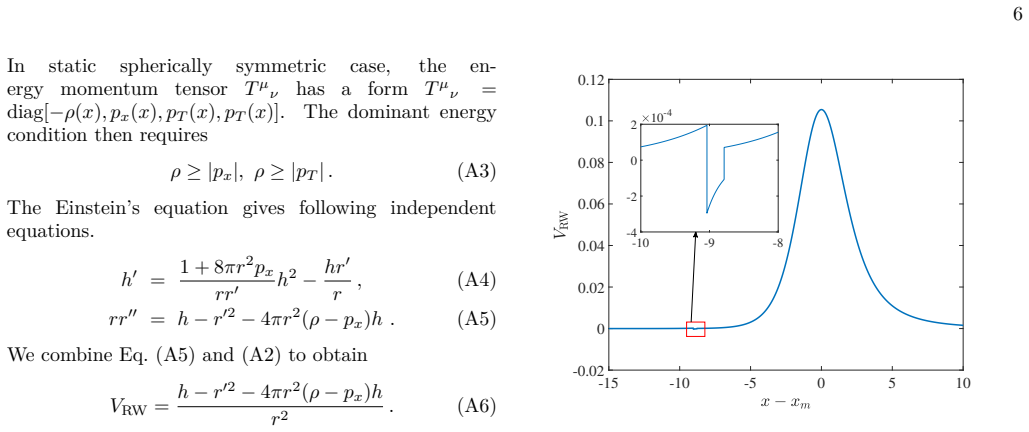
The central object is the deformed Regge-Wheeler potential $V_{\mathrm{eff}} = V_{\mathrm{RW}}(r_*) + \epsilon V_p(r_* - a, t)$ for s-wave scalar perturbations of Schwarzschild, with $V_{\mathrm{RW}} = h h'/r$ and tortoise coordinate mapping the horizon to $r_* \to -\infty$. The analysis solves the one-dimensional wave equation with no-reflect boundary conditions using fourth-order finite differences and a fourth-order Runge-Kutta time integrator, then locates the critical distance $a_c$ by bisection from the appearance of late-time exponential growth. The horizon's infinite tortoise-coordinate range is the load-bearing geometric feature: it allows a small local potential placed arbitrarily far down the throat to act over an unbounded interval, unlike the bounded $r_*$ range of a horizonless star.
What would settle it
Run the same time-domain evolutions at a sequence of decreasing grid spacings and time steps while fixing $\epsilon$ and $a$: if the exponential growth rate shrinks toward zero or $a_c$ stops growing as $\epsilon \to 0$, the infinitesimal-instability claim fails. A complementary check is a frequency-domain search for a quasinormal mode with positive imaginary part that appears only when $a < a_c$; without such a mode there is no spectral instability to match the time-domain growth.
Extended reading notes
Core claim
The central claim is that the stability of the Schwarzschild black hole against s-wave scalar perturbations is not robust: for a local deformation $V_{\mathrm{eff}} = V_{\mathrm{RW}}(r_*) + \epsilon V_p(r_* - a, t)$, with $V_p$ compactly supported (or random, or time-dependent), there is a critical distance $a_c$ such that for $a < a_c$ the perturbation grows exponentially instead of decaying. Numerically, for static negative bumps $a_c = 1/(\bar{V}_p \epsilon)$ where $\bar{V}_p$ is the spatial integral of $V_p$; for stochastic zero-mean potentials $a_c \propto 1/\epsilon^2$; for low-frequency oscillatory bumps with $w \to 0^+$, $a_c \propto 1/\epsilon$. Since $a_c$ grows without bound as $\epsilon \to 0$, there is no threshold amplitude below which the black hole is guaranteed stable: any positive $\epsilon$ can destabilize if placed close enough. The paper also finds that potentials that stabilize Minkowski spacetime can destabilize a black hole, and that a regular star with no horizon does not show this infinitesimal-bump instability, so the effect is tied to the horizon's infinite tortoise-coordinate range.
Load-bearing premise
The results hinge on the assumption that the late-time exponential growth seen in the numerical integrations is a genuine instability of the deformed wave equation and that the fitted power laws for $a_c$ keep holding as $\epsilon$ goes to zero; if the growth is a numerical artifact or the scaling bends at smaller amplitudes, the infinitesimal-bump conclusion does not follow.
Editorial extensions
If this is right
- A black hole surrounded by any matter that produces a negative, stochastic, or low-frequency oscillatory near-horizon potential deformation will, if the deformation lies closer than $a_c$, develop exponentially growing scalar perturbations rather than settling down.
- The energy-flux calculation in the paper implies that during this instability the scalar field transfers energy into the horizon and out to infinity, so the end state is not a static hairy configuration but a vacuum Schwarzschild black hole with larger horizon area.
- Near-horizon quantum fluctuations, redshifted to $\sim 1/r_h$ scales in tortoise coordinates, act as small stochastic deformations; the paper concludes that an isolated black hole is not guaranteed to remain stable over extended timescales if such fluctuations persist.
- The comparison with a Hayward star shows the effect is horizon-specific: an infinitesimal negative bump placed as close as possible to a regular star does not trigger instability, so the phenomenon is not just the negative bump acting in flat space.
- The authors note that analogous instability may occur near cosmological horizons in asymptotically de Sitter black holes.
Reading between the lines
- Editorial extension: the power-law scalings predict a sharp quantitative signature in the frequency domain; a spectral analysis should show a quasinormal mode crossing the real axis exactly when $a$ drops below $a_c$, with growth rate tied to the distance past the threshold.
- Editorial extension: because the critical distance diverges only polynomially in $1/\epsilon$, one can test the claim by computing $a_c$ at two or three smaller amplitudes with higher-resolution grids and checking whether $\epsilon a_c$ (or $\epsilon^2 a_c$) truly stays constant; a bend in the curve would signal a breakdown of the infinitesimal-bump conclusion.
- Editorial extension: for rotating black holes, the tortoise coordinate still runs to $-\infty$ but angular momentum modifies the effective potential; spin may change the critical distance and the scaling exponents, and the connection to turbulent black holes mentioned in the paper becomes testable.
Editorial analysis
A structured set of objections, weighed in public.
Referee Report
Summary. The manuscript studies the linear stability of Schwarzschild black holes against small local deformations of the Regge-Wheeler potential. The authors numerically solve the (1+1)-dimensional wave equation for an s-wave scalar field with three types of potential perturbations: a static negative Gaussian bump, a stochastic local potential, and a low-frequency time-dependent Gaussian bump. For each case they report that, when the perturbation is placed sufficiently close to the horizon, the scalar field grows exponentially at late times, and they extract scaling laws for the critical distance as a function of the perturbation amplitude: a_c ~ 1/(epsilon) for static negative bumps and low-frequency bumps, and a_c ~ 1/epsilon^2 for stochastic bumps. The paper concludes that infinitesimal near-horizon deformations can overturn the stability of a stable black hole, and it speculates that horizon-induced redshift of quantum fluctuations could destabilize isolated black holes.
Significance. If substantiated, the central claim would be significant: it would show that the linear stability of Schwarzschild is not structurally robust against small localized potential perturbations, contradicting the common expectation that sufficiently small metric deformations cannot change the stability of an initially stable black hole. The manuscript is clearly written, addresses a timely question, and includes useful supplementary analyses (a DEC-compatible construction of a negative bump in Appendix A, a comparison with a horizonless star in Appendix B, and an energy-flux argument in Appendix C). However, the significance is entirely conditional on the numerical reliability of the time-domain simulations and on the validity of the extrapolated scaling laws; neither is established in the present version.
major comments (4)
- [II] The numerical method is described only as a fourth-order finite-difference spatial discretization with RK4 time integration and 'no reflect' boundary conditions. The paper does not state the computational domain size in r*, the grid spacing, the time step, the duration of the simulations, or the precise implementation of the boundary conditions. This is load-bearing because the instability is diagnosed from visual exponential growth in Figures 1-3 and the critical distances are located by bisection; without grid-convergence and domain-size studies, the observed growth could be a finite-domain artifact, a boundary reflection, or a transient effect. In particular, the reported scaling a_c ~ 1/epsilon and 1/epsilon^2 coincides with the tail length of a would-be bound state, so the threshold may be set by the numerical boundary rather than by the continuum problem. A convergence study and a domain-size dependence test are essential before the central claim can be accepted.
- [III, Eq. (6)] The scaling law a_c = 1/(V_p epsilon) is presented as an asymptotic relation, but it is based on a small number of bisection points (visible in the right panel of Fig. 1) and is then extrapolated to arbitrarily small epsilon. No criterion is given for what constitutes 'instability' in the bisection procedure, no growth-rate threshold is specified, and no independent spectral (frequency-domain) confirmation is provided to show that a genuine exponentially growing mode crosses the real axis. The conclusion that 'infinitesimal' negative bumps always destabilize the black hole therefore exceeds the evidence presented, since the fitted power law could bend or break down at smaller epsilon.
- [IV and V, Eqs. (11) and (13)] The stochastic and low-frequency scaling laws a_c ~ 1/epsilon^2 and 1/epsilon are obtained by fitting the 'most left 6-7 points' in Figures 2 and 3, and the text claims universality after 'testing many different functions' without showing any of those tests. For the stochastic case, the spectral content of the random potential is not quantified, and no ensemble-averaging or statistical convergence is described. The 1/epsilon^2 scaling in particular is not explained by a simple bound-state estimate and would need independent confirmation, for example by solving for quasinormal modes or using a spectral method, before it can be treated as a physical result.
- [Appendix B] The comparison with a Hayward star is invoked to argue that the instability is specific to black hole geometry, but the argument is only that the tortoise coordinate has finite range for a star and infinite range for a black hole. This is a heuristic distinction, not a controlled numerical comparison: the stellar background also has a different potential profile and a different inner boundary condition. To support the claim that the effect is due to the near-horizon r* -> -infinity structure, the authors would need to compare black-hole and horizonless backgrounds with the same type of localized perturbation and the same numerical setup, or provide an analytic argument for the role of the semi-infinite domain.
minor comments (4)
- [II] The text says 'forth-order Rugge-Kutta method'; this should be 'fourth-order Runge-Kutta method'.
- [III, Fig. 1] The red line in the right panel of Fig. 1 is said to be 'not by fitting', but the definition of V_p is only given in the text; it would be clearer to explicitly state the integrated value of V_p for the chosen Gaussian profile and to show the relation between the fitted line and the data points with residual errors.
- [IV, Eq. (8)] The notation is confusing because the same symbol W is used for the spatial random function and for its zero-average integral condition, and U is used both for the temporal random function and for its time average; please use distinct symbols for the function and the mean.
- [V, Fig. 3] The left panel of Fig. 3 states w = 0.02 and sigma = 4, while the right panel states w = 0.001 and sigma = 4; the text discusses both cases but does not clearly state which parameters correspond to which data set in the bisection plot. Clarify the parameter choices and the number of points used for each fit.
Circularity Check
No significant circularity: the numerical instability claims and scaling laws are empirical outputs of time-domain simulations, not consequences of fitted inputs by construction.
full rationale
The paper's central derivation chain is numerical: it solves the perturbed wave equation (2) with potential (3) for three classes of Vp, locates a critical distance a_c by bisection, and reports the scaling laws (6), (11), and (13). These scaling laws are outputs of the simulations, not inputs fitted to reproduce them. The 'negative static bump' law a_c = 1/(Vp epsilon) is an inferred empirical relation; the paper explicitly labels the plotted line as 'not by fitting' only in the sense that the line is drawn from the formula after the exponent is read off the bisection data. No equation in the paper defines stability or instability in terms of a_c, and no parameter fitted to the late-time growth data is renamed as a prediction. Self-references are limited to background material (e.g., Ref. [26] on spectral instability, Ref. [39] announcing future frequency-domain work) and are not load-bearing for the stated numerical conclusion. The heuristic redshift argument in Sec. IV is an independent scaling estimate, not a derivation of the numerical results. The main concerns with the paper are numerical-convergence and extrapolation risks (no stated grid spacing or domain size, no convergence study, and power laws inferred from a finite range of epsilon), but those are correctness/robustness issues, not circularity. There is no step in which a claimed prediction is equivalent by construction to an input.
Assumptions & free parameters
free parameters (4)
- Stochastic scaling-law exponent =
-2 (slope of ln|a_c| vs ln epsilon, Fig. 2)
- Stochastic scaling-law intercept =
0.02
- Low-frequency scaling-law exponent =
-1 (slope of ln|a_c| vs ln epsilon, Fig. 3)
- Low-frequency scaling-law intercept =
-0.93
assumptions (5)
- ad hoc to paper All near-horizon environmental or quantum effects can be encoded as an additive local perturbation epsilon Vp(r*, t) to the Regge-Wheeler potential of a single s-wave scalar test field.
- domain assumption The numerical evolution uses no-reflection boundary conditions at both horizon and infinity and is stable enough that observed exponential growth is physical.
- ad hoc to paper The fitted power laws extend to arbitrarily small epsilon, so that a critical distance always exists for any infinitesimal amplitude.
- ad hoc to paper Planck-scale quantum fluctuations near the horizon are redshifted to O(r_h) stochastic potential variations in tortoise coordinates.
- domain assumption A single pseudo-random realization of W and U represents the generic stochastic behavior.
Cite this review
Pith. "Pith review of Numerical study on the robustness of the stability for stable black holes." pith.science (2026). https://pith.science/paper/3R3NYWYN
@misc{pith2026250607562,
  author       = {Pith},
  title        = {Pith review of: Numerical study on the robustness of the stability for stable black holes},
  year         = {2026},
  howpublished = {\url{https://pith.science/paper/3R3NYWYN}},
  note         = {Machine review of arXiv:2506.07562}
}
read the original abstract
This paper numerically studies if the stability of a stable black hole is robust against the small perturbation on geometry near its event horizon. In an other word, we numerically study if two nearly identical black holes may exhibit completely different stabilities at late time. As a toy model, it encodes the such perturbation into deformations of Regge-Wheeler potential. It considers three different types of local deformations-the negative static bump potential, the stochastic potential and bump potential modulated by time function in low frequency limit. Our numerical results show that infinitesimal local deformations on Regge-Wheeler potential near the horizon can overturn stability of a stable black hole, implying that late-time behavior of a stable black hole is extremely sensitive to geometry near horizon. Specially, certain deformations that stabilize systems in flat backgrounds can destabilize otherwise stable black holes. It also shows that horizon-induced redshift transforms near-horizon quantum fluctuations into classical-scale stochastic deformations capable of triggering instability, implying that even an isolated black hole cannot keep stable if the near-horizon quantum noise could be hold in extended timescales.
Figures


Figures from the paper (2 more)


Reference graph
Works this paper leans on
-
[1]
Subrahmanyan Chandrasekhar, The Mathematical The- ory of Black Holes (Oxford University Press, Oxford, 1983)
work page 1983
-
[2]
− sin(t/π) and W (x) = w0 [1 − tanh(4(x − 2)) tanh(4(x + 2))]Q(x). (9) with Q(x) = sin x + cos √ 2x + cosπx − sinπx +c0. (10) Herec0 andw0 are chosen so thatW has zero average and normalization condition max |W | = 1 is satisfied. The detailed forms of Eq. ( 9) is not important. We choose functions ( 9) and ( 10) just as a concrete example. The results are...
work page 2000
-
[3]
The quasi- normal modes of the Schwarzschild black hole,
S. Chandrasekhar and Steven L. Detweiler, “The quasi- normal modes of the Schwarzschild black hole,” Proc. Roy. Soc. Lond. A 344, 441–452 (1975)
work page 1975
-
[4]
Quantify- ing excitations of quasinormal mode systems,
Hans-Peter Nollert and Richard H. Price, “Quantify- ing excitations of quasinormal mode systems,” J. Math. Phys. 40, 980–1010 (1999) , arXiv:gr-qc/9810074
arXiv 1999
-
[5]
Quasinor- mal modes of stars and black holes,
Kostas D. Kokkotas and Bernd G. Schmidt, “Quasinor- mal modes of stars and black holes,” Living Rev. Rel. 2, 2 (1999) , arXiv:gr-qc/9909058
arXiv 1999
-
[6]
Quasinormal modes of black holes and black branes,
Emanuele Berti, Vitor Cardoso, and Andrei O. Starinets, “Quasinormal modes of black holes and black branes,” Class. Quant. Grav. 26, 163001 (2009) , arXiv:0905.2975 [gr-qc]
arXiv 2009
-
[7]
Quasinormal modes of black holes: From astrophysics to string theory,
R. A. Konoplya and A. Zhidenko, “Quasinormal modes of black holes: From astrophysics to string theory,” Rev. Mod. Phys. 83, 793–836 (2011) , arXiv:1102.4014 [gr-qc]
arXiv 2011
-
[8]
Spontaneous scalarization of black holes and compact stars from a Gauss-Bonnet coupling,
Hector O. Silva, Jeremy Sakstein, Leonardo Gualtieri, Thomas P. Sotiriou, and Emanuele Berti, “Spontaneous scalarization of black holes and compact stars from a Gauss-Bonnet coupling,” Phys. Rev. Lett. 120, 131104 (2018), arXiv:1711.02080 [gr-qc]
arXiv 2018
Show all 42 references
-
[9]
Spontaneous Scalarization of Charged Black Holes,
Carlos A. R. Herdeiro, Eugen Radu, Nicolas Sanchis- Gual, and José A. Font, “Spontaneous Scalarization of Charged Black Holes,” Phys. Rev. Lett. 121, 101102 (2018), arXiv:1806.05190 [gr-qc]
2018 arXiv
-
[10]
Spontaneous scalarization,
Daniela D. Doneva, Fethi M. Ramazanoğlu, Hector O. Silva, Thomas P. Sotiriou, and Stoytcho S. Yazad- jiev, “Spontaneous scalarization,” Rev. Mod. Phys. 96, 015004 (2024) , arXiv:2211.01766 [gr-qc]
2024 arXiv
-
[11]
Tachy- onic instability and spontaneous scalarization in param- eterized Schwarzschild-like black holes,
Hengyu Xu, Yizhi Zhan, and Shao-Jun Zhang, “Tachy- onic instability and spontaneous scalarization in param- eterized Schwarzschild-like black holes,” Eur. Phys. J. C 84, 617 (2024) , arXiv:2403.19392 [gr-qc]
2024 arXiv
-
[12]
Quasinormal modes of spontaneous scalarized Kerr black holes,
Wei Xiong and Peng-Cheng Li, “Quasinormal modes of spontaneous scalarized Kerr black holes,” (2024), arXiv:2411.19069 [gr-qc]
2024
-
[13]
Search techniques for gravita- tional waves from black hole ringdowns,
Jolien D. E. Creighton, “Search techniques for gravita- tional waves from black hole ringdowns,” Phys. Rev. D 60, 022001 (1999) , arXiv:gr-qc/9901084
1999 arXiv
-
[14]
Black hole spectroscopy: Testing general rel- ativity through gravitational wave observations,
Olaf Dreyer, Bernard J. Kelly, Badri Krishnan, Lee Samuel Finn, David Garrison, and Ramon Lopez- Aleman, “Black hole spectroscopy: Testing general rel- ativity through gravitational wave observations,” Class. Quant. Grav. 21, 787–804 (2004) , arXiv:gr-qc/0309007
2004 arXiv
-
[15]
On gravitational-wave spectroscopy of massive black holes with the space interferometer LISA,
Emanuele Berti, Vitor Cardoso, and Clifford M. Will, “On gravitational-wave spectroscopy of massive black holes with the space interferometer LISA,” Phys. Rev. D 73, 064030 (2006) , arXiv:gr-qc/0512160
2006 arXiv
-
[16]
Bayesian model selection for testing the no-hair theorem with black hole ringdowns,
S. Gossan, J. Veitch, and B. S. Sathyaprakash, “Bayesian model selection for testing the no-hair theorem with black hole ringdowns,” Phys. Rev. D 85, 124056 (2012) , arXiv:1111.5819 [gr-qc]
2012 arXiv
-
[17]
Extreme gravity tests with gravitational waves from compact binary coalescences: (II) ringdown,
Emanuele Berti, Kent Yagi, Huan Yang, and Nicolas Yunes, “Extreme gravity tests with gravitational waves from compact binary coalescences: (II) ringdown,” Gen. Rel. Grav. 50, 49 (2018) , arXiv:1801.03587 [gr-qc]
2018 arXiv
-
[18]
Gravi- tational wave ringdown analysis using the F - statistic,
Hai Tian Wang, Garvin Yim, and Lijing Shao, “Gravi- tational wave ringdown analysis using the F - statistic,” (2024), arXiv:2409.00970 [astro - ph.HE]
2024 arXiv
-
[19]
About the significance of quasinor- mal modes of black holes,
Hans-Peter Nollert, “About the significance of quasinor- mal modes of black holes,” Phys. Rev. D 53, 4397–4402 (1996), arXiv:gr-qc/9602032
1996 arXiv
-
[20]
Destabilizing the Fundamental Mode of Black Holes: The Elephant and the Flea,
Mark Ho-Yeuk Cheung, Kyriakos Destounis, Ro- drigo Panosso Macedo, Emanuele Berti, and Vitor Car- doso, “Destabilizing the Fundamental Mode of Black Holes: The Elephant and the Flea,” Phys. Rev. Lett. 128, 111103 (2022) , arXiv:2111.05415 [gr-qc]
2022 arXiv
-
[21]
Physical significance of the black hole quasinormal mode spectra instability,
Vitor Cardoso, Shilpa Kastha, and Rodrigo Panosso Macedo, “Physical significance of the black hole quasinormal mode spectra instability,” Phys. Rev. D 110, 024016 (2024) , arXiv:2404.01374 [gr-qc]
2024 arXiv
-
[22]
Universality of instability in the fundamental quasinormal modes of black holes,
Wei-Liang Qian, Guan-Ru Li, Ramin G. Daghigh, Stefan Randow, and Rui-Hong Yue, “Universality of instability in the fundamental quasinormal modes of black holes,” Phys. Rev. D 111, 024047 (2025) , arXiv:2409.17026 [gr- qc]
2025 arXiv
-
[23]
Resonant Excitation of Quasinormal Modes of Black Holes,
Hayato Motohashi, “Resonant Excitation of Quasinormal Modes of Black Holes,” Phys. Rev. Lett. 134, 141401 (2025), arXiv:2407.15191 [gr-qc]
2025 arXiv
-
[24]
Significance of Black Hole Quasinormal Modes: A Closer Look,
Ramin G. Daghigh, Michael D. Green, and Jodin C. Morey, “Significance of Black Hole Quasinormal Modes: A Closer Look,” Phys. Rev. D 101, 104009 (2020) , arXiv:2002.07251 [gr-qc]
2020 arXiv
-
[25]
Quasinormal modes of Schwarzschild black holes on the real axis,
Koutarou Kyutoku, Hayato Motohashi, and Takahiro Tanaka, “Quasinormal modes of Schwarzschild black holes on the real axis,” Phys. Rev. D 107, 044012 (2023) , arXiv:2206.00671 [gr-qc]
2023 arXiv
-
[26]
Stability of the fundamental quasinormal mode in time-domain observations against small perturbations,
Emanuele Berti, Vitor Cardoso, Mark Ho-Yeuk Cheung, Francesco Di Filippo, Francisco Duque, Paul Martens, and Shinji Mukohyama, “Stability of the fundamental quasinormal mode in time-domain observations against small perturbations,” Phys. Rev. D 106, 084011 (2022) , arXiv:2205....
2022 arXiv
-
[27]
Spectral instability of black holes: Relating the frequency domain to the time domain,
Yiqiu Yang, Zhan-Feng Mai, Run-Qiu Yang, Lijing Shao, and Emanuele Berti, “Spectral instability of black holes: Relating the frequency domain to the time domain,” Phys. Rev. D 110, 084018 (2024) , arXiv:2407.20131 [gr- qc]
2024 arXiv
-
[28]
Deciphering the Instability of the Black Hole Ringdown Quasinor- mal Spectrum,
A. Ianniccari, A. J. Iovino, A. Kehagias, P. Pani, G. Perna, D. Perrone, and A. Riotto, “Deciphering the Instability of the Black Hole Ringdown Quasinor- mal Spectrum,” Phys. Rev. Lett. 133, 211401 (2024) , arXiv:2407.20144 [gr-qc]
2024 arXiv
-
[29]
Ringdown stability: Graybody factors as sta- ble gravitational-wave observables,
Romeo Felice Rosato, Kyriakos Destounis, and Paolo Pani, “Ringdown stability: Graybody factors as sta- ble gravitational-wave observables,” Phys. Rev. D 110, L121501 (2024) , arXiv:2406.01692 [gr-qc]
2024 arXiv
-
[30]
Stability of a Schwarzschild singularity,
Tullio Regge and John A. Wheeler, “Stability of a Schwarzschild singularity,” Phys. Rev. 108, 1063–1069 9 (1957)
1957
-
[31]
The schwarzschild space-time,
S Chandrasekhar, “The schwarzschild space-time,” in The Mathematical Theory of Black Holes (Oxford Uni- versity Press, 1998)
1998
-
[32]
Black-hole spectroscopy: Quasinormal modes, ringdown stabil- ity and the pseudospectrum,
Kyriakos Destounis and Francisco Duque, “Black-hole spectroscopy: Quasinormal modes, ringdown stabil- ity and the pseudospectrum,” in Compact Objects in the Universe , edited by Eleftherios Papantonopoulos and Nikolaos Mavromatos (Springer Nature Switzerland, Cham, 2024) pp. 155–202
2024
-
[33]
Can environmental effects spoil precision gravitational-wave astrophysics?
Enrico Barausse, Vitor Cardoso, and Paolo Pani, “Can environmental effects spoil precision gravitational-wave astrophysics?” Phys. Rev. D 89, 104059 (2014)
2014
-
[34]
Searching for ultralight bosons with supermassive black hole ringdown,
Adrian Ka-Wai Chung, Joseph Gais, Mark Ho-Yeuk Che- ung, and Tjonnie G. F. Li, “Searching for ultralight bosons with supermassive black hole ringdown,” Phys. Rev. D 104, 084028 (2021)
2021
-
[35]
Perturbations of the Vaidya metric in the frequency do- main: Quasinormal modes and tidal response,
Lodovico Capuano, Luca Santoni, and Enrico Barausse, “Perturbations of the Vaidya metric in the frequency do- main: Quasinormal modes and tidal response,” Phys. Rev. D 110, 084081 (2024) , arXiv:2407.06009 [gr-qc]
2024 arXiv
-
[36]
Instability of reissner-nordström black holes in de sitter backgrounds,
Vitor Cardoso, Madalena Lemos, and Miguel Marques, “Instability of reissner-nordström black holes in de sitter backgrounds,” Phys. Rev. D 80, 127502 (2009)
2009
-
[37]
Agnostic black hole spectroscopy: Quasinormal mode content of numer- ical relativity waveforms and limits of validity of linear perturbation theory,
Vishal Baibhav, Mark Ho-Yeuk Cheung, Emanuele Berti, Vitor Cardoso, Gregorio Carullo, Roberto Cotesta, Wal- ter Del Pozzo, and Francisco Duque, “Agnostic black hole spectroscopy: Quasinormal mode content of numer- ical relativity waveforms and limits of validity of linear pert...
2023
-
[38]
The (in)stability of quasinormal modes of Boulware-Deser- Wheeler black hole in the hyperboloidal framework,
Li-Ming Cao, Liang-Bi Wu, and Yu-Sen Zhou, “The (in)stability of quasinormal modes of Boulware-Deser- Wheeler black hole in the hyperboloidal framework,” (2024), arXiv:2412.21092 [gr-qc]
2024 arXiv
-
[39]
Tur- bulent black holes,
Huan Yang, Aaron Zimmerman, and Luis Lehner, “Tur- bulent black holes,” Phys. Rev. Lett. 114, 081101 (2015)
2015
-
[40]
The analysis of frequency domain for static negative bump and static stochastic potential will be addressed in an upcoming publication
-
[41]
Formation and evaporation of reg- ular black holes,
Sean A. Hayward, “Formation and evaporation of reg- ular black holes,” Phys. Rev. Lett. 96, 031103 (2006) , arXiv:gr-qc/0506126
2006 arXiv
-
[42]
When the negative bump is sufficiently far way from the star, the instability can still be triggered but this is the effect of negative bump in flat space
Reviewed August 7, 2026 · model on record in the stance chip above.
Discussion (0). Sign in to comment.