REVIEW 3 major objections 5 minor 52 references
Synthesis by Design: Controlled Data Generation via Structural Guidance
T0 review · 3 major / 5 minor · reviewed 2026-08-07 · deepseek-v4-flash
Pith's one-line read This paper argues that encoding math reasoning as executable code—one line per reasoning step—converts problem generation into verifiable translation, yielding 39K training problems and a harder 6.1K benchmark that improve LLM math…
desk verdict A real, code-grounded data generation pipeline with a genuinely useful dataset, but the load-bearing code-line-to-reasoning-step mapping is unvalidated and the fine-tuning evidence is mixed. read the letter →
The pith
A machine-rendered reading of the paper's core claim, the machinery that carries it, and where it could break.
The reading
What carries the argument
The solution program and the variable-dependency graph parsed from it. The prompt asks the model to write one code line per reasoning step, annotated with that step as a comment, so that executing the program reproduces the boxed answer; parsing yields a tree-like computational graph whose nodes are variables and whose edges record which intermediate results depend on which earlier ones. This graph is what makes both intervention and measurement possible. Intervention picks a node $t_i$, inserts a proxy node $t'_i=f(t_i)$, and substitutes $t'_i$ for every later occurrence of $t_i$, so the sequential program recomputes all downstream quantities and the final answer is exact by construction. Difficulty is then quantified by counting the number of code blocks at the first indentation level, which the paper uses to build step-stratified benchmarks and to show that accuracy drops as step count rises.
What would settle it
Take a held-out batch of GSM8K and MATH problems, run the proposed generation pipeline, then give the generated problems to independent human annotators without showing them the solution code and ask them to (a) solve each problem and (b) mark the reasoning steps. If the code's root value disagrees with the human final answer on more than a small percentage of samples, or if human step counts differ materially from the first-indentation code-block count, the structural encoding and its difficulty measure would fail.
Extended reading notes
Core claim
The central claim is that the reasoning structure of a solved math problem can be lifted out of natural language into executable code and then treated as the object of study: leaves of the computational graph are the variables mentioned in the problem, the root is the final answer, and each internal node is one reasoning step with its dependencies visible. Starting from this graph, the paper generates new problems by structural intervention: it selects a node, maps it through $f$ to a proxy node (for GSM8K, $f$ is addition, subtraction, or multiplication by a random value, with division excluded; for MATH, the model chooses a transformation), replaces every later use of the original variable, and lets the program propagate new intermediate and final values. The agent's only remaining job is to translate the modified code back into a coherent question and reasoning text—what the paper calls an 'Answer → Problem' workflow—so generation quality no longer depends on the agent solving the new problem. Empirically, the paper claims that all evaluated models lose accuracy as the number of first-level code blocks grows, and that fine-tuning on the generated data improves accuracy on the original GSM8K and MATH sets relative to the compared data-generation baselines for Mistral-7B, Qwen-2-7B, and Llama-3-8B.
Load-bearing premise
The load-bearing premise is that the translated code preserves the reasoning process one line per step: if code lines, variable names, indentation blocks, and dependency edges diverge from the steps a human would list, then the step-level supervision and the step-count difficulty measure lose their meaning even though the code still returns the right number.
Editorial extensions
If this is right
- Generated data carries intermediate-step supervision as a free by-product: each line of solution code is a labeled reasoning step, so models can be trained with process signals rather than only final answers.
- Problem difficulty becomes measurable and controllable: the number of first-level code blocks assigns a step count to every item, allowing benchmarks and training sets to be stratified by difficulty.
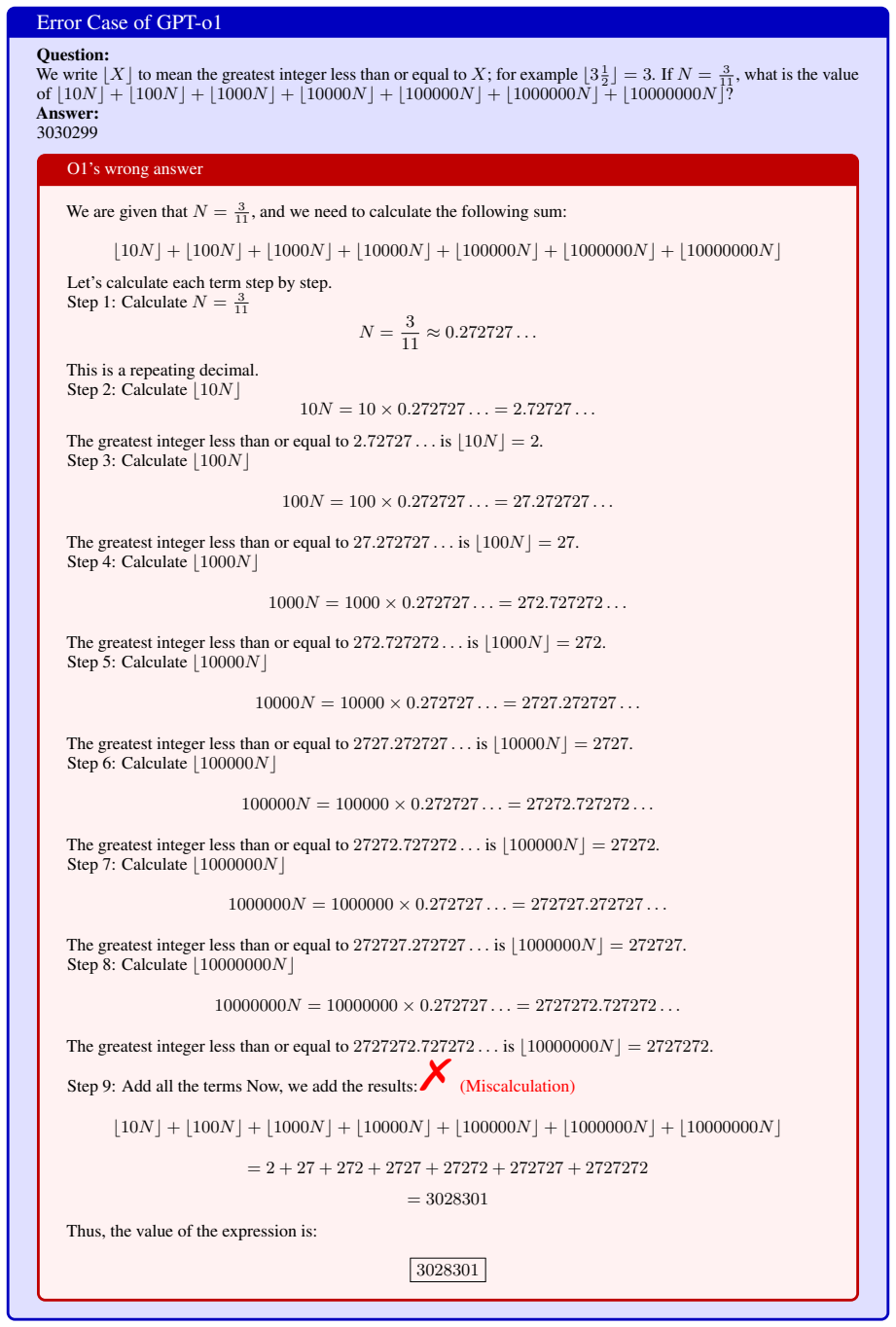
- Data generation no longer requires the generator to solve the new problem: because the intervened program already determines all intermediate and final values, the LLM only translates code into text, which is why the paper reports examples that the generating models themselves answer incorrectly.
- Fine-tuning on the 39K structurally generated samples improves accuracy on the original GSM8K and MATH for Mistral-7B, Qwen-2-7B, and Llama-3-8B compared with the pretrained baselines and with the other data-generation methods tested.
- The paper's benchmarks show that every evaluated model's accuracy declines as step count increases, which corroborates step count as a practical difficulty proxy for math reasoning.
Reading between the lines
- This suggests the intervention graph could be used to create adversarial or counterfactual tests on demand—e.g., changing one variable's role in the story to flip the answer category—a robustness use the paper does not explore.
- Because successive intervention rounds make problems progressively harder, the 39K data forms a natural curriculum; whether training on it in difficulty order beats the paper's mixed fine-tuning is a testable extension not reported.
- The appendix result that failed generations still help on MATH hints that the pipeline can generate deliberately 'wrong' but structurally labeled reasoning, which could be used to study reward hacking and error recovery in controlled experiments.
- The method's own MBPP example implies the machinery transfers beyond arithmetic word problems; testing it on planning or multi-step symbolic tasks would show whether the code-structure intervention generalizes as claimed.
Editorial analysis
A structured set of objections, weighed in public.
Referee Report
Summary. The paper introduces a data-generation framework for mathematical reasoning that translates existing GSM8K and MATH solutions into executable Python code, parses the code into a computational graph, intervenes on the graph (e.g., by introducing proxy variables), and translates the modified code back into new problems with step-level comments. The pipeline yields 39K training problems and a 6.1K-problem benchmark (MATH-Struct and GSM8K-Struct) whose difficulty is quantified by counting first-level code blocks as reasoning steps. The authors benchmark several LLMs on this benchmark, report that accuracy declines as step count increases, and fine-tune Mistral-7B, Qwen-2-7B, and Llama-3-8B on the generated data, showing top-two results in four of six model-dataset pairings on the original GSM8K/MATH test sets.
Significance. If the central code-to-step alignment were validated, this would be a useful contribution: it combines executable-code verification with structural intervention and step-level supervision, and it releases data and code. The paper's strengths include a concrete pipeline with local code-execution checks, a human evaluation (n=60, 89.2% valid questions), and fine-tuning comparisons against five established data-generation methods. The benchmark itself, with difficulty annotations, could be a resource for studying length-dependent reasoning failure. However, the load-bearing assumption that one code line corresponds to one reasoning step is not validated and appears violated in the paper's own examples, which weakens both the step-supervision and difficulty-ordering claims.
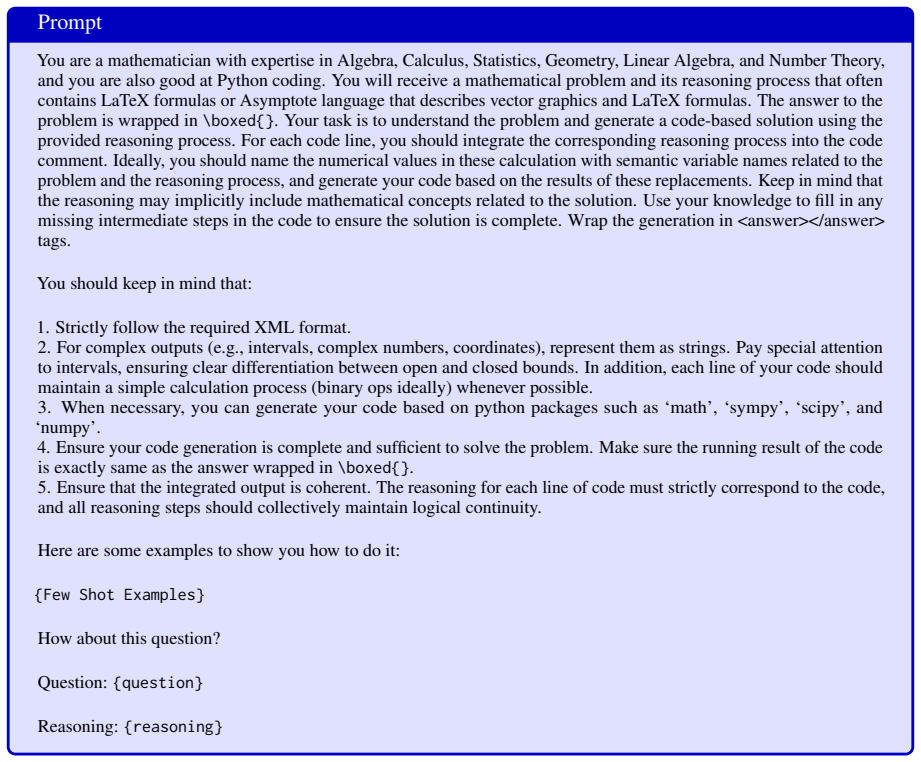
major comments (3)
- [Section 3.1, Figure 11, Appendix C.1] The central assumption that each code line corresponds to one reasoning step is both untested and contradicted by the paper's own examples. In Figure 11, two distinct reasoning comments ("Now for the first expression..." and "Therefore...") precede a single code line, while the single algebraic step "5x-3=12" is split across three code lines. Appendix C.1's instruction to "maintain a simple calculation process (binary ops ideally) whenever possible" actively encourages splitting one reasoning step into multiple code lines. Since Section 4.1's difficulty measure counts first-indentation code blocks and Section 3.1 builds the computational graph from code lines, both the step-level supervision and the difficulty ordering of the benchmark rest on this unvalidated mapping. The human evaluation in Appendix B.1 checks only whether a generated question is valid; it never checks whether code lines align with reasoning steps. The Limitations section's own report that 42% of MATH and 21% of GSM8K generated samples are discarded by GPT-4o despite successful code execution is independent evidence that executability does not guarantee reasoning fidelity.
- [Section 4.4, Table 2] The claim that the fine-tuning results "validate the effectiveness of our dataset" is not fully supported by the reported numbers. On Qwen-2-7B MATH, fine-tuning on the proposed data reduces accuracy from 46.20% (baseline) to 39.70%, and the method is not among the top two on that pairing (MammoTH achieves 40.78% and the baseline remains highest). On Llama-3-8B MATH, the method is third (19.70% vs MetaMath's 23.68% and MathScale's 21.58%). The proposed data is best only on GSM8K for Mistral-7B and Qwen-2-7B. The catastrophic-forgetting analysis in Appendix D (Table 3) reports a 9.1% correct-to-incorrect flip rate on MATH, but it does not compare flip rates for the other training datasets, so it does not establish that the degradation is not specific to the proposed data. The authors should either temper the effectiveness claim or provide a direct comparison of forgetting rates across all compared datasets.
- [Section 4.1, Appendix A.3] The claim that the benchmark is "harder" because of longer reasoning steps is evaluated on the same step-count measure used to construct the difficulty labels, and the only additional validation (Appendix A.3) filters the benchmark by the correctness of Claude-3-5-Sonnet and GPT-4o, the same families of models used in generation. This does not independently confirm that code-block count corresponds to human-perceived reasoning difficulty. An independent validation—for example, human difficulty ratings on a matched sample, or a comparison against an external step-annotation scheme—would be needed to support the difficulty-ordering claim.
minor comments (5)
- [Section 4, first paragraph] Typo: "datailed" should be "detailed".
- [Figure 1 and surrounding text] The variable "daises" is misspelled throughout; it should be "daisies".
- [Section 4.5] The sentence "their performance quickly degrades as the problem difficulty decreases" appears to say the opposite of what is intended; it should be "as the problem difficulty increases."
- [Table 3] The table header "GAM8K" should be "GSM8K."
- [Section 4.2] The model name "GPT-o12" should be "GPT-o1."
Circularity Check
No significant circularity: the paper's headline claims are tested on independent original GSM8K/MATH sets, and the benchmark trend is an empirical measurement rather than a definitional reduction.
full rationale
The paper's central effectiveness claims are evaluated on the original GSM8K and MATH test sets, which are independent of the proposed generation pipeline; fine-tuning on the generated 39K samples and measuring accuracy on those fixed external benchmarks does not reduce to the generation inputs. The proposed benchmark trend, in which model accuracy declines as the number of counted code blocks increases, is an empirical observation on held-out model outputs, not a value fitted from the same data. The step-count measure is explicitly presented as an operationalization ('we count the number of code blocks at the first level of indentation as an approximation of the solving steps'), and the paper does not derive a theorem from it. The involvement of GPT-4o and Claude-3-5-Sonnet in data generation and evaluation is disclosed by the authors, and while it may introduce mild evaluator overlap, it does not make any central claim equivalent to its inputs by construction. Citations to prior work on reasoning complexity, such as Qi et al. and Saxton et al., are external and not self-citations by the present authors. Potential concerns about the fidelity of the code-line-to-reasoning-step mapping and about the difficulty proxy being influenced by the code-generation prompt are validity or correctness risks, not circularity, and they do not amount to a specific equation or fitted parameter being renamed as a prediction. Therefore the paper's derivation chain is self-contained with respect to its main empirical claims.
Assumptions & free parameters
free parameters (3)
- random intervention operand for GSM8K =
unconstrained random integer (e.g., 3, 9, 6 in examples)
- intervention rounds =
3 (train), 8 (test)
- retention cutoff for quality filters =
51.4% GSM8K, 35.4% MATH retained
assumptions (5)
- domain assumption Solution code generated by Claude-3-5-Sonnet faithfully encodes the original reasoning steps.
- domain assumption The variable-dependency graph extracted from code captures the causal structure of the math problem.
- domain assumption Modifying a variable and replacing all downstream occurrences produces a valid new problem when sign/type changes are filtered.
- domain assumption Number of first-level code blocks is a valid difficulty proxy (reasoning-step count).
- domain assumption GPT-4o evaluation correctly separates valid from invalid generated problems.
Cite this review
Pith. "Pith review of Synthesis by Design: Controlled Data Generation via Structural Guidance." pith.science (2026). https://pith.science/paper/6T6IEXTH
@misc{pith2026250607664,
  author       = {Pith},
  title        = {Pith review of: Synthesis by Design: Controlled Data Generation via Structural Guidance},
  year         = {2026},
  howpublished = {\url{https://pith.science/paper/6T6IEXTH}},
  note         = {Machine review of arXiv:2506.07664}
}
read the original abstract
Mathematical reasoning remains challenging for LLMs due to complex logic and the need for precise computation. Existing methods enhance LLM reasoning by synthesizing datasets through problem rephrasing, but face issues with generation quality and problem complexity. To address this, we propose to extract structural information with generated problem-solving code from mathematical reasoning and guide data generation with structured solutions. Applied to MATH and GSM8K, our approach produces 39K problems with labeled intermediate steps and a 6.1K-problem benchmark of higher difficulty. Results on our benchmark show that model performance declines as reasoning length increases. Additionally, we conducted fine-tuning experiments using the proposed training data on a range of LLMs, and the results validate the effectiveness of our dataset. We hope the proposed method and dataset will contribute to future research in enhancing LLM reasoning capabilities. Our code and data are available at https://github.com/OpenCausaLab/StructuralGeneration.
Figures


Figures from the paper (22 more)




Reference graph
Works this paper leans on
-
[1]
Valid question (VQ): The problem is clear, unambiguous, and can be reasonably solved
-
[2]
Unclear or ambiguous question (UAQ): The problem is vague or open to multiple interpre- tations
-
[3]
Incomplete question (IQ): The problem lacks key information, making it unsolvable
-
[4]
On the planning abilities of large language models (a critical investigation with a proposed benchmark).Preprint, arXiv:2302.06706. Ke Wang, Houxing Ren, Aojun Zhou, Zimu Lu, Sichun Luo, Weikang Shi, Renrui Zhang, Linqi Song, Mingjie Zhan, and Hongsheng Li. 2024a. Mathcoder: Seamless code integration in LLMs for enhanced mathematical reasoning. InThe Twel...
arXiv 2023
-
[5]
but changed her mind and decided not to buy any utensils
Mismatch with ground truth (MGT): The problem does not align with the given ground truth, making evaluation unreliable. The result of our human evaluation is presented in Figure 8. It can be observed that valid questions (VQ) constitute nearly 90.0%, further confirming the high quality of our dataset. B.2 Examples of Harder Problems From Figure 9 to Figur...
work page 2024
-
[6]
Llamafactory: Unified efficient fine-tuning of 100+ language models. InProceedings of the 62nd Annual Meeting of the Association for Compu- tational Linguistics (Volume 3: System Demonstra- tions), Bangkok, Thailand. Association for Computa- tional Linguistics. Aojun Zhou, Ke Wang, Zimu Lu, Weikang Shi, Sichun Luo, Zipeng Qin, Shaoqing Lu, Anya Jia, Linqi...
arXiv 2023
-
[7]
- An additional 810 bolts are required due to a special royal decree for ceremonial banners
Additional Bolt Requirements: - An additional 162 bolts are needed due to a surge in festival attendance. - An additional 810 bolts are required due to a special royal decree for ceremonial banners
-
[8]
Total Additional Bolts: - Additional from festival attendance: 162 bolts - Additional from royal decree: 810 bolts - Total additional bolts:162 + 810 = 972bolts
Show all 52 references
-
[9]
Total Bolts Needed: - Total from the enlarged, intricate, and elaborate design plus additional requirements: 810 + 972 = 1782 bolts
-
[10]
Multiple possible answers (MPA): The prob- lem allows multiple correct solutions due to missing constraints
-
[11]
Therefore, the total number of additional bolts needed compared to the initial estimate is \boxed{1764}
Difference in Requirement: - Total more bolts needed compared to the original estimate:1782−18 = 1764. Therefore, the total number of additional bolts needed compared to the initial estimate is \boxed{1764}. ! Figure 10: Generated answers by Claude-3-5 Sonnet and GPT-4o. 17 Ex...
-
[12]
Let’s first establish the base amount: - Original estimate = 18 bolts
-
[13]
Calculate how the design changes affect the amount: - 5 times larger × 9 times more intricate × 6 times more elaborate - 5 × 9 × 6 = 270 times the original amount
-
[14]
Calculate new amount after design changes: - 18 × 270 = 4,860 bolts
-
[15]
Add extra bolts needed: - Additional due to surge: 162 bolts - Additional for banners: 810 bolts - Total extra: 162 + 810 = 972 bolts
-
[16]
Calculate total new amount: - 4,860 + 972 = 5,832 bolts
-
[17]
Find difference from original estimate: - 5,832 - 18 = 5,814 Therefore, 5,814 more bolts are needed compared to the original estimate.% Answer by GPT-4o Answer: To solve the problem step by step, let’s break down each part of the problem and make calculations as necessary:
-
[18]
Initial Blue Fiber Requirement: - Initial requirement for the robe is 2 bolts of blue fiber
-
[19]
If the base requirement is 2 bolts, then 2×5 = 10 bolts are needed just for the size increase
Design Enlargement: - The design needs to be made 5 times larger. If the base requirement is 2 bolts, then 2×5 = 10 bolts are needed just for the size increase
-
[20]
Hence, multiplying the enlarged design’s requirement by 9 gives us10×9 = 90bolts
Increased Intricacy: - The design must be made 9 times more intricate. Hence, multiplying the enlarged design’s requirement by 9 gives us10×9 = 90bolts
-
[21]
Therefore, multiplying the requirement by 6 yields: 90×6 = 540bolts of blue fiber
Elaboration for the Winter Festival: - The design must then be made 6 times more elaborate. Therefore, multiplying the requirement by 6 yields: 90×6 = 540bolts of blue fiber
-
[22]
Therefore, if the blue fiber needed is 540 bolts, then the white fiber requirements would be 540 2 = 270bolts
White Fiber Requirement: - The white fiber required is half of the blue fiber amount. Therefore, if the blue fiber needed is 540 bolts, then the white fiber requirements would be 540 2 = 270bolts
-
[23]
Total Fiber Requirement (excluding extras): - Blue fiber: 540 bolts - White fiber: 270 bolts - Total without extras:540 + 270 = 810bolts
-
[27]
Comparison with the Original Estimate: - The original estimate is 18 bolts
-
[29]
First, from5x−3 = 12 - Let’s solve for5x -5x= 15 - Therefore,x= 3
-
[30]
Now, let’s substitute5x= 15into each expression: -5x+ 3 = 18 -5x−3 = 12 -5x= 15
-
[31]
Our expression is(5x+ 3) 5 −(5x−3) 5 + (5x)5 - This becomes18 5 −12 5 + 155
-
[32]
Let’s calculate each term: -18 5 = 1,889,568 -12 5 = 248,832 -15 5 = 759,375
-
[33]
19 Example from MATH Answer by GPT-4o Answer: To solve the problem, we start by determining the value ofxfrom the equation5x−3 = 12
Now let’s do the final calculation: -1,889,568−248,832 + 759,375 -1,889,568 + 759,375−248,832 -2,648,943−248,832 -2,400,111 Therefore,\boxed{2,400,111}! Figure 12: Correct answer by Claude-3-5-Sonnet. 19 Example from MATH Answer by GPT-4o Answer: To solve the problem, we start...
-
[34]
Strictly follow the required XML format
-
[35]
Pay special attention to intervals, ensuring clear differentiation between open and closed bounds
For complex outputs (e.g., intervals, complex numbers, coordinates), represent them as strings. Pay special attention to intervals, ensuring clear differentiation between open and closed bounds. In addition, each line of your code should maintain a simple calculation process (...
-
[37]
Make sure the running result of the code is exactly same as the answer wrapped in\boxed{}
Ensure your code generation is complete and sufficient to solve the problem. Make sure the running result of the code is exactly same as the answer wrapped in\boxed{}
-
[38]
The reasoning for each line of code must strictly correspond to the code, and all reasoning steps should collectively maintain logical continuity
Ensure that the integrated output is coherent. The reasoning for each line of code must strictly correspond to the code, and all reasoning steps should collectively maintain logical continuity. Here are some examples to show you how to do it: {Few Shot Examples} How about this...
-
[39]
extra_var
Create a new question and the corresponding solution process by filling in the [REASON_PAD] placeholder before each line of code with reasoning that directly relates to it. The added intervention content is indicated in "extra_var" and “op_var", and there maybe some intermedia...
-
[40]
extra_var
Rename " extra_var" and " op_var" based on the modified question and modified reasoning process, wrapped "extra_var" in<exvar></exvar>tags and "op_var" inopvar></opvar>tags
-
[41]
Return the evaluation as either<eval>CORRECT</eval>or<eval>INCORRECT</eval>
Evaluate whether the new question and reasoning process are logically sound and free from factual, computational, or logical errors. Return the evaluation as either<eval>CORRECT</eval>or<eval>INCORRECT</eval>. You should keep in mind that:
-
[42]
Strictly follow the required XML format, and do not alter the code
-
[44]
Ensure the integrated output is complete and sufficient to solve the problem
-
[45]
The reasoning for each line of code must strictly correspond to the code, and all reasoning steps should collectively maintain logical continuity
Ensure that the integrated output is coherent. The reasoning for each line of code must strictly correspond to the code, and all reasoning steps should collectively maintain logical continuity
-
[46]
When evaluating, keep in mind that for a math problem, in the interest of computational simplicity, some exaggerated statements (such as excessive work or a huge amount of food intake, etc.) and professional errors in other fields are permissible. You should pay attention to a...
-
[47]
Ensure the problem remains logically consistent and relevant
Generate a more challenging problem that requires one additional reasoning step compared to the original problem. Ensure the problem remains logically consistent and relevant. You need to provide (1) the new problem enclosed in <question></question> and (2) the complete soluti...
-
[48]
Return the evaluation as either <eval>CORRECT</eval> or <eval>INCORRECT</eval>
Evaluate whether the new question and reasoning process are logically sound and free from factual, computational, or logical errors. Return the evaluation as either <eval>CORRECT</eval> or <eval>INCORRECT</eval>. Note that for the interest of computational simplicity, some exa...
-
[49]
Strictly follow the required xml format
-
[50]
Ensure the question is clear and precise, eliminating any ambiguity by clearly defining all terms and scenarios
-
[51]
Read and understand the latex and asymptote language in the reasoning process, you should keep them in the new question and modify them if necessary
-
[52]
When necessary, you can generate your code based on python packages such as ‘math’, ‘sympy’, ‘scipy’, and ‘numpy’
-
[53]
Remember to update the names of corresponding variables in the subsequent code to reflect the modification
-
[54]
29 Prompt Evaluate if the given question and the corresponding reasoning process are logically sound
When evaluating, pay special attention to the occurrence of decimals and negative results, as they often lead to unreasonable results in real-world or mathmatical contexts (such as 0.5 people, eat -3 apples, etc.) Here are some examples to show you how to do this task: {Few Sh...
-
[2021]
Luyu Gao, Aman Madaan, Shuyan Zhou, Uri Alon, Pengfei Liu, Yiming Yang, Jamie Callan, and Gra- ham Neubig
Training verifiers to solve math word prob- lems.arXiv preprint arXiv:2110.14168. Luyu Gao, Aman Madaan, Shuyan Zhou, Uri Alon, Pengfei Liu, Yiming Yang, Jamie Callan, and Gra- ham Neubig. 2023. Pal: Program-aided language models.Preprint, arXiv:2211.10435. Dan Hendrycks, Coll...
2023 arXiv
-
[2022]
InAdvances in Neural Information Processing Systems
Solving quantitative reasoning problems with language models. InAdvances in Neural Information Processing Systems. Hunter Lightman, Vineet Kosaraju, Yura Burda, Harri Edwards, Bowen Baker, Teddy Lee, Jan Leike, John Schulman, Ilya Sutskever, and Karl Cobbe
-
[2023]
Llama team
Let’s verify step by step.arXiv preprint arXiv:2305.20050. Llama team. 2024. The llama 3 herd of models. Preprint, arXiv:2407.21783. Haipeng Luo, Qingfeng Sun, Can Xu, Pu Zhao, Jian- guang Lou, Chongyang Tao, Xiubo Geng, Qingwei Lin, Shifeng Chen, Yansong Tang, and Dongmei Zha...
2024 arXiv
-
[2024]
InThe Twelfth In- ternational Conference on Learning Representations
MAmmoTH: Building math generalist models through hybrid instruction tuning. InThe Twelfth In- ternational Conference on Learning Representations. Aohan Zeng, Mingdao Liu, Rui Lu, Bowen Wang, Xiao Liu, Yuxiao Dong, and Jie Tang. 2023. Agenttun- ing: Enabling generalized agent a...
2023 arXiv
Reviewed August 7, 2026 · model on record in the stance chip above.
Discussion (0). Sign in to comment.