REVIEW 4 major objections 6 minor 17 references
Graph-Assisted Stitching for Offline Hierarchical Reinforcement Learning
T0 review · 4 major / 6 minor · reviewed 2026-08-07 · deepseek-v4-flash
Pith's one-line read The paper claims that replacing learned high-level policies with shortest-path search over a temporal-distance graph lifts offline hierarchical RL performance; the largest jump is from 1.0 to 88.3 on antmaze-giant-stitch.
desk verdict Strong empirical results, but the load-bearing premise—that TDR distances are true temporal distances and graph centroids are reachable by the low-level policy—is unvalidated, so the paper deserves careful peer review rather than blind trust. read the letter →
The pith
A machine-rendered reading of the paper's core claim, the machinery that carries it, and where it could break.
The reading
What carries the argument
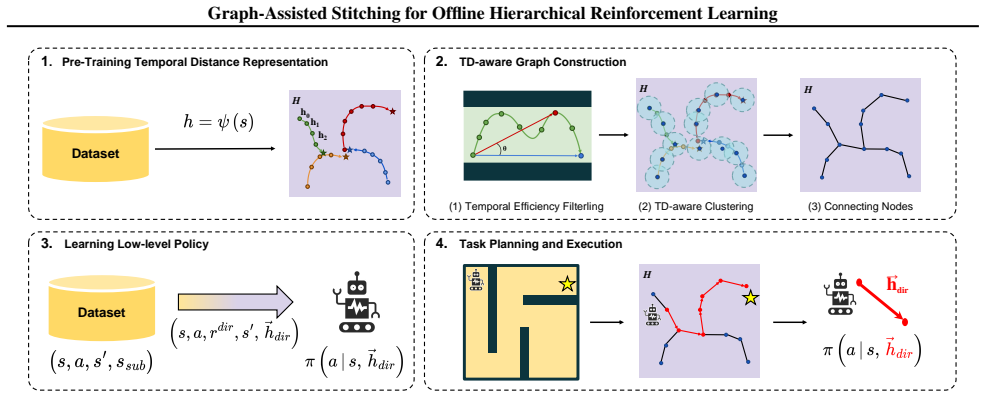
The Temporal Distance Representation (TDR) is a learned embedding $\psi: S \to H$ with the defining identity $d^*(s,g) = \|\psi(s) - \psi(g)\|_2$, where $d^*$ is the optimal number of transition steps; this carries the argument because clustering, edge construction, subgoal sampling, and planning all rely on that metric. The Temporal Efficiency (TE) score, $\theta_{TE} = \cos(\psi(s_{opt}) - \psi(s_{cur}), \, \psi(s_{reached}) - \psi(s_{cur}))$, is the second load-bearing mechanism: it filters out noise by keeping only states whose actual $H_{TD}$-step transition points in the same direction as the optimal one.
What would settle it
On a dataset like antmaze-giant-stitch, compare learned TDR distances between many state pairs with ground-truth minimum step counts derived from the recorded transitions; if the distances are systematically wrong on easily checkable pairs, or if repeatedly executing the planned node sequence fails to reduce distance to the goal, the central claim is falsified.
Extended reading notes
Core claim
The central claim is that the high-level policy in offline HRL can be replaced entirely by a graph search over states embedded in a Temporal Distance Representation (TDR) space. States are clustered at temporal-distance intervals, cluster centers become nodes, and edges connect nodes whose TDR distance falls below the threshold $H_{TD}$; a shortest-path algorithm then selects the next subgoal as the reachable node whose precomputed distance to the goal is smallest. The paper further claims that the Temporal Efficiency (TE) metric, which keeps only states whose $H_{TD}$-step transition aligns with the optimal direction, improves both graph quality and construction cost. On the most stitching-critical benchmark, the method reports 88.3 versus 1.0 for the best prior approach, which the paper reads as evidence that explicit graph-based stitching, not better high-level policy learning, is what breaks the long-horizon bottleneck.
Load-bearing premise
The load-bearing premise is that the learned Temporal Distance Representation actually makes Euclidean distance equal to the optimal number of transition steps, and that the resulting shortest paths through cluster centers are executable by the low-level policy.
Editorial extensions
If this is right
- High-level policy learning is not needed for offline HRL subgoal selection; shortest-path planning over a temporal-distance graph suffices.
- Graph-based stitching scales to long horizons where learned hierarchical policies collapse, as shown by the jump from 1.0 to 88.3 on antmaze-giant-stitch.
- Using far fewer than 1% of dataset states for the graph improves both efficiency and final performance, because TE filtering removes inefficient transition states.
- TD-aware subgoal sampling aligned with the temporal-distance threshold $H_{TD}$ trains the low-level policy more effectively than fixed step-based sampling.
- The same graph-construction recipe transfers to pixel-based observations, giving the strongest reported results on the most stitching-critical visual tasks.
Reading between the lines
- Editorial inference: if the TDR satisfies the temporal-distance identity only approximately, the graph inherits that error; a direct check would compare TDR distances with ground-truth shortest-step counts on held-out transitions.
- Editorial inference: the TE filter uses fixed thresholds (0.9 to 0.99) regardless of dataset quality, so a dataset-adaptive threshold is a natural extension the paper does not explore.
- Editorial inference: the same graph could be applied to online RL or model-based planning, where the executability of planned node sequences could be verified on the fly.
Editorial analysis
A structured set of objections, weighed in public.
Referee Report
Summary. The paper proposes Graph-Assisted Stitching (GAS), an offline hierarchical reinforcement learning method that replaces the high-level policy with explicit graph search. GAS first learns a Temporal Distance Representation (TDR) in which Euclidean distances are intended to equal optimal temporal distances, then builds a graph by clustering states in TDR space at fixed temporal intervals, filtering states with a Temporal Efficiency (TE) metric, and connecting nodes whose TDR distance is below a threshold. Task execution uses Dijkstra's shortest paths on this graph to select subgoals, which are passed to a DDPG+BC low-level policy as relative TDR directions. Experiments on OGBench and D4RL, including state-based and pixel-based benchmarks, report large gains over prior offline goal-conditioned and hierarchical methods, notably 88.3 vs. 1.0 on antmaze-giant-stitch. Extensive ablations cover TE filtering, TE threshold, node selection, subgoal sampling, HTD, TDR expectile/dimension, and BC coefficient.
Significance. If the proposed mechanism works as described, GAS is a substantial advance: it replaces learned high-level policies with structured graph planning in a learned temporal-distance space, and it demonstrates strong performance on long-horizon stitching tasks where prior methods nearly fail. The paper ships source code and evaluates on extensive state- and pixel-based benchmarks with many informative ablations. The main weakness is that the central premise connecting learned TDR distances to true temporal distances, and the executability of graph-node centroids by the low-level policy, are never validated; without such validation, the headline results are not yet fully attributable to the graph-based stitching mechanism.
major comments (4)
- [Section 3.3, Eq. (3)] The central premise that Euclidean distance in TDR space equals optimal temporal distance is never validated. The TDR is learned through the TD/expectile objective in Eq. (5), which does not by itself guarantee Eq. (3); moreover, Euclidean distance is symmetric and satisfies the triangle inequality, whereas optimal temporal distances in a general MDP need not. This premise is load-bearing for graph construction (Section 4.1), TE filtering (Eqs. 7-9), and planning (Algorithm 1). Please provide quantitative validation, for example by comparing ||ψ(s)-ψ(g)|| to ground-truth shortest-path step counts in the maze environments or to empirical optimal rollout lengths, and report the error distribution in reachable regions. Without this, the 88.3 result on antmaze-giant-stitch is not yet attributable to the proposed graph-based mechanism.
- [Section 4.1 and Algorithm 1, with Eq. (13)] Graph nodes are cluster centroids in TDR space, not actual states, while the low-level policy is trained only on directions to actual dataset states (Eq. 13, with s_sub = F(st, HTD) from the dataset). The paper does not demonstrate that the low-level policy can actually reach these centroid directions. Please add a reachability audit: roll out the trained low-level policy toward randomly selected graph nodes from nearby states, measure success rate and final TDR distance to the node, and compare against rollouts toward actual dataset states at similar TDR distances. Also consider ablating centroids with nearest actual states to determine whether centroids are necessary for the reported performance.
- [Section 4.2, Eqs. (7)-(9), and Table 3] The TE metric is self-confirming in that 'optimal future state' is defined via the same learned TDR (F selects the first future state at TDR distance ≥ HTD), so it filters states whose trajectories are consistent with the learned TDR, not necessarily states that are temporally efficient in the environment. Please validate TE against ground-truth shortest-path information (available in maze environments) or compare TE-filtered selection against a random subset of states of the same size. In addition, Table 3 and Figure 5 confound filtering with graph size: the 'All States' and 'Ours' graphs have very different node counts, and Figure 6 controls node count only for the node-selection comparison, not for the TE filtering comparison. Reporting an ablation that matches the number of nodes between filtered and unfiltered graphs would clarify whether the improvement in Table 3 is due to TE quality or simply to graph sparsity.
- [Algorithm 1] The pseudocode calls Dijkstra on the graph but does not specify edge weights. If edges are unweighted, the 'shortest distance' Dists[v] is an edge count and does not correspond to a temporal distance even if Eq. (3) were exact; if edges are weighted by TDR distances, this should be stated explicitly. This matters because the planning objective minimizes Dists[v] + ||hcur - v||, and the claim that GAS performs temporal-distance-aware planning depends on the weighting. Please specify the edge weights in Algorithm 1 and in Section 4.1, and justify why the chosen weighting reflects temporal distance.
minor comments (6)
- [Section 4.1 vs. Algorithm 2] Section 4.1 says a state is assigned to the nearest cluster if its distance is 'within HTD', while Algorithm 2 uses a threshold of HTD/2 for creating new clusters. This inconsistency should be resolved, since it affects the effective cluster radius and thus the graph structure.
- [Section 4.2, Eq. (7)] F(st, d) is undefined for states near the end of a trajectory where no future state satisfies ||ψ(st) - ψ(sk)|| ≥ d. The paper should specify how such states are handled in TE filtering (e.g., excluded from the filtered set).
- [Section 4.2 terminology] Calling F(st, HTD) the 'optimal future state' is misleading: it is simply the first future state at TDR distance ≥ HTD along the observed trajectory, not an optimal state in any policy sense. Consider renaming it to avoid overclaiming.
- [Appendix E, Figure 11] The visualization projects latent nodes onto x-y coordinates, which is illustrative but does not show whether low-level rollouts actually follow the planned path. Overlaying actual rollout trajectories from GAS on this figure would strengthen the executability evidence.
- [Table 3 / Section 5.2.2] The paper claims reduced computational overhead but reports only percentage of retained states and node counts, not wall-clock time or GPU hours. Please report actual runtime for graph construction and planning in a representative environment.
- [Algorithm 2] The cluster centers are updated to the mean of their assigned embeddings, but reassignment is not performed after the update. Since the initial assignment used the original first state as center, a single pass may produce suboptimal clusters; please note whether this is intentional or add a limited number of reassignment iterations.
Circularity Check
No significant circularity: GAS's central results are measured against external environment rewards, and the learned TDR is trained independently of the graph and TE filter.
full rationale
GAS's derivation chain is not circular. The TDR ψ is trained independently of graph construction through an IQL-style temporal-difference objective (Eqs. 4-6) on the offline dataset, following external prior work (Park et al., 2024c), and the paper does not define TDR in terms of the graph or TE filter. The low-level policy is trained with DDPG+BC on environment state/action data with a TD-aware relabeling rule; nothing in Eqs. (10)-(14) reduces task return to a fitted constant. The headline results (Tables 1-2) are normalized returns from OGBench/D4RL environment rewards, i.e., external benchmarks, not quantities constructed by the method. The TE metric (Eqs. 7-9) does define its 'optimal future state' via the learned TDR, so if Eq. (3) were inaccurate the filter would be self-referential rather than validating; however, this is an unvalidated modeling premise and a correctness risk, not a circular derivation, because the reported performance is not equal to TE by construction. The paper does contain self-citations ([Park et al., 2024a] in the FPS discussion, [Shin & Kim, 2023] for fixed-interval sampling, [Jeong et al., 2024] as application motivation), but none is load-bearing: the central mechanism is benchmarked against external methods and environment rewards. Missing reachability validation and task-specific hyperparameter tuning are concerns but do not constitute circularity.
Assumptions & free parameters
free parameters (5)
- HTD (temporal distance threshold) =
8 for most antmaze, 48 for scene-play, 24 for visual-scene-play
- TE threshold theta_TE =
0.99 for state-based antmaze, 0.9 for visual and kitchen
- TDR expectile =
0.999 for state-based, 0.95 for visual
- BC coefficient alpha =
1 for most, 0.01 for explore datasets, 10 for kitchen
- TDR latent dimension =
32
assumptions (4)
- domain assumption The learned TDR ψ satisfies Eq. (3): Euclidean distance in H equals optimal temporal distance in S
- ad hoc to paper A shortest path in the TDR graph is realizable by the learned low-level policy
- domain assumption The offline dataset has sufficient coverage for TDR learning and graph nodes to support goal reaching
- standard math Expectile loss and IQL-style value learning correctly estimate the temporal distance value function (Eq. 5)
Cite this review
Pith. "Pith review of Graph-Assisted Stitching for Offline Hierarchical Reinforcement Learning." pith.science (2026). https://pith.science/paper/V62HDCA7
@misc{pith2026250607744,
  author       = {Pith},
  title        = {Pith review of: Graph-Assisted Stitching for Offline Hierarchical Reinforcement Learning},
  year         = {2026},
  howpublished = {\url{https://pith.science/paper/V62HDCA7}},
  note         = {Machine review of arXiv:2506.07744}
}
read the original abstract
Existing offline hierarchical reinforcement learning methods rely on high-level policy learning to generate subgoal sequences. However, their efficiency degrades as task horizons increase, and they lack effective strategies for stitching useful state transitions across different trajectories. We propose Graph-Assisted Stitching (GAS), a novel framework that formulates subgoal selection as a graph search problem rather than learning an explicit high-level policy. By embedding states into a Temporal Distance Representation (TDR) space, GAS clusters semantically similar states from different trajectories into unified graph nodes, enabling efficient transition stitching. A shortest-path algorithm is then applied to select subgoal sequences within the graph, while a low-level policy learns to reach the subgoals. To improve graph quality, we introduce the Temporal Efficiency (TE) metric, which filters out noisy or inefficient transition states, significantly enhancing task performance. GAS outperforms prior offline HRL methods across locomotion, navigation, and manipulation tasks. Notably, in the most stitching-critical task, it achieves a score of 88.3, dramatically surpassing the previous state-of-the-art score of 1.0. Our source code is available at: https://github.com/qortmdgh4141/GAS.
Figures


Figures from the paper (7 more)


Reference graph
Works this paper leans on
-
[3]
D4rl: Datasets for deep data-driven reinforcement learning
Fu, J., Kumar, A., Nachum, O., Tucker, G., and Levine, S. D4rl: Datasets for deep data-driven reinforcement learning. ArXiv, abs/2004.07219,
arXiv 2004
-
[4]
16 Graph-Assisted Stitching for Offline Hierarchical Reinforcement Learning D
All scores are linearly scaled to the range [0, 100] (Fu et al., 2020; Park et al., 2025a). 16 Graph-Assisted Stitching for Offline Hierarchical Reinforcement Learning D. Implementation Details Implementation Our implementations of GAS and seven baselines are based on JAX (Bradbury et al., 2018). We run our experiments on an internal cluster consisting of...
work page 2020
-
[8]
12 Graph-Assisted Stitching for Offline Hierarchical Reinforcement Learning A. Graph Construction Algorithm 2 TD-Aware Graph Construction Input: Offline Dataset D, TDR ψ, Temporal Distance Threshold HTD, TE Threshold θthresh T E Output: Graph Hgraph = (V, E) // TE Filtering Initialize TDR state set: H ← ∅: for each trajectory τ ∈ Ddo for each state scur ∈...
work page 2000
-
[10]
GAS constructs a compact graph by performing TD-aware clustering on high-TE states selected via Temporal Efficiency (TE) filtering. This substantial reduction in the number of nodes significantly improves overall efficiency in task planning and execution (Algorithm 1). For example, in the antmaze-large-explore, only 2,499 nodes are selected from 5 million...
work page 2020
-
[11]
to achieve specific configurations. This environment requires sequential reasoning and diverse manipulation skill composition (Park et al., 2025a). For example, to place a cube in the drawer, the agent must first press a button to unlock it, then open the drawer before inserting the cube. This process requires the agent to make precise sequential decision...
work page 2012
-
[12]
to achieve four target subtasks, such as opening the microwave, moving the kettle, turning on the light switch, and sliding the cabinet door (Fu et al., 2020). Only a small portion of the dataset contains successful trajectories that complete all four subtasks sequentially. The state-based observation space is 30-dimensional, including joint and object-re...
work page 2020
-
[13]
is derived from a set of unstructured and unsegmented human demonstrations, originally collected using the PUPPET MuJoCo VR system (Kumar & Todorov, 2015; Gupta et al., 2020). Goal Specification for Evaluation We follow the goal specification protocol of OGBench (Park et al., 2025a), where each task provides five predefined state-goal pairs. For the kitch...
work page 2015
-
[16]
to process image inputs. While most components use 512-dimensional output features, we reduce the output dimension to 32 for the Temporal Distance Representation (TDR) to balance representational capacity and stability, as discussed in Appendix B. Following prior work (Park et al., 2023; 2024c; 2025a), we do not share encoders across components. As a resu...
work page 2023
Show all 17 references
-
[17]
Table 7: Common hyperparameters used across all datasets
with a probability of 0.5 to mitigate overfitting (Zheng et al., 2024). Table 7: Common hyperparameters used across all datasets. Hyperparameter Value Image representation architecture (pixel-based) Impala CNN (Espeholt et al.,
2024
-
[2007]
R., and Hinton, G
Ba, J., Kiros, J. R., and Hinton, G. E. Layer normalization. ArXiv, abs/1607.06450,
-
[2016]
This environment requires both high-level maze navigation and low-level locomotion skills
with 8 degrees of freedom (DoF) to reach a designated goal location in a maze. This environment requires both high-level maze navigation and low-level locomotion skills. It includes three maze sizes: medium, large, and giant, where larger mazes require more long-horizon reason...
2012
-
[2018]
Brockman, G., Cheung, V ., Pettersson, L., Schneider, J., Schulman, J., Tang, J., and Zaremba, W
URL https://github.com/google/jax. Brockman, G., Cheung, V ., Pettersson, L., Schneider, J., Schulman, J., Tang, J., and Zaremba, W. Openai gym. ArXiv, abs/1606.01540,
-
[2020]
Latent space policies for hierarchical reinforcement learning
Haarnoja, T., Zhou, A., Abbeel, P., and Levine, S. Latent space policies for hierarchical reinforcement learning. In International Conference on Machine Learning (ICML), 2018a. Haarnoja, T., Zhou, A., Abbeel, P., and Levine, S. Soft actor-critic: Off-policy maximum entropy dee...
-
[2021]
Finally, we benchmark HIQL (Park et al., 2023), which extends GCIQL to a hierarchical structure and generates subgoals in latent space
incorporating two-level policies, and HHILP, a hierarchical extension of HILP (Park et al., 2023; 2024c) that utilizes Temporal Distance Representation (TDR). Finally, we benchmark HIQL (Park et al., 2023), which extends GCIQL to a hierarchical structure and generates subgoals...
2023
-
[2022]
Offline rein- forcement learning: Tutorial, review, and perspectives on open problems
Levine, S., Kumar, A., Tucker, G., and Fu, J. Offline rein- forcement learning: Tutorial, review, and perspectives on open problems. ArXiv, abs/2005.01643,
2005 arXiv
-
[2023]
Behavior regularized offline reinforcement learning
Wu, Y ., Tucker, G., and Nachum, O. Behavior regularized offline reinforcement learning. ArXiv, abs/1911.11361,
1911 arXiv
-
[2024]
Sobal, V ., Zhang, W., Cho, K., Balestriero, R., Rudner, T. G. J., and LeCun, Y . Learning from reward-free offline data: A case for planning with latent dynamics models. ArXiv, abs/2502.14819,
Reviewed August 7, 2026 · model on record in the stance chip above.
Discussion (0). Sign in to comment.