REVIEW 4 major objections 6 minor 1 cited by
First-principles Quantum Insights into Bandgap Engineering, Valley Quantum Hall Effect, and Nonlinear Optical Response of Ge-Doped Graphene for Potential Optoelectronic Applications
T0 review · 4 major / 6 minor · reviewed 2026-08-07 · deepseek-v4-flash
Pith's one-line read Substitutional germanium in graphene breaks inversion symmetry and produces valley-antisymmetric Berry curvature and second harmonic generation, making the doped monolayer a candidate for valleytronic and nonlinear optoelectronic devices.
desk verdict A plausible bandgap-engineering study that overreaches with an unsubstantiated SHG claim and a misleading title. read the letter →
The pith
A machine-rendered reading of the paper's core claim, the machinery that carries it, and where it could break.
The reading
What carries the argument
The load-bearing object is the Berry curvature $\Omega_n(\mathbf{k})=\nabla_\mathbf{k}\times A_n(\mathbf{k})$ computed from the Bloch states, understood as an effective magnetic field in momentum space. Doping with Ge realizes an inversion-symmetry-breaking mass term $\hbar m\sigma_z$ in the Dirac Hamiltonian $H(k)=\pm\hbar v_F(\sigma_x k_x+\sigma_y k_y)+\hbar m\sigma_z$, which is exactly the term that allows $\Omega_n$ to be nonzero and opposite at $K$ and $K'$; its sign pattern yields the valley Hall velocity $v_h=(e/\hbar)E\times\Omega_n$, while the same broken inversion symmetry permits a second-order nonlinear susceptibility $\chi^{(2)}$ and hence second harmonic generation. The near-zero Chern numbers then follow from time-reversal symmetry, leaving a trivial topological phase despite nontrivial valley physics.
What would settle it
Recompute the Berry curvature and SHG coefficients with explicitly converged Wannier interpolation on a fine k-grid (for example 24×24×1 or denser) with defined projectors and reported disentanglement windows; if the antisymmetric $\Omega_z$ peaks at $K$ and $K'$, or the main $\chi^{(2)}$ peak near 1.1 eV for the 2% Ge cell, shifts by more than a few percent when the grid is doubled, the reported valley Hall and nonlinear signatures are numerical artifacts rather than intrinsic properties of Ge-doped graphene.
Extended reading notes
Core claim
On the paper's own terms, the central discovery is that replacing one carbon atom in a graphene supercell with germanium breaks spatial inversion symmetry while preserving time-reversal symmetry, and that this symmetry splitting is enough to produce a bandgap, a nonzero and valley-antisymmetric Berry curvature $\Omega_z(K)=-\Omega_z(K')$, and a nonzero second-order susceptibility $\chi^{(2)}$ that tracks optical absorption. The computed Chern numbers are near zero, so the system remains topologically trivial even though it shows valley-contrasting transport, and the authors read this combination as evidence of a potential (not quantized) valley Hall effect and of efficient second harmonic generation. The 12.5% and 3.125% doped supercells retain clear valley contrasts, while the 5.5% cell is reported as anomalous, with zero unpolarized gap and no valley polarization; the authors present this as part of the concentration dependence.
Load-bearing premise
The entire valley Hall and SHG picture depends on the accuracy of the numerical interpolation step that connects the plane-wave electronic states to the fine grids used for Berry curvature and nonlinear optical spectra, but the paper reports no projectors, disentanglement windows, interpolation grids, or convergence tests for that step; if it is unconverged, the reported $K$/$K'$ contrast and $\chi^{(2)}$ peaks could be numerical artifacts rather than intrinsic material properties.
Editorial extensions
If this is right
- Ge doping converts graphene into a semiconductor whose gap depends on dopant concentration, with 0.17 eV at 2% Ge and 1.06 eV at 12.5% Ge (HSE06), while the 5.5% cell behaves anomalously with zero unpolarized gap.
- Carriers from opposite valleys acquire opposite Hall velocities, so a lateral electric field should accumulate $K$-valley carriers on one edge and $K'$-valley carriers on the other, giving a device-relevant valley Hall response.
- The material should emit at $2\omega$ when pumped at $\omega$ near the gap, with the 2% Ge sample showing a clear second-harmonic feature around 1.1 eV that matches an absorption peak.
- Because the Chern number is zero for every concentration, the predicted valley Hall effect is not a quantized anomalous Hall effect; any edge accumulation would be ordinary diffusive valley transport rather than topologically protected current.
- Spin-orbit coupling from Ge lifts the orbital degeneracy of the bands, but the computed spin splitting is too small to select a single valley with circularly polarized light in the present doping range.
Reading between the lines
- A direct convergence test with denser k-meshes and explicit Wannier projectors would settle whether the antisymmetric Berry-curvature peaks and the $\chi^{(2)}$ peaks are intrinsic properties or interpolation artifacts; the near-zero Chern numbers make this check especially informative because small numerical noise could mimic or erase them.
- The reported concentration dependence is not monotonic: 5.5% Ge gives zero unpolarized gap while 3.125% gives 0.26 eV in the polarized hybrid calculation, so if confirmed, local bonding geometry around the dopant, not just doping fraction, controls the valley physics; formation-energy or strain-field calculations would identify the controlling factor.
- The same inversion-breaking mechanism should operate for other group-IV substituents such as Si and Sn, with the spin-orbit contribution to valley splitting expected to grow with atomic number, so a Ge-versus-Sn comparison would isolate the role of SOC in the valley response.
- Because the paper does not compute valley-resolved optical selection rules, its suggestion that circularly polarized light can read out the valley polarization remains untested; a direct calculation of left- versus right-circular absorption at the $K$ and $K'$ transitions would close that gap.
Editorial analysis
A structured set of objections, weighed in public.
Referee Report
Summary. The manuscript reports first-principles density functional theory (DFT) calculations, using PBE and HSE06 functionals with and without spin-orbit coupling, on Ge-doped graphene monolayers at nominal concentrations of 12.5%, 5.5%, 3.125%, and 2%. The authors compute band structures, density of states, Berry curvature, Chern numbers, optical absorption, and second-harmonic generation, and claim that Ge doping opens a bandgap, breaks inversion symmetry while preserving time-reversal symmetry, produces valley-contrasting Berry curvature with a potential valley Hall effect, and yields finite second-order susceptibilities. The central claim is that the bandgap, valley polarization, and nonlinear optical response can be tuned by varying the Ge doping concentration, making Ge-doped graphene a candidate for valleytronic and optoelectronic applications.
Significance. If the reported results are correct and reproducible, this paper would provide a systematic study of a chemically accessible graphene derivative for valleytronics and nonlinear optics. The use of two exchange-correlation functionals, several doping concentrations, and spin-orbit coupling is a constructive approach, and the reported opposite-sign Berry curvature at K and K' is consistent with the expected broken-inversion-symmetry physics. However, the significance is heavily conditional on verification of the SHG workflow and the Wannier-interpolation parameters, neither of which is provided. As it stands, the nonlinear-optical and valley Hall effect pillars are not yet established to the standard required for the claimed application-level conclusions.
major comments (4)
- [Section 3, Table 1] The text states that 'the width of bandgap increases with the increasing concentration of Ge doping' (paragraph near Figure 3), but Table 1 contradicts this monotonic claim: for the hybrid polarized calculations, the 3.125% doped supercell has a gap of 0.26 eV while the 5.5% doped supercell has a smaller gap of 0.168 eV; the hybrid unpolarized 4x4 supercell gap (0.273 eV) also exceeds the 3x3 gap (0.00 eV). Since the abstract presents doping-concentration tuning of the bandgap as a central result, the authors must either report the actual non-monotonic concentration dependence or explain the discrepancy and revise the associated discussion in Figures 3 and 4.
- [Section 2, Materials and computational methods] The SHG workflow is not reproducible as written. The text states that 'SHG coefficients were extracted using EPW and custom scripts,' but EPW is a Wannier-based electron-phonon package and does not implement second-order optical susceptibilities by itself. No expression for chi^(2) (velocity-gauge or length-gauge sum-over-states), no Wannier projectors, disentanglement windows, interpolation k-meshes, broadening parameters, or scissor corrections are reported, and no benchmark comparison is provided. Figure 9 therefore cannot be independently verified, and the central nonlinear-optical claim is unsupported. The authors should provide the exact chi^(2) formula, a step-by-step description of the post-processing workflow, and convergence tests, or the SHG pillar should be removed.
- [Section 2, Figure 7, Table 2] The Berry curvature results rely on Wannier interpolation via postw90, but the manuscript reports none of the required Wannier90 input parameters (projector functions, disentanglement windows, frozen windows, interpolation grids) and no convergence tests for the Berry curvature or the Chern number. Without these details, the magnitudes of Omega_z at K and K' and the small Chern numbers in Table 2 (on the order of 10^-4 to 10^-3) cannot be distinguished from interpolation artifacts. Please document the Wannierization parameters and add a convergence study with respect to the interpolation k-mesh and the Wannier subspace size.
- [Section 3, Berry curvature discussion and Conclusions] The symmetry relations stated for the Berry curvature are mutually inconsistent. The text writes 'Omega_n(k) = Omega_n(-k). This clearly indicates that the inversion symmetry in the system is broken while the time reversal symmetry i.e. Omega_n(k) = -Omega_n(-k) is preserved.' The first relation is the signature of preserved inversion symmetry, not broken inversion; with time-reversal symmetry the correct relation for a system with broken inversion is Omega_n(-k) = -Omega_n(k). In addition, the conclusion that time-reversal symmetry is preserved 'as indicated by zero Chern number' is not logically valid: a zero Chern number can also occur in time-reversal-broken systems and does not by itself prove TRS. These statements should be corrected.
minor comments (6)
- [Throughout] The manuscript contains numerous typographical errors and inconsistent notation, including 'valletronics', 'dopped', 'prinstine', 'SGH' instead of SHG, 'the energy band H amiltonian', and 'has is the corresponding geometrical phase'. A careful proofreading pass is needed.
- [Equations (1)-(5)] Equation (2) omits the reduced Planck constant and the vector character of the Pauli matrices; Equation (5) uses an undefined term 'ℏ l k_x sigma_0'. Since these equations are not used in the calculations, they can be streamlined or corrected to avoid confusion.
- [Table 1] The column headings 'Polarized' and 'Unpolarized' are confusing because Section 3 reports that the spin-up and spin-down DOS are identical and the magnetic moment is zero; please clarify what 'polarized' means in each case and why the hybrid polarized results differ from the unpolarized ones if there is no net spin polarization.
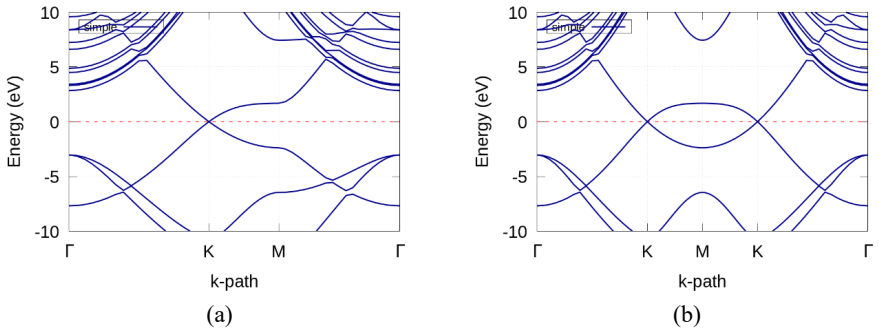
- [Figures 2-4] The band structure plots do not include energy axis labels, Fermi-level markings, or consistent k-path tick labels in all panels, which makes the reported gaps difficult to read from the figures.
- [Section 2 and Figure 1] The text refers to 'a lower unspecified concentration' in the list of dopant concentrations; this should be identified as the 2% concentration shown in Figure 1(d).
- [Figures 9 and 10] The SHG and absorption plots do not specify the polarization geometry or which Cartesian tensor component of chi^(2) is shown; please state the component and the light polarization used in the calculation.
Circularity Check
No significant circularity: the computed bandgaps, Berry curvature, Chern numbers, and SHG spectra are direct DFT outputs, not quantities defined in terms of the conclusions they support.
full rationale
The paper's derivation chain is a standard first-principles workflow: build Ge-doped graphene supercells, run PBE/HSE06 DFT, extract band structures, then use Wannier90/postw90 for Berry curvature and Chern numbers and a reported EPW/custom-script pipeline for second-harmonic generation. None of the target claims—bandgap opening, valley-contrasting Berry curvature, nonzero chi(2)—are inserted into the calculation as inputs. The bandgap is read from the computed band structure; the Berry curvature is computed from the Wannier-interpolated Bloch states; the Chern number is an integral of that computed curvature; the SHG spectra are post-processing outputs. There is no fitting of a parameter to the reported bandgaps or Berry-curvature maps, and no equation in the paper defines a target observable in terms of itself. Equations (1)–(5) are textbook definitions and the standard massive Dirac Hamiltonian; citation [13] to the authors' prior work is contextual and not load-bearing because the massive-Dirac form is independently standard. Refs [18,19] are used only to motivate bandgap engineering, not to justify a calculation. The pristine-graphene zero-gap result provides an external benchmark. The main weakness is methodological transparency: the SHG workflow is described only as 'EPW and custom scripts', with no chi(2) formula, Wannier projectors, disentanglement windows, interpolation meshes, or convergence tests, and EPW is primarily an electron-phonon code. That is a reproducibility and correctness risk, not circularity: under-reporting a workflow does not make the result equivalent to its input by construction. Accordingly, no circular step can be exhibited, and the appropriate finding is no significant circularity.
Assumptions & free parameters
assumptions (4)
- domain assumption GGA-PBE and HSE06 exchange-correlation functionals produce reliable band gaps and Berry curvature for Ge-doped graphene.
- domain assumption Substitutional Ge atoms occupy single carbon sites in relaxed supercells and remain stable.
- domain assumption Wannier interpolation and EPW-based SHG extraction are converged and accurate.
- domain assumption A 20 angstrom vacuum spacing is sufficient to decouple periodic images in the 2D slab.
Cite this review
Pith. "Pith review of First-principles Quantum Insights into Bandgap Engineering, Valley Quantum Hall Effect, and Nonlinear Optical Response of Ge-Doped Graphene for Potential Optoelectronic Applications." pith.science (2026). https://pith.science/paper/Z6REVE7K
@misc{pith2026250607745,
  author       = {Pith},
  title        = {Pith review of: First-principles Quantum Insights into Bandgap Engineering, Valley Quantum Hall Effect, and Nonlinear Optical Response of Ge-Doped Graphene for Potential Optoelectronic Applications},
  year         = {2026},
  howpublished = {\url{https://pith.science/paper/Z6REVE7K}},
  note         = {Machine review of arXiv:2506.07745}
}
read the original abstract
The valley in the band structure of materials has gained a lot of attention recently. The promising applications of the valley degree of freedom include the next-generation valleytronic devices, quantum information processing, quantum computing, and optoelectronic devices. Graphene is an ideal quantum material for high-speed valleytronic applications because of its high carrier mobility and convenience of bandgap engineering. Employing first-principles density functional theoretical approach, this study opted bandgap engineering strategy via Germanium doping to open bandgap and enhance valley selectivity in graphene monolayers. The impact of Ge dopant concentration of 2%, 3.125%, 5.5%, and 12.5% is explored on the valleytronic; valley Hall effect, valley transport, and optical properties. The reported results demonstrate that bandgap, valley polarization, and second harmonic generation can be tuned effectively by varying doping concentration of Germanium. The Berry curvature profile is antisymmetric for corresponding K and K' valleys, thus leading to valley-dependent transport properties and a potential valley Hall effect. Finally, the second-order susceptibilities exhibit corresponding optical absorption peaks, indicating efficient second-harmonic generation due to the broken inversion symmetry. These findings highlight the potential of Ge-doped graphene for nonlinear optics and valleytronics applications, while providing novel insights into its topological phase and transport properties.
Figures


Forward citations
Cited by 1 Pith paper
-
Exchange-Correlation Functionals in 2D Materials: Applications, Challenges, and Limitations
A review concluding that no exchange-correlation functional works universally in 2D materials, with SCAN/r2SCAN best for structure and magnetism, HSE06 for electronics, GW+BSE for optics, and PBE/PBEsol for thermal transport.
Reference graph
Works this paper leans on
-
[4]
Conclusions This study puts forth a new proposal of Ge -dopped composite graphene quantum material as a promising candidate to understand and instigate the phenomenon of the quantum valley Hall effect, valley polarization by computing energy band spectra, the Berry curvature , Chern number, and non-linear optical phenomenon such as absorption spectra and ...
-
[5]
The identical DOS profiles for spin up and spin down electrons show that there is no net spin polarization and the magnetic moment of the systems is zero. However, these results confirm that the doping of Ge in graphene facilitates to open a considerable bandgap. The SOC coupling is too minuscule both in the pristine and doped graphene that the valley pol...
-
[1]
Clarice D. Aiello et al. A Chirality-Based Quantum Leap. ACS Nano 2022, 16, 4, 4989– 5035
work page 2022
-
[2]
Dantong Zhanga, Guoqiang Shia, Kunfeng Chen, Chao Peng, Chunyi Zhi. What are the key degrees of freedom for the next generation of quantum functional materials? Next Materials 1, 100018 (2023) 1-12
work page 2023
-
[3]
A.A. Burkov. Weyl Metals. Annu. Rev. Condens. Matter Phys. 2018. 9:359–78
work page 2018
-
[6]
Rycerz A, Tworzydlo J, Beenakker CWJ (2007) Valley filter and valley valve in graphene. Nat Phys 3:172–175
work page 2007
-
[7]
Xiao D, Yao W, Niu Q (2007) Valley-contrasting physics in graphene: Magnetic moment and topological transport. Phys Rev Lett 99(23):236809
work page 2007
-
[8]
Yao W, Xiao D, Niu Q (2008) Valley-dependent optoelectronics from inversion symmetry breaking. Phys Rev B 77:235406
work page 2008
Show all 29 references
-
[9]
(2012) Valley-selective circular dichroism of monolayer molybdenum disulphide
Cao T, et al. (2012) Valley-selective circular dichroism of monolayer molybdenum disulphide. Nat Commun 3:887
2012
-
[10]
Phys Rev Lett 108(19): 196802
Xiao D, Liu GB, Feng W, Xu X, Yao W (2012) Coupled spin and valley physics in monolayers of MoS2 and other group-VI dichalcogenides. Phys Rev Lett 108(19): 196802
2012
-
[11]
Nat Nanotechnol 7(8):494–498
Mak KF, He K, Shan J, Heinz TF (2012) Control of valley polarization in monolayer MoS2 by optical helicity. Nat Nanotechnol 7(8):494–498
2012
-
[12]
Nat Nanotechnol 7(8):490–493
Zeng H, Dai J, Yao W, Xiao D, Cui X (2012) Valley polarization in MoS2 monolayers by optical pumping. Nat Nanotechnol 7(8):490–493
2012
-
[13]
Schaibley, Hongyi Yu, Genevieve Clark, Pasqual Rivera, Jason S
John R. Schaibley, Hongyi Yu, Genevieve Clark, Pasqual Rivera, Jason S. Ross, Kyle L. Seyler, Wang Yao, and Xiaodong Xu. Valleytronics in 2D materials. Nat Rev Mater 1, 16055 (2016)
2016
-
[14]
Sharma, D
S. Sharma, D. Gill, J. Krishna, J. K. Dewhurst & S. Shallcross. Direct coupling of light to valley current. Nat Commun 15, (2024)7579
2024
-
[15]
A potential candidate material for quantum anomalous Hall effect: Heterostructures of ferromagnetic insulator and graphene
Muhammad Irfan et al. A potential candidate material for quantum anomalous Hall effect: Heterostructures of ferromagnetic insulator and graphene. Physica B: Condensed Matter 673, (2024)415439
2024
-
[16]
Physical Review Letters 132, (2024)096302
Kamal Das, Koushik Ghorai, Dimitrie Culcer, and Amit Agarwal. Physical Review Letters 132, (2024)096302
2024
-
[17]
Vitale et al
Steven A. Vitale et al. Valleytronics: Opportunities, Challenges, and Paths Forward. Small 1801483 (2018) 1 -15
2018
-
[18]
Li, L., Shao, L., Liu, X. et al. Room-temperature valleytronic transistor. Nat. Nanotechnol. 15, 743–749 (2020)
2020
-
[19]
Quantum-Engineered Devices Based on 2D Materials for Next-Generation Information Processing and Storage
Arnab Pal et al. Quantum-Engineered Devices Based on 2D Materials for Next-Generation Information Processing and Storage. Adv. Mater. 35, 2109894 (2023)1- 32
2023
-
[20]
Proposal of graphene band-gap enhancement via heterostructure of graphene with boron nitride in vertical stacking scheme
Abdul Sattar et al. Proposal of graphene band-gap enhancement via heterostructure of graphene with boron nitride in vertical stacking scheme. Nanotechnology 32, 225705 (2021)
2021
-
[21]
Irfan, Muhammad; Ehsan, Siddique Akhtar; Pang, Wenhui;Sattar, Abdul;Mustafa, Hina; Latif, Hamid; Qin, Shengyong, Bandgap engineering and tuning of optoelectronic 21 properties of 2D NbSe2/MoS2 heterostructure using first principle computations, Physica Scripta 99, 15928 (2024)
2024
-
[22]
Valley-dependent electronic transport in a graphene with double magnetic-strained barriers
Man-Ting Li, Yang-Lai Hou, Jian-Duo Lu, Jin-Ze Ye, Jing Huang. Valley-dependent electronic transport in a graphene with double magnetic-strained barriers. Physica E: Low-dimensional Systems and Nanostructures 168, 116176 (2025)
2025
-
[23]
Valley-dependent band structure and valley polarization in periodically modulated graphene
Wei-Tao Lu. Valley-dependent band structure and valley polarization in periodically modulated graphene. Phys. Rev. B 94, 085403 (2016)
2016
-
[24]
Giant and Controllable Valley Currents in Graphene by Double Pumped THz Light
Sangeeta Sharma, Deepika Gill, Samuel Shallcross. Giant and Controllable Valley Currents in Graphene by Double Pumped THz Light. Nano Lett. 23(22), (2023)10305– 10310
2023
-
[25]
Advances and Trends in Chemically Doped Graphene
Sami Ullah et al. Advances and Trends in Chemically Doped Graphene. Adv. Mater. Interfaces 7, 2000999 (2020)1-23
2020
-
[26]
Dr. Pablo A. Denis. Chemical Reactivity and Band-Gap Opening of Graphene Doped with Gallium, Germanium, Arsenic, and Selenium Atoms. ChemPhysChem 15, (2014) 3994-4000
2014
-
[27]
QUANTUM ESPRESSO: a modular and open-source software project for quantum simulations of materials,
P. Giannozzi et al., "QUANTUM ESPRESSO: a modular and open-source software project for quantum simulations of materials," J. Phys. Condens. Matter 21, 395502 (2009)
2009
-
[28]
Gmitra, S
M. Gmitra, S. Konschuh, C. Ertler, C. Ambrosch-Draxl, and J. Fabian. Band-structure topologies of graphene: Spin-orbit coupling effects from first principles. PHYSICAL REVIEW B 80, 235431 (2009)
2009
-
[29]
Second harmonic spectroscopy to optically detect valley polarization in 2D materials
F Hipolito and Vitor M Pereira. Second harmonic spectroscopy to optically detect valley polarization in 2D materials. 2D Mater. 4, 021027 (2017)
2017
Reviewed August 7, 2026 · model on record in the stance chip above.
Discussion (0). Sign in to comment.