REVIEW 3 major objections 6 minor 84 references
Controlling Excitons in Quasi-1D Perovskites by Dielectric Screening and Connectivity
T0 review · 3 major / 6 minor · reviewed 2026-08-07 · deepseek-v4-flash
Pith's one-line read Increasing octahedral connectivity in quasi-1D perovskites raises exciton binding energies in idealized chains, but dielectric screening by organic cations reverses that ordering in real materials, making the organic spacer the decisive…
desk verdict First systematic GW+BSE map of quasi-1D perovskite excitons; the screening-induced reversal is real but partly confounded by structural differences in the face-sharing case. read the letter →
The pith
A machine-rendered reading of the paper's core claim, the machinery that carries it, and where it could break.
The reading
What carries the argument
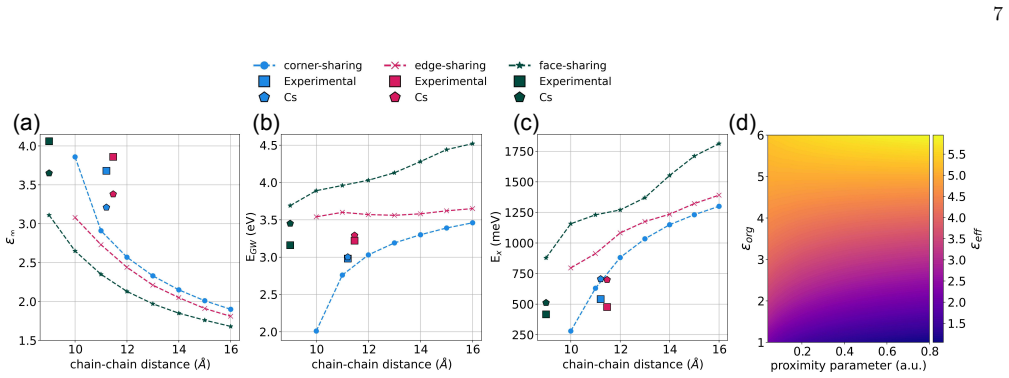
Two objects carry the argument. The first is the octahedral connectivity of the inorganic sublattice: metal-halide octahedra sharing one, two, or three halide ions form corner-, edge-, and face-sharing chains, respectively, and the paper scans this connectivity in otherwise minimal model structures to isolate its effect. The second is the dielectric environment supplied by the organic cations: a simple 2D electrostatic model of circular inorganic regions (dielectric constant ε_inorg, radius r) separated by distance L and embedded in a medium of dielectric constant ε_org, with the dimensionless proximity parameter (L−2r)/L, captures how the effective static dielectric constant rises sharply with ε_org and thus lowers exciton binding in real materials. The GW+BSE method supplies the exciton binding energies and absorption spectra, and group theory assigns the fine structure of the lowest excitons; the electrostatic model then rationalizes why the experimental structures depart from the model-structure trend.
What would settle it
Measure the exciton binding energies of the three experimental compounds (corner-, edge-, and face-sharing) directly, for example by magneto-absorption or two-photon absorption spectroscopy, and check whether the face-sharing crystal indeed has the smallest binding energy (about 0.42 eV) and the corner-sharing one the largest (about 0.54 eV), as predicted. If the ordering differs, or if the binding energies lie close to the model-structure values, the centrality of organic-cation screening is falsified.
Extended reading notes
Core claim
The central discovery is that octahedral connectivity and dielectric screening are competing controls on excitons in quasi-1D perovskites. In minimal inorganic model chains, greater sharing of halide octahedra (corner → edge → face) monotonically increases the exciton binding energy (881, 1082, and 1276 meV) and changes the fine structure and polarization of the absorption onset, with the corner-sharing chain showing one dark and three non-degenerate bright excitons and the edge-sharing chain showing four symmetry-allowed bright states. When the same connectivities are realized in actual synthesized organic–inorganic compounds, the computed binding energies collapse to 541, 476, and 416 meV, respectively, and the face-sharing material, not the corner-sharing one, binds excitons most weakly. The authors attribute this reversal to the dielectric response of the organic A-site cations, which screen the electron–hole interaction more strongly as the organic sublattice contributes more to the overall dielectric constant; a simple 2D electrostatic model of circular inorganic wires in an organic medium reproduces the exponential sensitivity of screening to chain proximity. The paper therefore claims that structural connectivity sets the underlying excitonic scale, but organic-cation screening is the decisive factor in real materials, and that tuning the organic spacer's dielectric properties offers a practical route to controlling exciton binding.
Load-bearing premise
The conclusion that organic-cation dielectric screening, rather than some other structural or electronic effect, is what reverses the exciton-binding trend rests on a simplified two-dimensional electrostatic model that, as the authors concede, reproduces only the exponential decay of the effective dielectric constant but not the microscopic details of the organic-inorganic interface at the relevant chain-chain distances.
Editorial extensions
If this is right
- In-situ optical probes that resolve the polarization and energy of the absorption onset could fingerprint which octahedral connectivity motif is present during perovskite film formation, since each geometry gives a distinct excitonic signature.
- The reversed ordering in real materials means that structural connectivity alone cannot predict exciton binding: the organic cation's dielectric response must be included, and it offers a separate tuning knob.
- Edge- and face-sharing chains exhibit flat bands and complex absorption onsets with strong out-of-chain polarization, which should be observable in polarized spectroscopy.
- Choosing organic spacers with low dielectric constants will raise exciton binding, while high-dielectric organic moieties can lower binding and potentially ease exciton dissociation in devices.
- Because binding energy scales roughly as 1/ε², small changes in the effective dielectric constant produce large changes in binding energy, amplifying the design leverage of the organic sublattice.
Reading between the lines
- Beyond the paper: the same 2D electrostatic screening argument should apply to other quasi-1D hybrid semiconductors and even to solvated iodoplumbate intermediates in perovskite synthesis, where the surrounding solvent plays the role of the organic dielectric; the paper's design rule then extends to choosing solvents that screen excitons during crystallization.
- Beyond the paper: the predicted non-degenerate bright exciton states in corner-sharing chains imply low-temperature photoluminescence should be polarized along the chain, a testable fingerprint that the paper does not explicitly call out.
- Beyond the paper: a systematic series of organic spacers of similar size but different dielectric constants (for example halogenated versus alkyl groups) would provide a quantitative test of the proximity parameter's exponential sensitivity, linking the toy model to measurable binding energies.
- Beyond the paper: the authors' inference about in-situ optical identification of connectivity motifs could be sharpened by simulating the full absorption spectrum of mixed-connectivity intermediates that occur during film formation, then correlating specific spectral shoulders with particular chain arrangements.
Editorial analysis
A structured set of objections, weighed in public.
Referee Report
Summary. The paper presents a first-principles study of quasi-1D metal-halide perovskites with corner-, edge-, and face-sharing octahedral connectivity, using G0W0+BSE with spin-orbit coupling. The authors construct idealized Cs-based model structures with a fixed chain-chain distance of 12 Å and find that increasing connectivity raises both the band gap and the exciton binding energy (881, 1082, and 1276 meV for corner, edge, and face sharing, respectively), accompanied by distinct excitonic fine structure and anisotropic optical absorption. They then study three experimental organic-inorganic structures with the same connectivity motifs and report a reversed trend in exciton binding energies (541, 476, and 416 meV), which they attribute mainly to dielectric screening by the organic A-site sublattice, supported by a 2D electrostatic model. The paper proposes design strategies based on controlling connectivity and the dielectric environment.
Significance. If the central claims hold, this work provides a valuable systematic dataset of excitonic properties across octahedral connectivity motifs in quasi-1D perovskites, with state-of-the-art G0W0+BSE calculations and no fitted parameters. The identification of connectivity as a tunable knob for exciton binding, and the demonstration that organic-cation screening can alter idealized trends, would be of broad interest to the hybrid perovskite community and to the interpretation of in-situ optical probes of perovskite formation. The careful use of model structures to isolate connectivity is a strength, as is the inclusion of experimental structures for comparison. However, the headline claim that organic-cation dielectric screening reverses the connectivity trend is only partially supported, because the face-sharing experimental material shows a residual deviation that the authors attribute to symmetry differences rather than to screening. The supporting electrostatic model is explicitly qualitative. These limitations do not undermine the primary computed values, but they do temper the design principles as currently stated.
major comments (3)
- [Section III (Fig. 4 and text following it)]
- [Section III, Fig. 4(d) and Supplemental Material]
- [Section II (Methods) and Section III]
minor comments (6)
- [Introduction]
- [Section III (corner-sharing results)]
- [Section III (edge-sharing results)]
- [Table I]
- [Section II and Fig. 1(d)]
- [References]
Circularity Check
No significant circularity: the central exciton binding energies come from parameter-free G0W0+BSE calculations, and the 2D electrostatic model is an explicitly qualitative rationalization rather than the source of the predicted values.
full rationale
The paper's central claims are computed ab initio: the model-structure trend (corner 881 meV, edge 1082 meV, face 1276 meV) and the experimental-structure reversal (541, 476, 416 meV) are direct outputs of G0W0+BSE calculations with no fitted parameters. The 2D electrostatic model in Fig. 4(d) is explicitly acknowledged to 'only reproduce the exponential decay of the effective static dielectric constant but not the microscopic details at the relevant experimental chain-chain distances'; it is used to rationalize the role of the organic sublattice, not to generate or fit the exciton binding energies. The Cs-substitution control is a computational experiment that isolates the molecular A-site contribution, and the fact that it does not fully explain the face-sharing deviation—leaving 'differences in symmetry'—is a stated limitation on causal attribution, not a circular step. Self-citations (e.g., Refs. 53 and 72) concern methodology and background rather than supplying the load-bearing conclusion, and the calculations are self-contained using standard codes (Quantum ESPRESSO and BerkeleyGW). No equation is defined in terms of the quantity it purports to predict, and no fitted parameter is renamed as a prediction. Therefore no circularity is present; the noted residual confound is a correctness/interpretation caveat, not circularity.
Assumptions & free parameters
free parameters (1)
- epsilon_inorg (electrostatic model) =
5
assumptions (4)
- domain assumption DFT-PBE+SOC with one-shot G0W0 provides a suitable starting point for BSE exciton calculations in quasi-1D perovskites.
- ad hoc to paper Model structures with a fixed chain-chain distance of 12 Å isolate connectivity effects.
- domain assumption Experimental structures are represented by relaxing only the molecular A-site while keeping the Pb-I network and lattice vectors fixed.
- ad hoc to paper The 2D electrostatic model with circular inorganic regions captures the dominant dielectric physics.
Cite this review
Pith. "Pith review of Controlling Excitons in Quasi-1D Perovskites by Dielectric Screening and Connectivity." pith.science (2026). https://pith.science/paper/GVFXNU2G
@misc{pith2026250607762,
  author       = {Pith},
  title        = {Pith review of: Controlling Excitons in Quasi-1D Perovskites by Dielectric Screening and Connectivity},
  year         = {2026},
  howpublished = {\url{https://pith.science/paper/GVFXNU2G}},
  note         = {Machine review of arXiv:2506.07762}
}
abstract
Reducing the dimensionality of metal-halide perovskites enhances quantum and dielectric confinement, enabling tunable excitonic properties. In one dimension, the arrangement of metal-halide octahedra in chains with corner-, edge-, or face-sharing connectivity allows for additional structural flexibility. This not only expands material design possibilities but also reflects quasi-one-dimensional motifs that arise during perovskite formation but are poorly understood. Using first-principles many-body perturbation theory within the $GW$ and Bethe-Salpeter Equation framework, we provide a comprehensive picture of how one-dimensional confinement, octahedral connectivity and dielectric screening affect optical absorption and exciton photophysics in these materials. Our calculations reveal that increasing octahedral connectivity leads to increased exciton binding and complex, anisotropic optical signatures. However, in experimentally synthesized organic-inorganic systems, pronounced dielectric screening effects can reduce exciton binding energies by several hundred meV, altering these trends. These findings offer insights and design principles for excitonic properties, and aid the interpretation of optical experiments on one-dimensional perovskites.
Figures


Figures from the paper (1 more)
Reference graph
Works this paper leans on
-
[1]
M. A. Green, A. Ho-Baillie, and H. J. Snaith, Nat. Pho- tonics 8, 506 (2014)
2014
-
[2]
H. S. Jung and N.-G. Park, Small11, 10 (2015)
2015
-
[3]
A. Y. Alsalloum, B. Turedi, X. Zheng, S. Mitra, A. A. Zhumekenov, K.J.Lee, P.Maity, I.Gereige, A.AlSaggaf, I. S. Roqan, O. F. Mohammed, and O. M. Bakr, ACS Energy Lett. 5, 657 (2020)
2020
-
[4]
I. C. Smith, M. D. Smith, A. Jaffe, Y. Lin, and H. I. Karunadasa, Chem. Mater.29, 1868 (2017)
2017
-
[5]
J.-C. Blancon, J. Even, C. C. Stoumpos, M. G. Kanatzidis, and A. D. Mohite, Nat. Nanotechnol.15, 969 (2020)
work page 2020
-
[6]
D. H. Cao, C. C. Stoumpos, O. K. Farha, J. T. Hupp, and M. G. Kanatzidis, J. Am. Chem. Soc.137, 7843 (2015)
work page 2015
- [7]
-
[8]
D. Marongiu, M. Saba, F. Quochi, A. Mura, and G. Bon- giovanni, J. Mater. Chem. C Mater. Opt. Electron. De- vices 7, 12006 (2019)
work page 2019
Show all 84 references
-
[9]
M. R. Filip, D. Y. Qiu, M. Del Ben, and J. B. Neaton, Nano Lett. 22, 4870 (2022)
2022
-
[10]
Chakraborty, G
R. Chakraborty, G. Paul, and A. J. Pal, Physical Review Applied 17, 054045 (2022)
2022
-
[11]
Simbula, L
A. Simbula, L. Wu, F. Pitzalis, R. Pau, S. Lai, F. Liu, S. Matta, D. Marongiu, F. Quochi, M. Saba, A. Mura, and G. Bongiovanni, Nat. Commun.14, 4125 (2023)
2023
-
[12]
J. C. Blancon, A. V. Stier, H. Tsai, W. Nie, C. C. Stoumpos, B. Traoré, L. Pedesseau, M. Kepenekian, F. Katsutani, G. T. Noe, J. Kono, S. Tretiak, S. A. Crooker, C. Katan, M. G. Kanatzidis, J. J. Crochet, J. Even, and A. D. Mohite, Nature Communications9, 2254 (2018)
2018
-
[14]
Harutyunyan, A
H.Tsai, W.Nie, J.-C.Blancon, C.C.Stoumpos, R.Asad- pour, B. Harutyunyan, A. J. Neukirch, R. Verduzco, J. J. Crochet, S. Tretiak, L. Pedesseau, J. Even, M. A. Alam, G. Gupta, J. Lou, P. M. Ajayan, M. J. Bedzyk, and M. G. Kanatzidis, Nature 536, 312 (2016)
2016
-
[15]
S. Li, X. Xu, C. A. Kocoj, C. Zhou, Y. Li, D. Chen, J. A. Bennett, S. Liu, L. Quan, S. Sarker, M. Liu, D. Y. Qiu, 8 and P. Guo, Nat. Commun.15, 2573 (2024)
2024
-
[16]
Chakraborty, P
R. Chakraborty, P. C. Sercel, X. Qin, D. B. Mitzi, and V. Blum, J. Am. Chem. Soc.146, 34811 (2024)
2024
-
[17]
Zhang, H.-M
W.-F. Zhang, H.-M. Pan, Y.-Y. Ma, D.-Y. Li, and Z. Jing, J. Mol. Struct.1253, 132221 (2022)
2022
-
[18]
Z. Yuan, C. Zhou, Y. Tian, Y. Shu, J. Messier, J. C. Wang, L. J. van de Burgt, K. Kountouriotis, Y. Xin, E. Holt, K. Schanze, R. Clark, T. Siegrist, and B. Ma, Nat. Commun. 8, 14051 (2017)
2017
-
[19]
W. P. D. Wong, J. V. Hanna, and A. C. Grimsdale, Acta Crystallogr. B Struct. Sci. Cryst. Eng. Mater. 77, 408 (2021)
2021
-
[20]
M. Z. Rahaman, S. Ge, C.-H. Lin, Y. Cui, and T. Wu, Small Struct. 2, 2000062 (2021)
2021
-
[21]
D. Duan, C. Ge, M. Z. Rahaman, C.-H. Lin, Y. Shi, H. Lin, H. Hu, and T. Wu, NPG Asia Materials15, 8 (2023)
2023
-
[22]
D. B. Mitzi, S. Wang, C. A. Feild, C. A. Chess, and A. M. Guloy, Science267, 1473 (1995)
1995
-
[23]
L. Mao, P. Guo, M. Kepenekian, I. Hadar, C. Katan, J. Even, R. D. Schaller, C. C. Stoumpos, and M. G. Kanatzidis, J. Am. Chem. Soc.140, 13078 (2018)
2018
-
[24]
G. Yu, F. Lin, K. Zhou, S. Fang, Y. Shi, W. Liu, H. Hu, B. Ma, and H. Lin, Chem. Mater.33, 5668 (2021)
2021
-
[25]
H. Lin, C. Zhou, Y. Tian, T. Siegrist, and B. Ma, ACS Energy Lett. 3, 54 (2018)
2018
-
[26]
Y. Chen, B. Liu, Q. Zhou, D. Ma, X. Han, D. He, S. Chen, Y. Li, S. Lu, Z.-X. Xu, C. Chen, H. Yu, and J. Chen, Journal of Materials Chemistry A 11, 18592 (2023)
2023
-
[27]
R. Wan, M. Yin, T.-H. Wang, C. E. Moore, and Y. Wu, Inorg. Chem. 64, 2868 (2025)
2025
-
[28]
Chandra Patra, R
B. Chandra Patra, R. Wan, C. E. Moore, and Y. Wu, Chemistry – A European Journal31, e202402535 (2024)
2024
-
[29]
Quarti, R
C. Quarti, R. Gautier, M. Zacharias, A. Gansmuller, and C. Katan, J. Am. Chem. Soc.147, 278 (2025)
2025
-
[30]
Y. Wang, H. Lou, C.-Y. Yue, and X.-W. Lei, CrystEng- Comm 24, 2201 (2022)
2022
-
[31]
Zheng, X
Y.Zhang, J.Liu, Z.Wang, Y.Xue, Q.Ou, L.Polavarapu, J. Zheng, X. Qi, and Q. Bao, Chem. Commun. (Camb.) 52, 13637 (2016)
2016
-
[32]
X. Guo, C. McCleese, C. Kolodziej, A. C. S. Samia, Y. Zhao, and C. Burda, Dalton Trans.45, 3806 (2016)
2016
-
[33]
A. A. Petrov, I. P. Sokolova, N. A. Belich, G. S. Peters, P. V. Dorovatovskii, Y. V. Zubavichus, V. N. Khrustalev, A. V. Petrov, M. Grätzel, E. A. Goodilin, and A. B. Tarasov, J. Phys. Chem. C Nanomater. Interfaces121, 20739 (2017)
2017
-
[34]
Babbe and C
F. Babbe and C. M. Sutter-Fella, Adv. Energy Mater. 10, 1903587 (2020)
2020
-
[35]
T.-B. Song, Z. Yuan, M. Mori, F. Motiwala, G. Segev, E. Masquelier, C. V. Stan, J. L. Slack, N. Tamura, and C. M. Sutter-Fella, Adv. Funct. Mater.30, 1908337 (2020)
2020
-
[36]
Hwang, J
I. Hwang, J. Phys. Chem. C127, 24011 (2023)
2023
-
[37]
K. Wang, H. Liu, Q. Huang, Z. Duan, J. Wang, C. Zhao, X. Lian, R. Liu, Y. Su, X. Guan, Y. Zhang, W. Lv, H. Zhou, G. Huang, Y. Shen, H. Zhang, and F. Xie, ACS Appl. Mater. Interf.16, 50972 (2024)
2024
-
[38]
L. Zhu, T. Li, N. Li, C. Hao, X. Xiao, D. Tian, Z. Fang, S. Wang, J. Feng, C. Ma, N. Wang, and J. Wang, Small 21, 2502535 (2025)
2025
-
[39]
Spies, S
M. Spies, S. Biberger, F. Eller, E. M. Herzig, and A. Köh- ler, Advanced Electronic Materialsn/a, 2500060 (2025)
2025
-
[40]
J. Qian, Q. Guo, L. Liu, B. Xu, and W. Tian, J. Mater. Chem. A Mater. Energy Sustain.5, 16786 (2017)
2017
-
[41]
Jiang, Z
X. Jiang, Z. Xu, Y. Zheng, J. Zeng, K.-Q. Chen, and Y. Feng, Phys. Chem. Chem. Phys.24, 17323 (2022)
2022
-
[42]
C. Xue, H. Huang, S. Nishihara, V. Biju, X.-M. Ren, and T. Nakamura, J. Phys. Chem. Lett.13, 7405 (2022)
2022
-
[43]
M. E. Kamminga, H.-H. Fang, M. R. Filip, F. Giustino, J. Baas, G. R. Blake, M. A. Loi, and T. T. M. Palstra, Chem. Mater. 28, 4554–4562 (2016)
2016
-
[44]
M. E. Kamminga, G. A. de Wijs, R. W. A. Havenith, G. R. Blake, and T. T. M. Palstra, Inorg. Chem. 56, 8408 (2017)
2017
-
[45]
Z. Deng, G. Kieslich, P. D. Bristowe, A. K. Cheetham, and S. Sun, APL Materials6, 114202 (2018)
2018
-
[46]
Rohlfing and S
M. Rohlfing and S. G. Louie, Physical Review B62, 4927 (2000)
2000
-
[47]
Puschnig and C
P. Puschnig and C. Ambrosch-Draxl, Physical Review B 66, 165105 (2002)
2002
-
[48]
Wirtz, A
L. Wirtz, A. Marini, and A. Rubio, Phys. Rev. Lett.96, 126104 (2006)
2006
-
[49]
D. Y. Qiu, F. H. da Jornada, and S. G. Louie, Phys. Rev. Lett. 111, 216805 (2013)
2013
-
[50]
S. E. Reyes-Lillo, T. Rangel, F. Bruneval, and J. B. Neaton, Physical Review B94, 041107 (2016)
2016
-
[51]
Giorgi, K
G. Giorgi, K. Yamashita, and M. Palummo, The Jour- nal of Physical Chemistry Letters 9, 5891 (2018), https://doi.org/10.1021/acs.jpclett.8b02653
2018 doi
-
[52]
D. Y. Qiu, G. Cohen, D. Novichkova, and S. Refaely- Abramson, Nano Lett.21, 7644 (2021)
2021
-
[53]
L.Leppert,TheJournalofChemicalPhysics 160,050902 (2024)
2024
-
[54]
I. W. Gilley, H. W. Kwon, C. Liu, Y. Yang, C. Huang, H. Wan, A. S. R. Bati, E. H. Oriel, M. Kepenekian, B. Vishal, S. Zeiske, K. S. Bayikadi, T. E. Wiggins, E. S. Vasileiadou, B. Chen, R. D. Schaller, J. Even, S. De Wolf, E. H. Sargent, and M. G. Kanatzidis, J. Am. Chem. Soc. ...
2025
-
[55]
Chen and M
Y. Chen and M. R. Filip, J. Phys. Chem. Lett.14, 10634 (2023)
2023
-
[56]
Umeyama, L
D. Umeyama, L. Leppert, B. A. Connor, M. A. Manumpil, J. B. Neaton, and H. I. Karunadasa, Angew. Chem. Int. Ed Engl.59, 19087 (2020)
2020
-
[57]
Matheu, F
R. Matheu, F. Ke, A. Breidenbach, N. Wolf, Y. Lee, Z. Liu, L. Leppert, Y. Lin, and H. I. Karunadasa, Ange- wandte Chemie International Edition 61, e202202911 (2022)
2022
-
[58]
Forde, S
A. Forde, S. Tretiak, and A. J. Neukirch, Nano Lett.23, 11586 (2023)
2023
-
[59]
X. Ni, H. Li, and J.-L. Brédas, ACS Mater. Lett.6, 3436 (2024)
2024
-
[60]
Boeije, F
Y. Boeije, F. Lie, M. Dubajić, E. Garip, A. Maufort, R.-I. Biega, S. Lenaers, M. Sauty, P. Ghosh, A. Radić, A. Loher, P. La Magna, H. Salway, A. Ashoka, X. W. Chua, Q. Gu, K. Van Hecke, L. Lutsen, D. Vanderzande, A. Rao, W. T. M. Van Gompel, L. Leppert, and S. D. Stranks, J. A...
2025
-
[61]
J. P. Perdew, K. Burke, and M. Ernzerhof, Phys. Rev. Lett. 77, 3865 (1996)
1996
-
[62]
Giannozzi, S
P. Giannozzi, S. Baroni, N. Bonini, M. Calandra, R. Car, C. Cavazzoni, D. Ceresoli, G. L. Chiarotti, M. Cococ- cioni, I. Dabo, A. Dal Corso, S. de Gironcoli, S. Fabris, G. Fratesi, R. Gebauer, U. Gerstmann, C. Gougoussis, A. Kokalj, M. Lazzeri, L. Martin-Samos, N. Marzari, F. ...
2009
-
[63]
Giannozzi, O
P. Giannozzi, O. Andreussi, T. Brumme, O. Bunau, M. Buongiorno Nardelli, M. Calandra, R. Car, C. Cavaz- zoni, D. Ceresoli, M. Cococcioni, N. Colonna, I. Carn- imeo, A. Dal Corso, S. de Gironcoli, P. Delugas, R. A. DiStasio, Jr, A. Ferretti, A. Floris, G. Fratesi, G. Fu- gallo,...
2017
-
[64]
M. J. van Setten, M. Giantomassi, E. Bousquet, M. J. Verstraete, D. R. Hamann, X. Gonze, and G.-M. Rig- nanese, Comput. Phys. Commun.226, 39 (2018)
2018
-
[65]
Deslippe, G
J. Deslippe, G. Samsonidze, D. A. Strubbe, M. Jain, M. L. Cohen, and S. G. Louie, Comput. Phys. Commun. 183, 1269 (2012)
2012
-
[66]
B. A. Barker, J. Deslippe, J. Lischner, M. Jain, O. V. Yazyev, D. A. Strubbe, and S. G. Louie, Phys. Rev. B. 106 (2022)
2022
-
[67]
afonari - Overview — github.com,https://github.com/ afonari/, [Accessed 02-09-2025]
2025
-
[68]
X. Gao, J. Luo, Y. Wu, A. Lu, M.-G. Ju, and J. Wang, Small Struct. 3, 2100219 (2022)
2022
-
[69]
Y.-B. Shi, N. Li, H.-K. Dong, S. Cao, K.-K. Song, Z.-F. Shao, and P. Qian, Mater. Sci. Semicond. Process.157, 107327 (2023)
2023
-
[70]
Fraccarollo, A
A. Fraccarollo, A. Zoccante, L. Marchese, and M. Cossi, Phys. Chem. Chem. Phys.22, 20573 (2020)
2020
-
[71]
M. R. Filip and F. Giustino, Physical Review B 90, 245145 (2014)
2014
-
[72]
L.Leppert, T.Rangel,andJ.B.Neaton,PhysicalReview Materials 3, 103803 (2019)
2019
-
[73]
M. R. Filip and L. Leppert, Electron. Struct.6, 033002 (2024)
2024
-
[74]
Ahmed, C
T. Ahmed, C. La-o vorakiat, T. Salim, Y. M. Lam, E. E. M. Chia, and J.-X. Zhu, EPL108, 67015 (2014)
2014
-
[75]
Cho and T
Y. Cho and T. C. Berkelbach, J. Phys. Chem. Lett.10, 6189 (2019)
2019
-
[76]
Quarti, G
C. Quarti, G. Giorgi, C. Katan, J. Even, and M. Palummo, Advanced Optical Materials11, 2202801 (2023)
2023
-
[77]
J. Even, J. Phys. Chem. Lett.6, 2238 (2015)
2015
-
[78]
Quarti, C
C. Quarti, C. Katan, and J. Even, JPhys Mater. 3, 042001 (2020)
2020
-
[79]
Sharifzadeh, P
S. Sharifzadeh, P. Darancet, L. Kronik, and J. B. Neaton, J. Phys. Chem. Lett.4, 2197 (2013)
2013
-
[80]
Biega, M
R.-I. Biega, M. R. Filip, L. Leppert, and J. B. Neaton, J. Phys. Chem. Lett.12, 2057 (2021)
2021
-
[81]
Daub and H
M. Daub and H. Hillebrecht, Inorg. Chem. 60, 3082 (2021)
2021
-
[82]
Lemmerer and D
A. Lemmerer and D. G. Billing, Acta Crystallogr. C62, m597 (2006)
2006
-
[83]
Saski, S
M. Saski, S. Sobczak, P. Ratajczyk, M. Terlecki, W. Marynowski, A. Borkenhagen, I. Justyniak, A. Ka- trusiak, and J. Lewiński, Small20, e2403685 (2024)
2024
-
[84]
J. S. Manser, B. Reid, and P. V. Kamat, J. Phys. Chem. C 119, 17065 (2015)
2015
-
[85]
Pratap, F
S. Pratap, F. Babbe, N. S. Barchi, Z. Yuan, T. Luong, Z. Haber, T.-B. Song, J. L. Slack, C. V. Stan, N. Tamura, C. M. Sutter-Fella, and P. Müller-Buschbaum, Nature Comm. 12, 5624 (2021)
2021
Reviewed August 7, 2026 · model on record in the stance chip above.
Discussion (0). Sign in to comment.