REVIEW 3 major objections 6 minor 1 cited by
Addition in Four Movements: Mapping Layer-wise Information Trajectories in LLMs
T0 review · 3 major / 6 minor · reviewed 2026-08-07 · deepseek-v4-flash
Pith's one-line read Multi-digit addition in LLaMA-3-8B-Instruct follows a fixed four-stage layer-wise order, from equation structure to output token.
desk verdict A careful, reproducible probe study with a plausible four-stage layer-wise ordering, but the conclusion overreaches: probe accuracy curves do not by themselves show the model computes rather than memorizes. read the letter →
The pith
A machine-rendered reading of the paper's core claim, the machinery that carries it, and where it could break.
The reading
What carries the argument
The load-bearing device is the layer-wise linear probe: for each layer state $l \in \{0,\ldots,32\}$ of LLaMA-3-8B-Instruct, a separate linear classifier is trained on the last-input-token hidden state $h_S^{(l)}$ to predict a task-specific arithmetic attribute (equation type, carry bit, sum bin, or result digit), and its held-out accuracy is plotted against depth. Complementing this, the logit lens projects the same hidden state through the unembedding matrix, $\ell^{(l)} = h_S^{(l)} W_U^\top$, to track when the correct next token first becomes top-1. The ordering of the resulting accuracy curves is what carries the argument: each signal family has a characteristic depth at which it becomes linearly accessible, and those depths fall in a consistent sequence across tasks and, qualitatively, across other 7B-scale models.
What would settle it
Train layer-wise linear probes on the same hidden states but with labels that have nothing to do with the arithmetic—for example, random shuffles of the digit classes or unrelated binary labels—and compare the accuracy curves; if any control probe matches the high-accuracy plateaus and the four-stage ordering, the trajectory is an artifact of depth-dependent linear separability rather than a signature of arithmetic computation.
Extended reading notes
Core claim
The central discovery is a layer-wise ordering of linearly decodable arithmetic information in LLaMA-3-8B-Instruct. Formula-structure signals (whether a prompt is a+b, b+a, or a+a) become decodable first, peaking in early-to-mid layers. Core computational features—carry indicators at each decimal position and the sum-range bin of the answer—emerge next, beginning around layer 14 and saturating around layer 19. Result-level numerical abstractions, namely the ones, tens, and hundreds digits of the sum, become reliably decodable later, saturating after roughly layer 28. Finally, logit-lens inspection shows the correct first answer token reaches rank 1 only in layers 23–32, peaking at layer 30, with no test case failing to reach top-1. The paper interprets this sequence as evidence that the model performs a structured, computation-like process rather than surface pattern matching, and further shows that a hundreds-digit probe trained on addition transfers to subtraction (~0.9 peak accuracy) and multiplication (~0.8).
Load-bearing premise
The argument depends on the assumption that the layer at which a probe first decodes a piece of information tells us when the model is actually processing that information; if hidden states simply become more linearly separable with depth for reasons unrelated to arithmetic, the observed ordering would not describe a processing trajectory.
Editorial extensions
If this is right
- In LLaMA-3-8B-Instruct, addition is not a single late readout: structure, carries, sum ranges, digit identities, and output commitment become decodable at different, ordered depths.
- The logit lens is most informative only in the final third of the network because the correct next token first reaches top-1 in layers 23–32, peaking at layer 30.
- Carry and sum-range information consolidates in mid layers (around L14–L19), before individual result digits become abstracted (after ~L28), implying that the model forms an intermediate result representation before the final digits.
- A digit probe trained on addition generalizes to subtraction (~0.9) and multiplication (~0.8), suggesting the model's numerical representations are partly operation-independent.
- The qualitative four-stage ordering recurs in other 7B-scale models, so the order of processing may be a general feature of these LLMs even if exact layer indices vary.
Reading between the lines
- The paper's ordering is correlational; a natural extension would be causal interventions—patching or ablating the carry or sum-range representations at mid layers to see whether late-layer digit decoding and final answers depend on them.
- If control probes with non-arithmetic labels match the same layer-wise accuracy curves, the four stages would be an artifact of linear separability, not a processing timeline.
- The cross-operation transfer result hints at a shared numerical subspace; one could test whether the degree of subspace alignment predicts transfer to division, mixed-base arithmetic, or longer operands.
- The fixed ordering could be exploited practically: layer-specific probes could locate where an arithmetic error is introduced, or identify which layers to edit to change a model's arithmetic behavior.
Editorial analysis
A structured set of objections, weighed in public.
Referee Report
Summary. The paper studies multi-digit addition in LLaMA-3-8B-Instruct by training linear probes on the last-token hidden state at every layer and by applying the logit lens. It reports a consistent layer-wise ordering of linearly decodable information: formula structure first, then sum-range and carry information, then individual result digits, and finally output-aligned top-1 commitment. The authors interpret this ordering as a four-stage information-processing trajectory and conclude that it supports a computation-like process over rote memorization. They also report similar curves for several 7B-scale models and release code and data.
Significance. The descriptive part of the paper is solid: probes are trained on a frozen model, splits are disjoint, results are averaged over five seeds, and the formula-structure probe is evaluated out-of-distribution across digit lengths. The cross-operation transfer of the hundreds-digit probe is a useful sanity check, and the release of code and data supports reproducibility. However, the paper's central significance depends on reading the layer-wise ordering of probe accuracy as a processing trajectory. That reading is not yet secured: the compared probe families differ in class count, baseline accuracy, and intrinsic difficulty; no control probes calibrate how linear separability of last-token states grows with depth per se; and the primary model was selected for showing the clearest four-stage ordering. The work therefore provides a useful descriptive map of where addition-related information is linearly accessible, but the claimed support for a computation-like process over memorization remains an interpretation rather than a demonstrated result.
major comments (3)
- [§3.4, §4, §5] The central inference that the layer at which a probe saturates reveals the order in which the model computes addition-related information is not operationalized or controlled. The four probe families are not commensurable: formula-structure probes are 3-way with chance 0.33, carry probes are binary with chance 0.50, sum-range and digit probes are 10-way with chance 0.10, and the logit-lens 'first top-1' metric has no chance baseline at all. No onset threshold is defined for 'near-perfect and stable' in §3.4, and no control probe (e.g., an unrelated prompt attribute or random-label probes) measures how linear separability at the last-token position grows with depth independently of task content. The observed ordering could therefore reflect task difficulty or the gradual aggregation of input information at the final token position rather than a computation trajectory. This is load-bearing because §7 uses the ordering as 'strong evidence' for a computation-like process; the paper should either provide matched control tasks and a quantitative onset criterion or substantially weaken that conclusion.
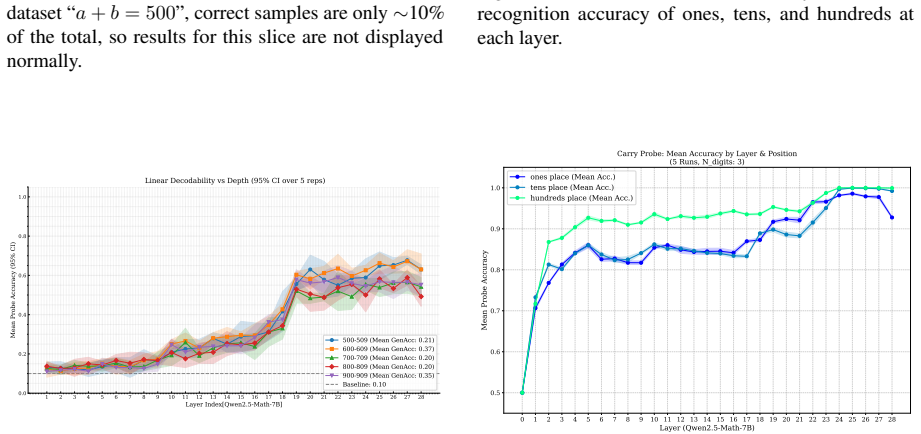
- [§3.1, §7, Appendix D] LLaMA-3-8B-Instruct was selected because it exhibited the clearest four-stage ordering (Section 3.1), yet Section 7 claims the trajectory is robust across architectures. Appendix D does not fully support this generalization: for Qwen2.5-Math-7B and AceMath, the first-correct-token layer is reported at layer 19 for essentially all samples (Figs. 25–26), and the sum-range probes reach only low generalization accuracy for Qwen (GenAcc 0.20–0.37 in Fig. 13). The apparent cross-model consistency should be established with the same onset criterion applied to all models, or the generalization claim should be restricted to the primary model.
- [§7, Limitations] The Conclusion's characterization of the observations as 'strong evidence' for a computation-like process over rote memorization exceeds what the correlational design can establish, and the Limitations section explicitly concedes that decodability does not imply necessity and that causal interventions are required. Since the ordered probe decodability is the only evidence offered for the computation-first interpretation, the conclusion should be reframed as a descriptive layer-wise map of linearly decodable information, with the computation-first reading presented as a hypothesis requiring causal verification.
minor comments (6)
- [Figure 3 caption vs. §4.1] The caption says accuracy plateaus in 'early-to-mid layers' while the main text says 'mid-to-late layers'; these should be reconciled.
- [Tables 1 and 2] Table 1 reports 98.18% overall accuracy for LLaMA-3-8B-Instruct while Table 2 reports 97.29% for the same model; the discrepancy is not explained.
- [§4.2, Appendix C.2] Appendix C.2 says the task is to 'predict the exact sum; each class is one sum value', while §4.2 describes a 10-way bin task such as '500-509'; the task definition and the relationship between classes and sum values should be clarified.
- [Figures 25–26] The captions for these figures refer to layers 23–32 while the plots show layers 19–28; the captions and axes should be made consistent.
- [Throughout] The model name appears as LLAMA, LLaMA, and Llama in different places; the spelling should be standardized.
- [Section 1] The line 'Status. This paper has been accepted to EMNLP 2025' is not scientific content and should be removed or moved to a footnote.
Circularity Check
No circular derivation: the four-stage ordering is an empirical probe finding, not an input to the analysis.
full rationale
The paper is an observational probing study rather than a derivation from fitted parameters. The four-stage trajectory is read directly from layer-wise probe accuracy curves, and no fitted parameter is renamed as a prediction. The model-selection rationale (choosing LLaMA-3-8B-Instruct because it showed the clearest layer-wise probe signals) is transparent and does not make the reported curves equivalent to the selection criterion by construction; the curves are independent measurements, and Appendix D explicitly checks whether the ordering persists in other models. The paper contains no load-bearing self-citation chain: the single author is not invoking prior theorems of his own, and the cited prior work is external. The Limitations section explicitly disclaims that decodability implies causal use or necessity, which shows the authors are aware that the probe-timeline inference is correlational rather than definitional. The conclusion that the ordering is 'strong evidence' for a computation-like process is an interpretive overreach relative to the correlational evidence, but that is an inferential gap or correctness risk, not a circular reduction of the kind required by the rubric. Accordingly, no specific circular step can be exhibited, and the honest finding is no significant circularity.
Assumptions & free parameters
assumptions (4)
- domain assumption Linear probe accuracy reflects the information content available in a hidden state for a given attribute.
- domain assumption The logit lens projection h_S W_U^T gives a faithful layer-wise next-token distribution.
- ad hoc to paper Probe tasks with different numbers of classes and baselines can be compared to infer an information-ordering timeline.
- domain assumption The last-token hidden state is a sufficient summary for decoding arithmetic attributes.
Cite this review
Pith. "Pith review of Addition in Four Movements: Mapping Layer-wise Information Trajectories in LLMs." pith.science (2026). https://pith.science/paper/BD7OKE2Y
@misc{pith2026250607824,
  author       = {Pith},
  title        = {Pith review of: Addition in Four Movements: Mapping Layer-wise Information Trajectories in LLMs},
  year         = {2026},
  howpublished = {\url{https://pith.science/paper/BD7OKE2Y}},
  note         = {Machine review of arXiv:2506.07824}
}
read the original abstract
Multi-digit addition is a clear probe of the computational power of large language models. To dissect the internal arithmetic processes in LLaMA-3-8B-Instruct, we combine linear probing with logit-lens inspection. Inspired by the step-by-step manner in which humans perform addition, we propose and analyze a coherent four-stage trajectory in the forward pass:Formula-structure representations become linearly decodable first, while the answer token is still far down the candidate list.Core computational features then emerge prominently.At deeper activation layers, numerical abstractions of the result become clearer, enabling near-perfect detection and decoding of the individual digits in the sum.Near the output, the model organizes and generates the final content, with the correct token reliably occupying the top rank.This trajectory suggests a hierarchical process that favors internal computation over rote memorization. We release our code and data to facilitate reproducibility.
Figures


Figures from the paper (15 more)




Forward citations
Cited by 1 Pith paper
-
Verbalizable Representations Form a Global Workspace in Language Models
Language models represent their current reasoning in a small, readable set of verbalizable vectors (the J-space) that functions like a global workspace.
Reference graph
Works this paper leans on
-
[1]
Yonatan Belinkov. 2022. https://doi.org/10.1162/COLI\_A\_00422 Probing classifiers: Promises, shortcomings, and advances . Comput. Linguistics, 48(1):207--219
doi:10.1162/coli 2022
-
[2]
Bilal Chughtai, Lawrence Chan, and Neel Nanda. 2023. https://openreview.net/forum?id=j4_YHiTAN63 Neural networks learn representation theory: Reverse engineering how networks perform group operations . In ICLR 2023 Workshop on Physics for Machine Learning
work page 2023
-
[3]
Aaron Grattafiori, Abhimanyu Dubey, Abhinav Jauhri, Abhinav Pandey, Abhishek Kadian, Ahmad Al-Dahle, Aiesha Letman, Akhil Mathur, Alan Schelten, Alex Vaughan, and 1 others. 2024. The llama 3 herd of models. arXiv preprint arXiv:2407.21783
arXiv 2024
-
[4]
Yifan Hou, Jiaoda Li, Yu Fei, Alessandro Stolfo, Wangchunshu Zhou, Guangtao Zeng, Antoine Bosselut, and Mrinmaya Sachan. 2023. https://doi.org/10.18653/V1/2023.EMNLP-MAIN.299 Towards a mechanistic interpretation of multi-step reasoning capabilities of language models . In Proceedings of the 2023 Conference on Empirical Methods in Natural Language Processi...
-
[5]
Albert Q. Jiang, Alexandre Sablayrolles, Arthur Mensch, Chris Bamford, Devendra Singh Chaplot, Diego de las Casas, Florian Bressand, Gianna Lengyel, Guillaume Lample, Lucile Saulnier, Lélio Renard Lavaud, Marie-Anne Lachaux, Pierre Stock, Teven Le Scao, Thibaut Lavril, Thomas Wang, Timothée Lacroix, and William El Sayed. 2023. https://arxiv.org/abs/2310.0...
arXiv 2023
-
[6]
Subhash Kantamneni and Max Tegmark. 2025. https://openreview.net/forum?id=CqViN4dQJk Language models use trigonometry to do addition . In ICLR 2025 Workshop on Building Trust in Language Models and Applications
2025
-
[7]
Shahar Katz, Yonatan Belinkov, Mor Geva, and Lior Wolf. 2024. https://doi.org/10.18653/V1/2024.EMNLP-MAIN.142 Backward lens: Projecting language model gradients into the vocabulary space . In Proceedings of the 2024 Conference on Empirical Methods in Natural Language Processing, EMNLP 2024, Miami, FL, USA, November 12-16, 2024 , pages 2390--2422. Associat...
-
[8]
Jorrit Kruthoff. 2024. https://arxiv.org/abs/2401.07993 Carrying over algorithm in transformers . Preprint, arXiv:2401.07993
work page Pith review arXiv 2024
Show all 22 references
-
[9]
Amit Arnold Levy and Mor Geva. 2025. https://aclanthology.org/2025.naacl-short.33/ Language models encode numbers using digit representations in base 10 . In Proceedings of the 2025 Conference of the Nations of the Americas Chapter of the Association for Computational Linguist...
2025
-
[10]
Zihan Liu, Yang Chen, Mohammad Shoeybi, Bryan Catanzaro, and Wei Ping. 2025. https://doi.org/10.18653/v1/2025.findings-acl.206 Acemath: Advancing frontier math reasoning with post-training and reward modeling . In Findings of the Association for Computational Linguistics: ACL ...
2025 doi
-
[11]
Neel Nanda, Lawrence Chan, Tom Lieberum, Jess Smith, and Jacob Steinhardt. 2023. https://openreview.net/forum?id=9XFSbDPmdW Progress measures for grokking via mechanistic interpretability . In The Eleventh International Conference on Learning Representations, ICLR 2023, Kigali...
2023
-
[12]
Yaniv Nikankin, Anja Reusch, Aaron Mueller, and Yonatan Belinkov. 2024. https://arxiv.org/abs/2410.21272 Arithmetic without algorithms: Language models solve math with a bag of heuristics . Preprint, arXiv:2410.21272
2024 arXiv
-
[13]
nostalgebraist. 2020. Interpreting gpt: the logit lens. https://www.lesswrong.com/posts/AcKRB8wDpdaN6v6ru/interpreting-gpt-the-logit-lens. LessWrong blog post
2020
-
[14]
Philip Quirke and Fazl Barez. 2024. https://openreview.net/forum?id=rIx1YXVWZb Understanding addition in transformers . In The Twelfth International Conference on Learning Representations, ICLR 2024, Vienna, Austria, May 7-11, 2024 . OpenReview.net
2024
-
[15]
Alessandro Stolfo, Yonatan Belinkov, and Mrinmaya Sachan. 2023. https://doi.org/10.18653/V1/2023.EMNLP-MAIN.435 A mechanistic interpretation of arithmetic reasoning in language models using causal mediation analysis . In Proceedings of the 2023 Conference on Empirical Methods ...
2023 doi
-
[16]
Yang Yan, Yu Lu, Renjun Xu, and Zhenzhong Lan. 2025. https://arxiv.org/abs/2504.05262 Do phd-level llms truly grasp elementary addition? probing rule learning vs. memorization in large language models . Preprint, arXiv:2504.05262
2025
- [17]
-
[18]
Zeping Yu and Sophia Ananiadou. 2024. https://doi.org/10.18653/v1/2024.emnlp-main.193 Interpreting arithmetic mechanism in large language models through comparative neuron analysis . In Proceedings of the 2024 Conference on Empirical Methods in Natural Language Processing, pag...
2024 doi
-
[19]
Tianyi Zhou, Deqing Fu, Vatsal Sharan, and Robin Jia. 2024. https://proceedings.neurips.cc/paper_files/paper/2024/file/2cc8dc30e52798b27d37b795cc153310-Paper-Conference.pdf Pre-trained large language models use fourier features to compute addition . In Advances in Neural Infor...
2024
-
[20]
Fangwei Zhu, Damai Dai, and Zhifang Sui. 2025. https://aclanthology.org/2025.coling-main.47/ Language models encode the value of numbers linearly . In Proceedings of the 31st International Conference on Computational Linguistics, COLING 2025, Abu Dhabi, UAE, January 19-24, 202...
2025
-
[21]
online" 'onlinestring :=
ENTRY address archivePrefix author booktitle chapter edition editor eid eprint eprinttype howpublished institution journal key month note number organization pages publisher school series title type volume year doi pubmed url lastchecked label extra.label sort.label short.list...
-
[22]
write newline
" write newline "" before.all 'output.state := FUNCTION n.dashify 't := "" t empty not t #1 #1 substring "-" = t #1 #2 substring "--" = not "--" * t #2 global.max substring 't := t #1 #1 substring "-" = "-" * t #2 global.max substring 't := while if t #1 #1 substring * t #2 gl...
Reviewed August 7, 2026 · model on record in the stance chip above.
Discussion (0). Sign in to comment.