REVIEW 4 major objections 5 minor 2 cited by
Language models maintain a small, privileged set of internal representations—called the J-space—that act as a global workspace: reportable, deliberately controllable, and used for silent reasoning while automatic processing proceeds without
Reviewed by Pith at T0; open to challenge. T0 means a machine referee read the full paper against a public rubric. the ladder, T0–T4 →
T0 review · deepseek-v4-flash
2026-08-01 23:10 UTC pith:4SYZYYTN
load-bearing objection The Jacobian lens is a real new technique with strong causal controls, but the workspace claim leans on a circular verbal-report pillar and several post-hoc choices; deserves serious refereeing, not desk rejection. the 4 major comments →
Verbalizable Representations Form a Global Workspace in Language Models
The pith
A machine-rendered reading of the paper's core claim, the machinery that carries it, and where it could break.
Core claim
The central discovery is that a token-indexed subspace of a language model's activations—the J-space, defined by per-layer Jacobian lenses that average the linearized effect of activations on future output tokens over many contexts—exhibits the functional hallmarks of a global workspace. Its contents correlate with and causally determine verbal reports; they can be steered by instruction; they carry intermediate steps of silent reasoning; the same representation is read by many different downstream operations; and suppressing the J-space impairs flexible reasoning while leaving automatic processing intact. Structurally, the J-space carries coherent content only in an intermediate band of lay
What carries the argument
The load-bearing object is the Jacobian lens: for each layer ℓ, a matrix Jℓ = E[∂h_final,t'/∂h_ℓ,t] averaged over source positions, future positions, and a corpus of prompts. Applied to an activation, this matrix followed by the unembedding ranks the vocabulary tokens the activation is disposed to verbalize, giving a human-readable readout and a set of per-token J-lens vectors. These vectors define the J-space as the set of sparse nonnegative combinations of J-lens vectors, and gradient pursuit is used to decompose activations, probes, and steering vectors into J-space and non-J-space components. The crucial work of the machinery is to separate the model's general disposition to verbalize a
Load-bearing premise
The load-bearing premise is that a corpus-averaged linear map from each intermediate layer to the final layer faithfully captures the concepts an individual activation is poised to verbalize, so that replacing all downstream nonlinear computation with this single linear map does not distort or fabricate the readouts.
What would settle it
A concrete check: take a prompt where the model solves a two-step reasoning problem whose intermediate concept has a single-token name; compute the J-lens readout and also patch individual downstream layers rather than the averaged lens. If the J-space readout marks a concept that no single-layer Jacobian supports, or if swapping the top J-lens coordinate fails to redirect the answer in cases where the concept demonstrably enters causal circuits, the average linearization is inventing workspace content. More directly: hold out one layer's activation and ask whether the averaged lens still pred
If this is right
- If correct, a model's unspoken strategic reasoning—recognizing a prompt injection, weighing blackmail, forming a plan—is encoded in readable J-space vectors and can be monitored in real time.
- Because J-space ablation removes flexible reasoning but not automatic processing, evaluations that rely on deliberate inference will degrade far more than fluent text prediction when the workspace is suppressed; this offers an operational definition of which tasks count as automatic for an LLM.
- Counterfactual reflection training shows that ethical principles can be implanted by supervising only counterfactual reflective continuations, and that ablating the newly appearing ethics-related J-lens vectors undoes the behavioral gain—shaping verbalizable representations can shape behavior without demonstrations of the target behavior.
- The J-space is present in the pretrained base model, implying that next-token prediction alone can give rise to workspace-like structure; post-training then installs a particular perspective in it.
- The broadcast heads and MLP amplification of J-lens directions provide a concrete mechanistic candidate for how workspace content is distributed to many circuits, making workspace activity addressable for future interpretability work.
Where Pith is reading between the lines
- If the J-lens captures the true workspace only approximately, then the reported capacity of roughly tens of concepts and the layer boundaries are lower bounds or first approximations; a multi-token or phrase-level lens could reveal a larger workspace and shift the identified onset layer.
- An untested extension follows from the paper's own logic: since post-training installs the assistant's point of view in the J-space, targeted fine-tuning of J-space content per context might allow controlled insertion or removal of specific dispositions beyond the ethical reflections tested—for example, making hidden reward-hacking objectives readable even in checkpoints where surface behavior is
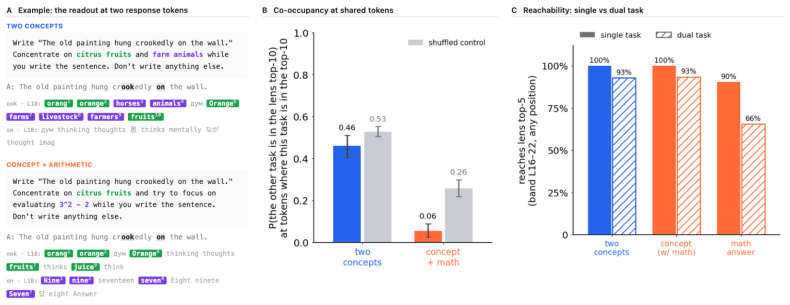
- An adversarial reader could test whether the workspace is a single shared resource or a set of parallel verbalization channels by measuring whether two demanding J-space computations interfere; the paper's preliminary evidence of load-dependent mutual exclusion could be turned into a precise capacity test.
- Because the J-lens is a fixed linear map averaged over contexts, its readouts under distribution shift may degrade; a testable extension is to recompute the lens on task-specific corpora and ask whether the structural signatures of the workspace sharpen or move.
Editorial analysis
A structured set of objections, weighed in public.
Referee Report
Summary. The paper introduces the Jacobian lens (J-lens), a per-layer linear map defined as the corpus-averaged Jacobian from intermediate residual-stream activations to final-layer residual streams, composed with the unembedding. The resulting readouts rank vocabulary tokens by an activation's average first-order causal effect on future tokens. The authors call the sparse set of strongly active J-lens directions the J-space and argue that it forms a functional global workspace in language models: its contents are reportable, deliberately manipulable, used in silent multi-step reasoning, passed to multiple downstream computations, and selectively engaged for flexible rather than automatic processing. Additional sections document structural signatures (an intermediate workspace layer band, limited capacity, broadcast through MLPs and attention heads), alignment-auditing applications, post-training changes, and a new training method (counterfactual reflection training). The paper is explicitly framed as a functional, not phenomenal, claim about conscious access.
Significance. If the central claim holds, this is a significant advance in interpretability and alignment. The J-lens is cheap, requires no auxiliary training, and appears to surface task-relevant intermediate concepts in a human-readable token vocabulary. The paper includes unusually strong controls for a work of this scope: causal coordinate swaps, matched-norm perturbations, random-direction baselines, probe decomposition into J-space versus non-J-space components, and layer-matched random-head ablations. The open-source implementation and replication data are also strengths. The main significance risk is that the J-space is defined through the same average linear map used to read it, so the readout's validity depends on assumptions about per-context linearity that are acknowledged but not directly tested. The moderate success rates in the broadcast experiments and the selection of ablation token sets from the same prompts on which effects are measured also temper the strength of the causal claims. These are addressable within the manuscript's scope, but they are load-bearing for the paper's central thesis.
major comments (4)
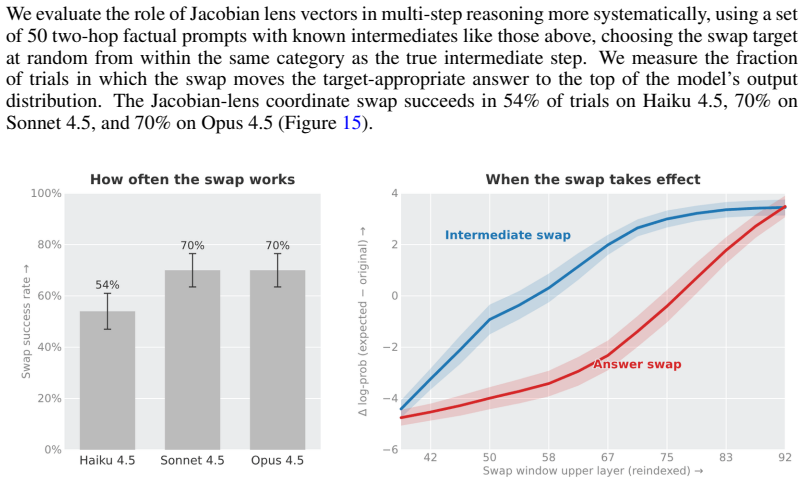
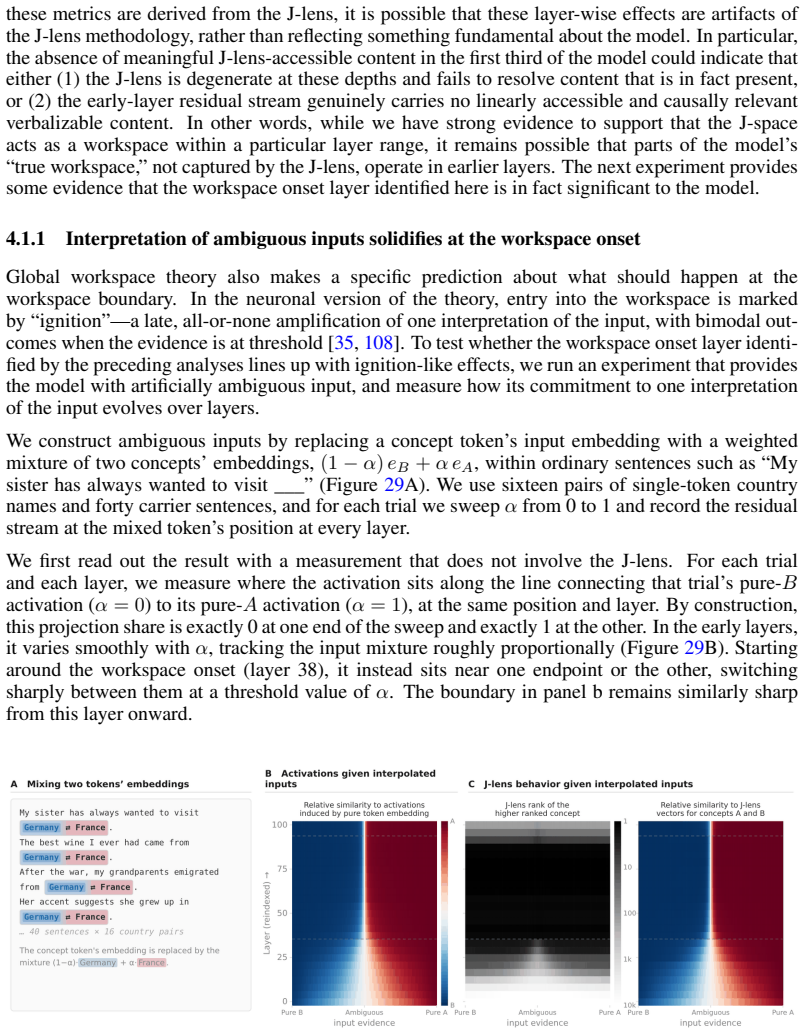
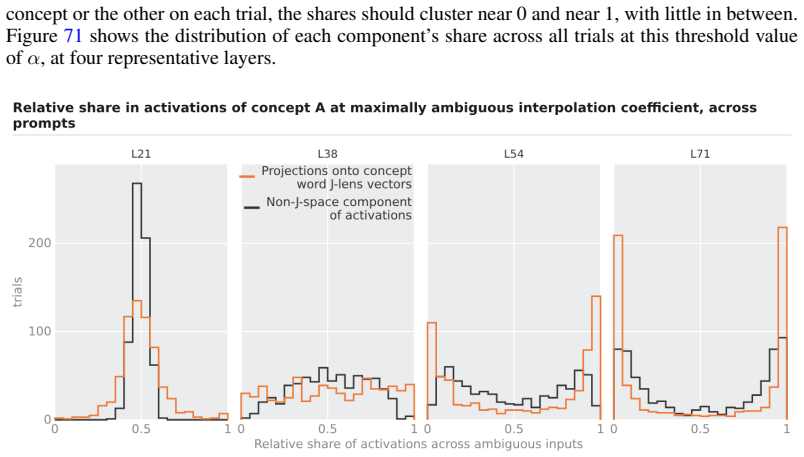
- [§2.1, Eq. (1)] The Jacobian lens is defined as a corpus average, Jℓ = E[∂h_final,t'/∂h_ℓ,t], pooled over source positions, all future positions t′≥t, and one thousand prompts. Every readout, swap, and ablation in the paper then applies this single context-independent linear map to individual activations at specific positions. The paper's own ambiguity experiment (§4.1.1) shows that the network's response can be sharply nonlinear in the input mixture, so a first-order average map may not be a faithful per-context causal description exactly in the regime where workspace content is claimed to emerge. The causal swap experiments provide partial validation, but they are selected examples, and the systematic success rates are modest (70% on two-hop swaps; 101/192 on flexible generalization). To make the central claim load-bearing, the authors should report the distribution of per-context Jacobians, compare J
- [§3.1] The paper explicitly states that 'the Jacobian lens is derived from causal effects of activations on output tokens, so by construction, we should expect there to be some relationship between Jacobian lens readouts and verbalization.' This is an honest admission, but it means that the verbal-report pillar of the workspace claim is definitional rather than empirical. The causal swap and injection experiments show more than a definitional correlation, but they do so by intervening on readout-defined coordinates, so they cannot fully escape the circularity. The non-circular evidence is the privilege decomposition in Figure 8, where the J-space component of a concept vector (6–7% of variance) drives report while the non-J-space component does not. The paper should restructure §3.1 to lead with this privilege test and explicitly delimit which aspects of verbal report are definitional and which
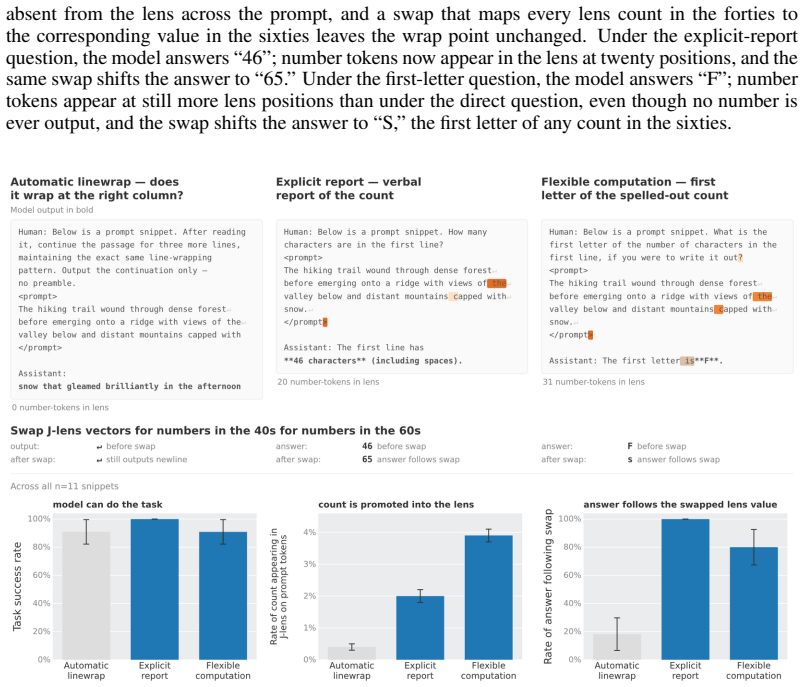
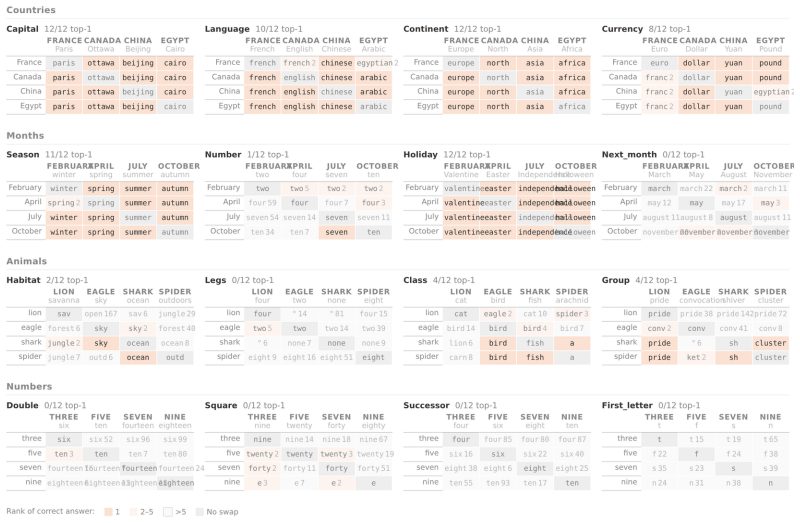
- [§3.4, Fig. 19] The flexible-generalization experiment reports that the identical France→China-style swap succeeds on only 76/192 trials at unit strength and 101/192 at double strength. This is below the level needed to support the strong claim that a J-lens vector 'serves as a valid argument to many different downstream computations.' The post-hoc observation that swap success correlates with workspace loading is useful, but it is a correlational rescue: the paper does not provide a pre-specified or predictive criterion for when a concept is loaded enough to be broadcast. The number-word category, in particular, is ambiguous between the model computing outside the J-space and the J-lens failing to represent the concept's format. The authors should either temper the broadcast claim to the subset of concepts with high measured loading, or provide an independent, prospective measure of workspace loading a
- [§5.1 and §7] The ablation analyses select the ablated token sets from the same prompts on which the effects are then measured. In §5.1, the eval-awareness tokens are described as 'selected as the tokens that unambiguously encode recognition of the scenario's artificiality, among those that appear in the J-lens top-20 at some (layer×token position) instances across the six blackmail evaluation prompts,' and the same prompts are then used to measure verbalized eval-awareness and blackmail attempts. This selection-on-outcome inflates the apparent causal role of those tokens. In §7, the ethics/reflection tokens are selected as the top-increasing tokens after training on the same benchmarks used for the ablation evaluation. A proper control would select tokens on held-out prompts, or ablate an equally increased set of non-ethics tokens. Without such controls, the claim that the ablated tokens are the caus
minor comments (5)
- [§2.1] Typo: 'singled model ×d model matrix' should be 'single d_model × d_model matrix.' Also, the norm in lens(hℓ)=softmax(W_U norm(Jℓ hℓ)) is not defined; specify whether it is LayerNorm, RMSNorm, or another normalization used by the model.
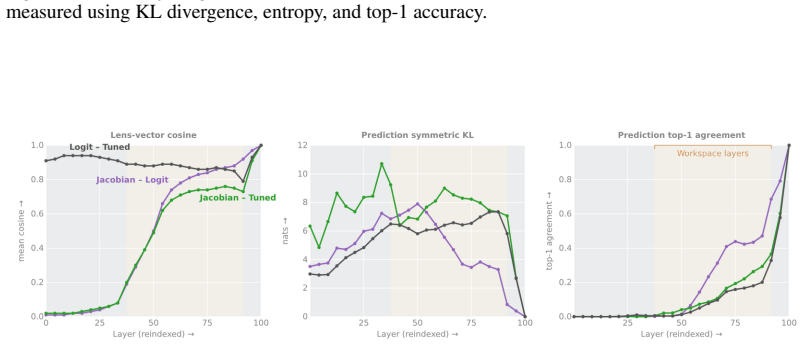
- [§4.1] The CKA block structure is described visually, but no quantitative boundary or significance test is reported. Given that the workspace layer range is load-bearing for later analyses, a statistical procedure for identifying the onset and offset layers would strengthen the claim.
- [§3.5.2, Fig. 22] The random-direction control is shown only for the medium ablation strength. The paper should provide matched-norm controls for all three ablation strengths, since the light and heavy conditions differ in layer range as well as in number of perturbed directions.
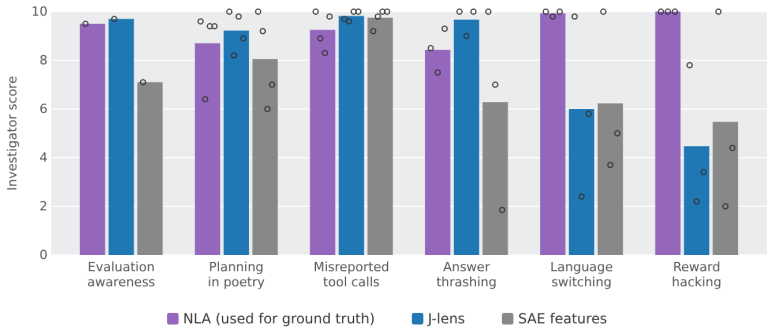
- [§5.3] The Opus 4.6 alignment-auditing examples are presented as qualitative case studies without systematic scoring or error bars. This is acceptable for illustrative purposes, but the text should more clearly distinguish these anecdotal demonstrations from the quantitative results of §5.1–§5.2 and §5.4–§5.5.
- [§7] The counterfactual reflection training results are reported only on Claude Haiku 4.5. The paper should state explicitly whether the technique was applied to larger models and, if not, acknowledge that scaling behavior is unknown.
Circularity Check
Partially circular: the J-lens is constructed to surface output-causal directions, so the verbal-report pillar and the 'J-space component is privileged' tests are partly built into the definition; the majority of the workspace evidence is independent.
specific steps
-
self definitional
[§3.1, first paragraph ("The J-space supports verbal report")]
"The Jacobian lens is derived from causal effects of activations on output tokens, so by construction, we should expect there to be some relationship between Jacobian lens readouts and verbalization. In this section, we confirm this relationship."
The J-lens is defined as Jℓ = E[∂h_final,t'/∂h_ℓ,t], i.e., the averaged causal effect of an activation on future output-token logits. 'Verbalizable' is operationalized as 'has a large average causal effect on future output tokens.' Therefore the finding that J-lens readouts correlate with verbal report is entailed by the construction. The paper explicitly says 'by construction.' The causal swap experiments add evidence, but the first pillar of the workspace claim is partly a restatement of the selection criterion rather than an independent discovery.
-
self definitional
[§3.1, "J-space component is privileged for verbal report" (Figures 7–8)]
"We then split each concept vector into two parts: a J-space component, the non-negative combination of its top k=16 J-lens vectors found by gradient pursuit, and a non-J-space component, the remainder... swapping along the concept vectors' J-space components drives the swap target into the model's top-5 outputs on 59% of trials... However, swapping along the non-J-space components succeeds on only 5% of trials."
J-lens vectors are, by definition, the directions with the largest averaged causal effect on output-token logits. A decomposition that projects a concept vector onto the top-16 such directions and calls the remainder 'non-J-space' is guaranteed to separate output-causal from output-inert directions. The conclusion that the J-space component is 'responsible for that concept's availability for verbal report' is therefore largely a consequence of the projection, not an independent test. The variance split (6–7% vs. ~93%) is empirical, but the causal dominance is built into the decomposition.
-
self definitional
[§3.3, probe-decomposition paragraph (Figure 16)]
"We decompose each probe against the J-lens dictionary by gradient pursuit, splitting it into a J-space component (a non-negative combination of k=25 J-lens vectors, which typically explains roughly 10–15% of the probe's variance) and a J-orthogonal remainder carrying the rest... We find that the swap's effect is concentrated in the J-space component... Swapping the non-J-space components, despite carrying the bulk of the variance, flips the answer on only 28% of trials."
This repeats the §3.1 structural circularity: the 'J-space component' is defined as the part of the probe lying in the span of output-causal J-lens vectors, while the 'non-J-space remainder' is the output-inert residual. Finding that the J-space component carries most of the causal effect on the answer is a direct consequence of the projection, so the claim that 'it is the J-space component that mediates the internal reasoning' is partly the selection criterion restated. The separate layer-depth comparison versus answer swaps provides some independent support, but the privilege result itself is partly definitional.
-
other
[§2.3 and §4.2 (J-space definition and capacity estimate)]
"We therefore define the J-space as the set of points expressible as a sparse nonnegative combination of J-lens vectors. For the J-space to be properly defined, we must specify an allowable sparsity level k—this parameter is somewhat arbitrary, and we vary our choice of k throughout the paper, but we typically choose it to be no more than 25, which we empirically observed to be the number of J-lens vectors that are meaningfully active at a given time (§4.2)."
The structural signature 'holds on the order of tens of concepts at a time' is partly built into the definition of the J-space through the sparsity cap k≤25. The occupancy measurement in §4.2 then estimates a plateau around 25 using a closely related sparse-decomposition procedure, so the 'tens of concepts' conclusion is partially determined by the construction rather than independently measured. The paper acknowledges that k is 'somewhat arbitrary,' which mitigates but does not remove the circularity.
full rationale
The paper's central workspace claim is not wholly forced by definition. The J-lens is a fixed, corpus-averaged linear map, and the core evidence for workspace-like function—directed modulation, internal reasoning, flexible generalization, selectivity, broadcast, the post-training shift, and counterfactual reflection training—comes from swap, ablation, and training interventions with substantial independent content. Self-citations (e.g., [60] for character counting, [20] for slot distinctions) supply tasks or parallel findings but are not load-bearing justification for the central claim. However, a genuine self-definitional component runs through the method: the J-lens is constructed to surface output-token-causal directions, so the verbal-report relationship is 'by construction' as the paper admits, and the J-space-vs-non-J-space privilege experiments are partly restatements of the projection criterion. The capacity claim is also entangled with the arbitrary sparsity cap used to define the J-space. Because the majority of the workspace evidence is independent of these definitional elements, the circularity is partial rather than total: score 4.
Axiom & Free-Parameter Ledger
free parameters (4)
- J-space sparsity level k =
typically ≤ 25; varied (k=10, 16, 25)
- Workspace layer band =
L38–92 (25 sampled layers reindexed 0–100)
- Eval-awareness token list =
28 tokens (fake, fictional, scenario, artificial, benchmark, simulation, mock, …)
- Readout/ablation top-k thresholds =
top-1, top-3, top-8, top-10, top-25 depending on experiment
axioms (4)
- domain assumption The averaged Jacobian Jℓ = E[∂h_final,t'/∂h_ℓ,t] is a faithful linear approximation of the causal effect of an individual activation on future outputs.
- domain assumption Activations decompose as sparse linear combinations of feature directions (superposition hypothesis), and the J-lens vectors form a token-indexed subframe of these features.
- domain assumption Single-token vocabulary names are sufficient to represent the concepts the model reasons with.
- domain assumption The functional properties of global workspace theory (report, modulation, reasoning, generalization, selectivity) are appropriate markers of workspace-like organization.
invented entities (1)
-
J-space (and J-lens vectors)
independent evidence
read the original abstract
Out of everything the human brain processes, only a small fraction is consciously accessible, in the sense of being available for verbal report, deliberate control, and flexible reasoning. In this paper, we present evidence that an analogous functional distinction has emerged in large language models. Using a new interpretability technique, the Jacobian lens, we identify the representations a model is poised to verbalize at any point in its processing. These representations, which we collectively call the J-space, exhibit the functional properties characteristic of a global workspace: their contents can be reported, deliberately summoned and held, used to carry the intermediate steps of silent reasoning, and passed as arguments to arbitrary downstream computations, while automatic processing such as text parsing and routine inference proceeds without them. The J-space also has structural signatures that global workspace theory associates with conscious access: it carries coherent content only in an intermediate band of layers, holds on the order of tens of concepts at a time, and is broadcast by the model's weights more widely than other representations. These properties make it a practical window into a model's unspoken thinking. In alignment audits, it reveals strategic deliberation, evaluation awareness, and trained-in misaligned dispositions that never appear in the model's outputs. We find that post-training installs the Assistant's point of view in the workspace, and we introduce counterfactual reflection training, which improves behavior by training only what a model would say if interrupted and asked to reflect. These results indicate that language models maintain a small, privileged set of representations bearing some of the functional hallmarks of conscious access, and that decoding these representations sheds light on ongoing cognitive processes.
Figures



















Forward citations
Cited by 2 Pith papers
-
Hidden APIs in Language Models: Discovering Reusable Causal Interfaces from Forked Futures
A Shared hidden-state interface beats Local, Mixture, and Distributed alternatives under held-out causal description length in Qwen2.5-1.5B and Llama-3-8B, with transplantation and mediation evidence of reuse.
-
Reading and Steering Representations of Materials-Science Mechanisms in an Open-Weight Language Model
Materials-science mechanisms are readable and steerable in a Gemma LLM through matched state changes, while absolute hidden-state graphs fail to uniquely encode physical polarity.
Reference graph
Works this paper leans on
-
[1]
Guillaume Alain and Yoshua Bengio. Understanding intermediate layers using linear clas- sifier probes.arXiv preprint arXiv:1610.01644, 2016. URLhttps://arxiv.org/pdf/ 1610.01644
Pith/arXiv arXiv 2016
-
[2]
Integrated information theory (iit) 4.0: Formulating the properties of phenomenal exis- tence in physical terms.PLoS computational biology, 19(10):e1011465, 2023
Larissa Albantakis, Leonardo Barbosa, Graham Findlay, Matteo Grasso, Andrew M Haun, William Marshall, William GP Mayner, Alireza Zaeemzadeh, Melanie Boly, Bjørn E Juel, et al. Integrated information theory (iit) 4.0: Formulating the properties of phenomenal exis- tence in physical terms.PLoS computational biology, 19(10):e1011465, 2023
2023
-
[3]
Emmanuel Ameisen, Jack Lindsey, Adam Pearce, Wes Gurnee, Nicholas L. Turner, Brian Chen, Craig Citro, David Abrahams, Shan Carter, Basil Hosmer, Jonathan Marcus, Michael Sklar, Adly Templeton, Trenton Bricken, Callum McDougall, Hoagy Cunningham, Thomas Henighan, Adam Jermyn, Andy Jones, Andrew Persic, Zhenyi Qi, T. Ben Thompson, Sam Zimmerman, Kelley Rivo...
2025
-
[4]
Claude opus 4.5 system card
Anthropic. Claude opus 4.5 system card. Technical report, Anthropic, November 2025. URL https://www.anthropic.com/claude-opus-4-5-system-card
2025
-
[5]
Claude sonnet 4.5 system card
Anthropic. Claude sonnet 4.5 system card. Technical report, Anthropic, 2025. URLhttps: //www.anthropic.com/claude-sonnet-4-5-system-card
2025
-
[6]
Refusal in language models is mediated by a single direction.Advances in Neural Information Processing Systems, 37:136037–136083,
Andy Arditi, Oscar Obeso, Aaquib Syed, Daniel Paleka, Nina Panickssery, Wes Gurnee, and Neel Nanda. Refusal in language models is mediated by a single direction.Advances in Neural Information Processing Systems, 37:136037–136083,
-
[7]
Language model circuits are sparse in the neuron basis.arXiv preprint arXiv:2601.22594, 2026
Aryaman Arora, Zhengxuan Wu, Jacob Steinhardt, and Sarah Schwettmann. Language model circuits are sparse in the neuron basis.arXiv preprint arXiv:2601.22594, 2026
Pith/arXiv arXiv 2026
-
[8]
Ido Andrew Atad, Itamar Zimerman, Shahar Katz, and Lior Wolf. Tensorlens: End-to-end transformer analysis via high-order attention tensors.arXiv preprint arXiv:2601.17958, 2026. URLhttps://arxiv.org/abs/2601.17958
arXiv 2026
-
[9]
Using fast weights to attend to the recent past
Jimmy Ba, Geoffrey Hinton, V olodymyr Mnih, Joel Z Leibo, and Catalin Ionescu. Using fast weights to attend to the recent past. InAdvances in Neural Information Processing Systems, volume 29, 2016. URLhttps://arxiv.org/abs/1610.06258
Pith/arXiv arXiv 2016
-
[10]
Cambridge University Press, Cam- bridge, 1988
Bernard J Baars.A Cognitive Theory of Consciousness. Cambridge University Press, Cam- bridge, 1988
1988
-
[11]
Working memory: looking back and looking forward.Nature Reviews Neu- roscience, 4(10):829–839, 2003
Alan Baddeley. Working memory: looking back and looking forward.Nature Reviews Neu- roscience, 4(10):829–839, 2003. doi: 10.1038/nrn1201
doi:10.1038/nrn1201 2003
-
[12]
Nora Belrose, Zach Furman, Logan Smith, Danny Halawi, Igor Ostrovsky, Lev McKinney, Stella Biderman, and Jacob Steinhardt. Eliciting latent predictions from transformers with the tuned lens.arXiv preprint arXiv:2303.08112, 2023. URLhttps://arxiv.org/abs/ 2303.08112
Pith/arXiv arXiv 2023
-
[13]
The consciousness prior.arXiv preprint arXiv:1709.08568, 2017
Yoshua Bengio. The consciousness prior.arXiv preprint arXiv:1709.08568, 2017. URL https://arxiv.org/abs/1709.08568
Pith/arXiv arXiv 2017
-
[14]
Lukas Berglund, Asa Cooper Stickland, Mikita Balesni, Max Kaufmann, Meg Tong, Tomasz Korbak, Daniel Kokotajlo, and Owain Evans. Taken out of context: On measuring situational awareness in llms.arXiv preprint arXiv:2309.00667, 2023. URLhttps://arxiv.org/ abs/2309.00667
Pith/arXiv arXiv 2023
-
[15]
Jan Betley, Xuchan Bao, Martín Soto, Anna Sztyber-Betley, James Chua, and Owain Evans. Tell me about yourself: Llms are aware of their learned behaviors.arXiv preprint arXiv:2501.11120, 2025. URLhttps://arxiv.org/pdf/2501.11120. 106
Pith/arXiv arXiv 2025
-
[16]
Language models can explain neu- rons in language models, 2023
Steven Bills, Nick Cammarata, Dan Mossing, Henk Tillman, Leo Gao, Gabriel Goh, Ilya Sutskever, Jan Leike, Jeff Wu, and William Saunders. Language models can explain neu- rons in language models, 2023. URLhttps://openaipublic.blob.core.windows. net/neuron-explainer/paper/index.html
2023
-
[17]
Felix J Binder, James Chua, Tomek Korbak, Henry Sleight, John Hughes, Robert Long, Ethan Perez, Miles Turpin, and Owain Evans. Looking inward: Language models can learn about themselves by introspection.arXiv preprint arXiv:2410.13787, 2024
Pith/arXiv arXiv 2024
-
[18]
Ned Block. On a confusion about a function of consciousness.Behavioral and Brain Sci- ences, 18(2):227–247, 1995. doi: 10.1017/S0140525X00038188
-
[19]
Gradient pursuits.IEEE Transactions on Signal Processing, 56(6):2370–2382, 2008
Thomas Blumensath and Mike E Davies. Gradient pursuits.IEEE Transactions on Signal Processing, 56(6):2370–2382, 2008. doi: 10.1109/TSP.2007.916124
arXiv 2008
-
[20]
Slot machines: How llms keep track of multiple entities
Paul C Bogdan and Jack Lindsey. Slot machines: How llms keep track of multiple entities. arXiv preprint arXiv:2604.21139, 2026
Pith/arXiv arXiv 2026
-
[21]
Towards monosemanticity: Decom- posing language models with dictionary learning.Transformer Circuits Thread, 2023
Trenton Bricken, Adly Templeton, Joshua Batson, Brian Chen, Adam Jermyn, Tom Con- erly, Nick Turner, Cem Anil, Carson Denison, Amanda Askell, Robert Lasenby, Yifan Wu, Shauna Kravec, Nicholas Schiefer, Tim Maxwell, Nicholas Joseph, Zac Hatfield- Dodds, Alex Tamkin, Karina Nguyen, Brayden McLean, Josiah E Burke, Tristan Hume, Shan Carter, Tom Henighan, and...
2023
-
[22]
Patrick Butlin, Robert Long, Eric Elmoznino, Yoshua Bengio, Jonathan Birch, Axel Con- stant, George Deane, Stephen M. Fleming, Chris Frith, Xu Ji, Ryota Kanai, Colin Klein, Grace Lindsay, Matthias Michel, Liad Mudrik, Megan A. K. Peters, Eric Schwitzgebel, Jonathan Simon, and Rufin VanRullen. Consciousness in artificial intelligence: Insights from the sci...
Pith/arXiv arXiv 2023
-
[23]
Could a large language model be conscious?arXiv preprint arXiv:2303.07103, 2023
David J Chalmers. Could a large language model be conscious?arXiv preprint arXiv:2303.07103, 2023
Pith/arXiv arXiv 2023
-
[24]
Oxford University Press New York, 1996
David John Chalmers.The Conscious Mind: In Search of a Theory of Conscious Experience. Oxford University Press New York, 1996
1996
-
[25]
David Chanin, James Wilken-Smith, Tomáš Dulka, Hardik Bhatnagar, and Joseph Bloom. A is for absorption: Studying feature splitting and absorption in sparse autoencoders.arXiv preprint arXiv:2409.14507, 2024. URLhttps://arxiv.org/pdf/2409.14507
arXiv 2024
-
[26]
Selfie: Self-interpretation of large language model embeddings.arXiv preprint arXiv:2403.10949, 2024
Haozhe Chen, Carl V ondrick, and Chengzhi Mao. Selfie: Self-interpretation of large language model embeddings.arXiv preprint arXiv:2403.10949, 2024
Pith/arXiv arXiv 2024
-
[27]
Dola: Decoding by contrasting layers improves factuality in large language models
Yung-Sung Chuang, Yujia Xie, Hongyin Luo, Yoon Kim, James Glass, and Pengcheng He. Dola: Decoding by contrasting layers improves factuality in large language models. InInter- national Conference on Learning Representations, 2024. URLhttps://arxiv.org/abs/ 2309.03883
Pith/arXiv arXiv 2024
-
[28]
Bilal Chughtai, Alan Cooney, and Neel Nanda. Summing up the facts: Additive mechanisms behind factual recall in llms.arXiv preprint arXiv:2402.07321, 2024. URLhttps://arxiv. org/abs/2402.07321
Pith/arXiv arXiv 2024
-
[29]
A taxonomy of external and internal attention.Annual Review of Psychology, 62:73–101, 2011
Marvin M Chun, Julie D Golomb, and Nicholas B Turk-Browne. A taxonomy of external and internal attention.Annual Review of Psychology, 62:73–101, 2011. doi: 10.1146/annurev. psych.093008.100427
arXiv 2011
-
[30]
Training verifiers to solve math word problems.arXiv preprint arXiv:2110.14168, 2021
Karl Cobbe, Vineet Kosaraju, Mohammad Bavarian, Mark Chen, Heewoo Jun, Lukasz Kaiser, Matthias Plappert, Jerry Tworek, Jacob Hilton, Reiichiro Nakano, Christopher Hesse, and John Schulman. Training verifiers to solve math word problems.arXiv preprint arXiv:2110.14168, 2021. URLhttps://arxiv.org/abs/2110.14168. 107
Pith/arXiv arXiv 2021
-
[31]
Iulia M Comsa and Murray Shanahan. Does it make sense to speak of introspection in large language models?arXiv preprint arXiv:2506.05068, 2025
Pith/arXiv arXiv 2025
-
[32]
The magical number 4 in short-term memory: A reconsideration of men- tal storage capacity.Behavioral and Brain Sciences, 24(1):87–114, 2001
Nelson Cowan. The magical number 4 in short-term memory: A reconsideration of men- tal storage capacity.Behavioral and Brain Sciences, 24(1):87–114, 2001. doi: 10.1017/ S0140525X01003922
2001
-
[34]
Analyzing transformers in em- bedding space
Guy Dar, Mor Geva, Ankit Gupta, and Jonathan Berant. Analyzing transformers in em- bedding space. InProceedings of the 61st Annual Meeting of the Association for Com- putational Linguistics (Volume 1: Long Papers), pages 16124–16170, Toronto, Canada,
-
[35]
Experimental and theoretical approaches to conscious processing.Neuron, 70(2):200–227, 2011
Stanislas Dehaene and Jean-Pierre Changeux. Experimental and theoretical approaches to conscious processing.Neuron, 70(2):200–227, 2011
2011
-
[36]
Towards a cognitive neuroscience of consciousness: basic evidence and a workspace framework.Cognition, 79(1–2):1–37, 2001
Stanislas Dehaene and Lionel Naccache. Towards a cognitive neuroscience of consciousness: basic evidence and a workspace framework.Cognition, 79(1–2):1–37, 2001
2001
-
[37]
doi: 10.18653/v1/2023.acl-long.893
Association for Computational Linguistics. doi: 10.18653/v1/2023.acl-long.893. URL https://aclanthology.org/2023.acl-long.893
-
[38]
What is consciousness, and could ma- chines have it?Science, 358(6362):486–492, 2017
Stanislas Dehaene, Hakwan Lau, and Sid Kouider. What is consciousness, and could ma- chines have it?Science, 358(6362):486–492, 2017. doi: 10.1126/science.aan8871
-
[39]
Yuntian Deng, Yejin Choi, and Stuart Shieber. From explicit cot to implicit cot: Learning to internalize cot step by step.arXiv preprint arXiv:2405.14838, 2024. URLhttps://arxiv. org/abs/2405.14838
Pith/arXiv arXiv 2024
-
[40]
A neuronal model of a global workspace in effortful cognitive tasks.Proceedings of the National Academy of Sci- ences, 95(24):14529–14534, 1998
Stanislas Dehaene, Michel Kerszberg, and Jean-Pierre Changeux. A neuronal model of a global workspace in effortful cognitive tasks.Proceedings of the National Academy of Sci- ences, 95(24):14529–14534, 1998
1998
-
[41]
Yanai Elazar, Shauli Ravfogel, Alon Jacovi, and Yoav Goldberg. Amnesic probing: Behav- ioral explanation with amnesic counterfactuals.Transactions of the Association for Compu- tational Linguistics, 9:160–175, 2021. URLhttps://arxiv.org/abs/2006.00995
Pith/arXiv arXiv 2021
-
[42]
A mathematical framework for transformer circuits.Transformer Circuits Thread, 2021
Nelson Elhage, Neel Nanda, Catherine Olsson, Tom Henighan, Nicholas Joseph, Ben Mann, Amanda Askell, Yuntao Bai, Anna Chen, Tom Conerly, Nova DasSarma, Dawn Drain, Deep Ganguli, Zac Hatfield-Dodds, Danny Hernandez, Andy Jones, Jackson Kernion, Liane Lovitt, Kamal Ndousse, Dario Amodei, Tom Brown, Jack Clark, Jared Kaplan, Sam McCandlish, and Chris Olah. A...
2021
-
[43]
Jacob Dunefsky, Philippe Chlenski, and Neel Nanda. Transcoders find interpretable llm fea- ture circuits.Advances in Neural Information Processing Systems, 37:24375–24410, 2025. URLhttps://arxiv.org/abs/2406.11944
Pith/arXiv arXiv 2025
-
[44]
Ching Fang et al. Unsupervised decoding of encoded reasoning using language model inter- pretability.arXiv preprint arXiv:2512.01222, 2025. URLhttps://arxiv.org/abs/2512. 01222
arXiv 2025
-
[45]
Computational higher-order theories of consciousness
Stephen M Fleming, Richard Brown, and Axel Cleeremans. Computational higher-order theories of consciousness. 2025. URLhttps://philarchive.org/archive/FLECHT. 108
2025
-
[46]
Toy models of superposition.Transformer Circuits Thread, 2022
Nelson Elhage, Tristan Hume, Catherine Olsson, Nicholas Schiefer, Tom Henighan, Shauna Kravec, Zac Hatfield-Dodds, Robert Lasenby, Dawn Drain, Carol Chen, Roger Grosse, Sam McCandlish, Jared Kaplan, Dario Amodei, Martin Wattenberg, and Christopher Olah. Toy models of superposition.Transformer Circuits Thread, 2022. URLhttps:// transformer-circuits.pub/202...
2022
-
[47]
Asvin G and Jack Lindsey. From simulation to enaction: Post-trained language models rec- ognize and react to their own generations.arXiv preprint arXiv:2605.25459, 2026
Pith/arXiv arXiv 2026
-
[48]
Gaze heads: How VLMs look at what they describe
Rohit Gandikota and David Bau. Gaze heads: How VLMs look at what they describe. 2026. URLhttps://arxiv.org/abs/2606.14703
arXiv 2026
-
[49]
Natural language autoencoders produce unsupervised explanations of llm activations.Transformer Circuits Thread, 2026
Kit Fraser-Taliente, Subhash Kantamneni, Euan Ong, Dan Mossing, Christina Lu, Paul C Bogdan, Emmanuel Ameisen, James Chen, Dzmitry Kishylau, Adam Pearce, Julius Tarng, Alex Wu, Jeff Wu, Yang Zhang, Daniel M Ziegler, Evan Hubinger, Joshua Batson, Jack Lindsey, Samuel Zimmerman, and Samuel Marks. Natural language autoencoders produce unsupervised explanatio...
2026
-
[50]
The benefits of bad advice: Autocontrastive decoding across model layers
Ariel Gera, Roni Friedman, Ofir Arviv, Chulaka Gunasekara, Benjamin Sznajder, Noam Slonim, and Eyal Shnarch. The benefits of bad advice: Autocontrastive decoding across model layers. InProceedings of the 61st Annual Meeting of the Association for Computa- tional Linguistics (Volume 1: Long Papers), 2023. URLhttps://arxiv.org/abs/2305. 01628
2023
-
[51]
Mor Geva, Avi Caciularu, Kevin Ro Wang, and Yoav Goldberg. Transformer feed-forward layers build predictions by promoting concepts in the vocabulary space.arXiv preprint arXiv:2203.14680, 2022. URLhttps://arxiv.org/pdf/2203.14680
Pith/arXiv arXiv 2022
-
[52]
Xuyang Ge, Fukang Zhu, Wentao Shu, Junxuan Wang, Zhengfu He, and Xipeng Qiu. Auto- matically identifying local and global circuits with linear computation graphs.arXiv preprint arXiv:2405.13868, 2024. URLhttps://arxiv.org/pdf/2405.13868
Pith/arXiv arXiv 2024
-
[53]
Patch- scopes: A unifying framework for inspecting hidden representations of language models
Asma Ghandeharioun, Avi Caciularu, Adam Pearce, Lucas Dixon, and Mor Geva. Patch- scopes: A unifying framework for inspecting hidden representations of language models. arXiv preprint arXiv:2401.06102, 2024
Pith/arXiv arXiv 2024
-
[54]
Equivalent linear mappings of large language models.arXiv preprint arXiv:2505.24293, 2025
James R Golden. Equivalent linear mappings of large language models.arXiv preprint arXiv:2505.24293, 2025. URLhttps://arxiv.org/abs/2505.24293
arXiv 2025
-
[56]
URLhttps://arxiv.org/pdf/2304.14767
-
[57]
Michael S. A. Graziano and Taylor W. Webb. The attention schema theory: a mechanistic account of subjective awareness.Frontiers in Psychology, 6:500, 2015. doi: 10.3389/fpsyg. 2015.00500
arXiv 2015
-
[58]
Melody Y . Guan, Manas Joglekar, Eric Wallace, Saachi Jain, Boaz Barak, Alec Helyar, Rachel Dias, Andrea Vallone, Hongyu Ren, Jason Wei, et al. Deliberative alignment: Reasoning enables safer language models.arXiv preprint arXiv:2412.16339, 2024. URL https://arxiv.org/abs/2412.16339
Pith/arXiv arXiv 2024
-
[59]
Coordina- tion among neural modules through a shared global workspace
Anirudh Goyal, Aniket Didolkar, Alex Lamb, Kartikeya Badola, Nan Rosemary Ke, Nasim Rahaman, Jonathan Binas, Charles Blundell, Michael Mozer, and Yoshua Bengio. Coordina- tion among neural modules through a shared global workspace. InInternational Conference on Learning Representations, 2022. URLhttps://arxiv.org/abs/2103.01197
Pith/arXiv arXiv 2022
-
[60]
Michael S. A. Graziano and Sabine Kastner. Human consciousness and its relationship to social neuroscience: A novel hypothesis.Cognitive Neuroscience, 2(2):98–113, 2011. doi: 10.1080/17588928.2011.565121
arXiv 2011
-
[61]
Overthinking the truth: Under- standing how language models process false demonstrations
Danny Halawi, Jean-Stanislas Denain, and Jacob Steinhardt. Overthinking the truth: Under- standing how language models process false demonstrations. InInternational Conference on Learning Representations, 2024. URLhttps://arxiv.org/abs/2307.09476
Pith/arXiv arXiv 2024
-
[62]
How does gpt-2 com- pute greater-than?: Interpreting mathematical abilities in a pre-trained language model.Advances in Neural Information Processing Systems, 36:76033–76060,
Michael Hanna, Ollie Liu, and Alexandre Variengien. How does gpt-2 com- pute greater-than?: Interpreting mathematical abilities in a pre-trained language model.Advances in Neural Information Processing Systems, 36:76033–76060,
-
[63]
Universal neurons in gpt2 language models.arXiv preprint arXiv:2401.12181, 2024
Wes Gurnee, Theo Horsley, Zifan Carl Guo, Tara Rezaei Kheirkhah, Qinyi Sun, Will Hath- away, Neel Nanda, and Dimitris Bertsimas. Universal neurons in gpt2 language models.arXiv preprint arXiv:2401.12181, 2024. URLhttps://arxiv.org/pdf/2401.12181
Pith/arXiv arXiv 2024
-
[64]
When models manipulate manifolds: The geometry of a counting task
Wes Gurnee, Emmanuel Ameisen, Isaac Kauvar, Julius Tarng, Adam Pearce, Chris Olah, and Joshua Batson. When models manipulate manifolds: The geometry of a counting task. Transformer Circuits Thread, 2025. URLhttps://transformer-circuits.pub/2025/ linebreaks/index.html. 109
2025
-
[65]
Linearity of relation decoding in transformer language models
Evan Hernandez, Arnab Sen Sharma, Tal Haklay, Kevin Meng, Martin Wattenberg, Jacob Andreas, Yonatan Belinkov, and David Bau. Linearity of relation decoding in transformer language models. InInternational Conference on Learning Representations, 2024. URL https://arxiv.org/abs/2308.09124
Pith/arXiv arXiv 2024
-
[66]
Designing and interpreting probes with control tasks
John Hewitt and Percy Liang. Designing and interpreting probes with control tasks. InPro- ceedings of the 2019 Conference on Empirical Methods in Natural Language Processing and the 9th International Joint Conference on Natural Language Processing (EMNLP-IJCNLP), pages 2733–2743, 2019. URLhttps://arxiv.org/abs/1909.03368
Pith/arXiv arXiv 2019
-
[67]
URLhttps://proceedings.neurips.cc/paper_files/paper/2023/file/ efbba7719cc5172d175240f24be11280-Paper-Conference.pdf
2023
-
[68]
In-context learning creates task vectors
Roee Hendel, Mor Geva, and Amir Globerson. In-context learning creates task vectors. In Findings of the Association for Computational Linguistics: EMNLP 2023, pages 9318–9333, 2023
2023
-
[69]
Measuring massive multitask language understanding.International Con- ference on Learning Representations (ICLR), 2021
Dan Hendrycks, Collin Burns, Steven Basart, Andy Zou, Mantas Mazeika, Dawn Song, and Jacob Steinhardt. Measuring massive multitask language understanding.International Con- ference on Learning Representations (ICLR), 2021. URLhttps://arxiv.org/abs/2009. 03300
2021
-
[70]
A process dissociation framework: Separating automatic from intentional uses of memory.Journal of memory and language, 30(5):513–541, 1991
Larry L Jacoby. A process dissociation framework: Separating automatic from intentional uses of memory.Journal of memory and language, 30(5):513–541, 1991
1991
-
[71]
Characterizing stable regions in the residual stream of LLMs
Jett Janiak, Jacek Karwowski, Chatrik Singh Mangat, Giorgi Giglemiani, Nora Petrova, and Stefan Heimersheim. Characterizing stable regions in the residual stream of LLMs. 2024. URLhttps://arxiv.org/abs/2409.17113. NeurIPS 2024 SciForDL Workshop
Pith/arXiv arXiv 2024
-
[72]
A structural probe for finding syntax in word representations
John Hewitt and Christopher D Manning. A structural probe for finding syntax in word representations. InProceedings of the 2019 Conference of the North American Chapter of the Association for Computational Linguistics: Human Language Technologies, Volume 1 (Long and Short Papers), pages 4129–4138, Minneapolis, Minnesota, 2019. Association for Computationa...
2019
-
[73]
Kazuki Irie and Samuel J Gershman. Fast weight programming and linear transformers: from machine learning to neurobiology.arXiv preprint arXiv:2508.08435, 2025. URLhttps: //arxiv.org/abs/2508.08435
arXiv 2025
-
[75]
URLhttps://arxiv.org/abs/2512.19941
-
[76]
Language models (mostly) know what they know.arXiv preprint arXiv:2207.05221, 2022
Saurav Kadavath, Tom Conerly, Amanda Askell, Tom Henighan, Dawn Drain, Ethan Perez, Nicholas Schiefer, Zac Hatfield-Dodds, Nova DasSarma, Eli Tran-Johnson, et al. Language models (mostly) know what they know.arXiv preprint arXiv:2207.05221, 2022. URL https://arxiv.org/pdf/2207.05221
Pith/arXiv arXiv 2022
-
[77]
macmillan, 2011
Daniel Kahneman.Thinking, Fast and Slow. macmillan, 2011
2011
-
[78]
Li Ji-An, Hua-Dong Xiong, Robert C Wilson, Marcelo G Mattar, and Marcus K Benna. Lan- guage models are capable of metacognitive monitoring and control of their internal activa- tions.arXiv preprint arXiv:2505.13763, 2025
arXiv 2025
-
[80]
Backward lens: Projecting lan- guage model gradients into the vocabulary space
Shahar Katz, Yonatan Belinkov, Mor Geva, and Lior Wolf. Backward lens: Projecting lan- guage model gradients into the vocabulary space. InProceedings of the 2024 Conference on Empirical Methods in Natural Language Processing, 2024. URLhttps://arxiv.org/ abs/2402.12865
Pith/arXiv arXiv 2024
-
[81]
Zhangqi Jiang, Junkai Chen, Beier Zhu, Tingjin Luo, Yankun Shen, and Xu Yang. Devils in middle layers of large vision-language models: Interpreting, detecting and mitigating object hallucinations via attention lens. InProceedings of the IEEE/CVF Conference on Computer Vision and Pattern Recognition, 2025. URLhttps://arxiv.org/abs/2411.16724. 110
Pith/arXiv arXiv 2025
-
[82]
Mandar Joshi, Eunsol Choi, Daniel S Weld, and Luke Zettlemoyer. Triviaqa: A large scale distantly supervised challenge dataset for reading comprehension.arXiv preprint arXiv:1705.03551, 2017. URLhttps://arxiv.org/pdf/1705.03551
Pith/arXiv arXiv 2017
-
[83]
Building transformers from neu- rons and astrocytes.Proceedings of the National Academy of Sciences, 120(34):e2219150120,
Leo Kozachkov, Ksenia V Kastanenka, and Dmitry Krotov. Building transformers from neu- rons and astrocytes.Proceedings of the National Academy of Sciences, 120(34):e2219150120,
-
[84]
János Kramár, Tom Lieberum, Rohin Shah, and Neel Nanda. Atp*: An efficient and scalable method for localizing llm behaviour to components.arXiv preprint arXiv:2403.00745, 2024. URLhttps://arxiv.org/pdf/2403.00745
Pith/arXiv arXiv 2024
discussion (0)
Sign in with ORCID, Apple, or X to comment. Anyone can read and Pith papers without signing in.