REVIEW 3 major objections 5 minor 17 references
Repeton: Structured Bug Repair with ReAct-Guided Patch-and-Test Cycles
T0 review · 3 major / 5 minor · reviewed 2026-08-07 · deepseek-v4-flash
Pith's one-line read A fully open, retrieval-free debug loop fixes 11.67% of SWE-bench Lite tasks.
desk verdict A reproducible open-source repair agent whose 11.67% is real but whose RAG comparison and validation-path analysis are too thin to support the abstract's claim. read the letter →
The pith
A machine-rendered reading of the paper's core claim, the machinery that carries it, and where it could break.
The reading
What carries the argument
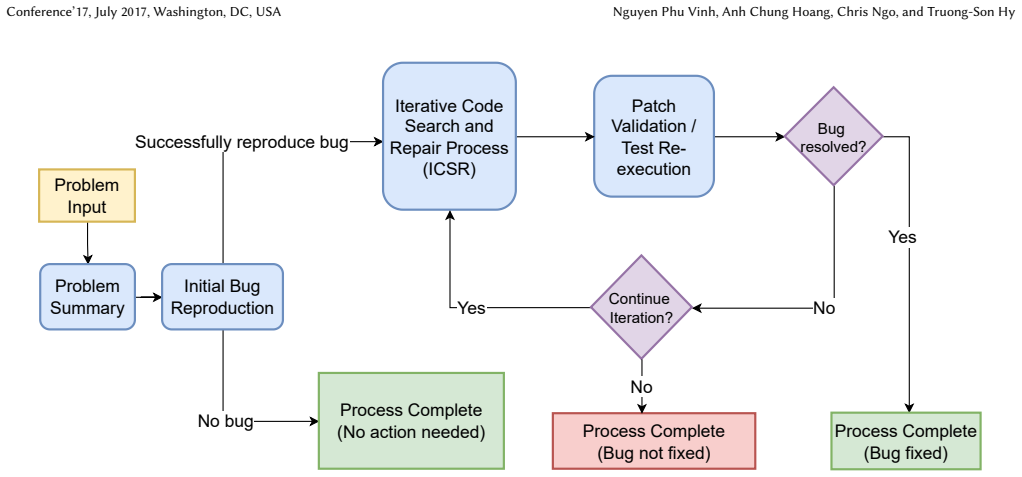
The load-bearing mechanism is the Iterative Repair and Validation (IRV) loop, wrapped around the Iterative Code Search and Repair (ICSR) process. ICSR moves through four stages — keyword extraction and file identification, file-structure summarization, precise code-region localization, and patch generation — with rollback at each stage and a rule that only one code region changes per iteration. IRV wraps this in a ReAct-style testing flow that first constructs a test reproducing the bug, then re-executes that test after each patch, feeding pass/fail information back into the next patch decision. The persistent problem summary, the truncation of conversation history, and the default of accepting the last patch when reproduction fails complete the system.
What would settle it
Run Repeton on the 300 SWE-bench Lite tasks twice: once with the Testing module active and once with a trivial script that always reports the bug as reproduced and accepts the last patch. If the success rates are nearly equal, the claimed test-driven validation is not carrying the result; if the rate drops sharply when reproduction fails, the bottleneck claim is confirmed.
Extended reading notes
Core claim
The central claim is that the separation of diagnosis, search, patching, and validation is what makes autonomous repair work, not the scale or retrieval apparatus of the model. Repeton's result is a workflow result: an open-weight LLM, guided by keyword heuristics and a persistent problem summary, can localize faults and produce patches that pass benchmark tests, and the pipeline can backtrack when a direction fails. The paper also reports where the loop breaks: reasoning sequences that exhaust the context window leave 152 issues with empty patches, and failures to reproduce the bug cause valid patches to be rejected in favor of the last generated patch. Those failure cases are treated as the useful output of the study, pointing to context management and test generation as the bottlenecks.
Load-bearing premise
The whole pipeline depends on the Testing module being able to write a test that reliably reproduces the reported bug; when that fails, valid patches are discarded and the last patch is accepted by default, so the resolution rate is bounded by test-generation ability rather than patch quality.
Editorial extensions
If this is right
- If 11.67% on SWE-bench Lite is reproducible with any open-weight model, retrieval-free patch-and-test agents become a viable transparent baseline for autonomous repair, and benchmark comparisons should control for test-oracle quality rather than just model choice.
- Because 152 of 300 failures end in empty patches from context exhaustion, changes that cap or compress the reasoning trace could translate directly into more resolved issues without any new retrieval machinery.
- The default accept-last-patch rule implies that improving bug reproduction alone would recover earlier, more correct patches and could raise the success rate even if patch generation stays unchanged.
- The single-region-per-iteration edit rule keeps patches minimal, so the pipeline is inspectable by a human reviewer in a way that holistic patch generators are not.
Reading between the lines
- Editorial inference: the paper's numbers suggest the binding constraint is not search or patch quality but the availability of a trustworthy test oracle; if test generation improves, most of the current failure modes should shrink.
- Editorial inference: because the pipeline is embedding-free and open, it could be applied to codebases where embedding infrastructure is unavailable or where privacy rules forbid sending the full repository to a retrieval service.
- A natural next experiment the paper does not run is to swap the test generator for a stronger one and measure the delta; a large delta would confirm that reproduction, not localization, is the current ceiling.
Editorial analysis
A structured set of objections, weighed in public.
Referee Report
Summary. The paper presents Repeton, a fully open-source LLM-based agent for automated bug repair in real-world Git repositories. Instead of generating holistic fixes, Repeton runs a structured patch-and-test loop: it summarizes the issue, searches for relevant files using keyword heuristics, locates precise code regions, generates minimal patches, and validates each patch through a test-producing Testing module. The pipeline is guided by ReAct-style prompting and avoids embedding-based retrieval. The authors evaluate on SWE-bench Lite and report 11.67% resolved instances (35/300), which outperforms the Moatless Tools + DeepSeekV3 baseline (0.00%) but is below Swe-Fixer (24.67%). They also present a failure-case analysis and claim that the method shows good performance compared to RAG-based methods in patch validity and interpretability.
Significance. If the claims are substantiated, the contribution is a transparent, reproducible, embedding-free repair agent that decomposes debugging into modular, verifiable stages and uses only open-weight models without task-specific fine-tuning. The explicit strengths are the open-source release, the rollback mechanisms in the iterative search process, the use of runtime test feedback, and the candid failure analysis. The significance is currently limited by the thin evaluation: the comparative claim about RAG-based methods rests on only two baselines, one of which scores zero, and the validation mechanism is acknowledged to be bypassed when reproduction fails. The paper is a reasonable systems contribution, but the empirical evidence is not yet strong enough for the central comparative claim.
major comments (3)
- [Section 4.1, Table 1] The comparative claim that Repeton shows "good performance compared to RAG-based methods" is unsupported by the reported evidence. Only two baselines are given: Moatless Tools + DeepSeekV3, which scores 0.00, and Swe-Fixer, which scores 24.67. Unless Swe-Fixer's text-retrieval module is the intended RAG baseline, no RAG-based method is directly evaluated; if it is the RAG baseline, then the RAG baseline outperforms Repeton by 13 percentage points. No error bars, repeated runs, or significance tests are reported, so the 11.67% score cannot be distinguished from noise relative to a single non-zero baseline. The claim should be scoped to "competitive with one open-weight baseline" or supported with direct RAG-based comparisons and variability estimates.
- [Section 5] The fallback acceptance path undermines the central causal claim that the patch-and-test loop yields validated repairs. The paper states that when the agent "fails to reproduce the reported error," multiple valid patches can be rejected and "only the last patch is accepted by default." At this point the test-based validation guard is bypassed. The paper does not report, for the 35 resolved instances, how many were accepted via this fallback versus how many passed a genuine reproduction-and-validation cycle, nor whether fallback-accepted patches pass the official SWE-bench tests. Without this breakdown, the headline 11.67% could reflect test-generation failures rather than patch quality. Please report the number of fallback acceptances and the validation success rate among resolved instances.
- [Section 5, Table 2] The failure taxonomy in Table 2 is ambiguous. The three categories "Resolved," "Unresolved," and "Empty Patch" sum to 300, but it is unclear whether "Unresolved" denotes instances where a non-empty patch was generated and tested but failed, and whether "Empty Patch" denotes instances where the agent returned no patch at all. Conflating these failure modes prevents the reader from assessing how often the Testing module actually produced a reproducing test and validated a patch. A clarified taxonomy with counts of generated patches, tested patches, and validated patches would directly address the load-bearing question raised by the fallback mechanism.
minor comments (5)
- [Section 4.1] The text says "Swebench-lite includes 300 GitHub repositories," but SWE-bench Lite consists of 300 task instances drawn from a smaller set of repositories; this should be corrected to avoid overstating benchmark breadth.
- [Figures 1 and 2] The acronyms IRV and IVR are used inconsistently: the text defines Iterative Repair and Validation (IRV), while Figure 1 and Figure 2's caption use "IVR." Please unify the terminology.
- [Section 2] There is a typo in the sentence "Performance in the SWE benchmark reveals the limitations of mand LLMs" which should presumably read "many LLMs." Also, "Swebench" and "SWE-bench" are used inconsistently throughout the manuscript.
- [Section 3.1] The testing flow is described in a way that is easy to misread: the Testing module's main goal is to produce a consistently failing test, yet the following sentence says that if the test passes the patch is finalized. Please clarify the control flow between test generation, test execution, and patch finalization.
- [References] The Moatless Tools reference [1] lists only a GitHub repository without a version, commit, or retrieval date, which makes exact reproduction of the baseline difficult.
Circularity Check
No circularity: the evaluation is anchored to the external SWE-bench Lite benchmark, with no fitted parameters, no benchmark-specific tuning, and no load-bearing self-citation chain.
full rationale
Repeton's central claim is an empirical performance result on SWE-bench Lite (35/300 = 11.67%) and a qualitative claim about interpretability. The pipeline is compared against externally reported open-weight baselines (Moatless Tools + DeepSeekV3, Swe-Fixer); no parameter is fitted to the benchmark, no test-set information is used to tune the framework, and no prior result by the same authors is invoked as load-bearing support. The design choices (ReAct-style prompting, keyword search, patch-and-test loop) are grounded in external prior work [15, 5, 14] and are not defined in terms of the outcome they are meant to explain. The only noteworthy passage is the Section 5 admission that when the agent fails to reproduce the reported error, 'multiple valid patches can be rejected. Eventually, only the last patch is accepted by default.' This is a genuine limitation and a threat to the interpretation of the 11.67% score, but it is not circularity: it does not make the benchmark result equal to an assumption or fitted input; it describes a fallback path that weakens the causal link between test-driven validation and resolved issues. The paper self-reports this failure mode rather than hiding it, and the benchmark score remains externally anchored. I therefore find no derivation-equivalent step, no fitted-input-renamed-as-prediction, and no self-citation chain.
Assumptions & free parameters
assumptions (3)
- domain assumption The LLM can generate a test that consistently fails on the buggy code and passes on the fixed code.
- domain assumption Keyword-based file search over the project tree, without embeddings, identifies relevant files often enough for a successful fix.
- domain assumption Passing the agent-generated test indicates the patch resolves the issue without breaking the project.
Cite this review
Pith. "Pith review of Repeton: Structured Bug Repair with ReAct-Guided Patch-and-Test Cycles." pith.science (2026). https://pith.science/paper/7WLDPMBG
@misc{pith2026250608173,
  author       = {Pith},
  title        = {Pith review of: Repeton: Structured Bug Repair with ReAct-Guided Patch-and-Test Cycles},
  year         = {2026},
  howpublished = {\url{https://pith.science/paper/7WLDPMBG}},
  note         = {Machine review of arXiv:2506.08173}
}
read the original abstract
Large Language Models (LLMs) have shown strong capabilities in code generation and comprehension, yet their application to complex software engineering tasks often suffers from low precision and limited interpretability. We present Repeton, a fully open-source framework that leverages LLMs for precise and automated code manipulation in real-world Git repositories. Rather than generating holistic fixes, Repeton operates through a structured patch-and-test pipeline: it iteratively diagnoses issues, proposes code changes, and validates each patch through automated testing. This stepwise process is guided by lightweight heuristics and development tools, avoiding reliance on embedding-based retrieval systems. Evaluated on the SWE-bench Lite benchmark, our method shows good performance compared to RAG-based methods in both patch validity and interpretability. By decomposing software engineering tasks into modular, verifiable stages, Repeton provides a practical path toward scalable and transparent autonomous debugging.
Figures

Reference graph
Works this paper leans on
-
[1]
AorWall. 2024. Moatless Tools. GitHub repository. https://github.com/aorwall/ moatless-tools
work page 2024
-
[2]
Islem Bouzenia, Premkumar Devanbu, and Michael Pradel. 2024. RepairA- gent: An Autonomous, LLM-Based Agent for Program Repair.arXiv preprint arXiv:2403.17134(2024)
arXiv 2024
-
[3]
Mark Chen, Jerry Tworek, Heewoo Jun, Qiming Yuan, Henrique P. Oliveira Pinto, Jared Kaplan, Harri Edwards, Yuri Burda, Nicholas Joseph, Greg Brockman, Alex Ray, Raul Puri, Gretchen Krueger, Michael Petrov, Heidy Khlaaf, Girish Sastry, Pamela Mishkin, Brooke Chan, Scott Gray, Nick Ryder, Mikhail Pavlov, Alethea Power, Lukasz Kaiser, Mohammad Bavarian, Clem...
arXiv 2021
-
[4]
Claire Le Goues, ThanhVu Nguyen, Stephanie Forrest, and Westley Weimer. 2012. GenProg: A Generic Method for Automatic Software Repair.IEEE Transactions on Software Engineering38, 1 (2012), 54–72. doi:10.1109/TSE.2011.104
-
[5]
Jimenez, John Yang, Alexander Wettig, Shunyu Yao, Kexin Pei, Ofir Press, and Karthik Narasimhan
Carlos E. Jimenez, John Yang, Alexander Wettig, Shunyu Yao, Kexin Pei, Ofir Press, and Karthik Narasimhan. 2024. SWE-bench: Can Language Models Resolve Real-World GitHub Issues?arXiv preprint arXiv:2310.06770(2024)
arXiv 2024
-
[6]
Xia, Longji Yang, Jen tse Huang, Zhouruixing Zhu, Ling- ming Zhang, and Michael R
Cheryl Lee, Chunqiu S. Xia, Longji Yang, Jen tse Huang, Zhouruixing Zhu, Ling- ming Zhang, and Michael R. Lyu. 2024. FixAgent: Hierarchical Multi-Agent Framework for Unified Software Debugging.arXiv preprint arXiv:2404.17153 (2024)
arXiv 2024
-
[7]
Zhengyao Liu, Yunlong Ma, Jingxuan Xu, Junchen Ai, Xiang Gao, Hailong Sun, and Abhik Roychoudhury. 2025. Agent That Debugs: Dynamic State-Guided Vulnerability Repair.arXiv preprint arXiv:2504.07634(2025)
arXiv 2025
-
[8]
Sergey Mechtaev, Jooyong Yi, and Abhik Roychoudhury. 2016. Angelix: Scalable Multiline Program Patch Synthesis via Symbolic Analysis. InProceedings of the 38th International Conference on Software Engineering (ICSE). ACM, 691–701
work page 2016
Show all 17 references
-
[9]
Anton Osika. 2023. GPT-Engineer: CLI Platform to Experiment with Code Gen- eration. GitHub repository. https://github.com/AntonOsika/gpt-engineer
2023
-
[10]
Yue Wang, Hung Le, Akhilesh Deepak Gotmare, Nghi Q. D. Bui, Junnan Li, and Steven C. H. Hoi. 2023. CodeT5+: Open Code Large Language Models for Code Understanding and Generation. InProceedings of the 2023 Conference on Empirical Methods in Natural Language Processing (EMNLP). ...
2023
-
[11]
Scott Wu. 2024. Introducing Devin, the First AI Software Engineer. Cognition.ai blog. https://cognition.ai/blog/introducing-devin
2024
-
[12]
Chengxing Xie, Bowen Li, Chang Gao, He Du, Wai Lam, Difan Zou, and Kai Chen. 2025. SWE-Fixer: Training Open-Source LLMs for Effective and Efficient GitHub Issue Resolution. InProceedings of the Deep Learning for Code (DL4C) Workshop at ICLR 2025
2025
-
[13]
Hui Yang, Sifu Yue, and Yunzhong He. 2023. Auto-GPT for Online Decision Making: Benchmarks and Additional Opinions.arXiv preprint arXiv:2306.02224 (2023)
2023 arXiv
-
[14]
Jimenez, Alexander Wettig, Kilian Lieret, Shunyu Yao, Karthik Narasimhan, and Ofir Press
John Yang, Carlos E. Jimenez, Alexander Wettig, Kilian Lieret, Shunyu Yao, Karthik Narasimhan, and Ofir Press. 2024. SWE-agent: Agent-Computer Inter- faces Enable Automated Software Engineering.arXiv preprint arXiv:2405.15793 (2024)
2024 arXiv
-
[15]
Shunyu Yao, Jeffrey Zhao, Dian Yu, Nan Du, Izhak Shafran, Karthik Narasimhan, and Yuan Cao. 2023. ReAct: Synergizing Reasoning and Acting in Language Models. arXiv:2210.03629 [cs.CL] https://arxiv.org/abs/2210.03629
2023 arXiv
-
[16]
Yuntong Zhang, Haifeng Ruan, Zhiyu Fan, and Abhik Roychoudhury
-
[2024]
Received 8 June 2025
AutoCodeRover: Autonomous Program Improvement.arXiv preprint arXiv:2404.05427(2024). Received 8 June 2025
2024 arXiv
Reviewed August 7, 2026 · model on record in the stance chip above.
Discussion (0). Sign in to comment.