REVIEW 3 major objections 5 minor 1 cited by
Constraining Ongoing Volcanic Outgassing Rates and Interior Compositions of Extrasolar Planets with Mass Measurements of Plasma Tori
T0 review · 3 major / 5 minor · reviewed 2026-08-07 · deepseek-v4-flash
Pith's one-line read A circumstellar plasma torus, if detected around a close-in rocky exoplanet, would be direct evidence of ongoing volcanism and would bound each species' outgassing rate to an order of magnitude.
desk verdict Useful forward model for exoplanet plasma tori, but the scale-height temperature choice inflates feasibility by ~10^3; fixable, worth refereeing. read the letter →
The pith
A machine-rendered reading of the paper's core claim, the machinery that carries it, and where it could break.
The reading
What carries the argument
The central object is the hypothetical circumstellar plasma torus, a quasi-steady ring of ionized volcanic material confined by the host star's magnetic field and forced to corotate with it, modeled directly on Jupiter's Io plasma torus. The argument runs on the mass balance between injection and the flux-tube interchange of magnetospheric convection, with the Alfvén radius $R_A$ marking the boundary where magnetic confinement loses to the stellar wind. The torus is approximated as a uniform-density warm torus occupying three scale heights $H_i = \sqrt{2k_B T/(3m_i\Omega^2)}$ beyond the planet's orbit, so a line-of-sight column $3H_i n_i$ produces absorption $f_{\mathrm{abs},i}\simeq 3H_i n_i\sigma_i$. Equation 16 ties these ingredients together, with $R_A$ and $\Omega$ carrying the star's influence and $H_i$, $\sigma_i$, and $m_i$ carrying the species dependence.
What would settle it
Observe GJ 367 A with a UV spectrograph at the C-II 134 nm and O-I 130 nm lines over multiple epochs spaced months apart, reaching sensitivity to 10% absorption. If the star shows no variable, species-selective absorption even though the planet outgasses above the Table 2 thresholds, the torus model underlying Eq. 16 is falsified for that system; conversely, variable absorption that tracks stellar rotation phase would confirm the torus and its magnetospheric confinement.
Extended reading notes
Core claim
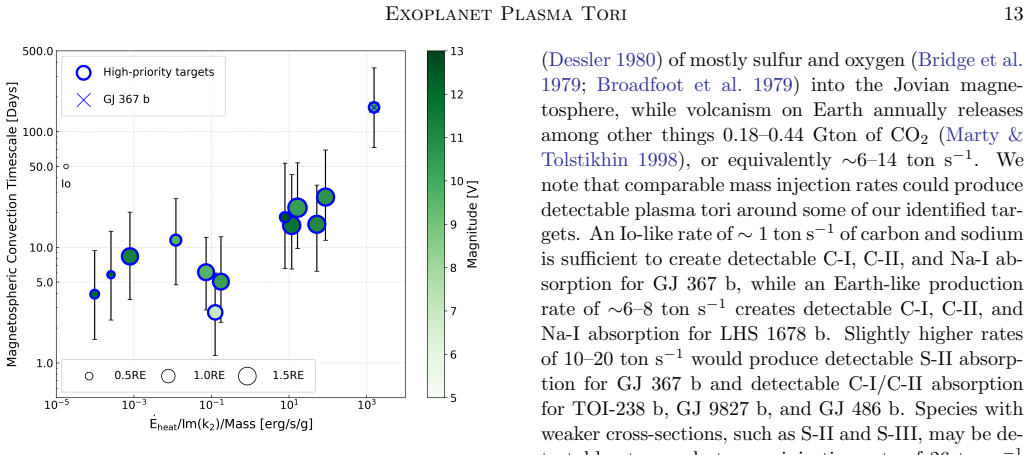
The central claim is that the quasi-steady mass of a circumstellar plasma torus is set by the balance between volcanic injection and removal by corotating magnetospheric convection, and that this mass can be read off from atomic absorption lines. Combining the convection timescale $\tau\gtrsim \sqrt{2/3}(R_A/a)^2 \Omega^{-1}$ with a warm-torus geometry of thickness three scale heights $H_i$ yields $f_{\mathrm{esc},i}\dot{M}_{\mathrm{volc},i}\lesssim (3/2)^{5/2}\pi^2 f_{\mathrm{abs},i}(H_i^2/\sigma_i)(a/R_A)^2 (1+2a/(3H_i)) m_i\Omega$, where $f_{\mathrm{abs},i}$ is the measured line absorption strength, $\sigma_i$ the absorbing cross section, $m_i$ the ion mass, $a$ the orbit radius, $R_A$ the stellar Alfvén radius, and $\Omega$ the stellar spin rate. This inequality is the load-bearing result: it turns a spectrum into an upper limit on volcanic outgassing per species, and it makes the detection itself a proof of ongoing volcanism because the torus cannot survive without continuous replenishment.
Load-bearing premise
The load-bearing premise is that each host star's magnetosphere can be treated as a symmetric dipole whose Alfvén radius is set by log-normal priors on field strength (mean 200 G, width 0.5 dex) and wind mass-loss rate (mean $10^{-14}\,M_\odot$/yr, width 0.5 dex); if the true Alfvén surface is smaller, more time-variable, or shredded by flares and coronal mass ejections, the predicted torus masses and detectability fall by orders of magnitude.
Editorial extensions
If this is right
- A detected plasma torus is a timestamp: since the torus disperses in weeks to months, its observation proves that the planet is volcanically active now, not merely that it was active sometime in the past.
- Measured absorption strengths give order-of-magnitude upper limits on each detected species' outgassing rate, so the ratio of detected to absent species (e.g., sulfur-rich, carbon-poor like Io) constrains the mantle's volatile inventory.
- Because the quasi-steady torus mass scales as $\sim R_A^2$, torus measurements also constrain the host star's magnetic field strength and wind mass-loss rate, turning the torus into a stellar magnetosphere probe.
- For GJ 367 b, total outgassing near 50 tons per second would produce 10% absorption in multiple carbon, oxygen, sodium, sulfur, and potassium lines, within reach of current UV-optical instruments; Io-like and Earth-like rates of 1-10 tons per second suffice for a few species.
- Torus observations are not phase-constrained like transits, so they can be scheduled at any time, which removes a major practical barrier to follow-up with space observatories.
Reading between the lines
- The paper's formalism could be applied to archival ultraviolet spectra of M dwarfs already known to host close-in rocky planets, searching for torus absorption without new observations.
- If torus mass tracks stellar magnetic activity, long-term monitoring would reveal stellar magnetic cycles from the waxing and waning of absorption strength, a diagnostic the paper mentions but does not develop.
- Non-detections will be ambiguous: because the predicted mass scales as $R_A^2$ and $R_A$ is uncertain by roughly an order of magnitude, a null detection could mean either no volcanism or a smaller Alfvén surface, so the strongest scientific return comes from positive detections.
- The same mass-balance argument should apply to volcanically active exomoons orbiting giant exoplanets inside their host magnetospheres, extending the method to a population the paper does not target.
Editorial analysis
A structured set of objections, weighed in public.
Referee Report
Summary. The manuscript proposes a method for detecting ongoing volcanic outgassing from exoplanets via circumstellar plasma tori. It scales the Io plasma torus physics to star-planet systems: volcanic mass loss is ionized and confined by the stellar magnetosphere, the quasi-steady torus mass is set by the injection rate times a magnetospheric convection timescale (Eq. 13), and torus absorption against the stellar disc is related to the species-specific injected mass rate (Eq. 16). The authors identify 13 high-priority targets, estimate Alfvén radii from log-normal priors on B* and Mdot_wind, and tabulate the outgassing rates needed to produce 10% absorption features, highlighting GJ 367 b as the most promising candidate. The paper is candid about several caveats, including the Hill et al. convection-timescale underestimation, the unmeasured escape fraction fesc, and ISM/stellar contamination.
Significance. If the method is correct, it offers a genuinely new observable for ongoing exoplanetary volcanism and interior composition, with a clear external anchor in the Io torus and a measurement that is not phase-constrained like transits. The analytic derivation in Section 3 is transparent and algebraically sound, the software is made available on Zenodo/GitHub, and the caveat section is unusually thorough for a proposal paper. The principal value is as a feasibility framework for future UV missions. The quantitative claims in Tables 1 and 2 should, however, be read as illustrative scalings rather than robust predictions, because the required rates depend strongly on several unmeasured or order-of-magnitude-uncertain inputs, notably the torus plasma temperature, the stellar magnetosphere priors, and the treatment of neutral species.
major comments (3)
- [Section 2.5, Eq. (11), Table 2] The torus scale height H in Eq. (11) is evaluated with T = Teq (1000–2000 K), but the relevant temperature for magnetically confined torus plasma is the post-pickup plasma temperature, not the planet's equilibrium temperature. The pickup energies quoted in Section 2.1 are tens of keV per ion for GJ 367 b, and the Io warm torus—the benchmark for this model—has T ~ 10^5 K rather than 10^3 K. Because Eq. (16) scales as (H_i^2/σ_i)(1 + 2a/(3H_i)), increasing T to 10^5 K raises the required injection rates in Table 2 by roughly two to three orders of magnitude (the scaling transitions from ~T to ~T^{3/2} once H_i becomes comparable to a). For several targets, 3H would then exceed R_A, violating the confinement geometry used to derive Eqs. (12)–(16). I recommend recomputing Table 2 with a physical torus temperature, or explicitly presenting the rates as functions of T over a wide range.
- [Sections 3.2.1 and 4, Table 2] Section 3.2.1 explicitly states that Eq. (16) cannot be used as-is for neutral clouds because the volume and removal timescale differ for neutral material, yet Table 2 and Section 4 quote required rates for C-I, O-I, Na-I, S-I, and K-I (and totals that include these species) using Eq. (16). This inconsistency directly affects the headline claim that Io-like rates of order 1 t/s of carbon and sodium would produce detectable absorption around GJ 367 b. The neutral-species rates should either be derived from an explicit neutral-cloud model or removed from Table 2, leaving the quantitative method to the ionic lines (C-II, S-II, S-III).
- [Tables 1 and 2, Eq. (16)] Table 2 reports single-valued required outgassing rates with no propagated uncertainties, even though the inputs R_A (log-normal priors of width 0.5 dex on B* and Mdot_wind), fesc, and T each carry factors of a few to orders of magnitude. Since Eq. (16) depends on (a/R_A)^2, the ~50% R_A uncertainties in Table 1 alone change the quoted rates by factors of roughly 2–4, and the prior widths imply larger excursions. Because the central comparison is whether required rates are 'realistic' (1–10 t/s) or exceptional (>100 t/s), the conclusions are sensitive to these unpropagated inputs. I recommend reporting the rates as ranges, or at least stating the dominant error terms and their effect on the Table 2 values.
minor comments (5)
- [Section 2.2, paragraph after Eq. (5)] The statement that changes in B* by a factor of ~2 can yield order-of-magnitude changes in the quasi-steady torus mass is not supported by Eq. (5): for large η*, R_A ∝ η*^{1/4}, so M_torus ∝ R_A^2 ∝ B*, i.e., a factor of 2 in B* changes the mass by a factor of ~2, not ~10.
- [Abstract] The abstract's phrase 'with minimal assumptions' overstates the method's current status: the calculation requires priors on B* and Mdot_wind, an assumed torus geometry and temperature, and the unmeasured escape fraction fesc. I suggest rewording to 'with a small number of stated assumptions' or similar.
- [Section 5.6] The text says 'HST STIS/FUV-MAMA low-resolution gratings can recover near-UV emission lines'; since FUV-MAMA is the far-UV channel, this should likely read NUV-MAMA for near-UV, or the wavelength range should be corrected.
- [Section 5.1.3] The target name 'HD 63443 d' appears twice; it should be 'HD 63433 d', matching Table 1 and the rest of the text.
- [Section 5.3] The sentence about the Hill et al. (1981) timescale being underestimated by ~100 and outgassing rates being overestimated is correct but could be clarified: because Eq. (16) is an upper limit, a larger true τ makes the inferred upper bound more stringent, not less.
Circularity Check
No significant circularity; the derivation is a self-contained forward model and the self-citations are not load-bearing.
full rationale
The paper's central derivation chain (Eqs. 10-16) is an analytic forward model: it combines the Hill et al. (1981) magnetospheric convection timescale, a dipolar Alfvén radius estimate with explicitly stated log-normal priors, and the Bagenal (1994) scale height to relate an assumed absorption strength fabs to the required volcanic injection rate fesc Mdot_volc. No parameter is fitted to the output it is used to predict; Table 2 is a detectability-threshold calculation for hypothetical 10% absorption features, not an inversion of measured data. The paper explicitly labels Eq. 10 as a lower bound and Eq. 16 as an upper limit, and Section 5.3 acknowledges that the convection timescale may be underestimated, which only strengthens the conservative direction of the bounds. The self-citations (Seligman et al. 2022, 2024; Feinstein et al. 2022) are used for tidal-heating scaling and flare statistics, which are ancillary to the main derivation and rest on standard results (Beuthe 2013; Peale & Cassen 1978). The temperature assumption for the torus scale height (Teq versus pickup-heated plasma) is a physical modeling choice, not a circular step; it affects numerical predictions but does not reduce Eq. 16 to its own inputs by definition. Therefore no circular step can be exhibited, and the paper is not circular in any load-bearing sense.
Assumptions & free parameters
free parameters (5)
- Stellar surface magnetic field prior B* =
log-normal mean 200 G, width 0.5 dex
- Stellar wind mass-loss prior Mdot_wind =
log-normal mean log10(Mdot_wind[Msun/yr]) = -14, width 0.5 dex
- Atmospheric escape fraction fesc =
assumed 1
- Torus thickness factor =
3 scale heights (H from Eq. 11)
- Torus plasma temperature/pressure for line profiles =
T=1000 K, p=1 nbar
assumptions (6)
- standard math Plasma behaves as an ideal MHD fluid and is confined to stellar magnetic field lines.
- domain assumption Stellar magnetosphere is azimuthally symmetric, dipolar, and corotates with the star; orbital angular momentum aligned.
- domain assumption Magnetospheric convection timescale from Hill et al. (1981), Eq. 10, scales to star-planet systems despite known ~100x underestimate at Io.
- domain assumption Outgassed material is substantially ionized and picked up by the stellar magnetosphere with fesc ~ 1.
- domain assumption Torus density is uniform within a torus of thickness 3H; number density follows isotropic exponential diffusion with scale height H.
- domain assumption Atomic absorption cross-sections from Cthulhu/VALD are accurate at torus conditions.
invented entities (1)
-
Circumstellar plasma torus (hypothetical)
independent evidence
Cite this review
Pith. "Pith review of Constraining Ongoing Volcanic Outgassing Rates and Interior Compositions of Extrasolar Planets with Mass Measurements of Plasma Tori." pith.science (2026). https://pith.science/paper/DXRNDDIY
@misc{pith2026250608177,
  author       = {Pith},
  title        = {Pith review of: Constraining Ongoing Volcanic Outgassing Rates and Interior Compositions of Extrasolar Planets with Mass Measurements of Plasma Tori},
  year         = {2026},
  howpublished = {\url{https://pith.science/paper/DXRNDDIY}},
  note         = {Machine review of arXiv:2506.08177}
}
abstract
We present a novel method of constraining volcanic activity on extrasolar terrestrial worlds via characterization of circumstellar plasma tori. Our work generalizes the physics of the Io plasma torus to propose a hypothetical circumstellar plasma torus generated by exoplanetary volcanism. The quasi-steady torus mass is determined by a balance between material injection and ejection rates from volcanic activity and corotating magnetospheric convection, respectively. By estimating the Alfv\'en surfaces of planet-hosting stars, we calculate the torus mass-removal timescale for a number of exoplanets with properties amenable to plasma torus construction. Assuming a uniform toroidal geometry comparable to Io's "warm" torus, we calculate quasi-steady torus masses inferable from the optical depth of atomic spectral features in torus-contaminated stellar spectra. The calculated quasi-steady masses can be used to constrain the volcanic outgassing rates of each species detected in the torus, providing quantitative estimates of bulk volcanic activity and interior composition with minimal assumptions. Such insight into the interior state of an exoplanet is otherwise accessible only after destruction via tidal forces. We demonstrate the feasibility of our method by showcasing known exoplanets which are susceptible to tidal heating and could generate readily-detectable tori with realistic outgassing rates of order 1 ton s$^{-1}$, comparable to the Io plasma torus mass injection rate. This methodology may be applied to stellar spectra measured with ultraviolet instruments with sufficient resolution to detect atomic lines and sensitivity to recover the ultraviolet continuum of GKM dwarf stars. This further motivates the need for ultraviolet instrumentation above Earth's atmosphere.
Figures


Figures from the paper (6 more)



Forward citations
Cited by 1 Pith paper
-
Volcanic Satellites and Ion Escape in the Magnetospheres of Ultra-Cool and Brown Dwarf Stars
Plasma feeding the radio magnetosphere of LSR J1835+3259 could be sourced by a weak stellar ionospheric outflow or, more plausibly, by a tidally heated Io-like volcanic satellite orbiting within ~10 stellar radii.
Reference graph
Works this paper leans on
-
[1]
, " * write output.state after.block = add.period write newline
ENTRY address archivePrefix author booktitle chapter doi edition editor eprint howpublished institution journal key month number organization pages publisher school series title misctitle type volume year version url label extra.label sort.label short.list INTEGERS output.state before.all mid.sentence after.sentence after.block FUNCTION init.state.consts ...
-
[2]
write newline
" write newline "" before.all 'output.state := FUNCTION format.url url empty "" new.block "" url * "" * if FUNCTION format.eprint eprint empty "" archivePrefix empty "" archivePrefix "arXiv" = new.block " " eprint * " " * new.block " " eprint * " " * if if if FUNCTION format.doi doi empty "" " " doi * " " * if FUNCTION format.pid doi empty eprint empty ur...
-
[3]
thebibliography [1] 20pt to REFERENCES 6pt =0pt -12pt 10pt plus 3pt =0pt =0pt =1pt plus 1pt =0pt =0pt -12pt =13pt plus 1pt =20pt =13pt plus 1pt \@M =10000 =-1.0em =0pt =0pt 0pt =0pt =1.0em @enumiv\@empty 10000 10000 `\.\@m \@noitemerr \@latex@warning Empty `thebibliography' environment \@ifnextchar \@reference \@latexerr Missing key on reference command E...
arXiv 2021
-
[4]
2024, The Journal of Open Source Software, 9, 6894, 10.21105/joss.06894
Agrawal , A., & MacDonald , R. 2024, The Journal of Open Source Software, 9, 6894, 10.21105/joss.06894
-
[5]
1943, Arkiv for Matematik, Astronomi och Fysik, 29B, 1
Alfv \'e n , H. 1943, Arkiv for Matematik, Astronomi och Fysik, 29B, 1
1943
-
[6]
Allard , F., Homeier , D., & Freytag , B. 2012, Philosophical Transactions of the Royal Society of London Series A, 370, 2765, 10.1098/rsta.2011.0269
arXiv 2012
-
[7]
R., Shkolnik , E., Ziemer , J., et al
Ardila , D. R., Shkolnik , E., Ziemer , J., et al. 2022, in Society of Photo-Optical Instrumentation Engineers (SPIE) Conference Series, Vol. 12181, Space Telescopes and Instrumentation 2022: Ultraviolet to Gamma Ray, ed. J.-W. A. den Herder , S. Nikzad , & K. Nakazawa , 1218104, 10.1117/12.2629000
-
[8]
Astudillo-Defru , N., Cloutier , R., Wang , S. X., et al. 2020, , 636, A58, 10.1051/0004-6361/201937179
Show all 168 references
- [9]
-
[10]
2020, Journal of Geophysical Research (Space Physics), 125, e27485, 10.1029/2019JA027485
Bagenal , F., & Dols , V. 2020, Journal of Geophysical Research (Space Physics), 125, e27485, 10.1029/2019JA027485
2020 doi
-
[11]
D., & Siscoe , G
Bagenal , F., Sullivan , J. D., & Siscoe , G. L. 1980, , 7, 41, 10.1029/GL007i001p00041
1980 doi
-
[12]
S., Piskunov , N., & O'Mara , B
Barklem , P. S., Piskunov , N., & O'Mara , B. J. 2000, Astron. and Astrophys. Suppl. Ser., 142, 467, 10.1051/aas:2000167
2000 doi
-
[13]
Barros , S. C. C., Demangeon , O. D. S., Alibert , Y., et al. 2022, , 665, A154, 10.1051/0004-6361/202244293
2022 doi
-
[14]
L., Bazilevskii , A
Barsukov , V. L., Bazilevskii , A. T., Burba , G. A., Bobina , N. N., & Kriuchkov , V. P. 1986, , 91, D378, 10.1029/JB091iB04p0D378
1986 doi
-
[15]
Z., Adams , F
Becker , J., Seligman , D. Z., Adams , F. C., & Styczinski , M. J. 2023, , 945, L24, 10.3847/2041-8213/acbe44
2023 doi
-
[16]
2024, arXiv e-prints, arXiv:2412.12056
Becker , J., Vanderburg , A., & Livesey , J. 2024, arXiv e-prints, arXiv:2412.12056. 2412.12056
2024
-
[17]
A., et al
Bello-Arufe , A., Damiano , M., Bennett , K. A., et al. 2025, arXiv e-prints, arXiv:2501.18680. 2501.18680
2025 arXiv
-
[18]
T., Matson , D
Bergstralh , J. T., Matson , D. L., & Johnson , T. V. 1975, , 195, L131, 10.1086/181727
1975 doi
-
[19]
2013, , 223, 308, 10.1016/j.icarus.2012.11.020
Beuthe , M. 2013, , 223, 308, 10.1016/j.icarus.2012.11.020
2013 doi
-
[20]
Biemont , E., Quinet , P., & Zeippen , C. J. 1993, , 102, 435
1993
-
[21]
Bigg , E. K. 1964, , 203, 1008, 10.1038/2031008a0
1964 doi
-
[22]
B., & Cruikshank , D
Binder , A. B., & Cruikshank , D. P. 1964, , 3, 299, 10.1016/0019-1035(64)90038-7
1964 doi
- [23]
-
[24]
S., Dumusque , X., Massa , A., et al
Bonomo , A. S., Dumusque , X., Massa , A., et al. 2023, , 677, A33, 10.1051/0004-6361/202346211
2023 doi
-
[25]
2013, , 557, A124, 10.1051/0004-6361/201321551
Bourrier , V., & Lecavelier des Etangs , A. 2013, , 557, A124, 10.1051/0004-6361/201321551
2013 doi
-
[26]
2013, , 551, A63, 10.1051/0004-6361/201220533
Bourrier , V., Lecavelier des Etangs , A., Dupuy , H., et al. 2013, , 551, A63, 10.1051/0004-6361/201220533
2013 doi
-
[27]
2018, , 620, A147, 10.1051/0004-6361/201833675
Bourrier , V., Lecavelier des Etangs , A., Ehrenreich , D., et al. 2018, , 620, A147, 10.1051/0004-6361/201833675
2018 doi
-
[28]
S., Belcher , J
Bridge , H. S., Belcher , J. W., Butler , R. J., et al. 1977, , 21, 259, 10.1007/BF00211542
1977 doi
-
[29]
S., Belcher , J
Bridge , H. S., Belcher , J. W., Lazarus , A. J., et al. 1979, Science, 204, 987, 10.1126/science.204.4396.987
1979 doi
-
[30]
L., Belton , M
Broadfoot , A. L., Belton , M. J. S., Takacs , P. Z., et al. 1979, Science, 204, 979, 10.1126/science.204.4396.979
1979 doi
-
[31]
A., & Chaffee , Frederic H., J
Brown , R. A., & Chaffee , Frederic H., J. 1974, , 187, L125, 10.1086/181413
1974 doi
-
[32]
A., Gonz \'a lez- \'A lvarez , E., Brady , M., et al
Caballero , J. A., Gonz \'a lez- \'A lvarez , E., Brady , M., et al. 2022, , 665, A120, 10.1051/0004-6361/202243548
2022 doi
-
[33]
K., Soares-Furtado , M., Vanderburg , A., et al
Capistrant , B. K., Soares-Furtado , M., Vanderburg , A., et al. 2024, , 167, 54, 10.3847/1538-3881/ad1039
2024 doi
-
[34]
R., Chhiber , R., Gilly , C
Cranmer , S. R., Chhiber , R., Gilly , C. R., et al. 2023, , 298, 126, 10.1007/s11207-023-02218-2
2023 doi
-
[35]
P., Jones , T
Cruikshank , D. P., Jones , T. J., & Pilcher , C. B. 1978, , 225, L89, 10.1086/182800
1978 doi
-
[36]
E., Howard , T
DeForest , C. E., Howard , T. A., & McComas , D. J. 2014, , 787, 124, 10.1088/0004-637X/787/2/124
2014 doi
-
[37]
A., & Goertz , C
Deift , P. A., & Goertz , C. K. 1973, , 21, 1417, 10.1016/0032-0633(73)90233-X
1973 doi
-
[38]
A., & Bagenal , F
Delamere , P. A., & Bagenal , F. 2003, Journal of Geophysical Research (Space Physics), 108, 1276, 10.1029/2002JA009706
2003 doi
-
[39]
Dessler , A. J. 1980, , 44, 291, 10.1016/0019-1035(80)90024-X
1980 doi
-
[40]
2015, , 577, A83, 10.1051/0004-6361/201424915
Dorn , C., Khan , A., Heng , K., et al. 2015, , 577, A83, 10.1051/0004-6361/201424915
2015 doi
-
[41]
A., Garc \' a Mu \ n oz , A., Sing , D
Dos Santos , L. A., Garc \' a Mu \ n oz , A., Sing , D. K., et al. 2023, , 166, 89, 10.3847/1538-3881/ace445
2023 doi
-
[42]
Draine , B. T. 2011, Physics of the Interstellar and Intergalactic Medium
2011
-
[43]
E., & Barnes , R
Driscoll , P. E., & Barnes , R. 2015, Astrobiology, 15, 739, 10.1089/ast.2015.1325
2015
-
[44]
M., Redfield, S., & Veras, D
Duvvuri, G. M., Redfield, S., & Veras, D. 2020, The Astrophysical Journal, 893, 166, 10.3847/1538-4357/ab7fa0
2020 doi
-
[45]
2024, in Society of Photo-Optical Instrumentation Engineers (SPIE) Conference Series, Vol
Feinberg , L., Ziemer , J., Ansdell , M., et al. 2024, in Society of Photo-Optical Instrumentation Engineers (SPIE) Conference Series, Vol. 13092, Space Telescopes and Instrumentation 2024: Optical, Infrared, and Millimeter Wave, ed. L. E. Coyle , S. Matsuura , & M. D. Perrin ...
2024 doi
-
[46]
D., Seligman , D
Feinstein , A. D., Seligman , D. Z., G \"u nther , M. N., & Adams , F. C. 2022, , 925, L9, 10.3847/2041-8213/ac4b5e
2022 doi
-
[47]
P., & Gautier , T
Fink , U., Larson , H. P., & Gautier , T. N., I. 1976, , 27, 439, 10.1016/0019-1035(76)90022-1
1976 doi
-
[48]
C., Mishra , I., Gazel , E., et al
First , E. C., Mishra , I., Gazel , E., et al. 2024, Nature Astronomy, 10.1038/s41550-024-02412-7
2024 doi
-
[49]
France , K., Loyd , R. O. P., Youngblood , A., et al. 2016, , 820, 89, 10.3847/0004-637X/820/2/89
2016 doi
-
[50]
2017, in Society of Photo-Optical Instrumentation Engineers (SPIE) Conference Series, Vol
France , K., Fleming , B., West , G., et al. 2017, in Society of Photo-Optical Instrumentation Engineers (SPIE) Conference Series, Vol. 10397, Society of Photo-Optical Instrumentation Engineers (SPIE) Conference Series, ed. O. H. Siegmund , 1039713, 10.1117/12.2272025
2017 doi
-
[51]
J., Petigura , E
Fulton , B. J., Petigura , E. A., Howard , A. W., et al. 2017, , 154, 109, 10.3847/1538-3881/aa80eb
2017 doi
-
[52]
L., Howard , W
Glazier , A. L., Howard , W. S., Corbett , H., et al. 2020, , 900, 27, 10.3847/1538-4357/aba4a6
2020 doi
-
[53]
L., Schwadron , N
Goelzer , M. L., Schwadron , N. A., & Smith , C. W. 2014, Journal of Geophysical Research (Space Physics), 119, 115, 10.1002/2013JA019420
2014 doi
-
[54]
Goertz , C. K. 1980, , 85, 2949, 10.1029/JA085iA06p02949
1980 doi
-
[55]
A., et al
Goffo , E., Gandolfi , D., Egger , J. A., et al. 2023, , 955, L3, 10.3847/2041-8213/ace0c7
2023 doi
-
[56]
1963, , 126, 257, 10.1093/mnras/126.3.257
Goldreich , P., & Gold , T. 1963, , 126, 257, 10.1093/mnras/126.3.257
1963 doi
-
[57]
1997, in Chemistry of the Elements (Second Edition), second edition edn
Greenwood, N., & Earnshaw, A. 1997, in Chemistry of the Elements (Second Edition), second edition edn. (Oxford: Butterworth-Heinemann), 645--746, https://doi.org/10.1016/B978-0-7506-3365-9.50021-3
1997 doi
-
[58]
H., et al
Gressier , A., Espinoza , N., Allen , N. H., et al. 2024, , 975, L10, 10.3847/2041-8213/ad73d1
2024 doi
-
[59]
H., Allard , F., Ferguson , J., Baron , E., & Alexander , D
Hauschildt , P. H., Allard , F., Ferguson , J., Baron , E., & Alexander , D. R. 1999, , 525, 871, 10.1086/307954
1999 doi
-
[60]
1992, , 56, 2155, 10.1016/0016-7037(92)90183-J
Head , James W., I., & Wilson , L. 1992, , 56, 2155, 10.1016/0016-7037(92)90183-J
1992 doi
-
[61]
G., O'Connell , R
Henning , W. G., O'Connell , R. J., & Sasselov , D. D. 2009, , 707, 1000, 10.1088/0004-637X/707/2/1000
2009 doi
-
[62]
R., & Hensley, S
Herrick, R. R., & Hensley, S. 2023, Science, 379, 1205, 10.1126/science.abm7735
2023 doi
-
[63]
Hill , T. W. 1980, Science, 207, 301, 10.1126/science.207.4428.301
1980 doi
-
[64]
W., Dessler , A
Hill , T. W., Dessler , A. J., & Maher , L. J. 1981, , 86, 9020, 10.1029/JA086iA11p09020
1981 doi
-
[65]
R., Timmes , F
Hinkel , N. R., Timmes , F. X., Young , P. A., Pagano , M. D., & Turnbull , M. C. 2014, , 148, 54, 10.1088/0004-6256/148/3/54
2014 doi
-
[66]
2023, , 954, 73, 10.3847/1538-4357/ace103
Hintz , D., Peacock , S., Barman , T., et al. 2023, , 954, 73, 10.3847/1538-4357/ace103
2023 doi
-
[67]
Hirschauer , A. S. 2023, in COS Instrument Handbook v. 16.0, Vol. 16, 16
2023
-
[68]
S., Kowalski , A
Howard , W. S., Kowalski , A. F., Flagg , L., et al. 2023, , 959, 64, 10.3847/1538-4357/acfe75
2023 doi
-
[69]
2024, , 630, 609, 10.1038/s41586-024-07432-x
Hu , R., Bello-Arufe , A., Zhang , M., et al. 2024, , 630, 609, 10.1038/s41586-024-07432-x
2024 doi
-
[70]
O., Wende-von Berg , S., Dreizler , S., et al
Husser , T. O., Wende-von Berg , S., Dreizler , S., et al. 2013, , 553, A6, 10.1051/0004-6361/201219058
2013 doi
-
[71]
1981, , 99, 126
Hut , P. 1981, , 99, 126
1981
-
[72]
2008, , 681, 1631, 10.1086/587641
Jackson , B., Greenberg , R., & Barnes , R. 2008, , 681, 1631, 10.1086/587641
2008 doi
-
[73]
Johnson , R. E. 1994, , 111, 65, 10.1006/icar.1994.1133
1994
- [74]
-
[75]
G., & Sasselov , D
Kaltenegger , L., Henning , W. G., & Sasselov , D. D. 2010, , 140, 1370, 10.1088/0004-6256/140/5/1370
2010 doi
-
[76]
M., Mioduszewski , A
Kao , M. M., Mioduszewski , A. J., Villadsen , J., & Shkolnik , E. L. 2023, , 619, 272, 10.1038/s41586-023-06138-w
2023 doi
-
[77]
Kasting , J. F. 1993, Science, 259, 920, 10.1126/science.259.5097.92010.1126/science.11536547
1993
-
[78]
P., & Suer , T.-A
Keszthelyi , L. P., & Suer , T.-A. 2023, in Astrophysics and Space Science Library, Vol. 468, Io: A New View of Jupiter's Moon, ed. R. M. C. Lopes , K. de Kleer , & J. T. Keane , 211--232, 10.1007/978-3-031-25670-7_7
2023 doi
-
[79]
G., Fossati , L., Johnstone , C
Kislyakova , K. G., Fossati , L., Johnstone , C. P., et al. 2018, , 858, 105, 10.3847/1538-4357/aabae4
2018 doi
- [80]
- [81]
- [82]
-
[83]
Kurucz , R. L. 1993 a
1993
-
[84]
2004, Robert L
---. 2004, Robert L. Kurucz on-line database of observed and predicted atomic transitions
2004
-
[85]
2012, Robert L
---. 2012, Robert L. Kurucz on-line database of observed and predicted atomic transitions
2012
-
[86]
L., & Peytremann , E
Kurucz , R. L., & Peytremann , E. 1975, SAO Special Report, 362, 1
1975
-
[87]
Y., Vergely , J
Lallement , R., Welsh , B. Y., Vergely , J. L., Crifo , F., & Sfeir , D. 2003, , 411, 447, 10.1051/0004-6361:20031214
2003 doi
-
[88]
Lam , K. W. F., Csizmadia , S., Astudillo-Defru , N., et al. 2021, Science, 374, 1271, 10.1126/science.aay3253
2021 doi
-
[89]
L., & Warner , B
Lambert , D. L., & Warner , B. 1968, , 138, 181
1968
-
[90]
B., Madhusudhan , N., & Cabot , S
Langeveld , A. B., Madhusudhan , N., & Cabot , S. H. C. 2022, , 514, 5192, 10.1093/mnras/stac1539
2022 doi
-
[91]
Lanza , A. F. 2022, , 658, A195, 10.1051/0004-6361/202142566
2022 doi
-
[92]
T., Donati , J
Lehmann , L. T., Donati , J. F., Fouqu \'e , P., et al. 2024, , 527, 4330, 10.1093/mnras/stad3472
2024 doi
-
[93]
Lindg rd , A., & Nielson , S. E. 1977, Atomic Data and Nuclear Data Tables, 19, 533, 10.1016/0092-640X(77)90017-1
1977 doi
-
[94]
D., Chen , C., Stevens , M
Liu , Y. D., Chen , C., Stevens , M. L., & Liu , M. 2021, , 908, L41, 10.3847/2041-8213/abe38e
2021 doi
-
[95]
Loyd , R. O. P., France , K., Youngblood , A., et al. 2016, , 824, 102, 10.3847/0004-637X/824/2/102
2016 doi
-
[96]
2015, Astrobiology, 15, 119, 10.1089/ast.2014.1231
Luger , R., & Barnes , R. 2015, Astrobiology, 15, 119, 10.1089/ast.2014.1231
2015
-
[97]
J., Kunimoto , M., et al
Luque , R., Fulton , B. J., Kunimoto , M., et al. 2022, , 664, A199, 10.1051/0004-6361/202243834
2022 doi
-
[98]
2024, in WFC3 Instrument Handbook for Cycle 32 v
Marinelli , M., & Dressel , L. 2024, in WFC3 Instrument Handbook for Cycle 32 v. 16, Vol. 16, 16
2024
-
[99]
2012, Earth and Planetary Science Letters, 313, 56, 10.1016/j.epsl.2011.10.040
Marty , B. 2012, Earth and Planetary Science Letters, 313, 56, 10.1016/j.epsl.2011.10.040
2012 doi
-
[100]
Marty , B., & Tolstikhin , I. N. 1998, Chemical Geology, 145, 233, 10.1016/S0009-2541(97)00145-9
1998 doi
-
[101]
A., & Serapinas , P
Mazing , M. A., & Serapinas , P. D. 1969, Optics and Spectroscopy, 27, 482
1969
-
[102]
F., Carr , M
McCauley , J. F., Carr , M. H., Cutts , J. A., et al. 1972, , 17, 289, 10.1016/0019-1035(72)90003-6
1972 doi
- [103]
-
[104]
L., J., Belcher , J
McNutt , R. L., J., Belcher , J. W., Sullivan , J. D., Bagenal , F., & Bridge , H. S. 1979, , 280, 803, 10.1038/280803a0
1979 doi
-
[105]
A., Synnott , S
Morabito , L. A., Synnott , S. P., Kupferman , P. N., & Collins , S. A. 1979, Science, 204, 972, 10.1126/science.204.4396.972
1979 doi
-
[106]
M., Morin , J., et al
Moutou , C., H \'e brard , E. M., Morin , J., et al. 2017, , 472, 4563, 10.1093/mnras/stx2306
2017 doi
-
[107]
2020, Planetary Systems Table , NASA IPAC DataSet, NEA12, 10.26133/NEA12
NASA Exoplanet Science Institute . 2020, Planetary Systems Table , NASA IPAC DataSet, NEA12, 10.26133/NEA12
2020 doi
-
[108]
2020, , 895, L47, 10.3847/2041-8213/ab93d7
Ohno , K., & Kawashima , Y. 2020, , 895, L47, 10.3847/2041-8213/ab93d7
2020 doi
-
[109]
J., Lockwood , M., Barnard , L
Owens , M. J., Lockwood , M., Barnard , L. A., et al. 2021, , 296, 82, 10.1007/s11207-021-01831-3
2021 doi
-
[110]
2009, in EAS Publications Series, Vol
Owocki , S. 2009, in EAS Publications Series, Vol. 39, EAS Publications Series, ed. C. Neiner & J. P. Zahn , 223--254, 10.1051/eas/0939012
2009
-
[111]
L., Hauschildt , P
Peacock , S., Barman , T., Shkolnik , E. L., Hauschildt , P. H., & Baron , E. 2019 a , , 871, 235, 10.3847/1538-4357/aaf891
2019 doi
-
[112]
L., et al
Peacock , S., Barman , T., Shkolnik , E. L., et al. 2019 b , , 886, 77, 10.3847/1538-4357/ab4f6f
2019 doi
-
[113]
J., & Cassen , P
Peale , S. J., & Cassen , P. 1978, , 36, 245, 10.1016/0019-1035(78)90109-4
1978 doi
-
[114]
J., Cassen , P., & Reynolds , R
Peale , S. J., Cassen , P., & Reynolds , R. T. 1979, Science, 203, 892, 10.1126/science.203.4383.892
1979 doi
-
[115]
1979, , 280, 755, 10.1038/280755a0
Pearl , J., Hanel , R., Kunde , V., et al. 1979, , 280, 755, 10.1038/280755a0
1979 doi
-
[116]
2024, , 689, A188, 10.1051/0004-6361/202449351
Poppenhaeger , K., Ketzer , L., Ilic , N., et al. 2024, , 689, A188, 10.1051/0004-6361/202449351
2024 doi
-
[117]
K., & Johnson , R
Pospieszalska , M. K., & Johnson , R. E. 1992, , 19, 949, 10.1029/92GL00397
1992 doi
-
[118]
2014, Magnetohydrodynamics of the Sun , 10.1017/CBO9781139020732
Priest , E. 2014, Magnetohydrodynamics of the Sun , 10.1017/CBO9781139020732
2014 doi
-
[119]
V., Apai , D., & Giampapa , M
Rackham , B. V., Apai , D., & Giampapa , M. S. 2018, , 853, 122, 10.3847/1538-4357/aaa08c
2018 doi
- [120]
-
[121]
2010, NIST Atomic Spectra Database (ver
Ralchenko , Y., Kramida , A., Reader , J., & NIST ASD Team . 2010, NIST Atomic Spectra Database (ver. 4.0.0), [Online]., National Institute of Standards and Technology, Gaithersburg, MD
2010
-
[122]
D., Siscoe , G
Richardson , J. D., Siscoe , G. L., Bagenal , F., & Sullivan , J. D. 1980, , 7, 37, 10.1029/GL007i001p00037
1980 doi
-
[123]
2024, Space Telescope Imaging Spectrograph Instrument Handbook for Cycle 33 , Hubble Space Telescope User Documentation, STIS Instrument Handbook, Version 24.0, (Baltimore: STScI)
Rickman , E., & Brown , J. 2024, Space Telescope Imaging Spectrograph Instrument Handbook for Cycle 33 , Hubble Space Telescope User Documentation, STIS Instrument Handbook, Version 24.0, (Baltimore: STScI)
2024
-
[124]
L., et al
Ryabchikova , T., Piskunov , N., Kurucz , R. L., et al. 2015, , 90, 054005, 10.1088/0031-8949/90/5/054005
2015 doi
-
[125]
Schreier , R., Eviatar , A., & Vasyli \= u nas , V. M. 1998, , 103, 19901, 10.1029/98JE00697
1998 doi
-
[126]
Z., Rogers , L
Seligman , D. Z., Rogers , L. A., Feinstein , A. D., et al. 2022, , 929, 54, 10.3847/1538-4357/ac5b69
2022 doi
-
[127]
Z., Feinstein , A
Seligman , D. Z., Feinstein , A. D., Lai , D., et al. 2024, , 961, 22, 10.3847/1538-4357/ad0b82
2024 doi
-
[128]
2003, , 410, 611, 10.1051/0004-6361:20031279
Semenov , D., Henning , T., Helling , C., Ilgner , M., & Sedlmayr , E. 2003, , 410, 611, 10.1051/0004-6361:20031279
2003 doi
-
[129]
Shemansky , D. E. 1980 a , , 236, 1043, 10.1086/157832
1980 doi
- [130]
-
[131]
2019, , 626, A86, 10.1051/0004-6361/201935315
Shulyak , D., Reiners , A., Nagel , E., et al. 2019, , 626, A86, 10.1051/0004-6361/201935315
2019 doi
-
[132]
L., Barclay , T., Schlieder , J
Silverstein , M. L., Barclay , T., Schlieder , J. E., et al. 2024, , 167, 255, 10.3847/1538-3881/ad3040
2024 doi
-
[133]
K., Lavvas , P., Ballester , G
Sing , D. K., Lavvas , P., Ballester , G. E., et al. 2019, , 158, 91, 10.3847/1538-3881/ab2986
2019 doi
- [134]
- [135]
-
[136]
A., Soderblom, L
Smith, B. A., Soderblom, L. A., Johnson, T. V., et al. 1979, Science, 204, 951, 10.1126/science.204.4396.951
1979 doi
-
[137]
J., Stewart , A
Steffl , A. J., Stewart , A. I. F., & Bagenal , F. 2004, , 172, 78, 10.1016/j.icarus.2003.12.027
2004 doi
-
[138]
M., Tomida , K., White , C
Stone , J. M., Tomida , K., White , C. J., & Felker , K. G. 2020, , 249, 4, 10.3847/1538-4365/ab929b
2020 doi
- [139]
-
[140]
F., Zhu , X., & Summers , M
Strobel , D. F., Zhu , X., & Summers , M. F. 1994, , 111, 18, 10.1006/icar.1994.1130
1994
-
[141]
G., Terrile , R
Strom , R. G., Terrile , R. J., Masursky , H., & Hansen , C. 1979, , 280, 733, 10.1038/280733a0
1979 doi
-
[142]
M., Gonz \'a lez Hern \'a ndez , J
Su \'a rez Mascare \ n o , A., Passegger , V. M., Gonz \'a lez Hern \'a ndez , J. I., et al. 2024, , 685, A56, 10.1051/0004-6361/202348958
2024 doi
- [143]
-
[144]
W., & Wilson , J
Thomas , N., Bagenal , F., Hill , T. W., & Wilson , J. K. 2004, in Jupiter. The Planet, Satellites and Magnetosphere, ed. F. Bagenal , T. E. Dowling , & W. B. McKinnon , Vol. 1, 561--591
2004
-
[145]
M., & Tsurutani , B
Thorne , R. M., & Tsurutani , B. T. 1979, , 6, 649, 10.1029/GL006i008p00649
1979 doi
-
[146]
1974, , 190, L85, 10.1086/181512
Trafton , L., Parkinson , T., & Macy , W., J. 1974, , 190, L85, 10.1086/181512
1974 doi
-
[147]
ud-Doula , A., & Owocki , S. P. 2002, , 576, 413, 10.1086/341543
2002 doi
-
[148]
J., & Sasselov , D
Valencia , D., O'Connell , R. J., & Sasselov , D. 2006, , 181, 545, 10.1016/j.icarus.2005.11.021
2006 doi
-
[149]
D., & O'Connell , R
Valencia , D., Sasselov , D. D., & O'Connell , R. J. 2007, , 656, 545, 10.1086/509800
2007 doi
-
[150]
2017, , 841, 124, 10.3847/1538-4357/aa6f05
Vida , K., K o v \'a ri , Z., P \'a l , A., Ol \'a h , K., & Kriskovics , L. 2017, , 841, 124, 10.3847/1538-4357/aa6f05
2017 doi
-
[151]
2016, , 590, A11, 10.1051/0004-6361/201527925
Vida , K., Kriskovics , L., Ol \'a h , K., et al. 2016, , 590, A11, 10.1051/0004-6361/201527925
2016 doi
-
[152]
A., Jardine , M., Morin , J., et al
Vidotto , A. A., Jardine , M., Morin , J., et al. 2014, , 438, 1162, 10.1093/mnras/stt2265
2014 doi
-
[153]
2018, , 860, 175, 10.3847/1538-4357/aac1c0
Wang , L., & Dai , F. 2018, , 860, 175, 10.3847/1538-4357/aac1c0
2018 doi
-
[154]
2024, , 975, L22, 10.3847/2041-8213/ad8161
Weiner Mansfield , M., Xue , Q., Zhang , M., et al. 2024, , 975, L22, 10.3847/2041-8213/ad8161
2024 doi
-
[155]
Y., Lallement , R., Vergely , J
Welsh , B. Y., Lallement , R., Vergely , J. L., & Raimond , S. 2010, , 510, A54, 10.1051/0004-6361/200913202
2010 doi
-
[156]
L., Smith , M
Wiese , W. L., Smith , M. W., & Miles , B. M. 1969, Atomic transition probabilities. Vol. 2: Sodium through Calcium. A critical data compilation , ed. Wiese, W. L., Smith, M. W., & Miles, B. M. (US Government Printing Office)
1969
-
[157]
J., Froning , C
Wilson , D. J., Froning , C. S., Duvvuri , G. M., et al. 2025, , 978, 85, 10.3847/1538-4357/ad9251
2025 doi
-
[158]
2019, Frontiers in Earth Science, 7, 10.3389/feart.2019.00263
Wong, K., Mason, E., Brune, S., et al. 2019, Frontiers in Earth Science, 7, 10.3389/feart.2019.00263
2019
-
[159]
J., Newton , E
Wright , N. J., Newton , E. R., Williams , P. K. G., Drake , J. J., & Yadav , R. K. 2018, , 479, 2351, 10.1093/mnras/sty1670
2018 doi
-
[160]
J., Krivova , N
Wu , C. J., Krivova , N. A., Solanki , S. K., & Usoskin , I. G. 2018, , 620, A120, 10.1051/0004-6361/201832956
2018 doi
-
[161]
Youngblood , A., France , K., Loyd , R. O. P., et al. 2016, , 824, 101, 10.3847/0004-637X/824/2/101
2016 doi
-
[162]
L., & Demore , W
Yung , Y. L., & Demore , W. B., eds. 1999, Photochemistry of planetary atmospheres
1999
-
[163]
J., & Catling , D
Zahnle , K. J., & Catling , D. C. 2017, , 843, 122, 10.3847/1538-4357/aa7846
2017 doi
-
[164]
1997, , 56, 459, 10.1088/0031-8949/56/5/009
Zerne , R., Caiyan , L., Berzinsh , U., & Svanberg , S. 1997, , 56, 459, 10.1088/0031-8949/56/5/009
1997 doi
-
[165]
2024, , 961, L44, 10.3847/2041-8213/ad1a07
Zhang , M., Hu , R., Inglis , J., et al. 2024, , 961, L44, 10.3847/2041-8213/ad1a07
2024 doi
-
[166]
2014, in Treatise on Geochemistry (Second Edition), second edition edn., ed
Zhang, Y. 2014, in Treatise on Geochemistry (Second Edition), second edition edn., ed. H. D. Holland & K. K. Turekian (Oxford: Elsevier), 37--69, https://doi.org/10.1016/B978-0-08-095975-7.01302-4
2014 doi
-
[167]
1993, Earth and Planetary Science Letters, 117, 331, 10.1016/0012-821X(93)90088-Q
Zhang , Y., & Zindler , A. 1993, Earth and Planetary Science Letters, 117, 331, 10.1016/0012-821X(93)90088-Q
1993 doi
-
[168]
Zhou , G., & Bayliss , D. D. R. 2012, , 426, 2483, 10.1111/j.1365-2966.2012.21817.x
2012
Reviewed August 7, 2026 · model on record in the stance chip above.
Discussion (0). Sign in to comment.