REVIEW 3 major objections 6 minor 1 cited by
A Multi-Species Atmospheric Escape Model with Excited Hydrogen and Helium: Application to HD209458b
T0 review · 3 major / 6 minor · reviewed 2026-08-07 · deepseek-v4-flash
Pith's one-line read The paper argues that the weak helium and hydrogen absorption seen in the archetypal hot Jupiter HD209458b does not require an atmosphere that is poor in helium.
desk verdict Serious escape model with new atomic data and a good sensitivity story, but the diffusive-separation claim clashes with the paper's own crossover-mass estimate and the Hα validation is partial. read the letter →
The pith
A machine-rendered reading of the paper's core claim, the machinery that carries it, and where it could break.
The reading
What carries the argument
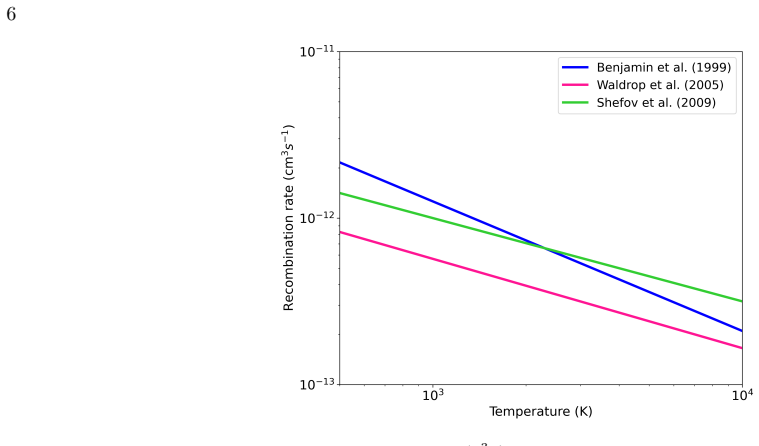
The machinery is a 1D thermosphere-ionosphere and hydrodynamic escape model coupled to a lower/middle atmosphere photochemical model, spanning the full atmosphere from 1000 bar to the exosphere. It solves continuity, momentum, and energy equations with multi-species transport, so diffusive separation emerges rather than being imposed. The observable is the density of metastable helium, the long-lived excited $2^3S$ state that produces the 10830 Å absorption, whose production is dominated by recombination of He$^+$ and whose loss at high altitude is dominated by photoionization; the model feeds new high-resolution photoionization cross-sections for this state, computed with the B-spline K-matrix method, into the chemistry. Hydrogen $n=2$ populations are set by a separate non-LTE calculation driven by Lyman-$\alpha$ resonant scattering, which is why H$\alpha$ responds differently to stellar activity and diffusion than He I.
What would settle it
Measure the He I 10830 Å transit depth of HD209458b in several epochs across the host star's activity cycle while monitoring a stellar activity indicator; the model predicts substantial variation (roughly a factor of two to three between solar minimum and maximum), and a stable depth would undercut the stellar-activity story. Also, an independent constraint putting $K_{zz}$ at or above $10^7$ m$^2$/s would largely erase the diffusive separation and force a different explanation.
Extended reading notes
Core claim
The central claim is that the observed He I 10830 Å transit depth of HD209458b, together with the upper limit on Hα, is reproduced by a multi-species hydrodynamic escape model that includes molecular and eddy diffusion and self-consistently computed non-LTE populations of excited hydrogen and helium. Starting from a solar-composition atmosphere, the model develops strong diffusive separation: the elemental He/H ratio falls from $8\%$ near the thermosphere base to about $2.5\%$ at high altitudes in the best-fit case. Matching the observations requires a photoelectron heating efficiency of $20\text{--}40\%$, lower than the $100\%$ often assumed, and yields mass-loss rates of $1.9\text{--}3\times10^{10}$ g/s depending on whether metals are included in the upper atmosphere. The paper also updates the metastable helium rate coefficients, most notably a high-resolution photoionization cross-section that includes EUV resonances and a temperature-dependent Penning ionization rate, which together lower the predicted He I transit depth by about a factor of $2.5$ relative to earlier rate sets.
Load-bearing premise
The claim depends on the model's diffusion treatment producing strong helium separation even though the standard crossover-mass criterion says helium should stay mixed with hydrogen at the inferred mass-loss rate, and on adopting an eddy diffusion coefficient of $K_{zz}=10^5$ m$^2$/s, at the low end of the literature range.
Editorial extensions
If this is right
- He I 10830 Å transit depths can no longer be read as direct proxies for mass-loss rate; the same depth can arise from different combinations of heating efficiency, eddy diffusion, and stellar activity, so population-level scatter does not require diverse atmospheric helium abundances.
- Simultaneous observations of He I, H$\alpha$, and stellar activity indicators can separate the effects of stellar XUV variability from planetary mixing and reveal the degree of diffusive separation.
- Mass-loss rates inferred for HD209458b from isothermal Parker-wind fits are degenerate; the self-consistent model favors lower rates, $1.9\text{--}3\times10^{10}$ g/s, at the low end of the previously published $1\text{--}10\times10^{10}$ g/s range.
- If the host star is as variable as the Sun, the He I transit depth of HD209458b should change over time, while H$\alpha$ should stay comparatively stable, offering a testable prediction.
Reading between the lines
- Editorial inference: the crossover-mass discrepancy suggests the standard limiting-escape criterion is not valid for strongly ionized, non-isothermal outflows with eddy diffusion, so other planets modeled with the same machinery may also show more separation than simple criteria predict.
- Editorial inference: because the new He($2^3S$) photoionization cross-section has strong resonances overlapping stellar coronal emission lines, the depth of the 10830 Å line may depend on the detailed shape of the stellar EUV spectrum, not just its integrated flux, which could explain some outliers in population studies.
- Editorial inference: the metal run's enhanced electron density boosting recombination implies that He I 10830 Å absorption could serve as an indirect probe of electron abundance in the thermosphere, connecting helium observations to ionization balance and heating.
Editorial analysis
A structured set of objections, weighed in public.
Referee Report
Summary. The paper presents a 1D multi-species hydrodynamic escape model for the upper atmosphere of the hot Jupiter HD209458b, coupled to a lower/middle-atmosphere photochemical model. It updates several He I(2^3S) excitation and de-excitation rates, including a new high-resolution photoionization cross-section, a temperature-dependent Penning ionization rate, proton de-excitation, and photoelectron excitation. The model is used to compute He I 10830 Å and H-alpha transit depths, and a 'best-fit' model is obtained by adjusting the photoelectron heating efficiency and eddy diffusion coefficient. The central claims are that the model reproduces the observed He I transit depth and the H-alpha upper limit, that this requires a photoelectron heating efficiency of 20–40% with mass-loss rates of 1.9–3e10 g/s, and that strong diffusive separation of helium (He/H dropping from 8% to about 2.5% at high altitudes) explains the weak signals without invoking a helium-poor bulk composition. The paper also explores sensitivity to stellar activity, eddy diffusion, tidal forcing, and the inclusion of metals.
Significance. If the central claims hold, the paper provides a physically motivated explanation for the weak He I 10830 Å and H-alpha absorption of HD209458b, connecting it to reduced photoelectron heating and diffusive separation, and it offers new atomic data (high-resolution He I(2^3S) photoionization cross-sections) that are made publicly available in machine-readable form. The systematic comparison among an isothermal Parker model, a self-consistent upper-atmosphere model, and a full-atmosphere model is a useful demonstration of how lower-boundary assumptions and energy balance affect inferred mass-loss rates. The main results are, however, load-bearing on two points that are not yet established: the internal consistency of the diffusive-separation prediction with the paper's own crossover-mass analysis, and the strength of the H-alpha constraints relative to the most restrictive published upper limits. These issues require substantial additional analysis before the headline conclusions can be accepted.
major comments (3)
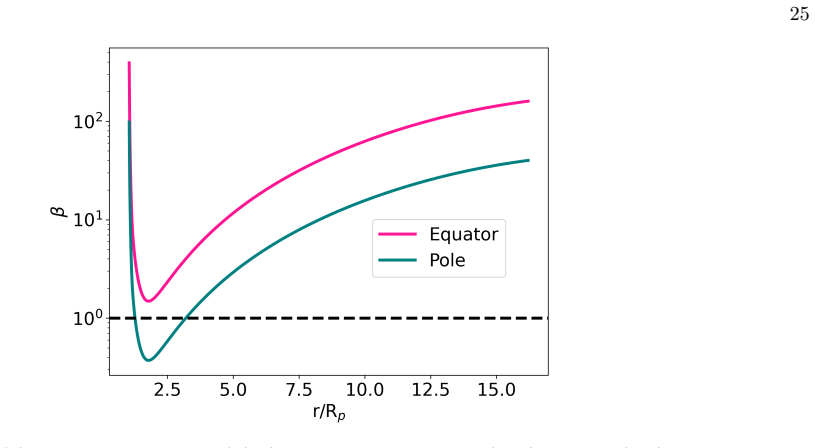
- [Section 4, Eq. (8)] The paper itself reports that the crossover-mass limit is Mdot_lim = 6.4e9 g/s at the pressure-averaged temperature of 5336 K, about one third of the best-fit mass-loss rate of 1.9e10 g/s; standard diffusion theory therefore predicts that helium should remain mixed with hydrogen. The rebuttal in the text is that the crossover equation assumes no eddy diffusion, constant temperature, and constant mixing ratio, but each of these corrections acts to increase mixing: eddy diffusion is an explicit mixing process, a temperature gradient does not suppress momentum transfer from H to He, and a strongly ionized upper atmosphere should further couple the species. The manuscript needs a quantitative reconciliation—for example, an altitude-resolved effective crossover mass or a direct comparison of diffusion and advection timescales in the region where separation occurs—before the central claim of strong diffusive separation can be considered supported.
- [Table 3 and Section 3.4] The photoelectron heating efficiency, the eddy diffusion coefficient Kzz, and the stellar activity level are treated as free parameters, and the best-fit model is selected by matching the same observed He I transit depth and H-alpha upper limit that are later used to validate the model. Because the heating efficiency and Kzz are degenerate (as the paper acknowledges in Section 3.5.2), the reported agreement does not by itself constrain the mass-loss rate or the degree of diffusive separation. Please provide an explicit parameter-space exploration or demonstrate that the conclusions are robust across the allowed range of Kzz and heating efficiency, ideally using an independent observable such as Ly-alpha or a simultaneous multi-line fit.
- [Section 3.4 and Figure 12] The claim that the model reproduces the observed H-alpha upper limit is based on the broad Jensen et al. (2012) limit, but the model's line-core absorption exceeds more restrictive published measurements: Astudillo-Defru and Rojo (2013) report -0.123% ± 0.012% in a 1.125 Å bandpass while the model predicts -0.4%, and Casasayas-Barris et al. (2021) imply an upper limit of about -0.3% in a 0.5 Å bandpass versus the model's -0.73%. The paper acknowledges these discrepancies but does not quantify whether the tidal or stellar-activity variations discussed in Section 3.5 are sufficient to resolve them; without such a demonstration, the H-alpha consistency claim in the abstract and conclusion is overstated.
minor comments (6)
- [Section 2.3] The star is referred to as 'HD2098458' in the paragraph on the stellar flux; this appears to be a typographical error for HD209458.
- [Section 4, Eq. (10)] The stellar wind density is quoted as 4000 g/cm^3, which is unphysical and must be a typographical error (presumably 4000 amu cm^-3 or a similar value); as written, the Chapman-Ferraro and hydropause estimates are not reproducible.
- [References] The reference Lavvas & Arfaux (2021) appears twice in the reference list; please remove the duplicate.
- [Section 2.4] The description of the secondary-electron scheme ('⌊E_p/Ecs⌋-1') would benefit from an explicit definition of the energy binning and the treatment of sub-threshold primaries; as written, the number of secondaries is ambiguous.
- [Table 2] In the He(2^3S) + e^- rate entries, the notation 'Υ31a 3' separates the oscillator-strength label from the factor of three in a way that is easy to misread; please restructure the rate column so that the oscillator strengths and numerical factors are unambiguous.
- [Section 3.5.2] The sentence stating that increasing the eddy diffusion coefficient 'reduces the mass loss rate by a factor of 1.1' is confusing; please report the actual mass-loss rates and the factor explicitly.
Circularity Check
He I match is a fit to the observed depth via the photoelectron heating efficiency, so the headline 'reproduces the observed He I transit depth' reduces by construction; diffusive separation and the Hα limit provide partial independent content.
-
fitted input called prediction
[Abstract; Section 3.4 'Best Fit Model']
"Our model reproduces the observed He I transit depth and Hα upper limit, showing strong diffusive separation. We match the observations assuming a photoelectron efficiency of 20-40%, depending on the composition of the atmosphere, corresponding to mass-loss rates of 1.9-3×10^10 g/s. ... The free parameters of this model include the photoelectron heating efficiency, the eddy diffusion coefficient, and the activity level of the star, none of which are well constrained for this system."
The observed He I 10830 Å depth is the target used to set the free photoelectron heating efficiency (and to select Kzz and activity level). The abstract then reports the resulting match as 'reproduces the observed He I transit depth', and the quoted mass-loss rate range is a consequence of that fitted efficiency rather than an independent model prediction. The Hα upper limit and the altitude-dependent He/H diffusive-separation profile are not fitted to the same observable and provide partial independent support, so the circularity is partial rather than total.
full rationale
The paper is largely a self-consistent forward model with updated atomic rates and full-atmosphere coupling, and much of its content is not circular: the T/P structure, the updated He I photoionization cross-sections and Penning rate, the sensitivity to stellar activity, the metal runs, the magnetosphere estimates, and the comparison with previous Parker-wind fits all stand on their own. The one clear reduction is the headline He I transit-depth 'reproduction': the photoelectron heating efficiency is a free parameter tuned to the observed He I depth (Section 3.4 explicitly lists it among free parameters), and the abstract then quotes the same matched depth as a success. The Hα upper limit is an independent, though weaker, constraint, and the diffusive-separation result is a genuine model output. However, its strength depends on the co-author-supplied low eddy diffusion coefficient Kzz = 1e5 m2/s (Arfaux & Lavvas 2023) and is internally in tension with the paper's own crossover-mass analysis (Section 4, Eq. 8), which predicts mixing at the fitted mass-loss rate. That tension is a physical-consistency concern, not a circular one. The updated atomic rates and cross-sections are ab initio or externally sourced and are not fitted to the target observables. Overall, the central He I agreement reduces by construction to a fitted parameter, while the Hα and diffusion content remain independent, giving partial circularity.
Assumptions & free parameters
free parameters (5)
- photoelectron heating efficiency =
0.40 best-fit H/He; 0.23 metal-rich; paper quotes 20-40%
- eddy diffusion coefficient Kzz =
1e5 m2/s (best fit); 1e6-1e7 tested
- stellar activity level (XUV spectrum) =
solar minimum baseline; solar average and maximum tested
- photochemical haze production rate =
1e-14 g cm-2 s-1
- JWST vs HST continuum shift =
Delta d = 0.000169 (Eureka), 0.000179 (Sparta)
assumptions (8)
- domain assumption The terminator transit geometry is represented by a 1D dayside-averaged illumination (solar zenith angle 60 degrees, incident flux divided by 2).
- domain assumption Multi-species transport is approximated with a diffusion approximation instead of separate momentum equations per species.
- ad hoc to paper Best-fit model uses Kzz=1e5 m2/s with no independent constraint on eddy diffusivity.
- domain assumption The He(2 3S) recombination rate is obtained by assuming all higher triplet states feed 2 3S and ground-state recombination equals total minus triplet case B.
- domain assumption Photoelectron excitation is bounded with a simplified secondary-electron scheme that ignores collisions of primaries with the background gas.
- domain assumption H(n=2) population and H alpha depth rely on a plane-parallel Ly-alpha Monte Carlo model iterated with the escape model.
- domain assumption The stellar XUV spectrum is a scaled solar minimum spectrum, with solar average/maximum for sensitivity tests.
- standard math Reaction rates from measured cross-sections are averaged over a Maxwell-Boltzmann velocity distribution.
Cite this review
Pith. "Pith review of A Multi-Species Atmospheric Escape Model with Excited Hydrogen and Helium: Application to HD209458b." pith.science (2026). https://pith.science/paper/DGJPDSCI
@misc{pith2026250608232,
  author       = {Pith},
  title        = {Pith review of: A Multi-Species Atmospheric Escape Model with Excited Hydrogen and Helium: Application to HD209458b},
  year         = {2026},
  howpublished = {\url{https://pith.science/paper/DGJPDSCI}},
  note         = {Machine review of arXiv:2506.08232}
}
abstract
Atmospheric escape shapes exoplanet evolution and star-planet interactions, with He I 10830 \AA\ absorption serving as a key tracer of mass loss in hot gas giants. However, transit depths vary significantly across observed systems for reasons that remain poorly understood. HD209458b, the archetypal hot-Jupiter, exhibits relatively weak He I 10830 \AA\ and H$\alpha$ absorption, which has been interpreted as evidence for a high H/He ratio (98/2), possibly due to diffusive separation. To investigate this possibility and other processes that control these transit depths, we reassess excitation and de-excitation rates for metastable helium and explore the impact of diffusion processes, stellar activity, and tidal forces on the upper atmosphere and transit depths using a model framework spanning the whole atmosphere. Our model reproduces the observed He I transit depth and H$\alpha$ upper limit, showing strong diffusive separation. We match the observations assuming a photoelectron efficiency of 20-40\%, depending on the composition of the atmosphere, corresponding to mass-loss rates of $1.9-3\times10^{10}$ g/s. We find that the He I 10830 \AA\ transit depth is sensitive to both stellar activity and diffusion processes, while H$\alpha$ is largely unaffected due to its strong dependence on Lyman-$\alpha$ excitation. These differences may help explain the system-to-system scatter seen in population-level studies of the He I line. While He I data alone may not tightly constrain mass-loss rates or temperatures, they do confirm atmospheric escape and help narrow the viable parameter space when interpreted with physically motivated models. Simultaneous observations of He I, H$\alpha$, and stellar activity indicators provide powerful constraints on upper atmosphere dynamics and composition, even in the absence of full transmission spectra.
Figures


Figures from the paper (17 more)




Forward citations
Cited by 1 Pith paper
-
A Self-Consistent 3D Hydrodynamic Model for Helium Transit Signatures in Evaporating Hot Jupiters
A 3D hydrodynamic model with self-consistent hydrogen-helium chemistry shows stellar winds compress escaping hot-Jupiter atmospheres and suppress the 1083 nm helium triplet signal, while a young star's strong XUV flux...
Reference graph
Works this paper leans on
-
[1]
Allan, A. P., & Vidotto, A. A. 2025, arXiv e-prints, arXiv:2504.02578, doi: 10.48550/arXiv.2504.02578
-
[2]
Alonso-Floriano, F. J., Snellen, I. A. G., Czesla, S., et al. 2019, A&A, 629, A110, doi: 10.1051/0004-6361/201935979
-
[3]
2022, Monthly Notices of the Royal Astronomical Society, 515, 4753–4779, doi: 10.1093/mnras/stac1772
Arfaux, A., & Lavvas, P. 2022, Monthly Notices of the Royal Astronomical Society, 515, 4753–4779, doi: 10.1093/mnras/stac1772
-
[4]
2023, MNRAS, 522, 2525, doi: 10.1093/mnras/stad1135
Arfaux, A., & Lavvas, P. 2023, MNRAS, 522, 2525, doi: 10.1093/mnras/stad1135
-
[5]
Argenti, L., & Lindroth, E. 2023, Phys. Rev. Res., 5, 033047, doi: 10.1103/PhysRevResearch.5.033047
-
[6]
2006, Journal of Physics B:
Argenti, L., & Moccia, R. 2006, Journal of Physics B:
2006
-
[7]
Atomic, Molecular and Optical Physics, 39, 2773, doi: 10.1088/0953-4075/39/12/012 —. 2008, Journal of Physics B: Atomic, Molecular and Optical Physics, 41, 035002, doi: 10.1088/0953-4075/41/3/035002 Astropy Collaboration, Price-Whelan, A. M., Sip˝ ocz, B. M., et al. 2018, AJ, 156, 123, doi: 10.3847/1538-3881/aabc4f Astropy Collaboration, Price-Whelan, A. ...
-
[8]
2013, A&A, 557, A56, doi: 10.1051/0004-6361/201219018 Augustoviˇ cov´ a, L., Kraemer, W
Astudillo-Defru, N., & Rojo, P. 2013, A&A, 557, A56, doi: 10.1051/0004-6361/201219018 Augustoviˇ cov´ a, L., Kraemer, W. P., & Sold´ an, P. 2014, Journal of Quantitative Spectroscopy and Radiative Transfer, 148, 27, doi: https://doi.org/10.1016/j.jqsrt.2014.06.012
Show all 94 references
-
[9]
E., & Mart ´ ın, F
Bachau, H., Cormier, E., Decleva, P., Hansen, J. E., & Mart ´ ın, F. 2001, Reports on Progress in Physics, 64, 1815, doi: 10.1088/0034-4885/64/12/205
2001 doi
-
[10]
Ballabio, G., & Owen, J. E. 2025, MNRAS, 537, 1305, doi: 10.1093/mnras/staf073
2025 doi
-
[11]
E., & Ben-Jaffel, L
Ballester, G. E., & Ben-Jaffel, L. 2015, ApJ, 804, 116, doi: 10.1088/0004-637X/804/2/116
2015 doi
-
[12]
2010, ApJ, 709, 1284, doi: 10.1088/0004-637X/709/2/1284
Ben-Jaffel, L., & Sona Hosseini, S. 2010, ApJ, 709, 1284, doi: 10.1088/0004-637X/709/2/1284
2010 doi
-
[13]
A., Skillman, E
Benjamin, R. A., Skillman, E. D., & Smits, D. P. 1999, ApJ, 514, 307, doi: 10.1086/306923
1999 doi
-
[14]
2024, A&A, 682, A115, doi: 10.1051/0004-6361/202347517
Biassoni, F., Caldiroli, A., Gallo, E., et al. 2024, A&A, 682, A115, doi: 10.1051/0004-6361/202347517
2024 doi
-
[15]
H., & Joachain, C
Bransden, B. H., & Joachain, C. J. 2003, Physics of Atoms and Molecules, 2nd edn. (Addison-Wesley)
2003
-
[16]
V., & Tully, J
Bray, I., Burgess, A., Fursa, D. V., & Tully, J. A. 2000, A&AS, 146, 481, doi: 10.1051/aas:2000277
2000 doi
-
[17]
Brown, T. M. 2001, ApJ, 553, 1006, doi: 10.1086/320950
2001 doi
-
[18]
2020, A&A, 640, C6, doi: 10.1051/0004-6361/201935623e
Casasayas-Barris, N., Pall´ e, E., Yan, F., et al. 2020, A&A, 640, C6, doi: 10.1051/0004-6361/201935623e
2020 doi
-
[19]
2021, A&A, 647, A26, doi: 10.1051/0004-6361/202039539
Casasayas-Barris, N., Palle, E., Stangret, M., et al. 2021, A&A, 647, A26, doi: 10.1051/0004-6361/202039539
2021 doi
-
[20]
M., Koskinen, T
Chadney, J. M., Koskinen, T. T., Galand, M., Unruh, Y. C., & Sanz-Forcada, J. 2017, A&A, 608, A75, doi: 10.1051/0004-6361/201731129
2017 doi
-
[21]
Chamberlain, J. W. 1960, ApJ, 131, 47, doi: 10.1086/146805
1960 doi
-
[22]
S., & Lane, N
Cohen, J. S., & Lane, N. F. 1971, Chemical Physics Letters, 10, 623, doi: 10.1016/0009-2614(71)87051-3
1971 doi
-
[23]
Connerney, J. E. P., Adriani, A., Allegrini, F., et al. 2017, Science, 356, 826, doi: 10.1126/science.aam5928
2017 doi
-
[24]
E., Fossati, L., Koskinen, T., et al
Cubillos, P. E., Fossati, L., Koskinen, T., et al. 2020, AJ, 159, 111, doi: 10.3847/1538-3881/ab6a0b
2020 doi
-
[25]
Schmitt, J. H. M. M. 2017, Astronomy and Astrophysics, 607, A101, doi: 10.1051/0004-6361/201731408 de Heer, F. J., & Jansen, R. H. J. 1977, Journal of Physics B Atomic Molecular Physics, 10, 3741, doi: 10.1088/0022-3700/10/18/030 30 Dos Santos, L. A., Vidotto, A. A., Vissaprag...
2017 doi
-
[26]
Drake, G. W. F. 1971, Phys. Rev. A, 3, 908, doi: 10.1103/PhysRevA.3.908
1971 doi
-
[27]
J., Petigura, E
Fulton, B. J., Petigura, E. A., Howard, A. W., et al. 2017, AJ, 154, 109, doi: 10.3847/1538-3881/aa80eb Garc ´ ıa Mu˜ noz, A., & Schneider, P. C. 2019, ApJL, 884, L43, doi: 10.3847/2041-8213/ab498d Garc ´ ıa Mu˜ noz, A. 2007, Planetary and Space Science, 55, 1426, doi: 10.1016...
2017 doi
-
[28]
Glover, S. C. O., & Jappsen, A.-K. 2007, The Astrophysical Journal, 666, 1, doi: 10.1086/519445
2007 doi
-
[29]
Gombosi, T. I. 1994, Gaskinetic Theory, Cambridge Atmospheric and Space Science Series (Cambridge University Press)
1994
-
[30]
2017, ApJ, 851, 150, doi: 10.3847/1538-4357/aa9b32
Huang, C., Arras, P., Christie, D., & Li, Z.-Y. 2017, ApJ, 851, 150, doi: 10.3847/1538-4357/aa9b32
2017 doi
-
[31]
2023, The Astrophysical Journal, 951, 123, doi: 10.3847/1538-4357/accd5e
Huang, C., Koskinen, T., Lavvas, P., & Fossati, L. 2023, The Astrophysical Journal, 951, 123, doi: 10.3847/1538-4357/accd5e
2023 doi
-
[32]
Hummer, D. G. 1962, Monthly Notices of the Royal Astronomical Society, 125, 461, doi: 10.1093/mnras/125.5.461
1962 doi
-
[33]
M., Pepin, R
Hunten, D. M., Pepin, R. O., & Walker, J. C. 1987, Icarus, 69, 532, doi: https://doi.org/10.1016/0019-1035(87)90022-4
1987 doi
-
[34]
Hunter, J. D. 2007, Computing in Science and Engineering, 9, 90, doi: 10.1109/MCSE.2007.55
2007 doi
-
[35]
O., Wende-von Berg, S., Dreizler, S., et al
Husser, T. O., Wende-von Berg, S., Dreizler, S., et al. 2013, A&A, 553, A6, doi: 10.1051/0004-6361/201219058
2013 doi
-
[36]
M., Hinkle, K
Indriolo, N., Hobbs, L. M., Hinkle, K. H., & McCall, B. J. 2009, ApJ, 703, 2131, doi: 10.1088/0004-637X/703/2/2131
2009 doi
-
[37]
Y., Pluriel, W., Bocchieri, A., et al
Jaziri, A. Y., Pluriel, W., Bocchieri, A., et al. 2024, A&A, 684, A25, doi: 10.1051/0004-6361/202347379
2024 doi
-
[38]
G., Redfield, S., Endl, M., et al
Jensen, A. G., Redfield, S., Endl, M., et al. 2012, ApJ, 751, 86, doi: 10.1088/0004-637X/751/2/86
2012 doi
-
[39]
G., Solomon, S
Judge, P. G., Solomon, S. C., & Ayres, T. R. 2003, ApJ, 593, 534, doi: 10.1086/376405
2003 doi
-
[40]
E., & Raftery, A
Kass, R. E., & Raftery, A. E. 1995, Journal of the American Statistical Association, 90, 773, doi: 10.1080/01621459.1995.10476572
1995
-
[41]
L., Shaikhislamov, I
Khodachenko, M. L., Shaikhislamov, I. F., Lammer, H., et al. 2021, MNRAS, 507, 3626, doi: 10.1093/mnras/stab2366
2021 doi
-
[42]
B., & Ferland, G
Kingdon, J. B., & Ferland, G. J. 1996, The Astrophysical Journal Supplement Series, 106, 205
1996
-
[43]
G., Holmstr¨ om, M., Lammer, H., Odert, P., & Khodachenko, M
Kislyakova, K. G., Holmstr¨ om, M., Lammer, H., Odert, P., & Khodachenko, M. L. 2014, Science, 346, 981, doi: 10.1126/science.1257829
2014 doi
-
[44]
T., Aylward, A
Koskinen, T. T., Aylward, A. D., & Miller, S. 2007, Nature, 450, 845, doi: 10.1038/nature06378
2007 doi
-
[45]
T., Harris, M
Koskinen, T. T., Harris, M. J., Yelle, R. V., & Lavvas, P. 2013a, Icarus, 226, 1678, doi: 10.1016/j.icarus.2012.09.027
2012 doi
-
[46]
T., Lavvas, P., Harris, M
Koskinen, T. T., Lavvas, P., Harris, M. J., & Yelle, R. V. 2014, Philosophical Transactions of the Royal Society A:
2014
-
[47]
Mathematical, Physical and Engineering Sciences, 372, 20130089, doi: 10.1098/rsta.2013.0089
2013
-
[48]
T., Lavvas, P., Huang, C., et al
Koskinen, T. T., Lavvas, P., Huang, C., et al. 2022, ApJ, 929, 52, doi: 10.3847/1538-4357/ac4f45
2022 doi
-
[49]
T., Yelle, R
Koskinen, T. T., Yelle, R. V., Harris, M. J., & Lavvas, P. 2013b, Icarus, 226, 1695, doi: 10.1016/j.icarus.2012.09.026
2012 doi
-
[50]
T., Yelle, R
Koskinen, T. T., Yelle, R. V., Lavvas, P., & Lewis, N. K. 2010, ApJ, 723, 116, doi: 10.1088/0004-637X/723/1/116
2010 doi
-
[51]
Krishnamurthy, V., & Cowan, N. B. 2024, The Astronomical Journal, 168, 30, doi: 10.3847/1538-3881/ad5441 Lamp´ on, M., L´ opez-Puertas, M., Lara, L. M., et al. 2020, A&A, 636, A13, doi: 10.1051/0004-6361/201937175
2024 doi
-
[53]
2021, MNRAS, 502, 5643, doi: 10.1093/mnras/stab456
Lavvas, P., & Arfaux, A. 2021, MNRAS, 502, 5643, doi: 10.1093/mnras/stab456
2021 doi
-
[54]
2005, Advances in Space Research, 35, 384, doi: https://doi.org/10.1016/j.asr.2004.11.004
Lemaire, P., Emerich, C., Vial, J.-C., et al. 2005, Advances in Space Research, 35, 384, doi: https://doi.org/10.1016/j.asr.2004.11.004
2005 doi
-
[55]
L., Yang, H., France, K., et al
Linsky, J. L., Yang, H., France, K., et al. 2010, ApJ, 717, 1291, doi: 10.1088/0004-637X/717/2/1291
2010 doi
- [56]
-
[57]
R., & Mason, E
Marrero, T. R., & Mason, E. A. 1972, Journal of Physical and Chemical Reference Data, 1, 3, doi: 10.1063/1.3253094
1972 doi
-
[58]
2024, Probing atmospheric escape through metastable He I triplet lines in 15 exoplanets observed with SPIRou
Masson, A., Vinatier, S., B´ ezard, B., et al. 2024, Probing atmospheric escape through metastable He I triplet lines in 15 exoplanets observed with SPIRou. https://arxiv.org/abs/2406.09225
2024
-
[59]
2016, A&A, 589, A75, doi: 10.1051/0004-6361/201528065
Mazeh, T., Holczer, T., & Faigler, S. 2016, A&A, 589, A75, doi: 10.1051/0004-6361/201528065
2016 doi
-
[60]
1979, Journal of Physics B Atomic Molecular Physics, 12, 1805, doi: 10.1088/0022-3700/12/11/008
Morgner, H., & Niehaus, A. 1979, Journal of Physics B Atomic Molecular Physics, 12, 1805, doi: 10.1088/0022-3700/12/11/008
1979 doi
-
[61]
I., Visscher, C., Fortney, J
Moses, J. I., Visscher, C., Fortney, J. J., et al. 2011, ApJ, 737, 15, doi: 10.1088/0004-637X/737/1/15
2011 doi
-
[62]
A., Chiang, E
Murray-Clay, R. A., Chiang, E. I., & Murray, N. 2009, ApJ, 693, 23, doi: 10.1088/0004-637X/693/1/23 31
2009 doi
-
[63]
Norcross, D. W. 1971, Journal of Physics B Atomic Molecular Physics, 4, 652, doi: 10.1088/0022-3700/4/5/006 Oklopˇ ci´ c, A. 2019, ApJ, 881, 133, doi: 10.3847/1538-4357/ab2f7f Oklopˇ ci´ c, A., & Hirata, C. M. 2018, ApJL, 855, L11, doi: 10.3847/2041-8213/aaada9
1971 doi
-
[64]
E., Shaikhislamov, I
Owen, J. E., Shaikhislamov, I. F., Lammer, H., Fossati, L., & Khodachenko, M. L. 2020, SSRv, 216, 129, doi: 10.1007/s11214-020-00756-w
2020 doi
- [65]
-
[66]
P., & Lian, Y
Parmentier, V., Showman, A. P., & Lian, Y. 2013, A&A, 558, A91, doi: 10.1051/0004-6361/201321132
2013 doi
-
[67]
1982, ApJ, 255, 489, doi: 10.1086/159849
Roberge, W., & Dalgarno, A. 1982, ApJ, 255, 489, doi: 10.1086/159849
1982 doi
-
[68]
2006, Atmospheric Chemistry and Physics, 5, doi: 10.5194/acpd-5-8689-2005
Sandu, A., & Sander, R. 2006, Atmospheric Chemistry and Physics, 5, doi: 10.5194/acpd-5-8689-2005
2006 doi
-
[69]
2025, A&A, 693, A285, doi: 10.1051/0004-6361/202451680
Sanz-Forcada, J., L´ opez-Puertas, M., Lamp´ on, M., et al. 2025, A&A, 693, A285, doi: 10.1051/0004-6361/202451680
2025 doi
- [70]
-
[71]
Seager, S., & Sasselov, D. D. 2000, ApJ, 537, 916, doi: 10.1086/309088
2000 doi
-
[72]
N., Semenov, A
Shefov, N. N., Semenov, A. I., & Yurchenko, O. T. 2009, Geomagnetism and Aeronomy, 49, 93, doi: 10.1134/S0016793209010137
2009 doi
-
[73]
K., Fortney, J
Sing, D. K., Fortney, J. J., Nikolov, N., et al. 2016, Nature, 529, 59, doi: 10.1038/nature16068
2016 doi
-
[74]
L., & Smith, C
Smith, III, F. L., & Smith, C. 1972, J. Geophys. Res., 77, 3592, doi: 10.1029/JA077i019p03592
1972 doi
-
[75]
2010, MNRAS, 408, 1689, doi: 10.1111/j.1365-2966.2010.17231.x
Southworth, J. 2010, MNRAS, 408, 1689, doi: 10.1111/j.1365-2966.2010.17231.x
2010
-
[76]
J., Sing, D
Spake, J. J., Sing, D. K., Evans, T. M., et al. 2018, Nature, 557, 68, doi: 10.1038/s41586-018-0067-5
2018 doi
-
[77]
C., Lepp, S., & Dalgarno, A
Stancil, P. C., Lepp, S., & Dalgarno, A. 1998, ApJ, 509, 1, doi: 10.1086/306473
1998 doi
-
[78]
J., & Hummer, D
Storey, P. J., & Hummer, D. G. 1995, MNRAS, 272, 41, doi: 10.1093/mnras/272.1.41
1995 doi
-
[79]
2024, Assessment of He I Triplet Absorption at 10830 ˚A in Escaping Atmospheres of Hot Gaseous Exoplanets, Poster presented at the Exoplanets V Conference,
Taylor, A., Koskinen, T., Argenti, L., & Lewis, N. 2024, Assessment of He I Triplet Absorption at 10830 ˚A in Escaping Atmospheres of Hot Gaseous Exoplanets, Poster presented at the Exoplanets V Conference,
2024
-
[80]
B., Pavlov, A
Tian, F., Toon, O. B., Pavlov, A. A., & De Sterck, H. 2005, ApJ, 621, 1049, doi: 10.1086/427204
2005 doi
- [81]
-
[82]
A., Ferland, G
Verner, D. A., Ferland, G. J., Korista, K. T., & Yakovlev, D. G. 1996, ApJ, 465, 487, doi: 10.1086/177435
1996 doi
-
[83]
M., et al
Vidal-Madjar, A., Lecavelier des Etangs, A., D´ esert, J. M., et al. 2003, Nature, 422, 143, doi: 10.1038/nature01448
2003 doi
-
[84]
M., Lecavelier des Etangs, A., et al
Vidal-Madjar, A., D´ esert, J. M., Lecavelier des Etangs, A., et al. 2004, ApJL, 604, L69, doi: 10.1086/383347
2004 doi
-
[85]
M., Bourrier, V., et al
Vidal-Madjar, A., Huitson, C. M., Bourrier, V., et al. 2013, A&A, 560, A54, doi: 10.1051/0004-6361/201322234
2013 doi
-
[86]
E., et al
Virtanen, P., Gommers, R., Oliphant, T. E., et al. 2020, Nature Methods, 17, 261, doi: 10.1038/s41592-019-0686-2
2020 doi
-
[87]
Voronov, G. S. 1997, Atomic Data and Nuclear Data Tables, 65, 1, doi: 10.1006/adnd.1997.0732
1997
-
[88]
S., Kerr, R
Waldrop, L. S., Kerr, R. B., Gonz´ aLez, S. A., et al. 2005, Journal of Geophysical Research (Space Physics), 110, A08304, doi: 10.1029/2004JA010855
2005 doi
-
[89]
2021a, ApJ, 914, 98, doi: 10.3847/1538-4357/abf1ee —
Wang, L., & Dai, F. 2021a, ApJ, 914, 98, doi: 10.3847/1538-4357/abf1ee —. 2021b, ApJ, 914, 99, doi: 10.3847/1538-4357/abf1ed Wes McKinney. 2010, in Proceedings of the 9th Python in Science Conference, ed. St´ efan van der Walt & Jarrod Millman, 56 – 61, doi: 10.25080/Majora-92...
2010 doi
-
[90]
N., Suto, Y., Turner, E
Winn, J. N., Suto, Y., Turner, E. L., et al. 2004, Publications of the Astronomical Society of Japan, 56, 655, doi: 10.1093/pasj/56.4.655
2004 doi
-
[91]
2023, ApJ, 953, 166, doi: 10.3847/1538-4357/ace43f
Xing, L., Yan, D., & Guo, J. 2023, ApJ, 953, 166, doi: 10.3847/1538-4357/ace43f
2023 doi
-
[92]
L., Zhang, M., et al
Xue, Q., Bean, J. L., Zhang, M., et al. 2024, ApJL, 963, L5, doi: 10.3847/2041-8213/ad2682
2024 doi
-
[93]
R., & Dalgarno, A
Yan, M., Sadeghpour, H. R., & Dalgarno, A. 1998, ApJ, 496, 1044, doi: 10.1086/305420
1998 doi
-
[94]
Yelle, R. V. 2004, Icarus, 170, 167, doi: 10.1016/j.icarus.2004.02.008
2004 doi
-
[95]
A., Wang, L., Dai, F., & Barrag´ an, O
Zhang, M., Knutson, H. A., Wang, L., Dai, F., & Barrag´ an, O. 2022, The Astronomical Journal, 163, 67, doi: 10.3847/1538-3881/ac3fa7
2022 doi
Reviewed August 7, 2026 · model on record in the stance chip above.
Discussion (0). Sign in to comment.