REVIEW 2 major objections 4 minor 41 references
Highly Compressed Tokenizer Can Generate Without Training
T0 review · 2 major / 4 minor · reviewed 2026-08-07 · deepseek-v4-flash
Pith's one-line read One pretrained 1D tokenizer, with no dedicated generative model, can edit and generate images through test-time optimization of its 32 discrete tokens.
desk verdict The paper's core finding—that a 32-token 1D VQ tokenizer enables generation via test-time optimization—is real, but the headline FID 8.2 is a best-case number; the honest seed-free version is 15.5. read the letter →
The pith
A machine-rendered reading of the paper's core claim, the machinery that carries it, and where it could break.
The reading
What carries the argument
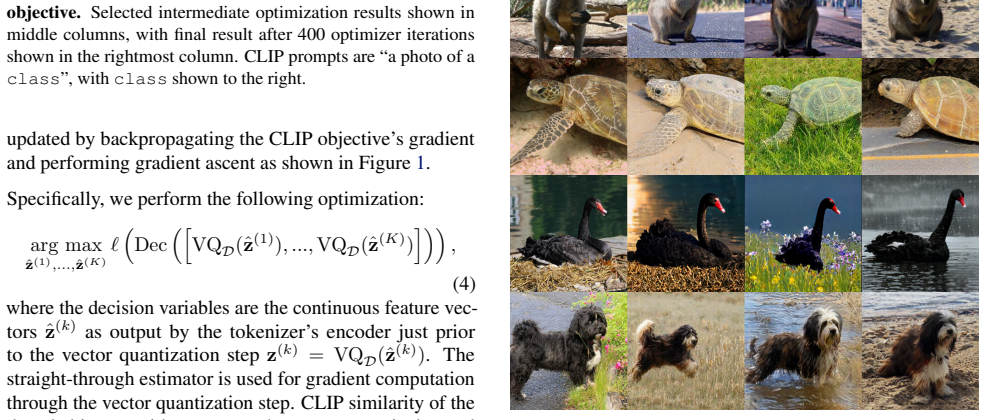
The load-bearing mechanism is test-time token optimization: the continuous feature vectors just before the vector-quantization step are treated as decision variables, and gradients of an image-level objective (CLIP similarity, L1 reconstruction, etc.) are backpropagated through the decoder and through the quantization step via a straight-through estimator. The paper emphasizes that the quantization step must be inside the optimization loop—optimizing the pre-quantization features directly gives poor results—and hypothesizes that VQ acts as a regularizer. A smaller set of tokens and a smaller codebook make the discrete search space easier to navigate and increase each token's global semantic responsibility.
What would settle it
Decode images from randomly sampled sequences of 32 tokens from the TiTok VQ-LL-32 codebook (with no optimization) and check whether the outputs are realistic and diverse; if they are not, the tokenizer alone is not generative and the reported results rely on the test-time optimization path rather than an emergent generative capacity.
Extended reading notes
Core claim
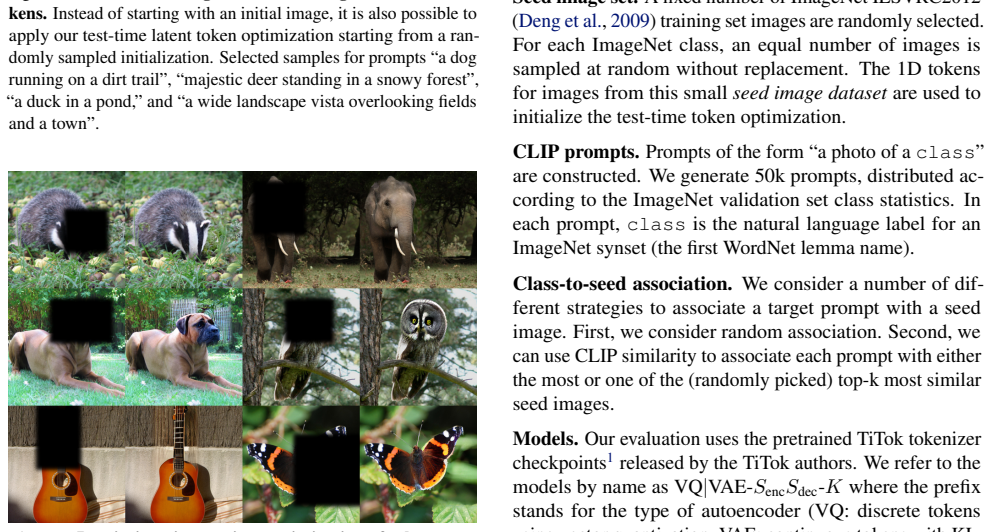
The paper's central discovery is that the latent space of a pretrained 1D tokenizer is semantically structured and generative enough that a decoder alone can be turned into an image generator. Concretely, each token position can encode a global attribute such as scene lighting, background blur, or subject type, so replacing one token with the corresponding token from another image transfers that attribute. Going further, the authors treat the tokenizer as an unconditional generator in a semi-parametric setting: initialize tokens from a seed image (or from noise), then optimize the pre-quantization features with straight-through gradients through the vector-quantization step to maximize a plug-and-play objective. This yields diverse, realistic images without training a generative model, and the paper finds that the more aggressive the compression—32 tokens over 64 or 128, discrete VQ over continuous latents, smaller codebooks—the better the generation quality.
Load-bearing premise
The method depends on straight-through gradient estimates through the vector-quantization step being a reliable optimization signal; the paper states this is essential (Section 4.1) but offers only a hypothesis that VQ provides regularization, not a mechanism.
Editorial extensions
If this is right
- Generative modeling can be decoupled from training: any highly compressed VQ tokenizer can be converted into a generator by adding test-time optimization, without learning a distribution over tokens.
- Tokenizer design should treat compression as a generative lever: reducing token count and codebook size improves training-free generation quality.
- The same optimization loop handles editing, inpainting, and generation, so a single pretrained tokenizer replaces role-specific generative models for these tasks.
- Class-conditioned generation from ImageNet with 1000 seed images and CLIP-based seed association reaches FID 8.2, competitive with trained unconditional and semi-parametric generators in the paper's comparison.
Reading between the lines
- If compression is what confers generative power, then pushing to even more extreme compression (e.g., 8 or 16 tokens) might further improve training-free generation, up to the point where the decoder must learn enough structure to be called a generator itself.
- The straight-through gradient assumption could be tested directly by swapping in alternative discrete-optimization rules (such as Gumbel-Softmax or a randomized search over the codebook) and measuring whether generation quality survives; if it does, the claim's stated mechanism would need revision.
- The finding suggests a new evaluation axis for tokenizer research: not just reconstruction fidelity but 'generative readiness' of the latent space, which could be measured by training-free FID.
- The same recipe may transfer to other domains—video, audio, or 3D data—wherever a highly compressed 1D discrete tokenizer exists.
Editorial analysis
A structured set of objections, weighed in public.
Referee Report
Summary. The paper demonstrates that a pretrained 1D image tokenizer with vector quantization (TiTok, 32 discrete tokens) can be used for image editing, inpainting, and class-conditional image generation without training any dedicated generative model. The main methods are heuristic copy-paste token manipulation for attribute editing and gradient-based test-time optimization of tokens using plug-and-play objectives such as CLIP similarity or reconstruction loss. On ImageNet class-conditional generation with 1000 seed images and CLIP-based seed association, the method achieves an FID-50k of 8.2 over 50k samples. Extensive ablations show that higher compression (fewer tokens, smaller codebook, discrete VQ, 1D structure) improves generation quality, and the paper honestly reports the adversarial vulnerability of CLIP guidance while adding SigLIP scores as a sanity check.
Significance. If the results hold, this paper offers a striking reframing of highly compressed 1D tokenizers as implicit generative models, with implications for understanding why heavy compression improves downstream generation. The paper is strong on empirical breadth: it ships code, ablates seed count, seed association, tokenizer type, VQ versus continuous latents, 1D versus 2D structure, optimization iterations, and noise/regularization tweaks, and it includes an adversarial sanity check for CLIP guidance. The central claim is an empirical existence proof rather than a derivation, so circularity concerns are minimal. The main limitations are the semi-parametric setting (the method needs a pool of seed images and CLIP-based association to reach the headline FID) and the post-hoc selection of optimization iterations in some comparisons; both are disclosed in the paper but deserve clearer treatment in the system-level comparison.
major comments (2)
- [Table 6 / Section 5.6] The reported FID-50k of 8.2 for 'Test-time optimization (VQ-LL-32)' is not tied to a single, fully described protocol. It appears to correspond to the fully tweaked pipeline from Table 4 (random crops, EMA, token noise, and token regularization) combined with CLIP top-1% seed association over a pool of 1000 seed images, yet Table 6 labels the data access only as '1000 random images' and the main text does not specify the iteration count or the tweaked configuration. Since this number is the strongest quantitative evidence that the tokenizer alone can approach trained generative models, the authors should state the exact configuration and include the random-association result (Table 1, FID-5k 20.7 for 2000 seeds) and the no-seed result (Table 5, FID-5k 15.5) in the same comparison so that the reader can see how much of the margin is due to CLIP-based seed selection and optimization tweaks.
- [Table 2 / Section C.2 / Figure A5] The tokenizer comparison uses the number of optimization iterations that yields the best FID-5k for each tokenizer. Because the FID-IS trade-off curves in Figure A5 cross as a function of iterations, the conclusion that more aggressive compression improves generation may be confounded by per-tokenizer optimization budgets rather than reflecting the tokenizer alone. Please report a fixed-iteration comparison (for example, 300 iterations for all models) and clarify whether the monotonic trend in Table 2 persists under a common budget.
minor comments (4)
- [Section 4.1, Eq. (4)] The notation VQD(·) is used in Eq. (4) before it is defined; please define it in the main text or reference Algorithm A1 at first use.
- [Section 5.4, Table 4] The rows '+token noise' and '+token reg' are not explicitly labeled as cumulative or independent additions on top of the (∗) configuration; please state the relationship so that the FID-50k value of 8.2 is reproducible.
- [Section 5.2] The sentence 'achieving an FID of 8.6 for 50k samples' refers to the EMA configuration in Table 4, but Table 1 reports only FID-5k; consider reporting FID-50k for the seed-size ablations as well to avoid inconsistency.
- [Section 3.1, Eq. (1)] The definition of the importance metric g(k)_P_i is difficult to parse; the notation involving 'cov' with a subscript 2 should be made explicit, for example by writing out the covariance matrix and the norm used.
Circularity Check
No significant circularity: the central claim is an empirical demonstration using an external pretrained tokenizer and independent evaluation metrics.
full rationale
The paper's central claim is empirical rather than derivational: a pretrained, externally released TiTok tokenizer, combined with test-time gradient optimization of its discrete tokens, can perform inpainting, text-guided editing, and semi-parametric generation. No quantity defined in the paper is constructed from the target result. The tokenizer weights (Yu et al., 2024b), CLIP, SigLIP, and ImageNet FID/IS statistics are all external inputs not fitted by this work, and the headline FID numbers are not obtained by optimizing a parameter against the reported metric. CLIP is used both as the optimization objective and as one evaluation score, but the paper includes SigLIP as an independent alignment check and an adversarial pixel-optimization control (Table 1) specifically to show that simply maximizing the CLIP score is not sufficient to produce the observed alignment. Choosing the number of optimization iterations by best FID-5k (Table 2, Section C.2) is a reporting decision, not a fitted parameter disguised as a prediction; it does not make the reported result equivalent to an input by construction. The semi-parametric setting with 1000 seed images is disclosed, and the paper also evaluates random-token initialization without seed images (Table 5), which weakens but does not erase the empirical claim. No load-bearing step reduces to a self-citation chain; cited prior work is either external (TiTok, CLIP, SigLIP) or used only as comparative baselines. Overall, the paper is a self-contained empirical study, and no circular step meeting the quoted-equation threshold was found.
Assumptions & free parameters
free parameters (6)
- optimization iterations N_iter =
varied 50-500; best FID selected per tokenizer (e.g., 300 for VQ-LL-32)
- initial noise scale sigma_init =
0.3
- L2 regularization weight lambda =
0.02
- EMA decay factor =
0.98
- noise schedule =
sigma_1^2=0.3 to sigma_200^2=0, cosine
- random crop count for CLIP loss =
8 crops covering 75% area
assumptions (4)
- domain assumption Pretrained TiTok VQ-LL-32 tokenizer (externally trained) provides a high-quality decoder that maps 32 discrete tokens to coherent images.
- domain assumption CLIP embeddings provide a semantically meaningful objective whose gradients steer image content toward the prompt.
- domain assumption Straight-through gradient estimates through vector quantization are a usable optimization signal in this discrete latent space.
- domain assumption Randomness from nondeterministic CUDA kernels plus seed variety provides sufficient output diversity.
Cite this review
Pith. "Pith review of Highly Compressed Tokenizer Can Generate Without Training." pith.science (2026). https://pith.science/paper/2V6OW2Z6
@misc{pith2026250608257,
  author       = {Pith},
  title        = {Pith review of: Highly Compressed Tokenizer Can Generate Without Training},
  year         = {2026},
  howpublished = {\url{https://pith.science/paper/2V6OW2Z6}},
  note         = {Machine review of arXiv:2506.08257}
}
read the original abstract
Commonly used image tokenizers produce a 2D grid of spatially arranged tokens. In contrast, so-called 1D image tokenizers represent images as highly compressed one-dimensional sequences of as few as 32 discrete tokens. We find that the high degree of compression achieved by a 1D tokenizer with vector quantization enables image editing and generative capabilities through heuristic manipulation of tokens, demonstrating that even very crude manipulations -- such as copying and replacing tokens between latent representations of images -- enable fine-grained image editing by transferring appearance and semantic attributes. Motivated by the expressivity of the 1D tokenizer's latent space, we construct an image generation pipeline leveraging gradient-based test-time optimization of tokens with plug-and-play loss functions such as reconstruction or CLIP similarity. Our approach is demonstrated for inpainting and text-guided image editing use cases, and can generate diverse and realistic samples without requiring training of any generative model.
Figures


Figures from the paper (4 more)


Reference graph
Works this paper leans on
-
[1]
write newline
" write newline "" before.all 'output.state := FUNCTION n.dashify 't := "" t empty not t #1 #1 substring "-" = t #1 #2 substring "--" = not "--" * t #2 global.max substring 't := t #1 #1 substring "-" = "-" * t #2 global.max substring 't := while if t #1 #1 substring * t #2 global.max substring 't := if while FUNCTION format.date year duplicate empty "emp...
-
[2]
Bao, F., Li, C., Sun, J., and Zhu, J. Why are conditional generative models better than unconditional ones? In NeurIPS 2022 Workshop on Score-Based Methods, 2022
work page 2022
-
[3]
Retrieval-augmented diffusion models
Blattmann, A., Rombach, R., Oktay, K., M \"u ller, J., and Ommer, B. Retrieval-augmented diffusion models. Advances in Neural Information Processing Systems, 35: 0 15309--15324, 2022
work page 2022
-
[4]
High fidelity visualization of what your self-supervised representation knows about
Bordes, F., Balestriero, R., and Vincent, P. High fidelity visualization of what your self-supervised representation knows about. Transactions on Machine Learning Research, 2022
work page 2022
-
[5]
Efficient-VQGAN : Towards high-resolution image generation with efficient vision transformers
Cao, S., Yin, Y., Huang, L., Liu, Y., Zhao, X., Zhao, D., and Huang, K. Efficient-VQGAN : Towards high-resolution image generation with efficient vision transformers. In Proceedings of the IEEE/CVF International Conference on Computer Vision, pp.\ 7368--7377, 2023
work page 2023
-
[6]
Casanova, A., Careil, M., Verbeek, J., Drozdzal, M., and Romero Soriano, A. Instance-conditioned GAN . Advances in Neural Information Processing Systems, 34: 0 27517--27529, 2021
work page 2021
-
[7]
Chang, H., Zhang, H., Jiang, L., Liu, C., and Freeman, W. T. MaskGIT : Masked generative image transformer. In The IEEE Conference on Computer Vision and Pattern Recognition, June 2022
work page 2022
-
[8]
VQGAN-CLIP : Open domain image generation and editing with natural language guidance
Crowson, K., Biderman, S., Kornis, D., Stander, D., Hallahan, E., Castricato, L., and Raff, E. VQGAN-CLIP : Open domain image generation and editing with natural language guidance. arXiv preprint arXiv:2204.08583, 2022
arXiv 2022
Show all 41 references
-
[9]
ImageNet : A large-scale hierarchical image database
Deng, J., Dong, W., Socher, R., Li, L.-J., Li, K., and Fei-Fei, L. ImageNet : A large-scale hierarchical image database. In IEEE Conference on Computer Vision and Pattern Recognition, pp.\ 248--255. Ieee, 2009
2009
-
[10]
and Nichol, A
Dhariwal, P. and Nichol, A. Diffusion models beat GANs on image synthesis. Advances in Neural Information Processing Systems, 34: 0 8780--8794, 2021
2021
-
[11]
Taming transformers for high-resolution image synthesis
Esser, P., Rombach, R., and Ommer, B. Taming transformers for high-resolution image synthesis. In Proceedings of the IEEE/CVF Conference on Computer Vision and Pattern Recognition, pp.\ 12873--12883, June 2021
2021
-
[12]
H., Chechik, G., and Cohen-Or, D
Gal, R., Alaluf, Y., Atzmon, Y., Patashnik, O., Bermano, A. H., Chechik, G., and Cohen-Or, D. An image is worth one word: Personalizing text-to-image generation using textual inversion. In Proceedings of the Eleventh International Conference on Learning Representations, 1--5 May 2023
2023
-
[13]
Generating images from caption and vice versa via CLIP -guided generative latent space search
Galatolo., F., Cimino., M., and Vaglini, G. Generating images from caption and vice versa via CLIP -guided generative latent space search. Proceedings of the International Conference on Image Processing and Vision Engineering, 2021
2021
-
[14]
GANs trained by a two time-scale update rule converge to a local nash equilibrium
Heusel, M., Ramsauer, H., Unterthiner, T., Nessler, B., and Hochreiter, S. GANs trained by a two time-scale update rule converge to a local nash equilibrium. Advances in Neural Information Processing Systems, 30, 2017
2017
-
[15]
Kingma, D. P. and Welling, M. Auto-encoding variational Bayes . In International Conference on Learning Representations , 2014
2014
-
[16]
Return of unconditional generation: A self-supervised representation generation method
Li, T., Katabi, D., and He, K. Return of unconditional generation: A self-supervised representation generation method. In Advances in Neural Information Processing Systems, 2024 a
2024
-
[17]
Autoregressive image generation without vector quantization
Li, T., Tian, Y., Li, H., Deng, M., and He, K. Autoregressive image generation without vector quantization. Advances in Neural Information Processing Systems, 37: 0 56424--56445, 2024 b
2024
-
[18]
Challenging common assumptions in the unsupervised learning of disentangled representations
Locatello, F., Bauer, S., Lucic, M., Raetsch, G., Gelly, S., Sch \"o lkopf, B., and Bachem, O. Challenging common assumptions in the unsupervised learning of disentangled representations. In International Conference on Machine Learning, pp.\ 4114--4124. PMLR, 2019
2019
-
[19]
Finite scalar quantization: Vq-vae made simple
Mentzer, F., Minnen, D., Agustsson, E., and Tschannen, M. Finite scalar quantization: Vq-vae made simple. In Proceedings of the Eleventh International Conference on Learning Representations, 2024
2024
-
[20]
Styleclip: Text-driven manipulation of stylegan imagery
Patashnik, O., Wu, Z., Shechtman, E., Cohen-Or, D., and Lischinski, D. Styleclip: Text-driven manipulation of stylegan imagery. In Proceedings of the IEEE/CVF international conference on computer vision, pp.\ 2085--2094, 2021
2021
-
[21]
and Xie, S
Peebles, W. and Xie, S. Scalable diffusion models with transformers. In Proceedings of the IEEE/CVF International Conference on Computer Vision, pp.\ 4195--4205, 2023
2023
-
[22]
W., Hallacy, C., Ramesh, A., Goh, G., Agarwal, S., Sastry, G., Askell, A., Mishkin, P., Clark, J., et al
Radford, A., Kim, J. W., Hallacy, C., Ramesh, A., Goh, G., Agarwal, S., Sastry, G., Askell, A., Mishkin, P., Clark, J., et al. Learning transferable visual models from natural language supervision. In International Conference on Machine Learning, pp.\ 8748--8763. PMLR, 2021
2021
-
[23]
Zero-shot text-to-image generation
Ramesh, A., Pavlov, M., Goh, G., Gray, S., Voss, C., Radford, A., Chen, M., and Sutskever, I. Zero-shot text-to-image generation. In Meila, M. and Zhang, T. (eds.), Proceedings of the 38th International Conference on Machine Learning, volume 139 of Proceedings of Machine Learn...
2021
-
[24]
DynamicViT : Efficient vision transformers with dynamic token sparsification
Rao, Y., Zhao, W., Liu, B., Lu, J., Zhou, J., and Hsieh, C.-J. DynamicViT : Efficient vision transformers with dynamic token sparsification. In Beygelzimer, A., Dauphin, Y., Liang, P., and Vaughan, J. W. (eds.), Advances in Neural Information Processing Systems, 2021
2021
-
[25]
Generating diverse high-fidelity images with VQ-VAE-2
Razavi, A., Van den Oord, A., and Vinyals, O. Generating diverse high-fidelity images with VQ-VAE-2 . Advances in Neural Information Processing Systems, 32, 2019
2019
-
[26]
High-resolution image synthesis with latent diffusion models
Rombach, R., Blattmann, A., Lorenz, D., Esser, P., and Ommer, B. High-resolution image synthesis with latent diffusion models. In Proceedings of the IEEE/CVF conference on computer vision and pattern recognition, pp.\ 10684--10695, 2022
2022
-
[27]
Improved techniques for training GANs
Salimans, T., Goodfellow, I., Zaremba, W., Cheung, V., Radford, A., and Chen, X. Improved techniques for training GANs . Advances in Neural Information Processing Systems, 29, 2016
2016
-
[28]
Image synthesis with a single (robust) classifier
Santurkar, S., Ilyas, A., Tsipras, D., Engstrom, L., Tran, B., and Madry, A. Image synthesis with a single (robust) classifier. Advances in Neural Information Processing Systems, 32, 2019
2019
-
[29]
KNN-Diffusion : Image generation via large-scale retrieval
Sheynin, S., Ashual, O., Polyak, A., Singer, U., Gafni, O., Nachmani, E., and Taigman, Y. KNN-Diffusion : Image generation via large-scale retrieval. In Proceedings of the Eleventh International Conference on Learning Representations, 1--5 May 2023
2023
-
[30]
Autoregressive model beats diffusion: Llama for scalable image generation
Sun, P., Jiang, Y., Chen, S., Zhang, S., Peng, B., Luo, P., and Yuan, Z. Autoregressive model beats diffusion: Llama for scalable image generation. arXiv preprint arXiv:2406.06525, 2024
2024 arXiv
-
[31]
ADDP : Learning general representations for image recognition and generation with alternating denoising diffusion process
Tian, C., Tao, C., Dai, J., Li, H., Li, Z., Lu, L., Wang, X., Li, H., Huang, G., and Zhu, X. ADDP : Learning general representations for image recognition and generation with alternating denoising diffusion process. In Proceedings of the Twelfth International Conference on Lea...
2024
-
[32]
Neural discrete representation learning
van den Oord, A., Vinyals, O., and Kavukcuoglu, K. Neural discrete representation learning. In Advances in Neural Information Processing Systems, volume 30, 2017
2017
-
[33]
Visual lexicon: Rich image features in language space
Wang, X., Zhou, X., Fathi, A., Darrell, T., and Schmid, C. Visual lexicon: Rich image features in language space. In Proceedings of the IEEE/CVF Conference on Computer Vision and Pattern Recognition, 2025
2025
-
[34]
J., Wang, W., Lin, K
Xie, J., Mao, W., Bai, Z., Zhang, D. J., Wang, W., Lin, K. Q., Gu, Y., Chen, Z., Yang, Z., and Shou, M. Z. Show-o: One single transformer to unify multimodal understanding and generation. arXiv preprint arXiv:2408.12528, 2024
2024 arXiv
-
[35]
Y., Zhang, H., Pang, R., Qin, J., Ku, A., Xu, Y., Baldridge, J., and Wu, Y
Yu, J., Li, X., Koh, J. Y., Zhang, H., Pang, R., Qin, J., Ku, A., Xu, Y., Baldridge, J., and Wu, Y. Vector-quantized image modeling with improved VQGAN . In Proceedings of the 10th International Conference on Learning Representations, 2023
2023
-
[36]
B., Versari, L., Sohn, K., Minnen, D., Cheng, Y., Birodkar, V., Gupta, A., Gu, X., Hauptmann, A
Yu, L., Lezama, J., Gundavarapu, N. B., Versari, L., Sohn, K., Minnen, D., Cheng, Y., Birodkar, V., Gupta, A., Gu, X., Hauptmann, A. G., Gong, B., Yang, M.-H., Essa, I., Ross, D. A., and Jiang, L. Language model beats diffusion -- tokenizer is key to visual generation. In Proc...
2024
-
[37]
An image is worth 32 tokens for reconstruction and generation
Yu, Q., Weber, M., Deng, X., Shen, X., Cremers, D., and Chen, L.-C. An image is worth 32 tokens for reconstruction and generation. In Advances in Neural Information Processing Systems, volume 38, 2024 b
2024
-
[38]
Sigmoid loss for language image pre-training
Zhai, X., Mustafa, B., Kolesnikov, A., and Beyer, L. Sigmoid loss for language image pre-training. In Proceedings of the IEEE/CVF International Conference on Computer Vision, pp.\ 11975--11986, 2023
2023
-
[39]
A., Shechtman, E., and Wang, O
Zhang, R., Isola, P., Efros, A. A., Shechtman, E., and Wang, O. The unreasonable effectiveness of deep features as a perceptual metric. In Proceedings of the IEEE conference on computer vision and pattern recognition, pp.\ 586--595, 2018
2018
-
[40]
Transfusion: Predict the next token and diffuse images with one multi-modal model
Zhou, C., Yu, L., Babu, A., Tirumala, K., Yasunaga, M., Shamis, L., Kahn, J., Ma, X., Zettlemoyer, L., and Levy, O. Transfusion: Predict the next token and diffuse images with one multi-modal model. 2025
2025
-
[41]
Shifted diffusion for text-to-image generation
Zhou, Y., Liu, B., Zhu, Y., Yang, X., Chen, C., and Xu, J. Shifted diffusion for text-to-image generation. In Proceedings of the IEEE/CVF Conference on Computer Vision and Pattern Recognition, pp.\ 10157--10166, 2023
2023
Reviewed August 7, 2026 · model on record in the stance chip above.
Discussion (0). Sign in to comment.