REVIEW 2 major objections 5 minor 51 references
Automatic Generation of Inference Making Questions for Reading Comprehension Assessments
T0 review · 2 major / 5 minor · reviewed 2026-08-07 · deepseek-v4-flash
Pith's one-line read The paper demonstrates that GPT-4o, prompted with a taxonomy of bridging inferences, can produce multiple-choice reading-comprehension questions that expert reviewers judge usable in grades 3–12, but it does not reliably generate the…
desk verdict Solid empirical study and a genuinely interesting null result on inference-type targeting, but the 'suitable for operational use' claim outruns the evidence. read the letter →
The pith
A machine-rendered reading of the paper's core claim, the machinery that carries it, and where it could break.
The reading
What carries the argument
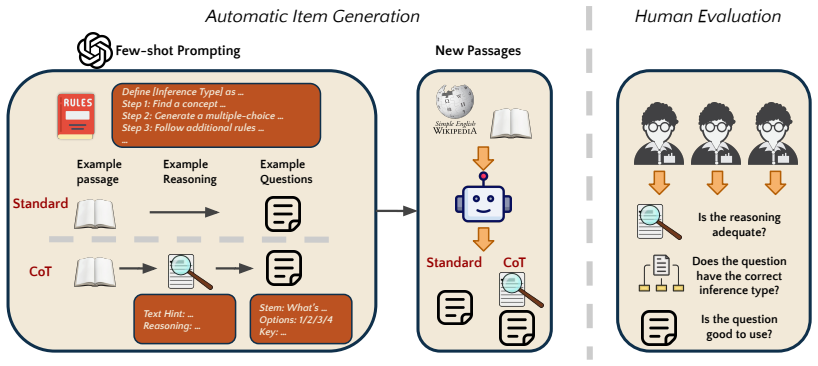
The carrying machinery is a taxonomy of bridging-inference questions—pronominal, pronominal bridging, text-connecting, and gap-filling—used in three places: to annotate an existing item bank, to structure hand-written training examples, and to define the evaluation rubric. Generation is done by few-shot prompting GPT-4o with inference-type-specific step-by-step instructions (find a pronoun, generate a multiple-choice question with distractors, follow additional rules), with a chain-of-thought variant that also asks the model to output a text hint and a reasoning note. The evaluation rubric scores each generated item on general quality, correct inference type, and adequacy of the model's reasoning, and the paper's headline numbers come from majority votes of three expert raters after an adjudication round.
What would settle it
A study that administers a sample of the expert-approved generated items to a large grade 3–12 student sample and calibrates them with item response theory would settle the operational-readiness claim: if expert-approved items show poor discrimination, unexpected difficulty, or differential functioning across student groups, then expert review alone is not sufficient.
Extended reading notes
Core claim
On the authors' own terms, the central finding is a contrast. GPT-4o, given a passage and a small set of manually written examples, can produce multiple-choice reading-comprehension items that expert reviewers rate highly: 93.8% of 357 generated items passed the general quality bar (correct key, clearly wrong distractors, developmentally appropriate for grades 3–12), with the best condition reaching 96.7%. But when the prompt asks for a particular bridging-inference type, the model matches the requested type only 42.6% of the time overall (best condition 46.1%), and text-connecting questions are especially unreliable at 24.1%. The paper also reports that the mix of inference types in the generated pool nonetheless resembles the mix in an existing expert-written item bank, and that chain-of-thought prompting gives no clear quality advantage over standard prompting. The authors conclude that automatic generation plus expert screening is a viable path for expanding diagnostic item banks, while type-targeted generation remains a hard, unsolved part of the task.
Load-bearing premise
The paper's operational-readiness claim rests entirely on expert human judgment; no student response data were collected, so the items' real difficulty, discrimination, and fairness are unknown.
Editorial extensions
If this is right
- A human-screened LLM pipeline can supply a substantial share of new multiple-choice reading-comprehension items: 93.8% of all 357 generated questions and 96.7% in the best condition passed expert review on general quality.
- More training examples improved generation quality, while chain-of-thought prompting gave no clear advantage over standard few-shot prompting.
- Per-item control of inference type is not yet reliable, with the best condition matching the requested type only 46.1% of the time and text-connecting questions being hardest at 24.1%.
- The overall distribution of inference types in the generated item bank closely matched the operational item bank, so aggregate coverage may be acceptable even though individual targeting fails.
- Human expert evaluation remains a necessary gate; the model's reasoning was judged adequate for only about 37–39% of the chain-of-thought items, which may explain why adding chain-of-thought did not help.
Reading between the lines
- If expert judgments do not track real item behavior, the 93.8% claim would overstate readiness; a practical validation would re-run the pipeline on a new passage set and compare expert scores with actual student response data.
- The decoupling of general quality from type accuracy suggests an alternative design the paper does not pursue: prompt for any good inference item, then classify its inference type after generation, using the taxonomy as a post-hoc filter rather than a generation constraint.
- The fact that text-connecting was hardest for both the model and the human question-writers points to an underlying construct difficulty; a testable extension is whether supplying more explicit text-connecting training examples, or constraining candidate noun-phrase pairs, closes that gap.
- A testable extension of the distribution-matching result is to accept the natural type mix of an LLM-generated item bank and use post-hoc annotation to balance parallel test forms, rather than forcing per-item type control.
Editorial analysis
A structured set of objections, weighed in public.
Referee Report
Summary. The paper introduces a taxonomy of bridging-inference types for reading comprehension (pronominal, pronominal bridging, text-connecting, gap-filling), validates it by annotating an operational item bank, and then uses the taxonomy to prompt GPT-4o via few-shot and chain-of-thought prompting to generate multiple-choice inference questions for new expository passages. The generated items are evaluated by three expert raters on general item quality, inference-type accuracy, and reasoning quality. The main empirical findings are that 93.8% of the 357 generated items are judged to be of good general quality, but only 42.6% match the requested inference type, and chain-of-thought prompting provides no clear benefit. The paper concludes that LLM-based item generation with human review is a promising path toward scalable diagnostic RC assessments.
Significance. If the results hold, the paper makes several useful contributions: a literature-grounded taxonomy of inference types that appears to capture meaningful distinctions in operational RC items; a new task formulation for generating questions targeting specific inference types; and a carefully designed human evaluation protocol with high inter-rater agreement (Fleiss' kappa 0.57-0.83). The public release of the example item bank is a concrete reproducibility asset. The work also provides a cautionary data point about LLMs' limited ability to control inference type, which is relevant to the educational NLP community. However, the central practical claim - that items are 'suitable for operational use' - is not fully supported by the evidence collected, as detailed in the major comments.
major comments (2)
- [Abstract; Section 5 (Results)] The claim that generated questions are 'suitable for operational use in grade 3-12 contexts' (Abstract and Section 5) overstates what the evaluation establishes. The rubric in Table 2 assesses answer correctness, distractor plausibility, and developmental safety; it does not measure item difficulty, discrimination, or bias, which are prerequisites for operational scoring and for valid inferences about student ability. The Limitations section explicitly acknowledges that the study 'did not include pilot testing in real-world settings to evaluate how the generated items perform with actual student responses.' Expert review alone does not establish operational readiness. The evidence supports the weaker claim that expert raters judged the items as acceptable, and the wording should be adjusted throughout, including the abstract and conclusion.
- [Section 4.3 (Human Evaluation)] The three raters are also the authors who designed the prompting framework and wrote the training examples. The quality ratings are therefore not independent of the generation pipeline, and the high inter-rater agreement among co-authors does not rule out shared expectations or confirmation bias. Because the 93.8% quality figure rests entirely on these ratings, the paper should either recruit external annotators or explicitly discuss this threat to validity and justify why the conclusions are not affected. At minimum, the authors should state this limitation and consider adding a blinded re-rating by a non-author as a robustness check.
minor comments (5)
- [Section 3.1] There is a typo in the sentence 'demonstrate its its value for future item development' - the word 'its' is repeated.
- [Section 5] In the paragraph discussing the distribution of inference types, 'the collect of items' should read 'the collection of items.'
- [Section 5] The statement that 'our results indicate no statistically significant differences in generation performance across the various prompting conditions' is not accompanied by any test statistic, effect size, or p-value. Please report the statistical details or qualify the claim as descriptive.
- [Section 4.2] The frequency penalty sweep from 0 to 0.3 is mentioned as yielding an optimum at 0.2, but no data are shown to support this choice. A supplementary table or figure of generation quality across penalty values would strengthen reproducibility.
- [Figure 5] The stacked bar chart is difficult to read because the legend keys and the 'true type' labels are visually similar and overlap. Consider replacing the figure with a confusion matrix or adding percentage labels to each segment.
Circularity Check
No significant circularity: the paper is an empirical human-evaluation study whose central quality claims rest on independent expert ratings, not on fitted parameters or self-referential definitions.
full rationale
This paper makes no formal derivation or first-principles prediction; it reports an empirical pipeline (taxonomy construction, few-shot GPT-4o item generation, and human evaluation). The taxonomy is adapted from external psycholinguistic literature (Graesser et al., 1994; Cain and Oakhill, 1999; Haviland and Clark, 1974) and used consistently for annotation, prompt construction, and evaluation; using the same taxonomy as both generation target and evaluation criterion is a standard operationalization and does not make the outcome entailed by the input. The headline claim that 93.8% of items were 'good-quality' comes from three expert raters independently scoring 357 generated items under an explicit rubric (Table 2), with agreement reported in Table 3; it is not computed from any equation or fitted parameter. The temperature and frequency-penalty settings are prompt-engineering choices, and the paper does not use them to predict any of its reported outcomes. Self-citations (Sabatini et al., 2019; Zelikman et al., 2023; Yeatman et al., 2024) are contextual, used for background or future-work directions, and are not load-bearing for the central empirical claims. The main legitimate concern is that 'suitable for operational use' outruns the evidence: the Limitations section explicitly states, 'Our study did not include pilot testing in real-world settings to evaluate how the generated items perform with actual student responses,' so item difficulty, discrimination, and bias were not measured. That is an external-validity / overclaim issue, not circularity, because the claimed conclusion is not definitionally equivalent to the measured rubric. No circular step can be exhibited with a specific reduction, so the appropriate finding is no significant circularity.
Assumptions & free parameters
free parameters (3)
- temperature =
0
- frequency_penalty =
0.2
- number_of_training_examples =
4 or 6 passages
assumptions (3)
- domain assumption The four-part taxonomy (pronominal, pronominal bridging, text-connecting, gap-filling) captures meaningful distinctions in inference-making for reading comprehension.
- domain assumption Expert human evaluation is a valid measure of item quality and operational suitability.
- domain assumption GPT-4o is representative of current LLM capabilities for this task.
Cite this review
Pith. "Pith review of Automatic Generation of Inference Making Questions for Reading Comprehension Assessments." pith.science (2026). https://pith.science/paper/PEMHQPAJ
@misc{pith2026250608260,
  author       = {Pith},
  title        = {Pith review of: Automatic Generation of Inference Making Questions for Reading Comprehension Assessments},
  year         = {2026},
  howpublished = {\url{https://pith.science/paper/PEMHQPAJ}},
  note         = {Machine review of arXiv:2506.08260}
}
read the original abstract
Inference making is an essential but complex skill in reading comprehension (RC). Some inferences require resolving references across sentences, and some rely on using prior knowledge to fill in the detail that is not explicitly written in the text. Diagnostic RC questions can help educators provide more effective and targeted reading instruction and interventions for school-age students. We introduce a taxonomy of inference types for RC and use it to analyze the distribution of items within a diagnostic RC item bank. Next, we present experiments using GPT-4o to generate bridging-inference RC items for given reading passages via few-shot prompting, comparing conditions with and without chain-of-thought prompts. Generated items were evaluated on three aspects: overall item quality, appropriate inference type, and LLM reasoning, achieving high inter-rater agreements above 0.90. Our results show that GPT-4o produced 93.8% good-quality questions suitable for operational use in grade 3-12 contexts; however, only 42.6% of the generated questions accurately matched the targeted inference type. We conclude that combining automatic item generation with human judgment offers a promising path toward scalable, high-quality diagnostic RC assessments.
Figures


Figures from the paper (5 more)


Reference graph
Works this paper leans on
-
[1]
Manish Agarwal, Rakshit Shah, and Prashanth Mannem. 2011. Automatic question generation using discourse cues. In Proceedings of the Sixth Workshop on Innovative Use of NLP for Building Educational Applications, pages 1--9
work page 2011
-
[2]
Jun Araki, Dheeraj Rajagopal, Sreecharan Sankaranarayanan, Susan Holm, Yukari Yamakawa, and Teruko Mitamura. 2016. Generating questions and multiple-choice answers using semantic analysis of texts. In Proceedings of COLING 2016, the 26th International Conference on Computational Linguistics: Technical Papers, pages 1125--1136
work page 2016
-
[3]
Nischal Ashok Kumar, Nigel Fernandez, Zichao Wang, and Andrew Lan. 2023. https://doi.org/10.18653/v1/2023.bea-1.22 Improving reading comprehension question generation with data augmentation and overgenerate-and-rank . In Proceedings of the 18th Workshop on Innovative Use of NLP for Building Educational Applications (BEA 2023), pages 247--259, Toronto, Can...
-
[4]
Yigal Attali, Andrew Runge, Geoffrey T LaFlair, Kevin Yancey, Sarah Goodwin, Yena Park, and Alina A Von Davier. 2022. The interactive reading task: Transformer-based automatic item generation. Frontiers in Artificial Intelligence, 5:903077
work page 2022
-
[5]
Nihat Bayat and G \"o khan C etinkaya. 2020. The relationship between inference skills and reading comprehension. Education and Science
work page 2020
-
[6]
Claudine Bowyer-Crane and Margaret J Snowling. 2005. Assessing children's inference generation: What do tests of reading comprehension measure? British journal of educational psychology, 75(2):189--201
work page 2005
-
[7]
Tom Brown, Benjamin Mann, Nick Ryder, Melanie Subbiah, Jared D Kaplan, Prafulla Dhariwal, Arvind Neelakantan, Pranav Shyam, Girish Sastry, Amanda Askell, et al. 2020. Language models are few-shot learners. Advances in neural information processing systems, 33:1877--1901
2020
-
[8]
Kate Cain. 2022. Children's reading comprehension difficulties. The science of reading: A handbook, pages 298--322
work page 2022
Show all 51 references
-
[9]
Kate Cain and Jane V Oakhill. 1999. Inference making ability and its relation to comprehension failure in young children. Reading and writing, 11:489--503
1999
-
[10]
Kate Cain, Jane V Oakhill, Marcia A Barnes, and Peter E Bryant. 2001. Comprehension skill, inference-making ability, and their relation to knowledge. Memory & cognition, 29(6):850--859
2001
-
[11]
Michael Flor and Brian Riordan. 2018. A semantic role-based approach to open-domain automatic question generation. In Proceedings of the thirteenth workshop on innovative use of NLP for building educational applications, pages 254--263
2018
-
[12]
Bilal Ghanem, Lauren Lutz Coleman, Julia Rivard Dexter, Spencer von der Ohe, and Alona Fyshe. 2022. https://doi.org/10.18653/v1/2022.findings-acl.168 Question generation for reading comprehension assessment by modeling how and what to ask . In Findings of the Association for C...
2022 doi
-
[13]
Arthur C Graesser, Murray Singer, and Tom Trabasso. 1994. Constructing inferences during narrative text comprehension. Psychological review, 101(3):371
1994
-
[14]
Susan E Haviland and Herbert H Clark. 1974. What's new? acquiring new information as a process in comprehension. Journal of verbal learning and verbal behavior, 13(5):512--521
1974
-
[15]
Yufang Hou. 2020. https://doi.org/10.18653/v1/2020.acl-main.132 Bridging anaphora resolution as question answering . In Proceedings of the 58th Annual Meeting of the Association for Computational Linguistics, pages 1428--1438, Online. Association for Computational Linguistics
2020 doi
-
[16]
Yufang Hou, Katja Markert, and Michael Strube. 2018. Unrestricted bridging resolution. Computational Linguistics, 44(2):237--284
2018
-
[17]
Aaron Hurst, Adam Lerer, Adam P Goucher, Adam Perelman, Aditya Ramesh, Aidan Clark, AJ Ostrow, Akila Welihinda, Alan Hayes, Alec Radford, et al. 2024. Gpt-4o system card. arXiv preprint arXiv:2410.21276
2024 arXiv
-
[18]
Kevin Hwang, Kenneth Wang, Maryam Alomair, Fow-Sen Choa, and Lujie Karen Chen. 2024. Towards automated multiple choice question generation and evaluation: aligning with bloom’s taxonomy. In International Conference on Artificial Intelligence in Education, pages 389--396. Springer
2024
-
[19]
Walter Kintsch. 1998. Comprehension: A paradigm for cognition. Cambridge university press
1998
-
[20]
Hideo Kobayashi, Yufang Hou, and Vincent Ng. 2022. https://aclanthology.org/2022.coling-1.64/ End-to-end neural bridging resolution . In Proceedings of the 29th International Conference on Computational Linguistics, pages 766--778, Gyeongju, Republic of Korea. International Co...
2022
-
[21]
Saurabh Kulshreshtha and Anna Rumshisky. 2022. Reasoning circuits: Few-shot multihop question generation with structured rationales. arXiv preprint arXiv:2211.08466
2022 arXiv
-
[22]
Ghader Kurdi, Jared Leo, Bijan Parsia, Uli Sattler, and Salam Al-Emari. 2020. A systematic review of automatic question generation for educational purposes. International Journal of Artificial Intelligence in Education, 30:121--204
2020
-
[23]
Kunze Li and Yu Zhang. 2024. Planning first, question second: An llm-guided method for controllable question generation. In Findings of the Association for Computational Linguistics ACL 2024, pages 4715--4729
2024
-
[24]
Yunting Liu, Shreya Bhandari, and Zachary A Pardos. 2025. Leveraging llm respondents for item evaluation: A psychometric analysis. British Journal of Educational Technology, 56(3):1028--1052
2025
-
[25]
Xinyi Lu and Xu Wang. 2024. Generative students: Using llm-simulated student profiles to support question item evaluation. In Proceedings of the Eleventh ACM Conference on Learning@ Scale, pages 16--27
2024
-
[26]
Kawshik Manikantan, Makarand Tapaswi, Vineet Gandhi, and Shubham Toshniwal. 2024. https://arxiv.org/abs/2411.07466 Identifyme: A challenging long-context mention resolution benchmark . Preprint, arXiv:2411.07466
2024 arXiv
-
[27]
Vaibhav Mavi, Anubhav Jangra, and Adam Jatowt. 2024. https://arxiv.org/abs/2204.09140 Multi-hop question answering . Preprint, arXiv:2204.09140
2024 arXiv
-
[28]
Nikahat Mulla and Prachi Gharpure. 2023. Automatic question generation: a review ofmethodologies, datasets, evaluation metrics, and applications. Progress in Artificial Intelligence , 12:1--32
2023
-
[29]
Edward J O'Brien, Anne E Cook, and Robert F Lorch. 2015. Inferences during reading. Cambridge University Press
2015
-
[30]
Onkar Pandit and Yufang Hou. 2021. https://doi.org/10.18653/v1/2021.naacl-main.327 Probing for bridging inference in transformer language models . In Proceedings of the 2021 Conference of the North American Chapter of the Association for Computational Linguistics: Human Langua...
2021 doi
-
[31]
E Margaret Perkoff, Abhidip Bhattacharyya, Jon Cai, and Jie Cao. 2023. Comparing neural question generation architectures for reading comprehension. In Proceedings of the 18th Workshop on Innovative Use of NLP for Building Educational Applications (BEA 2023), pages 556--566
2023
-
[32]
Yin Poon, John Sie Yuen Lee, Yu Yan Lam, Wing Lam Suen, Elsie Li Chen Ong, and Samuel Kai Wah Chu. 2024. https://aclanthology.org/2024.sighan-1.3/ Few-shot question generation for reading comprehension . In Proceedings of the 10th SIGHAN Workshop on Chinese Language Processing...
2024
-
[33]
Pranav Rajpurkar, Jian Zhang, Konstantin Lopyrev, and Percy Liang. 2016. https://doi.org/10.18653/v1/D16-1264 SQ u AD : 100,000+ questions for machine comprehension of text . In Proceedings of the 2016 Conference on Empirical Methods in Natural Language Processing, pages 2383-...
2016 doi
-
[34]
Manav Rathod, Tony Tu, and Katherine Stasaski. 2022. https://doi.org/10.18653/v1/2022.bea-1.26 Educational multi-question generation for reading comprehension . In Proceedings of the 17th Workshop on Innovative Use of NLP for Building Educational Applications (BEA 2022), pages...
2022 doi
-
[35]
Ina R \"o siger. 2018. https://aclanthology.org/L18-1058/ BASHI : A corpus of W all S treet J ournal articles annotated with bridging links . In Proceedings of the Eleventh International Conference on Language Resources and Evaluation ( LREC 2018) , Miyazaki, Japan. European L...
2018
-
[36]
John Sabatini, Jonathan Weeks, Tenaha O'Reilly, Kelly Bruce, Jonathan Steinberg, and Szu-Fu Chao. 2019. SARA Reading Components Tests, RISE forms: Technical Adequacy and Test Design . ETS Research Report Series, 2019(1):1--30
2019
-
[37]
Andreas S \"a uberli and Simon Clematide. 2024. https://aclanthology.org/2024.readi-1.3/ Automatic generation and evaluation of reading comprehension test items with large language models . In Proceedings of the 3rd Workshop on Tools and Resources for People with REAding DIffi...
2024
-
[38]
Franz Schmalhofer, Mark A McDaniel, and Dennis Keefe. 2002. A unified model for predictive and bridging inferences. Discourse Processes, 33(2):105--132
2002
-
[39]
Murray Singer, Peter Andruslak, Paul Reisdorf, and Nancy L Black. 1992. Individual differences in bridging inference processes. Memory & cognition, 20(5):539--548
1992
-
[40]
Murray Singer and Gilbert Remillard. 2004. Retrieving text inferences: Controlled and automatic influences. Memory & Cognition, 32(8):1223--1237
2004
-
[41]
Katherine Stasaski, Manav Rathod, Tony Tu, Yunfang Xiao, and Marti A Hearst. 2021. Automatically generating cause-and-effect questions from passages. In Proceedings of the 16th Workshop on Innovative Use of NLP for Building Educational Applications, pages 158--170
2021
-
[42]
Richard Thurlow and Paul van den Broek. 1997. Automaticity and inference generation during reading comprehension. Reading & Writing Quarterly: Overcoming Learning Difficulties, 13(2):165--181
1997
-
[43]
Masaki Uto, Yuto Tomikawa, and Ayaka Suzuki. 2023. https://doi.org/10.18653/v1/2023.bea-1.10 Difficulty-controllable neural question generation for reading comprehension using item response theory . In Proceedings of the 18th Workshop on Innovative Use of NLP for Building Educ...
2023 doi
-
[44]
Paul van den Broek, Katinka Beker, and Marja Oudega. 2015. Inference generation in text comprehension: Automatic and strategic processes in the construction of a mental representation . In Edward J. O'Brien, Anne E. Cook, and Robert F. Lorch Jr., editors, Inferences during rea...
2015
-
[45]
Jason Wei, Xuezhi Wang, Dale Schuurmans, Maarten Bosma, Fei Xia, Ed Chi, Quoc V Le, Denny Zhou, et al. 2022. Chain-of-thought prompting elicits reasoning in large language models. Advances in neural information processing systems, 35:24824--24837
2022
-
[46]
Ying Xu, Dakuo Wang, Mo Yu, Daniel Ritchie, Bingsheng Yao, Tongshuang Wu, Zheng Zhang, Toby Jia-Jun Li, Nora Bradford, Branda Sun, et al. 2022. Fantastic questions and where to find them: Fairytaleqa--an authentic dataset for narrative comprehension. arXiv preprint arXiv:2203.13947
2022 arXiv
-
[47]
Jason D Yeatman, Jasmine E Tran, Amy K Burkhardt, Wanjing Anya Ma, Jamie L Mitchell, Maya Yablonski, Liesbeth Gijbels, Carrie Townley-Flores, and Adam Richie-Halford. 2024. Development and validation of a rapid and precise online sentence reading efficiency assessment. In Fron...
2024
-
[48]
Eric Zelikman, Wanjing Ma, Jasmine Tran, Diyi Yang, Jason Yeatman, and Nick Haber. 2023. https://doi.org/10.18653/v1/2023.emnlp-main.135 Generating and evaluating tests for k-12 students with language model simulations: A case study on sentence reading efficiency . In Proceedi...
2023 doi
-
[49]
Eric Zelikman, Yuhuai Wu, Jesse Mu, and Noah Goodman. 2022. Star: Bootstrapping reasoning with reasoning. Advances in Neural Information Processing Systems, 35:15476--15488
2022
-
[50]
online" 'onlinestring :=
ENTRY address archivePrefix author booktitle chapter edition editor eid eprint eprinttype howpublished institution journal key month note number organization pages publisher school series title type volume year doi pubmed url lastchecked label extra.label sort.label short.list...
-
[51]
write newline
" write newline "" before.all 'output.state := FUNCTION n.dashify 't := "" t empty not t #1 #1 substring "-" = t #1 #2 substring "--" = not "--" * t #2 global.max substring 't := t #1 #1 substring "-" = "-" * t #2 global.max substring 't := while if t #1 #1 substring * t #2 gl...
Reviewed August 7, 2026 · model on record in the stance chip above.
Discussion (0). Sign in to comment.