REVIEW 3 major objections 5 minor 62 references
A non-local exchange potential for electronic structure calculations
T0 review · 3 major / 5 minor · reviewed 2026-08-07 · deepseek-v4-flash
Pith's one-line read A simple density-only exchange potential built from an extended exchange hole reproduces the asymptotic -1/r behavior, Slater's average, Kohn-Sham behavior for valence states, and atomic total energies within about 0.3% of experiment.
desk verdict A coherent non-local exchange model with the right long-range behavior, but the claimed universality is only tested on atoms and the atomic energy agreement leans on a fitted correlation parameter. read the letter →
The pith
A machine-rendered reading of the paper's core claim, the machinery that carries it, and where it could break.
The reading
What carries the argument
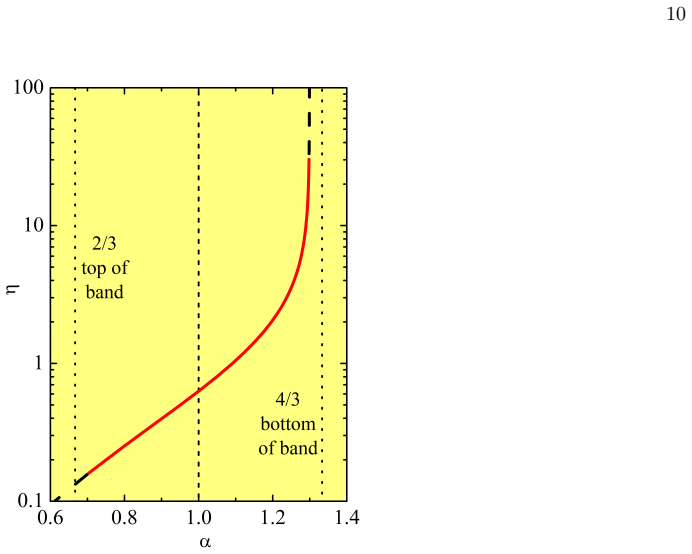
The central object is the NDX exchange-hole model: an exchange-charge density of the form $\bar\rho_x^{\mathrm{NDX}}(\mathbf r,\mathbf r') = \rho(\mathbf r') \max[1-(|\mathbf r-\mathbf r'|/r_c)^\eta,0]/2$, where $r_c$ is fixed at each point by requiring the hole to contain exactly one unit of charge (eq. 36), and the exponent $\eta$ is tied to the local exchange strength $\alpha$ through the free-electron-gas relation (eq. 35). A second ingredient is the spatial interpolation of $\alpha$ via the fractional electron charge inside a sphere around each nucleus (eq. 38), which sets $\alpha\approx 1.3$ near nuclei and $\alpha\approx 0.7$ far away. These pieces convert a non-local exchange integral into a local potential that still samples the density over an extended volume.
What would settle it
Take a strongly inhomogeneous system, such as bulk silicon or a stretched diatomic molecule, compute the NDX exchange potential self-consistently, and compare the resulting potential and electron energies with a high-accuracy wavefunction or exact Kohn-Sham reference; if the potential does not keep the -1/r tail and does not match Kohn-Sham exchange in regions between atoms, the claimed universality fails.
Extended reading notes
Core claim
On the paper's own terms, the discovery is that one can build a single, state-independent, density-only exchange potential that satisfies the physical constraints of exact exchange: the total exchange charge is exactly one electron, the potential decays as -1/r at large distances, the free-electron-gas average equals the Slater value, the density dependence obeys the Hohenberg-Kohn picture, and the potential acting on delocalized valence electrons comes close to the Kohn-Sham value. The authors argue that this is achieved without fitted exchange parameters, and that for atoms from He to Xe the NDX self-consistent total energies deviate by roughly 0.3% from experiment, while orbital energies improve over Hartree-Fock-Slater and local Kohn-Sham results, particularly for outer shells.
Load-bearing premise
The argument assumes that a relation worked out for a uniform electron gas and a linear interpolation of a strength parameter based on how much electron charge sits near each nucleus stay valid for any irregular electron density and for molecules and solids.
Editorial extensions
If this is right
- In a free electron gas, the NDX potential averages exactly to the Slater exchange potential, so the model inherits the known correct free-electron-gas limit without a local-density replacement.
- For atoms, NDX total energies land within about 0.3% of experimental values, comparable to fitted methods, while remaining parameter-free in its exchange part.
- For solids and molecules, the potential should recover Kohn-Sham exchange in interstitial regions and retain the -1/r tail, which local and most gradient-corrected potentials miss; this is the extension sketched in appendix C.
- Because it is a single, state-independent, density-only potential, NDX can be dropped into existing self-consistent-field and density-functional codes and also used for excited-state and electron-dynamics calculations that need one potential for all orbitals.
Reading between the lines
- A direct test the paper leaves implicit would be to apply NDX to bulk metals or wide-gap insulators and compare the band structure with exact Kohn-Sham or hybrid-functional results; the claimed interstitial Kohn-Sham agreement predicts small differences in valence-band dispersion.
- The same construction could be extended to spin-polarized systems by replacing the density factor with the parallel-spin density, as the authors note; a natural check is the exchange splitting in ferromagnetic transition metals.
- Because the NDX hole has no oscillatory part, it smooths shell-structure dips in the exchange potential; this suggests NDX may systematically shift core-valence excitation energies, a consequence not quantified in the paper.
- The 0.3% total-energy accuracy is demonstrated for ground-state atoms only; the paper's claim that the method transfers to molecules and solids would be strengthened by a benchmark against quantum-chemistry reference data for a few small molecules.
Editorial analysis
A structured set of objections, weighed in public.
Referee Report
Summary. The manuscript proposes a new density-only exchange potential, NDX, based on an extended exchange hole of the form G(l)=1-(l/r_c)^eta. The two shape parameters are fixed for a homogeneous free-electron gas by normalizing the hole to one electron (Eqs. 32-33) and by requiring the resulting exchange potential to reproduce a Slater-like potential with strength alpha (Eqs. 34-35). For inhomogeneous systems, alpha(r) is made to vary linearly with the fractional enclosed charge (Eqs. 38-39), interpolating between alpha approx 1.298 near nuclei and alpha approx 0.702 far away. The exchange potential is then computed from the density by solving the normalization condition for r_c and evaluating a three-dimensional integral (Eqs. 36-37). The authors implement the model in an atomic SCF code and compare orbital energies and total energies for He through Xe with Hartree-Fock, Dirac-Hartree-Fock, HFS-L, DFT-Becke, and experiment. They conclude that the potential satisfies conditions (ii), (iii), (iv), and (vi) exactly and (i) and (v) approximately, and they propose a multi-atomic generalization in Appendix C.
Significance. If the claims were fully established, the NDX potential would be a practically attractive density-only exchange approximation with correct -1/r asymptotics, Slater-like average behavior in the free-electron-gas limit, and Kohn-Sham-like behavior for valence and interstitial electrons. The core derivation in Section II C is internally consistent, and the atomic benchmarks are a useful systematic test; the paper also makes its target conditions explicit, which facilitates checking. The main value of the paper at this stage is the atomic implementation and the promising total-energy and orbital-energy comparisons. However, the advertised advantages for molecules and solids, including the interstitial-space Kohn-Sham behavior, are not tested, and the quantitative total-energy agreement depends on a correlation parameter fitted to experimental atomic energies. These gaps currently separate the paper's stated universality claims from what is actually demonstrated.
major comments (3)
- [Appendix C and Section I] The manuscript claims that the NDX potential is applicable to molecules, clusters, and solids and that condition (iv) is fulfilled exactly, but the multi-atomic construction in Eq. (C2) is not validated. The density-weighted average of the minimum over several nuclear fractional charges is not the same quantity as the single-center average used to derive alpha_bar=1 from Eq. (38), and the text only states that an average 'should yield' the Slater result for homonuclear systems. Since no molecular or solid-state SCF calculation is presented, the claims about interstitial-space behavior and approach to Kohn-Sham exchange for delocalized states are assertions rather than demonstrated results. A proof for periodic systems or at least one converged molecular or solid benchmark is needed to support the universality claim; alternatively, the exactness conditions should be restated as atom-only results.
- [Section III B and Appendix A] The reported 'about 0.3%' agreement of NDX total energies with experiment is not an ab-initio result of the exchange model alone. The correlation correction used in those total energies contains the fitted parameter beta_bar=0.74 +/- 0.10, determined by fitting experimental total energies in a separate Xalpha HFS-L calculation (Eq. A4). Because this same fitted correction is applied to the NDX total energies, the agreement is partly built into the comparison. The paper should report the sensitivity of the NDX total-energy deviations to beta over its uncertainty and should qualify the 0.3% claim accordingly.
- [Section II C, Eqs. (35) and (38)] Condition (iv) is stated as an exact condition for a free electron gas, but the exactness is ambiguous. Equation (35) is derived for a constant alpha in a homogeneous system, whereas Eq. (38) makes alpha spatially varying through the fractional enclosed charge f_far(r), which has no well-defined value in an infinite homogeneous electron gas without a nuclear center. If f_far is defined around an arbitrary origin, the NDX potential in a constant-density system becomes position-dependent, contradicting translational invariance. The paper should specify precisely in what averaged sense Eq. (38) enforces the Slater average and how the free-electron-gas condition is meant to be evaluated.
minor comments (5)
- [Throughout] There are several typographical errors, including 'ourselfes' (Section I), 'ab-inito' (Section I), 'funtional' (Fig. 5 caption), 'flexibel' (Conclusions), and 'Stucture' in reference [22]; these should be corrected.
- [Fig. 2 caption] The caption refers to 'the red part of the curve' but does not explain what distinguishes the red part from the rest of the curve; please clarify which branch is used for the NDX model and why.
- [Section III B and Fig. 7] The total-energy results are presented only graphically; a table of the numerical NDX, HFS-L, and reference total energies for the atoms considered would make the stated 0.3% deviation reproducible and easier to assess.
- [Section II D and Fig. 4] The absence of an oscillatory part in the NDX exchange hole is identified as the reason the NDX potential misses the inter-shell dip near r approx 0.35 a.u.; a brief discussion of whether this limitation is expected to affect molecules or solids would be helpful.
- [Appendix C] The computational cost of evaluating Eqs. (36)-(37) and Eq. (C2) in a periodic system is not estimated; a few remarks on scaling with system size would help readers judge the practical feasibility of the proposed multi-atomic extension.
Circularity Check
Several 'exact fulfillment' claims are built into NDX by construction, and the 0.3% total-energy benchmark relies on a correlation parameter fitted to the same experimental energies; atomic orbital energies remain a genuine independent test.
-
self definitional
[Section II C, Eqs. (34)-(35), with the claim of condition (iv) in Section I]
"Furthermore, we require that the resulting exchange potential (using eq. 10 and 31) will match the FEG result in eq. 27 ... From eqs. 33 and 34 we now obtain η as ... α = (2π²η(η+3)²/[9(η+2)³])^{1/3} (35) ... This relation for η has the great advantage of being independent of ρ0 as well as of rs. Thus, one can assume that eq. 35 is also a good approximation to the case of an inhomogeneous electron density."
The shape parameter η is fixed by imposing that the constant-density NDX potential equal the Slater expression -3α(3ρ/(8π))^{1/3} for a chosen α. Therefore the paper's claim that NDX 'fulfills condition (iv) exactly' (the free-electron-gas average equals Slater) is an identity inserted at the definition stage, not a property derived from independent input. The subsequent pointwise transfer of the FEG-derived η(α) to inhomogeneous densities is an assumption, but the FEG part is tautological.
-
self definitional
[Section II C, Eqs. (38)-(39), with the claim of condition (iv) in Section I]
"In this work, we simply use the following linear scaling for α α(⃗ r) = 1.298−2·0.298·f f ar(r) (38) ... Eq. 38 has been chosen in such a way that an average over the density is always equal to one ( ¯α= 1) independent of the density distribution. This means it is consistent with condition (iv) of the introduction."
The radial α profile is chosen so that the density-weighted average of α over a neutral atom is exactly 1, which is precisely the condition that the averaged exchange potential matches the Slater α=1 result. The claimed consistency with condition (iv) is therefore enforced by the constants 1.298 and 0.596 chosen in Eq. (38), not discovered from the calculation. The profile itself is an ad hoc interpolation between the free-electron-gas endpoint values 4/3 and 2/3, and the adjacent claim that valence electrons see α≈0.7 near the Kohn-Sham value is the same design choice restated as condition (v).
1 more flagged steps
-
fitted input called prediction
[Appendix A, Eqs. (A1)-(A4), and the total-energy benchmark claims in Sections III B and IV]
"The parameter β was then fixed by a fit to the experimental total energies [47]. Thus, the correlation correction is optimized for an X α variant of the HFS-L model in Fig. 7 and the average over all results for 11 atoms from He ... to Ar ... is ¯β= 0.74±0.10. ... In this work, we have used eqs. A2 and A3 with ¯β= 0.74 for the HFS-L, DFT-Becke (plus Latter correction) and the NDX results for the total energies."
The headline benchmark that 'NDX total energies deviate by only about 0.3% from the experimental values' is not a parameter-free prediction of the exchange model, because the correlation correction applied to NDX total energies uses β=0.74 fitted to the same experimental total-energy data (He-Ar) against which the agreement is quoted. Part of the reported 0.3% agreement is therefore statistically forced by the fit rather than earned by the NDX exchange potential. The orbital-energy comparisons, which do not use this fitted β, remain an independent test.
full rationale
The core NDX construction is an attempted ab initio exchange model with no fitted exchange parameters: Eq. (35) links the exchange-hole exponent η to a chosen α by requiring the constant-density potential to match Slater/Kohn-Sham forms, and Eq. (38) interpolates α from ~1.3 near nuclei to ~0.7 at large distances. Those are design constraints, and several of the paper's claims of 'exact' fulfillment of conditions (iii), (iv), (v), and (vi) are direct restatements of these imposed constraints rather than independently derived outcomes. That by-construction character is real but is not the worst form of circularity, because the potential is then used in genuine self-consistent atomic calculations producing orbital energies that are compared with DHF and experiment. The more concrete statistically forced element is the 0.3% total-energy agreement, which uses a correlation parameter β fitted to the experimental total energies used as the benchmark. This does not invalidate the exchange model, and the authors are transparent about the fit, but it means the headline total-energy accuracy is partly a fitted result. No load-bearing self-citation chain is present: the authors' earlier work [53] is cited only in connection with the SCF code, not as the justification for the NDX ansatz. Weighing the by-construction constraints against the genuinely predictive orbital energies, a score of 5 reflects partial, not total, circularity.
Assumptions & free parameters
free parameters (2)
- correlation scaling beta =
0.74 +/- 0.10
- alpha(r) endpoint values =
1.298 near nucleus, 0.702 far from nucleus
assumptions (4)
- ad hoc to paper The FEG-derived eta(alpha) relation (Eq. 35) remains valid for inhomogeneous electron densities.
- ad hoc to paper The exchange hole shape G(l)=1-(l/r_c)^eta with no oscillatory part captures the essential exchange physics.
- ad hoc to paper alpha(r) varies linearly with the fractional enclosed charge f_far(r) (Eq. 38), and the same scaling transfers to multi-atomic systems via Eq. C2.
- domain assumption Correlation can be treated separately from exchange using a local semiempirical correction (Appendix A).
Cite this review
Pith. "Pith review of A non-local exchange potential for electronic structure calculations." pith.science (2026). https://pith.science/paper/5NZYAER5
@misc{pith2026250608286,
  author       = {Pith},
  title        = {Pith review of: A non-local exchange potential for electronic structure calculations},
  year         = {2026},
  howpublished = {\url{https://pith.science/paper/5NZYAER5}},
  note         = {Machine review of arXiv:2506.08286}
}
read the original abstract
In this work we describe a model for the exchange interaction of electrons, as it follows from the Pauli exclusion principle. Starting from Hartree-Fock theory and making use of the free electron-gas model we propose a simple scheme to calculate the exchange-potential for atoms as well as simple molecules and solids. This method assures the correct asymptotic long-range behavior of the potential, contrary to local-density approximations that rely on a strongly simplified generalization of the well-known Kohn-Sham or Slater exchange interaction. Furthermore, our results approach the Kohn-Sham results in the interstitial space of solids. As a benchmark test, total energies and eigenenergies for atoms from He to Xe computed within our model are compared to other calculations as well as to experimental data.
Figures


Figures from the paper (5 more)


Reference graph
Works this paper leans on
-
[1]
Fischer C F ”The Hartree-Fock method for atoms: a numerical approach”(John Wiley, London, 1977)
work page 1977
-
[2]
Blume M and Watson R E 1962Proc. Roy. Soc.A270127; - - ibid 1963Proc. Roy. Soc.A271565
-
[3]
Cowan R D”The Theory of Atomic Structure and Spectra”(University of California Press, Berkeley, 1981); see also references therein
work page 1981
-
[4]
Sharp R T and Horton 1953Phys.Rev.30317
-
[5]
Talman J D and Shadwick W F 1976Phys.Rev.A1436; Talman J D 1989Comp.Phys.Comm.5485
-
[6]
related to the lowV e e x values around the K-shell position in Fig. 4. The NDX curve is seen to yield a rough representation of Slaters non-local Hartree-Fock result (mean HF). Keeping the simplicity of the NDX model in mind, this agreement looks promising. Only at intermediate distances below and above the L-shell radius there are significant deviations...
-
[7]
Grant I P, McKenzie B J, Norrington P H, Mayers D F and Pyper N C 1980Comput. Phys. Commun.21207
-
[8]
Krieger J B, Li Y and Iafrate G J 1992Phys.Rev.A45101; Li Y, Krieger J B and Iafrate G J 1993Phys.Rev.A47165
Show all 62 references
-
[9]
Callaway J,Solid-State Physicsed. by F. Seitz and D. Turnbull, Vol.7pp. 100 (1958, Academic Press, N.Y., USA)
1958
-
[10]
Data5201
Mann J B and Waber J T 1973At. Data5201
-
[11]
Bylander D M and Kleinman L 1995Phys.Rev.Lett.743660 24
-
[12]
Dimmock J O,Solid State Physicsed. by F. Seitz and D. Turnbull, Vol.26pp. 104 (1971, Academic Press, N.Y., USA)
1971
-
[13]
Reeves, Kyle G., Yao, Yi and Kanai, Yosuke 2016Phys. Rev. B94041108
-
[14]
G¨ orling A 1996Phys.Rev.B537024; St¨ adele M, Majewski J A, Vogl P and G¨ orling A 1997Phys.Rev.Lett.792089
-
[15]
Solleder, L
B. Solleder, L. Wirtz, and J. Burgd¨ orfer 2009Physical Review B79125107
-
[16]
Maliyov, Ivan and Crocombette, Jean-Paul and Bruneval, Fabien 2020Phys. Rev. B101035136
-
[17]
Dirac P A M 1930Proc. Camb. Phil. Soc.26376; G´ asp´ ar R 1954Acta.Phys.Hung3263; Kohn W and Sham L J 1965 Phys.Rev.140A1133
1965
-
[18]
Slater J C 1951Phys.Rev.81385
-
[19]
Herman F, van Dyke J P and Ortenburger I B 1969Phys.Rev.Lett.22807
-
[20]
Herman F, Callaway J and Acton F S 1954Phys.Rev.95371
-
[21]
Rev.99510
Latter R 1955Phys. Rev.99510
-
[22]
Stoddart J C, Beattie A M and March N H 1971Int. Journ. Quantum Chem.435
-
[23]
Hedin L and Lundqvist S 1969Solid State Physics231
-
[24]
Herman F and Skillman S”Atomic Stucture Calculations”(Prentice-Hall, Englewood Cliffs, New Jersey, 1963)
1963
-
[25]
von Barth U and Hedin L 1972J. Phys. C51629
-
[26]
Lundqvist B I 1977Phys. Kondens. Mater.6206
-
[27]
Jones W and March N H ”Theoretical solid state physics”vol.1(Wiley, London, 1973)
1973
-
[28]
Katsnelson A A, Stepanyuk V S, Sz´ asz A I, Farberovich O V”Computational Methods in Condensed Matter: Electronic Structure”(American Institute of Physics, New York, 1992)
1992
-
[29]
1988Phys.Rev.A383098
Becke, A.D. 1988Phys.Rev.A383098
-
[30]
Becke, A.D. 1986J. Chem. Phys.844524
-
[31]
Perdew J P, Chevary J A, Vosko S H, Jackson K A, Pederson M R, Singh D J and Fiolhais C 1992Phys.Rev.B466671
-
[32]
1986Phys.Rev.B338800
Perdew, J.P., Wang, Y. 1986Phys.Rev.B338800
-
[33]
Engel, E., Chevary, J.A., Macdonald, LD., and Vosko, S.H. 1992Z. Phys.D237
-
[34]
Perdew J P, Burke K and Ernzerhof M 1996Phys.Rev.Lett773865
-
[35]
Truhlar Citation: The Journal of Chemical Physics 72, 1415 (1980)
Kunizo Onda and Donald G. Truhlar Citation: The Journal of Chemical Physics 72, 1415 (1980)
1980
-
[36]
Riley and Donald G
Merle E. Riley and Donald G. Truhlar Citation: The Journal of Chemical Physics 63, 2182 (1975)
1975
-
[37]
Hohenberg P and Kohn W 1964Phys.Rev.136B864
-
[38]
Kahn, Paul Baybutt, and Donald G
Luis R. Kahn, Paul Baybutt, and Donald G. Truhlar J. Chem. Phys. 65, 3826 (1976)
1976
-
[39]
Physik61126; - ibid
Fock V 1930Z. Physik61126; - ibid. 1930Z. Physik62795
-
[40]
Messiah A”Quantum mechanics”vol.2(North-Holland Publ., Amsterdam, 1975)
1975
-
[41]
Brauer W”Einf¨ uhrung in die Elektronentheorie der Metalle”(Akademische Verlagsgesellschaft, Leipzig, 1966)
1966
-
[42]
Hartree D R ”The calculation of atomic structures”(John Wiley, London, 1957)
1957
-
[43]
Cambridge Phil
Hartree D R 1928Proc. Cambridge Phil. Soc.24111
-
[44]
Streitwolf H W 1962phys. stat. sol.21595
-
[45]
Echenique P M and Uranga M E”Interaction of charged particles with solids and surfaces” NATO ASI seriesVol.B271 (Plenum Press, New York, 1990) pp.39
1990
-
[46]
1934Phys.Rev.46509
Wigner E and Seitz F 1933Phys.Rev.43804; - - ibid. 1934Phys.Rev.46509
-
[47]
Moore C E”Ionization Potentials and Ionization Limits Derived from the Analyses of Optical Spectra”(NSRDS-NBS34, 1970); Bearden J A and Burr A F 1967 ”Reevaluation of X-Ray Atomic Energy Levels”Rev. Mod. Phys.39125; Cardona M and Ley L, Eds.,Photoemission in Solids I: General ...
1970
-
[48]
Blaha P, Schwarz K, Sorantin P and Trickey S B 1990Comp. Phys. Commun.59399
-
[49]
Koopmans 1933Physica1104
-
[50]
Jr.Atomic Energy Level and Grotrian Diagrams”, Vol
Bashkin, Stanley and Stoner, John O. Jr.Atomic Energy Level and Grotrian Diagrams”, Vol. 1 and 2, North-Holland Pub., Amsterdam 1978
1978
-
[51]
Slater J C 1960”Quantum theory of atomic structure”Vol.II(McGraw-Hill, New York, 1960)
1960
-
[52]
Foldy L L and Wouthuysen S A 1950Phys.Rev.7829
-
[53]
For the numerical densities and potentials a linear grid of 10000 radial points has been used with a spatial boundary of 20 a.u
using HFS-L potentials. For the numerical densities and potentials a linear grid of 10000 radial points has been used with a spatial boundary of 20 a.u. beyond which simple extrapolation is used. The estimated numerical all-over accuracy is about 6 digits. For the three atom t...
-
[54]
Bjorken J D and Drell S D”Relativistic quantum mechanics”(McGraw-Hill, New York, 1964)
1964
-
[55]
Schiwietz G, Grande P L, Auth C, Winter H and Salin A (1994)Phys. Rev. Lett.722159; Grande P L and Schiwietz G (1992)Phys. Lett.A163439; dos Santos J H R, Grande P L, Behar M, Boudinov H and Schiwietz G (1997)Phys. Rev. B554332
1994
-
[56]
Pines D 1955Solid State PhysicsI375
-
[57]
Rev.1111460
Cowan R D and Kirkwood J G 1958Phys. Rev.1111460
-
[58]
W J, Coldwell-Harsfall R A and Fein A E 1961Phys
Carr Jr. W J, Coldwell-Harsfall R A and Fein A E 1961Phys. Rev.124747
-
[59]
Rev.106364
Gell-Mann M and Brueckner K A 1957Phys. Rev.106364
-
[60]
W J and Maradudin A A 1964Phys
Carr Jr. W J and Maradudin A A 1964Phys. Rev.133A371
-
[61]
Rev.139A796
Hedin L 1965Phys. Rev.139A796
-
[62]
Gunnarsson O”The density functional theory of metallic surfaces” NATO ASI seriesVol.41(Plenum Press, New York,
Reviewed August 7, 2026 · model on record in the stance chip above.
Discussion (0). Sign in to comment.