REVIEW 4 major objections 4 minor 33 references
Differentiable Physics-Informed Adaptive Koopman Control for Stable Flight under Unknown Disturbances
T0 review · 4 major / 4 minor · reviewed 2026-08-07 · deepseek-v4-flash
Pith's one-line read This paper claims that unknown disturbances in robot control can be learned as a Koopman linear system, predicted ahead of time, and compensated, so a tethered space robot deploys within a 1% precision zone.
desk verdict The full text is a reproducible simulation paper on Koopman disturbance compensation for tethered space robots; the abstract's quadrotor experiments don't exist here, and Theorem 1's stability proof doesn't cover the implemented finite-N system. read the letter →
The pith
A machine-rendered reading of the paper's core claim, the machinery that carries it, and where it could break.
The reading
What carries the argument
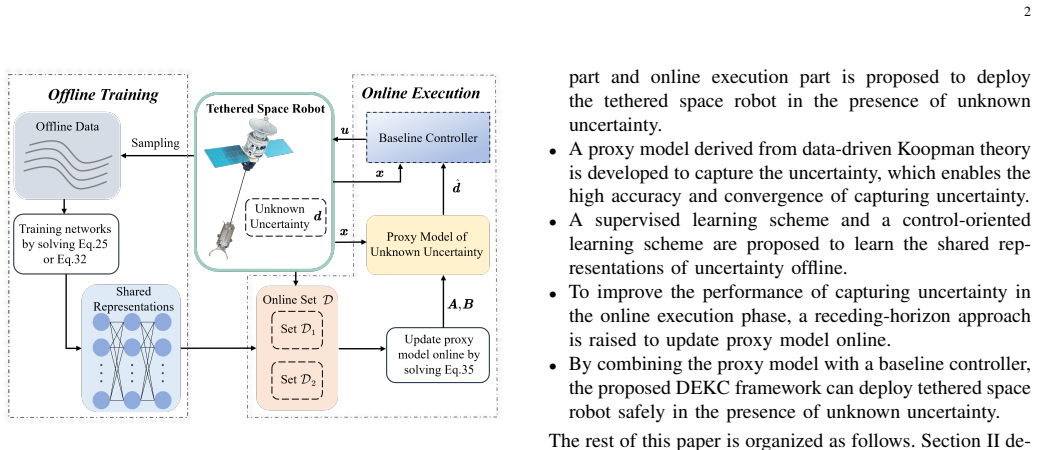
The load-bearing object is the lifted linear system, equations (18)-(20): a Koopman-operator surrogate in which the unknown disturbance $d$ lives in a feature space $z=\Phi(d)\in\mathbb{R}^N$, evolves linearly as $z_{k+1}=Az_k+B\zeta_k+r_k$, and is decoded by $d_k=Cz_k$. The lifting functions $\Phi$ are parameterized by a neural network, so the shared representations are learned from data rather than chosen by hand. The network and matrices are trained either by minimizing a multi-step prediction and reconstruction loss or by a control-oriented neural-ODE loss that avoids differentiating $x$ to obtain $d$ labels; during execution, a receding-horizon least-squares update, equation (35), refreshes $A$ and $B$. This machinery turns an unknown disturbance into a state that can be propagated forward, which is what allows the controller to preemptively compensate future disturbances.
What would settle it
Record the closed-loop residual $r_k = \Phi(d_{k+1}) - (A\Phi(d_k)+B\zeta_k)$ during the deployment simulations at $N=24$ and compare its magnitude with the disturbance $d$; if the residual is comparable to $d$, then the compensated error $d-\hat{d}$ does not vanish and the asymptotic theorem does not cover the implemented controller.
Extended reading notes
Core claim
On the paper's own terms, the discovery is that a bounded unknown disturbance can be represented by a finite-dimensional lifted linear system, equations (18)-(20), whose lifting functions are learned by a deep network and whose matrices are fit from data, so the disturbance trajectory becomes predictable. The proxy model's output $\hat{d}$ enters the tension control law (38), and the Lyapunov argument shows that in the ideal limit $N\to\infty$, $T\to\infty$ the residual $d-\hat{d}$ vanishes, leaving the Lyapunov derivative nonpositive and yielding asymptotic convergence to the deployment equilibrium. In the paper's simulations, the proxy-equipped controller reaches and holds the 1% precision zone, while the baseline feedback controller without it does not. The same proxy can be embedded in a model predictive controller, and updating $A,B$ online in a receding horizon allows the proxy to handle a new disturbance that was absent from the training set.
Load-bearing premise
The load-bearing premise is that the finite learned Koopman model is accurate enough in closed loop that its residual error is negligible; the theorem proves this only as the lifting dimension and data length go to infinity, not for the implemented $N=24$ and finite dataset.
Editorial extensions
If this is right
- Disturbance rejection shifts from reactive estimation to predictive compensation: the controller acts on where the disturbance is going rather than only where it is now.
- Because the proxy model is separate from the controller design, the same learned disturbance representation can be combined with different baselines, as demonstrated with both a feedback law and a model predictive controller.
- The control-oriented learning variant removes the need to differentiate noisy state data to build disturbance labels, which matters when $\dot{x}$ is not directly available.
- Online receding-horizon updates let the proxy handle disturbances that appear after deployment begins, with the paper's simulations showing better performance at higher update frequency.
Reading between the lines
- Nothing in the construction is specific to tethers, so the same proxy module could be applied to other systems whose environment produces structured, time-varying perturbations.
- The finite-size residual $r_k$ is never bounded for the implemented $N=24$; a finite-data error bound would be needed to turn the asymptotic theorem into a certificate for the deployed controller.
- The new-uncertainty experiment changes only one term in the disturbance formula; a stronger test would train on one family of disturbances and deploy on a qualitatively different environmental model.
- The abstract promises real-world quadrotor experiments, but the body of this text reports numerical simulations of a tethered space robot and contains no hardware section; any empirical flight-validation claim should be checked against the final published version.
Editorial analysis
A structured set of objections, weighed in public.
Referee Report
Summary. The paper proposes DEKC, a hybrid control framework for deploying a tethered space robot under unknown bounded disturbances. The main idea is to learn a finite-dimensional Koopman-based linear proxy model of the disturbance, with lifting functions parameterized by a neural network, and then use the proxy model's prediction to compensate the disturbance in a baseline feedback controller or in a model predictive controller. An online receding-horizon update of the Koopman matrices is also proposed. Numerical simulations on the tethered space robot show that the compensated controller keeps the system within the 1% precision zone in the tested scenarios, whereas the uncompensated controller does not, and the paper states that the proxy model can attenuate or even eliminate the effect of uncertainty.
Significance. If the theoretical guarantee were valid, the framework would be a useful contribution: it retains the nominal physics model, learns a linear surrogate of the residual dynamics, releases code, and offers both supervised and control-oriented training schemes. The proposed control-oriented scheme that avoids differentiating state data is a practical strength. However, the central stability theorem is a limit argument that does not connect to the finite-dimensional implementation, and the validation is limited to simulations with disturbances drawn from the same parametric family used in training. The abstract also claims real-world quadrotor experiments that do not appear anywhere in the manuscript. As presented, the significance of the paper is therefore not supported.
major comments (4)
- [Section IV-A, Theorem 1 and Eq. (40)] The stability proof of Theorem 1 is a limit argument: it invokes Lemma 1 and Lemma 2 to pass to N→∞ and T→∞, concluding that d−d̂→0 and thus V̇→−k3 λ̇²≤0. The implemented system, however, fixes N=24 and uses a finite dataset, and the manuscript provides no finite-N, finite-T bound on the residual r_k in Eq. (18) or on |d_k−Cz_k|. With a nonzero residual, the correct expression after substituting (38) into (37) is V̇=−k3 λ̇²+(d−d̂)λ̇, which does not imply asymptotic convergence to the equilibrium. Therefore Theorem 1 does not certify the closed-loop behavior of the actual DEKC implementation; it supports at most an idealized infinite-dimensional statement.
- [Abstract and Section VI] The abstract states that "real-world experiments on a quadrotor substantiate its superiority in tracking agile trajectories under uncertainties induced by aerodynamics and suspended payload," but the full text contains no quadrotor experiments at all. Section VI explicitly lists "hardware experiments" as future work. This is a direct contradiction between the claimed validation and the presented results, and the stated superiority over other methods is unsupported by the manuscript.
- [Section V-A and V-B] The offline training and the closed-loop evaluation use the same nominal dynamics (5) and the same uncertainty generator d=0.1(cos(t)+sin(α̇)+cos(λ̇)) for both data collection and testing. The "unknown" disturbance is therefore generated from the same model family used in training, so the reported precision-zone performance does not demonstrate robustness to genuinely unseen disturbances. The new-uncertainty experiment in Section V-C adds only a cos(λ) term within the same parametric class, which is a limited generalization test and does not justify the general claim of handling unknown disturbances.
- [Section V-B and Table I] The text claims that when the proxy model is combined with the baseline controller, the effect of uncertainty "can be attenuated or even eliminated." However, Table I reports prediction RMSEs of about 0.08, and the trajectories in Fig. 5 remain in the 1% zone but are not identically at the equilibrium. The word "eliminated" is stronger than the presented numerical evidence supports.
minor comments (4)
- [Eq. (39)] The expression V̇=−k3 λ̇²+d−d̂ has a dimension and algebraic error: after substituting (38) into (37), the disturbance term should be (d−d̂)λ̇, not d−d̂. The same issue appears in Eq. (40).
- [Section V-D] The sentence listing the weighting matrices says "Q=30·I∈R^{4×4}, Q=0·I∈R and P=0·I∈R^{4×4}" but the second matrix should presumably be R, the control weighting; as written, no control cost is defined.
- [Eq. (15)] The definition of Z_{2:T} contains a duplicate Φ(d2); it should presumably be [Φ(d2), Φ(d3), …, Φ(d_T)] to match the shift structure of EDMD.
- [Throughout] The term "data-enable" should be "data-enabled" in the title, abstract, and body; also, Section VI's statement that hardware experiments are future work directly contradicts the abstract's claim of real-world experiments, so the abstract must be corrected.
Circularity Check
No significant circularity: DEKC's control law uses the learned disturbance as feedforward compensation, and the stability claim is a conditional limit argument, not a self-referential reduction.
full rationale
DEKC's derivation is modular rather than circular. Equation (38) explicitly places the proxy-model output d_hat into the control law, and Eq. (39) algebraically reduces the Lyapunov derivative to -k3*dot_lambda^2 + d - d_hat. The remaining residual d - d_hat is then handed to external convergence results (Lemma 1 from [27] and Lemma 2 from [12]), which are independent works and not self-citations by the present authors. The training losses (24) and (30) minimize prediction and reconstruction errors of the lifted linear model, and the MPC formulations (41) and (42) use the resulting one-step predictor in a conventional way; this is a learned-model feedforward design, not a fitted parameter relabeled as a prediction. The stability theorem is conditioned on the limit N -> infinity, T -> infinity, so the finite-N = 24 implementation is not certified by the theorem; however, this is a rigor gap or unverified finite-N assumption, not a circular reduction. The abstract's claim of real-world quadrotor experiments is also contradicted by the conclusion listing hardware experiments as future work, but that is an evidence-consistency issue rather than circularity. No equation in the paper reduces to its own input by construction, and no load-bearing step is justified solely by a self-citation chain, so no circular step is present.
Assumptions & free parameters
free parameters (8)
- Lifting function dimension N =
24
- Number of historical uncertainty samples T_unknown =
1
- Network architecture and activation =
2 layers, 128 hidden neurons, ReLU
- Loss hyperparameters eta and xi =
eta = 1 - 10^-3, xi = 0.5
- Sampling interval t_s =
0.01 (dimensionless)
- Baseline controller gains k1, k2, k3 =
1, 0.5, 3.5
- Data collection controller =
u = 4 y2 + 2 y4 + 3
- Online update horizon m =
100 or 200
assumptions (6)
- domain assumption The in-plane tethered system dynamics are accurately captured by the Lagrange model in Eq. (3) with circular orbit and straight inelastic tether (Assumption 1).
- ad hoc to paper The unknown uncertainty d can be represented as a nonlinear dynamical system h() with known state x and unknown l_unknown (Eq. (10), Assumption 2).
- ad hoc to paper There exists a finite-dimensional lifted linear system with negligible residual r_k (Eq. (18)-(20)) that accurately evolves the uncertainty (Assumption 3 and Lemma 1 from [27]).
- domain assumption Training data is representative of the uncertainty encountered online; the empirical distributions match (Section V-A).
- standard math The neural network lifting functions are Lipschitz continuous (Assumption 6) and can be made orthonormal in practice (Remark 2).
- domain assumption The analytical solution of the online least-squares update (35) is stable and does not amplify noise.
Cite this review
Pith. "Pith review of Differentiable Physics-Informed Adaptive Koopman Control for Stable Flight under Unknown Disturbances." pith.science (2026). https://pith.science/paper/4SLVUQHN
@misc{pith2026250608319,
  author       = {Pith},
  title        = {Pith review of: Differentiable Physics-Informed Adaptive Koopman Control for Stable Flight under Unknown Disturbances},
  year         = {2026},
  howpublished = {\url{https://pith.science/paper/4SLVUQHN}},
  note         = {Machine review of arXiv:2506.08319}
}
read the original abstract
Uncertainties and disturbances in robotic systems, such as aerodynamic forces, are fundamentally outcomes of physical interactions with the environment, manifesting as learnable spatiotemporal sequences rather than random noise. However, achieving high-precision control for robotic systems operating in unstructured environments is often hindered by complex unmodeled dynamics and external disturbances. While learning-based methods offer powerful approximation capabilities, they typically suffer from heavy reliance on offline training and lack theoretical guarantees. Conversely, traditional robust control strategies are predominantly reactive, limited to instantaneous estimation without the foresight to anticipate future disturbance trends. To bridge this gap, this paper proposes a differentiable data-enabled Koopman control framework termed DEKC. Unlike black-box approaches, DEKC adopts a hybrid modeling strategy that retains the nominal physics model while employing a deep neural network to parameterize the lifting function of Koopman operator for unknown residual dynamics. Crucially, the framework formulates disturbances as a dynamical system, learning their temporal evolution in a global linear space. This enables the prediction of future disturbance trajectories, which are explicitly integrated into controller for preemptive compensation. Furthermore, an online backward gradient update mechanism is introduced to ensure real-time adaptation to time-varying uncertainties. Numerical simulations on a tethered space robot demonstrate the efficacy of the proposed DEKC in mitigating highly coupled uncertainties. Complementing these results, real-world experiments on a quadrotor substantiate its superiority in tracking agile trajectories under uncertainties induced by aerodynamics and suspended payload.
Figures


Figures from the paper (6 more)


Reference graph
Works this paper leans on
-
[10]
Evolver: Online learning and prediction of disturbances for robot control,
J. Jia, W. Zhang, K. Guo, J. Wang, X. Yu, Y . Shi, and L. Guo, “Evolver: Online learning and prediction of disturbances for robot control,”IEEE Transactions on Robotics, pp. 1–20, 2023
work page 2023
-
[1]
S. Patnala and A. Abdin, “Spacecraft collision avoidance: Data man- agement, risk assessment, decision planning models and algorithms,” in Space Data Management, A. Cortesi, Ed. Singapore: Springer Nature, 2024, pp. 15–45
work page 2024
-
[2]
A survey on the dynamics and control of tethered satellite systems,
A. K. Misra and V . J. Modi, “A survey on the dynamics and control of tethered satellite systems,”Tethers in Space, Sep. 1986
work page 1986
-
[3]
A review of space tether in new applications,
P. Huang, F. Zhang, L. Chen, Z. Meng, Y . Zhang, Z. Liu, and Y . Hu, “A review of space tether in new applications,”Nonlinear Dynamics, vol. 94, no. 1, pp. 1–19, Oct. 2018
work page 2018
-
[4]
Neural-fly enables rapid learning for agile flight in strong winds,
M. O’Connell, G. Shi, X. Shi, K. Azizzadenesheli, A. Anandkumar, Y . Yue, and S.-J. Chung, “Neural-fly enables rapid learning for agile flight in strong winds,”Science Robotics, vol. 7, no. 66, p. eabm6597, May 2022
work page 2022
-
[5]
Control- oriented meta-learning,
S. M. Richards, N. Azizan, J.-J. Slotine, and M. Pavone, “Control- oriented meta-learning,”The International Journal of Robotics Research, vol. 42, no. 10, pp. 777–797, Sep. 2023
work page 2023
-
[6]
Neural moving horizon estimation for robust flight control,
B. Wang, Z. Ma, S. Lai, and L. Zhao, “Neural moving horizon estimation for robust flight control,”IEEE Transactions on Robotics, vol. 40, pp. 639–659, 2024
work page 2024
-
[7]
Hamiltonian systems and transformation in hilbert space,
B. O. Koopman, “Hamiltonian systems and transformation in hilbert space,”Proceedings of the National Academy of Sciences of the United States of America, vol. 17, no. 5, pp. 315–318, May 1931
work page 1931
Show all 33 references
-
[8]
Generalizing koopman theory to allow for inputs and control,
J. L. Proctor, S. L. Brunton, and J. N. Kutz, “Generalizing koopman theory to allow for inputs and control,”SIAM Journal on Applied Dynamical Systems, vol. 17, no. 1, pp. 909–930, Jan. 2018
2018
-
[9]
Koopman operator dynamical models: Learning, analysis and control,
P. Bevanda, S. Sosnowski, and S. Hirche, “Koopman operator dynamical models: Learning, analysis and control,”Annual Reviews in Control, vol. 52, pp. 197–212, 2021
2021
-
[11]
Incorporating eso into deep koopman operator modeling for control of autonomous vehicles,
H. Chen and C. Lv, “Incorporating eso into deep koopman operator modeling for control of autonomous vehicles,”IEEE Transactions on Control Systems Technology, pp. 1–11, 2024
2024
-
[12]
Deep koopman learning of nonlinear time-varying systems,
W. Hao, B. Huang, W. Pan, D. Wu, and S. Mou, “Deep koopman learning of nonlinear time-varying systems,”Automatica, vol. 159, p. 111372, Jan. 2024
2024
-
[13]
Dynamics and control of tethered satellite systems,
A. Misra, “Dynamics and control of tethered satellite systems,”Acta Astronautica, vol. 63, no. 11-12, pp. 1169–1177, Dec. 2008
2008
-
[14]
Nonlinear optimal control of tethered satellite systems using tether offset in the presence of tether failure,
Godard, K. Kumar, and B. Tan, “Nonlinear optimal control of tethered satellite systems using tether offset in the presence of tether failure,” Acta Astronautica, vol. 66, no. 9-10, pp. 1434–1448, May 2010
2010
-
[15]
Fractional-order tension control law for deployment of space tether system,
G. Sun and Z. H. Zhu, “Fractional-order tension control law for deployment of space tether system,”Journal of Guidance, Control, and Dynamics, vol. 37, no. 6, pp. 2057–2062, Nov. 2014
2014
-
[16]
Simulation of a tethered microgravity robot pair and validation on a planar air bearing,
R. Mantellato, E. C. Lorenzini, D. Sternberg, D. Roascio, A. Saenz- Otero, and H. J. Zachrau, “Simulation of a tethered microgravity robot pair and validation on a planar air bearing,”Acta Astronautica, vol. 138, pp. 579–589, Sep. 2017
2017
-
[17]
Deployment control of tethered space systems with explicit velocity constraint and invariance principle,
L. Murugathasan and Z. H. Zhu, “Deployment control of tethered space systems with explicit velocity constraint and invariance principle,”Acta Astronautica, vol. 157, pp. 390–396, Apr. 2019
2019
-
[18]
Discrete-time sliding mode control for deployment of tethered space robot with only length and angle measurement,
Z. Ma and P. Huang, “Discrete-time sliding mode control for deployment of tethered space robot with only length and angle measurement,”IEEE Transactions on Aerospace and Electronic Systems, vol. 56, no. 1, pp. 585–596, Feb. 2020
2020
-
[19]
Stable spinning deployment control of a triangle tethered formation system,
F. Zhang, H. Zhou, P. Huang, and J. Guo, “Stable spinning deployment control of a triangle tethered formation system,”IEEE Transactions on Cybernetics, vol. 52, no. 11, pp. 11 442–11 452, Nov. 2022
2022
-
[20]
Disturbance-observer-based control and related methods—an overview,
W.-H. Chen, J. Yang, L. Guo, and S. Li, “Disturbance-observer-based control and related methods—an overview,”IEEE Transactions on Industrial Electronics, vol. 63, no. 2, pp. 1083–1095, Feb. 2016
2016
-
[21]
Observer-based event- driven control for discrete-time systems with disturbance rejection,
J. Zhang, W. X. Zheng, H. Xu, and Y . Xia, “Observer-based event- driven control for discrete-time systems with disturbance rejection,” IEEE Transactions on Cybernetics, vol. 51, no. 4, pp. 2120–2130, Apr. 2021
2021
-
[22]
Disturbance observer based control for nonlinear systems,
W.-H. Chen, “Disturbance observer based control for nonlinear systems,” IEEE/ASME Transactions on Mechatronics, vol. 9, no. 4, pp. 706–710, Dec. 2004
2004
-
[23]
Disturbance attenuation and rejection for systems with nonlinearity via dobc approach,
L. Guo and W.-H. Chen, “Disturbance attenuation and rejection for systems with nonlinearity via dobc approach,”International Journal of Robust and Nonlinear Control, vol. 15, no. 3, pp. 109–125, 2005
2005
-
[24]
Composite disturbance-observer-based control and h∞control for complex continuous models,
X. Wei and L. Guo, “Composite disturbance-observer-based control and h∞control for complex continuous models,”International Journal of Robust and Nonlinear Control, vol. 20, no. 1, pp. 106–118, 2010
2010
-
[25]
A nonlinear disturbance observer for robotic manipulators,
W.-H. Chen, D. Ballance, P. Gawthrop, and J. O’Reilly, “A nonlinear disturbance observer for robotic manipulators,”IEEE Transactions on Industrial Electronics, vol. 47, no. 4, pp. 932–938, Aug. 2000
2000
-
[26]
Extended dynamic mode decomposition with dictionary learning: A data-driven adaptive spectral decomposition of the koopman operator,
Q. Li, F. Dietrich, E. M. Bollt, and I. G. Kevrekidis, “Extended dynamic mode decomposition with dictionary learning: A data-driven adaptive spectral decomposition of the koopman operator,”Chaos: An Interdisciplinary Journal of Nonlinear Science, vol. 27, no. 10, p. 103111, Oct. 2017
2017
-
[27]
Linear predictors for nonlinear dynamical sys- tems: Koopman operator meets model predictive control,
M. Korda and I. Mezi ´c, “Linear predictors for nonlinear dynamical sys- tems: Koopman operator meets model predictive control,”Automatica, vol. 93, pp. 149–160, Jul. 2018
2018
-
[28]
Spectral normal- ization for generative adversarial networks,
T. Miyato, T. Kataoka, M. Koyama, and Y . Yoshida, “Spectral normal- ization for generative adversarial networks,” inInternational Conference on Learning Representations, Feb. 2018
2018
-
[29]
Feedback tether deployment and retrieval,
S. R. Vadali, “Feedback tether deployment and retrieval,”Journal of Guidance, Control, and Dynamics, vol. 14, no. 2, pp. 469–470, Mar. 1991
1991
-
[30]
Neural ordinary differential equations,
R. T. Q. Chen, Y . Rubanova, J. Bettencourt, and D. Duvenaud, “Neural ordinary differential equations,” inProceedings of the 32nd International Conference on Neural Information Processing Systems, ser. NIPS’18. Red Hook, NY , USA: Curran Associates Inc., Dec. 2018, pp. 6572– 6583
2018
-
[31]
Pytorch: An imperative style, high- performance deep learning library,
A. Paszke, S. Gross, F. Massa, A. Lerer, J. Bradbury, G. Chanan, T. Killeen, Z. Lin, N. Gimelshein, L. Antiga, A. Desmaison, A. Kopf, E. Yang, Z. DeVito, M. Raison, A. Tejani, S. Chilamkurthy, B. Steiner, L. Fang, J. Bai, and S. Chintala, “Pytorch: An imperative style, high- p...
2019
-
[32]
Casadi: A software framework for nonlinear optimization and optimal control,
J. A. E. Andersson, J. Gillis, G. Horn, J. B. Rawlings, and M. Diehl, “Casadi: A software framework for nonlinear optimization and optimal control,”Mathematical Programming Computation, vol. 11, no. 1, pp. 1–36, Mar. 2019
2019
-
[33]
A new tension control law for deployment of tethered satellites,
S. Pradeep, “A new tension control law for deployment of tethered satellites,”Mechanics Research Communications, vol. 24, no. 3, pp. 247–254, May 1997
1997
Reviewed August 7, 2026 · model on record in the stance chip above.
Discussion (0). Sign in to comment.