REVIEW 4 major objections 5 minor 42 references
Correspondence between quasiparticle dissipation and quantum information decay in open quantum systems
T0 review · 4 major / 5 minor · reviewed 2026-08-07 · deepseek-v4-flash
Pith's one-line read The frequency variation of a renormalized interaction measures system-bath entanglement and, in the weak-coupling limit, matches the Anderson impurity spectral function.
desk verdict Solid exact core on separability via the renormalized-interaction slope, but the SIAM correspondence is an under-tested identification with a normalization error in the continuum limit. read the letter →
The pith
A machine-rendered reading of the paper's core claim, the machinery that carries it, and where it could break.
The reading
What carries the argument
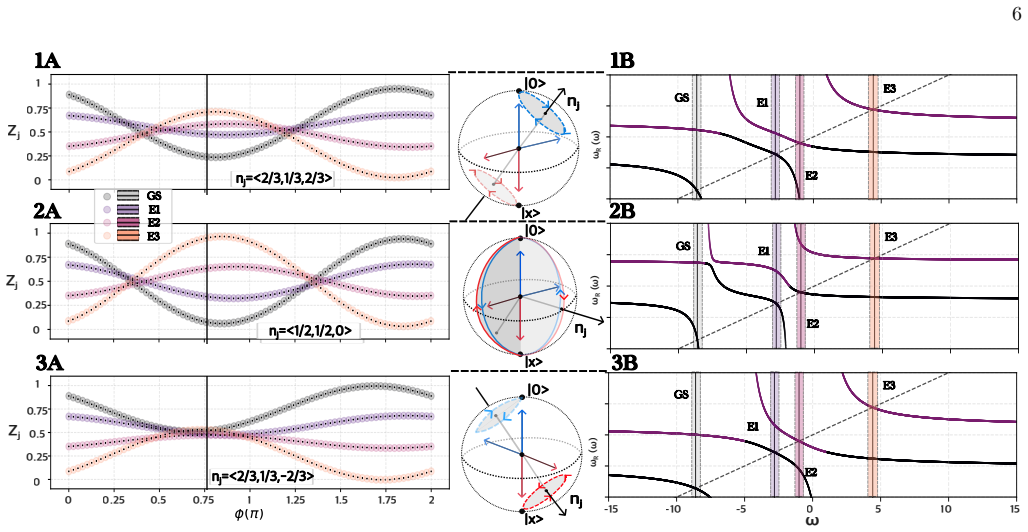
The central object is the renormalized interaction $M(\omega)=C(\omega-H_{R|j})^{-1}C^\dagger$, the Schur complement of the rest-space Hamiltonian, together with the gradient identity $Z_j(\omega_\lambda)=(1-\partial\omega_R/\partial\omega|_{\omega_\lambda})^{-1}$. This machinery turns the inaccessibility of the full Hilbert space into a one-dimensional frequency sweep: the interaction curve $\omega_R(\omega)$ connects the exact eigenvalues, and its slope at each fixed point tells how much of the eigenstate leaks out of the product-state subspace. The coupling kernel $\epsilon K$, defined through $C^\dagger(1/K)C=I_{SOI}\otimes P_j$, then supplies the scale $\sqrt{\epsilon K_{SS}}$ that becomes the Lorentzian width and the Anderson hybridization rate.
What would settle it
Diagonalize a small exactly solvable universe, such as the four-state two-site model used in the paper, and compare the exact degree of separability from Eq. 26 with the Lorentzian prediction of Eq. 34 while increasing the off-diagonal elements $M_{SS'}$ of the renormalized interaction at fixed $\epsilon$; a deviation in the weight factor's lineshape that grows beyond $O(\epsilon^2)$ as $M_{SS'}/M_{SS}$ rises would falsify the claimed correspondence between quasiparticle dissipation and information decay.
Extended reading notes
Core claim
Take any partition of the universe into a system of interest and a bath, and pin a particular bath state $|bath,j\rangle$. The static Hamiltonian $H_S^j = P_j H P_j$ describes the SOI in that frozen bath background; the rest of the bath is integrated out through the Schur complement $M(\omega)=C(\omega-H_{R|j})^{-1}C^\dagger$, giving a renormalized Hamiltonian $H_R^j(\omega)=H_S^j+\epsilon M(\omega)$ on the projected Hilbert space. The exact universe eigenvalues are recovered as fixed points $\omega_\lambda=\omega_R(\omega_\lambda)$. The central identity is that the slope of the interaction curve at a fixed point fixes the degree of separability, $Z_j(\omega_\lambda)=(1-\partial\omega_R/\partial\omega|_{\omega_\lambda})^{-1}=|a^j_\lambda|^2$, and this number lower-bounds the von Neumann entropy of the universe eigenstate. The spectral weight $W_j(\omega_\lambda-\omega_S)=Z_j z_j$ obeys a sum rule and, in the weak-interaction continuum limit, the rescaled weight factor is a Lorentzian with width $\sqrt{\epsilon K_{SS}}$. Comparing with the single-impurity Anderson model, the hybridization rate $|\Delta_0|=D_0 t_0^2$ is replaced by $\sqrt{\epsilon K_{SS}}$, so the rate at which a product state loses separability to the bath is the escape rate of an impurity state to a thermal continuum.
Load-bearing premise
The argument hinges on assuming that, near any eigenenergy, one diagonal piece of the renormalized interaction is much larger than all off-diagonal pieces, and that the interacting state stays nearly equal to the noninteracting state within an energy cutoff; if that is not true, the spectral weight is not a simple Lorentzian and the mapping to the Anderson model breaks down.
Editorial extensions
If this is right
- At any eigenenergy, the slope of the renormalized interaction curve gives a lower bound on the SOI-bath entanglement entropy without constructing the full reduced density matrix.
- In the weak-coupling continuum limit, a bare particle's rescaled spectral weight is a Lorentzian of width $\sqrt{\epsilon K_{SS}}$, so decoherence of a product state and decay of an impurity state are described by the same rate.
- The weight-factor sum rule becomes the normalization condition for the Anderson spectral function, so probability conservation in the many-body problem is inherited by the impurity model.
- The time-domain Green's function $G(t)=-i\Theta(t)e^{-i\omega_S t-|\Delta_0|t}$ separates coherent oscillation from exponential decoherence, giving a direct prescription for modelling open-system dynamics.
- Scanning interaction parameters with the maximum separability over bath states identifies regions where the bath acts as an effective classical external potential.
Reading between the lines
- A concrete consequence the authors do not spell out: in a weakly coupled open system, the measured decoherence rate of a system of interest should equal the quasiparticle spectral width $\sqrt{\epsilon K_{SS}}$; comparing the two experimentally would decide whether the correspondence is quantitative.
- The Lorentzian regime could be mapped by exact diagonalization of small models: computing $Z_j$ from Eq. 26 and fitting the weight factor to Eq. 34 would locate where off-diagonal interaction elements break the RPA-style assumption.
- Because the degree of separability depends on the chosen bath pointer state, optimizing over unitary bath transformations could produce a state-dependent entanglement witness for open systems, a direction the numerical scans only hint at.
- The paper's non-Hermitian two-level picture raises the possibility that dissipation and information loss share a single effective Hamiltonian beyond weak coupling, but that extension is left unproven.
Editorial analysis
A structured set of objections, weighed in public.
Referee Report
Summary. The paper introduces a projection-operator formalism, in the spirit of Nakajima-Zwanzig, to study the renormalized interaction between a system of interest (SOI) and a bath. The central object is the frequency-dependent renormalized Hamiltonian H_j^R(ω) = H_j^S + εM(ω), whose fixed-point solutions reproduce the exact eigenvalues of the full universe. The authors define a degree of separability Z_j(ω_λ) via the overlap between an eigenstate of the renormalized Hamiltonian and the universe eigenstate, and prove that Z_j sets a lower bound on the SOI-bath entanglement entropy. They further derive exact expressions for Z_j in terms of the coupling kernel K, and in the weak-coupling continuum limit approximate the weight factor as a Lorentzian with width √(εK_SS). This leads to the paper's central claim: the rescaled weight factor equals the Anderson impurity spectral function, so that the rate of information loss from the SOI corresponds to the quasiparticle decay rate in a single-impurity Anderson model. A numerical study of the maximum separability for a two-site fermionic model is presented.
Significance. If the central correspondence were rigorously established, it would offer a conceptually appealing connection between quasiparticle dissipation and decoherence in open quantum systems. The exact identities (Eqs. 19 and 26) and the entropy bound (Appendix) are clean and appear algebraically sound. The numerical study of Z_j and its parameter dependence provides a useful demonstration of the separability measure. However, the main claim is currently supported only by an uncontrolled Lorentzian ansatz, and the continuum normalization used to make the SIAM identification is arithmetically inconsistent. These issues must be resolved before the correspondence can be considered established.
major comments (4)
- [Weak Interaction Limit, Eq. (36)] The continuum normalization in Eq. (36) is inconsistent with the discrete sum rule. Equation (22) fixes Σ_λ W_j(ω_λ-ω_S)=1. With Eq. (35), W_j = W̃_j/(π√(εK_SS)), and the Lorentzian W̃_j in Eq. (34) integrates to unity, the continuum limit of the sum rule is ∫ dω ρ(ω) W̃_j(ω)/(π√(εK_SS)) = 1, which requires ρ(ω) = π√(εK_SS). But Eq. (36) states ρ(ω) = 1/(π√(εK_SS)), giving the integral (π√(εK_SS))^{-2} instead of 1. The identification A(ω-ω_S) ≡ W̃_j in Eq. (41) is therefore not self-consistent as written. The density of states and the normalization need to be re-derived or the definition of W̃_j adjusted.
- [Weak Interaction Limit, Eqs. (32)-(34)] The Lorentzian form Eq. (34) is the load-bearing step for the SIAM correspondence, yet it rests on unproven assumptions. The assertion z_j(ω_S^λ) ≈ 1 + O(ε²) from Eq. (32) fails whenever a static level spacing |ω_S - ω_S'| is comparable to or smaller than ε|M_SS'|; no such regime is excluded. The diagonal dominance M_SS ≫ M_SS' is introduced by analogy to RPA, without an error bound or a regime of validity. Since Eq. (34) is the basis for Eq. (41), the authors should either derive Eq. (34) with controlled errors or verify it numerically in a model with a large bath.
- [Numerical Demonstration, Figs. 2-4] The numerical section only computes the degree of separability Z_j for a four-state model; it does not test the central Lorentzian result Eq. (34) or the sum rule Eq. (36). The four-state model has only four eigenvalues, so the continuum limit Λ→∞, in which the Lorentzian and the SIAM mapping are defined, is not probed. A direct test of Eq. (34) in a model with many bath states (or an analytic computation of the next-order corrections) is needed to support the central claim.
- [Correspondence between quasiparticle dissipation and quantum information decay, Eq. (41)] The correspondence with the SIAM is established by identifying |Δ_0| ≡ √(εK_SS) and A(ω-ω_S) ≡ W̃_j(ω-ω_S), rather than by deriving one spectral function from the other. This is circular in the sense that the Lorentzian width is set equal by fiat; the physical content of the mapping therefore resides entirely in the (unproven) Lorentzian form of Eq. (34). The authors should make clear what is being derived versus what is being defined, and provide independent evidence that the weight factor actually takes the Anderson form.
minor comments (5)
- [Correspondence section, repeated paragraph] The paragraph beginning 'This formulation provides an alternative method for systematically identifying regions...' appears twice, once after Fig. 3 and again in the 'Correspondence between quasiparticle dissipation and quantum information decay' section; one copy should be removed.
- [General, cross-references] Several cross-references are off: in the main text, 'Eq. 55' and 'Eq. 56' refer to appendix equations, while the renormalized Hamiltonian is introduced in Eq. (10); please update these references to the correct equation numbers.
- [Eqs. (17), (50)-(54)] The symbol 'Log' is used for the logarithm in entropy expressions; it should be defined or replaced by 'ln' for mathematical consistency.
- [Eq. (30)] Equation (30) uses 'Exp' rather than 'exp'; the notation should be standardized throughout the manuscript.
- [References to supplementary material] The main text refers to 'supplementary material' for the entropy bound and the z_j approximation, but these derivations appear in the appendices of the same manuscript; please update the references accordingly.
Circularity Check
The SIAM correspondence is established by defining A ≡ W̃ and |Δ0| ≡ √εKSS, so the central mapping reduces to an identity; the exact Z_j formalism and numerics remain independent.
-
self definitional
[Section 'Correspondence between quasiparticle dissipation and quantum information decay', Eq. 41]
"It is evident that the impurity spectral function defined in Eq. 40 shares an identical standard Lorentzian dependence with the rescaled weight factor described in Eq. 34 by substituting the following: |∆0| ≡ √(εKSS), A(ω−ωS)≡ W̃j(ω−ωS). (41)"
The claimed correspondence is not derived from the SIAM parameters (D0, t0) or from an independent calculation of the impurity Green's function; instead the SIAM width |Δ0| is defined to equal √εKSS and the SIAM spectral function A is defined to equal the rescaled weight factor W̃. Since W̃ was already constructed as the Lorentzian in Eq. 34, every Lorentzian produced by the model is mapped to an Anderson spectral function by setting |Δ0| to its width. The central result—that the degree of separability 'corresponds to' the SIAM spectral weight—is therefore true by construction rather than by derivation, and the decay interpretation in Eq. 42 inherits this definitional identification.
full rationale
The exact projection formalism (Eqs. 10–26) is self-contained: Z_j is derived from the Schur complement and the gradient formula, and the entropy lower bound is proved in the appendix. The numerics in Figs. 2–4 test Z_j directly. The circularity burden is concentrated in the passage from the Lorentzian weight factor to the SIAM. Eq. 34 produces a normalized Lorentzian W̃ from uncontrolled assumptions (z_j≈1, M_SS≫M_SS'), and Eq. 41 then stipulates |Δ0| ≡ √εKSS and A ≡ W̃. The 'correspondence to the Anderson spectral function' is thus an act of naming, not a derivation: no independent calculation shows that the SIAM's D0(t0)^2 equals √εKSS; rather, the SIAM width is defined to match. Consequently the decay-rate interpretation (Eq. 42) is the Lorentzian width relabeled as |Δ0|. I additionally note an arithmetic inconsistency in Eq. 36: with W_j = W̃_j/(π√εKSS) from Eq. 35 and ρ=(π√εKSS)^{-1}, the continuum sum gives (π√εKSS)^{-2}, not 1; this is a correctness issue that further weakens the SIAM identification, but it is not itself a circular step. Self-citations are absent as load-bearing devices; the RPA analogy is motivational only. Net: partial circularity, score 6.
Assumptions & free parameters
free parameters (3)
- Energy cutoff Ω
- Diagonal kernel element K_SS =
matrix element of K = U Γ Γ† U (SVD of the coupling C)
- Perturbation parameter ε =
small, in practice ε→0
assumptions (5)
- domain assumption The universe Hamiltonian H is non-degenerate with Λ unique eigenvalues, and D_SOI ≤ D_bath.
- ad hoc to paper There exists an interaction kernel K such that C†(1/K)C = I (identity on the projected space).
- ad hoc to paper Weak-coupling assumptions: z_j(ω) ≈ 1 within the cutoff Ω, diagonal dominance M_SS ≫ M_SS', and linear frequency variation near fixed points.
- domain assumption Flat-band continuum: density of states and coupling are constants in the SIAM mapping.
- standard math For any bipartite pure state, fixing one probability Z_j, the entropy is minimized by the binary distribution (Z_j, 1-Z_j).
invented entities (2)
-
Fictitious particle with energy m_φ = ω_S and exchange energy ±|Δ_0|
-
Interaction kernel K
Cite this review
Pith. "Pith review of Correspondence between quasiparticle dissipation and quantum information decay in open quantum systems." pith.science (2026). https://pith.science/paper/3N4FGGCL
@misc{pith2026250608498,
  author       = {Pith},
  title        = {Pith review of: Correspondence between quasiparticle dissipation and quantum information decay in open quantum systems},
  year         = {2026},
  howpublished = {\url{https://pith.science/paper/3N4FGGCL}},
  note         = {Machine review of arXiv:2506.08498}
}
read the original abstract
Diagrammatic techniques simplify a weakly interacting many-body problem into an effective few-quasiparticle problem within a system of interest (SOI). If scattering events, mediated by a bath, between those quasiparticles can be approximated as density-density interactions, the bath behaves like an effective external potential. On the other hand, exchange interactions could entangle those quasiparticles and the bath, leading to an open quantum system that induces quantum decoherence and spectral broadening. We investigate the renormalized interaction between the SOI and the bath, employing a projection operator technique similar to the one used in the Nakajima-Zwanzig method. We find that the frequency variation of this renormalized interaction is analogous to the quasiparticle residue and provides a measure of the SOI-bath separability that serves as the lower bound of the SOI-bath entanglement entropy. In the weak-coupling regime and continuum limit, we demonstrate that the degree of SOI-bath separability corresponds to the quasiparticle spectral weight in the single-impurity Anderson model and find that the loss of quantum information to the continuum of the bath can be understood as a decay process where an initial single-impurity state escapes to a thermal bath. This work provides a direction for connecting energy dissipation in quasiparticles propagation to the loss of quantum information in open quantum systems.
Figures


Figures from the paper (3 more)


Reference graph
Works this paper leans on
-
[1]
Robert Zwanzig. Ensemble Method in the Theory of Irre- versibility.The Journal of Chemical Physics, 33(5):1338– 1341, 11 1960
work page 1960
-
[2]
H.P. Breuer and F. Petruccione.The Theory of Open Quantum Systems. Oxford University Press, 2002
work page 2002
-
[3]
Anderson.Basic Notions Of Condensed Matter Physics
P.W. Anderson.Basic Notions Of Condensed Matter Physics. Advanced Book Classics. Taylor & Francis Lim- ited (Sales), 2019
work page 2019
-
[4]
A. J. Leggett, S. Chakravarty, A. T. Dorsey, Matthew P. A. Fisher, Anupam Garg, and W. Zwerger. Dynamics of the dissipative two-state system.Rev. Mod. Phys., 59:1–85, Jan 1987
1987
-
[5]
Nonequilibrium dynamical mean-field theory and its applications.Rev
Hideo Aoki, Naoto Tsuji, Martin Eckstein, Marcus Kol- lar, Takashi Oka, and Philipp Werner. Nonequilibrium dynamical mean-field theory and its applications.Rev. Mod. Phys., 86:779–837, Jun 2014
work page 2014
- [6]
-
[7]
Kotliar, S
G. Kotliar, S. Y. Savrasov, K. Haule, V. S. Oudovenko, O. Parcollet, and C. A. Marianetti. Electronic structure calculations with dynamical mean-field theory.Rev. Mod. Phys., 78:865–951, Aug 2006
2006
-
[8]
Martin, Lucia Reining, and David M
Richard M. Martin, Lucia Reining, and David M. Ceper- ley.Interacting Electrons: Theory and Computational Approaches , chapter 7, 16, page 147, 423. Cambridge University Press, 2016
work page 2016
Show all 42 references
-
[9]
B. M. Garraway. Nonperturbative decay of an atomic system in a cavity.Phys. Rev. A, 55:2290–2303, Mar 1997
1997
-
[10]
Modelling the ultra-strongly coupled spin- boson model with unphysical modes.Nature Communi- cations, 10(1):3721, Aug 2019
Neill Lambert, Shahnawaz Ahmed, Mauro Cirio, and Franco Nori. Modelling the ultra-strongly coupled spin- boson model with unphysical modes.Nature Communi- cations, 10(1):3721, Aug 2019
2019
-
[11]
Effective-hamiltonian theory of open quantum systems at strong coupling.PRX Quantum, 4:020307, Apr 2023
Nicholas Anto-Sztrikacs, Ahsan Nazir, and Dvira Segal. Effective-hamiltonian theory of open quantum systems at strong coupling.PRX Quantum, 4:020307, Apr 2023
2023
-
[12]
Separability criterion for density matrices
Asher Peres. Separability criterion for density matrices. Phys. Rev. Lett., 77:1413–1415, Aug 1996
1996
-
[13]
David Mermin
N. David Mermin. Hidden variables and the two theorems of john bell.Rev. Mod. Phys., 65:803–815, Jul 1993
1993
-
[14]
J. S. Bell. On the einstein podolsky rosen paradox. Physics Physique Fizika, 1:195–200, Nov 1964
1964
-
[15]
Colloquium: Non-markovian dy- namics in open quantum systems.Rev
Heinz-Peter Breuer, Elsi-Mari Laine, Jyrki Piilo, and Bassano Vacchini. Colloquium: Non-markovian dy- namics in open quantum systems.Rev. Mod. Phys., 88:021002, Apr 2016. 12
2016
-
[16]
Signatures of non- classicality in mixed-state quantum computation.Phys
Animesh Datta and Sevag Gharibian. Signatures of non- classicality in mixed-state quantum computation.Phys. Rev. A, 79:042325, Apr 2009
2009
-
[17]
Paolo Giorda and Matteo G. A. Paris. Gaussian quantum discord.Phys. Rev. Lett., 105:020503, Jul 2010
2010
-
[18]
Harold Ollivier and Wojciech H. Zurek. Quantum dis- cord: A measure of the quantumness of correlations. Phys. Rev. Lett., 88:017901, Dec 2001
2001
-
[19]
Necessary and sufficient condition for nonzero quantum discord.Phys
Borivoje Daki´ c, Vlatko Vedral, and ˇCaslav Brukner. Necessary and sufficient condition for nonzero quantum discord.Phys. Rev. Lett., 105:190502, Nov 2010
2010
-
[20]
Clark, and Almut Beige
Kawthar Al Rasbi, Lewis A. Clark, and Almut Beige. Quantum physics cannot be captured by classical linear hidden variable theories even in the absence of entangle- ment.Frontiers in Physics, 12, 2024
2024
-
[21]
A short introduction to the Lindblad master equation.AIP Advances, 10(2):025106, 02 2020
Daniel Manzano. A short introduction to the Lindblad master equation.AIP Advances, 10(2):025106, 02 2020
2020
-
[22]
Landi, Dario Poletti, and Gernot Schaller
Gabriel T. Landi, Dario Poletti, and Gernot Schaller. Nonequilibrium boundary-driven quantum systems: Models, methods, and properties.Rev. Mod. Phys., 94:045006, Dec 2022
2022
-
[23]
Akihito Ishizaki and Yoshitaka Tanimura. Quantum dy- namics of system strongly coupled to low-temperature colored noise bath: Reduced hierarchy equations ap- proach.Journal of the Physical Society of Japan, 74(12):3131–3134, 2005
2005
-
[24]
Stochastic liouville, langevin, fokker–planck, and master equation approaches to quan- tum dissipative systems.Journal of the Physical Society of Japan, 75(8):082001, 2006
Yoshitaka Tanimura. Stochastic liouville, langevin, fokker–planck, and master equation approaches to quan- tum dissipative systems.Journal of the Physical Society of Japan, 75(8):082001, 2006
2006
-
[25]
Ahsan Nazir and Gernot Schaller.The Reaction Coordi- nate Mapping in Quantum Thermodynamics, pages 551–
-
[26]
Capturing non-markovian dynamics with the reaction coordinate method.Phys
Nicholas Anto-Sztrikacs and Dvira Segal. Capturing non-markovian dynamics with the reaction coordinate method.Phys. Rev. A, 104:052617, Nov 2021
2021
-
[27]
Levenson-Falk, and Kater W
Chandrashekhar Gaikwad, Daria Kowsari, Carson Brame, Xingrui Song, Haimeng Zhang, Martina Es- posito, Arpit Ranadive, Giulio Cappelli, Nicolas Roch, Eli M. Levenson-Falk, and Kater W. Murch. Entangle- ment assisted probe of the non-markovian to markovian transition in open qua...
2024
-
[28]
J. J. Sakurai and Jim Napolitano.Modern Quantum Me- chanics. Cambridge University Press, 2 edition, 2017
2017
-
[29]
Speeding up gw calculations to meet the challenge of large scale quasiparticle predictions.Scientific Reports, 6(1):36849, Nov 2016
Weiwei Gao, Weiyi Xia, Xiang Gao, and Peihong Zhang. Speeding up gw calculations to meet the challenge of large scale quasiparticle predictions.Scientific Reports, 6(1):36849, Nov 2016
2016
-
[30]
Ugeda, Aaron J
Miguel M. Ugeda, Aaron J. Bradley, Su-Fei Shi, Fe- lipe H. da Jornada, Yi Zhang, Diana Y. Qiu, Wei Ruan, Sung-Kwan Mo, Zahid Hussain, Zhi-Xun Shen, Feng Wang, Steven G. Louie, and Michael F. Crommie. Gi- ant bandgap renormalization and excitonic effects in a monolayer transiti...
2014
-
[31]
Strubbe, Manish Jain, Marvin L
Jack Deslippe, Georgy Samsonidze, David A. Strubbe, Manish Jain, Marvin L. Cohen, and Steven G. Louie. Berkeleygw: A massively parallel computer package for the calculation of the quasiparticle and optical proper- ties of materials and nanostructures.Computer Physics Communica...
2012
-
[32]
Latorre, Arnau Riera, and Karol ˙Zyczkowski
Dardo Goyeneche, Daniel Alsina, Jos´ e I. Latorre, Arnau Riera, and Karol ˙Zyczkowski. Absolutely maximally en- tangled states, combinatorial designs, and multiunitary matrices.Phys. Rev. A, 92:032316, Sep 2015
2015
-
[33]
Sch¨ afer, A
T. Sch¨ afer, A. Toschi, and Jan M. Tomczak. Separability of dynamical and nonlocal correlations in three dimen- sions.Phys. Rev. B, 91:121107, Mar 2015
2015
-
[34]
Simons.Condensed Mat- ter Field Theory
Alexander Altland and Ben D. Simons.Condensed Mat- ter Field Theory. Cambridge University Press, 2 edition, 2010
2010
-
[35]
Walls and G.J
D.F. Walls and G.J. Milburn.Quantum Optics. Springer Berlin Heidelberg, 2008
2008
-
[36]
Avoided surface crossings.Journal of the American Chemical Society, 97(3):479–487, Feb 1975
Lionel Salem, Claude Leforestier, Gerald Segal, and Ross Wetmore. Avoided surface crossings.Journal of the American Chemical Society, 97(3):479–487, Feb 1975
1975
-
[37]
B. A. Lippmann and Julian Schwinger. Variational prin- ciples for scattering processes. i.Phys. Rev., 79:469–480, Aug 1950
1950
-
[38]
Heßelmann and A
A. Heßelmann and A. G¨ orling. Random-phase approx- imation correlation methods for molecules and solids. Molecular Physics, 109(21):2473–2500, 2011
2011
-
[39]
P. W. Anderson. Localized magnetic states in metals. Phys. Rev., 124:41–53, Oct 1961
1961
-
[40]
Beckey, N
Jacob L. Beckey, N. Gigena, Patrick J. Coles, and M. Cerezo. Computable and operationally meaningful multipartite entanglement measures.Phys. Rev. Lett., 127:140501, Sep 2021
2021
-
[41]
Cullen and Pieter Kok
Alice R. Cullen and Pieter Kok. Calculating concen- tratable entanglement in graph states.Phys. Rev. A, 106:042411, Oct 2022. Appendix Fixed point solutionThe fixed point equationω λ =ω R(ωλ) can be expanded at linear order around a fixed point, (ωλ −ω S ) + ωS −ω R(ωS )− ∂ωR(...
2022
-
[577]
Springer International Publishing, Cham, 2018
2018
Reviewed August 7, 2026 · model on record in the stance chip above.
Discussion (0). Sign in to comment.