REVIEW 6 major objections 6 minor 47 references
MasHost Builds It All: Autonomous Multi-Agent System Directed by Reinforcement Learning
T0 review · 6 major / 6 minor · reviewed 2026-08-07 · deepseek-v4-flash
Pith's one-line read MasHost claims to be the first reinforcement-learning framework that constructs query-adaptive multi-agent systems from scratch, reporting the best average accuracy across six benchmarks.
desk verdict A workable RL recipe for building MAS graphs from a role pool, but the 'full autonomy' and benchmark claims run ahead of the evidence; worth refereeing rather than desk-rejecting. read the letter →
The pith
A machine-rendered reading of the paper's core claim, the machinery that carries it, and where it could break.
The reading
What carries the argument
Two mechanisms carry the argument. Joint Probabilistic Space Sampling treats role selection and connectivity as one differentiable action: the node policy produces a softmax over roles plus DELETE and EXIT, and the edge policy produces per-edge sigmoid scores that are multiplied by the selected role's probability before sampling. Hierarchical Relative Policy Optimization is the training objective: it adds a group-relative advantage, comparing accuracy and token cost across a group of constructed multi-agent systems, to an action-wise absolute reward that rewards reaching the correct answer and penalizes disrupting it, with an exemption time protecting early structure-building actions.
What would settle it
Run MasHost on queries from domains outside the role pool, such as legal reasoning or creative writing, without adding roles; if performance collapses to single-agent levels or the constructed graphs use obviously irrelevant roles, the full-space autonomous role-selection claim is falsified.
Extended reading notes
Core claim
The central claim is that the full construction of a multi-agent system, including which agents exist and how they communicate, can be posed as a graph-search problem and solved by reinforcement learning. MasHost's policy samples node-level actions from the union of a role pool and special DELETE and EXIT actions; whenever a role is added, a second policy samples edges to existing agents using joint probabilities that combine the role's selection probability with per-edge scores. Training uses Hierarchical Relative Policy Optimization, which combines a group-relative advantage over a batch of constructed systems, rewarding correct answers while penalizing token use, with an action-wise absolute reward that penalizes actions breaking a correct answer and protects early exploration through an exemption time. The paper reports that this yields the best accuracy among all compared methods on GSM8K, MATH, MMLU, GPQA, MBPP, and HumanEval, with an absolute improvement of up to 1.47% on GSM8K and an average of 74.20, while using fewer tokens than GPTSwarm, AFlow, and MaAS on MATH.
Load-bearing premise
The autonomy claim rests on the assumption that the hand-curated global role pool in the role prompts section is not implicitly fitted to the six evaluation benchmarks; if it is, MasHost is a larger candidate-pool sampler rather than a free explorer of the full role space.
Editorial extensions
If this is right
- Reinforcement-learning-discovered multi-agent graphs can beat hand-crafted workflows and prior semi-autonomous search on standard math, QA, and code benchmarks using a single cheap executor, GPT-4o-mini.
- Joint sampling of roles and edges makes full-graph construction tractable as a differentiable RL problem, removing the need for a predefined structure pool or task-level workflow.
- Adding structural rationality as an explicit reward objective prevents both redundant and oversimplified systems: removing one agent from a constructed system drops performance, while adding one degrades it slightly.
- MasHost is cost-competitive: on MATH it uses 3,630 prompt tokens and 3,698 completion tokens, cheaper than GPTSwarm, AFlow, and MaAS.
- Ablations attribute the largest performance drop to removing the hierarchical reward, indicating that the multi-level reward design is the main driver of the reported gains.
Reading between the lines
- The 'entire role space' in the autonomy argument is, in implementation, the hand-curated pool of the role prompts section, with human-written responsibilities and assist or reject conditions; a decisive test would be whether MasHost can handle queries whose useful roles are absent from that pool.
- Because reported averages come from five runs and no significance intervals are given, the 1.47% GSM8K gap over MaAS could be within run-to-run noise; a re-analysis with variance would settle how robust the lead is.
- The joint probability scaling couples role relevance with edge confidence, so low-probability roles are less likely to receive connections even when they are the right collaborator; an unnormalized or calibrated variant might behave differently.
- If the learned policies transfer across executor models, the same RL-trained graphs could be reused with cheaper or stronger LLMs, turning multi-agent system construction into a meta-learned capability rather than a per-benchmark artifact.
Editorial analysis
A structured set of objections, weighed in public.
Referee Report
Summary. The paper proposes MasHost, a reinforcement learning framework that formulates multi-agent system (MAS) construction as a graph-search problem. It introduces Joint Probabilistic Space Sampling (JPSS) to jointly sample agent roles and connectivity, and Hierarchical Relative Policy Optimization (HRPO) to optimize a reward combining performance, token efficiency, and component rationality. Experiments on six benchmarks (GSM8K, MATH, GPQA, MMLU, HumanEval, MBPP) with GPT-4o-mini report an average accuracy of 74.20, claimed to be the best among all compared methods, and the paper argues that this demonstrates autonomous, query-adaptive, and human-bias-free MAS construction.
Significance. If the central claims were fully supported, the paper would make a useful contribution: it extends adaptive MAS design beyond candidate-pool sampling by treating role and edge selection as a jointly learned probabilistic policy, and it introduces a hierarchical reward structure that is not present in the main baselines. The authors also provide an unusually broad baseline comparison across single-agent, handcrafted, workflow, and semi-autonomous MAS methods, and they report cost comparisons. However, the paper's strongest claims—full autonomy, freedom from human biases, consistency of best performance, and 100% role-query correlation—are not currently supported by the evidence, because the role space is hand-curated, several hyperparameters are tuned on the same test benchmarks, and the performance margins over the strongest baseline are small and reported without variance or significance tests.
major comments (6)
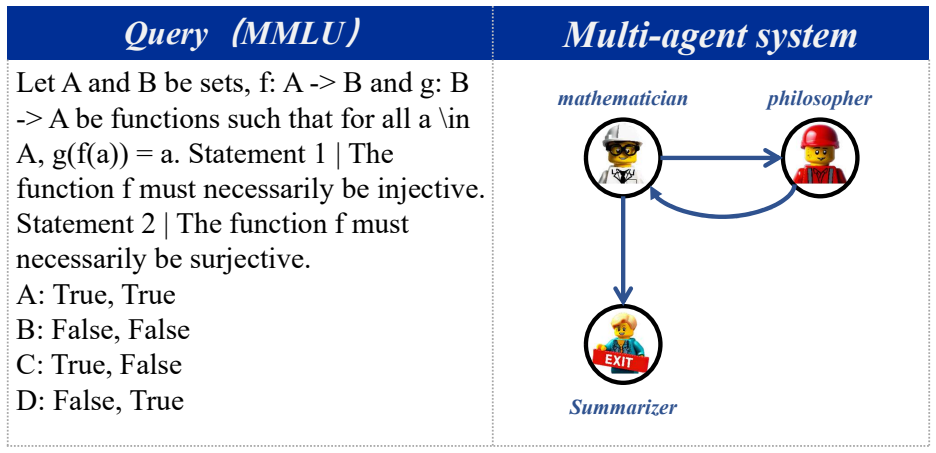
- [Sec. 5 and Sec. 6.9] The autonomy claim is contradicted by the implementation. Section 5 states that role sampling 'operates over the entire role space' without 'human-imposed restrictions,' but Algorithm 1 requires a 'full-scale role pool' and Sec. 6.9 describes a hand-curated global role pool whose entries contain human-written Responsibilities, Assist Conditions, and Reject Conditions. The visualized systems in Figs. 6–10 use roles such as Algebra Solver for GSM8K and Coding Algorithm Specialist for HumanEval, which are direct matches to the benchmarks. Under this reading, MasHost is an RL-driven candidate-pool method of the same general kind criticized in Sec. 3, and the 100% role-query correlation in Sec. 6.4 may simply reflect the policy learning to invoke roles whose Assist Conditions already encode the query-to-task mapping. The authors should either provide evidence that the role pool is not adapted to the six benchmarks (e.g., out-of-domain queries, systematic removal of task-specific roles, or a role pool built without access to benchmark categories) or substantially soften the 'full autonomy' and 'free from human biases' claims.
- [Sec. 6.6 and Sec. 6.8] Hyperparameters are tuned on the same benchmarks used for the headline numbers. Section 6.6 selects TE=3 and nr=4 from sensitivity curves on GSM8K and HumanEval, and Sec. 6.8 sets β separately for GSM8K (0.0001) and for the other datasets (0.00001). Since these very benchmarks appear in Table 1, the reported improvements may reflect test-set tuning rather than a generally applicable configuration. The authors should move hyperparameter selection to a validation split or an auxiliary set, or report results for a fixed configuration chosen without access to the evaluated test sets.
- [Table 1 and Sec. 6.2] The claim that MasHost 'consistently achieves the best performance among all compared methods' is not supported by the table. On HumanEval, MasHost scores 89.96 while MaAS scores 90.09, so MasHost is not the best on that benchmark. Moreover, Table 1 reports 'average performance across five independent runs' but gives no standard deviations, confidence intervals, or significance tests; the average margin over MaAS is only 0.64 points (74.20 vs. 73.56), and on several datasets the difference is below 1 point. The authors should report per-run variance and conduct paired significance tests (e.g., bootstrap or matched-pair tests) before claiming consistent superiority.
- [Sec. 6.4] The 'correlation matching strategy' used to claim 100% role-query correlation is not described. Without a precise definition of how a role is deemed 'relevant' to a query, a perfect correlation score is not interpretable, especially because the role definitions in Sec. 6.9 already contain Assist Conditions such as 'General mathematics questions' or 'General biology questions.' The authors should specify the matching algorithm, report the actual role-query pairs, and ideally compare against a baseline that samples roles uniformly from the same pool to show that the policy's role choices are informative beyond the pool's built-in category structure.
- [Eqs. (4)–(6) and Sec. 2.2] The action-wise reward in Eq. (5) requires judging the intermediate output O_t against the ground truth Y at every construction step, but the paper does not explain how O_t is obtained or evaluated for free-form generation tasks such as MATH, GPQA, or code generation. It is also unclear whether the policy receives this reward only at training time (which is legitimate) or whether the reward computation itself relies on evaluators that could leak information during test-time construction. The authors should clarify the protocol for comparing partial agent outputs to ground truth, and should state how O_t is defined when the current MAS has not yet produced a final answer.
- [Sec. 4.1 and Algorithm 1] Algorithm 1 samples a relative group of four MAS instances at every step (line 5) and then updates the policy inside the same loop, but the group-relative advantage in Eq. (4) is defined over a group G of L full MAS instances sampled from the old policy. This discrepancy between the per-step online group construction in Algorithm 1 and the batch-level formulation in Sec. 4.2 is not reconciled, and L is never specified. The authors should clarify whether the group is formed per step or per episode, and how the group rewards are aggregated over time.
minor comments (6)
- [Abstract and Sec. 6.2] The abstract says 'consistently outperforms most competitive baselines' while Sec. 6.2 says 'consistently achieves the best performance among all compared methods'; these statements are inconsistent and should be aligned.
- [Sec. 4.1] The token 'DELTE' appears in the enumeration of actions and should be corrected to 'DELETE'.
- [Sec. 6.4 and Fig. 3] The figure caption contains '(fight)' instead of '(right)', and the label 'M+ M M+' in the middle panel is unclear; the axes and legend should be described more carefully.
- [Table 2] The efficiency comparison is reported only on MATH; since cost is one of the three claimed objectives, the authors should provide cost results for all six benchmarks or explain why MATH alone is representative.
- [Sec. 6.9] The paper states that the global role pool 'includes all known applicable roles' but does not give the total number of roles, the process by which they were collected, or the exact list used in the experiments; the appendix shows only a subset of role prompts.
- [Sec. 6.5] In Table 3, 'Cost' is defined as a relative proportion of total token consumption during training, but the text and table do not specify which configuration is the reference for all rows or whether token counts include policy-network training and LLM inference separately.
Circularity Check
The autonomy claim is definitionally tied to the hand-curated 'global role pool'; benchmark results remain externally grounded.
-
self definitional
[Sec. 4.1, Sec. 5, Algorithm 1, Sec. 6.9]
"role sampling strategy, in contrast to prior methods restricted to task-specific role pools, operates over the entire role space ... Require: Query Q, full-scale role pool R ... Our MasHost relies on a global role pool, which includes all known applicable roles."
The paper defines the node action space as R={R1,...,RK} in Sec. 4.1, and Algorithm 1's only role-sampling input is the 'full-scale role pool R'. Sec. 6.9 then identifies that pool as the hand-authored global role list whose entries carry human-written Responsibilities, Assist Conditions, and Reject Conditions. Consequently, the Sec. 5 claim that role sampling 'operates over the entire role space' is true only by defining the role space to be exactly the human-curated pool. The conclusion that MasHost is 'free from human biases' is not derived from the RL mechanism; it is a relabeling of candidate-pool sampling, the very paradigm criticized in Sec. 3.
full rationale
No self-citation chain is load-bearing in this paper: the headline accuracy numbers in Table 1 are measured against external baselines on standard public benchmarks under a fixed executor (GPT-4o-mini), so they have independent grounding rather than reducing to the method's own fitted values. The one definitional circularity is in the autonomy framing. Sec. 4.1 defines the role space as R={R1,...,RK}, Algorithm 1 samples from a 'full-scale role pool R', and Sec. 6.9 reveals that this pool is a manually curated global role list with hand-written Responsibilities, Assist Conditions, and Reject Conditions. Thus the Sec. 5 statement that role sampling 'operates over the entire role space' is true only by equating 'entire role space' with that human-authored pool, making the 'free from human biases' conclusion definitional rather than derived. This is a load-bearing issue for the claimed novelty of 'fully autonomous Mas construction', but it does not undermine the independent benchmark comparisons. Separately, the sensitivity choices nr=4 and TE=3 are made using GSM8K and HumanEval (Sec. 6.6), the same datasets later reported in Table 1; this is a test-set selection concern that can bias the reported numbers, but it is not a by-construction equivalence, so it is noted rather than counted as a formal circularity step.
Assumptions & free parameters
free parameters (7)
- beta (token-efficiency reward scale) =
0.0001 (GSM8K), 0.00001 (other datasets)
- alpha (action-penalty slope) =
0.1
- TE (exemption time) =
3
- nr (training rounds) =
4
- gamma (discount factor) =
0.9
- epsilon (PPO clip threshold) =
0.1
- Group size L =
4
assumptions (5)
- standard math PPO clipped surrogate objective and importance sampling ratio (Eq 7), and GRPO group-relative normalization (Sec 4.2).
- domain assumption A multi-agent system can be adequately modeled as a directed graph of LLM agents with role attributes and interaction edges.
- domain assumption Ground-truth labels Y and step-wise verifiable intermediate outputs O_t are available for training queries.
- domain assumption The hand-curated global role pool of Sec 6.9 is unbiased and covers the "full-scale role space" claimed in Sec 5.
- ad hoc to paper The "correlation matching strategy" used to claim 100% role-query correlation is valid.
Cite this review
Pith. "Pith review of MasHost Builds It All: Autonomous Multi-Agent System Directed by Reinforcement Learning." pith.science (2026). https://pith.science/paper/LOXMDHK7
@misc{pith2026250608507,
  author       = {Pith},
  title        = {Pith review of: MasHost Builds It All: Autonomous Multi-Agent System Directed by Reinforcement Learning},
  year         = {2026},
  howpublished = {\url{https://pith.science/paper/LOXMDHK7}},
  note         = {Machine review of arXiv:2506.08507}
}
read the original abstract
Large Language Model (LLM)-driven Multi-agent systems (Mas) have recently emerged as a powerful paradigm for tackling complex real-world tasks. However, existing Mas construction methods typically rely on manually crafted interaction mechanisms or heuristic rules, introducing human biases and constraining the autonomous ability. Even with recent advances in adaptive Mas construction, existing systems largely remain within the paradigm of semi-autonomous patterns. In this work, we propose MasHost, a Reinforcement Learning (RL)-based framework for autonomous and query-adaptive Mas design. By formulating Mas construction as a graph search problem, our proposed MasHost jointly samples agent roles and their interactions through a unified probabilistic sampling mechanism. Beyond the accuracy and efficiency objectives pursued in prior works, we introduce component rationality as an additional and novel design principle in Mas. To achieve this multi-objective optimization, we propose Hierarchical Relative Policy Optimization (HRPO), a novel RL strategy that collaboratively integrates group-relative advantages and action-wise rewards. To our knowledge, our proposed MasHost is the first RL-driven framework for autonomous Mas graph construction. Extensive experiments on six benchmarks demonstrate that MasHost consistently outperforms most competitive baselines, validating its effectiveness, efficiency, and structure rationality.
Figures


Figures from the paper (7 more)


Reference graph
Works this paper leans on
-
[1]
Josh Achiam, Steven Adler, Sandhini Agarwal, Lama Ahmad, Ilge Akkaya, Florencia Leoni Aleman, Diogo Almeida, Janko Altenschmidt, Sam Altman, Shyamal Anadkat, et al. Gpt-4 technical report. arXiv preprint arXiv:2303.08774, 2023
arXiv 2023
-
[2]
Program synthesis with large language models
Jacob Austin, Augustus Odena, Maxwell Nye, Maarten Bosma, Henryk Michalewski, David Dohan, Ellen Jiang, Carrie Cai, Michael Terry, Quoc Le, et al. Program synthesis with large language models. arXiv preprint arXiv:2108.07732, 2021
arXiv 2021
-
[3]
Autoagents: A framework for automatic agent generation.arXiv preprint arXiv:2309.17288, 2023
Guangyao Chen, Siwei Dong, Yu Shu, Ge Zhang, Jaward Sesay, Börje F Karlsson, Jie Fu, and Yemin Shi. Autoagents: A framework for automatic agent generation.arXiv preprint arXiv:2309.17288, 2023
arXiv 2023
-
[4]
Evaluating large language models trained on code.arXiv preprint arXiv:2107.03374, 2021
Mark Chen, Jerry Tworek, Heewoo Jun, Qiming Yuan, Henrique Ponde De Oliveira Pinto, Jared Kaplan, Harri Edwards, Yuri Burda, Nicholas Joseph, Greg Brockman, et al. Evaluating large language models trained on code.arXiv preprint arXiv:2107.03374, 2021
arXiv 2021
-
[5]
Training verifiers to solve math word problems.arXiv preprint arXiv:2110.14168, 2021
Karl Cobbe, Vineet Kosaraju, Mohammad Bavarian, Mark Chen, Heewoo Jun, Lukasz Kaiser, Matthias Plappert, Jerry Tworek, Jacob Hilton, Reiichiro Nakano, et al. Training verifiers to solve math word problems.arXiv preprint arXiv:2110.14168, 2021
-
[6]
Yihe Deng and Paul Mineiro. Flow-dpo: Improving llm mathematical reasoning through online multi- agent learning.arXiv preprint arXiv:2410.22304, 2024
arXiv 2024
-
[7]
Improving factuality and reasoning in language models through multiagent debate
Yilun Du, Shuang Li, Antonio Torralba, Joshua B Tenenbaum, and Igor Mordatch. Improving factuality and reasoning in language models through multiagent debate. InForty-first International Conference on Machine Learning, 2023
2023
-
[8]
Taicheng Guo, Xiuying Chen, Yaqi Wang, Ruidi Chang, Shichao Pei, Nitesh V Chawla, Olaf Wiest, and Xiangliang Zhang. Large language model based multi-agents: A survey of progress and challenges.arXiv preprint arXiv:2402.01680, 2024
arXiv 2024
Show all 47 references
-
[9]
Measuring massive multitask language understanding.arXiv preprint arXiv:2009.03300, 2020
Dan Hendrycks, Collin Burns, Steven Basart, Andy Zou, Mantas Mazeika, Dawn Song, and Jacob Steinhardt. Measuring massive multitask language understanding.arXiv preprint arXiv:2009.03300, 2020
2009 arXiv
-
[10]
Measuring mathematical problem solving with the math dataset.arXiv preprint arXiv:2103.03874, 2021
Dan Hendrycks, Collin Burns, Saurav Kadavath, Akul Arora, Steven Basart, Eric Tang, Dawn Song, and Jacob Steinhardt. Measuring mathematical problem solving with the math dataset.arXiv preprint arXiv:2103.03874, 2021
2021 arXiv
-
[11]
Metagpt: Meta programming for multi-agent collaborative framework.arXiv preprint arXiv:2308.00352, 3(4):6, 2023
Sirui Hong, Xiawu Zheng, Jonathan Chen, Yuheng Cheng, Jinlin Wang, Ceyao Zhang, Zili Wang, Steven Ka Shing Yau, Zijuan Lin, Liyang Zhou, et al. Metagpt: Meta programming for multi-agent collaborative framework.arXiv preprint arXiv:2308.00352, 3(4):6, 2023
2023 arXiv
-
[12]
Automated design of agentic systems.arXiv preprint arXiv:2408.08435, 2024
Shengran Hu, Cong Lu, and Jeff Clune. Automated design of agentic systems.arXiv preprint arXiv:2408.08435, 2024
2024 arXiv
-
[13]
Self-organized agents: A llm multi-agent framework toward ultra large-scale code generation and optimization.arXiv preprint arXiv:2404.02183, 2024
Yoichi Ishibashi and Yoshimasa Nishimura. Self-organized agents: A llm multi-agent framework toward ultra large-scale code generation and optimization.arXiv preprint arXiv:2404.02183, 2024
2024 arXiv
-
[14]
Reinforcement learning: A survey
Leslie Pack Kaelbling, Michael L Littman, and Andrew W Moore. Reinforcement learning: A survey. Journal of artificial intelligence research, 4:237–285, 1996
1996
-
[15]
The dawn of natural language to sql: are we fully ready?arXiv preprint arXiv:2406.01265, 2024
Boyan Li, Yuyu Luo, Chengliang Chai, Guoliang Li, and Nan Tang. The dawn of natural language to sql: are we fully ready?arXiv preprint arXiv:2406.01265, 2024
2024 arXiv
-
[16]
Codetree: Agent- guided tree search for code generation with large language models.arXiv preprint arXiv:2411.04329, 2024
Jierui Li, Hung Le, Yingbo Zhou, Caiming Xiong, Silvio Savarese, and Doyen Sahoo. Codetree: Agent- guided tree search for code generation with large language models.arXiv preprint arXiv:2411.04329, 2024. 24
2024 arXiv
-
[17]
Personal llm agents: Insights and survey about the capability, efficiency and security.arXiv preprint arXiv:2401.05459, 2024
Yuanchun Li, Hao Wen, Weijun Wang, Xiangyu Li, Yizhen Yuan, Guohong Liu, Jiacheng Liu, Wenxing Xu, Xiang Wang, Yi Sun, et al. Personal llm agents: Insights and survey about the capability, efficiency and security.arXiv preprint arXiv:2401.05459, 2024
2024 arXiv
-
[18]
Deep reinforcement learning: An overview.arXiv preprint arXiv:1701.07274, 2017
Yuxi Li. Deep reinforcement learning: An overview.arXiv preprint arXiv:1701.07274, 2017
2017 arXiv
-
[19]
Dynamic llm-agent network: An llm-agent collaboration framework with agent team optimization.arXiv preprint arXiv:2310.02170, 2023
Zijun Liu, Yanzhe Zhang, Peng Li, Yang Liu, and Diyi Yang. Dynamic llm-agent network: An llm-agent collaboration framework with agent team optimization.arXiv preprint arXiv:2310.02170, 2023
2023 arXiv
-
[20]
Large language model agent: A survey on methodology, applications and challenges.arXiv preprint arXiv:2503.21460, 2025
Junyu Luo, Weizhi Zhang, Ye Yuan, Yusheng Zhao, Junwei Yang, Yiyang Gu, Bohan Wu, Binqi Chen, Ziyue Qiao, Qingqing Long, et al. Large language model agent: A survey on methodology, applications and challenges.arXiv preprint arXiv:2503.21460, 2025
2025 arXiv
-
[21]
Can generalist foundation models outcompete special-purpose tuning? case study in medicine.arXiv preprint arXiv:2311.16452, 2023
Harsha Nori, Yin Tat Lee, Sheng Zhang, Dean Carignan, Richard Edgar, Nicolo Fusi, Nicholas King, Jonathan Larson, Yuanzhi Li, Weishung Liu, et al. Can generalist foundation models outcompete special-purpose tuning? case study in medicine.arXiv preprint arXiv:2311.16452, 2023
2023 arXiv
-
[22]
Gpt-4o mini: Advancing cost-efficient intelligence
OpenAI. Gpt-4o mini: Advancing cost-efficient intelligence. https://openai.com/index/ gpt-4o-mini-advancing-cost-efficient-intelligence/, 2024. Accessed: 2025-05-10
2024
-
[23]
Gpqa: A graduate-level google-proof q&a benchmark
David Rein, Betty Li Hou, Asa Cooper Stickland, Jackson Petty, Richard Yuanzhe Pang, Julien Dirani, Julian Michael, and Samuel R Bowman. Gpqa: A graduate-level google-proof q&a benchmark. InFirst Conference on Language Modeling, 2024
2024
-
[24]
Code generation with alphacodium: From prompt engineering to flow engineering.arXiv preprint arXiv:2401.08500, 2024
Tal Ridnik, Dedy Kredo, and Itamar Friedman. Code generation with alphacodium: From prompt engineering to flow engineering.arXiv preprint arXiv:2401.08500, 2024
2024 arXiv
-
[25]
Proximal policy optimization algorithms.arXiv preprint arXiv:1707.06347, 2017
John Schulman, Filip Wolski, Prafulla Dhariwal, Alec Radford, and Oleg Klimov. Proximal policy optimization algorithms.arXiv preprint arXiv:1707.06347, 2017
2017 arXiv
-
[26]
Deepseekmath: Pushing the limits of mathematical reasoning in open language models.arXiv preprint arXiv:2402.03300, 2024
Zhihong Shao, Peiyi Wang, Qihao Zhu, Runxin Xu, Junxiao Song, Xiao Bi, Haowei Zhang, Mingchuan Zhang, YK Li, Y Wu, et al. Deepseekmath: Pushing the limits of mathematical reasoning in open language models.arXiv preprint arXiv:2402.03300, 2024
2024 arXiv
-
[27]
Reflexion: Language agents with verbal reinforcement learning.Advances in Neural Information Processing Systems, 36:8634–8652, 2023
Noah Shinn, Federico Cassano, Ashwin Gopinath, Karthik Narasimhan, and Shunyu Yao. Reflexion: Language agents with verbal reinforcement learning.Advances in Neural Information Processing Systems, 36:8634–8652, 2023
2023
-
[28]
Llm- planner: Few-shot grounded planning for embodied agents with large language models
Chan Hee Song, Jiaman Wu, Clayton Washington, Brian M Sadler, Wei-Lun Chao, and Yu Su. Llm- planner: Few-shot grounded planning for embodied agents with large language models. InProceedings of the IEEE/CVF international conference on computer vision, pages 2998–3009, 2023
2023
-
[29]
Llm-based multi-agent reinforcement learning: Current and future directions.arXiv preprint arXiv:2405.11106, 2024
Chuanneng Sun, Songjun Huang, and Dario Pompili. Llm-based multi-agent reinforcement learning: Current and future directions.arXiv preprint arXiv:2405.11106, 2024
2024 arXiv
-
[30]
Self-consistency improves chain of thought reasoning in language models.arXiv preprint arXiv:2203.11171, 2022
Xuezhi Wang, Jason Wei, Dale Schuurmans, Quoc Le, Ed Chi, Sharan Narang, Aakanksha Chowdhery, and Denny Zhou. Self-consistency improves chain of thought reasoning in language models.arXiv preprint arXiv:2203.11171, 2022
2022 arXiv
-
[31]
Unleashing the emergent cognitive synergy in large language models: A task-solving agent through multi-persona self-collaboration.arXiv preprint arXiv:2307.05300, 2023
Zhenhailong Wang, Shaoguang Mao, Wenshan Wu, Tao Ge, Furu Wei, and Heng Ji. Unleashing the emergent cognitive synergy in large language models: A task-solving agent through multi-persona self-collaboration.arXiv preprint arXiv:2307.05300, 2023
2023 arXiv
-
[32]
Chain-of-table: Evolving tables in the reasoning chain for table understanding.arXiv preprint arXiv:2401.04398, 2024
Zilong Wang, Hao Zhang, Chun-Liang Li, Julian Martin Eisenschlos, Vincent Perot, Zifeng Wang, Lesly Miculicich, Yasuhisa Fujii, Jingbo Shang, Chen-Yu Lee, et al. Chain-of-table: Evolving tables in the reasoning chain for table understanding.arXiv preprint arXiv:2401.04398, 2024
2024 arXiv
-
[33]
Chain-of-thought prompting elicits reasoning in large language models.Advances in neural information processing systems, 35:24824–24837, 2022
Jason Wei, Xuezhi Wang, Dale Schuurmans, Maarten Bosma, Fei Xia, Ed Chi, Quoc V Le, Denny Zhou, et al. Chain-of-thought prompting elicits reasoning in large language models.Advances in neural information processing systems, 35:24824–24837, 2022. 25
2022
-
[34]
Autogen: Enabling next-gen llm applications via multi-agent conversation.arXiv preprint arXiv:2308.08155, 2023
Qingyun Wu, Gagan Bansal, Jieyu Zhang, Yiran Wu, Beibin Li, Erkang Zhu, Li Jiang, Xiaoyun Zhang, Shaokun Zhang, Jiale Liu, et al. Autogen: Enabling next-gen llm applications via multi-agent conversation.arXiv preprint arXiv:2308.08155, 2023
2023 arXiv
-
[35]
Travelplanner: A benchmark for real-world planning with language agents.arXiv preprint arXiv:2402.01622, 2024
Jian Xie, Kai Zhang, Jiangjie Chen, Tinghui Zhu, Renze Lou, Yuandong Tian, Yanghua Xiao, and Yu Su. Travelplanner: A benchmark for real-world planning with language agents.arXiv preprint arXiv:2402.01622, 2024
2024 arXiv
-
[36]
Auto-gpt for online decision making: Benchmarks and additional opinions.arXiv preprint arXiv:2306.02224, 2023
Hui Yang, Sifu Yue, and Yunzhong He. Auto-gpt for online decision making: Benchmarks and additional opinions.arXiv preprint arXiv:2306.02224, 2023
2023 arXiv
-
[37]
React: Synergizing reasoning and acting in language models
Shunyu Yao, Jeffrey Zhao, Dian Yu, Nan Du, Izhak Shafran, Karthik Narasimhan, and Yuan Cao. React: Synergizing reasoning and acting in language models. InInternational Conference on Learning Representations (ICLR), 2023
2023
-
[38]
Mas-gpt: Training llms to build llm-based multi-agent systems.arXiv preprint arXiv:2503.03686, 2025
Rui Ye, Shuo Tang, Rui Ge, Yaxin Du, Zhenfei Yin, Siheng Chen, and Jing Shao. Mas-gpt: Training llms to build llm-based multi-agent systems.arXiv preprint arXiv:2503.03686, 2025
2025 arXiv
-
[39]
Masrouter: Learning to route llms for multi-agent systems.arXiv preprint arXiv:2502.11133, 2025
Yanwei Yue, Guibin Zhang, Boyang Liu, Guancheng Wan, Kun Wang, Dawei Cheng, and Yiyan Qi. Masrouter: Learning to route llms for multi-agent systems.arXiv preprint arXiv:2502.11133, 2025
2025 arXiv
-
[40]
Tablegpt: Towards unifying tables, nature language and commands into one gpt.arXiv preprint arXiv:2307.08674, 2023
Liangyu Zha, Junlin Zhou, Liyao Li, Rui Wang, Qingyi Huang, Saisai Yang, Jing Yuan, Changbao Su, Xiang Li, Aofeng Su, et al. Tablegpt: Towards unifying tables, nature language and commands into one gpt.arXiv preprint arXiv:2307.08674, 2023
2023 arXiv
-
[41]
Multi-agent architecture search via agentic supernet.arXiv preprint arXiv:2502.04180, 2025
Guibin Zhang, Luyang Niu, Junfeng Fang, Kun Wang, Lei Bai, and Xiang Wang. Multi-agent architecture search via agentic supernet.arXiv preprint arXiv:2502.04180, 2025
2025 arXiv
-
[42]
G-designer: Architecting multi-agent communication topologies via graph neural networks.arXiv preprint arXiv:2410.11782, 2024
Guibin Zhang, Yanwei Yue, Xiangguo Sun, Guancheng Wan, Miao Yu, Junfeng Fang, Kun Wang, Tianlong Chen, and Dawei Cheng. G-designer: Architecting multi-agent communication topologies via graph neural networks.arXiv preprint arXiv:2410.11782, 2024
-
[43]
Aflow: Automating agentic workflow generation.arXiv preprint arXiv:2410.10762, 2024
Jiayi Zhang, Jinyu Xiang, Zhaoyang Yu, Fengwei Teng, Xionghui Chen, Jiaqi Chen, Mingchen Zhuge, Xin Cheng, Sirui Hong, Jinlin Wang, et al. Aflow: Automating agentic workflow generation.arXiv preprint arXiv:2410.10762, 2024
2024 arXiv
-
[44]
Achieving> 97% on gsm8k: Deeply understanding the problems makes llms perfect reasoners.arXiv e-prints, pages arXiv–2404, 2024
Qihuang Zhong, Kang Wang, Ziyang Xu, Juhua Liu, Liang Ding, Bo Du, and Dacheng Tao. Achieving> 97% on gsm8k: Deeply understanding the problems makes llms perfect reasoners.arXiv e-prints, pages arXiv–2404, 2024
2024
-
[45]
Star-agents: Automatic data optimization with llm agents for instruction tuning.Advances in Neural Information Processing Systems, 37:4575–4597, 2024
Hang Zhou, Yehui Tang, Haochen Qin, Yujie Yang, Renren Jin, Deyi Xiong, Kai Han, and Yunhe Wang. Star-agents: Automatic data optimization with llm agents for instruction tuning.Advances in Neural Information Processing Systems, 37:4575–4597, 2024
2024
-
[46]
Are large language models good statisticians?arXiv preprint arXiv:2406.07815, 2024
Yizhang Zhu, Shiyin Du, Boyan Li, Yuyu Luo, and Nan Tang. Are large language models good statisticians?arXiv preprint arXiv:2406.07815, 2024
2024 arXiv
-
[47]
Gptswarm: Language agents as optimizable graphs
Mingchen Zhuge, Wenyi Wang, Louis Kirsch, Francesco Faccio, Dmitrii Khizbullin, and Jürgen Schmid- huber. Gptswarm: Language agents as optimizable graphs. InForty-first International Conference on Machine Learning, 2024. 26
2024
Reviewed August 7, 2026 · model on record in the stance chip above.
Discussion (0). Sign in to comment.