REVIEW 4 major objections 5 minor 1 cited by
Searching for Long-Lived Particles in Free Neutron Experiments
T0 review · 4 major / 5 minor · reviewed 2026-08-07 · deepseek-v4-flash
Pith's one-line read Free neutron decays could expose a hidden, long-lived particle at the European Spallation Source.
desk verdict The paper's event-rate estimate omits geometric acceptance by ~two orders of magnitude, undercutting its central claim, but the search channel itself is novel and worth a careful look. read the letter →
The pith
A machine-rendered reading of the paper's core claim, the machinery that carries it, and where it could break.
The reading
What carries the argument
The central object is the long-lived, nearly mass-degenerate exotic particle X, produced in n → X + gamma or n → X + nu, together with the small mass gap m_gap ≡ M_n − M_X. The argument is carried by two quantitative pieces: the Breit-Wigner off-shell probability P(X off-shell) that sets the Super-Kamiokande exclusion, and the flux-lifetime estimate Φ_X (1 − e^(−t_tube/τ_X)) T that converts the neutron flux into expected in-detector decays. The mass gap controls the velocity of X and therefore the time X spends inside the 6 m detector tube, which is why the experimental reach is limited to mass gaps of a few keV.
What would settle it
A dedicated Geant4 simulation of the NNBAR detector, run on the proposed signal topologies (X → π+π−, X → γγ, X → νγ) with the full cosmic-ray background model, would settle the central claim: if the background cannot be suppressed to zero while retaining at least 50% efficiency, the predicted event counts drop below the discovery threshold.
Extended reading notes
Core claim
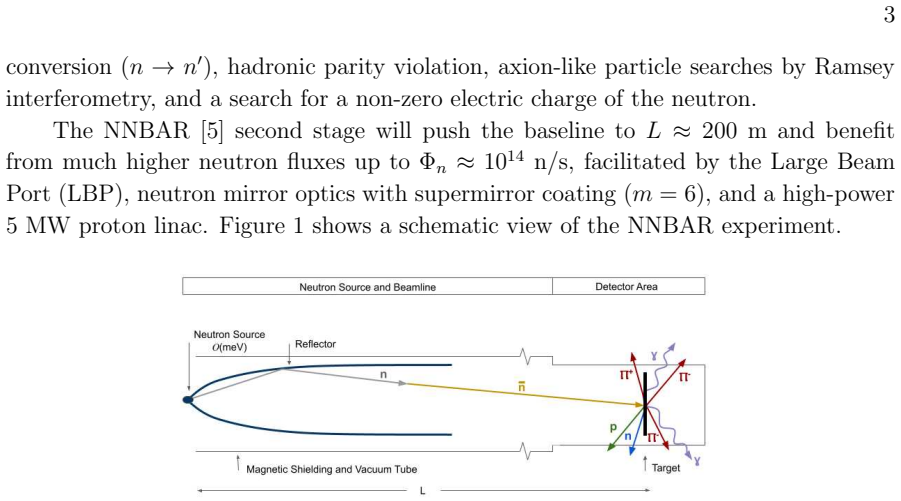
The central claim is that the kinematic gap just below the neutron mass—where an exotic daughter particle X is nearly degenerate with the neutron—is not excluded by Super-Kamiokande bounds and becomes experimentally accessible with the HIBEAM-NNBAR program at the European Spallation Source. From a Breit-Wigner off-shell probability integral and Super-Kamiokande's 370 kiloton-year exposure, the authors derive that X must have a width of order $10^{-35}$ MeV, a lifetime of roughly 5 × $10^{5}$ to 3.6 × $10^{6}$ years, and that the branching ratio for n → X + gamma can be as large as $10^{-3}$. Using the NNBAR flux of 2 × $10^{14}$ cold neutrons per second, a ~200 m flight path, and a 6 m detector tube, they find N_total ≈ 1, 3, and 7 decays in three years for the tight, medium, and loose benchmark scenarios at a mass gap of 1 keV. They conclude that a single background-free event would already constitute a discovery, and that the search can be run parasitically alongside neutron-antineutron oscillation searches.
Load-bearing premise
The prediction of 1 to 7 events assumes NNBAR will select the exotic decays with zero background and at least 50% efficiency, an assumption extrapolated from the neutron-antineutron detector design that the paper notes still requires dedicated Geant4 simulations.
Editorial extensions
If this is right
- If the 1–7 event estimate is realized, a previously unprobed slice of parameter space—mass gap around 1 keV, branching ratio up to 10^-3, X lifetime around 10^5–10^6 years—becomes testable with infrastructure already planned at the European Spallation Source.
- A single background-free event would constitute evidence for a new particle and for baryon-number violation in neutron decay, independent of any specific ultraviolet model.
- The search can run parasitically alongside the neutron-antineutron oscillation program, requiring no new beam or detector hardware and only offline analysis of the annihilation detector data.
- The reach is bounded: even a tenfold increase in neutron flux extends the probed mass gap only to about 20 keV, while larger gaps would require unfeasibly long flight paths, making NNBAR near the frontier of mensurability for this channel.
- Fermionic and bosonic spin hypotheses for X are distinguishable through final states in principle, though scalar versus vector discrimination may be difficult at the low event counts expected.
Reading between the lines
- If X exists with these couplings, the same mass-degeneracy logic should apply to other baryons (e.g., Λ or Σ), suggesting analogous searches in hyperon beams or nuclear decay experiments could probe complementary mass gaps.
- The background-free assumption is the fragile link; a dedicated Geant4 simulation of cosmic-ray rejection for the proposed single-photon and di-pion topologies could be run before NNBAR turns on, either confirming the 50% efficiency assumption or forcing the benchmarks downward.
- The paper's conservative assumption that all free-neutron lifetime experiments exclude visible exotic decays could be tested by reanalyzing existing beam-dump data from past neutron lifetime experiments for delayed multi-particle signatures.
- If no events are seen at NNBAR, the constraint on the n → X + gamma branching ratio would improve from 10^-3 to roughly 10^-6 to 10^-7, largely closing the degenerate-mass window and sharpening the neutron-lifetime anomaly discussion.
Editorial analysis
A structured set of objections, weighed in public.
Referee Report
Summary. The manuscript investigates the possibility that free neutrons decay into an exotic, long-lived particle X whose mass is nearly degenerate with the neutron, with X subsequently decaying visibly inside the planned HIBEAM-NNBAR detector at the European Spallation Source. It derives constraints on X's lifetime from Super-Kamiokande data via an off-shell suppression mechanism, yielding allowed lifetimes of roughly 10^5 to 10^6 years for a mass gap of order 1 keV. The central numerical result is an estimate that N_total ≈ 1, 3, and 7 events could be observed in NNBAR over three years for three benchmark scenarios (tight, medium, loose), leading to the abstract's claim that 'several events per year' could be observed. The paper also discusses theoretical motivations, effective Lagrangians for different spin hypotheses, and experimentally promising final states.
Significance. If the estimated event rates were reliable, the paper would identify a genuinely new and experimentally accessible window for exotic neutron decays, complementing existing large-volume searches by exploiting a kinematically blind region. The paper usefully articulates why bound-neutron experiments are insensitive to highly degenerate final states and why a long free-neutron beamline is uniquely suited to this search. It also provides a clear framework with benchmark scenarios and openly acknowledges the need for dedicated simulations. However, the central numerical claim is undermined by a missing geometric acceptance factor, and the abstract is not consistent with the paper's own event-rate calculation. These issues prevent the significance claim from being accepted as stated.
major comments (4)
- [Section 5, Eqs. (10)-(11)] The event-rate calculation neglects the geometric acceptance of the NNBAR detector. For the benchmark n -> X + gamma decay with m_gap = 1 keV, the X recoil momentum in the neutron rest frame is p* ≈ 1 keV, giving a recoil velocity v* ≈ 318 m/s, which is comparable to the neutron beam velocities (200-1000 m/s). Consequently, the lab-frame X can have a large transverse velocity component. An X produced at an upstream distance s will be displaced transversely by roughly s · (v_T / v_L) before reaching the detector. The detector aperture is only about 5 m across, so only X produced within a few meters of the detector will enter it; production over the full 200 m baseline, as integrated in Eq. (10), is not all accepted. Eq. (11) multiplies the total flux by the decay-in-tube probability without any acceptance factor, effectively assuming 100% acceptance. A rough estimate suggests an acceptance of order R/L ≈ 1-2% or smaller, reducing N_total to well below one event for the benchmark scenarios. This is a load-bearing issue for the paper's main claim.
- [Abstract and Section 5 (after Eq. (11))] The abstract states that 'several events per year could be observed in the NNBAR experiment,' but the calculation in Section 5 gives N_total ≈ 1, 3, and 7 events over three years of data-taking, and this is before applying the 50% detector efficiency quoted in Section 9. After the efficiency, the expected signal is at most about 3.5 events in three years, or roughly one event per year in the most optimistic scenario. The abstract and conclusion should be made quantitatively consistent with the body of the paper, and the body's estimate must be revised once the geometric acceptance is included.
- [Sections 4-6.1 and Eq. (11)] The choice m_gap = 1 keV is a critical assumption that drives the entire reach, but it is not derived from a concrete model. The paper calls this value 'best theoretically motivated' and 'the best experimental reach,' yet Section 6.1 provides only a general survey of dark portal scenarios without a mechanism that naturally produces m_gap = 1 keV. The Super-Kamiokande constraints, the decay-in-tube probability, and the acceptance all depend steeply on m_gap. The paper should either present a specific model that yields a nearly degenerate state or scan over m_gap to identify the actual reach, rather than fixing it at the value that maximizes the signal.
- [Section 9] The assumption of a background-free selection with at least 50% detector efficiency for the new X decay topologies is extrapolated from the neutron-antineutron annihilation detector design. The paper correctly notes that dedicated Geant4 simulations are required, but the event counts in Eq. (11) are already at the level of 1-7 events before acceptance; any additional efficiency loss or background contamination would render the search insensitive. This should be presented as a highly optimistic assumption rather than a baseline, and the conclusion should be softened accordingly.
minor comments (5)
- [Author affiliations] The affiliation line contains a typo: 'Institutionen f¨ or Fysik' should be 'Institutionen för Fysik'.
- [Section 5] The parameter T is introduced as 'T = 2 yrs, for 3 years of data assuming data is collected for two-thirds of a calendar year.' This phrasing is confusing; it would be clearer to define T as the total data-taking time in seconds and note the assumed duty cycle.
- [Section 5 and Section 9] The beam pipe length is given as 6 m in Section 5 (d_tube = 6 m) but approximately 6.5 m in Section 9; please reconcile these values or note that the difference is negligible.
- [Figure 2 caption] The caption says green regions represent 'discovery (5 or more events),' but the paper does not explain why five events is chosen as the discovery threshold. A justification or reference would help.
- [Section 4, Eq. (3)] The symbol T_year is used before it is defined; the definition 'T_year ~3.2 x 10^7 s' appears later in the sentence and should be introduced earlier.
Circularity Check
No significant circularity: the NNBAR event-rate prediction is a forward calculation from external Super-Kamiokande and free-neutron constraints, not a fit or self-citation chain.
full rationale
The derivation chain is self-contained and non-circular. The central inputs are external: the free-neutron branching-ratio limit BR ≤ 0.1% from Ref. [13], Super-Kamiokande exposures, efficiencies and backgrounds from Refs. [18–20], and NNBAR beam parameters from Refs. [5,7,26]. The Super-Kamiokande exclusion is used to set upper bounds on Γ_X (Eqs. (1)–(6)), yielding the benchmark lifetimes in Eqs. (7)–(9), and the NNBAR event count in Eq. (11) is then an honest forward calculation Φ_X · (1 − e^{−t_tube/τ_X}) · T. No parameter is fitted to NNBAR data and then reported as a prediction, and no central premise is justified solely by a same-author citation; the HIBEAM/NNBAR design reports supply engineering inputs, while the physics constraints come from independent experiments. The choice m_gap = 1 keV is a benchmark scenario, not an output derived from the event rate, so any self-selection in framing is not a circular reduction. The paper explicitly flags remaining experimental uncertainties, including the need for dedicated Geant4 simulations and confirmation of the background-free assumption, which are validation tasks rather than circularity. Concerns about geometric acceptance or the kinematics of v_X would affect numerical correctness, not circularity, and do not change this verdict.
Assumptions & free parameters
free parameters (5)
- Mass gap m_gap = M_n - M_X =
1 keV
- Exotic neutron decay branching ratio BR =
10^-3
- NNBAR detector efficiency =
50%
- NNBAR neutron flux Phi_n =
2 x 10^14 n/s
- Data-taking time T =
2 years (3 calendar years at 2/3 duty cycle)
assumptions (6)
- domain assumption Bound-neutron stability in large detectors forbids n -> X + gamma when M_X exceeds the kinematic threshold, and only off-shell X decays can contribute, controlled by a Breit-Wigner width.
- ad hoc to paper The Super-Kamiokande benchmark scenarios (detection efficiency 5%, 10%, 20% and backgrounds 1, 0.6, 0.3 events) bracket the true response to the new final states.
- ad hoc to paper NNBAR can achieve background-free selection with at least 50% efficiency for the X final states by extrapolating n-nbar cuts.
- domain assumption At meV kinetic energies, the neutron can be treated as a fundamental field, and the effective Lagrangians in Eqs. (12)-(14) capture the n-X interaction.
- ad hoc to paper A hidden-sector symmetry naturally produces exact or near-exact mass degeneracy between X and the neutron, motivating m_gap = 1 keV.
- domain assumption The particle X carries no electric charge, no QCD color, and no weak-isospin charge.
invented entities (1)
-
Exotic long-lived particle X (scalar, vector, or fermion) nearly degenerate with the neutron
Cite this review
Pith. "Pith review of Searching for Long-Lived Particles in Free Neutron Experiments." pith.science (2026). https://pith.science/paper/JDFTRH2V
@misc{pith2026250608701,
  author       = {Pith},
  title        = {Pith review of: Searching for Long-Lived Particles in Free Neutron Experiments},
  year         = {2026},
  howpublished = {\url{https://pith.science/paper/JDFTRH2V}},
  note         = {Machine review of arXiv:2506.08701}
}
read the original abstract
We explore the decay of free neutrons into exotic long-lived particles, whose decays could be detected in the next-generation free neutron experiments. We show that such a possibility is viable as long as the exotic particle is highly mass-degenerate with the neutron, avoiding exclusion by large-volume detectors. We estimate the number of observable events and identify the most promising final states from both theoretical and experimental perspectives. Our analysis highlights the unique capability of the HIBEAM-NNBAR experiment at the European Spallation Source to probe this unexplored region of parameter space, opening a new avenue for exploring physics beyond the Standard Model. We estimate that several events per year could be observed in the NNBAR experiment.
Figures


Forward citations
Cited by 1 Pith paper
-
Fundamental Nuclear and Particle Physics At Neutron Sources
A community whitepaper makes the case that ESS and neutron sources offer a competitive, complementary route to search for new physics, with proposed experiments in neutron decay, EDM, baryon number violation, neutrino...
Reference graph
Works this paper leans on
-
[1]
Dark Matter Interpretation of the Neutron Decay Anomaly.Phys
Bartosz Fornal and Benjamin Grinstein. Dark Matter Interpretation of the Neutron Decay Anomaly.Phys. Rev. Lett., 120(19):191801, 2018. [Erratum: Phys.Rev.Lett. 124, 219901 (2020)]
work page 2020
-
[2]
The European Spallation Source Design.Phys
Roland Garoby et al. The European Spallation Source Design.Phys. Scripta, 93(1):014001, 2018
work page 2018
-
[3]
A. Addazi et al. New high-sensitivity searches for neutrons converting into antineutrons and/or sterile neutrons at the HIBEAM/NNBAR experiment at the European Spallation Source.J. Phys. G, 48(7):070501, 2021. 18
work page 2021
-
[4]
V. Santoro et al. The HIBEAM instrument at the European spallation source.J. Phys. G, 52(4):040501, 2025
work page 2025
-
[5]
V. Santoro et al. HighNESS conceptual design report: Volume II. The NNBAR experiment.J. Neutron Res., 25(3-4):315–406, 2024
work page 2024
-
[6]
H. Abele et al. Particle Physics at the European Spallation Source.Phys. Rept., 1023:1–84, 2023
work page 2023
-
[7]
Sze-Chun Yiu et al. Status of the Design of an Annihilation Detector to Observe Neutron- Antineutron Conversions at the European Spallation Source.Symmetry, 14(1):76, 2022
work page 2022
- [8]
Show all 40 references
-
[9]
Fukuda et al
Y. Fukuda et al. The Super-Kamiokande detector.Nucl. Instrum. Meth. A, 501:418–462, 2003
2003
-
[10]
Review of Nucleon Decay Searches at Super-Kamiokande
Volodymyr Takhistov. Review of Nucleon Decay Searches at Super-Kamiokande. In51st Rencontres de Moriond on EW Interactions and Unified Theories, pages 437–444, 2016
2016
-
[11]
Baryon and Lepton Nonconserving Processes.Phys
Steven Weinberg. Baryon and Lepton Nonconserving Processes.Phys. Rev. Lett., 43:1566–1570, 1979
1979
-
[12]
Marciano, and Alberto Sirlin
Andrzej Czarnecki, William J. Marciano, and Alberto Sirlin. Neutron Lifetime and Axial Coupling Connection.Phys. Rev. Lett., 120(20):202002, 2018
2018
-
[13]
Dubbers, H
D. Dubbers, H. Saul, B. M¨ arkisch, T. Soldner, and H. Abele. Exotic decay channels are not the cause of the neutron lifetime anomaly.Phys. Lett. B, 791:6–10, 2019
2019
-
[14]
Le Joubioux et al
M. Le Joubioux et al. Search for a Neutron Dark Decay in He6.Phys. Rev. Lett., 132(13):132501, 2024
2024
-
[15]
The Puzzle of Neutron Lifetime.Nucl
Stephan Paul. The Puzzle of Neutron Lifetime.Nucl. Instrum. Meth. A, 611:157–166, 2009
2009
-
[16]
Neutron Dark Decay.Universe, 9(10):449, 2023
Bartosz Fornal. Neutron Dark Decay.Universe, 9(10):449, 2023
2023
-
[17]
Tanabashi et al
M. Tanabashi et al. Review of Particle Physics.Phys. Rev. D, 98(3):030001, 2018
2018
-
[18]
Taniuchi et al
N. Taniuchi et al. Search for proton decay via p→e+ηand p→µ+ηwith a 0.37 Mton-year exposure of Super-Kamiokande.Phys. Rev. D, 110(11):112011, 2024
2024
-
[19]
Abe et al
K. Abe et al. Search for nucleon decay into charged antilepton plus meson in 0.316 megaton·years exposure of the Super-Kamiokande water Cherenkov detector.Phys. Rev. D, 96(1):012003, 2017
2017
-
[20]
Nishino et al
H. Nishino et al. Search for Nucleon Decay into Charged Anti-lepton plus Meson in Super- Kamiokande I and II.Phys. Rev. D, 85:112001, 2012
2012
-
[21]
Sussman et al
S. Sussman et al. Dinucleon and Nucleon Decay to Two-Body Final States with no Hadrons in Super-Kamiokande. 11 2018
2018
-
[22]
Search for long-lived particles produced inppcollisions at √s= 13 TeV that decay into displaced hadronic jets in the ATLAS muon spectrometer.Phys
Morad Aaboud et al. Search for long-lived particles produced inppcollisions at √s= 13 TeV that decay into displaced hadronic jets in the ATLAS muon spectrometer.Phys. Rev. D, 99(5):052005, 2019
2019
-
[23]
Search for long-lived particles using nonprompt jets and missing transverse momentum with proton-proton collisions at √s= 13 TeV.Phys
Albert M Sirunyan et al. Search for long-lived particles using nonprompt jets and missing transverse momentum with proton-proton collisions at √s= 13 TeV.Phys. Lett. B, 797:134876, 2019
2019
-
[24]
Explore the lifetime frontier with MATHUSLA.JINST, 15(06):C06026, 2020
Henry Lubatti et al. Explore the lifetime frontier with MATHUSLA.JINST, 15(06):C06026, 2020
2020
-
[25]
Ahdida et al
C. Ahdida et al. The SHiP experiment at the proposed CERN SPS Beam Dump Facility.Eur. Phys. J. C, 82(5):486, 2022
2022
-
[26]
Santoro et al
V. Santoro et al. HighNESS Conceptual Design Report: Volume I. 9 2023
2023
-
[27]
Symmetry Breaking Through Bell-Jackiw Anomalies.Phys
Gerard ’t Hooft. Symmetry Breaking Through Bell-Jackiw Anomalies.Phys. Rev. Lett., 37:8–11, 1976
1976
-
[28]
A. D. Sakharov. Violation of CP Invariance, C asymmetry, and baryon asymmetry of the universe. Pisma Zh. Eksp. Teor. Fiz., 5:32–35, 1967
1967
-
[29]
Fukugita and T
M. Fukugita and T. Yanagida. Baryogenesis Without Grand Unification.Phys. Lett. B, 174:45–47, 1986
1986
-
[30]
Leptogenesis.Phys
Sacha Davidson, Enrico Nardi, and Yosef Nir. Leptogenesis.Phys. Rept., 466:105–177, 2008
2008
-
[31]
Proton stability in grand unified theories, in strings and in branes.Phys
Pran Nath and Pavel Fileviez Perez. Proton stability in grand unified theories, in strings and in branes.Phys. Rept., 441:191–317, 2007. 19
2007
-
[32]
Pavel Fileviez Perez and Mark B. Wise. Baryon and lepton number as local gauge symmetries. Phys. Rev. D, 82:011901, 2010. [Erratum: Phys.Rev.D 82, 079901 (2010)]
2010
-
[33]
Klebanov and Edward Witten
Igor R. Klebanov and Edward Witten. Proton decay in intersecting D-brane models.Nucl. Phys. B, 664:3–20, 2003
2003
-
[34]
Search for neutral long-lived particles that decay into displaced jets in the ATLAS calorimeter in association with leptons or jets usingppcollisions at √s= 13 TeV
Georges Aad et al. Search for neutral long-lived particles that decay into displaced jets in the ATLAS calorimeter in association with leptons or jets usingppcollisions at √s= 13 TeV. 7 2024
2024
-
[35]
Two U(1)’s and Epsilon Charge Shifts.Phys
Bob Holdom. Two U(1)’s and Epsilon Charge Shifts.Phys. Lett. B, 166:196–198, 1986
1986
-
[36]
Finkbeiner, Tracy R
Nima Arkani-Hamed, Douglas P. Finkbeiner, Tracy R. Slatyer, and Neal Weiner. A Theory of Dark Matter.Phys. Rev. D, 79:015014, 2009
2009
-
[37]
Sean Tulin, Hai-Bo Yu, and Kathryn M. Zurek. Beyond Collisionless Dark Matter: Particle Physics Dynamics for Dark Matter Halo Structure.Phys. Rev. D, 87(11):115007, 2013
2013
-
[38]
Voloshin
Maxim Pospelov, Adam Ritz, and Mikhail B. Voloshin. Secluded WIMP Dark Matter.Phys. Lett. B, 662:53–61, 2008
2008
-
[39]
Minimal dark matter.Nucl
Marco Cirelli, Nicolao Fornengo, and Alessandro Strumia. Minimal dark matter.Nucl. Phys. B, 753:178–194, 2006
2006
-
[40]
Agostinelli et al
S. Agostinelli et al. GEANT4–a simulation toolkit.Nucl. Instrum. Meth. A, 506:250–303, 2003
2003
Reviewed August 7, 2026 · model on record in the stance chip above.
Discussion (0). Sign in to comment.